XC3 Weaponlight

Archive for October, 2025

Flux Defense Launches the Innovative Antimatter Scopeswitch 2.0 — The Ultimate Control for Precision Shooting

Thursday, October 30th, 2025

Elevate your shooting experience with the new Scopeswitch 2.0, a game-changing device that combines rapid magnification adjustment with unmatched durability and versatility.

Salt Lake City, Utah — Flux Defense, a leader in advanced firearm accessories, is proud to announce the launch of the Antimatter Scopeswitch 2.0, the latest evolution in scope control technology. Designed for armed professionals, hunters, and competitive shooters alike, the Scopeswitch 2.0 offers a seamless way to control magnification while maintaining full engagement with your target.

“Every product here at Flux Defense has a pure focus: making it faster, lighter, and stronger. Most users rarely utilize the full range of zoom capabilities on their LPVOs. They set their scope to the needed power, use a red dot for close targets, and adjust magnification for longer ranges. The Scopeswitch 2.0 allows you to have a faster, positive ID on your target and greatly enhance situational awareness. It lets you smoothly and quickly zoom in and out without breaking your grip or losing your focus.”

Arrius Sorbonne, Co-owner of Flux Defense

“It’s one of the strongest, lightest mounts available that does more than simply hold your optic.”

Arrius Sorbonne, Co-owner of Flux Defense

Key Features & Benefits:

Innovative Guard System: Allows users to adjust magnification without taking their eye off the target—ideal for high-pressure scenarios, rapid target transitions, and dynamic hunting environments.

Precision Materials: Constructed from rugged 7075 T6 aircraft-grade aluminum and 4140 nitrided steel lugs, ensuring maximum strength with minimal weight.

Optimized Height: The 1.93-inch optical centerline supports upright shooting postures, compatibility with plate carriers, and passive aiming with night vision devices.

Low Profile, High Performance: Compatible with rifles as short as 10.5 inches, though longer barrels are recommended for optimal velocity with 5.56 rounds. The device is perfect for a wide range of tactical and sporting applications.

User Compatibility: Designed to work with scopes featuring low resistance zoom rings. Users are advised to test their optics for smooth operation prior to purchase; a detailed compatibility chart is available on the FAQ page.

What’s new on the Scopeswitch 2.0?

Competitive Pricing: We moved to a larger shop and have been able to streamlight production. Scopeswitch 2.0 price is $349.99

Stronger Hardware: We beefed up the cable clamp bolts to handle accidental over torquing during install

Ergonomics: Scopeswitch now includes our new Ergo-C-clamp slider with topo texture. Also ships with the deeper original slider.

Accessories: Now offering an optional pic rail riser giving you back valuable top “rail estate” for clip on thermal and nvg devices as well as a backup throw lever.

Scopeswitch 2.0 listing link: fluxdefense.com/shop/the-scopeswitch-2-0

Saab Receives Order for Giraffe 1X Radars from U.S. Army

Thursday, October 30th, 2025

The U.S. Army has awarded Saab, Inc. a contract to provide Giraffe 1X radars in support of foreign partners. The order value for this award is approximately USD $46 million. The order was booked in Q3 2025.

Saab will provide Giraffe 1X systems with deliveries starting in 2026. The order underscores the growing demand for Saab’s advanced radar technology to strengthen air defense and Counter-Unmanned Aircraft Systems (C-UAS) capabilities worldwide.

“Saab’s Giraffe 1X radars bring the U.S. Army a combat-proven capability that can be rapidly deployed to meet the growing spectrum of global threats, including unmanned aircraft systems,” said Erik Smith, President and CEO of Saab, Inc. “What sets Giraffe 1X apart is its ability to combine advanced counter-UAS performance, at extended ranges, within a compact, mobile design that commanders can trust in any environment. With continuous, real-time air surveillance, Giraffe 1X equips the U.S. and its partners with a decisive operational advantage, ensuring they can stay ahead of emerging challenges.”

As a small, lightweight 3D radar, Giraffe 1X can be used as a mobile, deployable or fixed asset that can be integrated into both ground and naval platforms. With its true multi-mission capability—spanning force protection, ground-based air defense, and sea surface surveillance—Giraffe 1X is the first radar of its kind, delivering unmatched operational flexibility to commanders.

Auterion Successfully Completes Artemis Program to Deliver Long-Range Deep Strike Drone

Thursday, October 30th, 2025

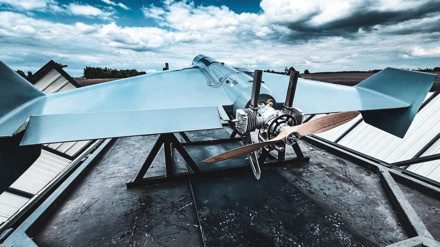
Arlington, VA – Auterion, a global leader in defense drone software and AI-enabled autonomous systems, today announced the successful completion of the Defense Innovation Unit’s Artemis project. The program delivered a deep strike drone proven in Ukraine with up to 1,000 miles range and visual targeting.

The Artemis system is a design similar to a Shahed drone, developed in Ukraine and with manufacturing lines being built in the U.S., Ukraine, and Germany. It offers a 1,000-mile range and can carry warheads of up to 40 kilograms. It relies on Auterion’s Skynode N mission computer and Auterion Visual Navigation system, enabling the drone to navigate and strike targets even when satellite-based navigation is disrupted. The built-in terminal guidance ensures pinpoint accuracy in the final stage of flight.

Auterion is partnered, for the Artemis program, with a Ukrainian hardware manufacturer, whose name is being kept confidential for operational security reasons. Auterion has built partnerships with U.S. and European manufacturers to scale up long range applications. Bringing learnings from the battlefield in Ukraine to U.S. forces and allied partners is a key contribution of Auterion to national security.

Government evaluators have signed off on the program after operational flight tests in Ukraine. The tests included ground launch, GPS and GPS?denied navigation, long-range transit, and terminal engagement. Following these successful evaluations, Auterion now offers the system to the U.S. Department of War and allied nations, with manufacturing capabilities established in both the United States and Europe.

“Software-driven autonomy is changing the nature of deterrence,” said Lorenz Meier, CEO of Auterion. “Our Artemis entrant is designed for mass production and rapid deployment, enabling partner nations to field resilient autonomous strike capabilities at scale. We are ready to build the long-range deterrence force needed to tackle new challenges, especially in the Indo?Pacific.”

The long range drone is part of Auterion’s larger portfolio of short to long-range, one-way attack drones being developed under U.S. defense initiatives. The system leverages Auterion’s open architecture and battle-tested software to ensure rapid adaptability and seamless integration within the broader defense ecosystem. This effort is building on the company’s proven track record of supplying AI?enabled strike kits to Ukraine.

With the Artemis program concluded, Auterion is entering the scale-up phase with the Department of War and allied partners to work towards co?production at mass scale. The company is committed to supporting domestic U.S. production while delivering a common software layer that ensures interoperability and continuous improvement. “This isn’t a black box. It’s a scalable platform that our partners can build and evolve,” Meier added.

auterion.com

Soldiers Conduct Combat Simulation with Scorpion Light Mobile Mortar Systems at U.S. Army’s Transformation in Contact 2.0

Thursday, October 30th, 2025

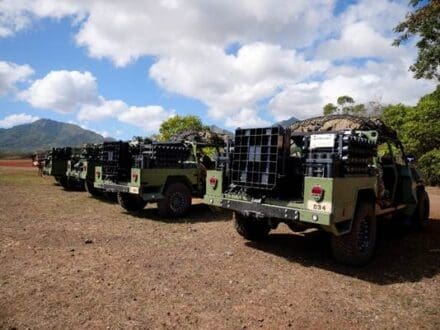
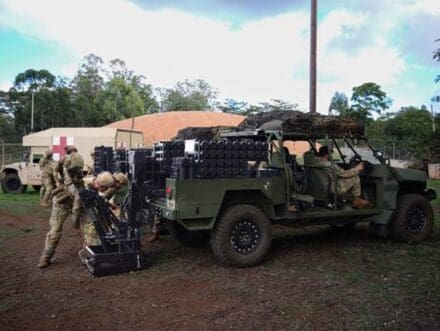
TAMPA, FL – (29 October 2025) – In the Pacific Ocean on the Hawaiian island of Oahu, soldiers from the U.S. Army’s 2nd Battalion, 35th Infantry Regiment trained and conducted tactical scenarios and simulated combat operations using the Scorpion Light 81mm mobile mortar system from Global Military Products. This effort, part of the U.S. Army’s Transformation in Contact (TiC) 2.0, was held at Schofield Barracks to help enhance the mobility, lethality, operator safety and air transportability of these assets.

The TiC 2.0 event, held from Oct. 20-25, provided soldiers with a hands-on opportunity to evaluate next-generation equipment in realistic field scenarios. Without any changes to the formation or concepts of operations, soldiers were able to emplace, fire rounds and displace faster than ever before, with the Infantry Squad Vehicle – Utility (ISV-U) variant able to carry the Scorpion Light 81mm mobile mortar system and 72 mortar rounds.

“Our participation in TiC 2.0 underscored the immense value the Scorpion Light brings to the modern fighting force,” said James Knight, senior manager, Defense Systems and Energetics, Global Military Products. “The soldiers’ feedback was invaluable and further validated the system’s ability to provide rapid, highly mobile, precise and survivable indirect fire. We are proud to be a part of the Army’s mission to field the next generation of combat-effective equipment.”

The tactical scenarios included tactical emplacement and displacement operations, highlighting key features of the Scorpion Light mobile mortar system:

Rapid Deployment and Mobility – The Scorpion Light system, mounted on the ISV-U, demonstrated its ability to emplace, fire and displace in under two minutes. This “shoot and scoot” capability is critical for survivability on a modern battlefield, allowing mortar teams to engage targets and reposition before an adversary can return effective counter-battery fire.

Automated Fire Control System – An advanced digital fire control system enabled rapid, accurate targeting and re-aiming with minimal crew intervention. Soldiers used this capability to engage multiple targets quickly and efficiently during simulated combat operations. The system can also operate with third-party fire control.

Enhanced Capability for Expeditionary Forces – With its ability to be internally transported by a CH-47 Chinook helicopter, the integrated Scorpion Light and ISV-U platform proved its suitability for rapid deployment in remote and austere environments. The event demonstrated how the system can provide critical indirect fire support to light infantry formations.

The two Scorpion Light systems will stay in Hawaii to take part in planned Joint Pacific Multinational Readiness Center (JPMRC) training exercises in early November where the system will be transported via C-17 for air insertion to participate in multiple days of combat scenarios.

The direct feedback gathered from soldiers during TiC 2.0 is another integral part of the Army’s modernization process. This feedback will directly inform future improvements and guide acquisition decisions for mobile mortar systems.

The Scorpion Light’s success in Hawaii follows other recent U.S. evaluations, including a live-fire demonstration with the U.S. Marine Corps at Marine Corps Base Quantico. A version of the same system is also seeing operational success in Ukraine. Scorpion’s modular design and proven capability continue to be recognized across the U.S. and with allied forces seeking mobile, lethal and survivable fire support solutions.

www.global-ordnance.com

Royal Marines Fully Field Persistent MPU5 Radios Empowering the UK Commando Force Modernization Initiative

Thursday, October 30th, 2025

  • Royal Marines field 2,000+ MPU5 radios, entering a new phase of large-scale operational deployment and collaboration with allied forces
  • Wave Relay® MANET technology creates a global communications fabric, enabling the Royal Marines to dominate in contested environments

Persistent Systems, LLC (“Persistent”), a leader in mobile ad hoc network (MANET) technology, announced that the UK Royal Marines have now fully fielded over 2,000 MPU5 radio systems in support of their UK Commando Force (UKCF) transformation. This marks a significant step in the Royal Marines’ move toward a more agile, technology-enabled expeditionary force.

MPU5 radios, running the Wave Relay® MANET, now form a highly scalable communications fabric uniting warfighters, unmanned systems, sensors, vehicles, and command posts. This deployment enables the Royal Marines to operate with greater autonomy, speed, and lethality in contested electronic warfare (EW) environments.

The Royal Marines are divesting from legacy government-only systems and embracing commercial, non-ITAR defense technology. This makes their force more interoperable with allies and places the UK at the forefront of multinational collaboration.

“True interoperability is about more than just working with allies. It’s about uniting every Marine, every vehicle, and every sensor into a single resilient network,” said Eve Shapiro, Senior Director of Sales and Business Development at Persistent. “With the Wave Relay MANET, the Royal Marines can execute complex, distributed operations while maintaining constant connectivity and situational awareness.”

The UKCF represents the most significant modernization of the Royal Marines since WWII, aimed at creating a globally deployable, autonomous littoral force. It emphasizes small, lethal teams, unmanned and AI-enabled systems, and networked C4ISR capabilities.

The MPU5 rollout, awarded to Persistent’s UK partner & distributor, Steatite Ltd., which includes handheld units and vehicle kits, supports UKCF’s operational demands across land, sea, and unmanned domains. Integration with platforms like all-terrain vehicles and unmanned systems enables uninterrupted connectivity regardless of terrain or mission set.

The Pros and Cons of Using AI in Military Divisions worldwide

Thursday, October 30th, 2025

As automated technology rapidly integrates into daily life, its impact on modern warfare is profound. Military divisions worldwide are deploying AI on the battlefield for defence, attack and reconnaissance. In a recent summit held in the Netherlands, 80 nations met to discuss the ethical and operational use of AI in military applications. More than 60 countries agreed to permit AI-driven combat strategies, recognising its potential to enhance decision-making and reduce human risk. Here, Taylor Eisenhauer, product manager at connector specialist PEI-Genesis explains the pros and cons of using AI in military operations.

The adoption of AI in defence is accelerating, with global military AI market projections expected to reach US$18.558 billion by 2029, up from US$4.956 billion in 2024, driven by advancements in machine learning, robotics, and autonomous systems. The deployment of AI-driven combat vehicles, drones, and robotic units is revolutionising modern warfare, reducing reliance on human personnel in high-risk environments.

However, certain issues remain regarding the advantages and concerns of employing AI on the battlefield. While AI offers enhanced strategic decision-making and operational efficiency, it also introduces significant ethical and security dilemmas.

Pros:

The use of AI in advanced military software and technologies can provide safety to soldiers, reduce human labour, and improve decision-making.

In terms of safety, humans can delegate dangerous tasks to non-human agents to protect themselves. For example, tactical ground robots can navigate terrains and handle explosives that can potentially harm personnel in combat. At the same time, robotic dogs can be utilised as an extra hand to carry or fetch necessary equipment. Using robots can save many human lives since these tasks can be performed without harming soldiers.

The United States believes that AI can reduce risks for soldiers by reducing human labour. War can put significant stress on the human body, and soldiers can become fatigued, impairing their ability to focus and perform effectively. This can lead to human error, harm mission success, and result in significant injuries or even defeat.

However, with AI, soldiers can utilise their time and energy better. For instance, rather than driving combat vehicles or flying aircraft, AI can take complete control and allow soldiers to focus their efforts elsewhere, such as analysing data and prepping for battle. This can significantly reduce the risk of injury and increase the chances of mission success.

Improved decision-making is another benefit of using AI. More accurate data analysis can help better target opponents. With automated technology, we can make smarter and safer decisions in combat with little to no mistakes. Drones and AI are utilised to identify and communicate risks or threats that may occur. They can more accurately determine objects in the distance, providing an advantage in preparing for an attack.

Cons:

On the other hand, some see AI as a setback or disadvantage due to the potential risks and dangers that can arise when trusting technology.

Security threats are a major concern with AI. There is a potential for AI to be hacked or manipulated by adversaries. If these systems are compromised, sensitive information can be stolen and exploited to the opposing team’s advantage.

The use of automated technology and AI, particularly in military robots, is a topic that sparks ethical concerns. With robots capable of performing tasks more efficiently and precisely than humans, there is a potential for one side to have an unfair advantage, leading to the replacement of human soldiers with machines. The result of this could be a future where wars are fought between robots, raising ethical questions about the morality of warfare.

Another issue arising from the use of AI is its unpredictability. If something goes wrong, it can be difficult to determine who is responsible. This concern becomes more significant as AI technologies become more advanced, with the potential to carry out tasks autonomously. If AI were to malfunction, innocent civilians could be harmed, and it is unclear who would be held accountable. Furthermore, granting machines a mind of their own may lead to unforeseen consequences; therefore, we must approach the development and deployment of these technologies with caution.

Prepare for the future of modern warfare

The debate about allowing AI to be used in modern warfare is endless. However, the reality is that AI is being implemented in military technologies worldwide, and nations must be equipped to protect and defend themselves.

To prepare for modern warfare, durable and reliable electrical connectors are needed to support these advanced technologies in harsh environments—PEI-Genesis partners with industry-leading suppliers to provide a broad inventory of products suitable for these demands.

For example, the Amphenol 2M Series of lightweight, micro-miniature circular connectors maximise SWaP (size, weight, and power) and meet D38999 specifications for vibration and shielding but weigh less than standard D38999 connectors. Whether this product is for a soldier’s headset, tactical or handheld equipment, airframes, or avionics boxes, the Amphenol 2M Series has application flexibility with multiple coupling types available to fit different electrical and mechanical requirements.

To find out more about the wide range of connectors for military operations offered by PEI-Genesis, visit www.peigenesis.com.

Rheinmetall and MBDA: German Laser Weapon System Close to Market Readiness

Wednesday, October 29th, 2025

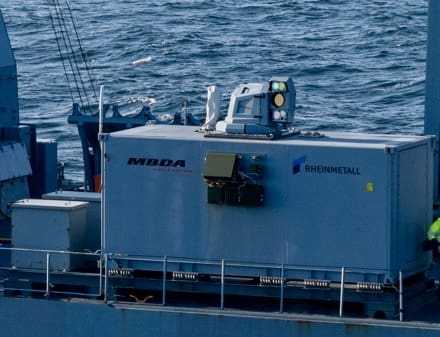
Düsseldorf/Schrobenhausen, 28 October 2025 – Following the successful completion of a one-year trial phase at sea, defence contractors Rheinmetall and MBDA Germany have transferred a laser demonstrator for the Navy to the Laser Competence Centre at the Technical Centre for Weapons and Ammunition (WTD 91) in Meppen for further testing. This marks a major step in the development of a high-energy laser weapon system for maritime use, and highlights the strong partnership between the two German technology companies.

Based on this, an operational laser weapon system could be available to the German Navy as of 2029, providing a powerful and cost-effective addition to conventional guided missiles.

Thanks to WTD 91’s support during the acceptance process, the demonstrator was successfully commissioned at the Laser Competence Centre in Meppen. This represents an important step towards achieving rapid market and operational readiness for a future laser system for the Navy.

The containerised demonstrator has already been successfully tested several times over the course of a year under real operational conditions at sea on board the frigate SACHSEN, proving the system’s robustness and performance. With the support of WTD 91 in Meppen, the laser container has now been put into operation for further land-based drone defence testing.

The laser weapon system offers new possibilities for counter-operations against non-cooperative targets. With its ability to precisely and effectively neutralise drones and other small, fast-moving targets, it addresses one of the most pressing challenges of our time. An operational laser weapon system complements cannons and guided missiles, particularly for the defence against drones and drone swarms, as well as for attacking speedboats and, if necessary, guided missiles in the closer and immediate vicinity. In the future, it could also be equipped with greater capabilities and be used to destroy supersonic guided missiles and rockets, as well as mortar and artillery shells. Unique technologies ‘designed and made in Germany’ ensure precise target detection and tracking, based on years of expertise in optics and sensor technology.
?
The long-standing and successful collaboration between Rheinmetall and MBDA in the field of laser weapons will ensure that this progress will be realised. Since 2019, both companies have been working closely together to develop high-energy laser effectors. The work on the system is divided nearby equally between the two companies. MBDA Germany is responsible for target detection and tracking, the control console, and connecting the laser weapon demonstrator to the command-and-control system. Rheinmetall’s responsibilities however include the aiming system, beam guidance and the demonstrator container, as well as the mechanical and electrical integration of the demonstrator on the deck of the frigate SACHSEN and, ultimately, the high-energy laser source including its peripherals.

Successful tests conducted on the frigate SACHSEN proved the demonstrator’s tracking capability, effectiveness and precision under real operational conditions for the first time in Europe, also without using the landscape as beam block (‘in front of blue sky’). These tests comprised over 100 live-firing trials and significantly more tracking trials. This technology has proven its high reaction speed and accuracy in combating drones, thereby significantly enhancing the effectiveness of drone defence.

Replacement Front Sight Posts From Blitzkrieg Components For Magpul MBUS PRO and MBUS 3 Sights

Wednesday, October 29th, 2025

These sight posts provide higher visibility and a superior sight picture for accurate aiming.  They make your sight easier to see in any light for faster and more accurate shots.

Options include Tritium Dots, brightly colored contrast stripes in bright orange and luminescent (glow) green as well as sight post tips in both flat and pointed profiles.  Simple, drop-in installation with no tools.  Get the high visibility and low-light capability you need with Blitzkrieg Sight Posts in your Magpul MBUS PRO or MBUS Gen 3 Sights.

Available now at www.blitzkriegcomponents.com.