XC3 Weaponlight

Archive for January, 2026

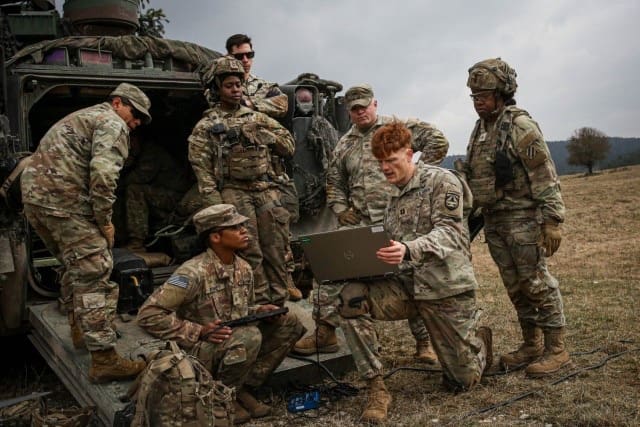
Army Establishes New AI, Machine Learning Career Path for Officers

Sunday, January 4th, 2026

WASHINGTON – The U.S. Army has established a new career pathway for officers to specialize in artificial intelligence and machine learning (AI/ML), formally designating the 49B AI/ML Officer as an official area of concentration. It advances the Army’s ongoing transformation into a data-centric and AI-enabled force.

Full implementation of the new career field will be phased. The first selection of officers will occur through the Army’s Volunteer Transfer Incentive Program (VTIP) beginning January 2026. The officers will be reclassified by the end of fiscal year 2026.

“This is a deliberate and crucial step in keeping pace with present and future operational requirements,” said Lt. Col. Orlandon Howard, U.S. Army spokesperson. “We’re building a dedicated cadre of in-house experts who will be at the forefront of integrating AI and machine learning across our warfighting functions.”

Initially, the 49B AOC will be open to all officers eligible for the VTIP. Those with advanced academic and technical backgrounds in fields related to AI/ML will be particularly competitive candidates. The Army is also exploring expanding this specialized field to include warrant officers in the future.

Officers selected for the 49B AOC will undergo rigorous graduate-level training and gain hands-on experience in building, deploying, and maintaining the Army’s cutting-edge AI-enabled systems. Their primary role will be to operationalize these advanced capabilities across the range of military operations.

The strategic purpose of this new MOS is to provide the Army with a core group of uniformed experts who can accelerate the integration of AI and machine learning. These specialists will apply their talents to a wide range of applications, including:

  • Accelerating battlefield decision-making: Enabling commanders to make faster, more informed decisions in complex environments.
  • Streamlining logistics: Optimizing supply chain and maintenance operations.
  • Supporting robotics and autonomous systems: Fielding and managing the next generation of battlefield robotics.

“Establishing the 49B AI/ML career path is another key investment to maintain our decisive edge as an Army,” said Howard. “Ultimately, it’s about building a force that can outthink, outpace, and outmaneuver any adversary.”

By U.S. Army Communication and Outreach Office

Blanchewater Gear – Legionnaire Caps Available for Pre-Order

Sunday, January 4th, 2026

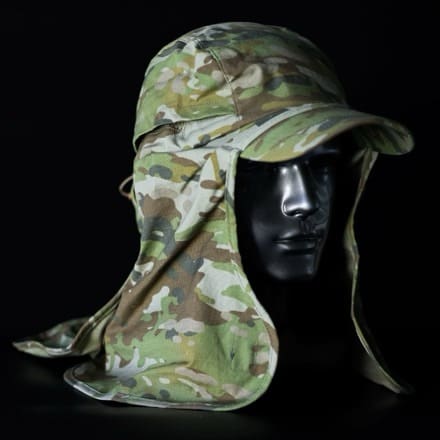
Offered in AMC or MultiCam, Australia’s Blanchwater Gear is making a run of Legionnaire Caps complete with full neck flap which can form a shroud.

Stock should be completed mid to late January and will ship ASAP.

www.blanchewatergear.com.au/products/legionnaire-hat-amc

Marine Corps Launches New Drone Training Program

Sunday, January 4th, 2026

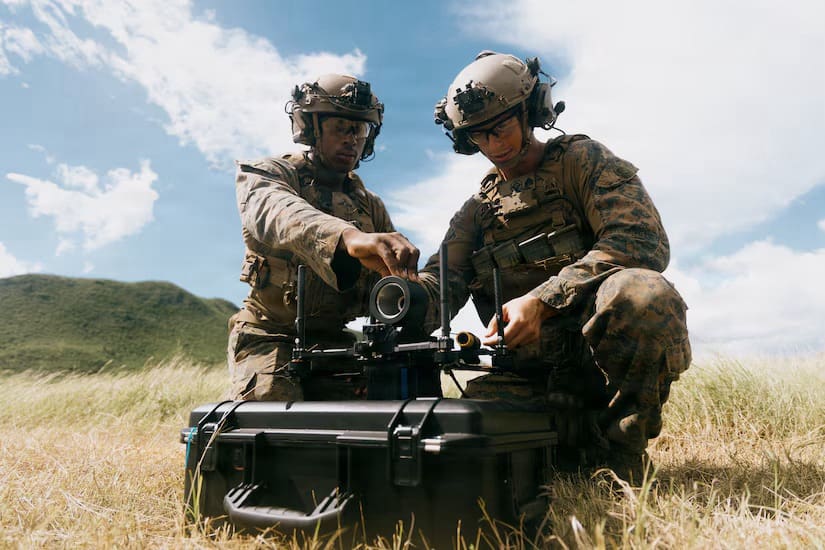
The Marine Corps has launched a training program to rapidly increase the number of small unmanned aircraft system operators for commercial off-the-shelf attack drones. 

The program, announced in Marine Corps administrative message 624/25, addresses a critical need for standardized training as the service integrates new systems, including the Neros Archer first-person-view attack drone and prepares for this significant investment in various drone technologies.  

This initiative builds on the service’s success over the past few months scaling FPV attack drones across the Fleet Marine Force. It also aligns directly with War Department plans to field tens of thousands, and then hundreds of thousands, of attack drones across service components starting in March 2026 and continuing over the next several years. 

The new framework, created by Training and Education Command, establishes six pilot courses and eight certifications to create a standard for drone operators across the force. These initiatives are designed to provide foundational skills for a variety of small unmanned aircraft systems. 

“We are fielding these courses as pilot programs to move quickly while maintaining our commitment to quality training and safety,” said Marine Corps Lt. Gen. Benjamin T. Watson, commanding general, Training and Education Command. “This allows us to validate all aspects of the training, from prerequisites and instructional methods to resourcing needs and certification standards, ensuring that we refine and perfect the curriculum before it becomes part of our long-term training framework.” 

Six approved pilot courses will certify Marines while testing instructional methods and curriculum. These courses include training for drone operators, payload specialists and instructors, with specific prerequisites such as simulator experience on Training and Education Command-approved systems. The courses aim to ensure proper integration and supervision of new drone capabilities. The Training and Education Command has also established a process to grant certifications to Marines who have existing qualifications and experience through an exception to policy. 

Seven organizations are designated as regional training hubs with the authority to immediately begin conducting the pilot courses, including schools within Training and Education Command, 1st Marine Division, 2nd Marine Division, III Marine Expeditionary Force, and Marine Forces Special Operations Command. 

Weapons Training Battalion at Marine Corps Base Quantico, Virginia, will serve as the interim central hub, responsible for standardizing training, certification and safety across the force. It will consolidate lessons learned and function as the Marine Corps’ focal point for adapting training to emerging platforms, payloads and evolving operational requirements. 

This effort to scale standardized FPV attack drone training was shaped by lessons from recent certifications, including two Marine Corps attack drone competitions, one in the National Capitol Region and the other in Okinawa, Japan. These efforts certified 19 attack drone operators, five attack drone instructors, seven payload specialists, and two payload specialist instructors. 

In mid-November, the Marine Corps Attack Drone Team also supported the certification of 22nd Marine Expeditionary Unit Marines, resulting in 14 attack drone operators and 11 payload specialists fully trained, equipped and ready for contingency operations. 

Over the next few months, the Marine Corps Attack Drone Team, alongside Weapons Training Battalion and regional hubs, will certify hundreds more Marines. By May 2026, all infantry, reconnaissance battalions and littoral combat teams across the Corps will be equipped to employ FPV attack drone capabilities. 

By Marine Corps SSgt Claudia Nix, U.S. Marine Corps Training and Education Command

My Thoughts on ARSOF’s Move to Create an Info War (IWAR) Branch

Saturday, January 3rd, 2026

Small Wars Journal recently published an article written by Special Warfare CW4 William Bryant. It lays the ground work for an Army SOF initiative to create an IWAR branch within the Army, presumably under their control. My comments below were originally published in Vol 5, Issue 51 of Soldier Systems Digest. It has been slightly expanded by mentioning the intersection of IW and IW (explained below).

You can read CW4 Bryant’s article at smallwarsjournal.com/2025/12/16/transforming-and-modernizing.

I’m glad someone finally published something public about this. My critique of the concept casts no aspersions on CW4 Bryant’s paper. I really enjoyed it and it plugged several holes I had regarding some of the thought processes behind this effort. The article is well written and sets the stage well, yet I continue to question the inclusion of Civil Affairs in this proposal.

Reality has a vote and that vote has already been cast from my understanding. ARSOF’s appetite was allegedly much bigger than what we see here, although it is alluded to. Along the lines of the SOF-Cyber-space triad, ARSOF attempted to create something which intertwined themselves with communities who quite frankly don’t need their help.

Word is that ARSOF wanted to shoot for the moon and absorb Cyber along with FA 30 and combine it with PSYOP and CA. Apparently, Cyber was having none of it and basically went radio silent in order to wait this silliness out. Remember, Cyber and its little brother element Electromagnetic Warfare are ascendant in the Army. Purportedly, the Army leadership was unconvinced of this power grab and suggested SOF reexamine its scheme. I’ve heard that there was even some pushback on integrating both PSYOP and CA into a new IWAR branch as CA was too big of a stretch.

Despite the fairly recent move to align CA and PSYOP Bns with the numbered SF Groups, a move akin to recreating the Special Action Forces of the 60s, ARSOF has long treated PSYOP and CA as red headed step children. Both are SOF core tasks and I don’t know a Green Beret who wants to conduct either one of them but they have consistently made decisions that diminish those two mission sets. Unfortunately, they’ll continue to neck step them across the enterprise in the future no matter how well intended decisions at the GO-level are.

In the mid-aughts USASOC made the regrettable decision to cut reserve component PSYOP and CA forces away which resulted in different capabilities and training programs from their active duty counterparts which remained in SOF. The Command is still trying to recover from that decision made so that USASOC was no longer responsible for preparing its reserve component PSYOP and CA troops, which were in high demand at the time, for deployments during the GWOT.

Eventually, they were organized under 1st Information Operations Command (Land) along with active duty Cyber and FA30 IO personnel. Unfortunately, 1st IO Command was deactivated earlier this year to make way for the Theater Information Advantage Detachments. What I believe we are seeing here is an attempt to recreate the 1st IO Cmd capability but under USASOC.

No one is going to deliver cyber effects at the tactical level because of authorities combined with a laborious targeting process. I’m sure you’d hear the same argument made regarding the use of PSYOP. It’s difficult to get permission to do and even more difficult to measure effectiveness. Consequently, we will continue to see these capabilities used at the operational and strategic levels of war.

Conversely, at the tactical level, EW is where it’s at. Every commander will want it once he understands that he gets geolocations for threat emitters and non-kinetic fires aka Electronic Attack aka jamming of signals or use of kinetic fires on the emitter. That’s stuff he can use to close with and destroy the enemy. He isn’t going to let it go.

Within a decade, every time a commander says “Cyber” he’ll mean “EW” and he’ll use that term simply because that’s the branch they are in. Regardless, he’s got EW on his mind. He’ll rarely ever encounter actual cyber operations and if he has Cyber personnel in his formation, he’ll wonder why they can’t deliver something useful like EW effects.

There is no way Big Army is going to let ARSOF absorb EW, so that means Cyber isn’t going anywhere either. Likely, they’ll decouple once Congress finally directs the Department to establish a separate Cyber service. Like the creation of USSOCOM Congress will eventually weigh in and through public law force the military stop messing around and create a uniformed service.

If Functional Area 30 officers are moved under this new branch, does this mean that ARSOF will assume responsibility to fill all of those billets in J39 shops as well as other assignments? To be sure, it has its own issues, but it’s a small yet very specialized force. Read more here. Perhaps finding a home in ARSOF will allow it to gain the identity it needs.

What does ARSOF need to do? I’d say, what has been proposed here. It’s a foot in the door, but they also need to grow PSYOP and integrate SOF EW and Deception capabilities into their repertoire. Those are capabilities that will be useful at the tactical level and help them better integrate across the formation.

They should also collocate those CA and PSYOP units with the numbered Groups and actually integrate their senior NCOs and officers across the formation, including at the SF Group level and above. I still find it odd that the first non-SF or Ranger to serve as Senior Enlisted Advisor for USASOC was a crypto-linguist and not a CMF 37 or 38 NCO.

I’d like to wrap this up by point out the ARSOF desire to create a new term, “IWAR” instead of the doctrinally established “Information Warfare.” It’s interesting and unacceptable, yet understandable. ARSOF engages in Irregular Warfare which they abbreviate as IW. They don’t want any confusion amongst their ranks, but the confusion has already been happening for quite some time. I know I regularly find myself initially confused during conversations regarding IW, listening for cues as to whether others are mentioning Irregular Warfare or Information Warfare. Having practiced both, often simultaneously, it leads my mind to wander in various directions. It will for others as well; hence, “IWAR.” As I’ve mentioned in the past, one of our biggest issues within the defense establishment is terminology, partially when it comes to anything cyber or information related. Until we get this fixed, we are going to talk past one another.

Excalibur Industries Special Forces Edition Car Badge

Saturday, January 3rd, 2026

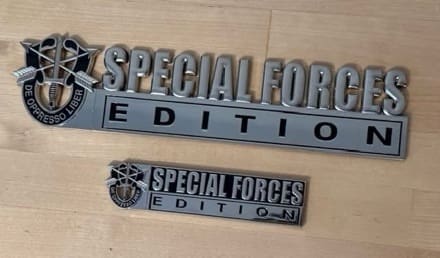
For the Special Forces Veteran, the commitment to excellence doesn’t end with service. Excalibur Industries is proud to offer the Special Forces Edition Car Badge 5″ version, a distinguished emblem that allows you to showcase your pride and affiliation wherever you go.

This isn’t just a car accessory; it’s a statement. It’s a way to connect with your brotherhood, to honor your service, and to let the world know what it means to be Special Forces.

Product Details:

Premium Quality: Crafted from durable metal for a lasting tribute.

Special Forces Designation: Boldly displays your affiliation with the US Army Special Forces.

Size: The badge measures 5″ by 1″, making it easily visible.

Color Options: Available in both Chrome and Black Nickel finishes.

Easy Application: Features an extra-strong 3M adhesive backing for secure and easy application to any vehicle surface.

Damage-Free Removal: Designed to be removed without causing damage to your vehicle’s finish.

$14 only at Excalibur. Also available in a 10″ Version for you guys driving the Ford F-150 King Ranch Edition.

Get it at xclibr.com/product/special-forces-edition-car-badge-5.

Autonomy in Action: Advancing CBRN Defense Capabilities with Unmanned Systems

Saturday, January 3rd, 2026

Our Nation’s warfighters encounter many known and unknown hazards on the modern battlefield including chemical, biological, radiological, and nuclear (CBRN) threats. Hand-held detection and identification capabilities enhance situational awareness and enable early warning and mitigation, but they can also be time intensive and physiologically burdensome. Additionally, some environments pose too great a risk or are simply inaccessible to warfighters. This is where the use of critical integrated layered CBRN defense assets like autonomous systems comes in.

In CBRN defense, an autonomous system refers to a capability that can independently detect, identify, and/or mitigate CBRN threats by leveraging sensors, robotics, artificial intelligence (AI), and automated decision-making algorithms. The key feature lies in its ability to function independently, acting as an intelligent partner, and keeping the warfighter at a safe distance, therefore enhancing force protection.

Currently, the Capability Program Executive Chemical, Biological, Radiological and Nuclear Defense (CPE CBRND) manages autonomous system efforts including the CBRN Sensor Integration on Robotic Platforms (CSIRP) and the Autonomous Decontamination System (ADS).

CSIRP is a rapid prototyping and fielding effort led by the CPE CBRND’s Joint Project Manager for CBRN Sensors (JPM CBRN Sensors) that focuses on integrating modular CBRN sensor solutions to enhance Unmanned Aircraft Systems (UAS) and Unmanned Ground Vehicles. It exploits advances in sensing, AI, machine learning, autonomy, and communications to enable timely and accurate detection, early warning, and reporting of CBRN hazards, benefiting the warfighter by reducing response times and limiting risk of exposure to CBRN threats.
The CSIRP SkyRaider UAS CBRN Hazard Mapping system is an example of CSIRP in action. The CSIRP SkyRaider UAS is a drone with modular detection equipment or sensors attached that can display CBRN hazard information on mapping, targeting, and communication devices. Once launched from the ground or platform, it is capable of autonomous operation beyond line-of-sight and can complete the programmed mission even through loss of GPS or communications. It is capable of self-navigating to the target, maneuvering in tight spaces, and avoiding obstacles.

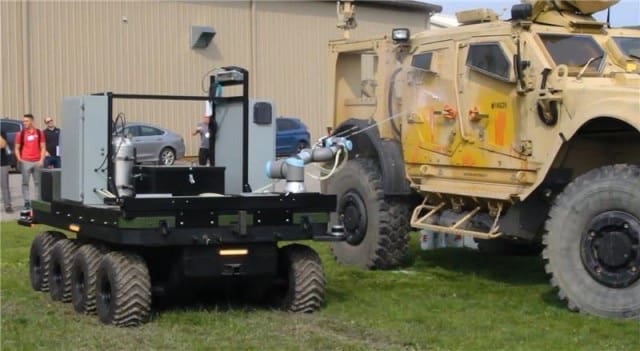
Likewise, the ADS program, led by the CPE CBRND’s Joint Project Manager for CBRN Protection (JPM CBRN Protection) will provide increased safety and efficiency of chemical and biological (CB) decontamination operations by utilizing automated, semi-autonomous, and/or autonomous processes to mitigate contamination on critical mission equipment, infrastructure, and terrain. ADS reduces reliance on warfighters’ manual labor and optimizes resource consumption.

To illustrate how these autonomous systems benefit the warfighter and Joint Force mission, imagine a platoon situated in a contested environment. The adversary launches a missile armed with a chemical warfare agent nearby and the dispersal pattern is unpredictable due to the terrain, wind conditions, and the missile’s detonation characteristics. Manned detection slows contamination mapping and poses risk to the Force, so rather than putting warfighters at risk, the platoon leader would deploy the SkyRaider UAS equipped with chemical sensors to quickly self-navigate and assess the broader area. This unmanned, rapid assessment minimizes personnel exposure and enhances force protection by communicating to leaders the timely information needed to make informed decisions. In this case, the platoon leader might deploy an ADS to decontaminate any equipment or areas the platoon will need to traverse, mitigating the risk of exposure to the warfighters through robotic means and reducing the time and logistical burden required to conduct decontamination operations.

Mark Colgan, CSIRP lead systems engineer for JPM CBRN Sensors, states, “Currently, warfighters have to suit up, do their mission, and then decontaminate their protective gear, equipment, vehicles, and more. We can now skip some of those steps by automating the process. They get the same results while remaining safe and completing the mission faster.”

The CSIRP effort is in constant pursuit of advanced sensing capabilities and improvements to leverage autonomy, specifically through its use of algorithms. To keep pace with advancing technologies, JPM CBRN Sensors and JPM CBRN Protection leverage CPE CBRND’s Joint Enterprise Technology Tool (JETT), a web-based platform designed to facilitate communication between the U.S. Government and industry members, for market research and to gain a better understanding of what industry is developing and their focus areas as they relate to program needs. The JPM CBRN Sensors team has utilized JETT to identify and engage with more than a dozen vendors with capabilities relevant to CSIRP. Colgan states, “JETT has proven valuable in answering the questions of ‘What else is out there?’ and ‘What’s coming next?”

This aligns with the Department of War’s Acquisition Transformation Strategy, which, in part, acknowledges that industry often outpaces the Defense Industrial Base and that the Department “must adopt an industry-driven environment for companies to share their product and service offerings to accelerate and scale capability delivery,” as well as “enable industry to better understand the Department’s needs and demonstrate mature products and services early in the acquisition process.”

To date, improvements have included software designed to operate with CPE CBRND’s CBRN Support to Command and Control (CSC2), which integrates CBRN sensor data and information into a common operating picture and provides actionable information to Commanders throughout the battlespace; flight software and sensor-driven algorithms that enable a number of unmanned systems to autonomously team up and relay messages among themselves and with their human counterparts; algorithms that synthesize data; and more.

As it stands, autonomous systems provide a decisive warfighter advantage by performing standoff detection of CBRN threats and critical decontamination functions so the warfighter can focus—at a safe distance—on the larger mission at hand. Looking ahead, AI and technology advancements will continue to optimize the role autonomous systems play in CBRN defense, enabling our warfighters to operate in a CBRN contested environment with more confidence.

By Vashelle Nino CPE CBRND Public Affairs

Orion Defence – M85A3 HG Pouch

Friday, January 2nd, 2026

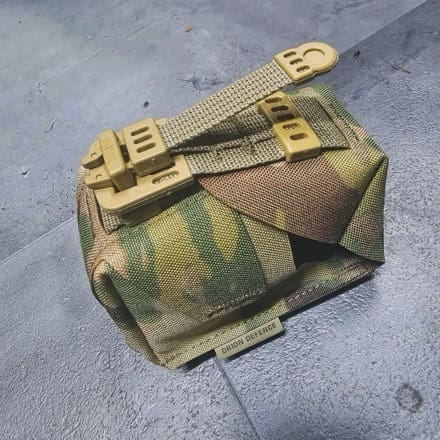
Photos of this have been floating around for quite awhile but I just saw them. This is a prototype pouch from Orion Defence for the new Danish handgrenade M85A3. I always appreciate the staple fasteners.


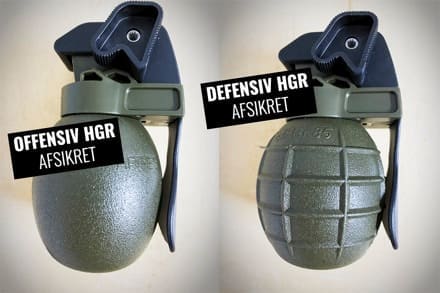
Manufactured by Rheinmetall the grenade is available in both offensive and defensive versions. Phots from Danish Defence Material and Procurement Agency.

BNC MOLLE Antenna Mount

Friday, January 2nd, 2026

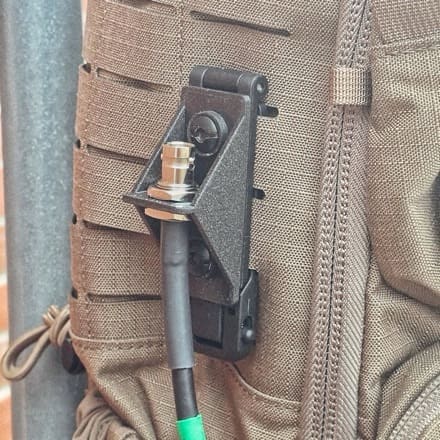
The BNC Molle Antenna Mount from Radio Made Easy allows you to securely mount your BNC Antenna to any 2 rows of PALS/MOLLE webbing. Available with or without antennas and coax.

radiomadeeasy.com/product/bnc-molle-antenna-extension