SIG SAUER - Never Settle

Author Archive

First Time: Polaris DAGOR On Display At DSEI

Tuesday, September 8th, 2015

Polaris Defense - DAGOR 2014 TESTING 2

MINNEAPOLIS (Sept. 8, 2015) — Polaris Defense and Polaris Britain Ltd., divisions of Polaris Industries Inc. (NYSE: PII), are displaying a full line up of highly mobile, tactical air transportable vehicles at the Defence & Security Equipment International (DSEI) show Sept. 15-18 in London. Polaris will be showing its newest production vehicle, DAGOR, along with the well-established MRZR and MV850 vehicle platforms. These vehicles are in service worldwide in more than 20 countries, which streamlines service and support and provides a high degree of interoperability and commonality among allied forces.

“Polaris Defense and Polaris Britain Ltd. bring game-changing resources in off-road mobility as part of a larger, commercial company,” said Doug Malikowski, Director, International Business, Polaris Defense. “DAGOR is here at DSEI to help demonstrate how well Polaris understands ultra-light mobility needs for armed forces around the world.”

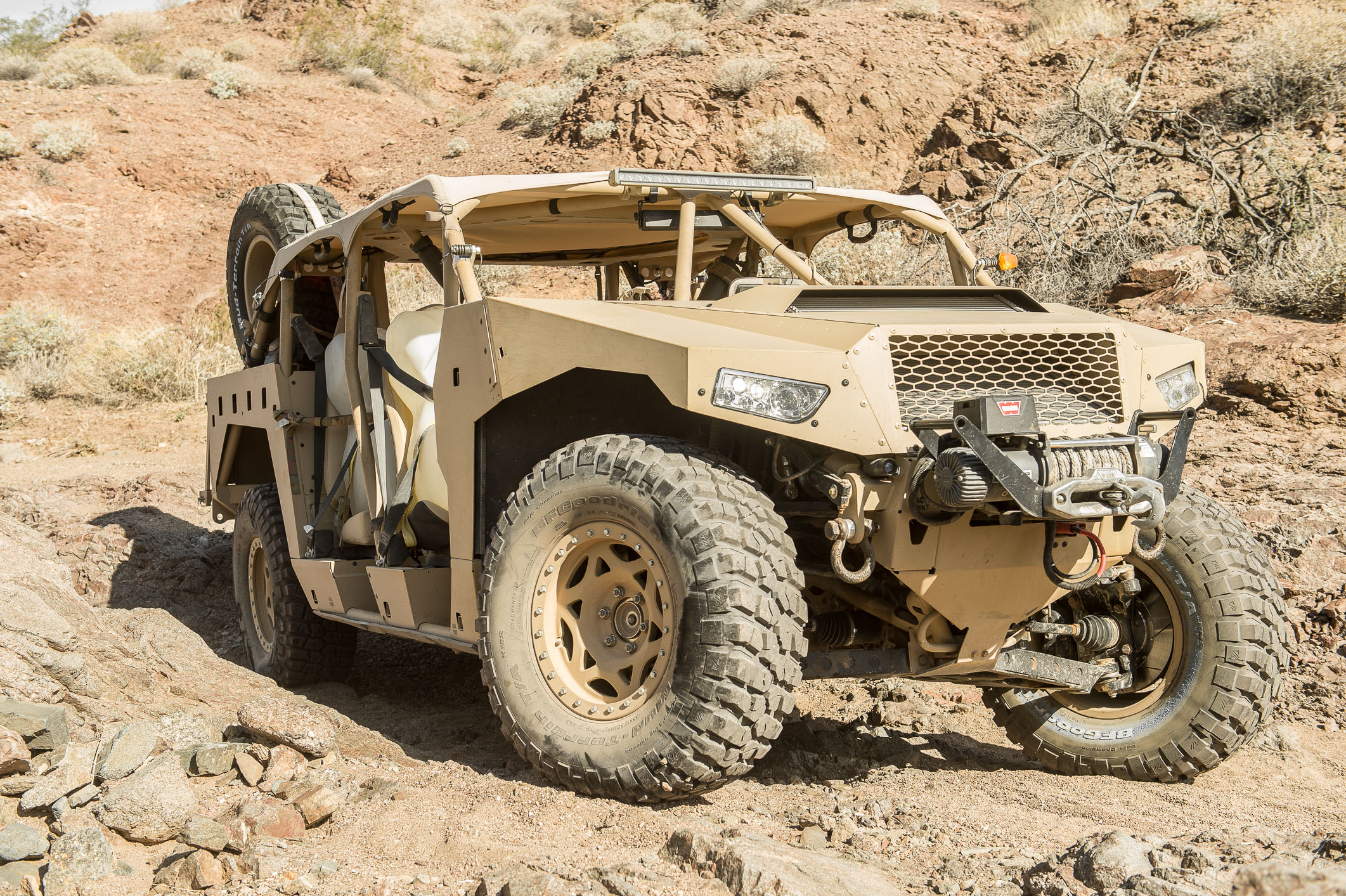
DAGOR was specifically designed for light infantry, expeditionary and special operations forces. It is easily transported by tactical air, carries enough payload to be mission effective and carries full payload (1,474 kg) in extreme off-road terrain. DAGOR meets those requirements in a robust and modular off-road vehicle platform that can be configured to carry up to nine soldiers with full kit. By traversing more concealed and unpredictable routes over terrain usually traveled on foot, DAGOR allows Warfighters to move quickly to the objective with mission-critical equipment. DAGOR is supported with a COTS supply chain, anywhere in the world, making it easy to use and easy to maintain, even when deployed.

The vehicle curb weight is less than 2,041 kg (4,500 lbs) to maximize tactical aircraft operational range. The width of DAGOR facilitates rapid loading into the CH-47 platform – without modification – and the weight allows it to be sling loaded under the UH-60 and NATO helicopters with similar lift capabilities. The vehicle has completed certification testing for CH-47 Internal Air Transport (IAT), air drop and UH-60 Sling Load. DAGOR is currently under contract with U.S. and allied Special Forces.

The MRZR 2 and MRZR 4 are highly mobile off-road platforms that are internally transportable in a variety of U.S. and allied military aircraft and can be configured a number of ways to help expeditionary forces meet mission requirements for emerging threats, while forward deployed. Some common tactical features of these off-road platforms include increased payload, standard winch, electronic power steering, aircraft tie-downs, fold down rollover protective structures (ROPS), large cargo boxes, IR light capability and blackout mode.

Polaris provides a wealth of engineering, production and sustainability resources that come with being a recognized leader in the off-road vehicle industry. Polaris maintains a robust global network of dealers, distributors, and subsidiaries, providing dedicated full life-cycle support for these vehicles throughout the world. And with a proven and well-established defense team, the company works closely with military customers to gain a thorough understanding of their off-road mobility needs.

www.polaris.com/en-us/military
The Baldwin Articles – Ponchos And Shelters

Tuesday, September 8th, 2015

Special Forces Veteran Terry Baldwin is continuing his series on the history of US Military equipment with ponchos and shelters.

P1010002

This is about effective tactical shelters that I have used in the field including various military issue ponchos, tarps and the Ecotat Multipurpose System. I recognize that today there are quite a few other potential options available but I’m going to stick with what I know works. In WW II and until at least the late-80s the US Military issued two basic shelter items. One was the canvas “Shelter Half” each of which came with (3) wooden poles and (5) aluminum tent pins. These so called “pup tents” were heavy, always leaked – even when new – and required two sets to form a complete shelter. The resulting 2-man floorless tents were intended strictly for bivouacs in relatively secure rear areas and not for the front lines. Other than in basic training I don’t believe any service member ever willingly carried or voluntarily used these things. I’m not sure exactly when these stopped being issued but I don’t think anyone was sorry to see them go.


The USGI poncho on the other hand was always a much more popular option. It was considerably lighter than the shelter half. It was actually waterproof and it was simple enough that it could be successfully erected by one person even in the middle of a pitch black night. The OD green poncho was the standard for many years. It was thicker and slightly heavier than the current versions and was quite durable. The lighter woodland type was introduced in the 80s but many “old soldiers” kept using the green ones for some years afterwards. The poncho was not issued with any accessories, but a hunk of 550 cord or some bungee cords was usually enough to construct a functional shelter in a wooded area. However, carrying some kind of lightweight tent pins was also advisable in order to anchor the poncho directly to the ground when necessary.

Probably the oddest fact about issue ponchos is that they are only rarely worn as ponchos in modern times. Even in the late 70s we had wet weather tops and bottoms that were usually worn to keep dry while active. The poncho was almost exclusively employed in the field as a sleeping shelter. In fact most people kept the hood tightly tied off to facilitate more rapid shelter construction. Many Allied countries prefer some form of tarp for expedient individual shelters instead. In the US we generally refer to the resulting simple structures as “hooches” while the British refer to them as “bashas”. Basha tarps are generally longer than a USGI poncho and therefore make a relatively spacious shelter that more easily accommodates a soldier and all his gear.

Since it has no hood opening the tarp cannot be worn like a poncho. But otherwise the two are very similar in form and function. They all come with grommets and web loops or snaps to provide lashing points and to allow two or more items to be linked together to make larger coverings. Either type can also be readily used as an improvised litter to move a causality or to construct a buoyant “poncho raft” to aid in crossing bodies of water. Mated with a poncho liner or blanket either can be a lightweight sleeping bag or bivy as well. When light discipline is a concern they can be used as expedient blackout screens during map checks and similar tactical activities. The OD green poncho could even be used as a makeshift chalk board. As long as you remember to bring chalk. And if you are in the boonies long enough, you can use your poncho or tarp to form the lining of a field washing machine to hand clean your cloths.

The Ecotat Multipurpose System was developed in the 80s by a retired Marine. It does have an NSN and was available for issue for a number of years. Besides M81 woodland they were made in solid coyotish brown and more recently in UCP. The Ecotat concept was pretty audacious, innovative and truly ahead of its time. The idea was to retain all the functionality of the poncho, make it more ergonomic so that it could be worn more comfortably as a garment AND give the soldier the option of constructing a complete modern one or two man tent with the included accessories. The first versions were also made of a brand new space age miracle fabric called Gore-Tex. I have one of the early ones that I acquired around 1984. This was still a few years before the Army began issuing jackets and pants made out of Gore-Tex. It was a very intriguing idea. But for the field soldier in moderate climate zones there just wasn’t much need for the full tent option. And even without the accessories it was considerably heavier than the OD green ponchos most of us were using at the time. Eventually a coated nylon Ecotat was produced that helped reduce the weight quite a bit but by that time the Army had lost interest in making them a general issue item.

I couldn’t begin to guess how many Ecotats were fielded or may still be out there in circulation. If anyone has recent experience with them as an issue item I would love to hear it. I believe that all of them were actually produced by Wiggy’s for Ecotat. The Ecotat company itself went out of business years ago. But Wiggy’s still makes these in several colors under the name “Freedom Shelter” although no longer in old style woodland. There are also some cheap knock offs out there made in China I presume. The Ecotat system is not the be all and end all of individual soldier shelters. Still, the idea of a truly multifunctional shelter system has great merit. I would love to see a fully modernized and improved A2 version of these developed. But the fact is the US Military has essentially come full circle and we are back where we were decades ago with two separate issue shelter systems. The USGI poncho or tarp continues to be the primary tactical shelter available to soldiers. And single purpose one and two person pup tents are available for bivouac and base camp situations like the Army’s Improved Combat Shelter. Albeit these are absolutely much better tents than their canvas ancestor.

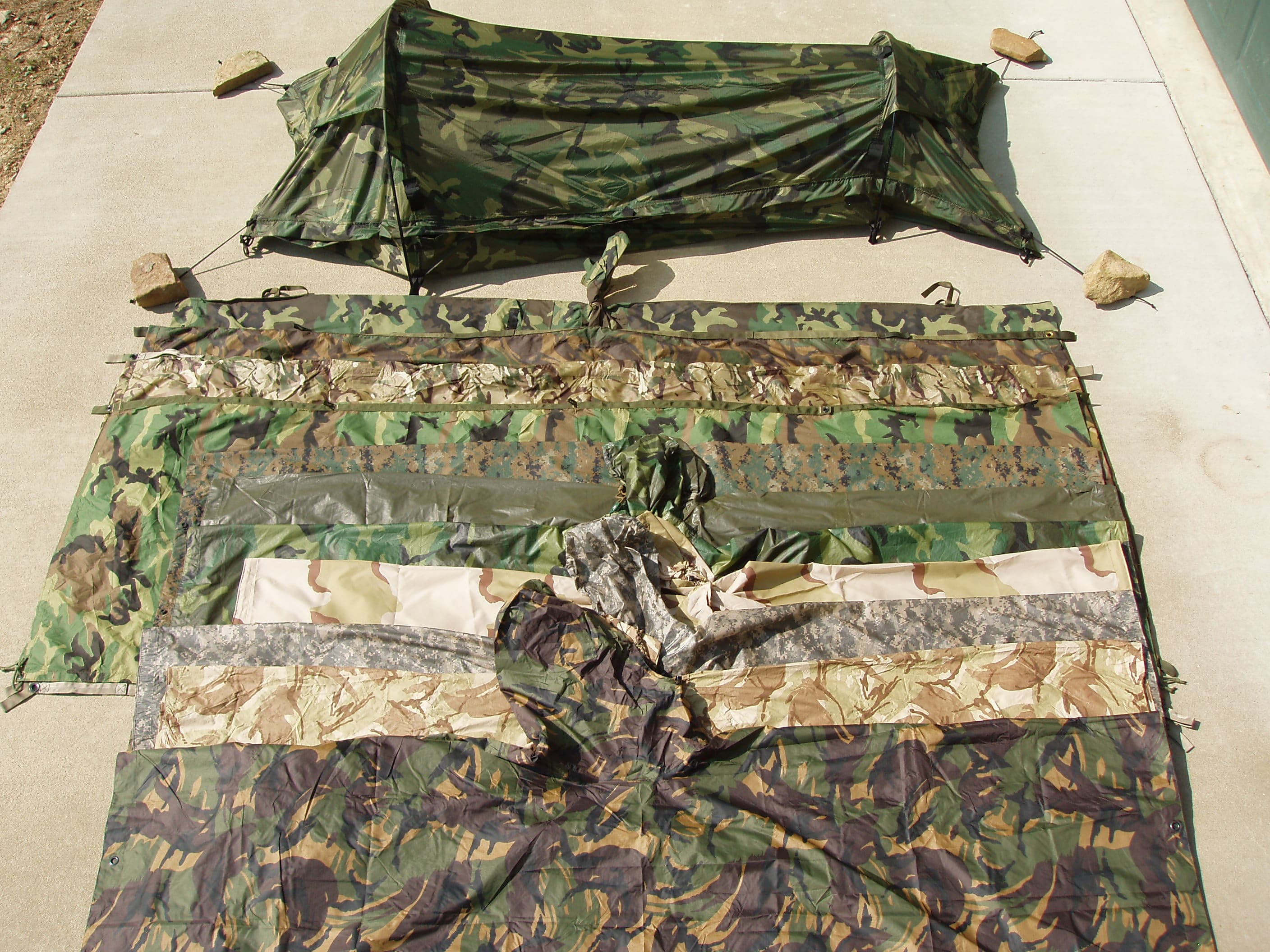
All of the items I’ve talked about do what they were designed to do quite well. Some are a little heavier or bulkier than others but not by too much. For me it came down to options and color scheme. If I knew I was going to be living out of a hooch for any length of time I generally preferred a tarp since it was roomier. If I was just carrying something for contingencies but didn’t expect to use it much I usually went with ponchos because they took up the least space. A key factor was always what camouflage pattern available to me would blend best with the terrain and season I expected to be working in most often on any given trip. The examples shown (top to bottom): Ecotat nylon in tent mode, Ecotat Gore-Tex, British DPM woodland tarp, British MTP (Multicam variant) tarp, M81 woodland commercial tarp, USMC MARPAT tarp, USGI OD green poncho, woodland poncho, post Desert Storm commercial tricolor desert poncho, UCP poncho, Gulf State DPM desert poncho and Dutch DPM woodland poncho. As a side note: all the ponchos except one have small hoods designed to be worn under helmets. The Dutch poncho and the Ecotats have much larger hoods designed to be worn over helmets.

I found the M81 woodland items were usually a good camouflage option in most temperate locations in spring and summer. However, I felt the DPM woodland worked better in some of the African countries I visited. I carried the desert variant DPM poncho most often in GWOT and found it especially appropriate for many places in Afghanistan. If I had gotten the MTP tarp sooner it would have worked at least as well and probably better in some locations. The newer MARPAT tarp might be a good choice if you are switching between widely varying environments since it is reversible woodland / coyote. And this may surprise some people but I found the UCP poncho worked quite well in some terrain overseas and even here on my homestead it is better than the woodland options during the late fall and winter months. If in doubt I went with the OD green poncho. It worked reasonably well in almost any terrain or climate. Bottom line: I highly recommend always carrying something that can be used to make a tactical shelter YOU can live with anytime you expect to be in the field. And in my experience any one of these military issue items would be a suitable choice.

Next: ALICE Packs Part 1.

Extreme Outfitters – New From Salewa

Tuesday, September 8th, 2015

Extreme Outfitters Salewa

www.extremeoutfitters.us/search.aspx?find=salewa

Corps Strength – Tail Wagging the Dog?

Monday, September 7th, 2015

478722781_1

In my mind and yes, I’ll admit it’s this is just an old Jarhead’s mind, there are some weird things in the fitness industry. Now, when I say “fitness industry” I’m talking about the vast array of exercise equipment, nutritional supplements, workout systems, etc. that are out there competing for your time and money. Diet and exercise books are a big part of this too, which makes me and my little book a small (very small) part of this huge thing which was valued at over 3 billion dollars last year. Obviously not all of these things fall under one company or person, but if you watch the “industry” you see that they all tend to all get in line with the latest trends. The bottom line with this is money, as everybody is trying to sell you something, so they’re always are looking for something new. Which is the exact opposite of myself, who is always looking for old stuff that has proven to have actually worked over the years. What normally happens is the whole thing rotates around and every few years they repackage the some stuff from a few years ago and resell it as new. I’ve seen this process go through many cycles, too many to list here.

Now there is something that has become a big thing over the last few years and from what I can tell it’s kind of original, as it’s not just another cycle repeating itself. That is the WOD, or Workout of the Day. Far as I can tell it mostly came from Cross Fit (which is another story). Most people who workout are familiar with this, it’s a combination of movements (weights, calisthenics and maybe some aerobic stuff) that you would go through and shoot to complete the required number reps in a certain time limit. Many gyms and trainers will post their WOD on the boards in gyms and on line. I’ve done many of them and posted many others of my own for my students.

In my case I always looked at them as just another way to motivate myself and others and a way to achieve and sometimes, measure specific fitness levels. However more and more I see that the WOD has become the end game? How you do on these things has a life of it’s own. The very popular Cross Fit games are really nothing more than extreme WODs when you get down to it. Which brings me to my point. That is how well you do in your workouts (what ever type they may be) should be focused to help you improve in some sport, activity or your overall fitness, which includes getting and keeping your weight in check. The WOD is like the tail wagging the dog, where the workout is the focus, where it is supposed to take you is not really a consideration. So what you say, fitness is fitness? If you just do these WODs you’ll be in great shape. IMO, this isn’t true when your focus is to maintain health and fitness for life and/or improve in any certain aspect of your life. I’ve seen many people in the last few years that are injured and/or get burned out and quit working out after a period focusing on Cross Fit/WOD stuff. Most of these workouts are not designed to improve any particular sport, but are designed themselves be the focus. This is backwards and in the end the vast majority of people will either hurt themselves or quit because of it. Seen it too many times, especially for older people or those trying to get back into shape from a layoff.

The key to long term fitness is to follow a program that is designed for you and you goals, not focused on just completing a certain amount of Burpees or Power Cleans in under a certain time. Like say in my book and tell everyone I’ve trained, our goal is “long term results, not short term fixes.” The WOD is just that, a short term fix, a workout of the day. For your life you need real goals, not something dreamed up by someone for that day. A tail can’t wag a dog, it will break first, same concept here.

Next week I’m off to Africa to train some of their Army guys for most of Sept. Till then train hard, be good when you can and stay safe always.

Semper Fi

MGunz

corpsstrength.com

ATS Tactical Gear – Mini IFAK System

Sunday, September 6th, 2015

Mini-IFAK-System-Black-1500

ATS’ Mini IFAK System is a two-piece kit, designed to be mounted on a duty belt. It consists of an outer pouch, and an inner tray. The pouch is constructed of 500D Cordura fabric, with a fold-over, Velcro-closed adjustable belt loop. The inner tray is a custom, smaller version of the ATS Medical Insert. A red nylon loop at the top of the insert makes it easy to remove from the pouch. The tray has two elastic loops for organizing medical supplies, and is stiffened with HDPE for rigidity, making it easy to deploy on the ground next to a casualty.

The Mini IFAK System is available in Black, and is covered by ATS’ lifetime warranty.

www.atstacticalgear.com/home

Extreme Outfitters – TacLace

Sunday, September 6th, 2015

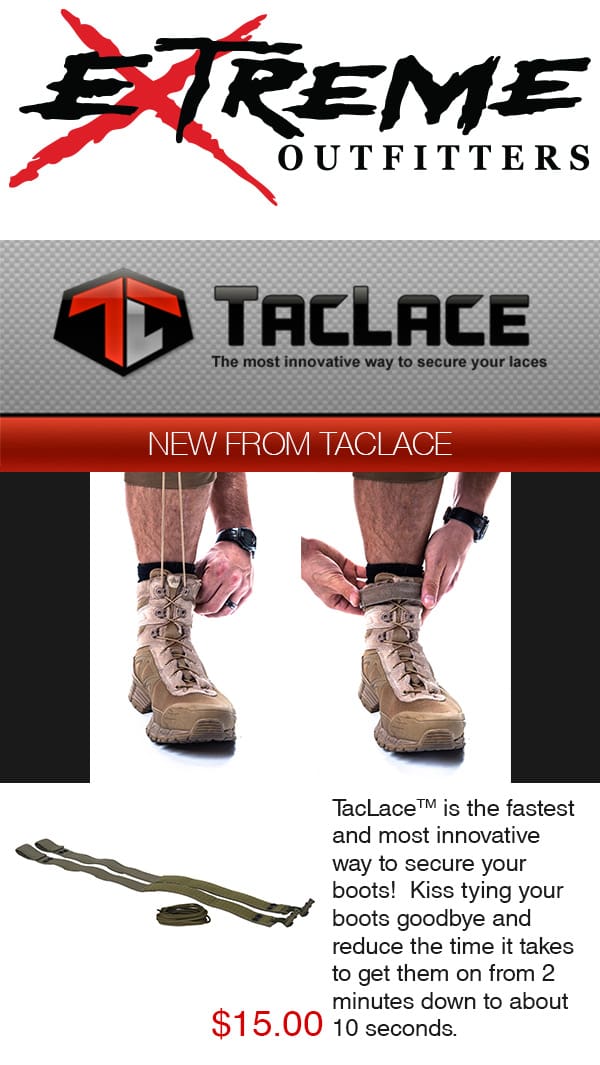
taclaceEO

www.extremeoutfitters.us – TacLace

Gunfighter Moment – Pat McNamara

Saturday, September 5th, 2015

Two things not practiced enough, or at all, on the range are proprioception and kinesthetic sense. Proprioception is the sense of the relative position of neighboring parts of the body and strength of effort being employed in movement and kinesthetic sense helps us detect weight, body position, or the relationship between movements in our body parts such as joints, muscles and tendons. In short, it is the muscle sense.

We stand too flat footed, on a flat range range, and work with a flat range mindset.

Even incorporating small movements laterally and to the oblique front and rear, will assist us in becoming more situationally aware of our body in the space that it occupies.

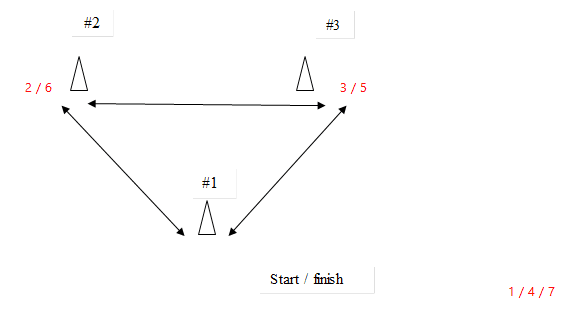
My Delta 7 drill is a simple fix to an otherwise mundane flat range world. Set three cones roughly a meter apart. Target is at 10 meters.

Delta 7 Drill

Start at cone #1, draw and engage one time to the A zone or to the steel. Move clockwise to cone #2 and #3 taking a shot from each. Once back at cone # 1, move counter clockwise to cone #3, #2 and finish back at cone #1. One step in that direction is good enough. Because visual acuity is important here too, take a snapshot look in the direction of movement including over your shoulder as you move backwards at an oblique angle before you move in that direction.

Patrick McNamara
SGM, US Army (Ret)

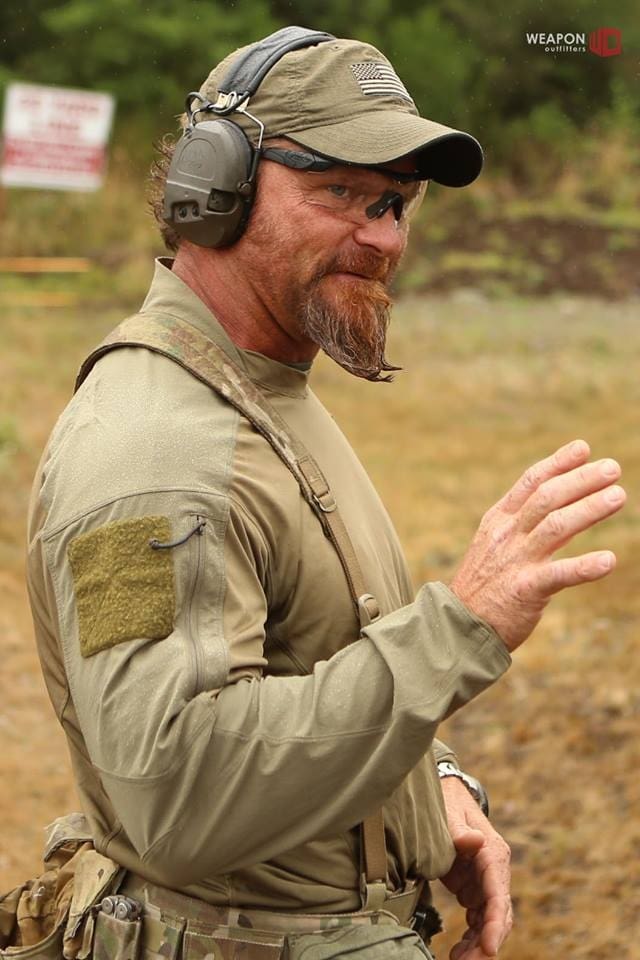
Pat McNamara

Patrick McNamara spent twenty-two years in the United States Army in a myriad of special operations units. When he worked in the premier Special Missions Unit, he became an impeccable marksman, shooting with accurate, lethal results and tactical effectiveness. McNamara has trained tactical applications of shooting to people of all levels of marksmanship, from varsity level soldiers, and police officers who work the streets to civilians with little to no time behind the trigger.

His military experience quickly taught him that there is more to tactical marksmanship than merely squeezing the trigger. Utilizing his years of experience, McNamara developed a training methodology that is safe, effective and combat relevant and encourages a continuous thought process. This methodology teaches how to maintain safety at all times and choose targets that force accountability, as well as provides courses covering several categories, including individual, collective, on line and standards.

While serving as his Unit’s Marksmanship NCO, he developed his own marksmanship club with NRA, CMP, and USPSA affiliations. Mac ran monthly IPSC matches and ran semi annual military marksmanship championships to encourage marksmanship fundamentals and competitiveness throughout the Army.He retired from the Army’s premier hostage rescue unit as a Sergeant Major and is the author of T.A.P.S. (Tactical Application of Practical Shooting). He also served as the Principle of TMACS Inc.

Gunfighter Moment is a weekly feature brought to you by Alias Training & Security Services. Each week Alias brings us a different Trainer and in turn they offer some words of wisdom.

AFCEA TechNet 2015 – GATR Technologies – Satcom

Saturday, September 5th, 2015

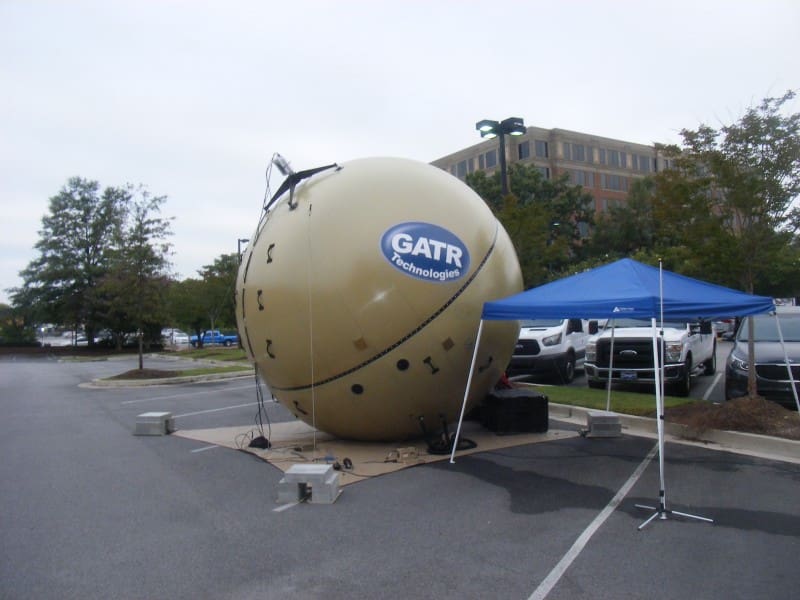
DSCF1909

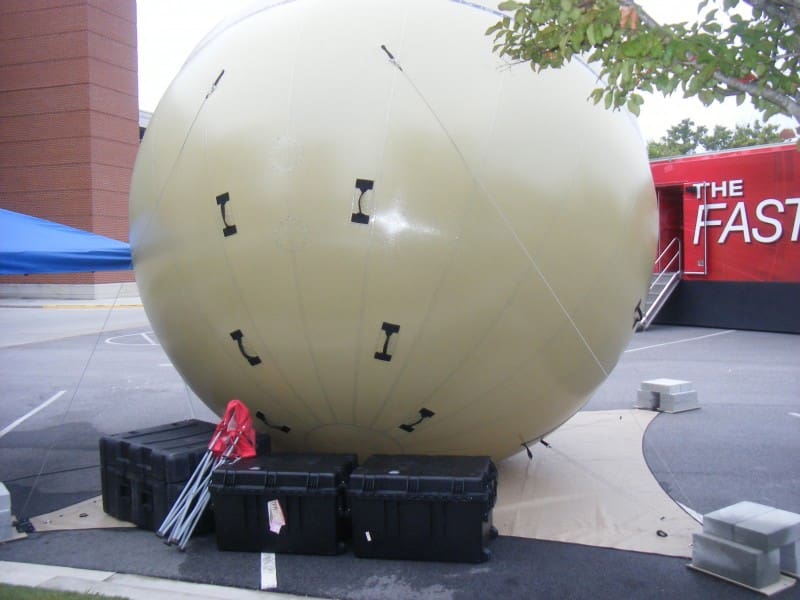
-Recently used for 25th ID Cobra Gold rotation after their SATCOM was rendered NMC during sealift. A 4 man team deployed via commercial air with a 4M GATR and provided DIV MAIN CP comms. What used to take a long bed 5-ton can now be put in the bed of a 4-pax or a large sedan.

-No component weighs over 80lbs. The ball was 77lbs. The ball itself can be transported in a canvas bag. Not jumpable unless soldier is 6’4″ + but definitely door-bundle per the retired JM rep. It can operate in windspeeds up 50 kts or so, well beyond the threshold of normal rigid dishes due to the aerodynamics of a ball versus a bowl.

-The two Pelican boxes hold the electronics and blowers. The Hardigg box holds the ball in its bag for palletizing. Not essential.

-The dish reflector shape is held by differential pressurization between the halves of the ball. If the ball is damaged punctured (by fragementation or small arms), the blowers kick up to compensate for air loss. It comes with a patch kit and is made of rip-stop material.

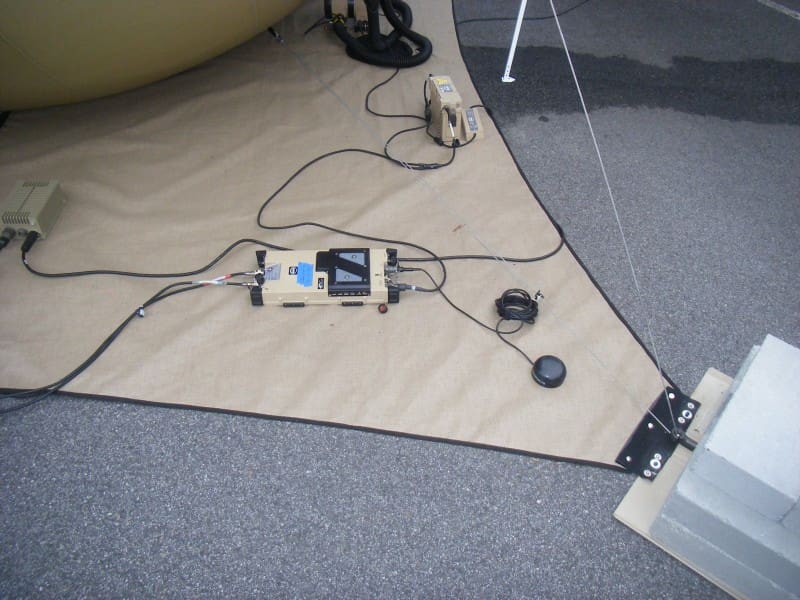
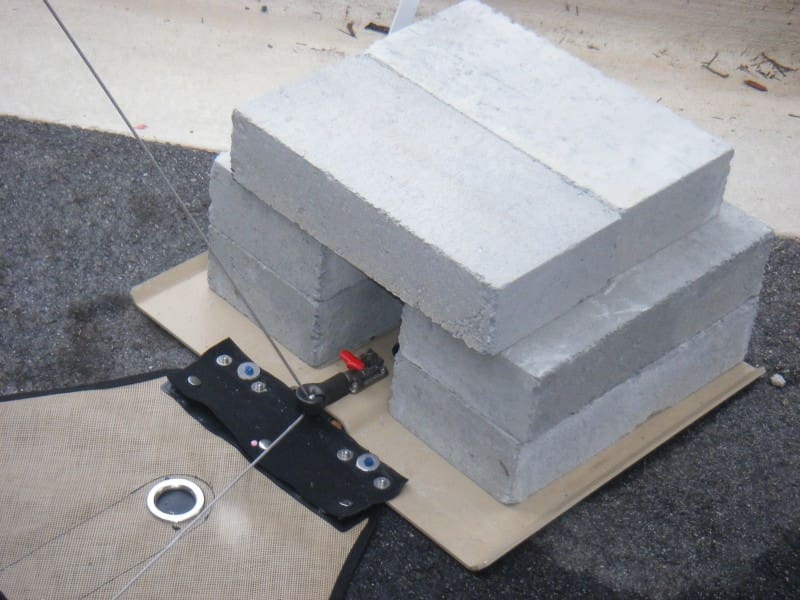
-Note the “Satellite this way” markings on ground mat and sizing of the anchor plates to allow ammo cans, 5 gallon jugs, sandbags, or bricks to be used. All tie-downcabling and turnbuckles are integrated for quick setup and no line snags. The protractor is also integrated for elevation checks of the dish. A clear vinyl window allows a visual check on the reflector shape without guessing. The slightly blurry photo with the oval in the corner is the view inside.

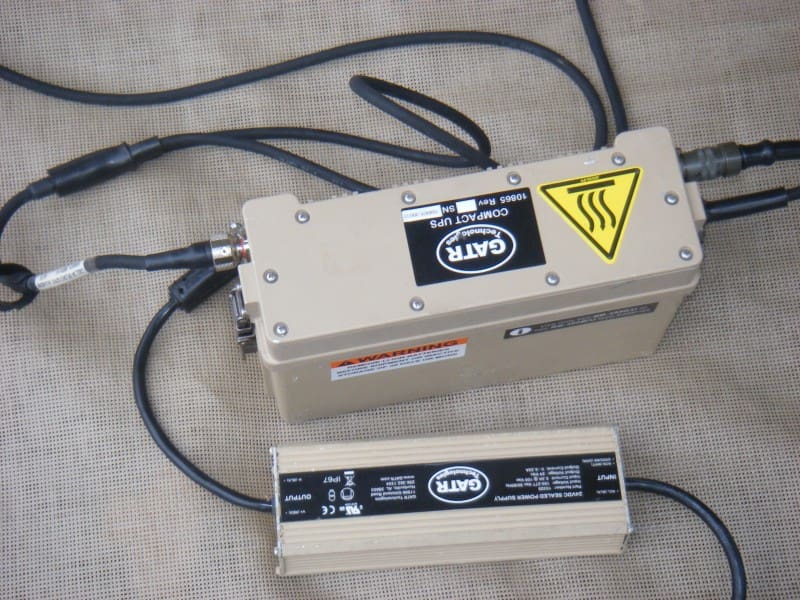
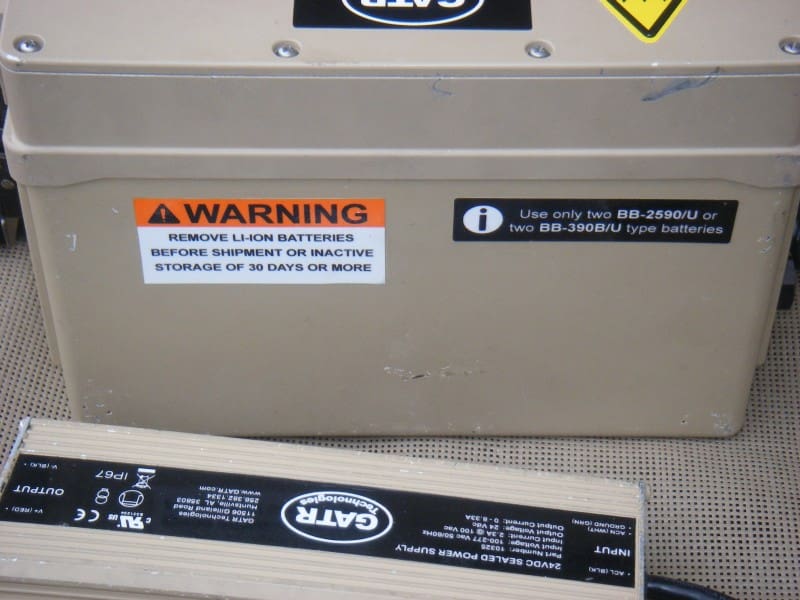
-Blowers use regular radio batteries for the UPS.

Available in smaller sizes, too.

www.gatr.com

Submitted by Fly On The Wall