Colt

Archive for the ‘Air Force’ Category

Uniform Integrated Protective Ensemble Air 2 Piece Under Garment Completes Testing at Dyess AFB

Tuesday, June 29th, 2021

KIRTLAND AIR FORCE BASE, N.M. (AFNS) —

A joint military test team recently conducted ongoing developmental and operational testing of the Uniform Integrated Protective Ensemble Air 2 Piece Under Garment at Dyess Air Force Base, Texas.

UIPE Air 2PUG is a two-piece carbon-based protective undergarment designed to be worn underneath the CWU-27/P flight suit and is intended to provide chemical, biological, radiological and nuclear protection to aircrews in toxic environments.

The test team was made up of members from the Air Force Operational Test and Evaluation Center’s Detachment 2 and the 28th Test and Evaluation Squadron from Eglin AFB, Florida, the Navy’s Operational Test and Evaluation Force, and the Air Force Life Cycle Management Center’s Agile Combat Support Directorate Human Systems Division.

The new system is intended to offer better mobility, breathability, and a lower thermal burden on aircrews. UIPE Air 2PUG allows aircrews to stay in the suit longer and do their jobs with less heat burden or chances of heat casualties.


During this phase of testing, the UIPE Air 2PUG was tested on C-130J Super Hercules aircrews from the 39th and 40th Airlift Squadrons that are part of the 317th Airlift Wing at Dyess AFB. The aircrew simulated aircraft preflight checks and conducted a ground egress in order to field test the new UIPE Air 2PUG garment. The test event also focused upon the garment’s interoperability and compatibility with current equipment.

“The joint ground test provided critical feedback from the user to the engineering and testing team,” said Lt. Col. Brent Gaylord, 317th Operational Support Squadron commander. “The 317th Airlift Wing utilized a full aircrew complement to include female aircrew members representative of our diverse crew force and ensuring all ergonomic factors are considered. Updating decade’s old equipment is an exciting process to be a part of and is critical to maintaining our qualitative advantage over global competitors as we continually pursue full spectrum readiness.”

“This was the final ground compatibility test event,” said Tech. Sgt. Bryce Gardner, AFOTEC Det. 2 Aircrew Flight Equipment Program manager. “Previous test events were conducted with the KC-135 (Stratotanker) at McConnell AFB, Kansas; the HH-60 (Pave Hawk) at Nellis AFB, Nevada; and the F-15 (Eagle) at Eglin AFB. Multi-Service Operational Test and Evaluation will occur in the first quarter of fiscal year 2022.

“This test event went very well and the test team gathered all the required data because of the outstanding support received from the Dyess Aircrew Flight Equipment team and the participating C-130 aircrew,” Gardner said.

Once testing is completed and UIPE Air 2PUG is approved, it will be fielded to all Air Force, Navy, Marine Corps and Army aircrews across fixed wing, rotary wing, ejection seat and large frame aircrafts.

AFOTEC’s mission is to inform the warfighter and acquisition through operational tests. AFOTEC evaluates the capability of systems to meet warfighter needs by planning, executing, and reporting independent operational assessments, tests, and evaluations. From concept development to system fielding, AFOTEC evaluates a system’s overall operational mission capability under realistic conditions. AFOTEC’s mission requires lock-step efforts with acquisition partners focused on shortening the combat capability delivery timeline.

By Katherine C. Gandara, Public Affairs Advisor, Headquarters Air Force Operational Test and Evaluation Center

AFSOC at “Strategic Inflection Point”

Sunday, June 27th, 2021

U.S. Air Force Lt Gen Slife, commander of Air Force Special Operations Command, addressed the Global SOF Foundation’s 2021 virtual SOF Imperatives Forum to discuss the critical mission areas AFSOC will need to focus on to remain competitive in the future operating environment on June 6, 2021.

Slife was joined by LTG Francis Beadudette, commanding general of U.S. Army Special Operations Command.

Linda Robinson, Global SOF Advisor, moderated the conversation with the two current SOF component commanders and begin with each commanders’ view of the state of special operations today.

“When I think of where we are at in 2021, we are at a third post-Vietnam discontinuity, a point of time where the future is best understood as not a linear extension of the past, but rather as something requiring something different all together,” Slife began.

“We have to maintain the ability to respond to crisis on behalf of the nation on a short notice anywhere around the globe, maintain pressure on counter violent extremist organizations,” said Slife. “We have to be prepared for conflict with peer adversaries in contested environments, and we have to compete strategically with global competitors who challenge U.S. interests and our way of life.”

Operating in contested environments, Slife continued, may require changes in how AFSOC deploys its forces.

“To the extent that we can, we need to be independent of main operating bases such as large runways, large fixed facilities,” said Slife. “We need to get smaller, lighter, and more expeditionary to succeed.”

“It’s imperative to lower our signature,” he continued. “We have to be able to blend into the noise both physically and electronically around the globe, wherever we want to compete.”

In a fiscally-constrained environment, Robinson asked Slife what areas of AFSOC might still see growth.

“Going forward I think we need to talk about language,” said Slife. “We need to take a look at ourselves in AFSOC and decide to what degree do we need regionally specialized forces who have deepened understanding of regions and cultures and nations inside those regions.”

When asked what AFSOC needs from its sister services in terms of cyber, electronic and communication capabilities, Slife stated he is not interested in growing an organic capability.

“While AFSOC has a range of kinetic and non-kinetic capabilities…as an enabler, I don’t want to be a duplicator of what people are already doing for us at scale,” said Slife. “I’m focused on the things that no one else can do and I don’t think we are in a resourcing environment that permits duplication for stuff that goes on elsewhere.”

When asked, “How much air support is enough?” Slife described his perspective on balancing the variables of mission, resources, and risk.

“The answer is it’s never enough. As you talk to ground formations, clearly they’ll tell you they need more aviation, he said.” “But it’s not a question of do we need more or not, it’s a question of, ‘At what level of risk?’”

“AFSOC is resourcing aviation at an appropriate level of risk. For every dollar we put into growing our aviation capabilities, there’s an opportunity cost elsewhere,” he went on. “That’s why the armed overwatch program is so important to us, because it’s a very cost effective way of providing that air support to our ground teammates who are going to be prosecuting these C-VEO operations for years to come,” said Slife.

In Slife’s closing remarks, he reiterated the men and women in AFSOC are a competitive advantage and it is up to leadership to ensure they are preparing a formation that is prepared and ready for tomorrow.

“Our challenge in leadership is to ensure that those middle school kids today who will put an AFSOC patch on in 10 years know when they come to AFSOC, they’ll still be relevant.”

Story by 1st Lt Melissa Crisostomo, Air Force Special Operations Command Public Affairs

AFWERX Agility Prime Partners with Kitty Hawk in First Medevac Exercise with Electric Aircraft

Saturday, June 26th, 2021

WRIGHT-PATTERSON AIR FORCE BASE, Ohio (AFNS) —

AFWERX Agility Prime and new partner Kitty Hawk reached a milestone in May with their first operational exercise.

“This exercise produced important data that will bolster the program going forward,” said Lt. Col. Martin Salinas, the mission design team lead in the Air Force Operational Test and Evaluation Center.

The technology and companies in the AFWERX Agility Prime program continue to mature rapidly with a new partner Kitty Hawk joining the government/industry team. In the program’s first exercise, a diverse group of industry and government operators, engineers, and test professionals assessed the ability to do medical evacuation, personnel recovery, and logistics with Kitty Hawk’s Heaviside electric vertical takeoff and landing, or eVTOL, aircraft. The Kitty Hawk team also demonstrated Heaviside’s remote flying capabilities.

The multi-disciplinary team gathered a rich catalogue of data to inform dual-use utility at the prototype stage that will inform future developmental and fielding decisions. Besides assessing different loading scenarios, the team also observed demonstrations of remotely piloted and fully autonomous flights with Heaviside.

“The world is going to need new modes of transportation and Heaviside is one path to getting us there,” said Sebastian Thrun, Kitty Hawk CEO. “We are excited to be working with Agility Prime and look forward to our continued collaboration as we bring eVTOLs to more people.”

Founded in 2010 and based in California, Kitty Hawk, has developed numerous eVTOL vehicles including the Heaviside vehicle, named after the English engineer, Oliver Heaviside. Designed to be fast, small, quiet and green, the aircraft flies at up to 180 mph with a potential range of 100 miles plus reserves on a single charge, according to Kitty Hawk’s website. Heaviside takes off and lands in a 30×30 foot space, reaches sound levels of 38 dBA at 1,000 feet, is 100x quieter than a helicopter and requires less than half the energy per mile of a conventional electric car.

“The Agility Prime and Kitty Hawk teams facilitated the convergence of Air Force and Marine Corps testers and operators to engage with Heaviside, all while experimenting within the context of Personnel Recovery and logistics use-case scenarios,” Salinas said.

Salinas attributed the success of the California tests to the eagerness of those involved. “Pushing experimental tests in an operational context is challenging and exciting,” he said.

Col. Don Haley, Air Education and Training Command Detachment 62 commander, who leads a team in developing training syllabi for these new electric aircraft, noted, “this collaborative commercial/DoD use-case exploration revealed common attributes that serve both urban air mobility and search and rescue operations: High-reliability, responsive launch & recovery, minimal logistical footprint, accessibility for mobility-challenged, low acoustic signature, and high levels of autonomy.”

“We are pleased to welcome a new partner and happy about the progress in this first Agility Prime exercise,” said Col. Nathan Diller, AFWERX Director. “This is just the beginning of many examples that the team will be exploring in the coming months to partner with commercial companies in a way that accelerates maturity for commercialization, while providing the Department of the Air Force with decision-quality data for future force design.”

For more information, visit www.afresearchlab.com.

By Air Force Research Lab, AFWERX

Royal Danish Air Force Brings Deployment Tradition to Shaw AFB

Friday, June 25th, 2021

SHAW AIR FORCE BASE, S.C. (AFNS) —

With 49 years of tradition in the making, the Royal Danish Air Force hosted their first Danish Contingent, or DANCON, march on U.S. soil at Shaw Air Force Base, June 5.

More than 60 participants from the RDAF, Ninth Air Force (Air Forces Central), 20th Fighter Wing, U.S. Army Central and other coalition forces had six hours to carry a 22-pound ruck for 15.5 miles.

“The history of the DANCON dates back to 1972, where it was held for the first time at a U.N. mission in Cyprus in the Mediterranean Sea,” said Royal Danish Air Force Lt. Col. John Roland Pedersen, the Danish detachment commander. “Ever since, it has become tradition that Danish contingents on a mission around the world have arranged a march similar to this one, which we are doing today.”

The march not only gives participants the opportunity to demonstrate their physical abilities, but it also allows them to build camaraderie within their own units and with members from other military branches and countries.

“At some point my legs were cramped up pretty bad,” said U.S. Army Sgt. 1st Class Layelquinn Ferguson, a forward observer assigned to the 4th Battlefield Coordination Detachment, USARCENT. “I was actually unable to stand until a coalition member stopped and helped me stretch and that was a huge help. To be honest, I would not have been able to get up by myself if he did not stop and help me up. And that’s what this is all about, coalition forces helping each other out.”

The DANCON march is not just about showing how fast you can finish and who finishes first. This traditional ruck reinforces teamwork and shows how military members take care of each other. They have great pride in upholding traditions and honoring legacies.

“The purpose of the DANCON is to challenge your physical, mental endurance and determination, but more importantly, it is an opportunity to meet new friends, have a few laughs and a pleasant break in the daily routines,” Pedersen said.

Members from the RDAF recently deployed to Shaw AFB as part of the recent transition of the 727th Expeditionary Air Control Squadron, known as “Kingpin,” from Al Dhafra Air Base, United Arab Emirates, to Shaw AFB. DANCONs, previously held at deployed locations overseas, are a legacy that will continue by the RDAF at Shaw AFB and other places around the globe.

By TSgt Elysia Wray, Ninth Air Force (Air Forces Central) Public Affairs

First Special Warfare Airmen Graduate Initial Apprentice Course for Special Reconnaissance

Wednesday, June 23rd, 2021

JOINT BASE SAN ANTONIO-CHAPMAN TRAINING ANNEX, Texas –The 352nd Special Warfare Training Squadron graduates the first wave of students from the new Special Reconnaissance Apprentice Course, June 17, 2021 at Pope Army Airfield, North Carolina.

Formerly branded as Special Operations Weather Teams (SOWTs), the SR career field recently underwent a major restructuring. While short term weather forecasting will remain in the SR’s skillset, it will no longer dominate SR’s training and mission focus.

“Today’s SR graduates are better equipped with unique training to conduct multi-domain reconnaissance and surveillance with an eye towards gaps identified in the Department of Defense’s long range reconnaissance and force projection capabilities,” said Maj. Spencer Reed, 352nd SWTS commander. “This ceremony not only celebrates the first organically trained SR Airmen in our wing, but in the U.S. Air Force. I’m incredibly proud.”

Special Reconnaissance Airmen are among the most highly trained personnel in the U.S. military. Airmen receive training in surveillance and reconnaissance, multi-domain electronic warfare, long-range precision engagement and target interdiction, small unmanned aircraft systems, preparation of the environment, personnel recovery, and advanced special tactics skills.

“The first SR Apprentice Course graduation signifies the first tangible step towards the Air Force building an increased capability,” said Senior Master Sgt.Trenton Seegmiller, Air Education and Training Command’s special reconnaissance functional manager. “It is one of many steps in a never-ending process to maintain our edge over near-peer competitors.”

The course curriculum includes collecting meteorological and environmental data- a holdover requirement from the SOWT career field, yet significantly reduced in scope. New skills added are demolition, communication and signaling, human intelligence gathering, operational preparation of the environment and tactical cyber applications.

“Previous iterations of training required multiple courses and training locations, totaling around 215 training days,” Reed said. “This new 86-day course provides an updated training syllabus with a 60% reduction in training time.”

SR Airmen train to provide global battlespace awareness and access by translating information into actionable intelligence. In the battlespace, SR Airmen are part of Special Tactics teams in sensitive, forward operating locations, focused on global strike, global access and recovery missions.

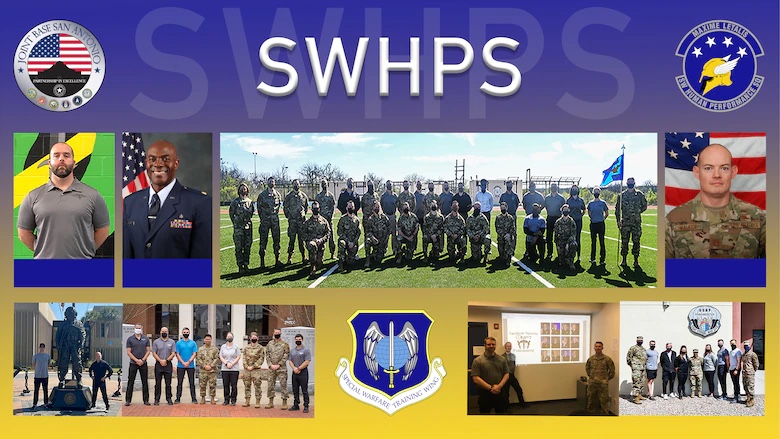
Members of the Special Warfare Training Wing provide initial training for all U.S. Air Force Special Warfare training AFSCs, to include, Combat Controllers, Pararescue, Special Reconnaissance, and Tactical Air Control Party Airmen.

To learn more about SR Airmen or other U.S. Air Force Special Warfare career opportunities, go to: www.airforce.com/careers/in-demand-careers/special-warfare.

Story by Nicholas J. De La Pena, Special Warfare Training Wing

AFRL Opens Research Altitude Chambers, Becomes Force in Aerospace Physiology

Wednesday, June 16th, 2021

WRIGHT-PATTERSON AIR FORCE BASE, Ohio (AFRL) – When Airmen are flying at 50,000 feet, they have to be prepared for every situation. And every piece of equipment that goes up with them must be able to function under the pressures of flight as well.

At the Air Force Research Laboratory, ensuring pilots, air crews, and all flight equipment can withstand various pressures, is one of the missions in the lab’s 711th Human Performance Wing, where research and aerospace medicine converge to enhance the performance and readiness of operational Airmen.

In order for these flying Airmen and their equipment to be ready, they must be tested against such pressures. Research must be conducted. Data must be collected. Training must occur. And all of this is made possible by AFRL’s human performance experts, in partnership with the Naval Medical Research Unit – Dayton, at Wright-Patterson Air Force Base with state-of-the-art facilities including NAMRU-D’s spacial disorientation device called the Kraken, AFRL’s human-rated centrifuge, and most recently added, the lab’s research altitude chambers, commonly known as the RAC.

On May 27, leadership and aerospace physiology experts from across the Air Force came together both in-person and virtually via Zoom in a ribbon-cutting ceremony to celebrate the opening of the RAC, a family of four computer-controlled altitude chambers.

“Aerospace physiology research and training, here in the RAC and in our other facilities, is essential to the readiness of our air crews and their missions,” said Darrell Phillipson, acting director of AFRL’s human performance wing, who presided over the ceremony. “Today, we are standing at the DoD’s epicenter of aerospace physiology research capability and expertise.”

But this convergence of expertise and facilities for aerospace physiology is anything but new. In fact, it’s been a plan for decades, growing and strategically relocating as technology has advanced.

Staff Sgt. Jonathan Rosales, the event’s master of ceremonies, discussed some of the history of how military scientists and researchers have provided the Air Force and sister services, including NASA, with groundbreaking research and training relating to the effects of weightlessness, pressure, altitude, temperature, acceleration and numerous other challenges that can arise in flight dating back as far as the late 1950s, decades before the strategic stand-up of the human performance wing in AFRL in 2008. He told the audience, which included Air Force Surgeon General Lt. Gen. Dorothy Hogg, Lt. Gen. Mark Ediger (ret.), AFRL Commander Maj. Gen. Heather Pringle, and AFRL Executive Director Tim Sakulich, among others, about the historical contribution to NASA with the development of space suits used by astronauts in the Gemini and Apollo programs.

As air frames and technology advance, so does research and training.  

“These four research altitude chambers will give us an unprecedented capability to test and gather data, ensuring the continued longevity of flight equipment, and providing us a more complete set of tools to measure the effects of altitude on our pilots and air crews,” said Phillipson. “And this larger family of test facilities, supporting labs, and world-class talent establishes AFRL, in partnership with NAMRU-D, as one of the most capable and functionally-equipped research centers in aerospace physiology in the world. These facilities ensure our air crews are ready now, and for whatever the future may bring.”

For additional information about the RAC and the capabilities of each chamber, click here. For additional information on AFRL’s centrifuge, click here. For information about NAMRU-D’s Kraken, visit here. For a quick recap of the RAC ribbon-cutting ceremony, click here.

By Gina Marie Giardina, Air Force Research Laboratory Public Affairs

Air Force Coins Official Maintenance Duty Uniform, Adds Immediate Wear of Tactical OCP Caps

Monday, June 14th, 2021

Air Force commanders of units with aircraft maintenance, industrial and other labor intensive Air Force Specialty Codes will have the option to authorize wear of a standardized, maintenance duty uniform, also referred to as coveralls, which may be worn on a day-to-day basis upon publication of the updated AFI 36-2903 anticipated for August 2021.

The career fields authorized to wear the MDU are: 2A, 2F, 2G, 2M, 2P, 2S, 2T, 2W, 3E, 3D, 1P.

“The MDU idea was presented to the 101st uniform board in November 2020 as a way to help increase readiness and timeliness from the work center to the flight line,” said Chief Master Sergeant of the Air Force JoAnne S. Bass. “We are hoping this change will instill a sense of culture and inclusivity for our maintainers who work to keep the mission going 24/7.”

When authorized by commanders, the sage MDU will be unit funded and members will wear the basic configuration consisting of a nametape, service tapes and rank along with the higher headquarters patch on the left sleeve and a subdued U.S. flag and organizational patch on the right sleeve. The coyote brown t-shirt, OCP patrol or tactical cap, coyote brown or green socks, and coyote brown boots, are worn with the uniform. The MDU will not be utilized for office work environments, non-industrial or non-labor tasking, but is authorized for wear when transiting from home to duty location and all locations on installations. It must be worn in serviceable condition. Local coverall variants are still authorized but only in work centers and on the flight line.

Tactical OCP Cap

Additionally, immediate wear of some tactical OCP caps is authorized while the Air Force continues the acquisition process to complete this new uniform item. These are not yet available through AAFES.

Current tactical OCP caps may be worn if they are made entirely of OCP material or OCP material with a coyote brown mesh back. No other colors or combinations are authorized. The Velcro or sew-on spice brown name tape will be worn centered on the back of the caps. The only item authorized for wear on the front of the cap is rank for officers.

Officers will wear either pinned, sewn or Velcro spice brown rank insignia centered ½ inch on the front of the cap on an OCP background. Air Force first lieutenants and lieutenant colonels will wear black rank. Velcro on the hat should not exceed the size of the insignia. Chaplains may wear the chaplain occupational badge sewn-on and centered ½ inch above the visor.

Enlisted members will not wear rank insignia or a subdued flag on the cap, only a name tape on the back of the cap is authorized. The front of the cap must not have any Velcro or other items.

In addition, females are authorized to pull their bun or ponytail through the back of the tactical OCP cap.

Once the acquisition process is complete for the new uniform item, which is expected to take approximately a year, all other caps will be unauthorized.

At this time, Guardians will adhere to the uniform standards of the U.S. Air Force until the U.S. Space Force develops its own policy.

Note: Theater commanders prescribe the dress and personal appearance standards in the theater of operations.

What Do You Call It?

Saturday, June 12th, 2021

Did you refer to the Standard Form 65-C (Large) as a Shotgun Envelope or Holey Joe?