FirstSpear

Archive for the ‘Air Force’ Category

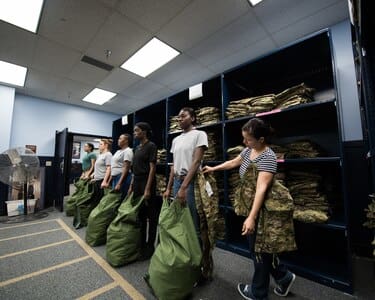
USAF Removes Uniform Barrier for Women, Authorizes Pants Option for Mess Dress

Saturday, August 8th, 2020

WASHINGTON (AFNS) — Based on overwhelming feedback from the field, Department of the Air Force officials announced today women may elect to wear pants or a skirt with their mess dress uniform.

The changes, which are effective immediately, are outlined in an exception-to-policy memorandum addressed to all Air Force personnel.

“It’s our responsibility to provide flexible uniform options that are functional and comfortable for all Air and Space Professionals,” said Lt. Gen. Brian Kelly, deputy chief of staff for manpower, personnel and services. “We have a lot of people working really hard to review our existing policies to make sure there are no unintended barriers or unfair practices that may be impacting specific groups of people on our team. We still have our work cut out for us, but this is a step in the right direction in creating an inclusive culture.”

Previously, women were required to wear a floor-length skirt with the mess dress uniform. As an interim solution, until women’s mess dress slacks are available for purchase in approximately 18-24 months, women are authorized to immediately purchase and alter men’s mess dress trousers.

Alterations for women opting to wear the men’s mess dress trousers will be provided by the Army and Air Force Exchange Service at no cost to the member.

“We hear you,” said Chief Master Sergeant of the Air Force Kaleth Wright. “This is a bit of good news for some of our teammates who’ve wanted this change for a while now. A small thing, but one that I hope can go a long way to helping Airmen realize that we listen, we hear and we care.”

Changes will be incorporated in the next update of Air Force Instruction 36-2903, Dress and Personal Appearance of Air Force Personnel. In the interim, for more information, the exception to policy memorandum and frequently asked questions are available on the public website of the Air Force’s Personnel Center at www.afpc.af.mil/Career-Management/Dress-and-Appearance.

The United States Air Force Awards Gentex Corporation Aircrew Laser Eye Protection (ALEP) Daytime Spectacle Contract

Monday, August 3rd, 2020

CARBONDALE, PA July 16, 2020 – Gentex Corporation, a global leader in personal protection and situational awareness solutions for defense forces, aircrew, emergency responders, and industrial personnel, announced today that it was awarded the United States Air Force Aircrew Laser Eye Protection (ALEP) Daytime Spectacle contract to develop and produce its laser protective eyewear for aircrew, the Block III Day Spectacle.

This order includes 10,000 Block III Day Spectacles over the next 18 months including development and full rate production. The Gentex lenses integrate the latest laser protective filter technology developed by the Air Force Research Laboratories (AFRL) for daytime applications. The lightweight, aviator-style frames fit comfortably on the face and feature contoured temple arms that integrate well with helmets and helmet components. The Gentex Block III Day spectacles joins our unique product line of other LEP spectacles developed for F-35, U.S. Navy EDU series and laser dazzle spectacles.

“With over 40 years of experience creating the highest quality vision protection for aircrew, this contract recognizes our continued innovation and evolution in the eyewear and visor market,” said Robert McCay, vice president at Gentex Corporation, “We’re proud to have won our second consecutive Delivery Order under Block III to develop products and technology that meet the challenges of ever-advancing technologies.”

Gentex’s portfolio of air products includes helmets, optical protection, respiratory, and situational awareness solutions. For more information visit, www.gentexcorp.com/industry-solutions/defense/air.  

Special Tactics Airmen Integrate Combat Capabilities During Exercise Commando Crucible

Monday, August 3rd, 2020

HURLBURT FIELD, Fla. (AFNS) —

Air Force special tactics teams provide a wide range of core responsibilities and combatant commands rely on ST operators to hone their skills long before arriving at a deployed location.

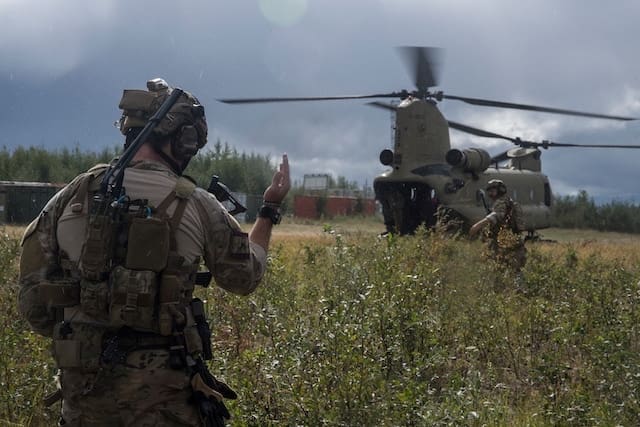
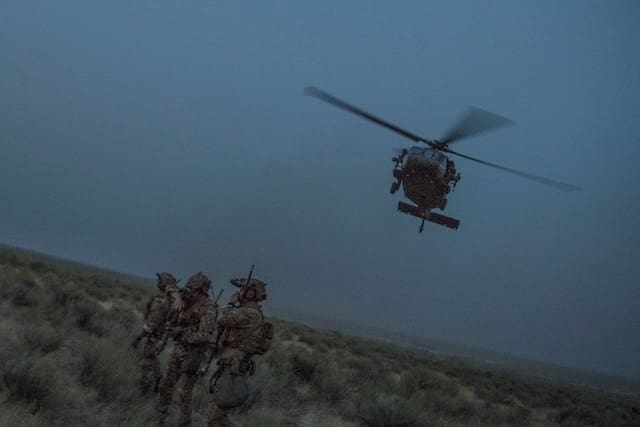
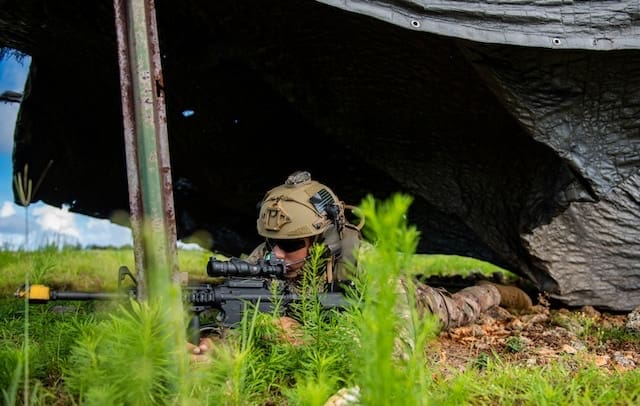
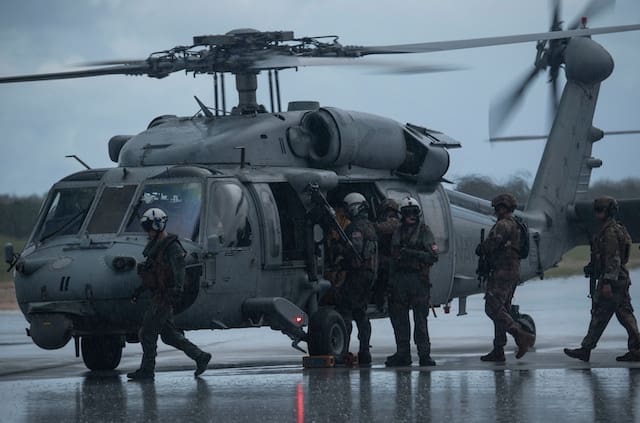
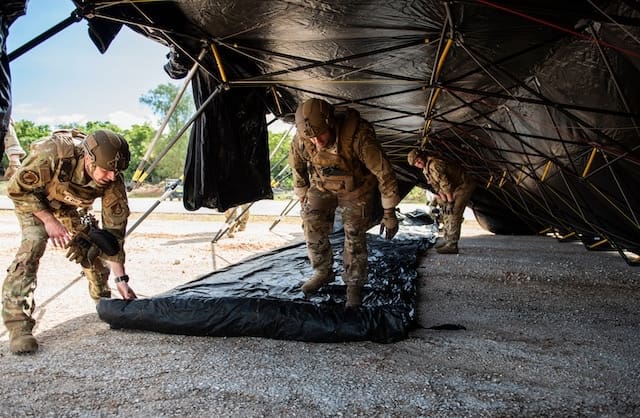
To meet the standards required for deployment, special tactics teams completed exercise Commando Crucible, from June 18-July 3, at Hurlburt Field and in Kinston, North Carolina.

“Despite logistical frustrations due to COVID-19 restrictions, the exercise allowed special tactics flights and attachments to conduct critical training on global access, precision strike, personnel recovery and foreign internal defense capabilities,” said a special tactics officer and lead planner for the exercise.

Special tactics operators led the training, which consisted of 253 participants and leveraged 40 aircraft from across Air Force Special Operations Command and Air Combat Command. One team of participants included members from the 53rd Air Traffic Control Squadron assigned to Robins Air Force Base, Georgia. The 53rd ATCS members played the role of a simulated host nation force and special tactics operators were responsible for training them on fundamental tactical skills and guiding them through a direct action training mission.

“The ST flights did a great job providing a plan of instruction in only three days to effectively integrate with the teams conducting the raids,” the special tactics officer said. “This is extremely realistic for a lot of the different partner forces we integrate with in deployed areas of operation.”

Col. Matt Allen, 24th Special Operations Wing commander, Col. Allison Black, the 24th SOW’s new vice commander and Chief Master Sgt. Jeff Guilmain, 24th SOW command chief, were present for portions of the exercise to observe the tactical units hitting their training objectives.

“We saw really well-rehearsed combat capability,” Guilmain said. “It was really valuable to watch how operators’ skills, both as individuals and as teams, have been refined over the months of training to provide incredible capability to the forward commanders. I’m glad we have that process in place where commanders can validate those capabilities and ensure readiness.”

Another critical readiness component teams were evaluated on was their ability to plan and carry out agile combat employment concepts. Special tactics forces have made this a priority in response to near-peer competition as well as AFSOC’s strategic guidance.

Special tactics operators traveled from Hurlburt Field to Kinston, N.C., to rapidly secure an airfield to use as a forward air refueling point, integrating combat Air Force assets such as F-15 Eagles, F-22 Raptors and AFSOC MC-130s.

“The ability for our aircraft to operate swiftly in contested areas improves U.S. Air Force lethality and presents strategic dilemmas for our adversaries. It also helps develop procedures to habitualize AFSOC and ACC units working together in support of the Air Superiority mission.” the special tactics officer said. “Overall, despite initial planning difficulties, the exercise execution went flawlessly and according to plan.”

Story by 1st Lt Alejandra Fontalvo , 24th Special Operations Wing

Photo by SSgt Rose Gudex

21st Special Tactics Squadron Recognized for Deployment Action in Fight Against Extremist Organizations

Saturday, August 1st, 2020

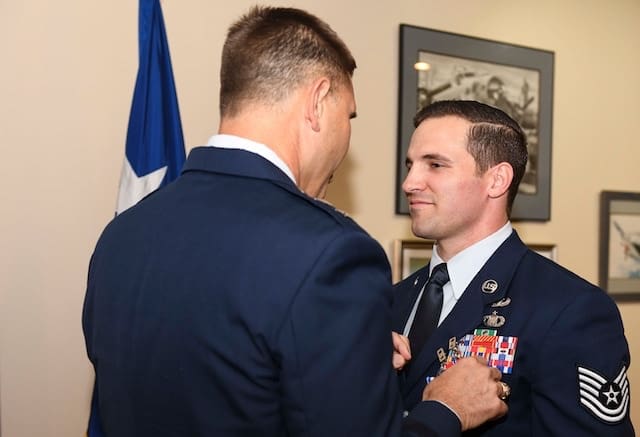
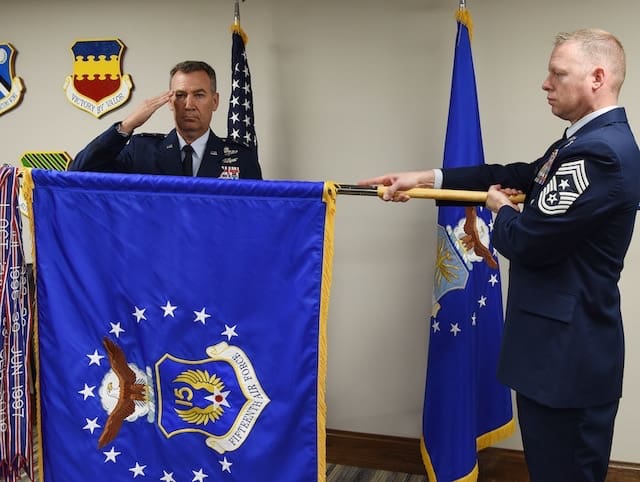
HURLBURT FIELD, Fla. – The 21st Special Tactics Squadron assigned to Pope Field, North Carolina gathered with family and friends July 24, 2020 to watch the presentation of over 90 awards for the squadron’s most recent deployment in 2019, battling six extremist organizations across three areas of responsibility.

“The majority of you would rather receive a decoration in your team room, your office or at home maybe, and not in public, but it’s important,” said Lt. Col. Randall Harvey, former commander of the 21st STS and ceremony speaker. “It’s important for you, because you need to understand that we know what you do and what you sacrifice. It’s important for your families because they need to know your stories. It’s important for Americans out there to know what other Americans are doing on their behalf. Finally, it’s important for those who have come before us and those who are no longer with us. We owe it to them to be here and be standing strong.”

The presentations started by recognizing the members of the squadron who deployed to Afghanistan in support of Operation Freedom’s Sentinel. The Special Tactics unit served as  primary tactical planners for infiltration, exfiltration, fires, as well as Intelligence Surveillance and Reconnaissance taskings in the execution of 241 direct-action raids during an especially “kinetic winter fighting season”. The team engaged in 235 firefights with hardened Taliban and ISIS-K fighters, controlled 4,985 aircraft, which conducted over 622 airstrikes on enemy targets, 235 of which were within  “danger close” range.  Their efforts removed 1,880 enemy personnel from the battlefield. Twelve Bronze Star Medals and four Bronze Star Medals with Valor were presented for actions contributed in this area of responsibility.

“In many ways it’s the greatest adventure to put yourself on the line… and step up when it counts the most,” said Harvey. “For some of you that line was a razor’s edge between life and death.”

In addition to the numerous precision strikes and direct action raids, the team made Special Tactics history by employing their leading global access capabilities. Specifically, one of the deployed teams single-handedly secured, established, controlled and commanded a mission support site during a 96-hour ST-organic and presidentially approved operation.

The squadron members deployed in support of Operation Inherent Resolve were also recognized for actions ranging from controlled fires, which put pressure on thousands of enemy fighters to surrender, to driving 190 joint and coalition missions and working with United Nations and Department of Defense partners to provide food and supplies to over 40,000 internally displaced citizens. Three additional Bronze Star Medals along with several Air Force and Army commendation medals were presented for OIR.

“You may not realize it, but you are the privileged ones,” said Harvey. “You are the privileged ones to have stepped into that arena and stepped on to the line when it mattered most. Many Americans will never know what that’s like.”

Lastly, a 12-person flight deployed to Africa was recognized for their integral role in building counter violent extremist capabilities with allied nations in Northwest and East Africa while navigating complex state and military systems to establish enduring Special Tactics-led foreign internal defense missions.

“In Africa, we partnered with key allies in Mali and Kenya, establishing new partnerships to integrate airpower into the ground scheme of maneuver… things no other [special operations force] can do out there,” said Harvey. “Our guys were on the ground day and night enhancing counterterrorism capabilities of these SOF units, while simultaneously reinforcing that the United States is the partner of choice in the region.”

The squadron’s Special Tactics leaders won approval from key Kenyan military leaders to craft and launch an air to ground integration training program for the Kenyan military, focused on improving tactics in the fight against Al Shabaab extremists. The program was deemed successful and sparked demand among Kenyan military and Air Force leaders for similar programs going forward.

“I want to say congratulations on a job well done,” said Harvey. “I’ll close with a quote from John F. Kennedy, he said ‘there are risks and costs to programs of action, but they are far less than the long-range risks and costs of comfortable inaction.’ Thank you for being men and women of action.”

Special Tactics is U.S. Special Operation Command’s tactical air and ground integration force, and the Air Force’s special operations ground force, leading Global Access, Precision Strike, Personnel Recovery and Battlefield Surgery operations on the battlefield. Since 9/11, Air Force Special Tactics operators have been involved in almost every major operation and have seen a significant amount of combat. It is the most highly decorated community in the Air Force since the end of the Vietnam War.

Massif Earns USAF Approval for Women’s-Fit 2-Piece Flight Suit for All Non-Ejection Seat Platforms

Tuesday, July 28th, 2020

Massif – a pioneer in making the best-fitting, best-performing apparel for all service members – gains new approval
 

ASHLAND, Ore. – July 28, 2020 – Massif, a world leader in flame-resistant clothing for the United States Military, today announced a new branch-wide approval from the United States Air Force for its women’s-fit 2-Piece Flight Suit for all non-ejection seat platforms.

This is further affirmation of Massif’s long-standing commitment to providing the best-fitting garments for all end users. Massif prides itself on purposeful clothing design with a high level of detail that syncs with the real-life needs of its end-user, for maximum performance in the field.

Over the last decade, there has been a steady growth of women in the military, particularly in aviation, with women making up 20.2% of the Air Force and 19% of the United States Navy (according to 2018 statistics). Massif recognized this growth early on and over the last several years has intentionally developed a line of women’s fit clothing that provides the best in comfort and performance for female service members.  

“We know that for a team to perform well, their gear needs to perform well.  That means optimal comfort and functionality for each specific individual on that team,” said Darci Knobel, Vice President of Customer Experience. “We have always been laser-focused on making sure our clothes fit and perform their best for all end-users and have made a concerted effort to be at the forefront of providing performance garments designed specifically for women. Today’s news is further validation of our commitment, having already received approvals from the United States Navy for the women’s-fit 2-Piece Flight Suit, and approvals from all branches, including the United States Coast Guard, for our women’s-fit base layers.”

Massif’s 2-Piece Flight Suit was designed from direct end-user feedback across multiple branches and platforms. Massif wanted to enhance the capabilities of the modern aviator and aircrewman with innovative design features unique to its garments. The original patented attachment system in the suit was built to allow flexibility and movement between the jacket and pant while still aiding coverage in flash events.

Massif recently launched a short documentary film in their Massif Film Series titled “Love the Mission,” highlighting Captain Lexi McRobert, Operations Officer, G/1-189 AVN. Captain McRobert is a great example of the company’s mission to design and develop garments for women who serve.

“The days of women having to wear men’s uniforms are over,” said Knobel. “The example of Captain McRobert in our latest short film is a great one. Like nearly every woman in the military, she was issued a men’s flight suit. Wearing our women’s-fit 2-Piece Flight Suit allowed her to feel and perform her best. We are proud to provide the option for all service members to have the best-fitting gear to keep going and perform at their highest level.”

For more information on Massif, visit www.massif.com, or see what the company is up to on Instagram and Facebook.

USAF Makes Badges More Identifiable On OCP Uniforms

Friday, July 24th, 2020

Name, rank, service and badges will be more identifiable on OCP

ARLINGTON, Va. (AFNS) —

Air and Space Professionals will soon be more recognizable in their Operational Camouflage Pattern uniforms.

OCP rank insignia, badges, name, and service tapes will now feature a lighter, three-color background pattern, versus the current seven-color pattern, to increase readability and ease rank recognition. 

“We received significant feedback that prompted this update,” said Lisa Truesdale, Air Force military force management policy deputy director. “The current rank insignia, badges, name, and service tapes on the OCP uniform are sometimes challenging to see against a seven-color background. Simplifying these features on a lighter, three-color pattern—while not compromising the overall functionality of the uniform—will improve our situational awareness in day-to-day interactions.”

The Air Force name and service tapes will retain their current spice brown letter stitching, while Space Force versions will still feature space blue stitching. Stitching for the Air Force rank insignia and badges will remain spice brown.

The Army and Air Force Exchange Service has already begun to transition inventories to the new three-color pattern name and service tapes. The Defense Logistics Agency is placing orders for the three-color pattern as seven-color backgrounds are phased out; some of the three-color insignia name tags should be in the inventory by Nov. 2020.

The U.S. Air Force Academy implemented the uniform change for the June 2020 class and Basic Military Training is on target for Oct. 2020.

The current seven-color background rank insignia, badges, name and service tapes are and will remain, authorized for wear.

By Secretary of the Air Force Public Affairs

DroneShield Announces USAF Contract Award

Thursday, July 23rd, 2020

DroneShield Ltd (ASX:DRO) (“DroneShield” or the “Company”) is pleased to announce that the United States Air Force (the “USAF”) has awarded DroneShield a contract to deploy multiple units of DroneShield’s DroneSentryTM integrated detect-and-defeat counterdrone (C-UAS) system at the Grand Forks Air Force airbase (in North Dakota, USA), protected by the 319th Security Forces Squadron of the USAF (the “319th SFS”). As part of the contract, the USAF acquired an option to acquire additional systems following the initial deployment.

The DroneSentryTM systems to be deployed feature DroneShield’s passive RfOneTM radiofrequency direction finding sensors, with a world-leading range for detection of small class 1 drones, combined with the Company’s DroneCannonTM fixed site electronic countermeasures systems. DroneSentryTM utilises DroneShieldCompleteTM user interface, an intuitive and feature-rich alerting, tracking and reporting software. The system will receive regular firmware updates, including the Company’s upcoming cutting edge Artificial Intelligence-based firmware rollout planned for late 2020.  

Oleg Vornik, DroneShield’s CEO, commented, “DroneShield was selected because our technology leverages Artificial Intelligence software and tracking/defeat automation that solves the 319th SFS problem statement (i.e. the requirements provided to the bidders on the contract) with little to no impact on manning.

This is DroneShield’s first U.S. Air Force deployment. We are immensely proud that the U.S. Air Force, one of the most demanding customers in the world, chose to deploy DroneShield’s flagship, fixed site detect-and-defeat system, incorporating our new RfOne MKIITM sensors. The USAF has a substantial requirement for the protection of its bases, in the US and forward deployments, and we look forward to continuing to support the service members and the expanded rollout of our solutions for their protection. In addition to our other recent work for the US military and government sector, a key market for us, the need for DroneShield’s industry-leading Counter-UAS solutions is expected to grow rapidly as global tensions continue to increase and the drone threat proliferates.”



For clarity, this announcement is not, and does not imply, a direct or an indirect endorsement of the Company’s products or services by any third party, including the U.S. Air Force.

First Munitions Squadron in AFSOC History

Sunday, July 12th, 2020

HURLBURT FIELD, Fla —

Formerly with the 1st Special Operations Maintenance Squadron, the munitions flight distinguished themselves as a new squadron in the 1st Special Operations Wing.

The 1st Special Operations Munitions Squadron activated July 8, 2020, and is the first munitions squadron in Air Force Special Operations Command history.

U.S. Air Force Maj. Clayton Seiler, commander of the 1st SOMUNS, assumed command after serving as the 7th Munitions Squadron commander at Dyess Air Force Base, Texas.

“Our role is to provide the best munitions support to our warfighters in the most efficient, effective and professional manner,” said Seiler.

1st SOMUNS Air Commandos build, collect, package and distribute munitions to the 1st SOW’s inventory aircraft, directly maintaining the readiness and lethality of the wing.

“There is a recognition for munitions being a unique skill set required for our mission,” said Seiler. “It also allows us to be a right sized squadron to focus on our Airmen and their families.”

The 1st SOMUNS is composed of four flights with more than 250 personnel, creating a separate squadron allowing focused leadership capable of being there for every Airman and their families.

“My family does so much to support what I’m doing here so I can focus and support our squadron needs,” said Seiler. “They’re my rock.”

Similar to Seiler’s family supporting him, he wants to create the same type of support within his squadron.

“We can make this squadron a culture and climate people want to be a part of,” said Seiler. “This is a great opportunity for everyone to make this squadron what they want it to be.”

Seiler’s first priority is to understand his Airmen, talk to his leadership team and build the squadron together.

“Our role is to support warfighters and ensure we provide them with everything needed to complete the mission,” said Seiler.

1st SOW aircraft are lethal because of the combat capability provided by the 1st SOMUNS.

“Without munitions, we would just have a fleet of airliners,” said Seiler.

By Airman 1st Class Blake Wiles, 1st Special Operations Wing Public Affairs