XC3 Weaponlight

Archive for the ‘C-UAS’ Category

DroneShield Expands Radar Interoperability with Robin Radar Systems

Thursday, March 19th, 2026

Sydney, Australia – 18 March 2026DroneShield (ASX:DRO), a global leader in counter-drone technology, today announced a partnership with Robin Radar Systems, strengthening advanced radar technologies to DroneShield’s growing sensor ecosystem. The interoperability expands radar options available to customers, strengthening layered airspace awareness across defense, critical infrastructure, and public safety environments.

Robin Radar Systems is recognized for its 360°, 3D radar technology designed to detect and track small airborne objects, including drones. Its radars are engineered to deliver reliable detection and classification performance across complex environments.

Image: Sample configuration of DroneShield’s DroneSentry layered defense with Robin Radar Systems

Expanding the Sensor Marketplace for Operators
DroneShield’s approach to counter-UAS is intentionally ecosystem-led. Rather than offering a closed or static solution, the company has invested in building a scalable marketplace of interoperable third-party sensors. This model gives operators the flexibility to select the right sensing technologies for their specific environment, threat profile, and operational constraints, both today and as requirements evolve.

By adding Robin Radar Systems to its ecosystem, DroneShield continues to expand the options available to customers seeking radar-based detection as part of a layered CUAS deployment. Radar can play a critical role in detecting and tracking airborne objects across wide areas and in challenging conditions, supporting persistent awareness and resilience.

At the center of this ecosystem is DroneShield’s DroneSentry-C2 powered by SensorFusionAI, which combines inputs from multiple sensor types to create a consolidated operational picture that reduces ambiguity and enhances decision confidence.

“Operators need systems that adapt to their mission, not the other way around,” said Angus Bean, DroneShield’s Chief Product Officer. “By partnering with Robin Radar Systems and expanding our sensor marketplace, we give customers more freedom to design their airspace security architecture, while SensorFusionAI ensures that all sensor inputs are fused into insights that support decisive action.”

Image: DroneShield’s DroneSentry-C2 brings together multiple sensors for a clear, single operating picture

Designed for Real-World Operations
“At Robin, we see ourselves as a new generation radar company – fast, adaptive, and built for integration. Our technology is designed to deliver seamless performance within broader security architectures. We’re pleased to be partnering with DroneShield to combine our market-leading IRIS 3D radar with their CUAS platform, enabling smarter, layered airspace protection worldwide,” said Marcel Verdonk, Robin Radar’s Chief Commercial Officer.

Robin Radar Systems brings decades of radar science and innovation to this partnership, delivering systems that are engineered for accuracy and optimized for modern CUAS challenges. This partnership ensures that operators no longer need to trade coverage for clarity. By combining complementary sensing technologies into a single, AI-enhanced platform, organizations can achieve both scale and understanding without increasing complexity.

JIATF-401 Hosts Industry Day to Strengthen c-sUAS Partnerships

Friday, March 13th, 2026

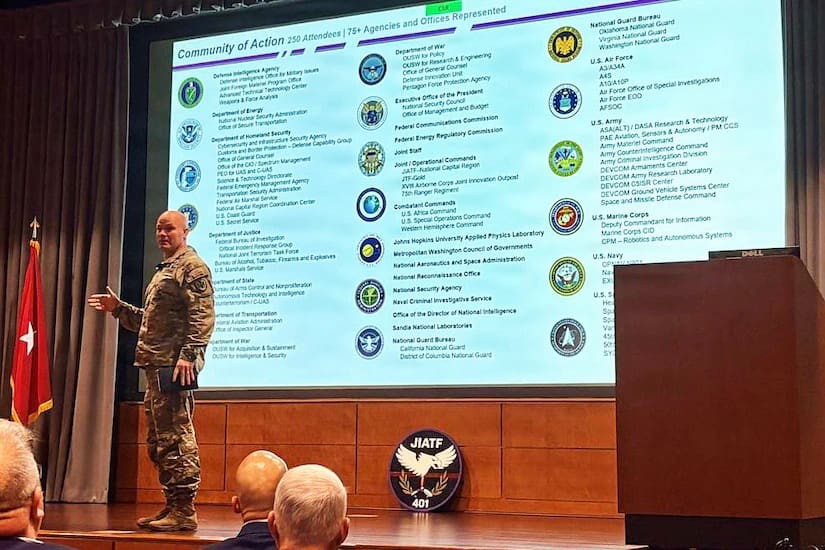
WASHINGTON — The Joint Interagency Task Force 401 (JIATF-401) hosted an Industry Day, bringing together representatives from industry and government partners to discuss collaboration and accelerate the development of counter-small Unmanned Aerial Systems (c-sUAS) capabilities at the Hilton Alexandria Mark Center, Alexandria, Va., on March 5, 2026.

The event provided a forum for JIATF-401 leadership to outline the organization’s mission, priorities and acquisition approaches while allowing industry partners to engage directly with government stakeholders on emerging technology and operational needs.

“I want you to know what we’re doing to make your products accessible to our customers and what we’re doing to expand that customer base so we can get greater depth in our industrial base,” said U.S. Army Brig. Gen. Matt Ross, Director, JIATF-401.

Ross highlighted how the accessibility and low cost of small unmanned systems have changed the security environment. Systems that were once limited are now widely available, allowing smaller groups or individuals to operate capabilities which previously required significant resources.

“What they’re concerned about is the proliferation of small unmanned systems that are inexpensive and give capability that was previously reserved for state adversaries to small groups and individuals,” Ross continued. “It’s not a new thing, but if you give them the ability to conduct some type of attack without fear of attribution or accountability, that changes the paradigm.”

He emphasized that industry feedback is necessary to address gaps in current systems and improve how c-sUAS technologies are integrated across the Department of War and interagency partners. He noted that companies frequently ask what standards or protocols their systems must meet to integrate with existing c-sUAS ecosystems.

“One of the things we want to do is change the way the department is thinking about counter-sUAS,” Ross said. “One of the ways we can incorrectly think about the problem is in how we manage risk or how we accomplish the mission. Instead of defeating the threat of a system, we have to think about the broader problem.”

This shift in thinking requires focusing on operational outcomes, rather than simply targeting individual systems and countering-small unmanned aircraft. It requires understanding how those platforms are used and how they enable broader mission effects. The growing complexity of the threat environment means there is no single system capable of addressing every scenario. Instead, organizations must rely on a layered approach that combines different capabilities to detect, track and defeat unmanned systems.

“I’m not asking for a 100 percent solution to defeat every drone – the silver bullet,” Ross concluded. “What we need is a layered defense: awareness, different capabilities and an ecosystem that works together so we can defeat threats consistently.”

Ross mentioned that continued collaboration between government and industry will be essential to developing those layered defenses and ensuring effective integration of c-sUAS technologies, supporting our warfighters at home and abroad.

By SGT Tien Dat Ngo

From IEDs to Drones – What the Dismounted Soldier Needs to Weather the Storm

Wednesday, March 11th, 2026

STORM 2 – C-UAS system for the dismounted soldier

At the turn of the century, remotely controlled IEDs littered routes and roadsides throughout Iraq and Afghanistan. These asymmetric and indiscriminate weapons exacted a devastating cost in human lives and, despite only costing hundreds of dollars to make, were capable of destroying military equipment worth millions.

The response to this threat was swift and decisive. The Joint IED Defeat Organization – stood up by US DOD in 2006 – had a singular mission: to defeat IEDs “as weapons of strategic influence.” Its approach spanned route clearance, persistent surveillance, forensic analysis of recovered devices to disrupt bomb-making networks, and the rapid procurement of blast-resistant MRAP vehicles.

Dismounted force protection methods and electronic countermeasures improved too, with manpack jammers creating protective RF bubbles around soldiers. These worked – but not without draining power, constraining movement and adding weight to already overburdened troops.

A new strategic reality needs a new standard for countermeasures

This tension between protection and performance defined the next phase of counter-IED systems. The requirement was no longer simply to jam more powerfully, but to protect more intelligently. Countermeasures had to become lighter, more efficient and more selective, reducing burden without impairing performance.

That requirement has only intensified. Twenty years on and today’s battlespace – denser, faster and more connected – demands something smarter and more discriminating in return.

“Dismounted soldiers increasingly face drone threats that are pervasive and persistent,” says Timothy Coley, Product Manager at Thales. “Whether it be a first-person view one-way attack drone or a munition-dropping drone, these threats keep heads on a perpetual swivel. The challenge is no longer just to shield a patrol from a single trigger – instead, countermeasures must be as agile and adaptive as the soldiers they protect.”

This new reality isn’t news to industry or militaries. Projects like Vanaheim, a British Army experimentation activity to understand the capability of relevant, reliable C-UAS solutions, come in response to the growing realisation of the threat and in anticipation of ever-shrinking countermeasure cycles.

The question now facing industry is whether the traditional rhythms of defence development – and the products they produce – can keep pace with a battlespace that waits for no one.

“When any hard-won advantage can be countered in a matter of weeks on the frontlines of Ukraine, the challenge for industry is to move faster – which includes adapting existing technology to address the very latest threats,” Timothy continues.

“We kept this tenet front-of-mind when we set out to rapidly develop STORM 2. Initially conceived as a counter-IED solution for dismounted soldiers, it has evolved to offer counter-UAS capability, allowing individual operators to disrupt RF?controlled drones. With a tenacious team of engineers, and a clarity of the operational need, we transformed the tech in a matter of weeks.”

Three key axes of countermeasure capability

When it comes to countering fast-moving aerial threats, Individual Electronic Countermeasures (IECM) – like STORM 2 – introduce a distributed protective layer that addresses the limitations of traditional ECM capabilities (weight; conspicuity; manoeuvrability).

Such countermeasures are soldier-centric and, as such, typically defined by three key axes of capability to keep individual operators protected: reactive jamming, frequency range, and power output.

“Reactive jamming doesn’t have the same power consumption and signature as an active jammer that’s sending out RF signals constantly,” says Timothy. “It’ll spring to life only when it needs to, saving battery life while keeping soldiers inconspicuous until the critical moment when the threat manifests.”

The wider the frequency range a device can operate across, the harder it is for an adversary to hop out of reach – while the higher the power output, the greater the chance of overpowering and jamming their signal entirely. However, a higher power output drains the battery quicker and makes the jamming signal more likely to be detected. As such, a fine balance is required to ensure an optimal solution.

Each axis is powerful on its own, but any capability that combines all three must balance Size, Weight and Power (SWaP) requirements to give dismounted soldiers an advantage while saving space for bullets, water and other mission-critical equipment.

Operational advantage depends on technological advancement

Where today STORM 2 offers reactive jamming across a wide frequency range, its architecture means it can be updated to deliver new functionality, from spectrum analysis and tactical electronic sensing through to signal characterisation.

“You’ll be able to ask and answer questions like: Have I detected a drone video transmitter or a combat net radio? What type of combat net radio might that be? Am I able to determine whether it’s running a frequency hopping cycle?

“You can start to peel back layers of detail about the kind of things that it might be detecting. Such insights can be critical, with every scrap of RF data able to provide a battlefield advantage.”

Capability must move at the speed of the fight

Relevant globally, the UK MOD has defined the problem in its most recent SDR.

“Drones now kill more people than traditional artillery in the war in Ukraine, and whoever gets new technology into the hands of their Armed Forces the quickest will win.”

“Behind all of the strategies and against an ever-evolving backdrop of threats is an unerring need: dismounted soldiers need capability (and capability development) that moves at the pace of relevance,” Timothy says.

“On a technical level, we reconfigured STORM 2 to offer C-UAS alongside C-IED such that it could respond to this new strategic reality. But we’re not done delivering. Technologically, it’ll need to evolve again and again if it’s to continue being useful to those who depend on it – and technology like it – for their survival.”

“After all, protection is no longer just about surviving the fight,” Timothy adds “It’s about understanding it, shaping it and thriving within it.”

STORM 2

Thales will be exhibiting STORM 2 at Future Soldier 2026. Visit us to learn more about our dismounted soldier capabilities.

Counter-Drone Training in Europe Equips US Forces for Evolving Threats

Wednesday, March 4th, 2026

GRAFENWOEHR, Germany — The senior enlisted advisor for Joint Interagency Task Force 401, Sgt. Maj. Kellen Rowley recently visited Germany to serve as the graduation speaker for the Joint Multidomain Counter-Unmanned Aerial Systems Course, or JMDCC.

The course, a U.S. Air Forces in Europe program executed with the support of the 7th Army Training Command, is at the forefront of developing joint service capabilities to counter the growing threat of unmanned aerial systems. This effort supports JIATF-401’s mission to provide counter-drone capabilities that protect U.S. personnel and facilities both domestically and internationally through a whole-of-government approach.

During his visit, Rowley observed the course’s culminating field training exercise, a rigorous 48-hour event that tested the skills of 22 U.S. Air Force, Army and Marine noncommissioned and commissioned officers. He also received a comprehensive overview of the course’s program of instruction and engaged with the 7th ATC leadership, which included a briefing on the Bumblebee training course, Test and Evaluation Center and the Warrior Unmanned Aerial Battalion.

In his remarks to the graduating class, Rowley emphasized the importance of taking proactive C-UAS measures at all echelons.

“The proliferation of UAS technology on the modern battlefield requires us to be agile and adaptive,” said Rowley. “We must ask ourselves: what are we doing to establish and rehearse our battle drills and SOPs at the small unit level? How are we integrating C-UAS into our collective training? The answers lie in the hands of talented and dedicated individuals like you… A vigilant and prepared force is the first and most effective line of defense.”

Highlighting the need for specialized skills, Rowley added, “We must actively identify talent within our ranks — the service members who possess the knowledge, capability, and desire to excel in this rapidly evolving space. They are the future of our C-UAS enterprise.”

Rowley noted the JMDCC’s platform-agnostic approach and focus on core competencies such as electronic warfare, sensor integration, and command and control. The three-week course is structured to provide a comprehensive learning experience, with one week of classroom theory, one week of practical exercises, and one week of lane training, culminating in the final FTX.

“The JMDCC is an excellent course that has intuitively set the standard for the train-the-trainer model we need across the force,” said SGM Rowley. “To my knowledge, there is no other C-UAS course in the department operating at this level of proficiency and realism.”

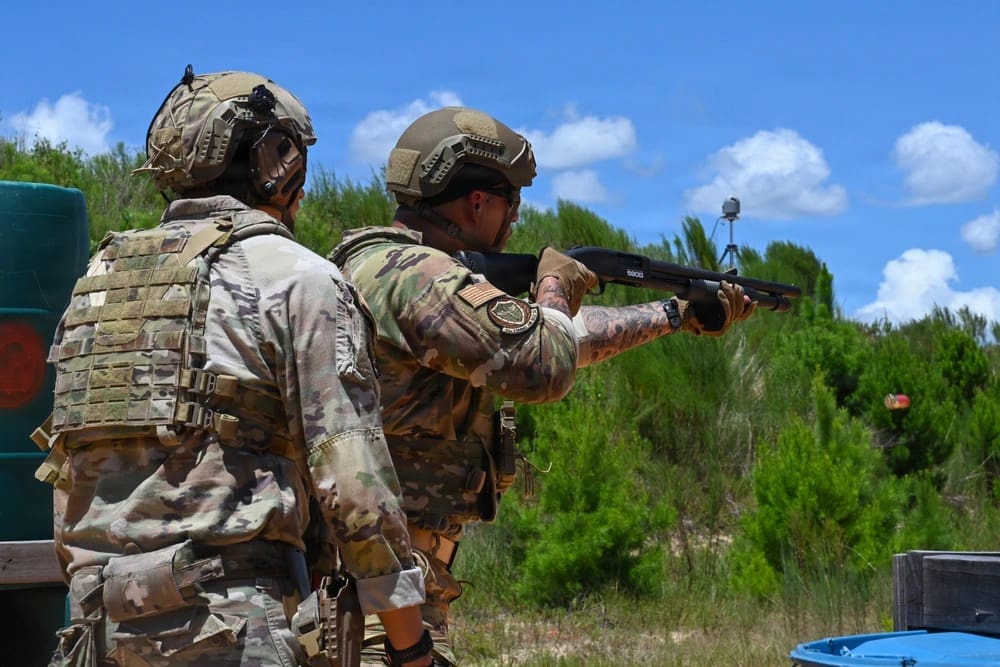
U.S. Soldiers, Airmen, Marines and Belgium Soldiers conduct weapons qualifications using the SMASH 2000 system during the Air Force’s Joint Multi-Domain Counter Unmanned Aircraft Systems Operator Course in the Grafenwoehr Training Area, Germany, Feb. 12, 2026. The U.S. Air Forces in Europe – Air Forces Africa assess the feasibility of expanding the Air Force’s Joint Multi-Domain Counter Unmanned Aircraft Systems Operator Course to a multi-service environment with the growing Unmanned Aircraft Systems threat. The 7th Army Training Command remains the premier location for U.S., NATO and partner testing, experimentation, readiness and interoperability. U.S. Army video by Sgt. Collin Mackall.

Story by COL Adam Scher

DroneShield Secures $21.7M Western Military Contracts

Friday, February 27th, 2026

Sydney, Australia – 26 February 2026 – DroneShield (ASX:DRO), a global leader in counter-drone technology, is pleased to announce that it has received a package of six standalone contracts for $21.7 million from an in-country reseller for delivery to a western military end-customer.

The contracts are for the supply of dismounted counter-drone systems, spare kits, and software subscriptions. All items are readily available from existing inventories and it is expected delivery will be made in Q1 2026, with payment expected in Q2 2026. No additional material conditions need to be satisfied.


Image: DroneShield RfPatrol Mk2

The reseller is a wholly-owned subsidiary of a multi-billion dollar, global, publicly listed company that is required to distribute the products to the western military end-customer. Over the past seven years, prior to this contract, DroneShield has received 39 contracts from this reseller totalling over $17.8 million.

Epirus, Digital Force Technologies Partner to Develop Non-Kinetic Counter UAS Kill Chain

Friday, February 27th, 2026

Los Angeles & San Diego, Calif—February 23, 2026Epirus and Digital Force Technologies (DFT) have partnered to deliver a fully integrated counter-UAS kill chain unifying the companies’ respective technologies for detection, tracking, identification, localization and non-kinetic, low collateral defeat of unmanned aerial systems (UAS) threats.

Under the agreement, Epirus will lead systems integration of DFT’s Seraphim command-and control and multi-modal sensor fusion software with Epirus’ Leonidas high-power microwave (HPM) platform for critical point defense.

Epirus’ Leonidas high-power microwave is a proven non-kinetic counter-UAS solution that  leverages electromagnetic interference to defeat swarming, AI-controlled and fiber-optic guided UAS that can evade legacy electronic warfare tactics. The Leonidas platform emits precise  electromagnetic interference to disable the critical electronics onboard a drone, neutralizing the  threat. Using software-based, operator-defined safe zones, Leonidas provides a scalable, high precision and low-collateral counter-UAS capability. The platform defeated a 49-drone swarm simultaneously with a targeted burst of electromagnetic interference at a 2025 live-fire demonstration.

DFT’s Seraphim software platform and counter-UAS Family of Systems deliver autonomous  tracking and identification of UAS threats in complex operational environments. Trusted to support  critical missions worldwide, Seraphim is built on a modular, scalable architecture that remains  sensor- and effector-agnostic, enabling rapid integration of best-in-class capabilities. Seraphim  combines sensing, decision support and effects coordination through a unified operational  interface. By fusing data in real-time and autonomously prioritizing threats, the platform enables  operators to move from detection to response with speed and precision.

“Leonidas was designed to maximize interoperability with partner technologies,” said Andy Lowery, Epirus CEO. “This collaboration marries our systems integration and swarm defeat  expertise with DFT’s edge processing and automation knowhow to deliver exactly what our  customers are asking for: a flexible, adaptable and fully integrated counter-UAS kill chain for critical point defense missions.”

“Integrating Seraphim with Epirus’ Leonidas high-power microwave platform extends AI-enabled  decision making through the defeat layer of the counter-UAS kill chain, delivering a turnkey detect to-defeat capability,” said Justin MacLaurin, Digital Force Technologies CEO. “This partnership  reflects a shared commitment to scalable, interoperable systems that give operators faster, more  effective solutions to defeat evolving drone threats.”

The companies will partner on U.S. government demonstration activities and are expected to  present their full counter-UAS kill chain solution later this year.

Eyes on the Horizon: Honing Counter Drone Skills in Eastern Europe

Friday, February 27th, 2026

Download the full document here: No. 26-1120, Eyes on the Horizon: Honing Counter Drone Skills in Eastern Europe (Feb 26) [PDF – 2.9 MB]

“In a situation where seconds determine survival, C-sUAS training isn’t just preparation, it’s a measurement of readiness. We must be ready to counter the evolving threat of unmanned systems…to dominate the skies.”

– 173rd IBCT (A) UAS subject matter expert.

Introduction

Observations from the Russia-Ukraine War have revealed emergent tactics, techniques, and procedures (TTPs) in the employment of small-unmanned aircraft systems (sUAS), which have proliferated across the battle space. Russian sUAS have become a significant and persistent factor in protection considerations for Eastern European nations, particularly bordering Ukraine. The rapid employment of sUAS compresses the decision-making cycle to mere seconds, rendering traditional centralized air defense approval processes ineffective at the tactical edge. Consequently, the training environment in future U.S. Army Europe and Africa exercises must replicate the compressed decision cycles and complex threat environments seen in Eastern Europe, ensuring tactical leaders have both the tools and the authority to act decisively.

Numerous drone incursions from the Russia-Ukraine War have spilled over into neighboring countries. These incursions have heightened concerns over unexploded ordnance (UXO), particularly in Moldova’s southern regions: Cahul, L?pu?na, and Tighina which are near the Ukraine border. UXO threats in these regions raise concerns about public safety and regional security. These challenges and concerns are not unique to Moldova but are prevalent across NATO’s Eastern Flank Deterrence Line, underscoring the need for enhanced counter small-unmanned aircraft systems (C-sUAS) capabilities and regional collaboration. This publication provides insights on how U.S. Army Europe and Africa (USAREUR-AF) units plan and execute C-sUAS training along with lessons learned from exercise Fire Shield ’25 executed in Moldova in August 2025.

Background

USAREUR-AF leadership plans to conduct C-sUAS activities in exercises to build readiness with subordinate units, integrate emergent technologies, and exchange best practices with Allies and partners. However, host nation legal frameworks governing radio frequency (RF) jamming often constrain full replication of real-world, non-kinetic defeat operations across many established training areas in Western Europe during peace time. Partner nations, like Moldova, that formerly belonged to the U.S.S.R., are optimum locations to conduct C-sUAS training because of drone incursion threats that bleed over from the Russia-Ukraine War. These threats have created a regulatory environment that allows C-sUAS equipment to operate and a host nation appetite for electronic warfare (EW) focused training. As a result, the 173rd Infantry Brigade Combat Team (Airborne) partnered with the 2nd Moldovan Brigade to conduct C-sUAS training as part of the Moldovan annual exercise Fire Shield ‘25 from 4-14 August 2025 at the Bulboaca Training Area in Moldova.

By CPT Madison Fuentes, CPT Saundra Johnson, Scott Safer, Samuel Flaming

DSTG and DroneShield Sign Bilateral Collaborative Research Agreement to Advance Counter-Drone Technology

Thursday, February 26th, 2026

Sydney, Australia – 26 February 2026 – DroneShield (ASX:DRO), a global leader in counter-drone technology, today announced the signing of a Bilateral Collaborative Research Agreement (CRA) with the Australian Department of Defence (Defence), through the Defence Science and Technology Group (DSTG), to strengthen Australia’s capability in counter-drone technology.

The agreement establishes a framework for sharing data on emerging drone technologies and access to either parties test articles, ranges and facilities. This collaboration will leverage DSTG’s scientific expertise and DroneShield’s industry-leading counter-drone technology to ensure both organisations continue to deliver world-class solutions to emerging threats posed by new drones.

DroneShield has also announced the establishment of a $13 million R&D Hub in Adelaide for counter-drone technology, strategically located to enable closer collaboration with Defence and DSTG. This investment complements DroneShield’s previous R&D collaborations, such as with the DSTG-supported Defence Innovation Network that helped develop DroneOptID, DroneShield’s optical system for detection, identification and tracking of fast-moving drones.


Image: A new partnership between DroneShield and DSTG will establish a framework for sharing data on emerging drone technologies

Angus Bean, Chief Product Officer of DroneShield said, “This agreement represents an important step in advancing counter-drone technology not only for Defence but for DroneShield’s end-users globally. Working closely with DSTG allows us to combine our practical experience with their research expertise to deliver innovative solutions that meet the evolving needs of the Australian Defence Force.”

The collaboration will focus on emerging drone technologies through sharing data, test articles and conducting collaborative test programs to drive innovation areas that enhance detection, tracking, and neutralisation of unauthorised drones, supporting Defence and industry efforts to safeguard Australia’s security in an increasingly complex operational environment.

DSTG’s media release including quotes attributable to Chief Defence Scientist Prof Tanya Monro may be viewed at: defence.gov.au/news-events/releases/2026-02-25/australia-accelerate-counter-drone-research-droneshield