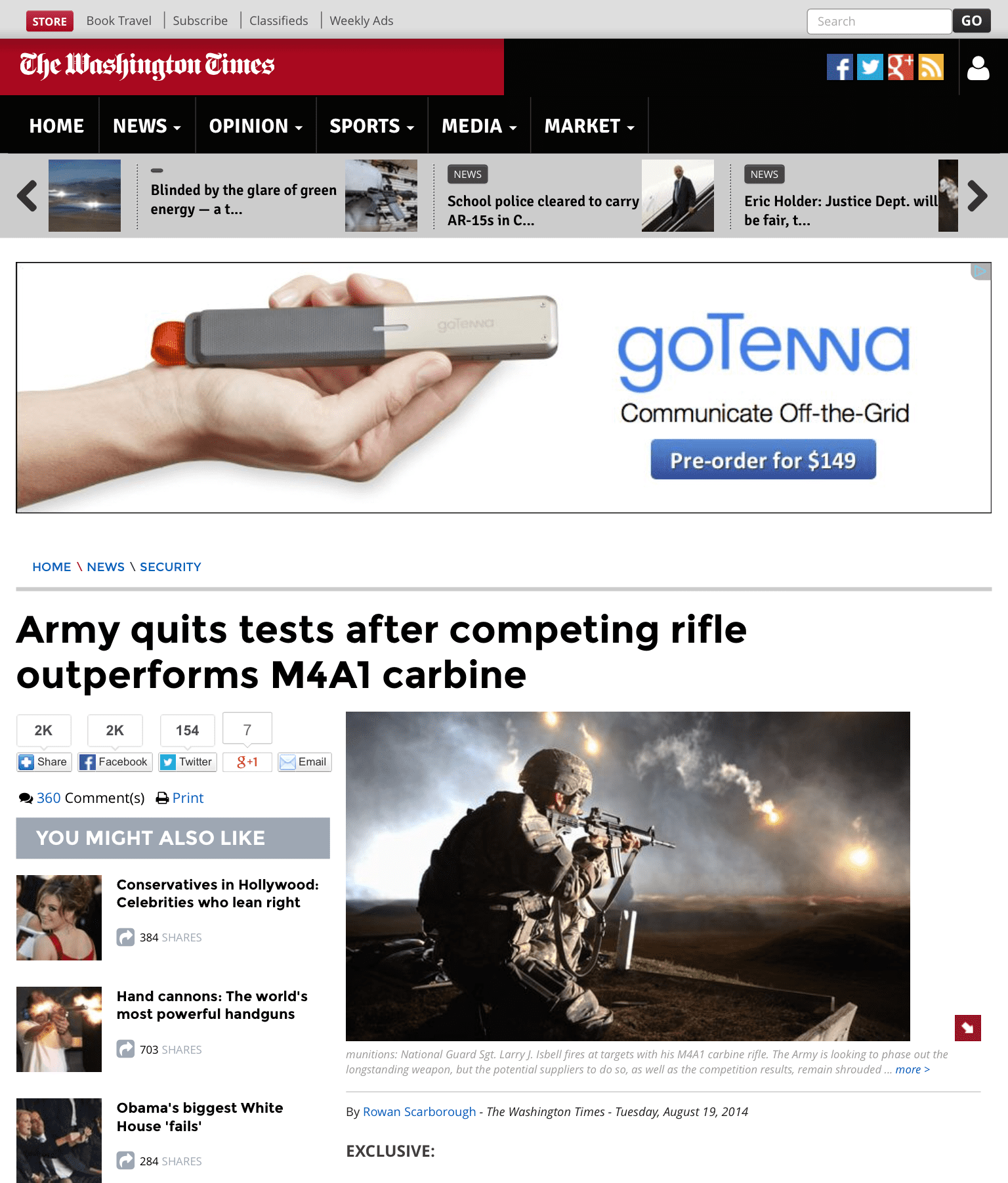
Our official response to the Washington Times article entitled “Army quits tests after competing rifle outperforms M4A1 carbine”?
“Derp”
That is all…


Our official response to the Washington Times article entitled “Army quits tests after competing rifle outperforms M4A1 carbine”?
“Derp”
That is all…
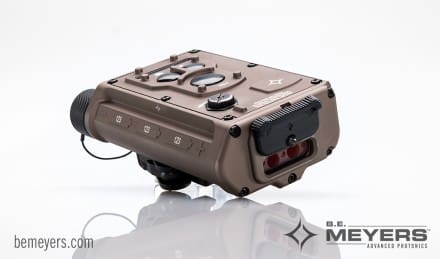
June 16, 2014 (Redmond, WA) – B.E. Meyers & Co. Inc. is proud to announce the United States Marine Corps Systems Command (MARCORSYSCOM) has awarded them a contract for the GLARE RECOIL (http://bemeyers.com/product/glare-recoil/) in support of the Ocular Interruption (OI) Program. The GLARE® RECOIL joins the established GLARE® product line of non-lethal green lasers that have helped evolve escalation of force protocols over the last 10 years. With over 36,000 hail and warning lasers fielded since 2004, the GLARE® product line is the most widely deployed system in service across the DoD.
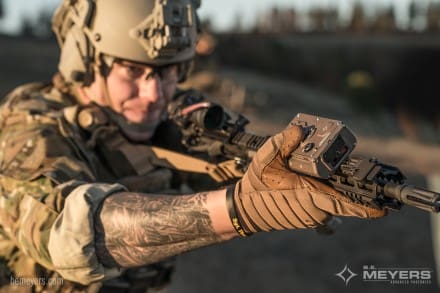
MARCORSYSCOM met with B.E. Meyers & Co. Inc. in Redmond, WA last week to discuss future deliveries and technology advancements by B.E. Meyers & Co. as part of the official post-award conference.
“B.E. Meyers’ reputation as a technology innovator and industry leader in non-lethal laser capabilities now benefits the Corps, and we are proud to be able to provide to them with the appropriate equipment to meet the challenges of the modern battlefield”, said Mike Alvis, CEO of B.E. Meyers & Co. Inc. “The GLARE series of products have a proven track record of helping determine threats on the battlefield as well as saving lives. The GLARE® RECOIL will provide U.S. Marines in convoys, checkpoints, and during port security operations with the best technology available to ensure the safety of the Marine on watch as well as the host-nation populace.”

In 2011, B.E. Meyers & Co. Inc. was awarded the contract for the Army’s Green Laser Interdiction System (GLIS) Program through PEO Soldier as well as multiple other deliveries to all branches of the U.S. Military. The GLARE® RECOIL joins the GLARE® LA/9-P, GLARE® MOUT Plus, GLARE® MOUT, GLARE® Enforcer, and GBD-IIIC family of combat-proven green laser ocular interruption devices.
MARCORSYSCOM in Quantico, VA is the procurement entity for the United States Marine Corps non-lethal capabilities, and will service the requirements of this program with B.E. Meyers & Co. Inc. to the greatest benefit of the U.S. Government, the Corps, and the Marine in the fight. The Ocular Interruption (OI) System solicitation number is M67854-13-R-1040.
Back in July of 2012, Project Manager Soldier Weapons released a Sources Sought Notice for a Compact Semi-Automatic Sniper System, by conducting a “market survey to identify potential sources for manufacturing a complete system or reconfiguring some or all of the existing 7.62 x 51mm M110 Semi-Automatic Sniper System (SASS).”
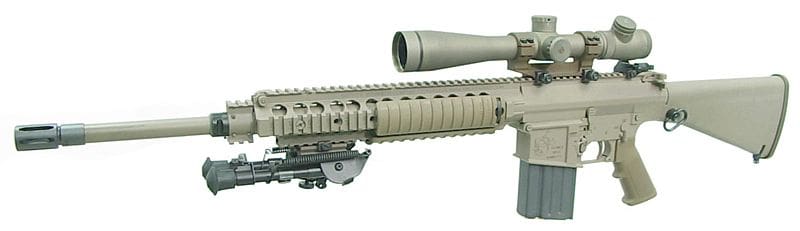
Manufactured by Knights Armament, the current M110 is a lightweight, direct gas operated, semi-automatic, box magazine fed, 7.62 x 51mm rifle intended to engage and defeat personnel targets out to 800 meters.
After an initial RFP released back in November 2012, the wait is finally over: PM SW has released a finalized Draft Request for Proposals.
The details are as follows:
The Army Contracting Command – New Jersey (ACC-NJ), on behalf of Project Manager Soldier Weapons (PM SW), intends to award a single Indefinite Delivery/Indefinite Quantity (IDIQ) contract with Firm Fixed Price (FFP) Delivery Orders. This requirement will be solicited as Full and Open Competition. The minimum ordering obligation is thirty (30) CSASSs to be used for Production Qualification Testing/Operational Testing (PQT/OT). The period of performance for the base contract will be twelve (12) months for PQT/OT. Option one (I) will permit the Government to order production of systems, which will be the quantity of CSASSs needed to match the current M110 Army Acquisition Objective of no more than three thousand, six hundred forty three (3,643). Option one (I) will also include spare parts, depot support, first article testing, and Instructor and Key Personnel Training (I&KPT). Congruently, option one (I) will create five (5) – one (1) year ordering periods with Firm Fixed Price (FFP) delivery orders. Option two (II) is for the purchase of a technical data package (TDP) and Government Purpose Rights (GPR). The Government does not anticipate placing delivery orders beyond the PQT/OT quantities (30 ea) until the successful completion of Milestone C/Type Classification-Standard.
Offerors looking to compete in this requirement have the option to submit no more than two (2) proposal(s) to acquire a new system or to retrofit the existing M110 SASS. The contractor shall manufacture, produce, and support the CSASS. The contractor shall provide for all necessary labor, material, supplies, services, facilities, and equipment to perform the requirements of the Statement of Objectives (SOO) in Section C of the formal Request for Proposal (RFP).
The CSASS is intended to more effectively execute a broad spectrum of missions than the M110 Semi Automatic Sniper System (SASS). The CSASS will provide the following upgrades: improved reliability, improved accuracy, and improved ergonomics; reduced weight and length; advanced coatings; improved optics; reduced felt recoil; enhanced suppressor performance; enhanced modular rail capabilities; an improved bipod, trigger, pistol grip, and buttstock.
www.fbo.gov/index?s=opportunity&mode=form&id=7474a989b4929cfe52783861999d051a&tab=core&_cview=1
I’ve known Jonathon Douglas (JD) Long for several years. Originally written for his blog, this piece is based on some DAU material along with additional amplification based on his experience. I asked him if I could share it here in SSD as it’s always good for industry to see an insider’s perspective regarding contracts. For those of us that aren’t contracting professionals or members of industry, it’s a great learning opportunity. Thanks Jonathon!
From the Defense Acquisition University we are reminded about the “Ten Commandments of Effective Contracts.” Although seemingly simple and straightforward, the Ten Commandments could be a great facing page for any acquisition professional creating or responding to DoD procurement efforts.
1. “Read the contract.” That includes reading the request for information, request for sources sought, request for bid and or proposal (RFB/RFP) and responses to contractor questions after a RFB/RFP has been published. That means everyone on the source selection panel must read the contract and associated requirements documents before initiating a source selection. that means that industry should read their bid proposal along side the RFB/RFP to ensure they have answered all the government’s information requirements.
2. “The contract is interpreted as a whole.”
3. “Only the Contracting Officer may change or agree to changes in the Contract.” So to my colleagues in industry, it doesn’t matter what the helpful contract specialist or the quality assurance representative agreed to, until that agreement is institutionalized as an amendment to an RFB/RFP or a modification to a contract – its doesn’t count (meaning not legally sustainable). Remember – proposal requests are amended and contracts are modified.
4. “Requirements or material changes must be approved and documented.” While it might be acceptable following contract award and early in the spin-up towards manufacturing; to place advanced orders for material changes – you must follow-up quickly with the Contracting Officer (KO) in writing to describe what those changes are and which government official directed you to make that change. This ensure that the KO will follow-up with a signed modification as documentation. Don’t move forward and invest significant sums or manufacturing change plans until you have the signed modification in hand.
5. Approved and documented requirements take precedence over verbal requests.” See my comment above in number 4.
6. “No funding means no requirement.” Note to business developers – unless your customer has a validated requirement and associated funding, you don’t have real future business. The government cannot award a contract without a validated requirement and a valid funding Line of Accounting – not going to happen. This brings about the discussion on how best to meet future government needs. I have experienced two strategies: (1) Anticipate government requirements early on as described in some Advanced Planning Brief to Industry document or a Preplanned Product Improvement with the advantage being that both have an initial requirement concept in mind and likely some funding, or (2) “Build it and they will come” strategy. I believe that there was much more room for strategy (2) over the last twelve years of constant combat when the military services (mainly ground combat forces) refreshed much of their basic equipment, were open to new concepts and were well funded. However, I do not believe that this trend is continuing and with the draw-down in Afghanistan and US combat operations ending in 2015, I think focusing on existing requirements or incremental improvements is a more sustainable business development approach. I have heard the term “cost neutral improvement” several times.
7. “The contract schedule takes precedence over the contract clauses.”
8. “Contract clauses take precedence over the other documents, exhibits and attachments.” The contract clauses flow from the Federal Acquisition Regulation (FAR) and contain statutory language and direction that cannot be overwritten by a text narrative to do something otherwise. In reference to specifications – according to the uniform contract format, specifications are last in the order of precedence following documents, exhibits, and attachments (see commandment 9. below).
9. “Other documents, exhibits and attachments take precedence over the specifications.”
10. “Plain English takes precedence over technical language. Ambiguous language is interpreted against the drafter.” Now while I am not exactly sure about the practical application I believe this is similar to the baseball analogy that “tie goes to the runner!”
Now if we can just get the total solicitation page count decreased and the contract award cycle time faster, we would be doing great!
GREENSBORO, NC, May 30, 2014 — Burlington Industries LLC, a division of International Textile Group (ITG), announced today it has been awarded a $2.2 million contract to supply micro denier polyester fabrics to the U.S. Marine Corps for use in their physical training (PT) shorts. These fabrics will be produced at the company’s facilities in Cordova and Burlington, North Carolina.
These advanced woven 100% micro denier polyester fabrics are part of Burlington’s MCS® family of performance fabrics. These lightweight fabrics are breathable and have inherent moisture management properties. Using Sorbtek® fiber technology made by Unifi, Burlington’s MCS® fabric works by absorbing moisture, moving it away from the skin, and releasing it on the surface of the fabric for quick evaporation. This allows the wearer of the shorts to remain cool, dry and comfortable. In addition, Sorbtek® fiber provides inherent soil release properties to protect the fabrics against everyday soils, like sweat and grass.
“We are focused on producing a variety of advanced fabrics that support and further the efforts of our U.S. Armed Forces,” said Burlington President Jeff Peck. “Our MCS® technology is the performance foundation of the U.S. Marine Corps general purpose trunk and provides our Marines the physical training apparel that can withstand the rigors of Marine use.”
Burlington has been an integral part of the defense supply chain for more than 50 years and is uniquely positioned as one of today’s most diversified R&D centers for performance and technical fabrics for the military. “We continue to explore new opportunities to equip and protect our U.S. Armed Forces,” said Peck. “Our products range from basic innovations that elevate the performance of PT, battle and dress uniforms to the newest advanced technologies in infrared, insect repellant, cold weather, fire, and battle protection.”
Several years ago, to expand its military business, ITG combined the resources from four of its business units, Burlington, Safety Components, Narricot, and Carlisle, to create an extensive military products platform of diversified fabrics developed to service the specific needs of the military market. Products include fabrics for camouflage combat and utility uniforms, Class A dress uniforms, physical training and extreme cold weather wear, flame resistant and fire fighting protective clothing, high performance equipment, ballistic fabric and webbing for body armor and load carrying equipment, and other specialty items.
Burlington has been awarded a total of eight military contracts over the past 12 months totaling more than $238 million over a five-year period. Awards include dress uniform and physical training uniform fabrics for the U.S. Air Force, U.S. Marine Corps and the U.S. Navy.
www.itg-global.com/companies/bww_apparel
From the outset, I have to say that technically, the Army is just looking for a new fabric, as there has been no talk (at least publicly) about developing a specialized uniform layout for tropical environments. However, in addition to a new jungle boot that we talked about last week, Natick has released a Sources Sought Notice entitled, “Light Weight Tropical Uniform“. This is excellent news.
To read the meat and potatoes of what the Army is looking for, see it here at RFITropWeight.
This is an interesting move as it is an admission that the current fabric used in the ACU, a 50/50 NYCO or nylon/cotton blend adopted for the Enhanced Hot Weather Battle Dress Uniform in the early 90s isn’t really much of a tropical weight fabric. Prior to this, Hot Weather BDUs were made from a 100% ripstop cotton fabric. This came about as the Army “rediscovered” the need for a tropical weight version of the BDU during the invasion of Grenada in 1983. The Army had begun fielding the Woodland camouflaged BDU, made from a heavy, 50/50 nylon/cotton twill in 1981. Designed for use in central Europe, they were too hot for hot weather use. However, the comfortable, quick drying, 50/50 NYCO poplin fabric of the HWBDU was to be replaced within a decade.

By the early 90s, a serious garrison mentality had taken hold in the US Army. Soldier were starching their HWBDUs and the process was wearing them out rather quickly, with fraying at the cuffs and collars in as little as six months. Instead of telling Soldiers to stop starching a uniform fabric optimized for tropical environments, the Army introduced a new fabric that would be more durable when starched and pressed under high heat. Unfortunately, this 50/50 NYCO fabric compromise fabric isn’t so great in the hot weather environments the uniform was intended for. The nylon content lowers breathability, making the fabric feel warmer. Operational capability was abandoned in favor of looking good in garrison. When the ACU came along, the Army incorporated that same 50/50 NYCO poplin fabric. Now that the Pacific Pivot is in, and the Army is scrambling to recreate capabilities like the jungle boot that it had abandoned years ago, it has dawned on somebody that they can find a better fabric solution and I am glad.
Granted, the Universal Camouflage Pattern is an issue in the jungle and Woodland EHWBDUs are will in use by some Army SOF and students at the new US Army Jungle School in Hawaii. Hopefully, the Army will work out a solution for this dilemma. But, we can always look back to a simple solution fielded during the Viet Nam War.
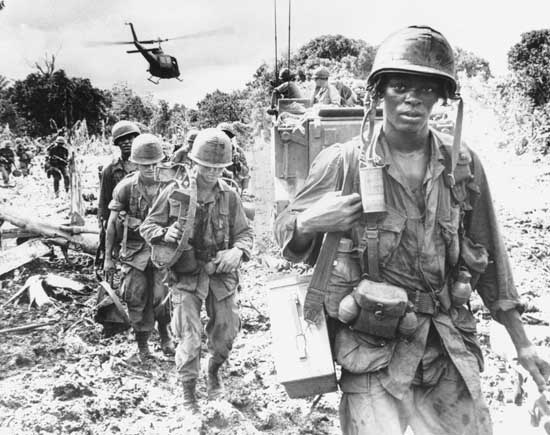
I’ve called it “The Greatest Uniform Ever Fielded By The US Army” and in my opinion, the OG-107 Jungle Fatigue in 100% ripstop cotton remains just that.
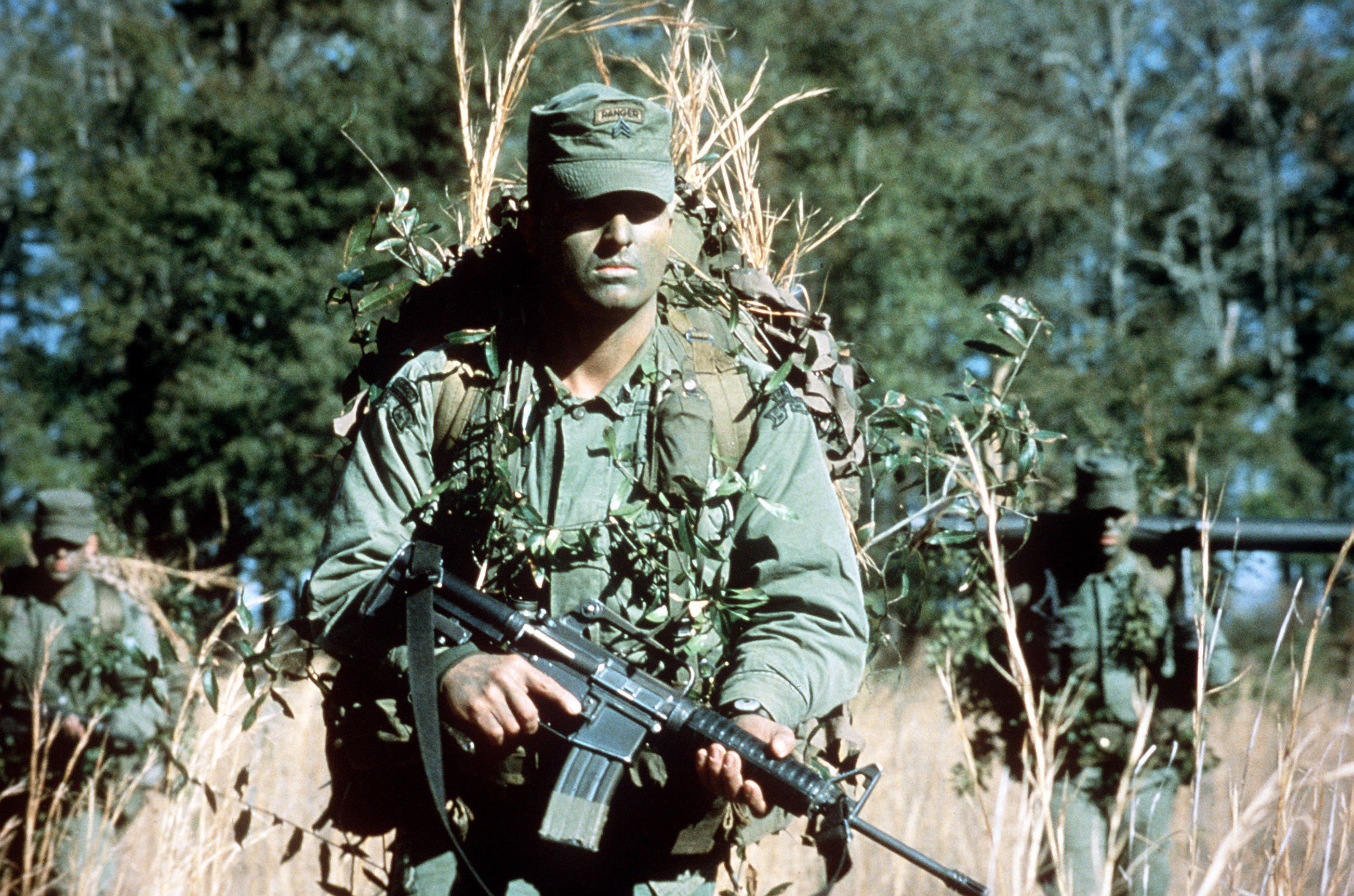
In fact, this uniform, as well as the ERDL camouflaged variant, continued to be worn well into the late 80s by Special operations Forces.
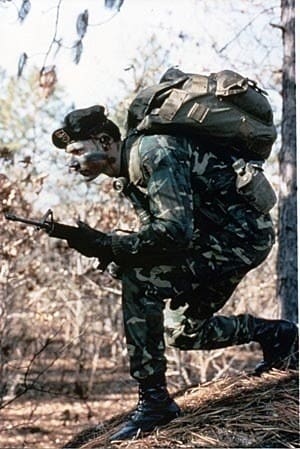
Rightfully so, the Army is looking, at a minimum (threshold), for a no-drip, no-melt solution fabric story. Naturally, if the star’s aligned (object) they’d like a full FR solution, although this is probably overkill considering the operational environment.
If you’ve got something that you think will work, the Army needs to hear from you by 1200EST on 08 May 2014. They’ll also need 5 yards of fabric (any color) and a the usual slew of technical data. Make sure you read the details in the amendments. The Army is going to use this data to help scope an actual requirement, making this is a very important part if the process.
With so much development in the textile industry over the past 10 years, here’s to hoping that the Army identifies a fabric optimized for use in hot-wet environments.
If you’re a Pre-9/11 Veteran, the old, green, issue jungle boot holds a special place in your heart. After over 12 years at war, the Army not only abandoned the design that served us for almost 40 years but seems to have forgotten it ever issued them.
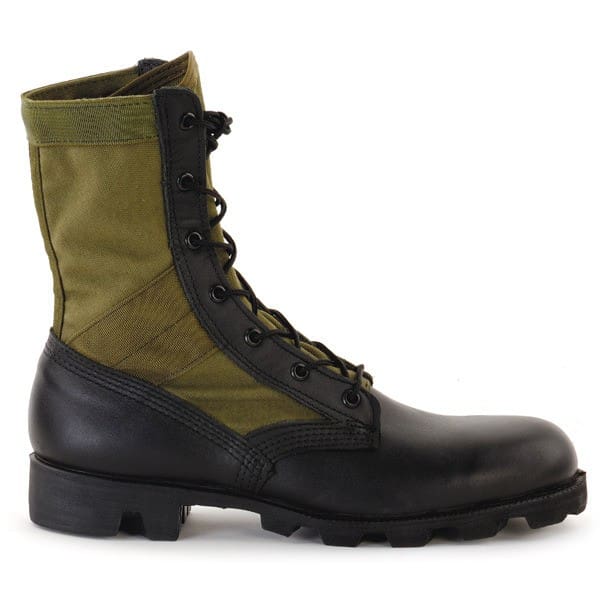
Several commercially developed jungle boots have appeared over the years in including designs from the new defunct OTB, 5.11 Tactical, Oakley LSA Terrain and Water Boots and the Rocky design seen below. I’ve also seen a new design from Bates called the Recondo that is very promising.
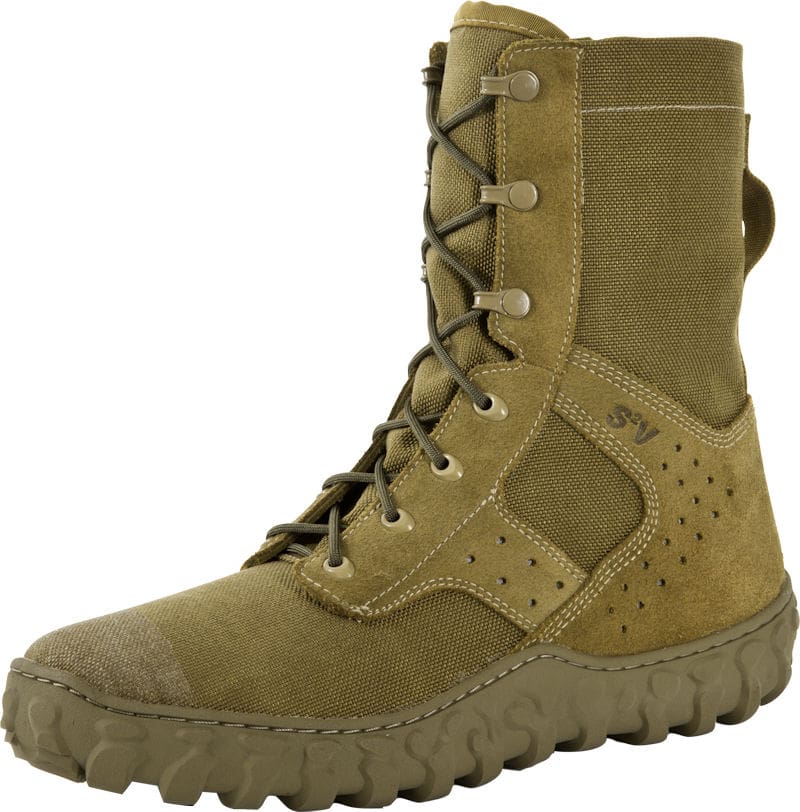
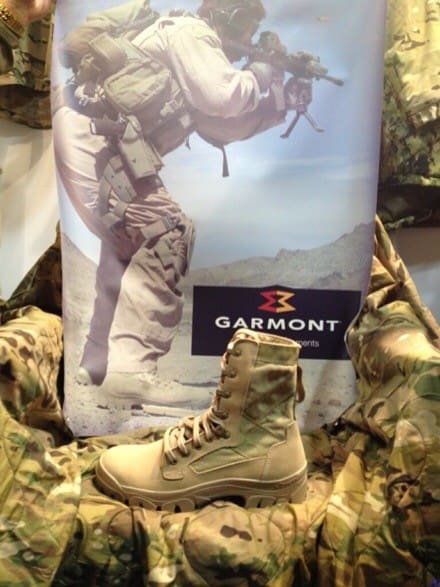
Just earlier this year, the Defense Logistics Agency even issued an NSN for a “Fast Drying Boot” to Garmont for the T8 even though it isn’t Berry Compliant because there wasn’t anything else available in the stock system.
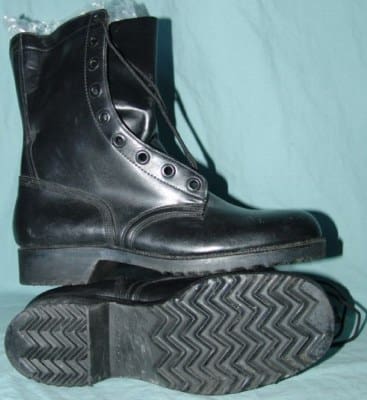
Now, based on the “Pacific Pivot” and the resurgence of the Jungle School (in Hawaii), the Army’s PEO Soldier is finally heeding calls from operational forces over the last few years for “Hot Weather Jungle Combat Boots”. About a month ago, COL Robert Mortlock, PEO Soldier’s PM for Soldier Protection and Individual Equipment began to socialize his office’s intent to seek out a new boot. Initially, it sounded as if the boot would be evaluated under the Army’s resurrected Soldier Enhancement Program with commercial solutions cherry picked for the requirement. At the time, it sounded as if only two boots would be looked at and one of those had already failed an assessment by the US Army Special Operations Command. COL Mortlock’s public comments weren’t very encouraging, as they sounded as if the Army had just newly discovered the concept of Direct Molded Sole technology. Mortlock referred to them as “direct attach outsoles” in an Army press release but I don’t think he actually knows what that is, considering he discussed a glued sole in his description. Glue comes apart in a Hot Wet environment and you’re left with pieces of boots. So that SSD readers know, Direct Molded Soles, or “Vulcanized Rubber” soles aren’t glued but rather hot molded into place and were used is the jungle boot as well as the leather leg boot you were issued during Basic training up into the 1990s. Below is a 60-70s model. Later issued leather combat boots swapped out the tread pattern from the chevron seen here, added a padded collar and speed lacing.
They haven’t discovered anything new here. The technology to produce this style of boot sole was developed by a division of Wellco named Ro-Search almost 60 years ago. Unfortunately, almost no one aside from Altama and Wellco still have the machinery to do this because Ro-Search leased, rather than sold, the machines and molds to the various boot manufacturers who supplied the military. When requirements were changed to include more comfortable mid-soles and construction techniques, the machinery was returned to its owners. Once the jungle and desert boots were dropped, the capability was as well.
However, the Army has finally done it right and actually issued an RFI. This Sources Sought Notice allows industry to put their best foot forward and tell the Army how it can fulfill this jungle boot requirement. Hopefully, this will result in an improved requirement when it is actually released.
According to the document:
“The hot weather jungle combat boots must be capable of meeting critical technical requirements, as follows:
1) Durable enough to last 12 months of wear in jungle environments where high humidity and repeated submersion in water are expected;
2) Quick drying and highly breathable, to allow for heat and moisture to exit the boot when worn;
3) Drainage which allows for evacuation of water from the boot while walking;
4) Light weight construction (under 2lbs/boot) with materials that resist water absorption ;
5) A Pronounced heel to allow for improved grip when walking down loose, muddy declines;
6) Tread/Lug pattern that easily sheds mud and debris while walking;
7) Outsoles that provide propulsion and superior traction while allowing for braking and stability moving both up and down wet, muddy slopes;
8) Able to keep mud, sediment, and debris out of boot while maneuvering through water and deep mud;
9) Designed to reduce pressure points and discomfort during descents on uneven, rugged terrain; and
10) Provide for quick break-in.”
The list is fairly broad which is good. But, a few points. We don’t seem to learn lessons very well which will become clear as you read this. Lessons learned in combat during past wars have been forgotten.
The boot cannot have any padding or linings. In the early 90s, Natick added a padded collar to the jungle boot and changed the color to black. The padding would eventually absorb water if you spent any time in a tropical environment. The black color was for uniformity more than camouflage. At least the leather remained smooth, full grain out leather. The current use of rough out leather can be problematic for use in hot-wet environments. That’s a lesson we learned in the Pacific during WWII. Another concern is that companies are going to want to add some form of cushioned midsole for comfort. Please don’t. It will absorb water. Speaking of midsoles, I see no requirement for a counter to ‘punji stakes’. This form of booby trap is a staple of jungle warfare. We learned this lesson in Viet Nam.
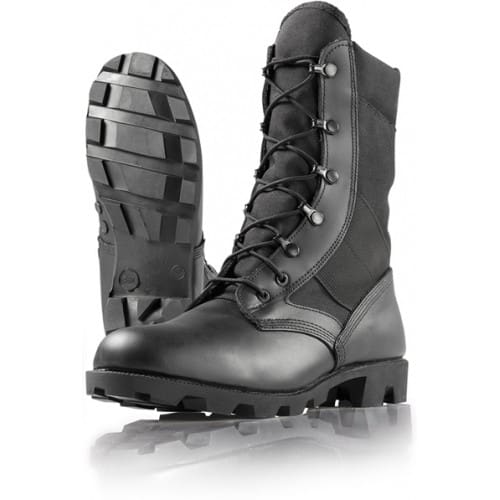
Instead of a midsole, the Army issued a Saran mesh insole insert with the jungle boot that provided cushion and helped keep the Soldier’s foot from directly sitting on the footbed in order to help keep the feet dry and increase ventilation. This is absolutely critical in the jungle. Finally, while the requirement is great concerning the capability of the sole, thus far, no one has shown superior performance to the Panama sole created during the Viet Nam specifically to improve traction and shed the mud that builds up in more traditional lug patterns. I for one, am hoping that Altama will offer up their traditional 1960s issue Green Jungle Boot with Panama tread to see how it performs against newer designs.
I’m glad to see that SEP has been reenergized and I’m also happy to see that the Army is seriously looking at jungle equipment. But, I suggest they crack the books and look at what worked in the past and see what might be readopted or adapted.
Last week, the Department of the Air Force awarded ADS Inc a contract for $1,908,872.41 to deliver non-FR Combat Shirts under the Defensor Fortis-Load Carrying System 2 program. Intended for use by AF Security Forces, these Combat Shirts differ from the Airman Battle Shirt by being manufactured from lightweight, non-FR materials yet like the ABS, incorporate a mock turtleneck and also sport the Digital Tigerstripe Pattern worn by all stateside Airmen. These are going to be worn by SF on gate duty when they wear body armor such as IBA or equivalent to increase comfort and are not intended to be worn in a deployed environment.
Here is a full description:
All fabric shall be lightweight, breathable, moisture wicking and odor resistant; long sleeve “over the head” style with a semi-tight fit that eliminates bunching or riding up under armor; right & left sleeves shall contain: Air Force Digital Tiger Stripe Camouflage Print, hook and loop cuff closures, anti-abrasion padded elbow patches, two-channel flapped pen pocket on both forearms secured by hook & loop fastener tape, zippered shoulder pockets with 6-1/4 inch opening for all sizes (opening toward front of arm); right shoulder pocket must accommodate hook & loop name tape and rank insignia; fastener tape dimensions: loop fastener for name tape shall be 1 inch wide x 5-1/2 inches long, loop fastener for the rank patch shall be 2 inches wide x 2 inches long; torso & mock turtle neck shall be AF Sage Green 1641 (match color in Tiger Stripe Green) or Army Foliage Green 504; modesty panel covering chest area. These will be available in X-Small through XXX-Large.
There is still no award on the load carriage portion of the solicitation.