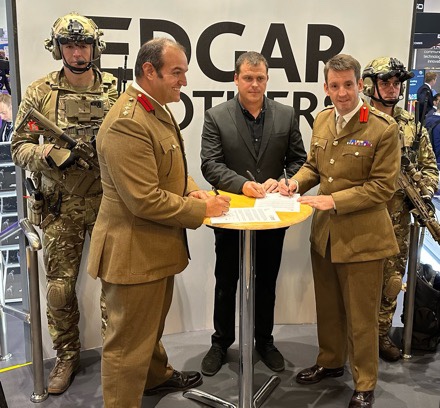
ABERDEEN PROVING GROUND, MD – After more than six months of competitive white papers and technical evaluations for the Terrestrial Layer System – Brigade Combat Team (TLS BCT) Manpack, the U.S. Army entered into an Other Transaction Authority (OTA) agreement through the Consortium for Command, Control, and Communications in Cyberspace (C5) with Mastodon Design, LLC to support Phase 1 – Prototype Build and Demonstration. The agreement totals $1,521,490 for a 9-month Period of Performance.
The TLS BCT Manpack system will be a tailorable, modular, terrestrial capability that allows the integration of Signals Intelligence and Electromagnetic Warfare collection, processing, exploitation, reporting, and effects capabilities for SIGINT Collection Team and Electromagnetic Warfare Team elements. TLS BCT Manpack will provide the Brigade Combat Team commander a tactical advantage with agility and improved intelligence, surveillance, reconnaissance, and targeting in Multi-Domain Operations.
“The TLS BCT Manpack compliments the TLS BCT and TLS Echelons Above Brigade (TLS EAB) family of systems with a shared and open systems approach that creates the flexibility and efficiencies needed against a highly adaptive threat,” said Kenneth Strayer, Project Manager, Electronic Warfare and Cyber (PM EW&C). PM EW&C plans to transition the TLS BCT Manpack from prototyping to production in FY2024.