FirstSpear

Archive for the ‘Guest Post’ Category

Assignment Incentive Pay to be Authorized for Airmen, Guardians Stationed at Extremely Cold Locations

Wednesday, April 10th, 2024

ARLINGTON, Va. (AFNS) —  

Effective April 1, the Department of the Air Force approved a new incentive pay for Airmen and Guardians assigned to qualifying bases in the U.S. where the temperature is expected to drop below minus 20 degrees Fahrenheit. 

Cold Weather Assignment Incentive Pay is a single lump sum payment given to Airmen and Guardians after signing an agreement to serve a prescribed tour length of at least 12 months, depending on qualifying location.  

Locations that meet this threshold include Minot and Grand Forks Air Force Bases and Cavalier Space Force Station in North Dakota, Clear Space Force Station, Eielson Air Force Base and Joint Base Elmendorf-Richardson in Alaska, as well as Malmstrom AFB, Montana.  

“Airmen and Guardians living in extremely cold conditions faced unique out-of-pocket costs,” said Alex Wagner, Assistant Secretary of the Air Force for Manpower and Reserve Affairs. “In addition to the assignment and retention benefits of the pay, it also comes down to making sure we do our best to take care of our service members and their families stationed at these critical installations.”  

This payment intends to ease the financial burden of purchasing certain cold weather essentials, such as extreme cold weather gear, all-season and/or snow tires, tire mounts and alignments, engine block heaters and emergency winter car kits, as well as further incentivizing assignments. 

Although AIP-CW is effective April 1, the first pay date is anticipated for July 1, 2024, meaning Airmen and Guardians who move to a qualifying location between April 1 and June 30 will receive payment retroactively.  

The amount of AIP-CW Airmen and Guardians are eligible to receive is based on criteria in the five pay levels outlined in the table below and is subject to change. 

This change follows the Department of Defenseimplementation of the Fiscal Year 2023 National Defense Authorization Act, which included language authorizing special duty pay for members based in cold-weather climate conditions and the FY24 NDAA, which clarifies the temperature parameters that qualify an area as a cold-weather location. 

“We want to ensure Airmen, Guardians and their families have the resources needed to safely live and work in an extreme cold-weather environment,” Wagner added.  

The official guidance memorandum can be found here

Secretary of the Air Force Public Affairs

Tactical Tuesday: The Ultimate Tactical Jeans with 11 Pockets

Tuesday, April 9th, 2024

While the traditional “5 pocket jean” has long been a staple in everyone’s wardrobe, Vertx takes it to a whole new level with their revolutionary Defiance Jeans.

The Defiance Jean offers unparalleled functionality without compromising on style – plus a staggering 11 pockets. The mesh front pockets with lanyard retention not only provide added breathability and comfort, but also ensure the security of essential items like keys.

Vertx goes above and beyond with the inclusion of 2 rear yoke pockets, providing ample storage for magazines, tourniquets, phones, or any items you want quick access to without cluttering your front pockets. The standard back pockets are far from ordinary, featuring wallet traps to safeguard your valuables against pickpocketing and accidental loss.

To further enhance versatility, the Defiance Jean boasts 4 strategically located mini-stash pockets throughout the pants, ensuring you’re always prepared for any situation. And let’s not forget the advanced technology incorporated into these tactical jeans. Coolmax® fabric keeps you cool and comfortable, while CCW oriented belt loops, YKK zippers, and a gusseted crotch prevent blowouts and provide unmatched durability.

Don’t just take our word for it – experience the superiority of the Defiance Jean yourself. Discover why these are the best tactical jeans on the market, trusted by professionals and enthusiasts alike.

Army Futures Command General Lays Out Continuous Transformation Plan

Tuesday, April 9th, 2024

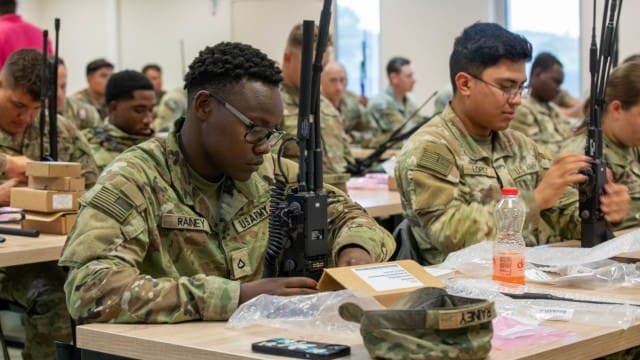
WASHINGTON — To give Soldiers what they need to win the nation’s wars now and in the future, the Army must continuously transform and adapt to advances in technology, said Gen. James E. Rainey, commanding general of Army Futures Command.

This flexibility is needed, he said, because of how quickly the environment is evolving.

“The amount of technical disruption in the character of war is unprecedented, and it just continues to go faster and faster,” he said during a keynote presentation at the U.S. Army Global Force Symposium in Huntsville, Alabama last week. “Whatever you think you know this year, come back in 90 days, and you’ll know something different.”

To combat this changing landscape, the service is focused on transformation in three different periods: 18-24 months, two to seven years, and seven to 15 years. Work done in each period has a ripple effect on the others.

The first period is referred to as transformation in contact. This area deals with capabilities delivered to deployed warfighters for testing and analysis. They provide real-world feedback allowing the Army to make necessary adjustments for future use.

In this area, the Army can adapt to current warfighting conditions. This was used when the service noticed the value of loitering munitions, also known as suicide drones, in the war in Ukraine. Army Futures Command put in a priority-directed requirement and is in the process of buying the capability.

AFC is also working with industry partners on ground-based rockets, ground-based missiles and counter-unmanned aircraft systems that work on offense to protect light infantry and armored companies.

“The United States Army, we believe in offense and attacking,” he said. “So, there is a big opportunity to figure out how we are going to provide effective counter-UAS capabilities to units on offense.”

Human-machine integrated formations is another initiative the service is working on in the 18–24-month period. This program brings robotics and autonomous vehicles into fighting formations. The goal of the project is to keep Soldiers out of harm’s way whenever possible.

The Army tested numerous integrated formations during Project Convergence Capstone 4 in Fort Irwin, California last month.

“This is one of our major efforts inside the Army,” Rainey said. “It’s going very well and is full of opportunities to go to the next level. We’re never going to replace humans with machines, it’s about optimizing them.”

The Army will start prototyping the first integrated platoons in the next two years.

The two-to-seven-year period is known as deliberate transformation. In this time frame, the service is continuing to work on the Future Long Range Assault Aircraft, extending the range of cannon artillery, adding magazine depth and improving indirect fire weapons, engineering capabilities and the network.

Rainey said the service’s number one priority in deliberate transformation is improving the network. The service is working on a data-centric system to enable commanders to make quicker and more informed decisions.

The Future Long Range Assault Aircraft is a hot topic issue with the service’s recent aviation rebalance. Rainey assured that the Army is committed to FLRAA and the capability it brings to maneuver rifle squads.

“We don’t do attrition warfare,” he said. “We do maneuver warfare. So, FLRAA is an absolute must we have to continue to deliver, and it’s in good shape.”

Innovating in engineering battalions is another key priority for the Army, he explained.

“We’re more likely to get stopped by the terrain than by an enemy we fight and that’s not OK,” he said. “We [have got to] get after the engineering transformation and modernization.”

The Army announced the end of the Extended Range Cannon Artillery platform program last month but the requirement to extend cannon fire remains. The service recently completed a tactical fires study on artillery modernization. The research from the study showed significant success in extending the range by making adjustments to the rounds, Rainey said.

AFC is taking this knowledge and looking at ways to innovate the rounds and the propulsion systems. They are also looking to increase magazine depth to give Soldiers not just the capability but the capacity they need.

The last time frame is referred to as concept-driven transformation. This is where the Army is looking to sustain advantages, develop new capabilities and build endurance for future conflicts.

The service is working on merging offensive and defensive fire systems, adding robotics to contested logistics, bringing survivability and lethality to light infantry divisions, decreasing the weight of armored formations, and increasing its emphasis on war gaming.

This continuous transformation over all three periods is meant to make the Army more adaptable, flexible and lethal while giving Soldiers the capacity and capabilities to win now and in the future.

“Whatever we do as we transform, we have to preserve that people advantage we have,” Rainey said. “They are our greatest asset.”

By Christopher Hurd, Army News Service

MATBOCK Monday: How a SOIDC Loads His Graverobber Assault Medic

Monday, April 8th, 2024

Fully loaded out MATBOCK GRAM that was sent to them from a SOF Medic with 15 years of experience. Check it out here.

Email sales@matbock.com to schedule a meeting.

www.matbock.com/collections/grave-robber/products/gram

Hometown Army Fellow Joins PEO Soldier as Next Gen Body Armor Engineer

Monday, April 8th, 2024

Born and raised in Alexandria, Va., Britt Wieland grew up going to the Ft. Belvoir summer camp.

Now, as a civilian engineer with PEO Soldier, she works on the Army’s next generation body armor at Fort Belvoir.

Wieland’s primary focus as a Body Armor Engineer is the Army’s new hard armor.  In her current position, she enjoys seeing the direct impact of her work on the warfighter every day.

“We procure and field the latest body armor to our Soldiers,” explained Wieland.

“I have some friends serving in the Army, and every time they receive the newest gear, they call me to rant and rave about how excited they are, and I take a sense of pride in knowing I get to play a part in serving those who serve us. There aren’t many jobs that give you that kind of opportunity and fulfillment.”

Having trained as both a Hard and Soft Armor Engineer, Britt frequently is called upon to brief Soldiers, Army Senior Leaders, and industry partners on the Vital Torso Protection (VTP) system.

VTP is a subsystem of the Soldier Protection System, the Army’s newest Personal Protective Equipment. The Army is currently collecting data to verify trade space of weight reduction with protection ability for Soldiers to reduce the Soldier’s load and increase mobility in tactical environments.

“Our goal is to rebalance the testing to optimize the time and cost spent, while maintaining performance. This will allow industry to redirect resources towards developing more advanced designs and technologies, which in turn, benefits the Soldier.”

As the chair for the Vital Torso Protection Purchase Description project, Wieland has had an opportunity to work on the Army’s newest hard armor, where she has demonstrated her leadership skills during the process of changing the testing and evaluations for VTP.

“We’re looking to make the test procedures more statistically significant, operationally relevant, and aligned with the original requirements,” explains Wieland.

“I feel really special knowing my leadership trusted me to represent them even though I was less than a year into my career.”

Britt has served in key briefing roles to the special operations community, including the Spear Side-by-Side, which aimed to develop understanding and communality amongst the kit used in SOF versus the general Army, and USASOC Women in ARSOF, which supports holistic improvements to not only the kit of female Soldiers, but also improvements to uniforms, healthcare and quality of life.

“Britt has been able to brief key senior leaders and a large group of female Sergeants Major from ARSTAFF on improvements to PPE and paths forward for iterative changes based on Soldier feedback. She’s also taken part in HFEs to gain knowledge on Soldier kit,” said Maj. Kim Pierre-Zamora, the assistant product manager for the body armor team.

“There’s also a special place in my heart for the Army’s mission to better equip female and small statured soldiers,” Britt Wieland said.

“As a smaller female myself, I take pride in being a female engineer that gets to help take on this task and find it extremely rewarding every time I get to fit a female Warrior with a new kit that was made with them in mind,” Wieland said.

Britt Wieland graduated Summa Cum Laude from Lawrence Technological University in 2021 with a Bachelor of Science in Biomedical Engineering. She became an Army Fellow in 2020 and joined PEO Soldier as a Department of the Army civilian in 2023.

By Scott Sundsvold, Army

Welding Individual Protective Safety Ensemble

Sunday, April 7th, 2024

Last month, members of Product Manager Soldier Clothing and Individual Equipment (PdM SCIE) issued the Welding Individual Protective Safety Ensemble to Soldiers at Fort Eustis, Virginia is. The ensemble provides Soldiers with personal protective equipment to perform most welding duties in any operational environment. The equipment went into Limited User Testing and Evaluation with Allied Trade Specialists, focusing on Soldier ease of movement and functionality. Early testing included welding tasks while wearing body armor.

Rapid Raven 24-1: Posturing EMS Warfighters for Combat

Sunday, April 7th, 2024

EGLIN AIR FORCE BASE, Fla. —  

In order to establish readiness and further operationalize the wing, the 350th Spectrum Warfare Wing went into a warfighting posture during Rapid Raven 24-1, its first internal exercise designed to test its ability to wage war in the Electromagnetic Spectrum and meet combat requirements and timelines.

“The Air Force can’t succeed in war if our wing can’t execute its mission essential tasks at the speed of relevance,” said U.S. Air Force Col. Josh Koslov, 350th SWW commander. “Rapid Raven wasn’t just an exercise; it was a chance to attack our mission essential tasks as a whole and see what works and what doesn’t.”

During Rapid Raven, the wing challenged its members’ ability to sense and respond to changes in the EMS and rapidly reprogram mission data files (MDF) in a wartime environment, focusing on command-and-control elements.

“In order for us to beat China, we have to be able to do our job in less than three hours,” said Koslov. “It’s an easy thing to say but a harder thing to do. When you start peeling back three hours, what does that actually mean? We addressed that question this week.”

The results from this exercise will inform future tactics, techniques, and procedures in the wing, increasing the speed at which the Air Force can assert spectrum dominance and inform the requirements the wing needs. The exercise also identified requirements needed by the wing to execute its mission at the pace of battle.

“Rapid Raven was able to identify opportunities to go even faster in the future,” said Dylan Duplechain, 350th SWW chief engineer. “With modern, hardened communication pathways to receive and push data, as well as AI/ML [artificial intelligence/machine learning] tools to assist with decision-making, we can further improve warfighting lethality within our current portfolio.”

The exercise simulated 24-hour operations, beginning with the wing receiving an emergency operational change request for updated MDFs based on a new complex emitter, triggering the Electronic Warfare Integrated Reprogramming (EWIR) cycle across squadrons.

“We purposely chose threats in multiple bands [frequency range] that should affect most of the systems, requiring reprogramming,” said U.S. Air Force Maj. Joseph Ellis, 350th SWW A3 operations director. “It’s about stressing the wing in a combat-representative environment to the point where we’ll learn a lot about our skills to get better and faster.”

Reprogramming, or updating, MDFs is crucial in times of conflict to provide warfighters with data about the electronic landscape, to include latest threat intelligence, that allows aircraft, aircrew, and commanders to sense, identify, locate, and counter threats in the EMS.

Conducting rapid reprogramming of MDFs is paramount to combat the wartime reserve modes for systems and platforms used during conflict or emergencies, a point stressed by U.S. Air Force Chief of Staff Gen. David Allvin, during his nomination hearing in front of the Senate Armed Services Committee last September.

“In a high-end fight, warfighters require Spectrum dependent systems to win,” said Allvin. “These systems will operate on frequency bands across the entire Spectrum and are critical in a peer-contested environment. We expect our adversaries to attack across the Spectrum and we must be ready and responsive to that, by training and fighting in all parts of it.”

Throughout the exercise, all members captured data detailing timelines, effective aspects of procedures, and areas that impacted the speed of reprogramming for teams.

The feedback collected from across the wing will drive impactful change, increasing the pace of reprogramming operations and laying out the parameters necessary for the wing to effectively generate combat power through data to the warfighter.

“Data is our weapon and key to defeating any adversary and that’s what Rapid Raven focused on,” said Koslov. “The ability to receive, manipulate and turn that data into a combat capability that the warfighter can take into battle at the speed of relevance is what will allow us to win.”

The wing plans to expand the Rapid Raven exercise and ramp up the intensity and scope for future iterations as it continuously tests its ability to provide EMSO capabilities at a moment’s notice and meet the growing demand for Spectrum capabilities.

“We came to the wing about a year and a half ago and we talked about operationalizing the war fighting mission and war fighting culture,” said Koslov. “It took us a year and a half to build up to what we did this week, and it was awesome. Our Crows really embraced the warfighting culture that we need to beat our adversaries and China.”

At the conclusion of the exercise, the wing came together for an awards ceremony to recognize top performers who embraced the warfighting culture and led the way for reprogramming efforts.

The winners were:
Rapidest Ravens – 68th Electronic Warfare Squadron AV Shop
MVP – 39th Electronic Warfare Squadron EW Help Desk
Perseverance Award – 453d Electronic Warfare Squadron Threat Change Detection Team

By Capt Benjamin Aronson, 350th Spectrum Warfare Wing Public Affairs

The Solution Sandstorm: 75th Innovation Command Crystallizes Partnerships During PC-C4

Saturday, April 6th, 2024

FORT IRWIN, Calif. — A dark, empty conference room at Fort Irwin’s National Training Center suddenly illuminates as Brig. Gen. John Stanley, deputy commanding general, 75th U.S. Army Reserve Innovation Command, enters and calls on all Soldiers wearing the 75th patch to huddle around him and his command staff.

“Project Convergence is our culminating event,” Stanley said to the handpicked Soldiers for this cutting-edge exercise. “You are the connective tissue between the Army and its DOD partners … You will add value to the Army’s Transformation Enterprise by identifying practical solutions to novel ideas that will codify future military doctrine.”

The nods from the warfighters gathered in the drab workspace silently affirmed that they were already putting Stanley’s words into practice.

In early March, approximately 40 Soldiers from the 75th USARIC joined forces with various Army commands and defense contractors in the deserts of Fort Irwin to assess and enhance emerging technologies during Project Convergence Capstone 4. This U.S. Army-hosted experiment encouraged service members from all U.S. military branches and allied nations to forge the future of warfare from the tactical to the strategic level.

“PC-C4 thrusts frontier technology into realistic scenarios that the Army might face against ever-evolving adversaries,” said Stanley, who was recently promoted in February. “The 75th USARIC helps our partners refine their systems and equipment by applying our military experience and civilian expertise.”

The 75th USARIC stands out among other Army Reserve commands through its unique mission set that demands highly skilled Soldiers who are leaders in their area of expertise. As part of the Army’s Transformation Enterprise, the 75th USARIC provides specialized capabilities to solve the Army’s toughest problems. Its ranks comprise seasoned professionals specializing in robotics, biotechnology, project management, cyber security, machine learning, and other advanced fields. Divided into two groups and 16 detachments, this two-star command has approximately 500 Soldiers, with many currently working for Fortune 500 companies at the management or executive level. Some are founders of their own tech start-up firms. About one out of five Soldiers in the 75th USARIC has a doctorate, with many more holding master’s degrees and IT certifications.

“Members of the 75th readily translate complex discussions among scientists, engineers and Soldiers on the ground,” said Lt. Col. Andrew Miller, innovation officer with Support Group, 75th USARIC. “We assess network issues and technical challenges in the design phase, then integrate solutions to help teams better perform in the execution phase.”

In his civilian capacity, Miller has served as a project manager at one of the world’s leading companies in software, hardware and cloud services. His corporate background helped secure a leading role in 75th’s partnership with the Army Research Laboratory’s Deep Autonomous Reconnaissance & Targeting Sensing program. DARTS integrates sensing and automation technology to produce accurate target information. Miller and several 75th USARIC Soldiers collaborated alongside the DARTS development team throughout PC-C4 to see firsthand how the system would perform in a simulated, battlefield scenario.

“Having the 75th at PC-C4 to support this program is incredibly beneficial,” said Jeffrey Houser, lead research scientist DARTS. “Army Research Laboratory has many scientists and engineers who are very good at creating cutting-edge technology for our troops. However, we sometimes struggle with communicating to our end users how to take full advantage of these advanced systems. The 75th Soldiers here not only speak the language of those in Army operations, but they also ask questions and make recommendations that my team wouldn’t have otherwise considered.”

These inquisitive innovators expanded their services to Future Vertical Lift, a key priority in the Army Transformational Enterprise. The FVL Cross Functional Team aims to modernize Army aviation by improving speed, range and coordination to take decisive action in various operational environments. Programs that fall under FVL-CFT’s scope include advanced rotorcraft, unmanned aerial vehicles, and even autonomous helicopters.

A pair of 75th USARIC Soldiers from the Command’s Huntsville detachment proactively inserted themselves with the design team for the K1000ULE, an ultra-long endurance unmanned aerial system led by Kraus Hamdani Aerospace.

“The first and maybe most important step we took during Project Convergence was to develop close relationships through face-to-face conversations,” said 1st Lt. Omega Marks, innovation officer, 75th USARIC. “By joining these technical discussions, we gained a deeper understanding of the [K1000ULE] contributions to Future Vertical Lift, and we proved to the [Kraus Hamdani] Aerospace team that the 75th can enhance the K1000ULE’s capabilities by identifying potential issues and offering viable solutions.”

Marks, who also serves as a cyber security assessor for a company contracted by the U.S. State Department, joined her enlisted counterpart, Staff Sgt. Christopher Wright, noncommissioned officer-in-charge, Huntsville Detachment, 75th USARIC, to help enhance the K1000ULE’s capabilities.

“Many of the 11 distinct types of technology we saw [at PC-C4] greatly benefited from a thorough analysis of potential cyber threats,” said Wright, who works as a senior security engineer for a Fortune 100 company. Our inclusion in matters of surveillance, networking and electronic countermeasures addressed issues that could compromise performance or, worse, enable our adversaries to exploit our technology against us.”

While most 75th USARIC Soldiers at Fort Irwin stormed PC-C4 with innovative solutions at the tactical, operational and strategic level, one fostered a climate of transformation along the spiritual plane.

The 75th USARIC’s command chaplain, Col. (Chaplain) Ken Harris initially came to Fort Irwin to provide religious support for fellow 75th Soldiers. His invitation to attend the garrison’s chapel services, seek guidance through prayer or request spiritual counseling captured attracted both service members and civilians hailing from France, Japan, Canada, Australia, New Zealand and the United States.

“I was blessed to pray alongside Soldiers from allied nations for their work in protecting freedom – including freedom of religion – around the world,” said Harris, a Lutheran pastor and an associate for a Fortune 500 financial services company. “Peace can be made through strength. Strength can be enhanced by interoperability of advanced technology … Peace through strength is also forged through enhancing relationships with our brothers- and sisters-in-arms.”

Stanley and the command team believe that cultivating these relationships will redefine the 75th USARIC’s role in ensuring the Army dominates every battlespace against any adversary.

“The 75th earned its place at Project Convergence by identifying solutions that improve processes across multiple domains,” said Stanley. “Who we engage and how we help them accomplish their objectives at PC-C4 will pave the way for future 75th USARIC missions that will deliver Army of 2030 and design the Army of 2040.”



By SFC John Carkeet