Celebrate 20 years of the TLR-1

Archive for the ‘Guest Post’ Category

Space Control Squadron Redesignated Electronic Warfare Squadron

Wednesday, June 21st, 2023

CAPE CANAVERAL SPACE FORCE STATION, Fla. – The 114th Space Control Squadron, a geographically separated unit assigned to the Florida Air National Guard’s 125th Fighter Wing, was redesignated as the 114th Electromagnetic Warfare Squadron Jan. 14.

The redesignation more accurately associates the unit’s name with its mission and aligns it with active-duty Space Force counterparts who were redesignated last year. It also reflects the evolution of electromagnetic warfare technologies to the forefront of space operations.

U.S. Air Force Lt. Col. Scott McGuire, commander of the 114th Electromagnetic Warfare Squadron, said the squadron will now be recognized, by name, as a combat unit providing critical electromagnetic warfare functions to joint force warfighters across domains. At the same time, they will continue providing the same support to the U.S. Space Force. This change also recognizes that these Airmen offer the same capabilities as their active-duty Space Force counterparts.

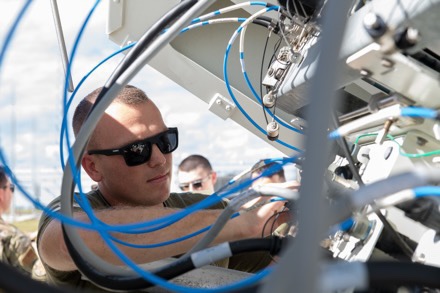
The 114th’s mission is to organize, train and equip personnel to conduct electromagnetic attacks in contested, congested and constrained environments downrange, using specialized equipment such as the counter communications system, or CCS. The CCS denies communications from satellites in orbit, cutting off adversarial communications during a conflict, creating a safer, more secure environment for U.S. and joint warfighters.

“Successful space operations depend on dominating the electromagnetic spectrum,” said Ed Zoiss, president of the space and airborne systems segment for L3Harris Technologies and a Navy veteran. “Denying our enemies the ability to use their space assets protects U.S. warfighter operations.”

While the mission is the same, the newly designated electromagnetic warfare squadron remains committed to developing combat-trained, combat-ready and combat-focused Airmen ready to support warfighters across all domains.

“The Department of Defense’s growing dependence on the electromagnetic spectrum to remain connected and share data is only growing,” said U.S. Air Force Lt. Col. Anthony Surman, assistant operations officer at the 114th Electromagnetic Warfare Squadron. “It’s important that we recognize that we need the capability to conduct both electromagnetic and kinetic attacks; we can deliver a multitude of options.”

Air National Guard units reporting to the former U.S. Space Command have continued supporting space-centric missions for the Space Force since its inception in 2019. The units have an atypical arrangement in which they fall under a major command of the Air Force while receiving operational taskings from the Space Force.

By Senior Airman Jacob Hancock, 125th Fighter Wing Public Affairs

Army Rolls Out New Army Body Composition Program

Tuesday, June 20th, 2023

WASHINGTON — The Army rolled out its new Army Body Composition Program Monday that outlines a more accurate way to assess Soldiers’ body fat.

At a recent event, Sgt. Maj. Christopher P. Stevens, Army G-1 personnel sergeant major, and Holly McClung, lead researcher for the body composition study at the Army Research Institute of Environmental Medicine, talked about the roll out of the new program in detail.

“For years, we have been committed to reducing body fat across the force. It’s one of the driving factors in supporting the holistic health and fitness program, as well as one of the reasons to request a study on the Army Body Composition Program,” said Sgt. Maj. of the Army Michael A. Grinston in a prepared statement. “As we got feedback from the study, we found there were ways to modernize the ABCP and better uphold the standards established in the regulations. As we implement these policies, performance on the [Army Combat Fitness Test] will increase while body fat decreases at a scale never before seen in our Army.”

The new changes, which also apply to Army National Guard and Army Reserve, replace the older method of measurement with a one-site tape test that is one measurement across the belly button. The previous test had two measurements across the belly and the neck.

“This new tape test requires taping only at one site, and the use of a corresponding calculation model for all Soldiers,” Stevens said. “[The] height and weight screening table remains the first line of assessment so no change to that.”

“From the clinical application in the medical world, a waist circumference, abdominal around your belly button, is linked to long-term health outcomes,” McClung said. “Not only are we looking at the performance of the Soldier today, but the long-term health of the Soldier in years to come within the Army.”

As far as those who are unable to pass, the Army has methods in place that assist Soldiers with a path to a healthier lifestyle and, hopefully, will bring them up to standard.

“We want to help them, we want to put them on a health promotion track, work with some dietitians and some trainers and bring them up to standard,” McClung said. “It’s making sure that we’re helping our Soldiers today, as well as in the long run.”

With the older method, it was found that some Soldiers were passing when they should have failed, and some would fail when they should have passed, McClung said.

“That’s why as a team, the policy working group came up with the three different methods, so that we could pull out those top performers that maybe were failing,” McClung said.

Like the previous test, Soldiers who fail the height and weight will need to take the new standards test. Soldiers who fail the first taping method can use the previous taping method as confirmation until June 12, 2024, as the new method is phased in. After failing those tests, the Soldier will be flagged, which can negatively impact their career.

If the Soldier fails both of those versions of the tape test, they can request, if reasonably available, supplemental assessment with the Dual X-ray Absorptiometry, InBody 770 or Bod Pod. These three devices are an advanced way to measure body fat composition.

“What’s going to stay in place when it comes to profession in the Army Body Composition Program is weight loss,” Stevens said.

These changes were made based on extensive research. The Army-wide study, which the ABCP is based on, was completed earlier this year, and evaluated the effectiveness of the new test on more than 2,600 Soldiers.

“We were hearing a lot from Soldiers in listening sessions and other forums who were concerned with the ACFT,” McClung said. “One of the main outcomes of this study was the first time that the Army has actually linked physical performance to body composition.”

The Army will continue to use the data from the study to make modifications to the program if necessary.

“This new policy will increase the readiness of the force by giving every Soldier a more accurate assessment of their health and fitness,” Stevens said. “The overall focus of the program is to have an effective and accurate assessment of the holistic health and fitness of the force, while at the same time providing Soldiers with the resources they need to improve and preserve individual and unit readiness.”

By SFC Michael Reinsch, Army News Service

Ocean State Innovations Printing Services

Monday, June 19th, 2023

For further information, contact our sales department:

Geoff Senko: geoff@osinnovate.com   

Peter Raneri: peter@osinnovate.com

AFCEC Successfully Tests Multi-Capable Airmen Airfield Repair Concept

Monday, June 19th, 2023

JOINT BASE SAN ANTONIO-LACKLAND, Texas (AFNS) —  

The concept of a cross section of Airmen carrying out important wartime tasks seems like a good idea, but does it work?

That’s what the Air Force Civil Engineer Center’s readiness team set out to prove May 22-24 during a Rapid Damage Repair Multi-Capable Airmen exercise at an Air Force regional training site at Dobbins Air Force Base, Georgia.

The exercise, the first of its kind for AFCEC, successfully demonstrated the concept said Master Sgt. Broc French, contingency training program manager at the center.

“In a deployed location, we might not be able to rely solely on civil engineers to execute traditionally CE work,” he said. “This exercise showcased that Airmen from various Air Force specialties can execute these types of repairs and support our CEs.”

In preparation for the exercise, five civil engineer Airmen from the 366th Civil Engineer Squadron at Mountain Home AFB, Idaho, attended a five-day course in 2022 to learn how to perform wartime RDR tasks.

To test the MCA concept, a combination of 25 CE and non-CE Mountain Home AFB Airmen, with no prior RDR experience, were then selected from across the base to take part in the exercise at Dobbins AFB’s Air Force Reserve Command Expeditionary Combat Support Training Certification Center.

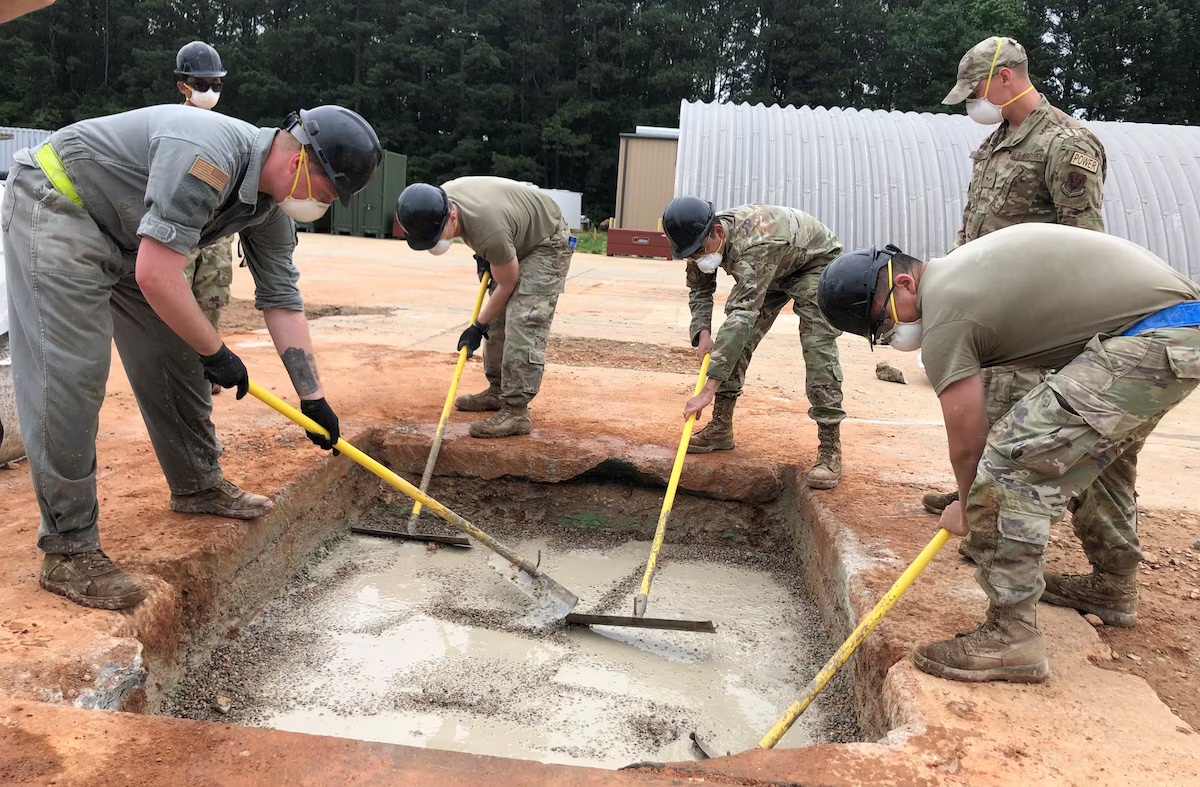
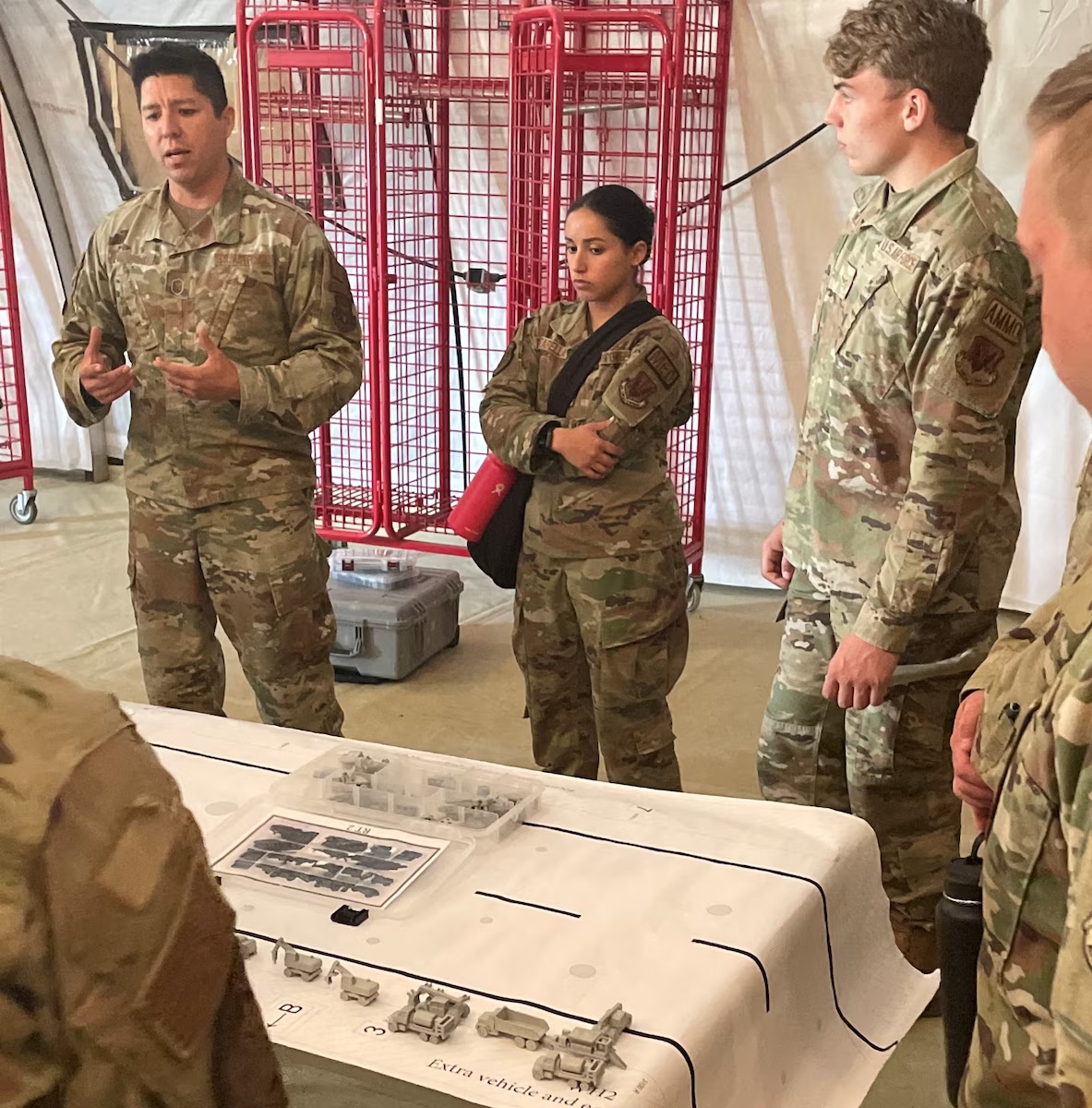
Once at the Georgia base, the five engineer teammates became their instructors for two days of classroom, tabletop and hands-on training, followed by a practical test with the team of CE, finance, maintenance, munitions, medical and operations support Airmen having to complete six concrete crater repairs and spall operations within four hours.

In essence, they repaired airfield damage that could limit the ability of aircraft to take off and land in a real-world, wartime environment.

“Traditionally, civil engineers do the rapid damage repair like we did here, but with this beta test, we brought in different squadrons and different groups to augment some of the tasks in the repair process … and they executed,” said Chief Master Sgt. Chad Lepley, AFCEC Readiness Directorate senior enlisted leader.

Senior Airman Kayla Panzarella is a medic at Mountain Home AFB, but she was a CE “dirt boy” during the exercise.

“Being a complete outsider to this world and routine, I thought it was very clear and precise for what I needed,” Panzarella said of the training. “I was super nervous to come in here and start cutting concrete after two days, but my instructor was amazing. He taught me everything and was patient. That’s really what you need in an environment like this coming from different jobs to something as scary as this is.

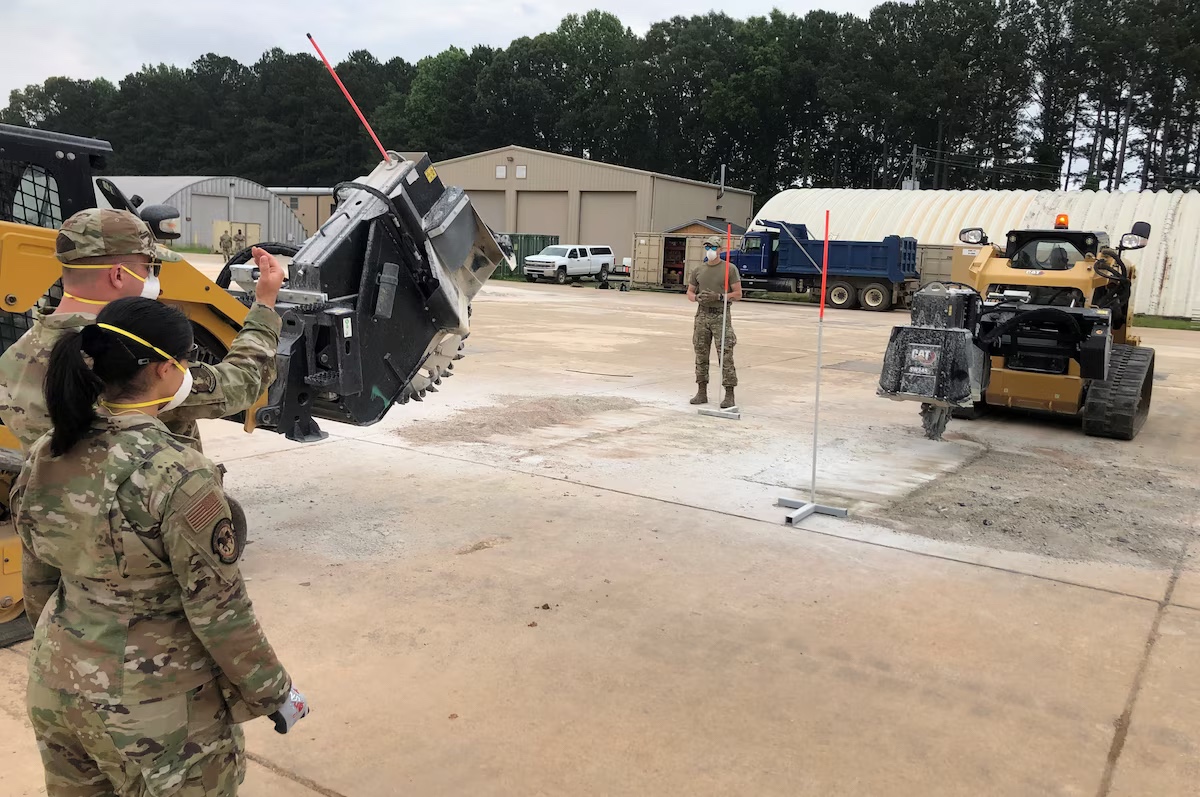
I can’t explain the feeling of doing this wartime task, this mission. I remember looking out from inside the (concrete-cutting heavy equipment) and having the feeling of, ‘Wow, we’re doing this … I’m so proud of myself, proud of this team.’ It was a feeling I can’t really explain … just excellence in what we were doing. It was a great feeling.”

French was impressed with the entire operation.

“It’s been outstanding … pretty awesome to see Airmen who have never been in a compact track loader or ever touched any of this equipment executing the mission,” he said. “After two days, they’ve been able to fill craters and, if it were a real-world scenario, be able to get aircraft off the ground quickly. This is a great concept that works, and we’re looking to expand it in the future.”

Master Sgt. Patrick Murphy, the 366th CES heavy repair section chief at Mountain Home AFB and instructor lead during the exercise, said the positive attitudes of everyone involved were key to the success of the event.

“This (exercise and MCA concept) is a really good start for changing the battlefield space,” Murphy said. “If you could take different career fields like security forces, medical and finance like we had out here, you could put people together to form an ‘A Squad.’ With that, you could take care of everything with a small force, as long as you had the right attitude like we had with folks this week.”

Story by Debbie Aragon, Air Force Installation and Mission Support Center Public Affairs

Photos by Brian Goddin

UF PRO Presents – It’s Beer:30. Debating Thermal Protection

Sunday, June 18th, 2023

Exploring the role of thermal signature in combat zones

In this episode of Beer:30, Armin and Darko are joined by Marko Peljhan, co-founder and partner at C-Astral Aerospace, a globally recognised company that manufactures and services fixed-wing small Unmanned Aircraft Systems. They discuss the challenges of countering detection, the quest for effective camouflage, and the battle against heat signature technology.

ufpro.com/us

ACE Course Prepares Airmen for Strategic Engagements in Indo-Pacific

Sunday, June 18th, 2023

MAXWELL AIR FORCE BASE, Ala. (AFNS) —  

The National Defense Strategy and the U.S. Indo-Pacific Strategy identify the Indo-Pacific as a priority theater vital to the nation’s security and prosperity.

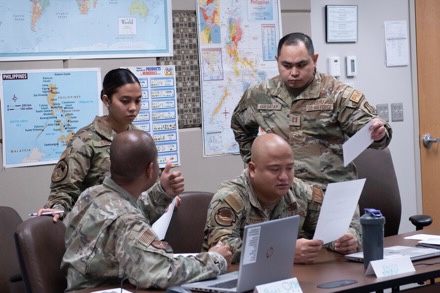
The Air Force Culture and Language Center has partnered with the Air Force Special Operations School and the Defense Language Institute Foreign Language Center on an innovative agile combat employment course. The most recent course focused on U.S. Indo-Pacific Command and taught in the Tagalog language, to demonstrate U.S. long-term commitment to strengthening partner autonomy and options throughout this region.

Eight Tagalog-speaking scholars in the Air Force’s Language Enabled Airman Program with a wide range of operational backgrounds — from medical and cyber operations to logistics and bioenvironmental engineering—were competitively selected to participate in this three-week course, held May 8-26, at Hurlburt Field, Florida.

The course is designed to build on the language and cultural skills they’ve gained throughout their LEAP experience to prepare them for Agile Combat Employment and their role in advancing a free and open Indo-Pacific region.

“There’s a sense of urgency in seamlessly working with partners and allies for integrated deterrence, especially in the INDOPACOM region,” said Howard Ward, AFCLC director. “Our force must understand culture to work with our counterparts and be highly skilled in the languages to get tempo and speed to build capacity and operating capability for ACE to be a credible deterrent.”

The program consists of one week of the special operations school’s “Intercultural Skills for Engagement,” or ENGAGE, course followed by two weeks of operationally focused advanced Tagalog language and cultural studies taught by a DLIFLC professor.

During the two weeks of operationally focused language studies in Tagalog, students gained knowledge and enhanced language proficiency on strategic topics relevant to the INDOPACOM theater, such as the state of Philippine and U.S. relations, Philippine and China relations related to economy, current events, and humanitarian aid and recovery efforts.

“This course connects Airmen to the operational environment in the safety of the classroom while still offering sufficient authenticity and operational relevance,” said Dr. Aleksandra Churinov, site director for the DLIFLC Hurlburt Field Language Training Detachment.                   

The students also took a deep dive into the Enhanced Defense Cooperation Agreement to lead in-depth discussions on U.S. basing scenarios in the Philippines. This educational model prepared LEAP Scholars to use their language, regional expertise, and culture skills to facilitate future strategic conversations among senior leaders of U.S. military, partners, and allies in the Indo-Pacific while effectively bridging cultural barriers to enable ACE.

“There have been several announcements recently on basing and access agreements with the Philippines that are extremely important,” Ward said. “These students are being prepared in a unique way to have the conversation on how we, both the U.S. and the Philippines, can build our capacity together to move as one seamless team in deterring aggression from our adversaries.”

The ENGAGE course included lessons to help students enhance cultural competencies for military operations in areas such as modern information warfare, conflict de-escalation, negotiation strategies for military effectiveness, and key leader engagements. LEAP Scholars also integrated with air commando students during the course, providing a deeper cultural context to each lesson.

“It was incredible to have the Filipino students in this course to provide accurate and insightful cultural context to all the lessons we covered,” said Maj. Krista Schaeffer, a non-standard aviation pilot enrolled in the ENGAGE course. “I felt lucky to have this opportunity. I think this collaboration is a win-win, and I am excited about the future iterations.”

Scholars put the knowledge gained through classroom activities and discussion into practice in realistic scenarios conducted completely in the Tagalog language on operational tactics such as establishing operations centers, developing airfield suitability assessments, and conducting virtual planning conferences. These scenarios equipped students with the skills needed to determine the interest of the Philippines and the U.S. to increase strategic joint capacity.

“We create complex scenarios that students must navigate in the target language to demonstrate their cultural knowledge and understanding. When our Tagalog group can go to the Philippines and serve as liaisons between the Philippine military, the Filipino population, and the U.S. military personnel, they can bring a greater level of understanding and integration to facilitate a strategic partnership,” said Lt. Col. Jared Cordell, special operations school’s chief of faculty development.

Master Sgt. Ramchand Francisco, one of the Tagalog LEAP Scholars who participated in the course, recently supported bilateral cooperation in the Philippines with the Philippine marine corps and U.S. counterparts through LEAP. From his experience during that mission and this course, he said he saw the need to build rapport in the Philippines as one of the most critical factors for seamless integration in the Indo-Pacific region.

“The U.S. is very transactional and wants to get the job done in bilateral relations with the Philippines, but the Philippines will not agree without trust and a mutually beneficial bilateral connection. Our cultural skills as LEAP Scholars are essential to facilitate that strategic relationship,” he explained.

Upon completion of the course, these multi-capable Airmen will be postured to support advancing a “free and open Indo-Pacific” by modernizing long-standing alliances and strengthening emerging partnerships through expertise in the Tagalog language and the Philippine culture. They will also leave the course with integrated capabilities and interoperability across core functions, a vital component of the ACE framework.

By Mikala McCurry, Air Force Cultural Language Center Outreach Team

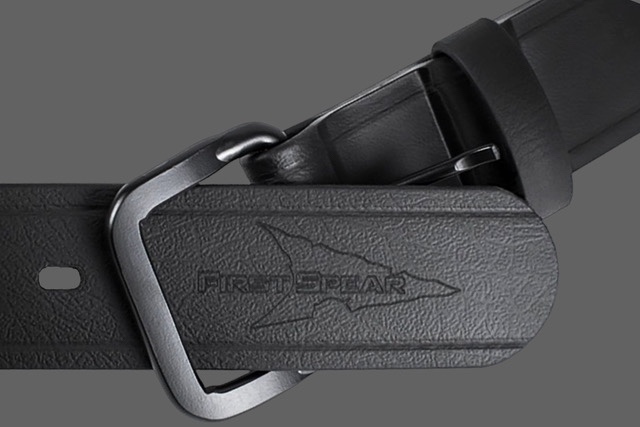
FirstSpear Friday Focus – Line One Belt

Friday, June 16th, 2023

Looking for a belt that can handle anything and still look stylish? Look no further than our Line One Belt! This tactical wonder is named after the old NSW term for first level clothing or gear and provides incredible performance without sacrificing comfort or flexibility. Made from urethane covered nylon, this belt can hold up against any weather and won’t crack, peel, or stiffen in the cold.

The non-slip coating means no more “break-in” time and it won’t lose its shape, even with sweat or water. Plus, it’s perfect for concealed carry or just keeping your pants up with panache. Don’t miss out on the Line One Belt, our most popular choice for everyday wear!

Check out FirstSpear to find American Made kit and accessories, Built For The X.

AFRL Collaborates with Industry Partners on In-Theater Alternative to GPS

Friday, June 16th, 2023

WRIGHT-PATTERSON AIR FORCE BASE, OHIO (AFRL) — The Air Force Research Laboratory, or AFRL, partnered with Luminous Cyber Corp. to develop a more resilient alternative to GPS for regions where coverage is not as reliable or where there is a risk of interference or jamming by malicious actors. Luminous develops alternative-position navigation and timing, or A-PNT solutions for navigation of crewed and uncrewed orbital, avionic, marine and mounted land-based systems.

Luminous submitted their in-theater GPS alternative through the Air and Space Force Tech Connect website, which helps entities from industry, small business and academia gain access to relevant Air and Space Force subject matter experts to provide opportunities to develop new technologies relevant to the U.S. military.

“The submission provides an alternative to GPS along with ultra-wideband secure communications links, an integrated capability needed by our warfighters,” said Dr. Nicholaos I. Limberopoulos, integration lead, aerospace components and subsystems technology at AFRL’s Sensors Directorate. “The submission met the needs for developing a needed integrated capability.”

Collaborating through the Tech Connect website, AFRL’s Sensors Directorate worked with Luminous Cyber to adapt their commercially available Location Information Service, or LIS, platform to provide resilient real-time geolocation and time synchronization information to warfighters in GPS-denied environments.

“We found out about the Tech Connect website through Aegis Creek, a team who specializes in helping small tech companies leverage non-dilutive funding to effectively bring ideas to market,” said Dr. Charles Barry, founder and CEO of Luminous Cyber Corp. “There are a large number of different ways to engage with Air Force and Space Force technical stakeholders. Tech Connect is one of the easiest and most responsive, and it’s well worth the effort.”

Strong collaboration with Tech Connect is key for continuous access to new technology ideas from industry and academia. The Tech Connect program has been a huge success, according to Limberopoulos.

Luminous Cyber sought to adapt their commercially available LIS platform, using their real-time network multilateration technology to include providing geolocation and synchronization data for fixed and mobile airborne Air Force assets in locations where GPS is less reliable because of the danger of outages, jamming, space weather impacts and geographical obstructions. Adapting an already commercially available option to work within the Air Force’s requirements also helped to provide a lower-cost solution than developing one from scratch.

“Luminous’ solution combines advanced algorithms, AI, machine learning and multi-sensor data fusion to provide the utmost in accuracy, safety and reliability,” said Barry. “Given the increasing reliance on GPS and the wide availability of inexpensive tools to jam, spoof and obstruct GPS transmissions, robust A-PNT tools are in high demand.”

According to Luminous, a clear and present danger exists to government and military assets in areas where GPS is not as dependable due to the dependence on GPS for A-PNT, data. Their LIS platform intends to provide an alternative to GPS in areas where signals are less reliable.

Luminous Cyber submitted the idea through the Tech Connect program in May 2021. After initial contact and determining that the proposal had merit, the AFRL Sensors Directorate reached out to Luminous Cyber and the Florida International University o proceed with further development.

“[Tech Connect] gives us confidence that no good ideas are rejected and that those considered and brought forth to us have a good chance of meeting our integrated capability development requirements and making a real difference to the warfighter,” said Limberopoulos.

After further development, Luminous Cyber was selected and funded and underwent a successful transition to a Small Business Innovation Research/Small Business Technology Transfer Phase II with a project kick-off in June 2022.

“Our experience with the Air Force has been quite positive and helped us drive our technology from ideation to product,” said Barry. “A-PNT is crucial to the future of shipping and transportation because of the rise of technologies that can interfere with GPS.”

Jeremy Dunn Air Force Research Laboratory Public Affairs