Register Now for SOF Week

Archive for the ‘Guest Post’ Category

The Other Side of the Bullet

Friday, December 23rd, 2022

Who picks your duty ammunition? The short answer is YOU. You should at least have a say in what your department or range staff chooses. You will be the one carrying the ammunition for either self-defense or in defense of others. This article will highlight the major components of the right ammunition and what you should look for when choosing your duty ammo.  

There’s a lot that goes into selecting duty ammunition: performance, penetration, accuracy, wound cavity, cost, and even politics. To be honest, most officers probably don’t pay attention to all of them, I know I didn’t when I first started. My goal is to give you the details you need to make an informed decision so you can have the confidence that if the trigger must be pulled, you can be damn sure the ammunition coming out of the muzzle is going to do its job.

After sitting on the other side of the rounds for 25 years as a Police Officer in California, I think I’ve earned a seat at the table for this discussion. Now I offer my expertise as a member of the G9 Defense team where we develop, test and manufacture very specialized ammunition specifically engineered to provide lethal and accurate defense for highly concentrated human environments. Pull up a chair and let’s get into it. Don’t take your department or range staff’s word for it—here’s your due diligence.  

I may be dating myself here, but when I began my law enforcement career back in 1992, I only had one choice for duty ammunition. Upon graduating from the academy, the police department issued .38 caliber Smith and Wesson revolvers plus 18 rounds to new recruits—I know, crazy right? The department was always budget conscious if you know what I mean. Semi-automatics were just starting to become popular with our department, but they were costly to purchase. If you wanted to carry a semi-auto, you had to buy your own duty weapon and ammunition, then take an eight-hour transition course to get signed off by the range staff. After taking the course, I picked my duty ammunition from the pre-approved list provided by management and loaded up my magazines. I never really gave too much thought about the projectile’s performance, ballistics, or cost. I trusted the range staff that tested and evaluated the ammunition we were going to use. I had to put into practice what I learned from the academy and use that knowledge in real world scenarios as a police officer where every trigger pull could save or take a life.

As I moved through my law enforcement career, going from Field Training Officer (seven years), Tactical Flight Officer and Pilot (four years) and then a K-9 Officer (fourteen years), I still never really investigated ammunition performance. Thinking back now I tell myself, shame on me. I should have pushed back a little to influence arguably the most important equipment in my daily carry. Simply, I always trusted the range staff that was doing the testing and evaluating of duty ammunition to have the best ammunition selected. At that time, the industry standard was using hollow points. All the big manufacturers were making them and for the most part, they worked. One thing you need to remember is that ammunition has not drastically changed since WWII. The design and concept have remained pretty much the same. Kind of like that adage “If it ain’t broke, don’t fix it.” So why consider new or different ammunition? Well, just like with most things, technology changes, new ideas come out, and maybe those advancements can have a substantial impact on your job and safety.

So, what should you consider when evaluating your choice of ammunition?

Performance  

One of the first things I’d encourage you to consider when evaluating which ammunition to use is performance. How does your ammunition actually work? G9 Defense is a fairly new ammunition company with an innovative design in bullet technology and have most duty calibers readily available with the EHP (External Hollow Point) design. Let’s look at the G9 Defense 9 mm 80 grain EHP for example:

• muzzle velocity of 1480 fps

• design has a controlled penetration based on fluid dynamics

• the projectile is made of solid copper with three angled parabolic flutes

• projectile will stop at approximately 18 inches of depth in 10% ordnance gel with or without barriers

• EHP projectile does not need to expand for terminal effect like traditional hollow points

• 100% reliability in contrast to traditional hollow points

With G9’s improved barrier penetration, high velocity, and the low frontal surface area allows the projectile to penetrate barriers, such as windshields, with very limited deflection or deformation while remaining on target, which leads me to the next topic, penetration.

Penetration

G9’s 9 mm EHP design will not over penetrate on the target like a traditional hollow point if the round fails to deform or open. Traditional hollow points need to expand or “open up” for maximum effect. If the hollow point gets clogged with some sort of barrier or clothing, it basically becomes a Full Metal Jacket (FMJ), and over penetrates. In most reports I’ve read, traditional hollow points fail to deform or open 30% of the time and over 50% of the time when encountering domestic, soft, or hard armor. Don’t take my word for it, there are several third-party reports and tests for you to review and decide for yourself.

G9 Defense’s Website

Defensive Handgun Ammunition Characteristics and Bullet Types 2022 report conducted by Viper Weapons

.308 APX Steel Tip Through Windshield

136 gr 308 Armor Penetrating Round

9mm 77 gr Armor Penetrating Cavitator in Level 3-A Armor

Kimble County, Texas Sheriff’s Office

Wound Cavity

The design of the G9 Defense EHP enables maximum wound cavities. With the shape of the parabolic flutes, it uses Solid Metal Fluid Transfer (SMFT) to move blood, tissue, and organs out away from the projectiles path at a high velocity. Think about a boat propeller in the water, as the propeller spins it pushes the water out away from physical propeller and uses that force to move the boat. In short, it takes the kinetic energy from the projectile and transfers it to the target causing a wider wound channel. If you could stop a threat with less rounds, would you? Being more effective with your ammunition is better than overcompensation for poor performance. View our gel block photos here. In the photos you can see that the G9 projectiles all stop around eighteen inches of penetration and don’t deviate through armor or other mediums while wreaking havoc on its acquired threat.

Accuracy

This comes down to practice, practice, practice. I can’t over state this enough. You need to keep up on your training and drills with your weapon system. Train with the ammunition that you are going to carry. I know some of you are going to say, “Why would I use duty ammunition when I can just use ball ammunition and get the same training? It will cost me too much money to train all the time.” You need to train like you fight. Make sure the ammunition you use will feed and cycle through your handgun. Trust in your ammunition comes with time and that time covers hundreds of trigger pulls. You need to be accurate with the duty ammunition that you carry. Create that muscle memory so when or if you get into that situation when you need to fire your weapon, it becomes a natural movement. Train on failures with your weapon so you know what they feel like and how to clear them quickly. Enhance your time on the range and don’t be afraid to ask someone for pointers if you’re not proficient with your handgun or rifle skills. Get with someone who can teach enhanced shooting techniques.

Cost

You’ve probably heard it said before, but you can’t put a price on your life. If your department is unwilling to accommodate higher quality ammunition for the sake of your safety and effectiveness, it may be worth investing in yourself. You can find more information on the cost of our patented ammunition on our website.

Politics

Lastly, there are a few questions that need to be looked at from a management perspective. If you are in management or plan to present this information to your management, numbers are the most important thing. The more numbers the better.

• How many Officer Involved Shootings are my officers getting involved in on average in a year?

• What is the hit vs. miss percentage?

• Are the suspects starting to wear body armor?

If you knew your standard hollow point ammunition has up to a 50% failure rate when passing through a hardened media, why are you still issuing it? This is something the range staff and management should have a conversation about at least a couple of times a year. Police work has a very fluid dynamic to it that constantly evolves and changes. The evolution is something we have all seen over the last few years. Police work is not the same as it was when I was working. Over the last several years, you can see how the political environment has played a major part in police work, and likely duty ammunition selection. I could probably write another article on the political impact of modern policing, but I am not sure my blood pressure could handle it.

Like I said at the beginning, it is up to you to decide or at least have input into what you carry on duty. The next time you go to the range, talk to the range staff about their selection process for duty ammunition. Do they evaluate performance, penetration, and wound cavity? See if there is a committee made up of different ranks within the department. Ask to be a part of how ammunition is selected for duty. Do your research and have information in your back pocket to back up your opinion. Look at third party reports and videos. If you’re able get a few buddies together and buy some different ammunition, go test it yourself. It doesn’t have to be a huge scientific experiment but look at those points I mentioned above. How does your ammunition stack up when it comes to performance, penetration, wound cavity, and accuracy. Shoot some different types of mediums, like clothing, lightweight and heavy jackets, drywall, and plywood. Ask the range staff about how they test through automobile glass. Your life is on the line—help select the best ammunition available to keep you in the fight another day.

Written by Retired Police Officer, Michael Wooldridge

Long Beach Police Department, Long Beach, CA

FirstSpear Friday Focus: Merry Christmas

Friday, December 23rd, 2022

Merry Christmas and Happy Holidays to you and your’s. FirstSpear is proud to support those at the Tip of The Spear with 100% American Made gear.

Checkout FirstSpear to learn more about our American Made products, Built For The X.

Accomplished EOD Soldier Now Serves as Army Golden Knight

Friday, December 23rd, 2022

FORT BRAGG, N.C. — A U.S. Army explosive ordnance disposal Soldier made a grand entrance into the Army-Navy game at Lincoln Financial Field in Philadelphia, Dec. 10.

Staff Sgt. Devin T. Diaz jumped into the stadium during the pre-game activities as a member of the U.S. Army Golden Knights Parachute Team.

A native of Sunnyvale, California, Diaz previously served in the 47th Ordnance Company (EOD) on Fort Hood, Texas, and the 759th Ordnance Company (EOD) on Fort Irwin, California.

Both EOD companies are part of the 71st EOD Group and 20th Chemical, Biological, Radiological, Nuclear, Explosives (CBRNE) Command, the U.S. military’s premier all hazards formation. From 19 bases on 16 states, Soldiers and U.S. Army civilians from 20th CBRNE Command take on the world’s most dangerous hazards in support of joint, interagency and allied operations.

Diaz later served in the U.S. Army Asymmetric Warfare Group on Fort Meade, Maryland, as an EOD advisor. He was the first staff sergeant to make it through the Operational Advisor Training Course in the history of the group.

Diaz decided to become an EOD technician while serving with the military police in Afghanistan on a Counter Improvised Explosive Device team. He was selected for the EOD program in 2011.

He has deployed to Afghanistan three times, including two deployments with Military Police and one as an EOD team leader. He also deployed with the 759th EOD Company to Syria.

From range clearance operations at the National Training Center on Fort Irwin, California, to defeating improvised explosive devices in a combat zone, Diaz has honed his lifesaving and mission-enabling skills. In one of many unique missions in Afghanistan, as an EOD team leader with the 47th EOD Company, Diaz conducted post-blast analysis on 15 trucks that had been destroyed by insurgents with improvised explosive devices.

While serving in the 759th EOD Company, Diaz was also a member of the winning Bomb Squad team in the U.S. Department of Homeland Security-hosted competition called Urban Shield that brought together California SWAT teams, Fire and Rescue Teams, Emergency Medical Services and Bomb Techs.

He said it takes perseverance to succeed as an Army EOD technician.

“The more resilient that you can be, the better an EOD tech you can be,” said Diaz.

Earlier this year, Diaz demonstrated this kind of resilience when he tore his patellar tendon. After having surgery in February, Diaz was told it would take six to eight months before he could run or jump again.

He started running again four months later and participated in a half marathon six months later. On Oct. 9, he jumped into the Army Ten Miler in Washington, D.C., and then ran the race. He said he intends to participate in the Miami Marathon and he is preparing for an ultramarathon in the future.

Diaz was picked for the Golden Knights during the 2020 assessment and selection. Any American Soldier can apply to serve in the Golden Knights if they have completed 75 free fall jumps, either in the military or as a civilian.

Since the team’s inception, the Golden Knights have participated in 16,000 events in 50 states and 48 countries. With 50 jumpers and 50 support personnel, the teams travel roughly 240 days out of every year. They are one of three U.S. Department of Defense-sanctioned aerial demonstration teams, together with the U.S. Navy Blue Angels and U.S. Air Force Thunderbirds.

As a Golden Knight, Diaz has landed at sports venues and community events around the nation.

From landing on the aircraft carrier USS Midway Museum in San Diego to jumping into Yankees Stadium in New York City, Diaz has participated in 40 different events during his two years as a member of the Golden Knights’ Gold Team.

The highlight of his jumps so far has been landing on the field before the San Francisco 49ers and Los Angeles Chargers game, Nov. 13.

“I got to jump into my hometown stadium,” said Diaz, who has served in the U.S. Army for almost 17 years. “Not only did I get to do that, but my wife and my father were on the field when I landed.”

Command Sgt. Maj. David J. Silva, the senior enlisted leader from the 71st Ordnance Group (EOD), said Diaz personifies the high caliber of Soldiers serving in the Army EOD community.

“He is a consummate professional who never stops seeking and conquering the next challenge. Whether its disarming IEDs in Syria, improving the Army’s ability to counter asymmetric threats or now supporting recruiting as a member of the elite Golden Knights, he’s an example of what you can achieve if you refuse to get comfortable,” said Silva, a master EOD technician from Long Beach, California, who is the senior enlisted leader for the EOD group that commands all U.S. Army EOD Soldiers stationed west of the Mississippi River.

“He proves EOD isn’t just a military occupational specialty. It’s a profession that gives you the skills to succeed in any venture. We have bomb techs who are working with industry partners and civilian agencies, flying planes and helicopters, ship captains in the Army’s sea fleet and working in Congressional fellowships. We offer complex training under high pressure situations with caring leaders to ensure mission success. That success doesn’t stop in the Army, it carries over to life,” said Silva. “It’s not just a job, it’s a calling that doesn’t stop at the bomb.”

By Walter Ham

215 Gear Joins Mammoth Nation

Thursday, December 22nd, 2022

We have joined Mammoth Nation! If you haven’t heard, Mammoth Nation is America’s Conservative Discount Marketplace. They’re a membership-based online shopping platform with an emphasis on American-owned businesses and/or products made in America while also openly supporting Conservative Candidates and Causes. Members receive great discounts from a growing list of companies that share our values.

Check them out at www.mammothnation.com

Support our new affiliate and many other great American companies by joining Mammoth Nation today!

Save 30% on membership fees by using promo code 215GEAR30

Or use this link mammothnation.com/join-mammoth-nation

C-145A Combat Coyote Makes Final Run After Decade of Service

Thursday, December 22nd, 2022

DUKE FIELD, Fla. —  

Aircrews from the Air Force Reserve’s 711th Special Operations Squadron departed the Duke Field flightline Dec. 15, 2022, in four C-145A Combat Coyote aircraft for the last time after 10 years of service to Air Force Special Operations Command.

When the aircraft returned, aviators, loadmasters, and ground crew alike all gathered to respectfully mark the end of an era.

The Combat Coyote’s landed in sequence and proceeded in tight formation down the taxiiway as if to offer one final show for the small group of awaiting spectators.

“There weren’t many other aircraft in the Air Force like this one,” said retired Chief Master Sgt. Bobby Barton, former senior enlisted leader of the 919th Special Operations Group. “These guys loved this airplane, it really stood out from the crowd.”

The 919th Special Operations Wing began utilizing the Combat Coyote in 2012. Combat Aviation Advisors from the 711th SOS used the aircraft to maintain proficiency prior to instructing partner nation aircrew on a wide range of advanced aviation tactics. Instructors from the 5th Special Operations Squadron Detachment 1 at Duke Field trained U.S. Air Force pilots on the aircraft for Air Force Special Operations Command.

Although it was not used for overseas deployments in recent years, the Combat Coyote’s provided a tactical mobility advantage to missions downrange when they were initially purchased by the command. They could make short landings and takeoffs, ideal for rural, undeveloped airfields and cargo delivery to forward operating bases.

“Today’s flight was a little bitter sweet,” said Maj. Kristoffer Williams, 711th SOS chief of safety. “It’s been a great aircraft to fly, the Wolfhound was good to us while it lasted.”

The 919th SOW was the last wing operating the airframe, officially retiring it from the U.S. Air Force. Citizen Air Commandos and their families gathered on the flightline to watch the planes land and congratulate pilots on the final flight.

“We put a lot of blood, sweat and tears into this airframe,” said Williams. “We learned to appreciate it, but it’s time to move on to the next aircraft.”

The wing has a historical precedent of adapting to the needs of the Air Force. The 919th SOW previously retired the beloved AC-130H Spectre and the MC-130E Combat Talon I. As it has in years past, the wing is prepared to transform to meet the future needs of Air Force Special Operations Command.

“The only constant in the Air Force is change,” said Barton. “The people that flew the C-145 enjoyed it. It was a nice aircraft to have for a while, but I’m looking forward to the next one.”

By Senior Airman Dylan Gentile, 919th Special Operations Wing

Wood Fired Ovens & Accessories from WPPO

Wednesday, December 21st, 2022

A friend recently gave us a heads up about WPPO, a small business which manufactures Wood Fired Ovens and Accessories.

Although it’s something you wouldn’t normally see on SSD, we thought it was worth a share considering the holiday season.

So whether you’re looking for a unique gift for a loved one or are salivating over all of the delicious pies you could bake in one of these ovens on your next bivouac, check them out.

Greetings from WPPO LLC! We are the fastest-growing and most renowned wood fired oven manufacturers located in the United States and abroad.

At WPPO LLC, we pride ourselves on people over profits, quality over quantity, and service over self-service. With these three priorities at the top of our list, we have become one of the fastest-growing, highly respected Wood Fired Oven manufacturers in North America and abroad.

With our own innovative mindset, we develop, design, test, and manufacture all of our ovens to meet every customer’s demands. From portable to professional ovens, we have you covered.

We use high-quality materials, advanced technology, state of the art machinery, and high-quality people in every aspect of our business. We feel we have the best from our manufacturing facilities domestically and abroad through to our distribution and dealer network.

We are a small privately owned company with great values, knowledge, understanding, and most importantly, a love for wood-fired ovens.

We hope you will join our family of friends inspired by food.

We hope to get fired up with you,

– Dan & Lisa

Get 20% off and free shipping on any wood fired oven from the website. Use Promo Code “SSD20”.

www.wppollc.com

US Navy – New Boot Design and NWU Fleece Wear Rules Announced in Extensive Uniform Update

Wednesday, December 21st, 2022

ARLINGTON, Va. – A new boot option for Sailors is expected to be available in Navy Exchange Uniform Shops as soon as January, according to an extensive uniform update released in NAVADMIN 285/22 . The update also announces seven uniform policy improvements while introducing details of five additional uniform initiatives now underway.

The update also announces seven uniform policy improvements while introducing details of five additional uniform initiatives now underway.

“The following uniform and grooming policy updates are intended to reduce out-of-pocket expenses, simplify sea bag requirements, and to announce design changes of uniform components and breast insignia,” Vice Adm. Richard J. Cheeseman, the chief of naval personnel, wrote in the message.

Here’s a look at the highlights:

I-Boot 5

The Navy’s latest in working uniform footwear, in development for the past four years, became operational Oct. 1 when issue started at Recruit Training Command in Great Lakes, Ill.

The I-Boot 5 is a lightweight safety boot with a full inner lining and steel toes. Its smooth outer leather uppers will be available in either black or brown. 

Wearing the boot is approved for nearly every Navy environment, including flight decks at all commands afloat and ashore. The boot should be available in January 2023 at Navy Exchange Uniform Shops. 

Existing Navy Working Uniform boots and the I-Boot 4 remain authorized for wear as long as they are serviceable. Other approved optional boots are also still authorized for wear. A complete list is available in the Navy Uniform Regulations.

Black Cold Weather Parka

Also, effective immediately, the black cold weather parka (CWP) can be worn with the NWU Type III when wearing camouflage isn’t a mission requirement.

However, wear is only authorized ashore in non-operational and non-industrial environments. That’s because the CWP material isn’t strong enough to withstand use in industrial or operational environments, which will cause premature wear and tear and shorten its wear life.

The NWU Type III parka is still authorized, and the expansion of CWP wear is in addition to its intended purpose as an outer garment for wear with service and service dress uniforms.

Alternate PT Uniform Fitness Suit

Now approved is an alternate version of the existing Navy’s fitness suit jacket and pants. While retaining the design and color of the standard fitness suit, the new version has no reflective piping.

According to the message, the new version should be available at your local Navy Exchange Uniform Center in November 2022. Sailors should wear a reflective belt or vest when wearing the physical training uniform outdoors while working out during reduced visibility hours.

Naval Security Force Insignia

The Navy is phasing out the four-digit, alpha-numeric serial number on Navy Security Force (NSF) Identification (ID) Badges. Effective immediately, a new badge will be issued. It is identical to the original, except where the serial number was at the base of the badge now has a black engraved star instead.

NSF metal badges with the serial number design are still authorized for wear until the Sailor is honorably discharged or retired. The new NSF metal identification badges will be available for command purchase; details and stock numbers are in the NAVADMIN.

Qualifying Sailors can now wear the newly approved Navy Security Force Qualification Breast Insignia, expected in Navy Exchange Uniform Shops soon.

The award of the insignia is through the Navy Security Force Qualification Program, which was approved earlier this year in NAVADMIN 094/22 on April 13. The qualification program is only open to active and reserve Sailors in the Master-at-Arms rating and Navy Security Force Officers.

Dinner Dress Blue and White Jacket

Lieutenant commanders will no longer be mandated to have the Dinner Dress Blue and White uniforms. That requirement is changed, only requiring O-5 through O-10 officers to have the uniform. It remains optional for pay grades E-1 through O-4.

Female Uniform Updates

For women, the earring policy now allows optional wear of silver, white and yellow gold, white pearl and colorless diamond earrings with all uniforms for both officers and enlisted.

Earring manner of wear and authorized size while in uniform remains the same as outlined in the Navy Uniform Regulations. However, earring wear may be restricted by the commanding officer if they present a foreign object debris hazard.

The belted white skirt is now authorized for optional wear with the officer and chief petty officer Summer White and Service Dress White uniforms, along with the unbelted white skirt, which remains optional.

Women can also look forward to a redesigned Maternity Service Dress Blue Coat, expected to be available sometime in 2023. Design improvements include adjustable side tabs to align with all current maternity uniform tops.

Also under development are two new over-blouse concepts for the female officer and chief petty officer Summer White and Service Dress Blue uniforms, respectively. Initial designs are currently under development.

Size Standardization Underway

The Chief of Naval Personnel, Navy Exchange Service Command and Navy Clothing and Textile Research Facility are carrying out a collaborative effort to improve the design and fit of male and female Sailor uniforms through standardization of sizes.

The plan expects to give a better fit of uniforms to today’s population, reducing the need for alterations beyond typical hemming. The effort’s current focus is on female slacks, skirts, shirts and blouses. 

More details are available in the NAVADMIN. More uniform information is available on the Navy Uniform Matters Website.

The Navy Uniform Matters Office welcomes feedback and recommendations from Sailors about uniform and grooming policies via the MyNavy UNIFORMS App or MyNavy Portal. Once signed into MNP, select Professional Resources, then choose Navy U.S. Uniforms and “Ask the Chiefs.”

From Mass Communication Specialist 1st Class Mark D. Faram, Chief of Naval Personnel public affairs

US Army’s 3d CR Troopers Test New CBRN Protection Garments

Wednesday, December 21st, 2022

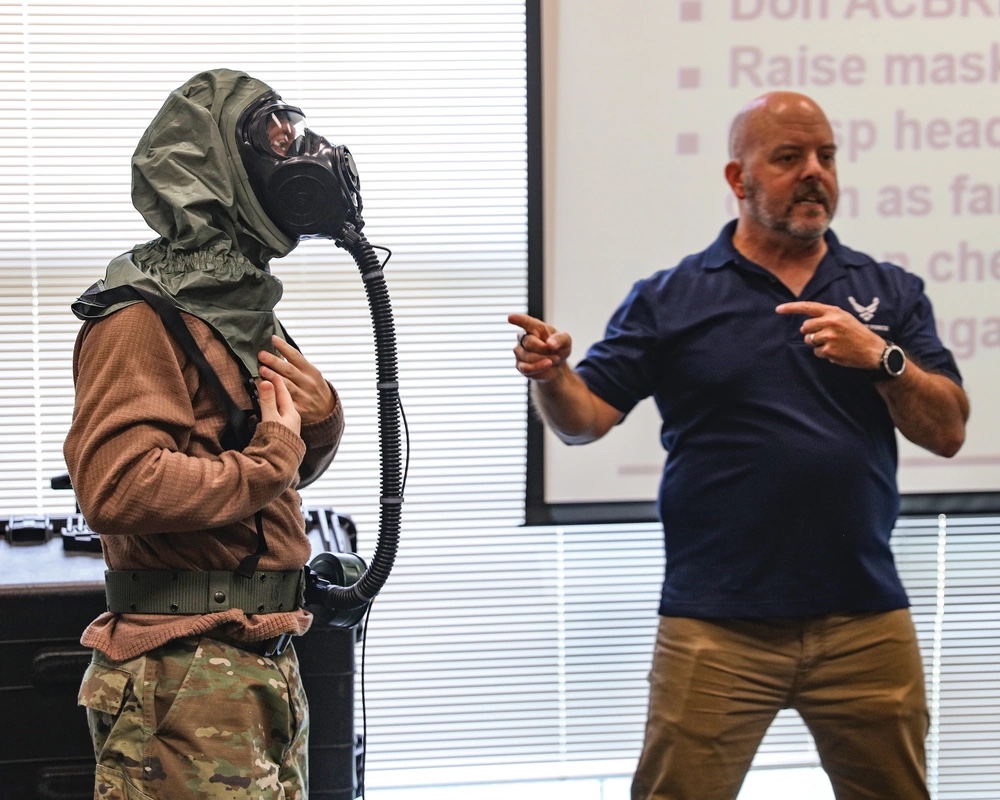
FORT HOOD, Texas—3d Cavalry Regiment Troopers took part in testing new Chemical, Biological, Radiation, and Nuclear protection garments here Dec. 5-8.

The Chemical, Biological Duty Uniform (CBDU), is still in the testing phase but is projected to replace the Joint Service Lightweight Integrated Suit Technology (JSLIST) and fielded in the next few years.

Features of the new CBDU improve on the fitting, comfort, weight, temperature regulation, and CBRN protection – much needed upgrades from the JSLIST Troopers are currently fielded, according to Tiffany Swidrak, a test support analyst for the Joint Program Executive Office for Chemical, Biological, Radiological and Nuclear Defense – General Purpose team.

“We’re doing simple simulations by having the [Trooper] wear the garments and move around in them while we take measurements,” said Dr. Todd Garlie, a research anthropologist from U.S. Army Combat Capabilities Development Command. “It’s critical that we get Soldiers’ feedback on how the garments fit. If you don’t have good fitting equipment, you can’t perform your mission.”

The new CBDU is both lighter and cooler than the current JSLIST, mainly due to how it is worn. It is integrated into the duty uniform, rather than being a separate set of overgarments.

“It feels like you’re wearing a thicker set of pajamas,” said Staff Sgt. Zachary Keel, a cavalry scout leader assigned to 4th Squadron, 3d CR. “I think it’s a big improvement to the JSLIST.”

The CBDU has been in the testing phase for several months and will soon be fielded across most branches of the military.

“Our goal at (USACCDC) is that we optimize the equipment,” said Garlie “The mission is simple. Protect the Soldier, bring them home safely.”

Story by SSG Christopher Stewart 

3d Cavalry Regiment Public Affairs Office