Register Now for SOF Week

Archive for the ‘Guest Post’ Category

Georgia National Guard Tests New Live-Fire Range System

Sunday, April 10th, 2022

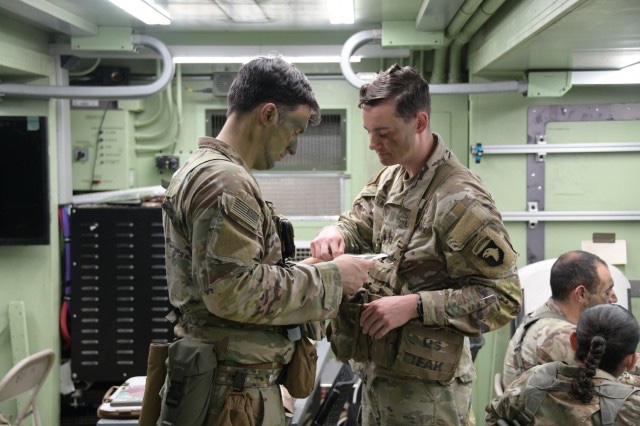
FORT STEWART, Ga. – The Georgia Army National Guard’s 122nd Tactical Support Detachment traveled to Fort Stewart for the April 1-3 drill weekend to train and qualify Soldiers on the M4 carbine rifle and M17 pistol.

The training, conducted annually to ensure unit readiness, was unique due to the software that Soldiers from the 122nd TSD operated from the range tower to control targets, score shooters and provide statistical feedback. TRACR II had been an untested Army system; the 122nd TSD was the first unit to use the new technology.

Targetry Range Automated Control and Recording (TRACR II) provided these Georgia Guardsmen with firsthand experience on a fresh interface that addressed many of the after-action reviews and suggestions made by previous operators of the legacy system.

“No Soldier has ever operated TRACR II yet,” Alex Stinefast, Program Executive Office Simulation, Training and Instrumentation (PEO STRI) program manager for TRACR II, said before the 122nd used the system on the range. “The intent is to leave it in Fort Stewart for 120 days and gather Soldiers’ feedback so that we can make improvements prior to going into full-rate production and send it out to all of the Army.”

The legacy TRACR software has been in use since its development and implementation in 2005-08 and has been updated approximately six times, according to David Howard, TRACR II program engineer.

“We’ve gone from the old Java-based type of application to more of a web-based application, which you see now on your phones,” said Howard.

Soldiers of the 122nd TSD said the software had a familiar app-like feel and was easy to learn and use when supporting range operations.

“I think it’s very beginner-friendly,” said Sgt. Desmond Albright, from the 122nd TSD.

Within 30 minutes, he learned the program and navigated the controls. The new colorful display on the system allowed him and other users from the detachment to select multiple targets, create scenarios, and assign motions to the silhouettes on the range. The leaders overseeing the training and qualification could provide individual scorecards to all the shooters to let them know which targets they had engaged or missed.

“It was a great experience,” said Albright. “As far as being newly introduced to [TRACR II] for the first time, it was pretty easy to use.”

Supported by the new TRACR II software, all participating Soldiers successfully engaged the required amount of targets with their assigned weapons and recorded qualifying scores.

The TRACR II team hopes the new software provides a platform for better training in Fort Stewart and throughout the Army.

“We are expecting the new equipment training to be significantly shorter,” said Stinefast. “We are hoping that the range operators can come in and figure out how to operate it and then start running the range.”

By MAJ Charles Emmons, Georgia National Guard

Thinking Outside the Mailbox: Robins AFB First Base to Get Intelligent Lockers

Saturday, April 9th, 2022

ROBINS AIR FORCE BASE, Ga. (AFNS) —

What started out as an Airman’s innovative idea to help his wingmen is now a reality at Robins Air Force Base.

The installation held a ribbon cutting ceremony March 30 for its recently installed Intelligent Lockers, giving the Airmen at the dormitories a centralized location to receive their packages after hours.

The lockers started as an idea presented by Senior Airman Ricardo Morales, 461st Aircraft Maintenance group crew chief, during the 2021 Air Force Installation Maintenance and Mission Support Center Innovation Rodeo. Morales was chosen as the winner, and subsequently, Robins AFB was awarded $235,000 and became the first base to install the Intelligent Lockers at its dorms.

“It makes me so happy to see the lockers are ready to be used by all the Airmen in the dorms,” Morales said. “I’d like to thank everyone who contributed to the implementation of the lockers.”

Morales said the locker idea came to him after noticing fellow Airmen experienced delays in getting their packages because their work schedules conflicted with the limited post office hours on base.

According to Morales, his idea not only saves space in the postal facility but allows Airmen to pick up their mail at a convenient time for them.

“I couldn’t have done it without the support of my local innovation hub and AFMISC,” Morales said during a ribbon-cutting ceremony for the new lockers. “This will improve life for Airmen because they can now retrieve their packages 24/7. Shift workers will now be able to get off their shift and retrieve their package at any time of the day without having to work around the base post office’s limited hours.”

Several members of installation leadership attended the ceremony, including Col. Rosalie Duarte, 78th Air Base Wing vice commander, who gave opening remarks.

“Innovation is a top priority of our Air Force leaders, starting with (Air Force Chief of Staff) Gen. Charles Q. Brown, Jr., when he demanded that we accelerate, change, or lose,” Duarte said. “Here at Robins, we’ve taken this direction on innovation very seriously by empowering our Airmen – both military and civilian. We truly believe empowered Airmen can solve any problem.”

Also in attendance was Maj. Gen. Michael Koscheski, Fifteenth Air Force commander.

“This is wonderful,” Koscheski said. “We need to grow that innovative spirit across our force. That is how we are going to accelerate change,” he said. “We have to think our way to a better Air Force, and today is a great example at how we will do that.”

Col. Michelle Carns, 461st Air Control Wing commander, commended Morales for his tenacity.

“This was almost a two-year process,” Carns said. “He never quit, never gave up, and hung in there no matter what he encountered. I love what he did because it was not just about him; it was about the team.

“He wasn’t the only one not getting his mail, and he wanted to do something community-minded,” she continued. “His innovation will improve the quality of life for all Airmen living in the dorms here at Robins.”

Carns said seven other bases have already scheduled Intelligent Lockers to be installed at their facilities and eventually this service will be available across the Air Force. 

Morales encourages everyone to put on their thinking caps to bring positive change to the Air Force.

“Innovation has no rank,” he said. “You can still make a difference. Get connected with your local innovation hub so they can help you navigate your idea and provide you with any needed resources. I did this as an Airman 1st Class; you can too.” 

By Kisha Foster Johnson, Robins Air Force Base Public Affairs

FirstSpear Friday Focus: Hooded Field Shirt

Friday, April 8th, 2022

Spring is here and FirstSpear is giving us a look at an extremely popular garment from their all American merino wool apparel line up, the Hooded Field Shirt. This garment is generously cut with an oversized hood with absolutely no hardware making for an incredibly comfortable and highly functional base layer or perfect stand-alone top when temperatures are fluctuating. Perfect for layering under jackets when the temperatures are cool and moisture-wicking properties of wool will help keep you cool in the heat.

• American Merino Wool

• Generously cut for long-term comfort

• Oversized hood

• Low profile cuffs with thumb holes

• Made in the USA

In stock and now shipping in black, commando, sand and heather grey. These are 100% made in the USA with USA materials.

For more information, check out www.first-spear.com/technical-apparel/american-merino-wool/field-hoodie.

Marines with 1st Battalion, 12th Marines, 3rd Marine Division Experiment with Twenty-First Century Foraging Concepts

Friday, April 8th, 2022

KANEOHE BAY, Hawaii —

U.S. Marines with 1st Battalion, 12th Marines, 3rd Marine Division experimented Twenty-First Century Foraging concepts during Spartan Fury 22.1 at Pohakuloa Training Area, Hawaii, March 2022.

Twenty-First Century Foraging concepts enable commanders to extend and enhance operational rations for a period without needing outside logistics support. “It is imperative that the Marine Corps logistics functions continue to adapt to force design and the future warfighting concepts. That includes reducing our logistical footprint,” said Lt. Col. Richard Neikirk, commanding officer of 1st Battalion, 12th Marines.

During the exercise, individual Marines procured dry goods and fresh produce from local suppliers utilizing cash 1105 funds. The Marines were able to find and purchase eggs, sausage, bacon, chicken, rice, and canned vegetables. The food was brought back to the training area where the Marines experimented with various field cooking methods.

 “It is imperative that the Marine Corps logistics functions continue to adapt to force design and the future warfighting concepts. That includes reducing our logistical footprint”

 Lt. Col. Richard Neikirk, 1st Battalion, 12th Marines commanding officer

The Marines used lightweight, expeditionary, non-organic food service equipment such as individual cooking stoves, volcano grills, and the Expeditionary Food Service Trailer that is currently being developed by the Fort Lee Instructor staff. This equipment is designed to be sustainable for long durations in austere environments and will be employed by the lowest level of any unit and in any environment.

The food was able to feed the battery for three days with two cooked meals a day. The warm meals were a welcomed change from the self-contained, individual field rations that are typically consumed in the field. By cooking and procuring food, the battery proved that it could sustain itself without outside support for a duration of time. Limiting the need for outside logistics support enhances a unit’s ability to be adaptable, mobile, and lethal.

The experimentation allowed the Food Service Specialist accompanied by the Marines in the battery to exercise foraging concepts in a CONUS training environment. “This trial period allowed the Fort Lee Instructor staff to gain real life data and procedural analysis,” said Capt. Norman Bunch, operations officer at Marine Detachment Fort Lee.

The data collected during Spartan Fury 22.1 will be used to develop future training and readiness standards as well as the future periods of instruction for Entry Level, Non-Commissioned Officer, and Staff Non-Commissioned Officer Courses.

By Staff Sgt. Olivia Knapp

The Royal Dutch Marines: A Way of Life

Thursday, April 7th, 2022

GRAFENWOEHR TRAINING AREA, Germany – It is a commitment not to be taken lightly. The choice to become a Royal Dutch Marine is more than committing oneself to a new job – it’s committing to a new way of life.

“It was a lot harder than I thought it was going to be,” admitted Marine 2nd class Collins. Collins, born to a Dutch mother and an American father, followed in the footsteps of his father who served in the United States Army. “I was looking for the biggest challenge I could find, and I was looking for an exciting job, and I found both.”

Collins said that waking up early, not always getting enough food or sleep, combined with the rigors of physical training, initially made adjustment to military life a challenge.

“The Dutch Marines are known for their arduous training programs, which are primarily focused around hardship,” said 1LTC van Haaren. Enlisted Marines must complete two phases to become a Royal Dutch Marine. Part of the second phase takes place at Grafenwoehr, Germany, because according to van Haaren, the Netherlands lacks live-fire ranges. This phase is initial tactical training, and consists of 15 weeks of rigorous training, which is demanding both physically and mentally.

At the completion first phase, only half of the enlisted hopefuls will pass.

The speed march is an example of one of the more challenging physical and mental events for prospective Royal Dutch Marines. The Marines ran carrying rucksacks weighing approximately 40 pounds, in addition to weapons (the Colt C7 and switching off the general-purpose machine gun FM MAG 7.62). The speed march was five miles long and completed in under just 50 minutes.

The reason for the demanding nature of training is simple – to fashion the Marines into their most strong and capable selves, and to ensure only the most resolute of them make it to the Royal Dutch Marine Corps.

“Once you’re in, it’s usually for life,” said van Haaren, who himself plans to make a career of the Royal Dutch Marines.

According to van Haaren, the Royal Dutch Marine Corps specializes in carrying out special maritime operations, amphibious landings, and expeditionary land operations with light infantry units. They can be deployed for long periods of time, under all climatological and geographical circumstances. As sea soldiers, they deploy from Royal Netherlands Navy ships to carry out amphibious landings. On the ground, the Royal Dutch Marines must be capable of sustaining their own survival for up to 72 hours with zero support.

For that reason, both phases of training must be intense.

On the ranges of Grafenwoehr Training Area, equipped with Colt C7s, the Marines practice fire and movement drills which consist of individual and platoon movements. The Marines also work in pairs to train on their general-purpose machine gun, the 7.62 FN MAG, with one Marine reloading and signaling to the firer when to shoot. The ability to do this requires a great deal of teamwork, discipline, and situational awareness.

The practice of live fire could be potentially unnerving for some, but for the right few, the process can be invigorating.

“I really enjoyed the shooting drills,” said Collins, with a grin. “Probably one of my favorite things to do.” Collins had never shot prior to enlisting.

After their time in Grafenwoehr, the Marines will return to the Netherlands and continue their second phase of training. It takes place at the Mariniers Opleidings Centrum at the Van Ghentkazerne in Rotterdam. During this time, the Marines execute multiple land and amphibious validation operations. Fresh challenges will await them, with more demands on their bodies and minds.

For Collins, these demands are worth it. He motivates himself by thinking of his father, who he wants to make proud, and by avowing to himself to finish what he started.

“Being a Marine, to me, means to keep going where others might quit,” said Collins. “To always help the guy to the left and right of you, and to help the less fortunate around the world.”

Once both phases of training are successfully completed, van Haaren said the Marines will receive their “dark blue beret”. From there, they will be assigned at last to the operational units of the Royal Dutch Marine Corps. Their training will be complete, but their real journey and the rest of their lives, will have just begun.

Learn more about the Grafenwoehr Training Area at: www.7atc.army.mil

By SPC Elizabeth MacPherson

S.O.Tech x GWA ARVN Pack Redux in Tiger Stripe

Wednesday, April 6th, 2022

“A combination of the old tried and true with modern technology – a reflection of SOTECH.”

Respecting the calls for us to reintroduce our h-harnesses and belts, we recognized a trend to go back to the battle tested designs of the past. In doing so, we wanted to honor our beginnings by doing a reboot of an ALICE Pack predecessor – the ARVN Ranger Pack, a favorite of MACV-SOG and other SOF units.

At a base level, this is a hat tip to our early days modifying ALICE packs, but it’s much more significant than that. SOTECH started in a time when we were issued the same tired designs that barely evolved from World War Two through Korea and Vietnam and into the Cold War of the 80’s.

There was a creativity born from lessons from the field, and a handful of innovators started companies to modify and then create alternatives. In this vein, we took the day pack version of what would become the ALICE and modernized and modified the design with Tegris and improved cuts (the pack was designed for small-framed Vietnamese soldiers). The result is an EDC pack that takes you back to your days in BDUs every time you cinch that ribbed web through those metal tabler buckles.

The ARVN pack meticulously recreated, every small detail accounted for. Original steel hardware upcycled from original issued kit.

Updates from the original:

-Updated 420D Nylon vs canvas. Same nylon as the Medium and Large ALICE packs

-Snap closure front 2 pockets for easier and faster access

-Hidden HDPE insert with foam backer for extra comfort

-Updated frame, from steel to modern laser cut Tegris, designed in collab. with GWA

-Repositioned bottom shoulder strap ring to the side for extra comfort

S.O.Tech x GWA ARVN Packs in Tiger will run $200.

Packs go live on sotechtactical.com main page on 4/8 at 12pm PST.

Use following code at checkout for free shipping (domestic orders only): asseenonssd

www.sotechtactical.com

“Built to survive the world’s worst!”

U.S. Army Special Operations Command Troops Test RA-1 Ram Air Parachute Automatic Activation Device

Wednesday, April 6th, 2022

FORT BRAGG, North Carolina – Airborne equipment testers here are busy with Special Operations Soldiers testing the Army’s newest Enhanced Electronic Automatic Activation Device (EEAAD).

The Airborne and Special Operations Test Directorate (ABNSOTD) is gathering data from the operational user to support an Army-wide fielding decision to replace the aging reserve automatic activation device currently fielded to military free-fall (MFF) units.

“The EEAAD provides the capability of the rigger shop to download the data instantly, which is not provided by the currently fielded automated activation device,” said a Parachute Rigger with the U.S. Army Special Operations Command.

The ABNSOTD first completed risk reduction efforts for the EEAAD using only ABNSOTD test jumpers to ensure that the intended test item did not impose additional and unforeseen risks or hazards to the jumper before operational test jumps.

Operational testing started in the vertical wind tunnel.

“This allowed the test team to observe the approach load system under simulated free-fall conditions being employed by a MFF qualified test jumper,” said James Cochran (JC), a seasoned Military Test Plans Analyst with the ABNSOTD.

“The ABNSOTD employed a host of risk reduction measures to ensure the potential test item was safe and effective from the intended user’s standpoint,” he said.

Operational Soldiers from USASOC finished testing with the RA-1 main parachute and reserve with the EEAAD installed by conducting MFF test jumps into the Laurinburg, North Carolina drop zone.

“The EEAAD will not only provide MFF operators with a next-generation reserve parachute activation device but will also facilitate after action reviews,” said Lt. Col Derek Johnson, Chief of ABNSOTD’s test division.

“The EEAAD will also support jump incident investigations by providing the ability to download and analyze flight data at the unit level,” he added.

The operational testing consisted of new user training and military free fall jumps followed by data collection of jump data, downloaded from the EEAAD.

“The simplicity of the menus and setting provides more confidence to the jumper that the device will work as expected,” said one USASOC Operator.

By Mr. Richard Hedgecock, Military Test Plans Analyst, Airborne and Special Operations Test Directorate, U.S. Army Operational Test Command

109th AW Modernizes LC-130 for Future Fight

Tuesday, April 5th, 2022

SCHENECTADY, N.Y. (AFNS) —  

LC-130 Hercules aircraft will have a smoother takeoff from Antarctica and Greenland thanks to the 109th Maintenance Squadron. 

Propulsion specialists with the 109th assembled the first Air National Guard-built T56 3.5 turbo engine. The 3.5 modification is part of an Air Force initiative to update C-130 aircraft. 

The 109th’s engine is the first to be assembled in-unit by Airmen. 

This 3.5 engine is the finishing piece to modernizing the 109th’s legacy fleet into a more powerful and eco-friendly force. 

Operating the Defense Department’s only ski-equipped LC-130 Hercules aircraft, the 109th MXS deploys annually to the austere environments of Greenland and Antarctica in support of the National Science Foundation. 

Occasionally, the aircraft have trouble taking off from icy surfaces of these areas of operation due to heavy cargo loads or friction lock under the skis. 

Traditionally, jet-assisted takeoff bottles are used to create extra thrust to get the aircraft off the snow or ice and into the air. JATO production, however, officially stopped in 1991. 

Maj. Jim Roth, 109th MXS commander, explained the increasing challenges using JATO. 

“They are depleting, and every time we use them, we have to shoot eight off at a time, and it begins to present a real logistical concern when it comes to the decreasing supply,” Roth said. 

The new T56-8-15A 3.5 engines, combined with the LC-130H’s NP2000 eight-bladed propellers, are the answer to beginning to shift away from JATO bottles. 

“The updated features allow the aircraft to create the same thrust as JATO bottles but at lower operating temperatures, making them more eco-friendly,” said Staff Sgt. Jason Candido, a propulsion specialist with the 109th. “We’re looking at an efficiency of about 20 percent more fuel efficiency compared to the 3.0 engine.” 

The aircraft will also be able to carry heavier cargo loads to remote polar regions. 

“We are the only heavy airlift able to reach these remote polar camps. These new engines allow for greater range and capacity. We’re advancing the Arctic Strategy that much more,” Roth said. “It’s the expertise and abilities of 109th Airmen like Jason Candido that drive us forward.” 

Candido, who has been at the 109th for more than 10 years, was one of the Airmen who assembled the new engine. 

“This is the exact same engine that we’ve been using for years. Just the internals are different,” Candido said. “The updated engine uses different types of metal in the turbine and compressor that have better heat retention, giving us the same power at lower temperatures.” 

Assembling the 3.5 engine is a two-person job that took approximately a month to complete, he said. 

“This is exactly what the National Guard is all about. It’s about retaining key talent and having an experienced workforce. Bringing that to the table allows us to do this stuff,” Roth said. 



“For me, there’s a lot of pride in putting this engine together,” Candido said. “A lot of people just look at the engine, but I look at my work. It’s like art.” 

The improved engines will also cut down on frequent maintenance and inspection. 

When the LC-130Hs finished the transition from four to eight-bladed propellers in 2018, Candido said there was a noticeable difference in maintenance time. 

“Whenever we had a seal leak in Antarctica, you couldn’t replace that one blade. You had to do the entire process to put a brand new one back on,” Candido said. 

The eight-bladed propellers, however, are designed for a simpler fix in the event of a seal leak. 

“We went from having an engine with a day-and-a-half downtime to maybe two hours, and then it’s flying again,” Candido said. 

The 109th propulsion shop has the approval to assemble the rest of the 3.5 engines, some in Little Rock, Arkansas. 

Members from the 109th MXS will attend a conference at the end of March to discuss a timeline to outfit all LC-130Hs with the 3.5 engines. 

“We are plowing ahead with our own builds to help supplement the force. We are building ours quickly, so we’re ready to go as soon as possible,” Roth said.

By SSgt Madison Daquelente, 109th Air Wing Public Affairs