GORE-TEX Professional

Archive for the ‘Guest Post’ Category

From Care Package to Camouflage

Wednesday, October 8th, 2025

FORT LIBERTY, N.C. – Seven years ago, a civilian sent a care package to an overseas Soldier unaware that the simple act of kindness would turn into a lifelong friendship and a career in the U.S. Army.

Pfc. Dakota Barnes, a behavioral health technician assigned to Headquarters and Headquarters Battery, 18th Field Artillery Brigade, experienced a tragic loss years before joining the U.S. Army. A friend’s brother – an Army medic affectionately known as “Doc” –took his own life after suffering silently from post-traumatic stress disorder. Spurred to action after attending his funeral, Barnes sought a way to support Soldiers experiencing detrimental behavioral health conditions.

“I knew I had to do something to help the who-knows-how-many Soldiers that were struggling the same way he had been,” Barnes said. “At 21 years old, I didn’t feel I had many opportunities or abilities, but I knew I could send pieces of home to those missing it.”

Barnes started working with an organization called America’s Adopt a U.S. Soldier (AAUSS) and the Cpl. Charles O. Palmer II Memorial Troop Support Program. Both organizations worked to send care packages out to service members. She attended packing events and deployment ceremonies, getting involved as much as possible.

“I sent quite a few boxes and adopted platoons and Soldiers and that’s how I met Andrew,” Barnes said.

Now-Staff Sgt. Andrew Walsh is currently assigned to the 1-174 Air Defense Regiment, Ohio National Guard, as a 94T or a short-range air defense systems repairer. Walsh has been in the Army for almost 10 years. Thinking back to 2017, Walsh recalled how he and Barnes first connected.

“Our unit put out a thing where you sign up for correspondance and civilians reach out,” Walsh recalled. “Dakota was the most consistent and because of that we kept in touch via email at first and then through Facebook messenger.”

Walsh was deployed to Bagram, Afghanistan and spent nine months in country working with Counter Rocket Artillery and Mortar (C-RAM). Walsh said having a pen pal helped pass the time during deployment and boosted morale throughout his unit.

“It was nice to talk to someone, who wasn’t family, who cared,” Walsh said. “We were getting ready for Christmas and Dakota sent us shotgun shell ornaments and other decorations. We got a lot of compliments on the mini-Christmas tree, and I’d tell them it was from my pen pal.”

In 2023, inspired by years of friendship and her newfound connection with service, Barnes decided to join the Army in the behavioral health field after much consideration and help from Walsh.

“I know active duty makes more sense for her, but I did try to get her to go National Guard,” Walsh joked. “When she finished basic training and advance individualized training, I was proud of her.”

Now, the tables have turned, and Barnes has built a rapport with Walsh as a mentor, looking to him for help and support. Walsh has stepped up as an example of professionalism and expertise, providing Barnes with essential knowledge for her success in the Army.

“He has been helping me with so many Army things – from the day I started considering joining all the way to settling into my first duty station and attempting to put my gear together,” Barnes said.

Walsh echoed the statement, saying he provides her with Army-related help whenever possible.

“She was getting ready for the field recently and didn’t have her body armor together, so I was helping her via video call to get everything together, being an NCO for her,” Walsh said.

Barnes and Walsh finally connected in person for the first time this year. Walsh is currently on rotation in Virginia and Barnes is stationed at Fort Liberty, N.C., so the pair met over a long weekend. Walsh said when they finally met, it was like seeing an old friend he hadn’t seen in a while.

“I’ve known her for seven years now, so I was just like ‘Sup bro,’ when we finally met,” Walsh said.

Both said relationships like this are important to maintain between civilians and service members. Walsh said that it’s necessary to foster relationships outside of the Army, allowing Soldiers the mental break from their day-to-day operations. Barnes agreed, saying while civilians and service members lead markedly different lives due to the nature of their professions, the mutual support and camaraderie they can lend each other is invaluable.

“I loved going above and beyond for the Soldiers I adopted,” Barnes said. “[Andrew] did the same for me. At the end of his deployment, he took the U.S. Flag flown at the base with a certificate and everything and sent it to me as a thank you. I still have it to this day.”

IWC Launches Its First Course on Irregular Warfare Approaches for the Homeland

Tuesday, October 7th, 2025

ARLINGTON, VA — The Department of War Irregular Warfare Center (IWC) announced the launch of its newest online course, Irregular Warfare (IW) 110: IW Approaches for Homeland Security and Defense, available now to homeland defense and homeland security professionals as of September 22, 2025.

According to national security experts, the U.S. homeland is under persistent unconventional attack in the ‘gray zone’ short of war from both threat nations like China as well as non-state actors such as transnational criminal organizations (TCO) and foreign terrorist organizations (FTO).

IW110 is a four-hour long self-paced virtual course about how the homeland can be better secured and how to defend the U.S. homeland using approaches such as countering threat networks, counter threat finance, and military counterterrorism techniques. Additionally, IW-110 explains how IW concepts like total /comprehensive defense, and countering hybrid threats can offer effective practices to establish a whole-of-society defense posture to increase resiliency against U.S. adversary activities in this gray zone.

The course is built with interactive courseware that integrates text, graphics, video and other media to enhance learning and encourage participants engagement. The course focuses on three objectives including Describe the current Homeland Security and Homeland Defense environment, identify irregular threats to the U.S. homeland from state and non-state actors, and examine the application of IW approaches/activities domestically to counter diverse threats to the homeland. The course includes five core sections and concludes with a final exam that must be passed to receive a completion certificate.

IW110 capitalizes on the IWC educational successes with the introductory IW101 course and advanced IW201 course, which have gained over 2,600 enrollments. This latest IWC course is specifically designed for Homeland Defense and Homeland Security professionals in the Department of War and interagency partners at the Federal, State and local levels. However, as an unclassified resource, it is also open to anyone interested in understanding how irregular warfare approaches can be employed to better protect our citizens and critical infrastructure.

This course helps realize the intent of the 2020 National Defense Strategy IW Annex to institutionalize and operationalize IW as a core competency for the U.S. military, as well as fulfill the Irregular Warfare Center’s (IWC) Congressionally mandated mission in Title 10 §345 “to serve as a central mechanism for developing the irregular warfare knowledge of the Department of War and advancing the understanding of irregular warfare concepts and doctrine” and “coordinating and aligning Department education curricula, standards, and objectives related to irregular warfare.”

Irregular Warfare 110 is hosted in two virtual offerings including the Center for Homeland Defense and Security self-study courses website. Registration and access information are available on our website irregularwarfarecenter.org/education/irregular-warfare-110

For more news and information about the IWC follow us on social media and subscribe to our DVIDS feed at:

LinkedIn www.linkedin.com/company/irregularwarfarecenter

X (former Twitter) x.com/IrregularWarCtr

Courtesy Story

Irregular Warfare Center

Primary Arms x Second Amendment Foundation

Sunday, October 5th, 2025

Each month, Second Amendment Foundation (SAF) teams up with an industry partner to host a giveaway that helps raise donations for their mission. This month it is our friends at Primary Arms.

Every donation counts as an entry, and these contributions go directly toward SAF’s work defending and advancing the Second Amendment through education, legal action, and grassroots initiatives. The more people who see these giveaways, the bigger the impact—and the more support SAF receives to continue this important work.

WIN This Rifle and Great Prize Pack from Primary Arms!  Prize Package Includes: 

Rifle: LaRue Tactical KRG Siete 6.5 Creedmoor Bolt Action Rifle – 23″

Optic: Primary Arms SLx 3-18x50mm FFP Gen II Rifle Scope – Illuminated ACSS Athena BPR MIL Reticle

Mount: LaRue Tactical 20 MOA PSR 30mm Scope Mount with QD Lever Mount

Bipod: Magpul MOE Bipod – Sling Stud – Black

Rifle Case: Magpul DAKA 53″ Soft Rifle Case – Black

Shooting Mat: Primary Arms Gear Compact Shooting Mat – Flat Dark Earth

Magazines: AMEND2 AICS Short Action 12 Round Magazine (x3)

Total MSRP $4,127.51Thank you to Primary Arms for their donations and support to make this sweepstakes possible.

Make your donation and enter to win here.

CMSSF Unveils World-Class Master Sergeant Framework

Sunday, October 5th, 2025

NATIONAL HARBOR, Md. (AFNS) —

The Space Force is charting a new course for enlisted development, focusing on building “World-Class Master Sergeants” to lead the way. During a recent address at the Air, Space and Cyber Conference, Chief Master Sgt. of the Space Force John Bentivegna outlined a new framework aimed at strengthening leadership and expertise at the core of the service. 

Bentivegna emphasized that the future of space operations hinges on empowering exceptional leaders. “Our focus is at the tactical and operational levels, ensuring that our master sergeants are fully prepared to lead across critical mission areas,” he stated. 

Master sergeants, with support from senior enlisted, will drive mission execution and foster the development of technical sergeants, sergeants, and specialists. In this model, the Space Force is reimagining the Master Sergeant rank, positioning it not merely as a step within the senior noncommissioned officer tier, but as the pinnacle of enlisted service – a role that embodies mission-focused leadership. 

“If we focus on developing the right master sergeants … we’ll naturally have the right talent to create E-8s and E-9s,” Bentivegna explained. “There is a need for meaningful and challenging training to build a strong and cohesive team for the future of the Space Force.” 

A key element of this vision is a rigorous training pipeline. The Space Force will implement a demanding Basic Military Training program, designed to push trainees to their limits. Successfully completing this initial training will result in promotion from E-1 to E-2, signaling their readiness. Subsequent specialized skills training will be equally selective, with successful completion resulting in promotion to E-3, demonstrating warfighting competence. 

Following specialty training, Guardians transition to operational roles, undergoing qualification training. Certification by their local squadron commander signifies their “combat-mission ready” status, leading to a promotion to E-4. This commitment to combat readiness is a cornerstone of the new framework. 

The Space Force is also embracing a “fully-qualified promotion” model. Historically, promotion to E-5 involved sending records of eligible Guardians to a board where each record is scored and only a set percentage are promoted based on merit.  

Bentivegna emphasized that promotions shouldn’t be based on competition against others, but on meeting established standards. “Guardians who demonstrate competence through training, experience, and acceptance of greater responsibility will be rewarded through promotion.”  

This model focuses on proving skills and preparedness, rather than competing for a limited number of promotions. This year marks a shift toward this model. A 100% opportunity was offered for eligible E-4s to advance to E-5 by meeting established standards rather than being compared against their peers. 

Looking ahead, the Space Force aims to further empower commanders. In 2026, the service plans to delegate promotion authority for E-5s to tactical-level commanders, rewarding Guardians for their ability to learn and prove their skills. This initiative emphasizes warfighting competence and proven skills over competition for limited promotion slots. 

Master sergeants will be central to the Space Force’s culture of mentorship and leadership. They will lead diverse teams comprised of officers, enlisted, and civilians, managing resources, executing critical missions, and mentoring the next generation of leaders to shape the force’s future success.   

As Bentivegna said, “We need Guardian who are subject matter experts, but we also need them to teach, to train, to mentor. So, there is no saying, ‘I will be a technical subject matter expert, I want to do operations, I don’t want to lead.’ There is no such thing, We all lead at our levels. We all have influence over others.” 

This framework underscores the Space Force’s commitment to developing highly skilled and effective enlisted leaders. By implementing demanding training programs, modernizing the promotion system, and emphasizing operational excellence, the Space Force seeks to empower its master sergeants to lead and develop the next generation of Guardians, ensuring readiness for future challenges in the space domain. 

Secretary of the Air Force Public Affairs

Army Fields M250 Automatic Rifle to Minnesota National Guard

Saturday, October 4th, 2025

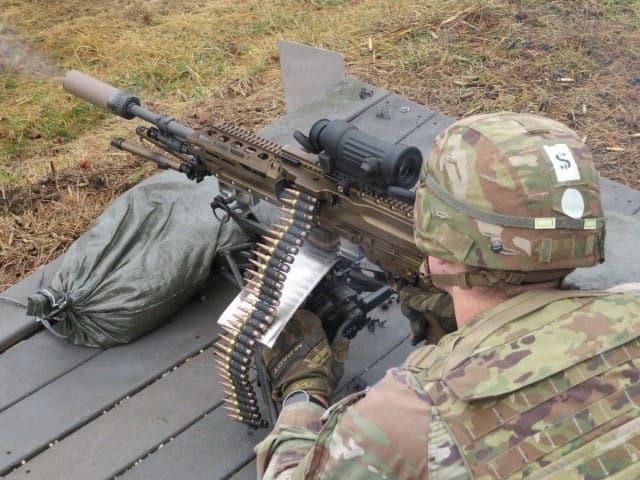
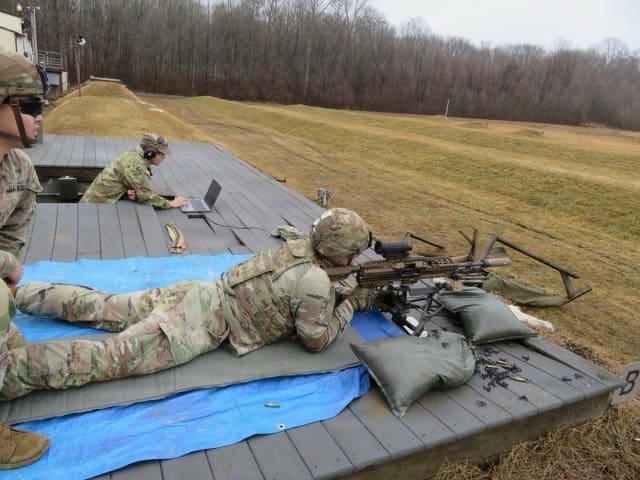
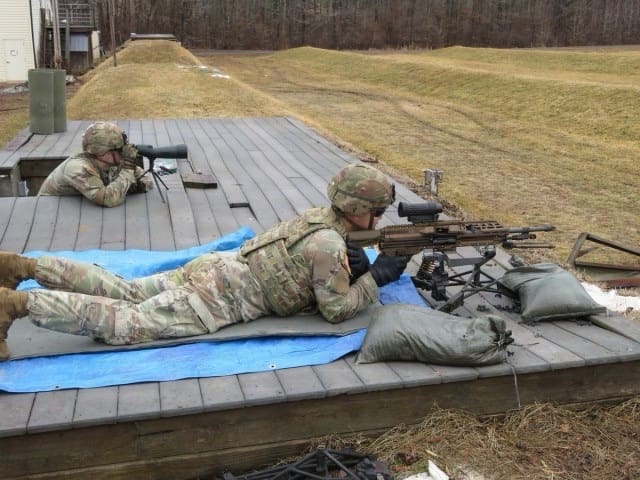
CAMP RIPLEY, Minn. — The Minnesota National Guard’s 34th Infantry Division is among the first Guard units to field the Army’s newest automatic rifle, the M250, during a new equipment training event at Camp Ripley.

The M250, part of the Army’s Next Generation Squad Weapon program, replaces the M249 Squad Automatic Weapon and introduces a new 6.8mm cartridge, higher muzzle velocity and advanced optic capabilities. The new equipment training fielding marks a milestone for the Guard, giving Soldiers hands-on instruction to build confidence and proficiency with the new system.

The event is led by Project Manager Soldier Lethality, PM SL, under Program Executive Office Soldier, which oversees the Army’s small arms and fire-control systems. PM SL experts deliver classroom instruction, explaining the M250’s technical features, ballistics and optic functions.

On the range, the U.S. Army Marksmanship Unit’s Instructor Training Group, ITG, turns that technical knowledge into practical performance. Sgt. 1st Class Chuck Riegel, ITG’s primary instructor for the event, emphasizes fundamentals such as sight alignment, trigger control and recoil management to ensure Soldiers can use the weapon effectively in live-fire conditions.

“We take PM Soldier Lethality’s technical knowledge and put it into performance on the range,” Riegel said. “We show Soldiers everything they learned in class, then focus on the shot process and what they need to do to get hits on target.”

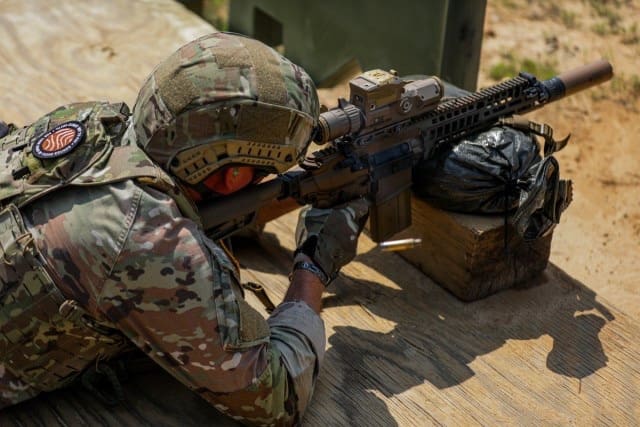
The M250’s advanced optic is one of the biggest changes for Soldiers. With its onboard ballistic system, it is unlike anything many have used before. Riegel said once Guardsmen fire live rounds with it, their confidence grows quickly.

“The optic ensures every Soldier has the capability to make first-round hits at distance, whether in single shot or burst,” he said. “And the cartridge’s terminal performance is incredible — it will defeat pretty much anything they come across.”

The shift from the 5.56mm round of the SAW to the 6.8mm cartridge means Guardsmen must adjust to new ballistics and extended ranges. According to Riegel, this requires more understanding of long-range shooting but ultimately makes units more lethal.

The NET fielding also highlights the value of PM SL and ITG working together. While PM SL explains the technical aspects of the M250 and its optic, ITG makes sure Soldiers can apply that knowledge in live training.

“ITG provides the most up-to-date marksmanship instruction and techniques used across the Army,” Riegel said. “PM Soldier Lethality explains the technical aspects in great detail so Soldiers understand the why behind the new equipment.”


As the Army continues to field the NGSW program, Guard units like the 34th Infantry Division are among the first to gain experience with the M250, strengthening readiness across the Total Force.

For units interested in similar training, Riegel encourages them to reach out. “If units want to get in contact with the Instructor Training Group, all they have to do is send us a message,” he said. “We’ll provide a training request form and deliver tailored training to meet their needs.”

By SFC Timothy Hamlin

The SureFire Turbo Series

Friday, October 3rd, 2025

The SureFire Turbo series pushes the limits in both handheld and weapon-mounted lights to give you the upper hand in any hostile encounter, near or far. Every Turbo model delivers high-candela illumination that reaches out to extreme distances. Our tightly focused Turbo beams are ideal for LE and military use, where piercing through tinted windows or assessing threats from a safe distance can provide a crucial advantage. You can count on them to offer the far-reaching light you need while also retaining a corona of diffused light, so you maintain situational awareness. And they deliver the same proven durability and dependability that’s synonymous with SureFire.

www.surefire.com/turbo

FirstSpear Friday Focus: Operator Glove

Friday, October 3rd, 2025

The FirstSpear Operator Glove (OG) is built for moments where maximum dexterity and precision are non-negotiable. Designed with cutting-edge materials and modern construction methods, the Operator Glove delivers peak performance without compromise.

Its patent-pending trigger finger design sets a new standard in tactile sensitivity, giving operators precise control for critical weapon functions, magazine changes, and other high-stakes tasks.

The Operator Glove excels as a lightweight, standalone solution for missions that demand speed, accuracy, and superior touch. For added durability and protection, it is engineered to seamlessly integrate with the Operator Outer Glove (OOG), creating a complete combat system for the hands. This versatility makes the Operator Glove adaptable across a wide range of operational requirements.

Constructed from ultra-thin, high-performance fabrics, the OG is optimized for unmatched dexterity and lightweight feel. The palm features FirstSpear High Dexterity Leather (FS-HDL) with a digital-textured Pittards Goatskin overlay for enhanced grip and precise weapon handling. Core-spun Merino Wool with a nylon core provides breathability, durability, and moisture resistance while remaining inherently flame resistant with No Melt, No Drip protection.

Touchscreen-compatible index and thumb tips allow seamless use of PDAs and tablets without breaking stride. The natural odor resistance and antibacterial properties of the materials add to long-wear comfort in demanding environments. While the OG is not designed for prolonged heavy abuse, it is engineered to excel throughout a full training cycle and deployment, making it an ideal tool for operators who need performance at the highest level.

To request an estimate click image above or visit First-Spear.com/Request-For-Estimate. FirstSpear is the premier source for cutting edge-tactical gear for military, law enforcement and those who train. For more information visit First-Spear.

NSA’s 12th Annual Codebreaker Challenge is Underway for 2025

Thursday, October 2nd, 2025

The National Security Agency (NSA) is launching their annual series of critical real-world scenarios for U.S.-based academic institutions titled Codebreaker Challenge. In its 12th iteration for 2025, the Codebreaker Challenge gives students the opportunity to analyze high-risk situations closely resembling the Intelligence Community’s classified tasks, equipping them for national security challenges. Participants will go head-to-head with other schools to accomplish mission-driven tasks aimed at enhancing their skills in reverse engineering, vulnerability research, cryptography, programming/scripting, and beyond.

This year’s challenge is to assist the Air Force’s Cyber Operations Squadron in maintaining the U.S. military’s cyber dominance against advanced foreign adversaries attempting to infiltrate and steal information. The goal is to investigate unusual behavior detected by an Air Force analyst and defend American interests against sophisticated nation-state threats. Maintaining vigilance and reinforcing the defense of robust yet vulnerable military networks is paramount.


“The Codebreaker Challenge is an opportunity for the future leaders of cyber defense to showcase their skills, and it’s extraordinary to see the enthusiasm and dedication they bring to the competition,” said Lieutenant General William Hartman, performing the duties of the Director of NSA. “I look forward to announcing this year’s winners and celebrating their success.”

The seven tasks in the challenge each have a particular point value and ramp up in complexity as students advance. After completion, points are earned by schools, and the highest totals win in three divisions, each based on the count of student participants.

The Codebreaker Challenge is open to anyone with an email address from a recognized U.S. school or university. All players register and log in individually. Students, professors, and alumni can participate, but only students will earn points and awards.

Join in and register for the challenge at nsa-codebreaker.org, where you can also watch this year’s kick-off video. Get ready to make your mark in the world of cybersecurity!

Via NSA