TYR Tactical

Archive for the ‘Guest Post’ Category

Five Deployable Combat Wings Selected in Evolution of Force Presentation


Friday, April 4th, 2025

ARLINGTON, Va. (AFNS) —

The U.S. Air Force has identified the first five Regular Air Force candidate locations to build a Deployable Combat Wing Unit Type Code and is scheduling site surveys to begin in the coming weeks. Site surveys will determine the ability of these locations to build a DCW UTC, and findings will be submitted for final location approval.

The first five installations selected as candidates are the 19th Airlift Wing, Little Rock Air Force Base, Arkansas; 23rd Wing, Moody AFB, Georgia; the 366th Fighter Wing, Mountain Home AFB, Idaho; the 4th Fighter Wing, Seymour Johnson AFB, North Carolina; and the 20th Fighter Wing, Shaw AFB, South Carolina.

The change marks an evolution in how the U.S. Air Force deploys its forces from a crowd-sourced model to one in which Airmen from the same installation deploy together as part of a mission-ready Unit of Action built for today’s fight. It acknowledges the need for Airmen to train together and build team cohesion to arrive in theater as a lethal team ready to operate in environments that will likely be more contested than those of the past two decades.

“We are transitioning our Deployment Model to best meet the evolving national security environment,” said Air Force Chief of Staff Gen. David W. Allvin, in a recent memo to Airmen. “At the heart of this transformation is the creation of the Deployable Combat Wing Unit Type Codes – a shift in how we prepare for and execute deployments.”

After final approval in the strategic basing process, selected locations will be responsible for entering into the AFFORGEN cycle through their DCW UTCs beginning in 2025. Part of this process will involve increasing the population of Airmen assigned to each installation in order to ensure wings are able to meet their home station and deployed requirements and are manned to accomplish their respective missions.

The Air Force Personnel Center is postured to conduct permanent changes of station, maximizing volunteer opportunities, to provide the required manpower to these five installations pending final approval in the strategic basing process. Air Force leaders are calling for Airmen to lean into this organizational change and be eager to take on the challenges and rewards of shaping this new way of operating in defense of the nation.

In his memo, Allvin emphasized the need for “highly motivated Airmen,” ready to work together to, “enhance combat readiness,” and “deliver decisive airpower from day one.”

Airmen aligned to the DCW UTC will complete the Air Force Force Generation cycle together. The overall AFFORGEN model improves unit readiness through greater deployment predictability, improves pre-deployment training, and establishes certification requirements that demonstrate unit preparedness for specific missions.

DCW UTCs represent the next phase in the evolution of how the U.S. Air Force presents and deploys forces. As the model is phased in it is expected to replace the Expeditionary Air Base and Air Task Force. XABs are expected to sunset in fiscal year 2027 with ATFs anticipated to be phased out in fiscal year 2028. A phased approach with more than one type of unit of action is required to ensure near-continuous crisis response availability and sustained readiness for the force while DCW UTCs are under construction.

There will be follow-on information for Total Force and additional Regular Air Force locations released in coming months as the Air Force completes the strategic basing process for the first five DCW UTC candidates.

By SSgt Cheyenne Lewis-Roberts
Secretary of the Air Force Public Affairs

HCMH II Harness Bison Belt

Thursday, April 3rd, 2025

Designed as a collaboration between Helix Operations, Ferro Concepts, and DOM Systems HCMH II Harness Bison Belt builds on the Ferro Concepts Bison Belt, designed to be ultra-light and slim without sacrificing functionality.

For added comfort when wearing lighter clothing or carrying a heavy load, the DOM Padded Belt offers the perfect solution—enhancing comfort with minimal extra weight.

This bespoke system that allows operators to mount their gear without compromise, all while integrating seamlessly with the HCMH II harness system.

A comprehensive solution, delivering unmatched versatility and reliability for operators in the field.

helixoperations.com

Army Streamlines Training Requirements to Enhance Warfighting Readiness

Thursday, April 3rd, 2025

WASHINGTON — The U.S. Army will unveil an updated version of Army Regulation 350-1, Army Training and Leader Development, on June 1, 2025. This revision, which streamlines the regulation from over 250 pages to fewer than 100, will enable small-unit leaders and tactical formations to focus on training to fight and win on modern and future battlefields.

The updated regulation marks a significant step toward simplifying training requirements while enhancing warfighting readiness and effectiveness across the force. In addition, it will remove administrative burdens and unnecessary distractions, allowing Soldiers to focus on essential warfighting skills.

The revised AR 350-1 reduces the number of mandatory training tasks from 24 to 17, reduces requirements, eliminates redundancies and highlights tasks that are essential to warfighting, readiness and lethality. The updates focus on retaining only the essential training required by Department of Defense policies, as well as critical Army-specific tasks that support combat readiness.

Six tasks have been shifted to optional training, at the discretion of commanders, and one task has been eliminated entirely. Outdated programs, including “Resilience Training” and “Structured Self-Development,” have also been removed.

These revisions aim to alleviate the burden on commanders by granting them greater flexibility in customizing training schedules to meet specific mission requirements. The new regulation eliminates restrictions on the duration and locations of certain training events and encourages alternative methods of training delivery.

These changes are part of the Army’s broader effort to prioritize readiness by eliminating unnecessary administrative burdens and sharpening the focus on preparing Soldiers for decisive action in combat. The revised regulation also reorganizes appendices for improved clarity, emphasizing tasks related to warfighting capabilities.

This update reflects the Army’s commitment to ensuring that Soldiers are better prepared for real-world missions while reducing non-essential requirements that can detract from operational effectiveness.

To read the draft of AR-350-1, click here.

The Baldwin Files – My Farewell Adress

Wednesday, April 2nd, 2025

“A human being should be able to change a diaper, plan an invasion, butcher a hog, conn a ship, design a building, write a sonnet, balance accounts, build a wall, set a bone, comfort the dying, take orders, give orders, cooperate, act alone, solve equations, analyze a new problem, pitch manure, program a computer, cook a tasty meal, fight efficiently, die gallantly. Specialization is for insects.”

— Robert Heinlein

I believe in that Heinlein quote (above). I have tried to live my life that way. I recommend it. My first article on SSD was posted on 1 March 2015. At the time, I fully expected it to be one and done. Now, ten years and 59 articles later, it is time for me to take a new direction. Therefore, this will be my finalsubmission here – or anywhere else. I am proud of the articles that have been posted on SSD and – in some cases – reposted on other sites. I have been and always will be grateful to Eric for allowing me to rant and rave on his industry platform. He has been a great friend.

People and times must inevitably change. In the last year plus, I have been traveling considerably more often than I have since I retired in 2011. I have been putting myself back out there professionally and reconnecting with various associates and teammates. This outreach was prompted by some recent losses among my close friends. Specifically, four Command Sergeant Majors that I served with since the early 90s and had known for over 30 years. They all died of various cancers in the last two years. Two were younger than me.

I celebrate their lives and service, but their passing was a stark reminder of my mortality. I realized there were still constructivethings I wanted to do in the time left to me. Writing episodically like I have been, was not one of those things. That said, I am going to do something that I have been reluctant to do – in fact, I stated that I would not do it. I will consolidate these SSD articles into a book that I will self-publish sometime later this year. It now seems like the best way to close out this chapter of my life appropriately.

What I want to concentrate on are opportunities to teach, coach, and mentor some of the next generation of Army leaders. To that end, I have been down to The Army’s Officer Candidate School (OCS) three times since I wrote an article on OCS last August. I will go down again in June and about every 9-10 weeks thereafter. Each time, I spend a week at the school preaching the gospel of leadership to the heathen OCS Candidates – and sometimes the Cadre too.

I am going to keep doing that as long as I am able and the leadership of the school is willing to put up with me. In fact, this summer I am going to ask the OCS Alumni Association to recruit 2-3 more folks to join in some kind of rotation so that we can have better coverage of the classes than one person can provide. OCS Candidates are leadership sponges. They will take in anything and everything they can get.

I am working on getting something similar going (virtually for now) with the ROTC Cadets at Norwich University in Vermont. I will be joining a couple of still-serving Green Berets on a video conference to talk to Cadets about SF/SOF opportunities in early April. Hopefully, that can become a routinely scheduled interaction in the future. Later in April, I expect to be back at SWCS for a week doing the same sort of thing.

In May and again in September, I will visit Fort Cambell and spend time with the 5th Special Forces Group and the Air Assault School as I have done for the last few years. I will take every opportunity that I can find or manufacture to stay “plugged in” and do some professional mentoring. It is always a good use of my time. Whether it is any value added for my target audiences is for them to judge. To be clear, I am not paid for my time or travels. All I have asked for in return is continued access; and so far, I have been successful in getting that cooperation from the various commands. I just have to keep earning that privilege. I suppose doing it “pro bono” confirms that I am still a soldier, not a businessman. I can live with that.

The pictures that accompany this piece show some aspects of the 56-acre “Homestead” I have been working on these last 13 years since I retired. While the façade is, obviously, unfinished, the interior is almost done. Those pallets in the first picture are the stones that eventually will be on the front of the dome just like they already are on the garage (2nd Picture). This is my physical “farewell address” if you will. It may or may not be of interest to the regular readers of my articles. My friends joke that I won’t live long enough to finish it at the snail-like pace I appear to be working. They might be right. Some have speculated that it is imaginary. A couple of my friends have seen it as a work in progress over the years, but these pictures should also prove to those who have not that it does exist!

My wife and I have our office space and library on the second floor of the 3-Bay garage on the right of the second picture. I designed both buildings myself and, therefore, the interior layouts are customized to our preferences. We have had plenty of professional and semi-professional help building our dream home, but she and I have indeed touched every inch of it as it has gone up. It is ours. And, because I have been paying as we go, I owe nothing on any of it. Slowly but surely, the plan has come together. Still, getting this home fully finished is definitely moving to the front of my priorities now as well. It is past time.

These pictures are over a year old and there have been a number of improvements since then. For example, I got the rails up on the stairwell not too long ago (not shown). The bar (3rd and 5thpictures) was a “housewarming” gift from my youngest Brother a few years back. He bought it for $50 at a flea market. It was intact but in bad shape when we got it, but my wife and I refurbished and fully stocked it. That Brother had worked in construction all his adult life. He was heavily involved in all aspects of this long project.

He died of lung cancer about 4 years ago. His loss set our schedule back quite a bit. It took me a long time to come back to the project at all. To fill the blank space between the stairwell and the kitchen (3rd Picture), I have someone – with more woodworking skills than I – building me a custom display case for my guns. Every real Hillbilly knows that your firearmsshould never be stored too far from your liquor. My Brother would like it that way and I think the friends I have lost would too. Here’s to all of them.

When I close out with an OCS Company, I tell them goodbye and good luck. Then I say that it is “traditional” for an old person to tell youngsters how much we envy the journey in front of them and tell them that we wish we could do it all over ourselves. I go on to say that I am sure that most folks who do soare sincere. But if I said it, it would be bullshit! I tell them that I do NOT envy them. I would not take their place and start over even if I could. I do not need a do-over. I have run my race. I am satisfied with my career and my life. I can only hope and wish for them that when they finish their careers – however, short or long that might be – they will be as satisfied as I am now. For those reading this, I would wish the same.

I have been blessed with great good luck my entire life. Although I did not always recognize it in the moment. It is demonstrably true; I am one lucky Sumbitch. Like the Starship Troopers (the book, not the movie) protagonist Juan “Johnny” Rico, my luck has always been people. I have had countless great mentors, role models, and teammates. Not to mention that I have almost exclusively worked with truly high-performance people. People you can count on and trust. People who never quit growing and improving. People who thrive on challenges. Being associated with people like that has made me a better person. Therefore, I have had very few disappointments of any kind in my life, and in terms of my professional journey, Je Ne Regrette Rien! I regret nothing.

In conclusion, and to paraphrase McArther and Chesty Puller, I am not fading away just yet, but I am choosing to attack in another direction! One final thought on leadership. A leader keeps moving ahead and must blaze his or her own path forward. Poor leaders cut a path only wide enough for themselves to pass through. Good leaders cut a wider opening to bring their organization forward with them. The best leaders cut the widest lane possible. If you fancy yourself a leader, a good leader, cut that wider path. Show those that follow you how it is done.

De Oppresso Liber!

LTC Terry Baldwin, US Army (Ret) served on active duty from 1975-2011 in various Infantry and Special Forces assignments. SSD has been blessed by his friendship and role as both reader and contributor. We encourage him to remain engaged with our readership through our comments section and we expect to continue our phone calls and correspondence.

Elevate Your Precision: OKSI’s Advanced EO/IR Seekers and Terminal Guidance

Wednesday, April 2nd, 2025

At OKSI, we’ve spent decades pushing the boundaries of EO/IR sensing, and we’re proud to introduce our next-generation seekers and terminal guidance software—engineered to surpass any solution on the market. Our proven track record in advanced imaging and autonomous targeting sets the stage for unmatched performance and reliability in modern battlefields with harsh Electronic Warfare (EW) environments.

Why Choose OKSI?

Hardware Your Way

From Commercial Off-the-Shelf (COTS) to fully custom options, our low-cost modular and passive EO/IR seekers let you integrate powerful, precision-guidance capabilities without reinventing your entire platform.

Seamless Platform Integration

Our containerized terminal guidance software modules are platform-agnostic, running flawlessly on NVIDIA, Qualcomm Snapdragon, or even FPGA hardware. Providing precision guidance in both air and ground domains.

No GPS? No Problem

Our seekers excel in EW environments by eliminating reliance on GPS—giving you robust performance when it matters most.

Passive, Laser-Free Operation

By removing the need for laser teams or designators, we reduce complexity, risk, and costs.

Fire-and-Forget Capability

Launch once (with or without a lock) and let our seekers’ advanced image-based ATR, and visual navigation algorithms do the rest.

Sophisticated Target Tracking

Whether static or dynamic, our proprietary pipelines track targets with pinpoint accuracy, enabling critical LOAL (Lock-On-After-Launch) functionality and maximum effectiveness with vulnerability aimpoint exploitation.

Midcourse Mastery

Our visual-based navigation is the ideal solution for long range strike—enabling absolute positional awareness during midcourse and terminal phase for a variety of engagement profiles.

Applications

Ideal for Long-Range Strike / SOPGM, Loitering and Guided Munitions, C-UAS, Air-Launched Effects, UAS and FPV, Rockets, Mortars, and UAS Air-Dropped Munitions—our seekers seamlessly integrate into existing and next-gen platforms alike.

Choose OKSI to gain a competitive edge. Let us empower your operations with decades of proven expertise and cutting-edge EO/IR guidance solutions—because when every second counts, you need a partner who delivers unwavering accuracy and reliability. This isn’t marketing fluff and generated graphics for future aspirations. OKSI is providing real results to complex scenarios today.

Get in touch to learn how our EO/IR seekers can redefine your mission success. Contact solutions@oksi.ai

Marine Corps Launches Attack Drone Team

Wednesday, April 2nd, 2025

MARINE CORPS BASE QUANTICO, Va. —

MARINE CORPS BASE QUANTICO, Va. – On Jan. 3, 2025, the Commanding Generals of Training Command, Maj. Gen. Anthony M. Henderson, and the Marine Corps Warfighting Laboratory, Brig. Gen. Simon M. Doran, established the Marine Corps Attack Drone Team in response to the rapid proliferation of armed first-person view drone technology and tactics.

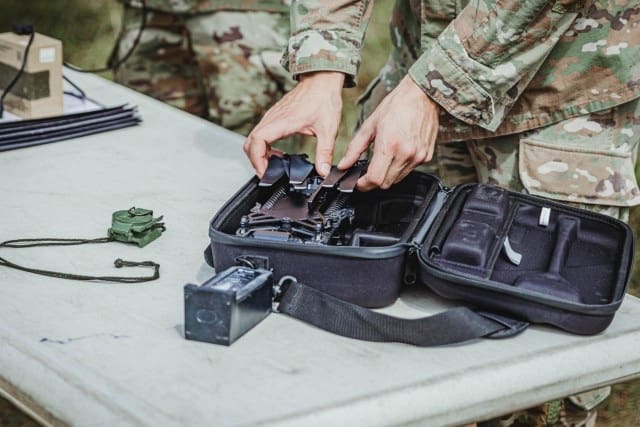
A Neros Archer first-person view drone sits on a case during a demonstration range at Weapons Training Battalion on Marine Corps Base Quantico, Virginia, March 7, 2025. The Marine Corps Attack Drone Team used the Neros Archer FPV drone to engage targets on the range to showcase the drone’s capabilities on the battlefield. (U.S. Marine Corps photo by Cpl. Joshua Barker)

The creation of MCADT comes in response to the rapid proliferation of armed first-person view drone technology and tactics observed in modern conflicts, particularly in Eastern Europe. As emerging threats continue to evolve, the Marine Corps is prioritizing the integration of FPV drone capabilities to enhance lethality and operational effectiveness across the Fleet Marine Force.

“MCADT is committed to rapidly integrating armed first-person view drones into the FMF, enhancing small-unit lethality and providing organic capabilities that warfighters currently lack” said Maj. Alejandro Tavizon, headquarters company commander at Weapons Training Battalion and officer in charge of MCADT. “By leveraging emerging technologies and refining drone employment tactics, we are ensuring that Marines remain agile, adaptive, and lethal in the modern battlespace.”

MCADT will be based at WTBn-Quantico under Training Command, fostering close collaboration with the Marine Corps Warfighting Laboratory. This placement builds on 124 years of expertise from the Marine Corps Shooting Team (MCST), which has long facilitated the Corps’ culture of marksmanship and paved the way for the development of this program. The Shooting Team’s legacy in precision weapons and the capabilities of the WTBn-Quantico Precision Weapons Section further enhance MCADT’s mission.

The team’s mission is to integrate lessons from modern combat; represent the Marine Corps in inter-Service, national, and international competitions; and, through iterative training and competition, provide input to the development of cutting-edge FPV drone capabilities to enhance warfighting effectiveness. MCADT will:

– Develop and refine armed FPV drone training for Marines across the Total Force.
– Inform service-level requirements to ensure the rapid fielding of cutting-edge FPV technologies.
– Enhance individual and unit lethality through hands-on instruction during competitive training events.

“Today’s battlefield is changing rapidly, and we must adapt just as quickly. The Marine Corps Attack Drone Team will ensure that our warfighters remain at the forefront of precision drone employment, providing a critical advantage in future conflicts.” Maj. Alejandro Tavizon, Weapons Training Battalion Headquarters Company commander and officer in charge of MCADT

MCADT will serve as the Marine Corps’ subject matter experts on FPV drone employment and represent the Corps in inter-service, national, and international competitions. The first of these will be the U.S. National Drone Association’s Military Drone Crucible Championship, held from June 30 to July 3, 2025, in Florida. Competing against units like the 75th Ranger Regiment, MCADT will execute tactical missions using FPVs and small UAS in realistic scenarios designed to simulate modern combat. The competition will feature tactical inserts and full mission profiles designed to implement the ‘hunter-killer method’ using both small, unmanned aircraft systems and FPVs, incorporating a variety of flight control options, such as radio frequency, fiber-optic, and artificial intelligent-enabled, which will enhance operational effectiveness.

Following the competition, MCADT will share insights to refine tactics and further improve operational effectiveness. In April 2026, MCADT will host a final championship and selection event at Marine Corps Base Quantico, coinciding with the Marine Corps Marksmanship Competition Championships. Top drone operators will be selected to augment MCADT for future competitions.

MCADT’s impact extends beyond competition. FPV drones offer squad-level lethality up to 20 kilometers for under $5,000, compared to more expensive weapons systems with less capability. This provides a cost-effective and scalable solution for modern combat.

MCADT is already employing several USMC program of record and non-program of record small UAS and FPV controlled drones, through assistance from MCWL and their dedication to the partnership to MCADT. Each of these drones offers distinct capabilities, and the MCADT will use them, as well as additional drones to be received in the coming weeks, to effectively complete their missions.

The Competition-in-Arms Program will expand to incorporate drone competitions within the existing Marine Corps Marksmanship Competition series. The MCADT will run competitions throughout FY26 in conjunction with the MCST. These events will provide opportunities to continuously refine and enhance the skills needed to effectively operate these new precision weapons, ultimately increasing the lethality of Marines and Marine units across the FMF.

“Right now, our focus is on rapidly building proficiency by sending Marines to a variety of training courses and increasing hands-on familiarization,” said Tavizon. “Our goal is to ensure they can not only operate these systems effectively but also integrate them seamlessly into a team. This means mastering primary platforms, having redundancy with backup systems, and getting the necessary repetitions to employ payloads with precision under real-world conditions.”

The establishment of MCADT marks a significant advancement in modernizing Marine Corps capabilities, equipping Marines with cutting-edge drone technology that enhances lethality at extended ranges, all at a fraction of the cost of current long-range weapon systems. Through continuous training, competitions, and collaboration, MCADT is already shaping – and will continue to shape – how the Corps locates, closes with, and destroys our nation’s adversaries.

By Cpl Joshua Barker | Marine Corps Training and Education Command

AETC Prioritizes Data Literacy to Equip Staff for Digital Future

Tuesday, April 1st, 2025

JOINT BASE SAN ANTONIO-RANDOLPH, Texas (AFNS) —  

In today’s increasingly data-driven landscape, the ability to collect, analyze and interpret information effectively is paramount to developing a lethal and ready force. 

Recognizing this, Air Education and Training Command has launched a comprehensive initiative to enhance the data literacy of its staff, equipping them with essential skills for the digital age. 

“The initiative emerged from the command’s strategic operational approach and supports a key line of effort for the command,” Jerry Perez, AETC Chief of Force Development Experiences and Validation, told attendees during the command’s annual Force Development Summit, March 25. “Failure to adapt puts us behind our peers and competitors, impacting our ability to make the right and best decisions.” 

The initiative began with a self-assessment survey administered to AETC staff in November 2023, revealing that over 50% of respondents assessed their data literacy proficiency as basic or less. 

“This concerning trend underscored the need for upskilling,” Perez said. “We’ve got to be better than that. In today’s environment, a basic level is not going to be good enough.” 

The response to the trend has been a multi-pronged approach, Perez said. 

A new performance element, emphasizing foundational training in data literacy was introduced for this year. 

Three core competencies – data management, data analysis and data visualization – were identified, each with four proficiency levels, with the current focus on achieving basic and intermediate proficiency levels across the staff. 

A foundational data literacy course, developed in collaboration with AETC/A9 and AETC/A6, was made available on the AETC learning platform and is mandatory for all staff. 

Additionally, tailored learning pathways focusing on specific areas like AI and Power BI were created to further enhance data literacy skills. 

Looking ahead, AETC’s commitment to data literacy extends beyond this initial push, said Perez. 

A new civilian performance element for the 2025-2026 appraisal period will focus on the practical application of learned data skills. 

Senior staff at the director level will soon be required to undergo AI training. 

Furthermore, personalized learning pathways based on specific roles and responsibilities are being developed to provide more targeted training. 

“By investing in its workforce’s data literacy, AETC is taking proactive steps to ensure its readiness for the challenges and opportunities of the digital age,” Perez said. “This forward-thinking approach will undoubtedly pay dividends, enabling the command to make more informed decisions and maintain its competitive edge for years to come.” 

By Dreshawn Murray, Air Education and Training Command

Ukrainian Armed Forces Actively Using RAROG Polymer Machine Gun Belts at the Frontline

Monday, March 31st, 2025

Modern warfare involves the infiltration of contemporary technological solutions. One such innovation is the unique development by the Ukrainian company «Kharkiv Factory of Personal Protective Equipment» RAROG, specifically an ammo logistics system for machine guns PK/PKM.

The metal belt for the PK, PKM, and SG serves as the basis for equipping machine guns, but it is not manufactured either in Ukraine or in the overwhelming majority of the 53 countries that have machine guns in their arsenals. In addition to the shortage caused by the lack of production and constant battlefield losses, the metal belt has several significant disadvantages, including the need to remove it from the battlefield, manual loading of rounds, heavy weight, masking noise, corrosion, and so on.

Experts from the Kharkiv Factory of Personal Protective Equipment (Ukrainian Defence Innovations (UDI) Group, former Rarog Group) have found solutions to all these issues by developing a world`s first polymer disintegrated links for machine gun ammo belt, which significantly improves the mobility and effectiveness of machine gunners on the battlefield. This fact has been proven both through field testing and in actual combat. First samples were tested back in 2016. In 2019 Rarog won Sikorsky challenge (competition of innovative startup projects), suggested a new ammo logistic system for Armed Forces of Ukraine based on polymer links.

The polymer machine gun belt consists of a series of links, each of which has three rings connected by a crossbar. The links are hinged and connected by cartridges inserted into the aligned rings. This belt is three times lighter than the metal analogues, has low cost and high production speed, minimal noise during transportation, no corrosion, and prevents snags during operations. A key difference of this system is that the belts could be supplied to the combat zone already loaded, so soldiers do not need to spend time on this task. The standard machine gun belt for the PKM is supplied in solid links of at least 25 units. This creates inconvenience when shooting, the so-called tail. The links of the polymer belt simply fly out along with the cartridge cases. The metal belt must be collected and reloaded, the polymer belt is one-time use (although in training ground conditions Ukrainian soldiers use it up to 4 times in a row). Also, cartridges loaded into a metal belt are subject to corrosion during storage. This creates a risk that the machine gun may fail in a critical situation. Cartridges loaded into a polymer belt make less noise when moving as well.

The development and testing process of the polymer belt took much time, as Rarog aimed to ensure maximum convenience, reliability, and efficiency in this product. UDI Group`s representatives are in constant communication with Ukrainian defenders participating in combat operations on various parts of the frontline, and receive feedback from them. Over the course of the war, the polymer belt produced by the Kharkiv Factory of Personal Protective Equipment has been used by the soldiers of Airborne Assault Forces, 54th Separate Mechanized Brigade, 24th Separate Mechanized Brigade, 3rd Separate Assault Brigade, and other units of the Armed Forces of Ukraine. Soldiers have praised the ergonomics, ease of transport and versatility of the polymer machine gun belt.

The opponents did not ignore this product. In 2022, an article was published on the website of the well-known Russian magazine «Kalashnikov», where the author, a weapons expert and editor-in-chief of the publication, Mikhail Degtyaryov, accused the experts from Rarog of «lack of professional knowledge and ignoring historical experience», while also emphasizing that replacing the usual metal belt with a much lighter and cheaper polymer one was impossible due to several critical shortcomings.

However, two years later, several Russian companies introduced their «new products» – analogs of Ukrainian development, one of which even made it to the cover of the aforementioned expert magazine.