SIG SAUER - Never Settle

Archive for the ‘Guest Post’ Category

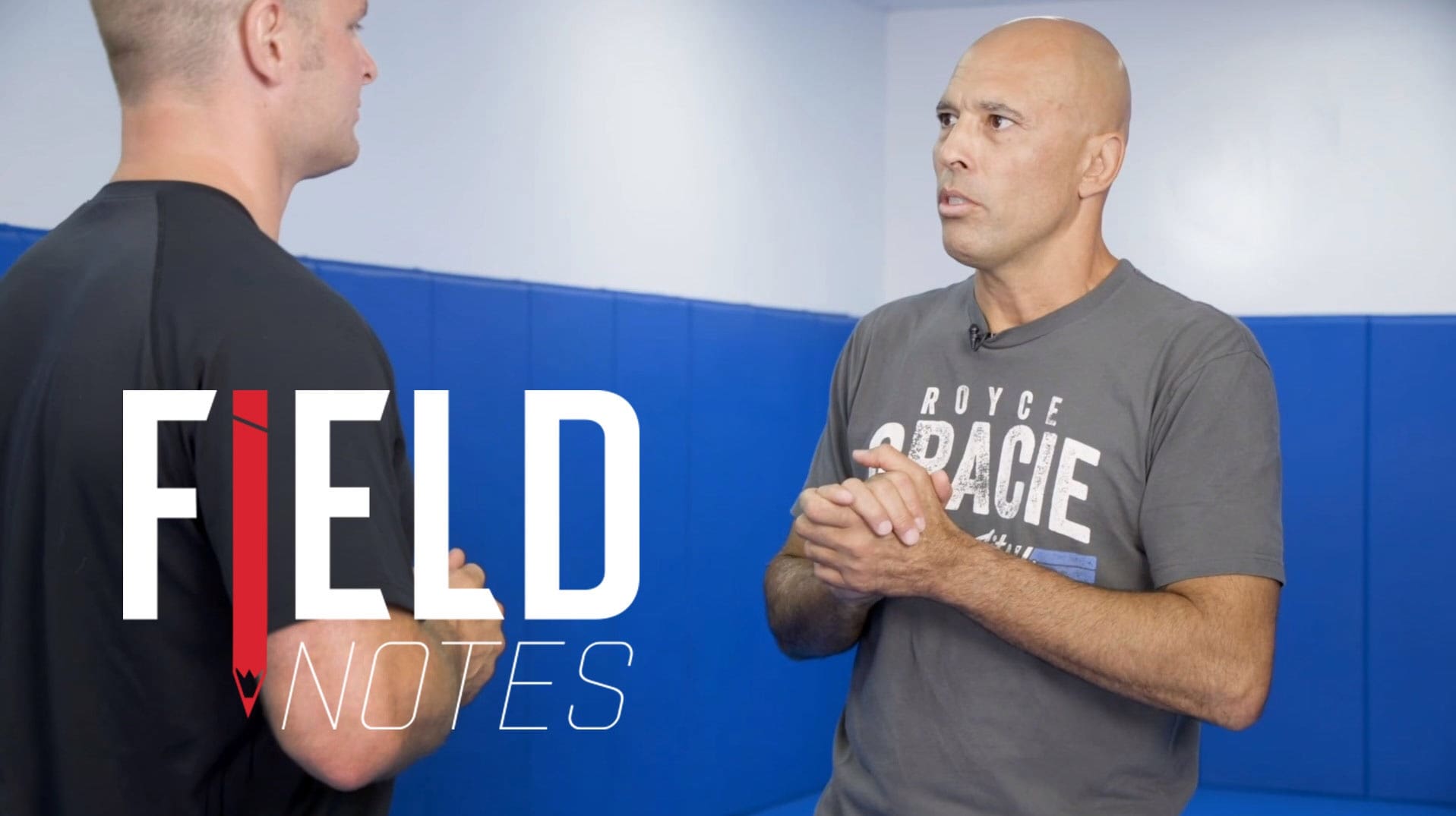
Field Notes Ep 37 – Gracie Jiu-Jitsu for Law Enforcement Featuring Royce Gracie

Thursday, November 22nd, 2018

In this episode, Royce Gracie discusses Gracie Jiu-Jitsu  techniques for Law Enforcement Officers.

Royce Gracie was born in Rio de Janeiro, Brazil and is one of nine children, seven of whom are boys. His training in Jiu-Jitsu began at a very early age as a game with his father Helio. He never pushed any of the children to take formal classes until they wanted to do so. However, they often went to the Academy in Rio after school and on weekends.

Royce began competing in tournaments at age eight. He received his blue belt at age 16 and was promoted to black belt in less than two years. Royce moved to the United States at age 18 to live with his brother, Rorion. They began teaching private classes out of their garage, sometimes for more than ten hours a day.  Together they opened the Gracie Jiu-Jitsu Academy 30 years ago in Torrance, California. Although Royce no longer teaches there because of his rigorous travel schedule, it remains one of the largest martial arts schools in the country.

Royce’s reputable career as a fighter began in 1993 after defeating three opponents in the first Ultimate Fighting Championship in Denver, Colorado. His brother Rorion came up with this innovative challenge as a way to show Gracie Jiu-Jitsu to the world. Discipline after discipline was defeated by the slight 6’1”, 180 pound Royce Gracie.  The viewers were in awe.

His opponents consistently outweighed him by more than 50 pounds. He went on to win 3 UFC titles and today is the only man in the history of no holds barred matches to successfully defeat four opponents in one night.  After leaving the UFC Royce went on to compete in MMA events in Japan and is a huge icon in this country.

Royce holds the record for the longest MMA match in history: 90 minutes against Japanese superstar Kazushi Sakuraba in PRIDE Grand PRIX 2000. He also showed total domination of the Olympic Judo Gold Medalist Hidehiko Yoshida.  His largest opponent was Sumo Grand Champion Akebono, 6? 8? 486lbs. Royce vs. Akebono was the main event of K-1 Premium Dynamite New Years Eve show on New Year’s Eve in 2004. Royce defeated the giant in just 2min and 13sec with a shoulder lock.  Royce’s continued success has opened the eyes of many disbelievers to the importance of leverage and technique in grappling.

In November of 2003, Royce Gracie was the first fighter to be inducted into the UFC Hall of Fame along with fellow UFC veteran Ken Shamrock.  Since then Royce’s face has has been seen on countless martial arts magazines such as Black Belt, Inside MMA and Tapout.  He has also been featured in Men’s Health and Fitness and GQ and continues to give magazine and radio interviews.  His recognition spans the globe to include fans on most every continent.  In 2014 Royce was named one of the 50 Greatest Athletes in the World by Sports Illustrated.

Today Royce is privileged to spread the techniques perfected by his father all over the world. Throughout his busy fighting career Royce has maintained a rigorous travel schedule of seminars and classes.  He currently oversees  more than 55 US and international Royce Gracie Jiu-jitsu Networks.  The techniques of Gracie Jiiu-jitsu have become mainstream in most martial arts dojos.  Fighters everywhere are racing to learn and implement this jiu-jitsu in their training regimen.

His list of students is enormous. Royce has taught many of the big screen greats like Chuck Norris, Ed O’Neal, Guy Ritchie, Jim Carrey, Josh Duhamel and Nicholas Cage. He has also been very active with the CIA, FBI, DEA, Secret Service, Army Rangers, Army Special Forces, Navy Seals and many sheriff and police departments.  His G.R.A.C.I.E. course for law enforcement has gained international recognition. Aside from teaching at his Networks across the United States, he regularly visits Canada, England, Scotland, Portugal, Spain, Israel, Australia, UAE and South America.

Royce makes his home in Southern California with his wife, Marianne, three sons, Khonry, Khor and Kheydon and daughter, Kharianna.  He maintains an impressive training regimen, which includes running, weight training, cross training, meditation and countless hours of Gracie Jiu-Jitsu. He is a full time professional athlete who eagerly awaits his next challenge. Recently he completed a 40 mile run with his long time trainer, James Strom.  In Royce’s own words, “Go ahead, tell me what I can’t do!”

roycegracie.com

www.surefire.com

Cyber Force Looks To Grow With Boost To Electronic Warfare

Wednesday, November 21st, 2018

WASHINGTON — With the cyber domain expected to see constant battles in future warfare, Army leaders say new efforts are underway to strengthen the Army’s cyber force so it can defend forward against adversaries.

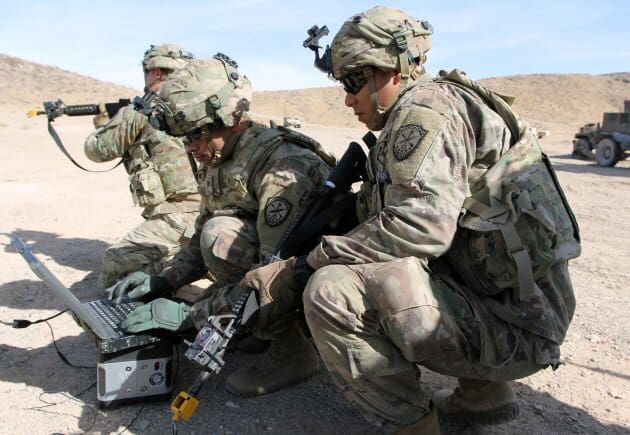
Spc. Victorious Fuqua, left center, and Staff Sgt. Isaias Laureano, right, both cyber operations specialists from the Expeditionary Cyber Support Detachment, 782nd Military Intelligence Battalion (Cyber), from Fort Gordon, Ga., provide offensive cyber operations during training at the National Training Center, Fort Irwin, Calif., Jan. 18-24, 2018. The Army’s cyber force plans to incorporate more electronic warfare and information operations assets in its future mission. (Photo Credit: Steven P. Stover)

One aspect being bolstered is electronic warfare. The Army has now placed 29-series EW Soldiers into cyber’s 17-series career field as the service zeroes in on it.

“We have really focused on the next phase of development and that’s in our electronic warfare force,” said Brig. Gen. Jennifer Buckner, director of cyber in the Army’s G-3/5/7 office.

The goal is to combine EW assets along with cyber and information operations capabilities across all echelons of the Army.

The Multi-Domain Task Force, which has experimented with those capabilities in the Pacific, will continue to serve as a proving ground. This fiscal year, there are plans to stand up an EW platoon within I Corps to support the U.S. Army Pacific-led task force.

“That will be kind of the first test case for our electronic warfare organizations,” Buckner said Thursday during an interview at the International Cyber Conference on Cyber Conflict U.S., or CyCon U.S. “We’re going to experiment with the capabilities as much as we’re going to also try to validate force design that we’ve put on paper.”

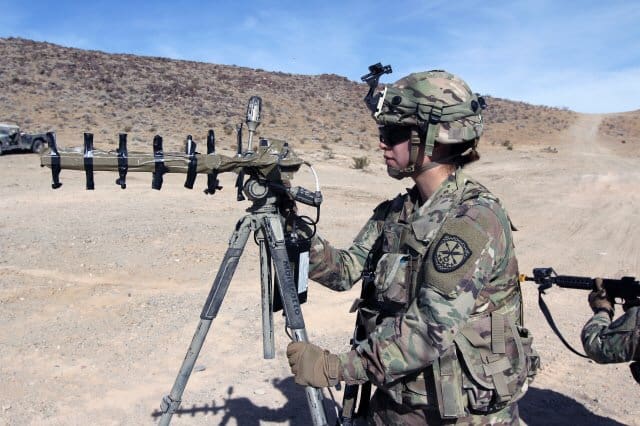
Sgt. Camille Coffey, a cyber operations specialist from the Expeditionary Cyber Support Detachment, 782nd Military Intelligence Battalion (Cyber), from Fort Gordon, Ga., provides offensive cyber operations as part of the Cyber Electromagnetic Activities Support to Corps and Below program at the National Training Center, Fort Irwin, Calif., Jan. 18-24, 2018. The Army’s cyber force plans to incorporate more electronic warfare and information operations assets in its future mission. (Photo Credit: Steven P. Stover )

In the coming years, the plan is to place an EW platoon in every brigade combat team’s military intelligence company. New EW companies will also fall under expeditionary military intelligence brigades.

Cyber and electromagnetic activity cells, or CEMA, will even be built up to advise commanders at the brigade, division, corps and Army Service Component Command levels.

“We’ll have an operational force and we’ll also have the planning and staff element that would help employ them,” Buckner said.

An additional piece, she added, is the Cyber Warfare Support Battalion. The battalion will grow over the next five to six years and include about 600 personnel in expeditionary cyber teams.

The idea behind it is “that we can tailor force packages, if you will, to downward reinforce to tactical levels,” she said.

Personnel numbers in the other efforts are still being worked on and will depend on the Army’s end strength and growth, she added.

Army leaders also hope to help fill its cyber ranks with more cadets and civilian professionals.

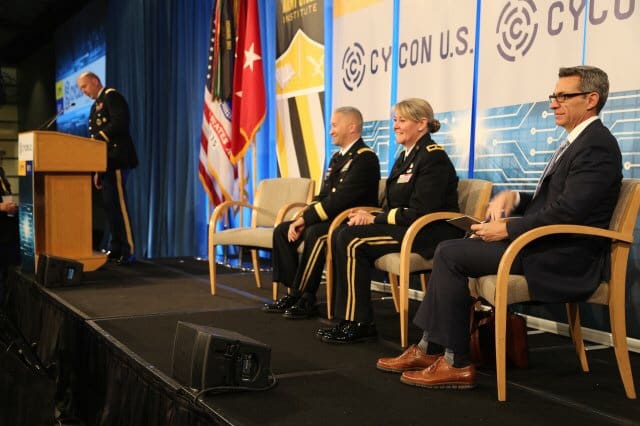
Brig. Gen. Jennifer Buckner, second from right, director of cyber within the Army’s G3/5/7 office, participates in a panel discussion at the International Conference on Cyber Conflict U.S. in Washington, D.C., Nov. 15, 2018. CyCon U.S. ensures outreach to bridge gaps and to promote information exchange across Army, military, and academic, industry, and government cyber communities. (Photo Credit: Pfc. Aaron Mitchell)

Throughout the ROTC community, there are about 50 cadets who commission into cyber each year.

At the U.S. Military Academy, many cadets have also expressed interest to commission into cyber. As of right now, though, only 26 cadets at the academy can do so.

“We got a large amount of interest [but] don’t quite have the demand side right yet from the Army,” said Col. Andrew Hall, director of the Army Cyber Institute, which is located at West Point, New York.

Cadets who branch into military intelligence or signal will benefit the cyber force, too.

“That’s also a huge win for us because those are our primary partners in this fight,” Buckner said.

Last year, the Army Cyber Command began the Cyber Direct Commissioning Program in an effort to entice cyber experts in the civilian world to suit up in an Army uniform.

The program received around 250 applicants and at least two of them — former enlisted Soldiers — were commissioned as first lieutenants in May.

Those who qualify under the program have the opportunity to join the Army as first lieutenant, with the possibility of a higher rank. Up to $65,000 in student loan repayment over the course of an officer’s initial three-year term is also on the table to attract desired applicants.

The program is currently searching for its first applicant to be automatically promoted to colonel.

“Right now, we have a system where generally an 18-year-old is the target,” Hall said of Army recruiting. “But we’re saying what happens if someone wakes up at 37 and decides that they want to serve? What happens if that person has had an entire portfolio of work where they could step in … as a battalion commander?”

While atypical, he noted, direct commissions were common during World War II to fill in gaps.

“We want to have flexibility so that we don’t limit patriotic service to 18-year-olds,” he said. “We want to give the entire country an opportunity to serve.”

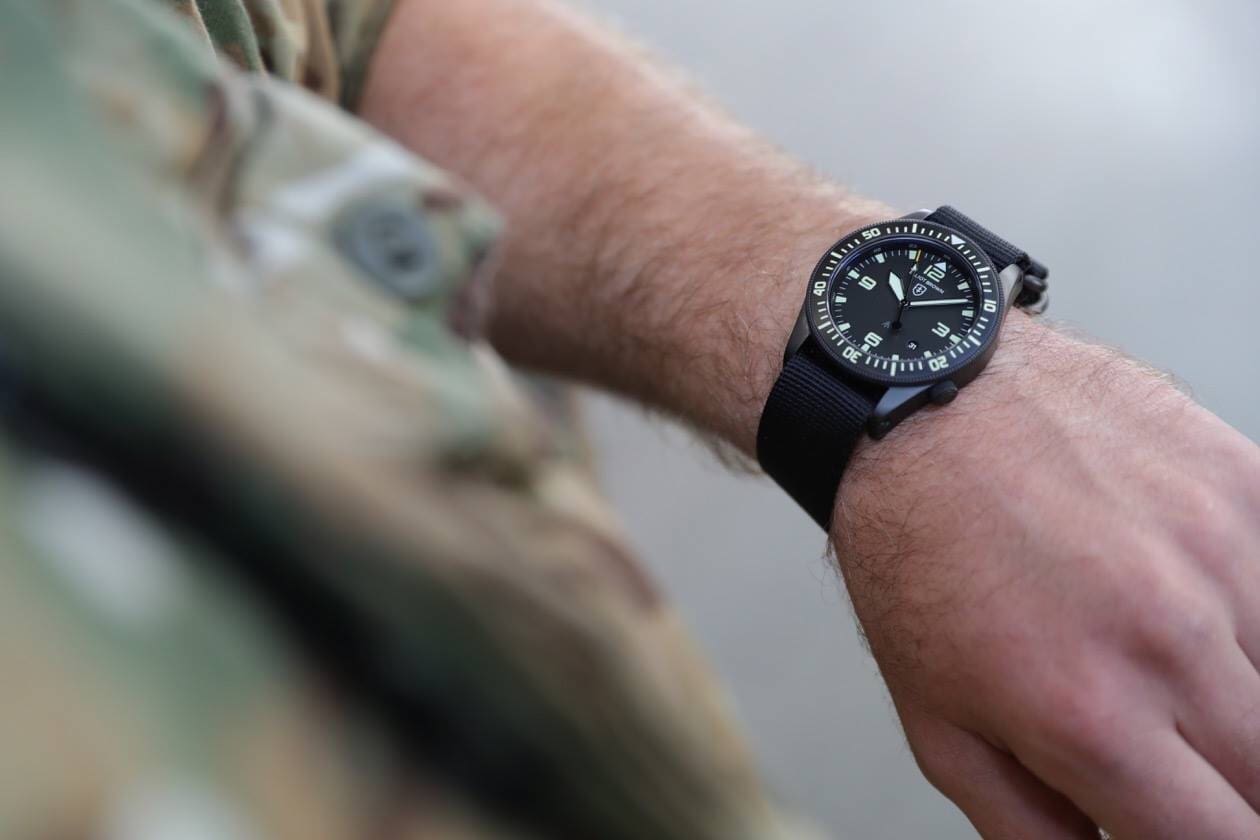
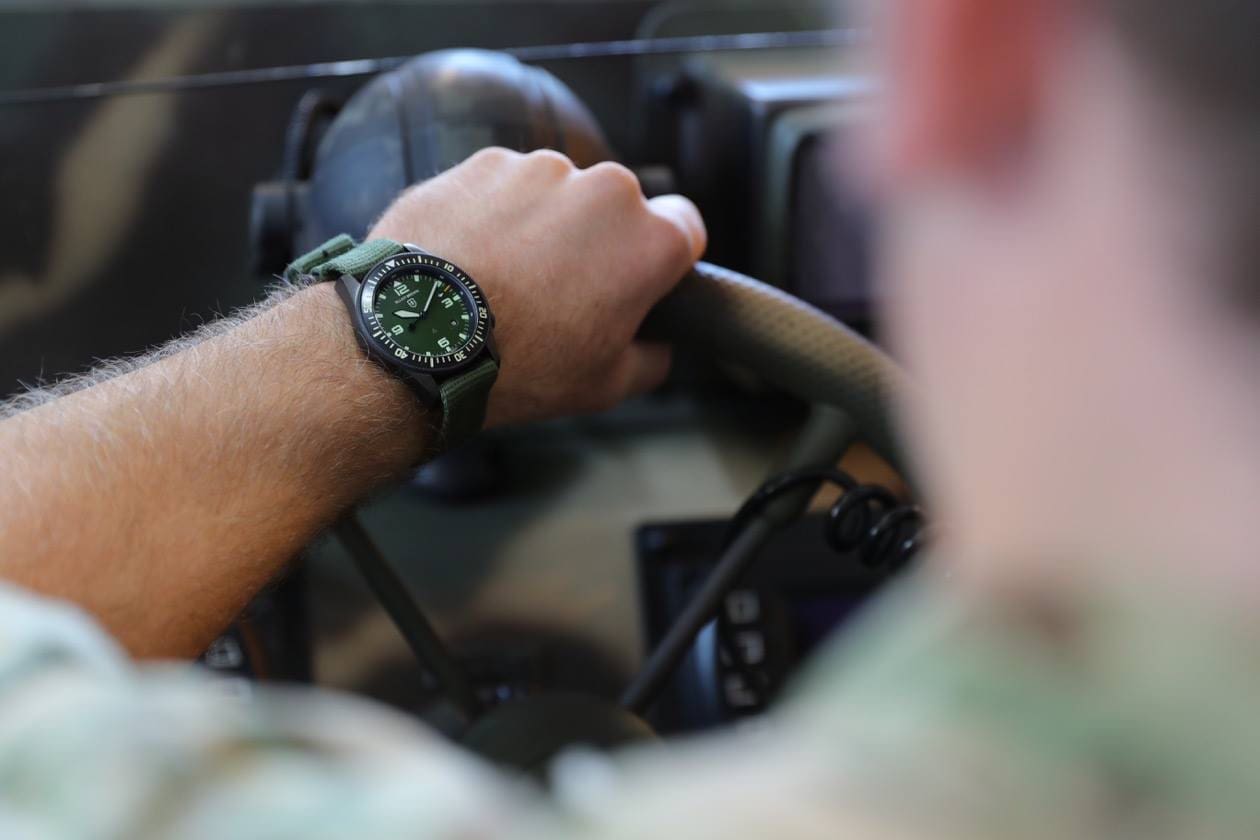
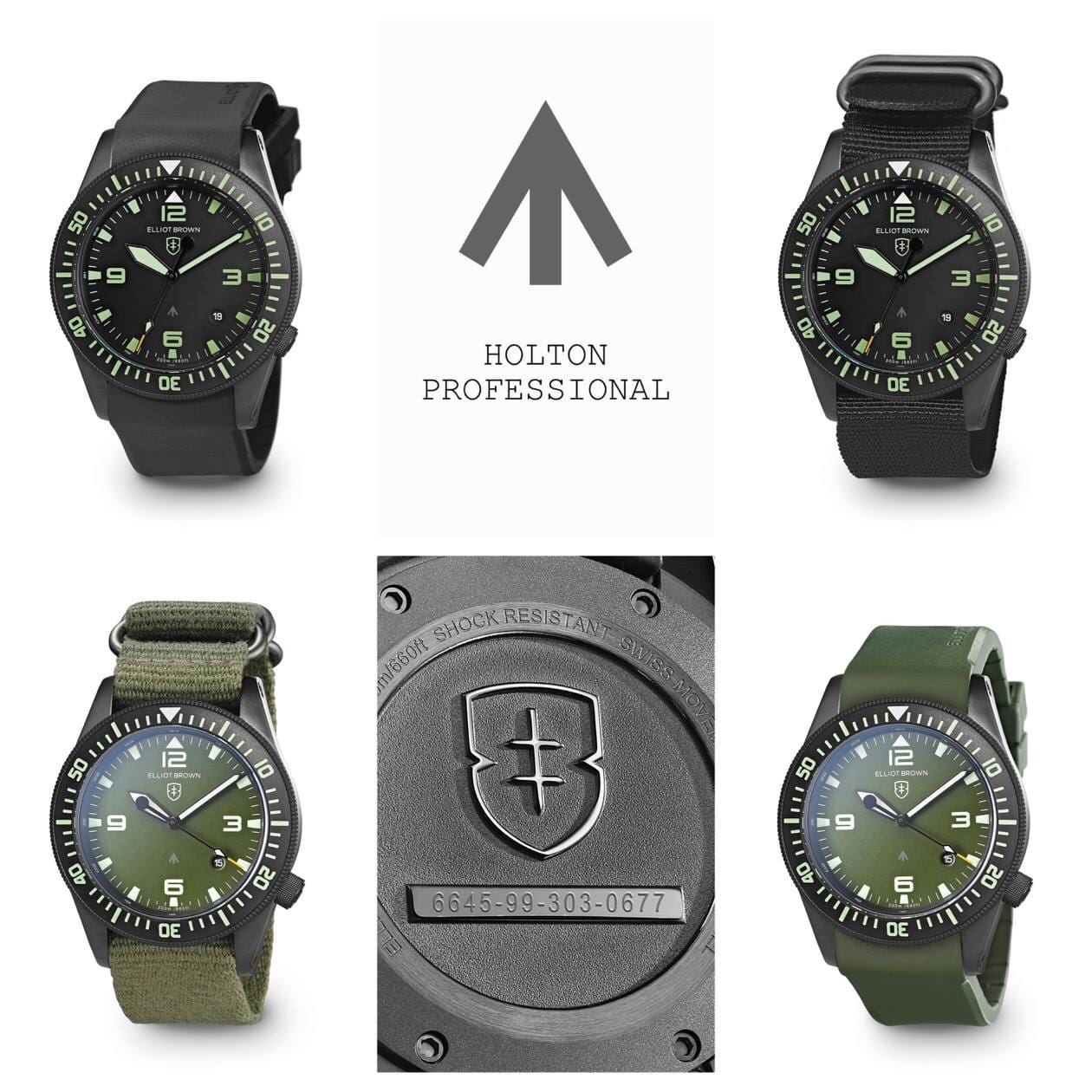
Brigantes Presents – High Angled Solutions – Elliot Brown Watches the Holton Professional Series

Wednesday, November 21st, 2018

What makes this watch special is its audience.

This watch was developed in collaboration with a specialist branch of the British armed forces.

Having purchased Elliot Brown watches privately it became clear that operators preferred them to the watches they had previously been issued with and approached Elliot Brown to develop a new model with spring bars that would not break, a bezel that could be operated easily even wearing gloves, whose water and dust resistance would be more than up to harsh conditions, with fit for purpose straps that would be a cinch to change and be instantly readable day or night.

We asked operators to bring their current watches and discuss what worked and what didn’t, only then we were able to fully understand the requirement and create the internal brief that made sure the resulting watch would perform faultlessly.

The result is possibly the ultimate field watch whose design language echoes that of vintage military watches yet with all the trademark Elliot Brown house design cues, creating a sense of continuity and familiarity.

The Holton Professional series is the first military issue watch to be created by a British watch company in more than ten years. It is unapologetically fit for purpose and designed for use every day no matter how harsh the conditions.

It takes its name from Holton Heath in Dorset, the location of a wartime cordite factory.

* Please note, the high grip bezel is not suitable for use with cuffed shirts as prolongued contact may cause fabric to fray *

For more information get in touch by email on international@brigantes.com or for UK customers warrior@brigantes.com.

The Baldwin Files – The Army Green Uniform

Monday, November 19th, 2018

This article is about Pinks & Greens or OGs or whatever we eventually call the newly approved U.S. Army dress uniform. However, it is about larger concepts as well. When I was a lieutenant in the 2nd Bn, 505th PIR, 1985-88, I had the great good fortune to get to spend time with LTG(R) James Gavin (picture right). He had been the WWII commander of the 505th and later the 82nd Airborne Division. He made four combat jumps during the war and was awarded the Distinguished Service Cross (DSC) twice. During the mid-80s, he was our honorary Colonel of the Regiment. He took the ceremonial duties seriously and came to almost all of our unit events during that time. I took every opportunity to talk to him and we even had a couple of one-on-one discussions about leadership. It was an honor and an education. When General Gavin’s health began to fail, COL(R) Benjamin Vandervoort took over the duty. Vandervoort had commanded the 2nd Battalion during the war and he too had earned two DSCs. He was played by John Wayne in the movie “The Longest Day” and did break his ankle during the Normandy jump. He recovered, jumped into Holland, and was seriously wounded by German mortar fire at Nijmegen three months later.

From a professional development perspective, I have had many such fortuitous encounters over the years. Heck, I had Aaron Banks over to my house for dinner and beers when I was a Detachment Commander in 5th Group and spent an afternoon chatting with John Singlaub in the Group area on one warm summer day. Both were WWII Jedburghs and Special Forces legends. Therefore, these historical figures are perhaps a little more real and relevant to me than they may be for the current generation of soldiers. Big wars make big heroes and fewer and fewer of these giants are still with us. We may never be blessed with their likes again. I have talked a great deal about symbolism before. How important it is to appreciate and perpetuate unit histories, heraldry and special customs. These intangibles are not trivial. Instead, they are key building blocks in creating and sustaining unique group identities and unit cohesion. However, symbols only have as much power as we consciously imbue in them. If leaders teach soldiers that the service uniform is anachronistic and superfluous they will treat it that way rather than displaying the appropriate respect. Not esteem for the clothing item itself, but rather for what the uniform represents. That should not happen. Good units revere their symbols and take pride in their uniforms.

The Army has made this fundamental mistake many times. Despite having won a worldwide war on multiple continents, the Army actually suffered an identity crisis and loss of confidence after 1945. Because of the atomic bomb, there was a growing belief – even within the ranks – that traditional ground combat itself was obsolete. Rapid post-war demobilization gutted experienced officer and NCO leadership. Tiny budgets barely supported constabulary duties in occupied countries like Germany and Japan. Readiness, training and basic unit cohesion was not a priority. This leads us to Task Force Smith and the dark early days of the Korean Conflict. Marine Corps funding and state of training was not significantly better that the Army’s. However, there were considerably different levels of esprit between the Army and Marines. This disparity is evident in the retreat from Chosin Reservoir. In that campaign, Marine units maintained good order and performed notably better than many Army units. It was not gear or tactical training that made the difference but rather a shared unit identity and stubborn pride that proved to be the critical factor. Make no mistake, symbols like the Eagle, Globe and Anchor (EGA) and the uniform of a Marine only mean something in combat because the Corps makes the concerted effort to give those items significance and power.

Unfortunately, the brutal but ultimately indecisive Korean Conflict did nothing to reestablish Army confidence in itself. Rather, the “lesson” of Korea was that the early and widespread use of atomic bombs would be necessary to avoid any future, similar strategic stalemate. Therefore, the Army decided it needed a new “modern” identity. That in turn meant discarding prominent symbols of the old Army. The Army dress uniform or “Dress Greens” that most of us grew up with was one of the misguided results. That new dress uniform was deliberately cut in a business rather than martial style. More obviously, the color had no historical connection with any previous Army uniform. Furthermore, although there was still conscription, the Army began – for the first time – to sell itself to the American people as a job rather than a profession. It was a huge mistake precisely because it erased a strong identity and replaced it with a muddled professional ethos that was inferior and less resilient.
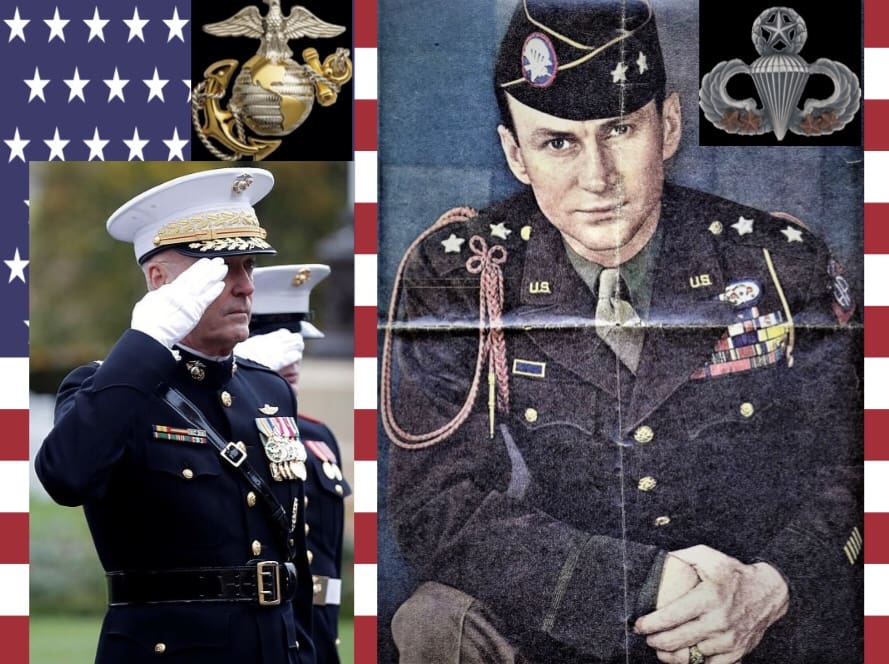
The Army has an unfortunate habit of forgetting history and disregarding heraldry because, I suspect, there are too many people who do not think it is important for combat readiness. Those people are wrong. On the other hand, the Marine Corps has been exponentially more successful in avoiding similar identity pitfalls. For example, on the left side of the picture is GEN Dunford, the current Chairman of the Joint Chiefs, visiting Belleau Wood this last week. While his uniform is perhaps not identical to the early 20th Century Marine dress uniform, it is close enough that a WWII Marine would instantly recognize it, as would just about every American – and many people in other countries around the world. Are dress uniforms important in shaping that desirable and unbreakable unit identity?  I say yes. However, one need not take my word for it; the evidence is clear that the Marine Corps’ leadership thinks so and has thought so for generations.

It is no coincidence that the American people have much more difficulty in identifying their own soldiers. The Army has done a bad job of establishing an enduring “brand” or strong collective identity like the Corps. It is sad but all too true. The Army has had a strong sense of distinctiveness in the past, most notable during the post-Civil War period (1866-1898) and the post-WWI period (1920-1940). Both time periods saw an all-volunteer but woefully underfunded Army in which a career was no less than thirty years and selfless service was almost a given. The first era was indelibly shaped by leaders like Sherman and Sheridan and gave us the classic blue uniform. Leaders like MacArthur, Marshall and Eisenhower left their mark on the second while wearing P&Gs. It is only fitting, in my opinion, that we reestablish a link back to the uniforms of that period.

Some argue that because less than perfect or even bad decisions have been made about uniforms in the pass we must now forgo making any future decisions. Nonsense. When it becomes clear that a decision is not achieving the desired result it is the obligation of a leader to make a correction. Many of the mistakes in this arena were made in the name of cost cutting in one way, shape, or form. The Army has always been penny wise and pound foolish. Probably that is because the return on the investment in symbols and esprit de corps is only discernable in the toughest of situations. Others argue that dress uniforms have no utility because they are not worn often enough to be “cost effective.” Since when has the intrinsic value or the symbolic power of an item depended on frequency of use? Take the American Flag for example. It is unquestionably one of the most powerful symbols of our national identity. It has always been with me – whether it was visible on my uniform or not – because I have long since internalized its meaning and power. When going into battle, soldiers now wear it on our sleeves while Marines do not. Yet it accompanies and bolsters the resolve of all of us – visibly displayed or otherwise. A dress uniform may not get much use but it should nevertheless mean something when it is worn – no matter how infrequently.

Other times the Army has been driven by some vague sense that we needed to discard history in order to effectively move into the future. Wrong again. Service and Unit histories are cumulative, built over generations, and become more powerful over time. We do not shake the etch-a-sketch, erase unit histories and start over after each conflict. A point I tried to make about the 5th Special Forces Group Flash some time ago. Except for the 82nd, none of the WWII Airborne Divisions had a history. None of the 500 series Parachute Infantry Battalions or Regiments had a history. Leaders recognized the need so they expended a great deal of precious time and energy to build a collective identity. Mostly that involved symbolism. Jump Wings were essentially the paratroopers EGA, and jump boots clearly set him apart from all other soldiers. Moreover, creating that mystique was not a training distractor but rather essential in preparing those soldiers to prevail in combat. Today, Jump Wings and bloused jump boots may seem inconsequential and even unnecessary in a peacetime garrison environment, but they meant a great deal at Bastogne. Ask any man who was there.

I admit I have been surprised about how many people have waxed nostalgic over the old Dress Greens. By my recollection, from day one people were constantly bitching about how unmilitary they looked and especially about the god-awful color. As early as the mid-70s, surveys consistently showed that soldiers would have preferred to re-adopt a P&G type uniform. Several times, including the mid-80s, there was even serious movement in that direction. Instead, the Army doubled down and made the situation worse. First, as a cost saving measure the Army stopped issuing the well-liked Khaki summer Class-B uniform; then replaced the tan shirt – the last vestige of the older era uniforms – with a blue-green version also without any historical precedent. The last major decision that converted the Dress Blue, formal uniform, into the ASU actually ruined two uniforms at once. Kluging the purposes and the heraldry of both into a hybrid that serves neither purpose well. The blue pants and white shirt of the ASU make a particularly unflattering Class-B uniform. And it does not help unit cohesion that there is an accommodation for a wartime service unit badge on the ASU pocket, but no place for the current unit of assignment.

However, even now the situation is not hopeless. It is up to leaders. Uniform items can mean everything or nothing. The Green Beret for example is just a piece of dyed wool – but just try to take it away from someone who has earned it. The Airborne Maroon Beret was not important until GEN Rogers took in away in 1978. The Airborne community made their displeasure known until they got in back in 1983. If berets are not important, why are people still re-litigating the Ranger Beret decision twenty years later? These pieces of headgear are significant – as are badges, tabs and unit patches – but only in as much as they are a visible reflection of the unit’s identity and character. Unfortunately, as we all know, the Army failed to give the black beret any power when it became standardized service headgear. I expect better results from the P&Gs simply because they do reflect history, are indeed iconic, and the American people can actually tell that it is the uniform of a soldier.

As to the question of cost, a new dress uniform purchase – of any flavor – can be a considerable individual expenditure. However, in the time between announcement, availability and required to have dates, soldiers have the opportunity to plan and budget for the eventuality. Many soldiers need not worry at all. Approximately 75% of soldiers get out after one term or less, 50% of officers leave after completing their initial obligation. Because these uniform changeovers are deliberately spread out over years the majority of soldiers will never need to buy the new uniform and will leave service with whatever they were initially issued. Even if that were not true, I think the current Army leadership has made a decision that is good for the service. They have reembraced storied organizational history and it is long overdue. In fact, I would like the Army to go faster and further and issue P&Gs to all soldiers RFI style – the sooner the better. Moreover, it should come with a pamphlet that outlines the history AND the Army should pay for initial fittings and additional tailoring every three years or upon promotion to sergeant and each grade after.  It would be a small investment that could pay huge dividends. I also look forward to ASUs reverting to a cleaner formal “Dress Blue” status. No doubt P&Gs will provide a more suitable and professional looking Class-B configuration as well. In any case, the Army will only get out of this uniform change whatever leaders put into it.

Bottom line: Do I think a modern soldier – commissioned, warrant, noncommissioned or enlisted – can and should be proud to wear a dress uniform reminiscent of those worn before and during WWII thru Korea by leaders like: James Gavin, Matthew Ridgeway, Reuben Tucker, Robert Frederick, Aaron Banks, John Singlaub, Lewis Millet, Hal Moore, Audie Murphy and William Darby – just to name a few?  Damn right I do.

Administrative addendum: Earlier discussions on this site about this subject has been contentious at times and frankly overly personalized. We have all – myself included – resorted to ad hominem attacks when we are angry. I have said it before and will say it again; in adult and professional debates, smearing an opponent’s character does nothing to strengthen an argument, provide evidence in support of a position, or prove a point. Another thing, I am the soldier I am today because of NCOs. I actually sought a commission on the advice of an NCO. I came out on the SFC promotion list at just nine years of service (which at the time was fast for infantry). I was feeling confident in my enlisted career prospects at that point. My First Sergeant sat me down and gave me a different perspective. He said, “You are doing great. In four years, you will probably have my job. Or, in four years, you could be commanding an infantry company. I think you would be good at that too. Which would you prefer?” I thought about it and decided I was more intrigued by the challenge of command and dropped my OCS packet soon after.

In doing so, I benefited from the full support of my chain of command, NCOs and officers alike. These were the kind of professionals I grew up with and admire. They reinforced what I had always been taught. NCOs and officers are teammates and partners in building and leading units. I have never had time for anyone who – for any reason – cannot be a teammate deserving of full trust and confidence. I have done some things in my career, drunk and sober, that are worthy of a reasonable amount of ridicule. I have made more than my share of bad decisions that merit being called out. Good teammates – of all ranks – have consistently done that for me when necessary; and I am the better leader and person for it. While there has been a very few occasional exceptions – the odd bad leader – I have served in units where the relationship between almost all NCOs and officers has been one of mutual respect and shared purpose. That should be the standard. NCOs denigrating all officers or officers disparaging all NCOs is unhelpful, unprofessional, and unnecessary. Good leaders do not do that. It is never “us versus them” in good units.

Finally, I would never have the audacity to equate my service to those who saw combat in WWII, Korea or Vietnam. Those stalwart soldiers participated in engagements of a size, scope, duration, hardship and danger well beyond anything I ever experienced. However, I am confident enough that the length and girth of my professional “resume” is adequate when compared to most soldiers that have served since Vietnam. Not the longest or the most impressive…but not embarrassingly small either. So – although I do not see any sense in it – if someone feels any compelling need to measure his resume against mine to judge who is or is not a “real soldier,” I suppose we can go down that rabbit hole. However, I would prefer a more productive and reasoned discussion. I expect that a good number of people may take a divergent or even opposing position from mine. That is fine. I will not question your intellect, professionalism or your integrity just because we disagree. I only expect the same in return.

De Opresso Liber.

LTC Terry Baldwin, US Army (Ret) served on active duty from 1975-2011 in various Infantry and Special Forces assignments. SSD is blessed to have him as both reader and contributor.


SERE Combatives Enhancing Self-Defense

Sunday, November 18th, 2018

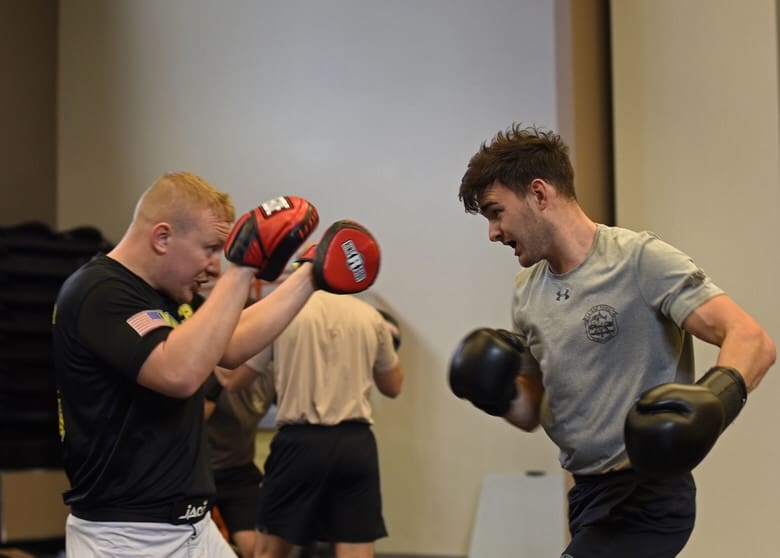
FAIRCHILD AIR FORCE BASE, Wash. — The Air Force recently implemented an advanced Survival, Evasion, Resistance and Escape Combatives Program to enhance SERE specialists’ capability to instruct self-defense techniques to aircrews, thereby increasing survival chances in an unfriendly environment.

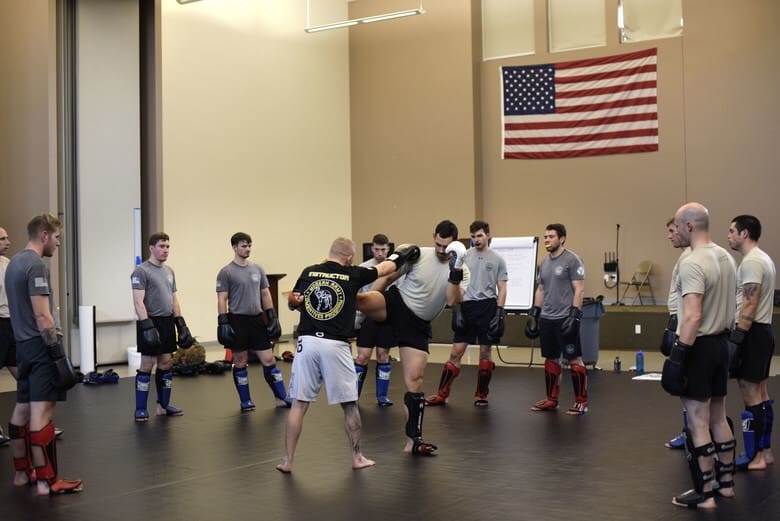
U.S Air Force Senior Airman Skyler Pendleton, 22nd Training Squadron Survival, Evasion, Resistance and Escape specialist and SERE Combatives Program instructor, blocks punches from Airman 1st Class Justin Croteau, 22nd TRS SERE specialist, during a four-hour block of combative training at Fairchild Air Force Base, Washington, Nov. 7, 2018. The 80-hour program trains on projectile, striking, clenching and grappling self-defense techniques. (U.S. Air Force photo/Airman 1st class Jesenia Landaverde)

The combatives class trains in advanced projectile, striking, clenching and grappling self-defense techniques for SERE specialist Airmen.

“The program is not about learning how to fight,” said Senior Airman Skyler Pendleton, 22nd Training Squadron SERE specialist and SERE Combatives Program instructor. “It’s about learning how to defend yourself whether it is downtown, in a deployed location or in a worse environment where you may need to evade or escape.”

U.S Air Force Senior Airman Skyler Pendleton, 22nd Training Squadron Survival Evasion Resistance Escape specialist and SERE Combatives Program instructor, demonstrates self-defense moves to other SERE specialists during a combatives class at Fairchild Air Force Base, Washington, Nov. 7, 2018. The Air Force recently implemented an advanced SERE Combatives Program to enhance SERE specialists’ capability to provide self-defense techniques and increase survivability in an unfriendly environment. (U.S. Air Force photo/Airman 1st class Jesenia Landaverde)

The 80-hour program is an advancement of the 40-hour course SERE specialists take in technical training.

“Some of the techniques are more complex than we’re used to,” said Staff Sgt. Erik Wieland, 306th Rescue Squadron SERE specialist reservist from Davis-Monthan Air Force Base, Arizona. “It’s challenging to take every step and perform it perfectly- not only to complete the course, but to go back to your unit and teach it to your customers correctly, so they are prepared in the field.”

Instructors evaluate specialists on various moves from across the entire spectrum of combatives through hands-on demonstrations and through a question-and-answer portion. Specialists must explain the importance of combatives moves and tell instructors why certain moves may be more efficient than others in combat scenarios.

“This training is different than MMA, boxing, wrestling, etc.,” Pendleton said. “One must realize this is the game of life, there are no rules and anything is fair play. You might have to knee someone in the face or do whatever it takes to get out of a situation and survive. We keep the training controlled but try not to get stuck in a rule-based system of fighting where you can’t do certain moves because it is considered dangerous.”


SERE specialists prepare isolated personnel for any emergency event or captivity situation. This advanced program will increase mission readiness for aircrew by creating a heightened level of assurance in their ability to prevent or escape precarious situations and return home with honor.

By Airman 1st Class Jesenia Landaverde, 92nd Air Refueling Wing Public Affairs

SCUBAPRO Sunday – SeaWing Nova and Jet Fin Skins from MATBOCK

Sunday, November 18th, 2018

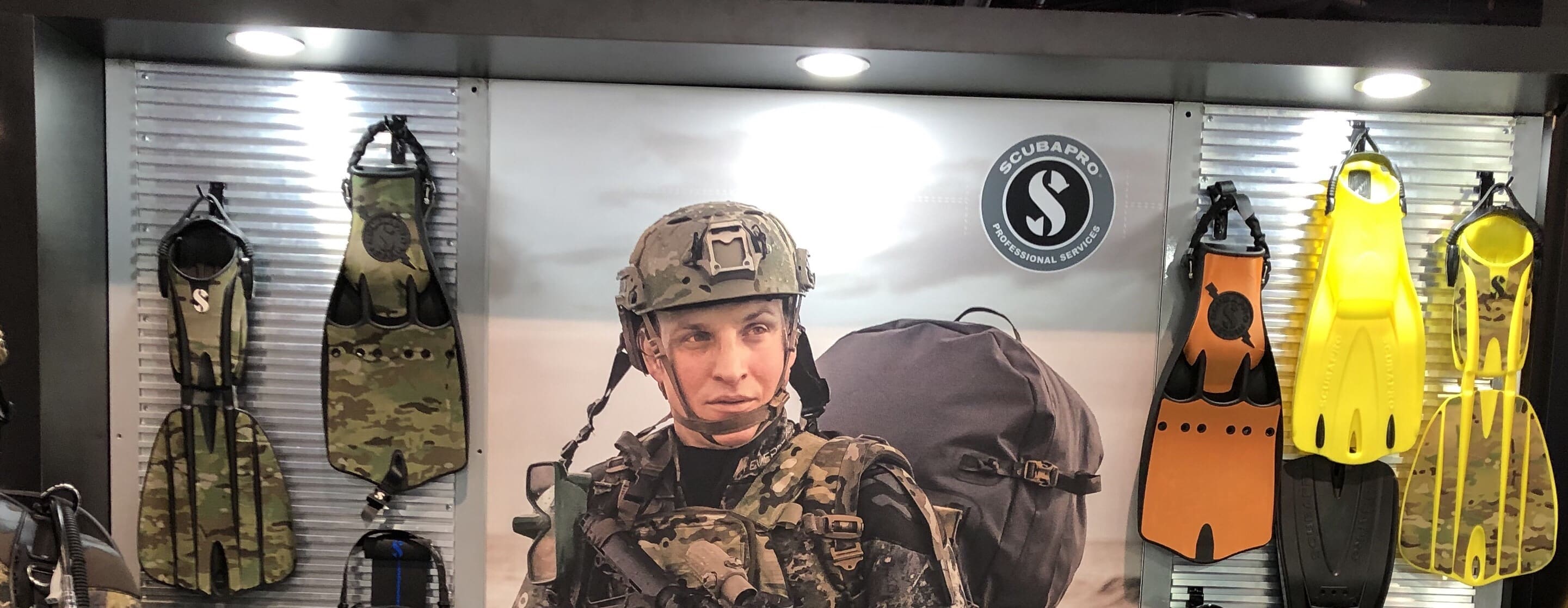
SCUBAPRO and MATBOCK have teamed up to make Skins for two of SCUBAPROs most iconic fins. The SeaWing Nova’s and the Jet fins. The Patent pending MATBOCK Skins is a multi-layer adhesive/fabric laminate designed to give the user the ability to camouflage/ change any surface desired. The Skins are waterproof and oil resistant and can be used multiple times. These skins are designed and laser cut specifically for the SCUBAPRO SeaWing Nova’s and Jet fins.

www.matbock.com/collections/skins/products/scuba-pro-skins

Army Researchers Developing Heat Illness Mitigation App

Friday, November 16th, 2018

NATICK, Mass. — There is a delicate balance between training Soldiers rigorously and training them safely.

Warfighters can lose valuable training days due to unit leaders taking overzealous safety precautions, and as a result, they cannot learn and practice the necessary skills to become a ready and lethal force. However, warfighters training rigorously while forgoing safety can lead to disastrous consequences such as heat illness. These consequences can cost the U.S. military valuable training time, money and operational readiness.

Heat illness is a particular concern during warmer months, but that does not mean warfighters have beat the heat as soon as summer has ended. Surprisingly, heat illness can happen year round due to a combination of factors, not just heat and humidity.

“Body heat production from physical activity is the number one factor that causes body core temperature to rise,” said Laurie Blanchard, a biomedical engineer from the U.S. Army Research Institute of Environmental Medicine, or USARIEM. “Hot environments add to body heat gain, and hot and humid environments and heavy clothing make it more difficult to get rid of body heat. Put them all together, and you have a recipe for heat illness.”

To help solve this problem, Blanchard and other USARIEM researchers have been developing a mobile application that can help unit leaders understand how these factors affect military readiness so they can mitigate risk and optimize training.

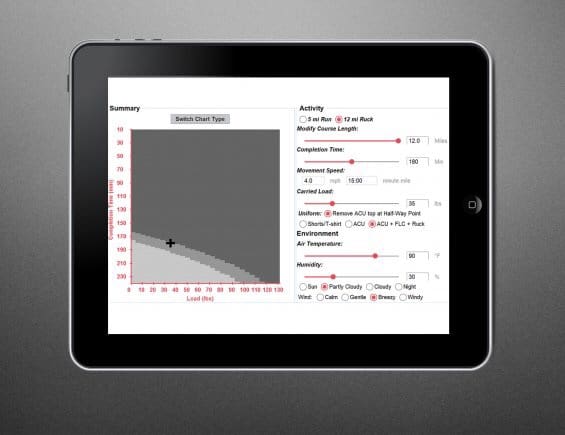
The Heat Strain Decision Aid, or HSDA, is a tablet- and computer-based app that can help unit leaders and mission planners quickly determine a Soldier’s risk of heat illness during training or operational scenarios. HSDA’s simulations of heat stress, according to Blanchard, support the safe work time tables found in current Army heat injury prevention doctrine, Technical Bulletin Medical 507, or TB Med 507.

By pressing a few buttons and toggling a few settings, unit leaders can use the science-based guidance on the tablet- and computer-based Heat Strain Decision Aid, or HSDA, to quickly determine a troop’s risk of heat illness during training or operational scenarios. HSDA was developed by U.S. Army Research Institute of Environmental Medicine, or USARIEM, researchers based on over 30 years of studies on heat illness, hydration and core body temperature in simulated and realistic training environments. (Photo Credit: U.S. Army photo by Mallory Roussel )

“HSDA contains equations that predict how body core temperature changes during and after training and how changes in clothing, activity and environment affect the specific rise and fall of body core temperature,” Blanchard said. “This mission planning tool gives unit leaders objective, science-based guidance that can be found in TB Med 507, the Army’s current heat illness and hydration guidance, in a way that is easy and useful for developing prevention and mitigation strategies against heat illness.”

When unit leaders open HSDA on a tablet or computer, they can adjust warfighters’ activities, clothing, the environmental conditions and the intensity and duration of the exercise simply by pressing a few buttons and toggling a few switches. HSDA does the rest of the work by displaying a chart to the user that estimates how likely troops will experience heat illness during a training or operational scenario.

HSDA even shows leaders when warfighters would be most likely to experience a heat illness during the span of an exercise. For example, a unit leader using HSDA could see that Soldiers would be most likely to experience a heat illness during the first hour of a three-hour loaded ruck march.

“One of the advantages of using HSDA is that unit leaders have a tool that helps them visualize how different mitigation strategies can affect their risks of heat illness,” Blanchard said. “Users can manipulate HSDA’s settings to see how changing uniforms, the length and pace of an exercise and the load carried can increase or decrease heat illness risk.

“Even in those cases where the distance, pace and load cannot be altered, such as for a required training event at a specialty school, HSDA can help users plan effective treatment strategies for expected heat casualties, like providing extra ice sheets, closely watching trainees and planning medical evacuations in advance.”

USARIEM researchers developed the user-friendly software interface for the app warfighters know today. Yet the math behind HSDA has existed long before apps were even invented. According to Blanchard, USARIEM developed HSDA from over 30 years of research on heat illness, hydration and body core temperature. Researchers were able to build and validate the equations within HSDA by conducting hundreds of field studies on thousands of subjects in a variety of environments.

Researchers conducted even more laboratory studies at Natick Soldier Systems Center in the Doriot Climatic Chambers, a unique facility that can simulate an extreme range of global weather conditions, from hot deserts to the chilly Arctic. Blanchard and other researchers measured Soldiers’ body core temperatures as they marched on treadmills while carrying external loads and wearing a wide range of clothing, from Army physical training uniforms (shorts and a t-shirt), to Army Combat Uniforms, to insulating chemical, biological and ballistic protective gear.

This year, USARIEM briefed the HSDA app to the Training and Doctrine Command’s Heat Illness and Prevention Subcommittee. USARIEM received several requests for a copy and is now working with the U.S. Army Medical Materiel Development Activity to make HSDA available to download.

Since spring 2018, USARIEM has transitioned a current version of HSDA to the 1st Special Warfare Training Group (Airborne) at the U.S. Army John F. Kennedy Special Warfare Center and School and to the U.S. Air Force 352nd Battlefield Airmen Training Squadron, who both specifically requested to use the app to mitigate heat illness during training. Under an international agreement, USARIEM has also developed a version of HSDA for the U.K. Institute of Naval Medicine, who incorporated the app into their training centers as a tool to reduce the incidence of heat injuries.

“Unit readiness is dependent on rigorous military training,” Blanchard said. “However, training without taking safety precautions, especially during warmer months, can lead to heat illness, heat stroke and even death. These injuries can have significant medical costs, can have long-term medical implications and can force lost training days, impacting unit readiness and individual Soldier careers.

“We have been able to design current versions of HSDA for specific military groups at their sites. Transitioning the app to U.S. and international warfare training groups has allowed us to collect valuable feedback that we can incorporate into HSDA to make it a more robust app that all warfighters can use.”

By Mallory Roussel (USARIEM)

FirstSpear Friday Focus – Cold Climate Glove

Friday, November 16th, 2018

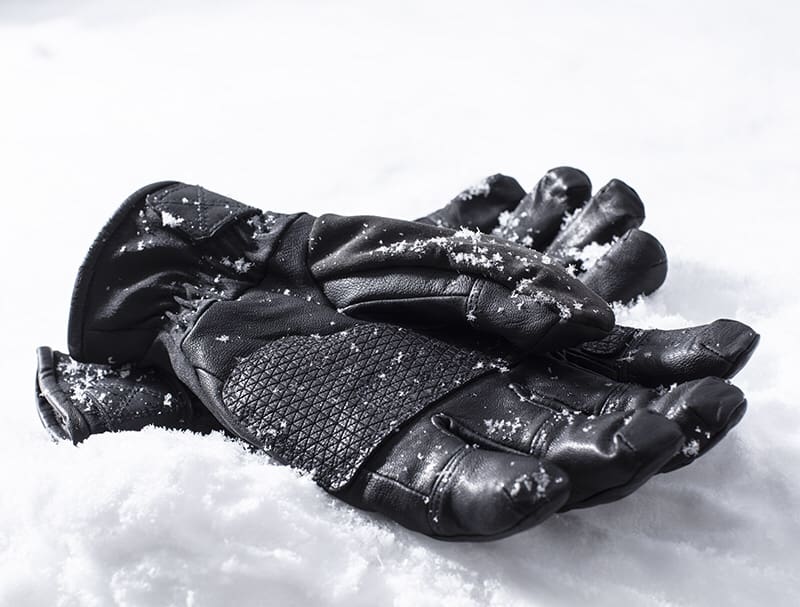
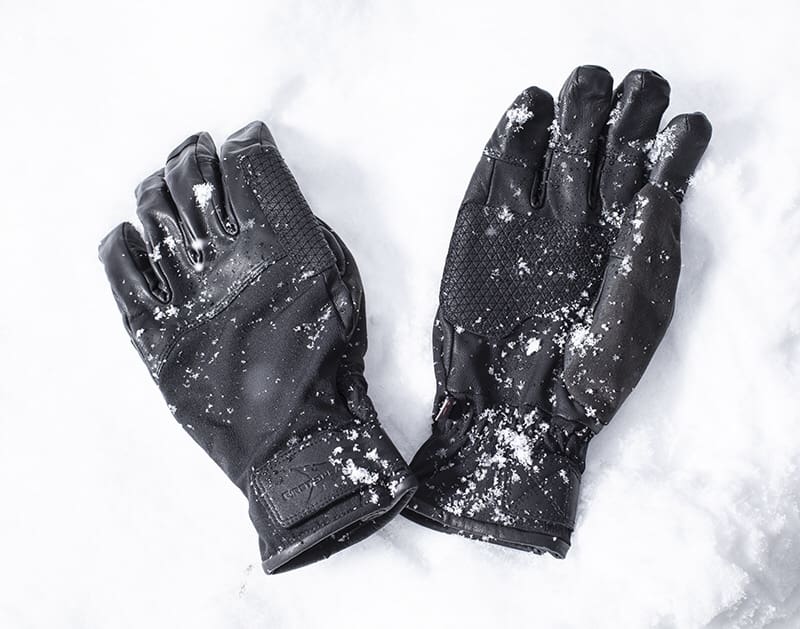
Just in time for winter FirstSpear has announced the all new new Cold Climate Glove is now available for purchase.

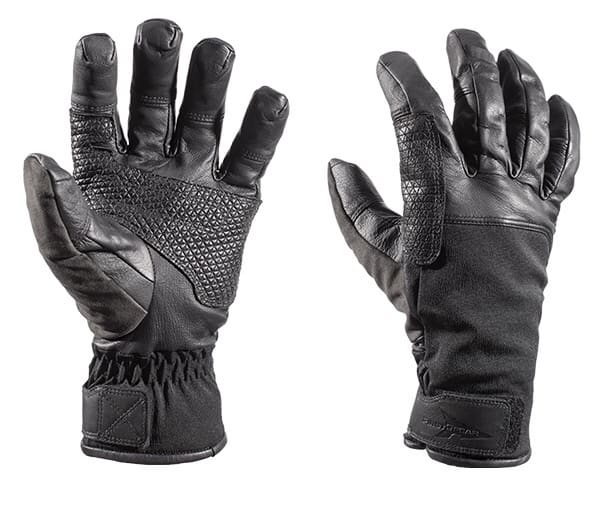
As with all FirstSpear equipment this is simply not your average winter glove. Built with a keratin leather palm patch, Primaloft Gold insulation, and a waterproof breathable insert. Incredibly warm with excellent dexterity allowing basic trigger control.

Additionally, they removed the insulation from the upper half of the Trigger Finger to increase basic trigger manipulation and make it easier when using a Touch Screen. In fact, Touch Screen sensitive index fingers and adjustable wrist cuffs come standard on this premium cold climate glove from FirstSpear. Available and now shipping in sizes small – 2X.

www.first-spear.com/technical-apparel/handwear/cold-climate-glove-ccg-7370