XC3 Weaponlight

Archive for the ‘Guest Post’ Category

Ribbon Cutting for Utah Guard’s New Special Forces Readiness Center

Sunday, August 11th, 2019

CAMP WILLIAMS, Utah —

The Utah National Guard’s 19th Special Forces Group (Airborne) will held a ribbon-cutting ceremony for the newly built Staff Sgt. Aaron Rhett Butler Special Forces Readiness Center, at 10 a.m., Friday, Aug. 9, 2019 at Camp Williams.

This state-of-the-art building has been in the works for the past 10 years, and broke ground for construction on Oct. 17, 2017. It has been built by Jacobsen Construction of Salt Lake City, at a cost of $39 million. The more than 140,000-square-foot facility will serve as the administrative building, classroom building and main training and operations space for the 19th Special Forces Group Headquarters and 1st Battalion, 19th SFG (A). The project will not officially be completed until the end of September.

The building is dedicated to Staff Sgt. Aaron R. Butler who was killed in action on Aug. 16, 2017, while engaging with the enemy in Afghanistan. The loss of Butler reminds us that the focus of the 19th SFG (A) is to provide quality training to each service member, in preparation to defend the U.S. and free the oppressed in far reaches of the world.

The 19th SFG (A) is growing to become one of the largest major commands in Utah. The 19th SFG (A) originally constituted in the Utah National Guard on May 1, 1960 and enjoys a long and successful history as one of only two National Guard Special Forces Groups in the nation. Its unique mission, capabilities and unit cohesiveness have been demonstrated may times around the globe.  From its earliest exercises in the Republic of Korea to the continuing War on Terrorism, the Soldiers of the 19th SFG (A) continue to be a relevant asset to international defense initiatives while also being leaders in their respective local communities.

The armory employs approximately 120 full-time personnel and hosts more than 600 Soldiers every month for training.

MAJ D.J. Gibb, the Utah National Guard PAI initially prepared this report as a media advisory.

SCUBAPRO Sunday – Twin Jet Fins

Sunday, August 11th, 2019

If you have been diving for a while now, you have undoubtedly come across the SCUBAPRO Twin Jet Open Heel Split Fins. They bear a unique patented split fin propeller technology, which provides maximum propulsion with minimal effort underwater.  With those main features, they can enhance your dives while avoiding cramped leg muscles and strained ankles. 


The revolutionary patented design of the SCUBAPRO Twin Jet Open Heel Split Fins was inspired by the dynamic propulsion of the humpback whale. The blades unique shape and angle provide symmetrical power to help you create a smoother, more stable kicks without wearing you out or causing drag. At the same time, it allows you to move more quickly and effortlessly while swimming at great depths, despite the long blade length—all without sacrificing control. 

As a diving fin, the SCUBAPRO Twin Jet is made with both an open-heeled and a full-foot version. The Open Heel comes with a broader foot pockets and offers a more customizable fit for those wearing dive boots for use in colder, deeper waters or boots for over the beach operations/ VBSS. Having strapped fins gives you the chance to adjust the fit as your boots start to compress at greater depths when diving.


The fin straps come with quick-connect swivel buckles, which makes donning and doffing easier. You can also change the rubber heel strap out, to take advantage of the optional spring heel straps. The SCUBAPRO Twin Jet open-heeled fins are one of the most comfortable fins on the market.

They come in different Colors and Buoyancy Options. SCUBAPRO has kept different types of divers in mind when they designed the Twin Jet Fins line. You’ll find that the fins come in multiple color options—black, blue, gray, and yellow—but it’s also important to note that the different colors signify differences buoyancy also.

The black fins are the best, for military divers, as they are negatively buoyant and provide a more traditional fining experience with its rigid blades. But if you’re looking for more flexible blades and don’t mind having slightly positively buoyant fins.


Product Features:

• Monprene® Construction 

• Patented Split-Fin Propeller Technology

• Extra-Wide Foot Pocket

• Extended Soleplate

• Drag-Reducing Vents

• Quick-Connect Swivel Buckles

• Compatible with Spring Heel Straps

Key Benefits:

• Powerful Propulsion with Minimal Effort

• Smooth and Stable Kicks

• Preserves Energy

• Reduces Drag

• Fits Boots

• Easy Donning and Doffing

• Highly durable and Will Last a Lifetime

One of the only drawbacks for the Twin Jet fins is if you have to push something thru the water besides just you. But add something like pulling a buddy or ruck. Then you might want to go with a stiffer fin like Jet fin’s or SeaWing Nova Gorilla. The Spilt fin’s are one of the most popular used by the military and countless divers around the world.


Army General, SOCOM Commander Emphasizes Character to New SEALs

Saturday, August 10th, 2019

The legendary toughness of the Navy’s SEAL teams was on display as the general in charge of U.S. Special Operations Command addressed the 57 sailors graduating from SEAL Qualification Training Class 322 in Coronado, Calif.

Socom Commander Army Gen. Richard Clarke opened his Aug. 2 address noting he felt fortunate to be addressing the graduating class.

“I am glad to break the streak as the first U.S. Army officer and the first U.S. Army Ranger to preside over a [SEAL qualification] graduation,” Clarke said. 

The class began training 15 months ago with 157 students. The physical and mental challenges the sailors faced whittled down the numbers and polished those who made it through to graduation.

“For each of you preparing to walk across this stage, it is an almost indescribable achievement,” Clarke said.

The new SEALs are a diverse group, hailing from 21 different states, the general said, telling the graduates the only thing they shared when the training began “was a desire to test yourselves, to experience a unique challenge, to be part of something bigger than yourselves and to put the needs of the nation ahead of your own.”

Clarke noted the new SEALs have charged through the surf many times in the past 15 months of training, but the next time they do it, it will be different — it will be as members of operational units. 

“Right now, around the globe, Navy SEALs — your teammates — are hard at work,” Clarke said. “SEALs have — and will continue to play — an active and vital role in our national security efforts.” 

SEALs continue to quietly and professionally set the conditions for their fellow service members to deter, disrupt and defeat any adversary, the general said. “You can be sure that we will continue to ask our SEALs to accept the most difficult missions,” he said. “This will challenge you in ways you cannot anticipate, and you need to be ready now.”

That these missions will require physical and technical competence is a given. But they will also require the SEALs to demonstrate character, the general told the graduates. “The themes of trust and of teamwork have been a large part of your training,” Clarke said. “Across the [Special Operations Command] enterprise, trust is our currency with the American people. It’s a powerful but fragile credibility that each of us must guard fiercely.”

“The American people trust that you — that we — will take on these challenges,” he added. “That we will not only win, but win with honor [and] with your values intact. Never allow a disordered loyalty to an individual or team to obscure the values, commitment and trust you share with your great Navy service, with Socom and with the nation.”

Clarke said the new SEALs will have lives in their hands, and that how they respond will affect their fellow citizens. Graduating from the SEAL Qualification Course is the first step. “We count your success here as assurance of your courage, your competence and, most of all, your character. I know that all of you are sufficient for the task,” he said.

The next time they have to wade into cold waters, Clarke said, he wants them to “wade into the unknown boldly, and keep your hands steady.”

The new SEALs are now part of this greater team of special operators who “share a common commitment to protect the American people, our prosperity and, most important, our way of life,” Clarke said.

BY JIM GARAMONE, Defense.gov

Army Awards Laser Weapon System Contract

Saturday, August 10th, 2019

REDSTONE ARSENAL, Ala. — The U.S. Army issued a contract award to accelerate the rapid prototyping and fielding of its first combat-capable laser weapon system.

This prototype will deliver 50 kilowatt (kW)-class lasers on a platoon of four Stryker vehicles in Fiscal Year 2022, supporting the Maneuver-Short Range Air Defense (M-SHORAD) mission. The directed energy M-SHORAD capability is intended to protect maneuvering Brigade Combat Teams from unmanned aerial systems (UAS), rotary-wing aircraft, and rockets, artillery and mortar (RAM).

“The time is now to get directed energy weapons to the battlefield,” said LTG L. Neil Thurgood, Director of Hypersonics, Directed Energy, Space and Rapid Acquisition. “The Army recognizes the need for directed energy lasers as part of the Army’s modernization plan. This is no longer a research effort or a demonstration effort. It is a strategic combat capability, and we are on the right path to get it in Soldiers’ hands.”

High energy lasers engage at the speed of light and provide a solution to a constantly evolving threat space, while reducing the logistics trail associated with conventional kinetic weapon systems. In May 2019, the Army approved a new strategy for accelerating the rapid prototyping and fielding of a variety of directed energy weapons to enable Army modernization.

As the first step in delivering prototypes with residual combat capability, the Army Rapid Capabilities and Critical Technologies Office (RCCTO) has selected two vendors to build the directed energy M-SHORAD mission prototypes in order to foster competition and stimulate the industrial base for directed energy capabilities. Those vendors, Northrop Grumman and Raytheon, are subcontractors in an Other Transaction Authority (OTA) agreement between the Army and Kord Technologies.

Under the OTA award action, issued on July 26 in the amount of $203 million, Kord has teamed with Northrop Grumman and Raytheon to develop the competing prototypes with support from General Dynamics Land Systems, which makes the Stryker, for integration work. Under the terms of the contract, the two laser vendors have approximately one year to produce the required laser subsystems, integrate them onto the Stryker platform, and complete a competitive performance checkout leading into a range demonstration against various threats.

After the Army evaluates the results, it plans to purchase three additional laser-equipped Strykers, for a total of four prototype vehicles that would be fielded to an operational M-SHORAD platoon in Fiscal Year 2022. The OTA award has the potential to increase to $490 million for the delivery of the four prototypes.

The directed energy M-SHORAD prototypes are part of the progression of an Army technology maturation initiative known as the Multi-Mission High Energy Laser (MMHEL).

“Both the Army and commercial industry have made substantial improvements in the efficiency of high energy lasers — to the point where we can get militarily significant laser power onto a tactically relevant platform,” said Dr. Craig Robin, RCCTO Senior Research Scientist for Directed Energy Applications. “Now, we are in position to quickly prototype, compete for the best solution, and deliver to a combat unit.”

The Army is also welcoming participation from additional vendors who were not selected for the OTA awards, but desire to compete for the same M-SHORAD requirement and timeline using their own internal research and development funding.

In a related effort, the Army is also adapting its High Energy Laser Tactical Vehicle Demonstrator (HEL-TVD) system into a prototype program order to increase its combat effectiveness and speed up its delivery to Soldiers.

The Army will adjust the current HEL-TVD, a 100 kW-class laser system integrated on a Family of Medium Tactical Vehicles platform developed by Dynetics and subcontractor Lockheed Martin. Under the new directed energy strategy, the Army is leveraging progress made in that effort in order to merge the HEL-TVD with similar technologies in development by the Navy and the Office of the Secretary of Defense.

This partnership will allow the services to achieve a higher power system, of approximately 250-300 kW-class, that can protect sites from RAM and UAS as well as more stressing threats — significantly increasing the warfighting capability being transitioned on the original timeline. The Army’s goal is to deliver four such prototype lasers integrated on tactical vehicles, for a capability known as High Energy Laser-Indirect Fire Protection Capability (HEL-IFPC), to a platoon by Fiscal Year 2024.

“By teaming with the other services and our industry partners, we will not only save resources, but exponentially increase the power level and get a better system to Soldiers faster,” Thurgood said.

The Army RCCTO, headquartered at Redstone Arsenal, Ala., is chartered to develop rapid prototypes and field residual combat capabilities. Its current focus areas are hypersonics and directed energy.

By Claire Heininger, U.S. Army

FirstSpear Friday Focus – OEM Partner Series, Hill People Gear

Friday, August 9th, 2019

This Friday Focus we have another installment of our FirstSpear OEM Partner series where we take a look at one of the great American companies FirstSpear manufactures equipment for. Today we are taking a look at one of FirstSpear’s very first OEM Partners, Hill People Gear, and two very popular items now available in all new Elk Brown.

HPG Operations manager, Kevin McDowell says, “The new Elk Brown is a rich earth tone that is at home in a variety of environments from woodland to desert to urban. It reminds us of the past while being perfectly suited for the tasks of today, which is why it takes it’s place as HPG’s flagship color.”

Ute

Designed and tested in Western Colorado and named after “the brothers to the bear” who ranged from the front slope of the Colorado Rockies out into the desert wilderness of the Colorado Plateau in eastern Utah. The Utes are an independent and adaptable people who inhabited a wide variety of landscapes from slickrock canyon to alpine bowl.

The pack we have named after the Utes is similarly adaptable, designed to handle loads from 20 up to as many pounds as you can safely carry with equal aplomb.

M2016 Butt Pack

HPG’s rendition of the venerable military butt pack can be used as shoulder bag, lumbar pack, and top pocket. This is a panel loading pack with some internal organizational options and significant external expansion via lightweight FirstSpear 6/12 PALS cut fabric and compression straps.

US Army Developing Battlefield Network Authentication Tokens

Tuesday, August 6th, 2019

New wearable authentication more than a “token” gesture
ABERDEEN PROVING GROUND, Md. — The Army Futures Command, or AFC, is developing wearable identity authentication and authorization technologies that will enable Soldiers to securely access network-based capabilities while operating on the move in contested, threat-based environments.

Photo: SPC Dustin D. Biven, 22nd Mobile Public Affairs Detachment

Since 2001, the Common Access Card, or CAC, has served as the de facto, government-wide standard for network and system security access control. However, CAC cards are not operationally suited for use in every environment.

Moreover, the Army lacks a standard way for Soldiers at every echelon to prove their identity when operating systems, devices and applications on Army networks.

With this in mind, AFC’s major subordinate command, the U.S. Army Combat Capabilities Development Command, or CCDC, is researching and developing authentication technologies that will provide Soldiers with secure and simple ways to identify, authenticate and be authorized access to Army networks, operating systems, servers, laptops, applications, web services, radios, weapon systems and handheld devices.

Photo: Combat Camera, courtesy of CCDC C5ISR Center public affairs

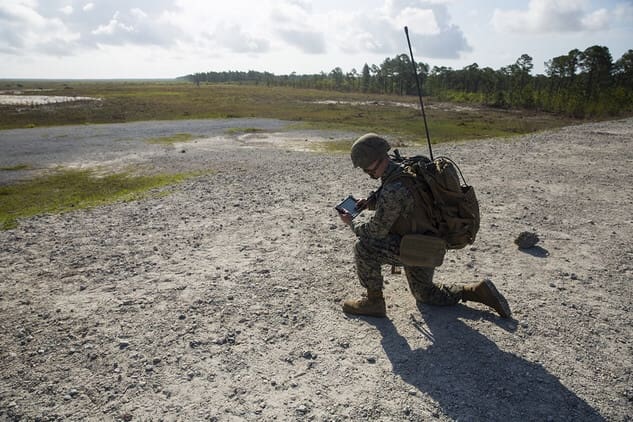
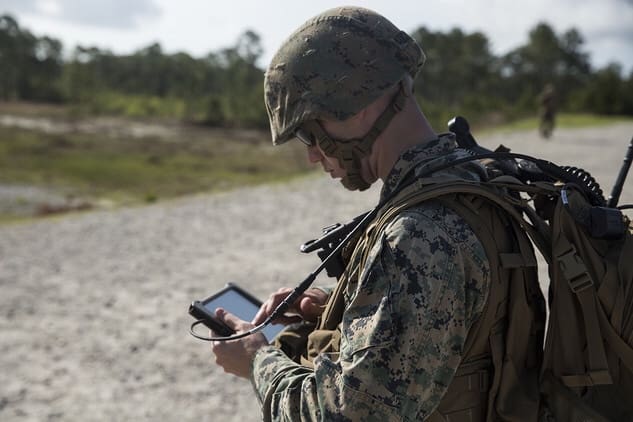
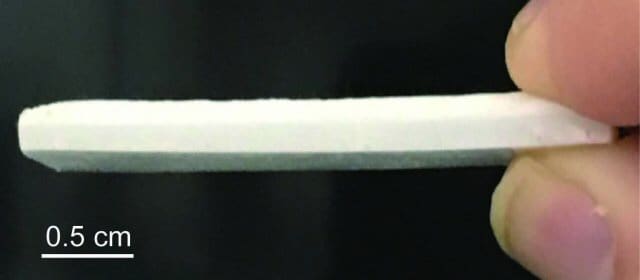
CCDC’s Command, Control, Communications, Computers, Cyber, Intelligence, Surveillance and Reconnaissance, or C5ISR, Center is designing wearable identity tokens for Soldiers to use to log on to mission command systems, networks and tactical platforms. The tokens are wireless, lightweight, flexible and rugged, and they can be inserted in a Soldier’s pocket, attached to a sleeve or integrated into a wrist band like a Fitbit.

Conceptually, Soldiers wearing these tokens could simply approach a system to login, be recognized by that system, which would then prompt the Soldier to enter a PIN or use a biometric as a second factor, and be automatically logged out when they walk out of the system’s range.

“The Army is driving towards a simpler and intuitive tactical network, so we’re aligning our Science and Technology resources to explore the challenges associated with this mission space, inform senior decision makers of the lessons learned and deliver capabilities that support Army Modernization and address the Soldier’s needs — now and in the future,” said Brian Dempsey, Tactical Network Protection chief for the C5ISR Center’s Space and Terrestrial Communications Directorate, or S&TCD.

Photo: Douglas Scott

The wearable identity tokens combine the security of a public key-based credential — similar to the credential on the CAC — with cutting-edge advances in the commercial wireless payment industry and flexible hybrid electronics, explained Ogedi Okwudishu, project lead for the Tactical Identity and Access Management, or TIDAM, program.

“As part of the Army Futures Command, we’re looking to move at the speed of the information age. We want to be able to research, test, proof the concepts and integrate emerging IT capabilities from industry as they become available. There’s no point re-inventing the wheel,” Okwudishu said.

Under the current paradigm, tactical platforms would need to be retrofitted with specialized equipment in order to read new identity authentication technologies. Such deployments and retrofitting can be very costly. Wearable tokens, however, leverage already existing communication and protocol capabilities, Okwudishu pointed out.

“Soldiers should not have to take out a smartcard, insert it into a card reader and then remember to remove the card from the reader when they are done,” said Okwudishu. “Contactless identity tokens are not only easy to use, they provide a significant cost savings for the Army. You can continue to add authentication capabilities without needing to redesign, or deploy new, tactical hardware to every laptop, server, handheld device or weapon system in the field.”

Since beginning the TIDAM program in 2017, the C5ISR Center has worked closely with Soldiers and Program Executive Offices, or PEOs, Soldier and Command, Control Communications-Tactical, or C3T, to validate, demonstrate and mature the technology.

The center’s S&TCD is working with Project Manager Integrated Visual Augmentation System, or IVAS, to finalize a transition agreement with PEO Soldier for wearable authenticator infrastructure technologies. In the meantime, the directorate is developing a wearable authenticator software provisioner that will enable the secure placement of credentials on the wearable tokens and the ability to do this “locally” at the brigade level and below.

S&TCD is also working from a roadmap it jointly developed with PEO Soldier to integrate the capability with various systems from PEO Soldier and PEO C3T. Currently, the goal for fielding the tokens is in FY 22.

“I think this is a really great idea,” said Sgt. 1st Class David Worthington, senior enlisted advisor for the C5ISR Center. “Nobody has done anything like this yet. If done properly, it will make the authentication process a lot easier and a lot faster. More important, it provides more reciprocity at the tactical level for log-ins, so you can track what people are doing on the network.”

By Douglas Scott

Max Talk 32: Highlights from the Texas Class 2019

Monday, August 5th, 2019

This is the thirty-second installment of ‘Max Talk Monday’ which shares select episodes from a series of instructional videos. Max Velocity Tactical (MVT) has established a reputation on the leading edge of tactical live fire and force on force training. MVT is dedicated to developing and training tactical excellence at the individual and team level.

This week’s video is a compilation from the Texas Class 2019. This is an annual class open to all MVT alumni.

More of these instructional videos can be found by subscribing to the Max Velocity Tactical YouTube Channel.

Detailed explanations can be found in the MVT Tactical Manual: Small Unit Tactics.

Max is a tactical trainer and author, a lifelong professional soldier with extensive military experience. Both enlisted and commissioned (via the Royal Military Academy Sandhurst) into the elite Parachute Regiment, Max served in the British Army equivalent of US Special Operations Forces: The Parachute Regiment maintains a battalion (1 PARA) under Director Special Forces as part of the SFSG, with 2 and 3 PARA additionally serving in the UK’s elite Rapid Response Force. Max served on numerous operational tours (known as combat deployments in the US), and also served as a recruit instructor at the PARA Training Depot. Max spent a further five years working operationally as a paramilitary contractor in both Iraq and Afghanistan; the latter two years working for the British Government in Helmand Province.

Max has been running Max Velocity Tactical (MVT) since 2013. MVT has established a reputation on the leading edge of tactical live fire and force on force training, specializing in teaching Small Unit Tactics. MVT is dedicated to developing and training tactical excellence at the individual and team level. MVT operates the Velocity Training Center (VTC) tactical and leadership training facility near to Romney, West Virginia. MVT classes utilize professional combat marksmanship, tactical and leadership training, in order to develop situational awareness, teamwork, leadership, decision making and communication.

Website: Max Velocity Tactical

YouTube: Max Velocity Tactical

Excellence in Tactical Training.

Strikehold’s Leapfest Wrap-Up

Monday, August 5th, 2019

We are fortunate to share Strikehold.net’s coverage of Leapfest 2019, the annual military parachuting competition hosted by the Rhode Island National Guard.

Leapfest is the largest, longest standing, international static line parachute training event and competition. Conducted by the Rhode Island Army National Guard, the purpose of Leapfest is to promote international camaraderie and Esprit de Corps among Airborne Soldiers, while also showcasing the capabilities of the Rhode Island National Guard.

Paratroopers are specially selected, trained, and highly disciplined soldiers. They are able to rapidly deploy, land, and sustain a powerful combat force to achieve strategic objectives – such as seizing and holding key terrain or infrastructure. They can also be dropped behind enemy lines to conduct raids and other types of tactical interdiction missions. They are typically used as countries’ rapid deployment forces, with the ability to operate on any terrain in any environment with little warning.

Airborne forces can vary in size from an airborne company, a regimental combat team, or to an entire division or corps. To become a paratrooper, a soldier must go through rigorous physical and psychological training and conditioning in order to be ready to jump and fight without hesitation.

Leapfest is routinely attended by teams from across the Armed Forces of the United States (both Active and Reserve forces) as well as multiple international teams. Participants aim to land as close as possible to a marked, designated area within the landing zone. Upon landing and completing a PLF (parachute landing fall), participants are timed by qualified judges until they reach the designated area.

Each team consists of 5 participants: 4 jumpers and 1 alternate jumper. Each jumper must complete 2 jumps to be qualified for the individual award, and each team must complete 8 jumps in total to be qualified for the team award.

Jumpers exit from a CH-47 Chinook helicopter at an altitude of 1500 feet (457 meters) using an MC-6 static line, steerable, parabolic parachute. The MC-6 is the latest advanced-design steerable, round-canopy, parachute, and was developed through the Special Operations Forces Tactical Assault Parachute Systems (SOFTAPS) program. The MC-6 utilizes the same SF-10A canopy that has been in use with US Special Operations Forces for over 10 years. The MC-6 Maneuverable Troop Parachute System consists of the SF-10A Main Canopy, the T-11R Reserve, and the T-11 Harness.

This year there was a total of 35 teams from the US and 20 teams from 12 international Partner Nations. This year’s international teams hail from Canada, Chile, Czech Republic, Dominican Republic, Germany, Netherlands, Italy, Jordan, Mexico, Morocco, Qatar, South Africa, United Kingdom and New Zealand.

In addition to the competition, Leapfest also features a day of friendship jumps conducted by international Jump Masters, followed by a Wings Exchange Ceremony prior to the official Closing Ceremonies.

Further info about Leapfest can be found online and on Facebook.

To view all of the photos taken during the competition, visit strikehold.net/2019/08/04/leapfest-2019.

Thanks Lawrence!