SIG SAUER - Never Settle

Archive for the ‘Guest Post’ Category

FirstSpear Friday Focus – New Base Layer Bottoms

Friday, December 28th, 2018

Meet the all new Base Layer Bottoms from FirstSpear’s Advanced Clothing Materials Line (ACM). Featuring three available styles a Boxer Brief, Calf Length, and Full Length. All three are built with FirstSpear’s ACM BASE-100 a super light wool package providing excellent natural moisture wicking properties. All three feature a front facing fly, gusseted crotch and flat seamed technology.

The full length is a traditional full length inseam finished with a low ankle cuff, the Calf Length is cut just below the knee designed to pick up where your boot sock stops reducing clutter under footwear and increasing comfort. The Boxer brief is finished in a traditional boxer brief length. 100% American Made with American Materials, now shipping on first-spear.com

www.first-spear.com/technical-apparel/american-merino-wool/base-layer-bottoms

Step Aside, Annie Oakley, Because This Girl Can Shoot

Thursday, December 27th, 2018

TNVC President and CEO Victor DiCosola with six-time Olympic medalist, Kim Rhode


I am humbled every day by the amazing people I get to spend time with. One in particular is very special to me, and I am honored to be with Kim Rhode, the most decorated US shooter and first female Olympian to medal in six consecutive games, including 3 golds. (Only Italian luger Armin Zoeggeler has done it on the men’s side). And Kim will have the opportunity to make history in the upcoming 2020 Olympics in Japan as the only Olympic athlete to ever capture 7 consecutive Olympic medals. 

Kim’s coach and father, Richard, has helped me immensely honing my skills in International Bunker, along with my personal shooting coach Brian Burrows. They all are the most gracious professionals you can ever meet and hang with. (Instagram @KimRhode)

-Victor DiCosola

TNVC President and CEO


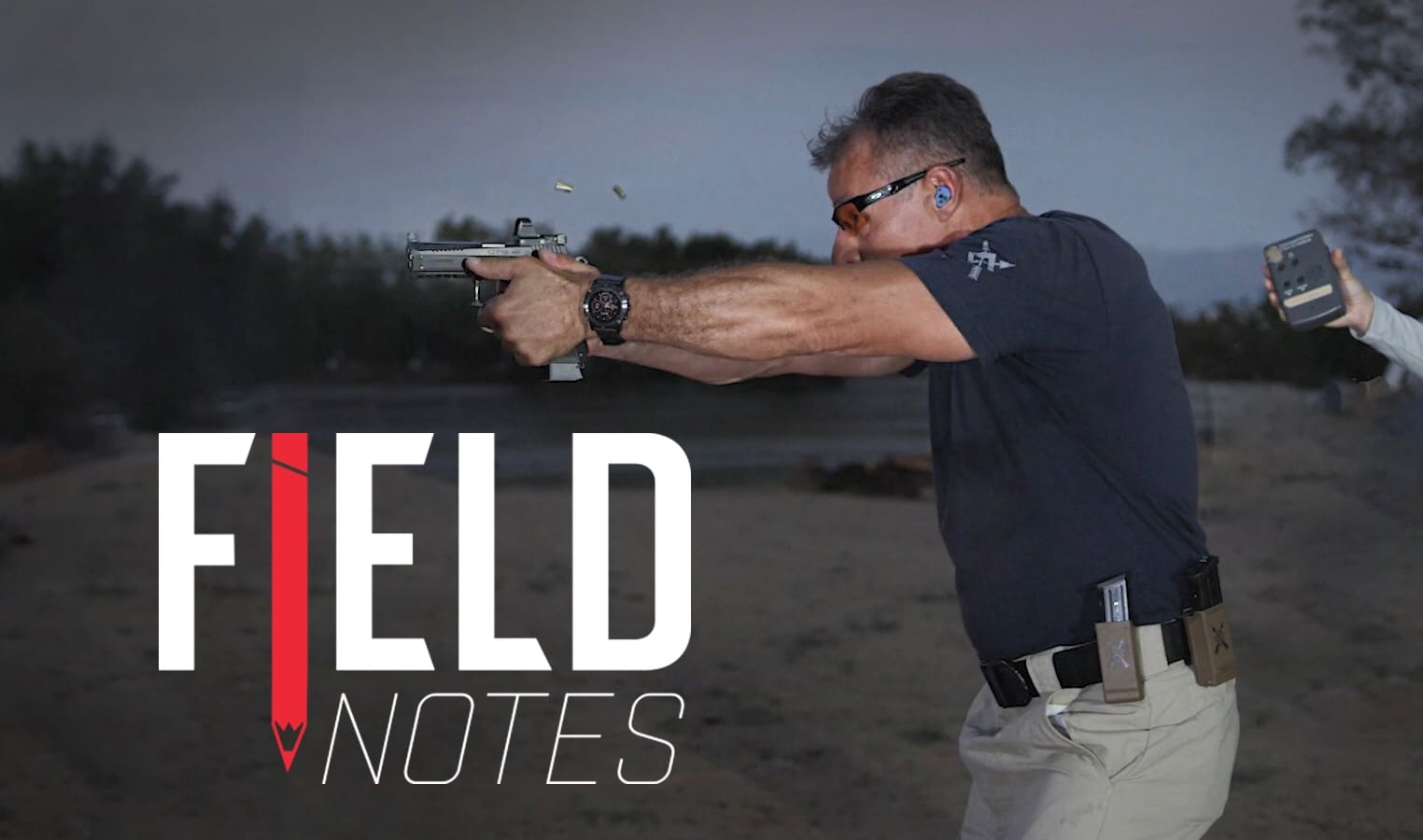
SureFire Field Notes Ep 39 – How to Speed Reload With Larry Vickers

Wednesday, December 26th, 2018

Larry Vickers is a retired US Army 1st SFOD- Delta combat veteran with years of experience in the firearms industry as a combat marksmanship instructor and industry consultant. In recent years he has hosted several tactical firearms related TV shows. Currently Larry presents videos on the Vickers Tactical Youtube channel of which Bravo Company is the presenting sponsor. Larry Vickers special operations background is one of the most unique in the industry today; he has been directly or indirectly involved in the some of the most significant special operations missions of the last quarter century. During Operation Just Cause he participated in Operation Acid Gambit – the rescue of Kurt Muse from Modelo Prison in Panama City, Panama. As a tactics and marksmanship instructor on active duty he helped train special operations personnel that later captured Saddam Hussein and eliminated his sons Uday and Qusay Hussein. In addition, he was directly involved in the design and development of the HK416 for Tier One SOF use, which was used by Naval Special Warfare personnel to kill Osama Bin Laden. Larry Vickers has developed various small arms accessories, with the most notable being his signature sling manufactured by Blue Force Gear, Glock accessories by Tangodown, and 1911 specific products by Wilson Combat. In addition he has maintained strong relationships with premium companies within the firearms industry such as Blue Force Gear, BCM, Aimpoint, CCWSafe, Wilson Combat, and Tangodown. He has developed and offered a line of Vickers Tactical Glock pistols sold exclusively thru Lipseys Inc.. He is also author of the Vickers Guide series of firearm books. Larry Vickers travels the country conducting combat marksmanship classes for law abiding civilians, law enforcement and military.

www.vickerstactical.com
www.aztectrainingservices.com
www.surefire.com

The Baldwin Files – Forgotten SWCS History

Wednesday, December 26th, 2018

I sent the following email just before I retired in 2011 to an old friend who had just taken a senior position at the Special Warfare Center and School (SWCS) at Fort Bragg. During the time in question, 2000-01, I was commanding F Company, 1st Battalion, 1st Special Warfare Training Group at Camp Mackall.  My company was responsible for two phases of the Special Forces Qualification Course or Q Course for short.  What was then called Phase II, focused on Land Navigation and Small Unit Tactics; and Phase IV, focused on Unconventional Warfare (UW), including the culminating Robin Sage Exercise. I am one of the few that had firsthand knowledge of this historical episode – since it was never made public – for reasons that will become obvious.  I thought it was past time to share it with a larger audience and save it for posterity.  I have edited what follows only to spell out contractions and the numerous acronyms for clarity.

Believe it or not, this is a true story.  In 2000 and 2001 (before 9/11) a small group of senior Special Forces Officers at SWCS and some retired leaders – including one former Group Commander – were developing plans to radically “reinvent” or “reboot”  Special Forces (SF) for the new millennia. I am not going to mention names, but you know these men. They were convinced that the classic core SF mission of Unconventional Warfare (UW), aka Guerrilla Warfare, was as obsolete as the horse cavalry.  Moreover, if our Regiment did not significantly change we would risk becoming irrelevant in the 21st Century.  Therefore, they were determined to save SF…even if it meant discarding everything that makes us who we are.

This cabal looked at our history and reached some firm (but fatally flawed) conclusions: First, they determined that if any U.S. President ever considered doing small scale UW again, it would be a covert or clandestine effort conducted by the CIA. If any Department of Defense (DoD) forces were involved, those troops would come from the “black” SOF and not the “white” SF Groups (God, how I hate those terms). Because the Vietnam War had been less than successful at the strategic level, they also believed that our national leaders would never again have the political will to conduct Counterinsurgency or Nation Building.  Of course, they had to willfully disregard the myriad of tactical and operational successes and the breadth of Special Operation Activities that SF accomplished during the conflict in SE Asia.  

They looked at Desert Shield/Storm and concluded that the only mission SF conducted that conventional commanders were comfortable with – and praised – was the Coalition Support Team (CST) mission. The Special Reconnaissance (SR) missions (referred to as Strategic Reconnaissance in older manuals) executed by SF were only marginally successful and not very helpful at the operational level. Although I would argue that was because we were constrained from operating mounted a la the LRDG as 5th Group had detachments well trained to execute.  Instead, we inserted teams on foot in a fashion similar to conventional LRS units. Oddly enough, those “black” units tasked with “Scud Hunting” went in mounted, were more successful, and therefore had a more appropriate SOF operational impact. 

They looked at other operations and contingencies (Panama, Somalia) and decided that the SF contribution to combat operations was, to their way of thinking, marginal. Instead, they liked what had been done with SF ODAs in Haiti and in Northern Iraq after Desert Storm. SF had received much praise from conventional Army leaders for effectively working with indigenous people in largely permissive environments for humanitarian purposes. The cabal concluded that utilizing ODAs as “super” CAT-As instead of “cowboy” warriors was non-threatening to Conventional Force commanders and therefore a “safe” mission to retain. 

Based in part on the restraints placed on our adviser effort in El Salvador as well as constrained partner operations in Bosnia and Kosovo there was also a strong perception that Force Protection priorities (Risk Aversion) would preclude future SF advisory efforts from ever accompanying our counterparts on actual combat operations during Foreign Internal Defense (FID) activities.  Therefore, there was no need to prepare ODAs to conduct direct combat as an integral component of FID. Small scale and short duration Direct Action (DA) “surgical operations” would be the purview of those aforementioned “black” SOF units. Likewise, rapidly maturing technologies like drones and advanced reconnaissance satellites meant that SR as we had known it was also no longer a necessary or relevant skill set for SF soldiers.

No UW, no DA, no SR and no “combat” FID. So what would SF soldiers and ODAs be trained, equipped and organized to do in support of National Strategic objectives?  The cabal’s verdict…Peacetime FID.  In fact, they went so far as to declare that there should be “no such thing” as an SF unilateral mission. The “by, with and through” methodology was actually meant to purposely constrain and limit SF utility so that we could not be “mis-utilized” in some direct role.  We would in effect “opt out” of being a Full Spectrum Special Operations Force. Clandestine and covert would not be in our vocabulary, and there would be no need for classified or advanced skills and no compartmented SF operations…ever. Infiltration techniques like HALO and SCUBA would only be applicable to the training of others and never for ODA independent insertions and extractions.

We would still call ourselves “SF,” but in my opinion, we would have only been “Short Bus” Special.  I mentioned to one of the “true believers” of this radical concept that by confining ourselves to such a narrow mission set we would effectively self-select SF to be a Combat Support Function rather than a Combat Function. He seemed to take my not-at-all-subtle criticism in stride and told me that the train had already left the station and I had better get on board.

This far reaching but poorly conceived initiative scared the living daylights out of me.  I do not know how far it would have gotten. At the time, the schemers were keeping it “on the down low” because I am sure there would have been an extreme backlash from the force once this proposed transformation was out in the open. However, in the late Fall of 2000, there was a “Grey Beard” Conference held at Camp MacKall and most of the retired SF Generals were in attendance.  I was not privy to the conference sessions but was told afterwards by my Battalion Commander (you know who that was) that the proposal was discussed and at least some of the Gray Beards were “OK with it.” Whether that is true or not, after the conference the cabal continued their preparations to implement the training shift “on order.”

This was not all just theoretical discussion on their part. By the early Summer of 2001, initial steps were actively taken to phase out and eventually eliminate Robin Sage as a UW exercise in Pineland.  Instead, SWCS was preparing to shift to “FID Lane” training to be conducted entirely on the Fort Bragg reservation. The student ODAs would link up with their Host Nation (HN) counterparts (formerly known as Gs) and teach conventional small unit tactics and individual skills in a “secure HN area.”  The culminating event would be the ODA advising and assisting their counterparts through an actual Fort Bragg live fire maneuver range. Imagine that. The most complicated task we would demand in the Q Course of our SF soldiers and teams is that they can safely conduct a live fire range under peacetime rules. And, to add insult to injury, in combat we would relegate them to act as glorified liaison teams (CSTs) or surrogate CAT-As at best.

Of course, 9/11 occurred and their plan and their premise became moot. All have since retired and/or faded into well-earned obscurity. That is a very good thing as far as I am concerned. I do not fault these gentlemen for not having precognition and foreseeing GWOT. I do fault them for cherry picking historical examples that supported their thesis and ignoring the rest. I fault them for being so timid that they would retreat from SF heritage – not under pressure from the Army or DoD – but out of fear. I fault them for not understanding that our success in FID is directly related to the fact that we are – first, foremost, and always – combat soldiers and combat units with a long history of skill and valor to prove it. But most of all, I fault them for not understanding what makes us Special Forces. It is not a beret, a tab, or a title.  It is in fact the UW Mission.

UW is not just one more thing on our “to do” list alongside other potential tasks/missions of equal importance and priority. UW is the foundational mission that shapes our individual troopers and our teams. Training for it in the Q Course and the Groups teaches our people to operate effectively in any complex, uncertain and ambiguous situation or any challenging environment. It teaches them to be able to act alone or as part of a team sometimes without much in the way of outside support. It reinforces the individual and collective traits of self-reliance, adaptability and determination. UW teaches our operators that when all else fails they can always rely on their wits, their training and their teammates. No other mission set does that. UW makes us good at FID and just about anything else we might be asked to do. The opposite is not true.

So, what is my point?  This is ancient history. It did not happen. Crisis averted.  But wait, as we draw down from the larger scale conflicts in Iraq and eventually Afghanistan we will again rightly reassess ourselves and look at ways we need to change to meet emerging threats and missions. I have already seen or heard public and private comments by well-meaning but sadly uninformed individuals (some wearing long tabs) that we (SF) “lost our way” to a certain extent over the last decade plus.  The argument goes that we became too enamored with DA missions and we have to “get back to our roots” as an “Indirect” force rather than a “Direct” force. 

First, you and I both know that their premise is false. SF conducted almost all of our combat activities “by, with, through and alongside” our indigenous counterparts. Either we partnered with existing forces like the Northern Alliance in Afghanistan or the Peshmurga in Northern Iraq – or we created surrogate forces where none existed. Ultimately building successful high-end HN Counterinsurgency and Counterterrorism forces in Afghanistan and Iraq.  Yet, U.S. SF teams also rightly retained the option and capability to conduct unilateral operations when appropriate.  It would be just as wrong for us to back away from our DA skills now, as it would have been in 2000-2001. Clearly, our DA skills remain a vital enabler that directly supports the UW and FID missions as well as enhances our ability to provide our own measure of credible force protection or independent offensive action under any circumstances.

Some people still worry that we are the only SOF unit that does not fit into a well-defined niche. The rest generally specialize in narrower mission sets and they are very good at what they do. The concern is that we (SF) are trying to be “jacks of all (SOF) trades”…and therefore appear to outsiders as perhaps “unfocused” and “masters of none.” I would argue that there is great goodness in having a highly skilled force that is not a one trick pony. I think the incredible range of activities that SF soldiers and teams are successfully conducting around the world every day proves that. Moreover, in my opinion, we do have a clear focus because we spend our careers mastering the UW Mission and the UW Environment. In short, with UW as our foundational and defining task I believe we are on very firm footing.  And I do not see us going the way of the horse cavalry anytime soon.

I am not trying to set myself up as the arbitrator of what SF should and should not be in the future. However, I have been around long enough and seen enough to know a little about what we are and what we are not. We are not Combat Support and we are not second string to the “black” side. We are unapologetic men of action and can justly call ourselves the best of the best. I am very pleased with where the Regiment is now and I have even greater expectations for the future. The schoolhouse is where we define ourselves. It is where we shape not only our entry-level operators but our senior leaders as well. Based on what I have just told you, I would just caution that not everyone who has a Special Forces Tab necessarily “gets it.”  Of course, you already knew that. On a personal level, I can tell you that I am very thankful that you are where you are right now. Moreover, I envy you the opportunity to directly shape that bright future.

De Oppresso Liber.

Terry                  

LTC Terry Baldwin, US Army (Ret) served on active duty from 1975-2011 in various Infantry and Special Forces assignments. SSD is blessed to have him as both reader and contributor.

5th Quartermaster Brings Holiday Cheer with Operation Toy Drop

Tuesday, December 25th, 2018

ALZEY, Germany — U.S., NATO ally and partner paratroopers participated in the 5th Quartermaster Theater Aerial Delivery Company’s Operation Toy Drop Dec. 11-14.

Capt. Rizzoli Elias, company commander, the 5th Quartermaster Theater Aerial Delivery Company, 16th Special Troops Battalion, 16th Sustainment Brigade, gives a German child a stuffed animal as part of Operation Toy Drop at Alzey, Germany Dec. 13. Operation Toy Drop is an annual multi-national training event designed to strengthen relations with the local community and develop interoperability.

Operation Toy Drop is an annual multi-national training event. It entails sharing airborne operations, tactics, techniques and procedures, strengthening relationships with local communities and with NATO allies and partners as well as developing interoperability.

“It’s so much fun seeing other nations get in on our training and us to get on their training to see how they operate with these airborne operations, to see how we operate,” said Sgt. Kyle D. Shields, a parachute rigger with the 5th Quartermaster, Theater Aerial Delivery Company, 16th Special Troops Battalion, 16th Sustainment Brigade.

A paratrooper with an open parachute descends over Alzey Drop Zone during Operation Toy Drop in Alzey, Germany, Dec. 13. Operation Toy Drop is an annual multi-national training event designed to strengthen relations and develop interoperability.

“All of us use different parachute systems across the different militaries, so it’s just trying to get everybody synced up in one parachute system and make sure everybody understands that every system has a risk factor and different ways you have to steer it, fly it and turn it,” Shields said.

Holiday cheer played a major role during Operation Toy Drop.

Part of this cheer was Santa Claus, Mrs. Claus, and elves jumping out of an airplane and then giving toys to children from the Kaiserslautern area. Both U.S. and German children smiled and laughed with excitement as they received presents from members of the 5th Quartermaster, Theater Aerial Delivery Company, who dressed up as Christmas characters during Operation Toy Drop. The toys given to the children were donated by paratroopers participating in this event.

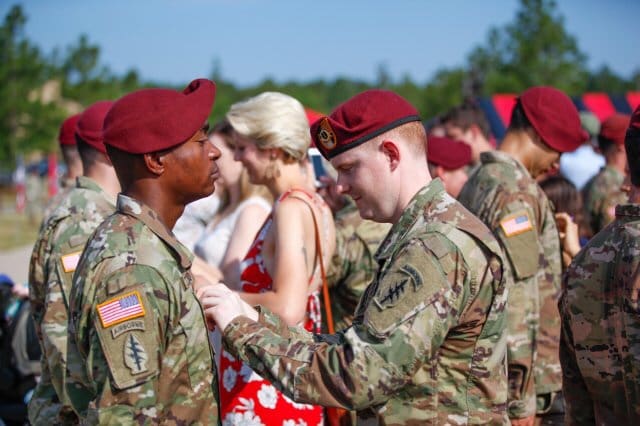
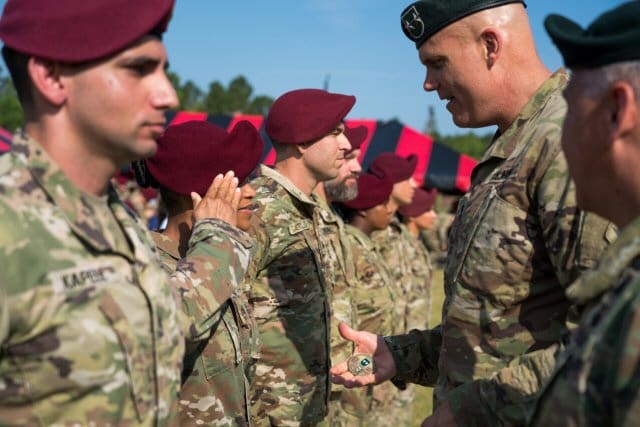
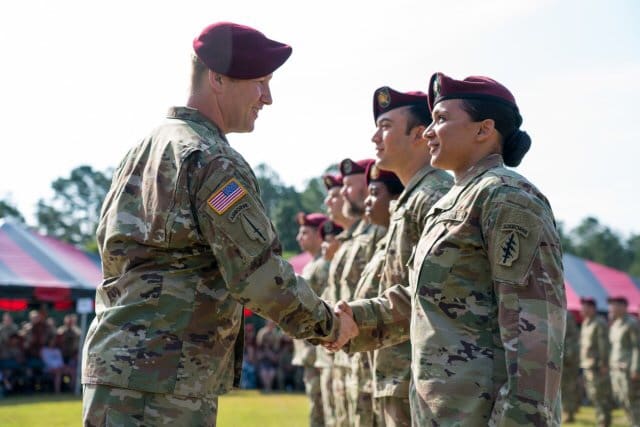
U.S., NATO ally, and partner service members receive Irish jump wings during a wing ceremony exchange hosted by the 5th Quartermaster Theater Aerial Delivery Company, at Rhine Ordnance Barracks, Kaiserslautern, Germany Dec. 14. The paratroopers earned their jump wings while participating in Operation Toy Drop, an annual multi-national training event designed to strengthen relations with the local community and develop interoperability.

“It’s a huge role for us to give back, especially to the local community within Germany, to all these kids and the American community that may not get as many presents as we do on Christmas,” said Sgt. Joshua A. Parkinson, an aerial delivery supervisor with the 5th Quartermaster, Theater Aerial Delivery Company. “For us to be able to do something for them while enjoying it together, then to get to watch their faces at the drop zone as Santa comes around and hands them toys from a bundle that dropped down from the sky … it’s really an indescribable feeling, but it’s something that every single jumper out here, whether they’re American or not, absolutely loves.”

Paratroopers from U.S., NATO ally and partner militaries “high five” children at Alzey Drop Zone during Operation Toy Drop at Alzey, Germany Dec. 13. During this event U.S. and German children received toys as part of Operation Toy Drop, an annual multi-national training event designed to strengthen relations with the local community and develop interoperability.

Operation Toy Drop concluded with a wing exchange ceremony, in which paratroopers that jumped with a foreign nation, would get a certificate with that country’s wings.

“For us being able to give them American jump wings and from us receiving any number of the number of countries that are here, even the British are giving out jump wings for the first time in years, for me that is absolutely huge,” Parkinson said. “It builds a real sense of these are the people to my left and right that I can count on. We go downrange, we go to a firefight these are the people we’ll be working with and for me that is absolutely everything.”

According to Shields, one of the biggest takeaways is looking forward to future operations with the NATO allies.

“We established a lot of good connections and contacts here while we were doing Operation Toy Drop,” Shields said. “That allows us to communicate with the other armies that are around us so that we can plan additional training exercises and other tactics teaching.”

By SSG Sinthia Rosario

Army Wins Packard Award for Rapid Delivery of Electronic Warfare Prototypes

Monday, December 24th, 2018

ABERDEEN PROVING GROUND, Md. — For their efforts in answering an Operational Needs Statement from U.S. Army Europe and delivering first-of-a-kind electronic warfare prototypes for brigade and below, the Army Rapid Capabilities Office and Project Manager Electronic Warfare & Cyber have earned the 2018 David Packard Award for Acquisition Excellence.

The award, announced Dec. 7 by Hon. Ellen Lord, Under Secretary of Defense for Acquisition and Sustainment, is the Department of Defense’s most prestigious acquisition team award and is given annually to a few select recipients across the armed services and defense agencies. It recognizes organizations with significant contributions demonstrating exemplary innovation and best acquisition practices.

“This award is a remarkable honor and we are proud of the unique partnership that was formed between the two organizations to close a strategic capability gap against a rapidly modernizing adversary,” said Dr. Bruce Jette, Army Acquisition Executive. “Their approach, working with operational units every step of the way, enabled the Army to move much faster than traditional acquisition methods and serves as a model for other Army rapid acquisition efforts.”

In addition to the Army Rapid Capabilities Office (RCO) and Project Manager Electronic Warfare & Cyber (PM EW&C), other winners of the 2018 David Packard award were the Air Force’s Enhanced Polar System Team, the Special Operations Command’s Stand-Off Precision Guided Munitions Team, and the Missile Defense Agency’s Spacebased Kill Assessment Program Management Office.

Soldiers with CEWI Platoon, Delta Company, 54th Brigade Engineer Battalion, provide actionable signal intelligence to help the 173rd Airborne Brigade during Saber Junction 18 in Germany. Soldiers with the 173rd were among the first units to receive the new electronic warfare prototype systems provided by the Army Rapid Capabilities Office and Project Manager Electronic Warfare & Cyber in response to an Operational Needs Statement.

The Army award was based on the delivery of new equipment to the 2nd Cavalry Regiment, 173rd Airborne Brigade, and the 1st and 2nd Armored Brigades, 1st Infantry Division. The prototypes, fielded earlier this year, enable Soldiers to implement electronic protection for their own formations, detect and understand enemy activity in the electromagnetic spectrum, and disrupt adversaries through electronic attack effects.

This freedom of action is essential to ground maneuver operations, since the majority of equipment, vehicles and air support Soldiers rely on to complete their missions either emit, receive on, are connected into, or are otherwise networked back into the electromagnetic spectrum or cyber domain.

In Europe, where Russian aggression, tactics and capabilities have demonstrated the ability to use the electromagnetic spectrum to affect military operations, the impact of the prototype capabilities is significant.

“This award is a testament to the outstanding work of the men and women of both PM EW&C as well as our RCO partners,” said Maj. Gen. Kirk Vollmecke, program executive officer for Intelligence, Electronic Warfare & Sensors. “We are extremely proud to have piloted this effort as it afforded the Army an opportunity to accelerate its EW capabilities and close the capability gaps with our near peers. The implementation of agile, adaptive acquisition processes are imperative as we balance the immediate needs of our men and women in the field today along with future enduring requirements.”

The team’s acquisition approach — which adapted existing systems and incorporated emerging technologies to provide new electronic warfare effects and meet the emerging threat — represented a fundamental and innovative shift in how the Army delivers a new capability. In teaming up, the organizations created a phased prototyping, experimentation and fielding approach that incorporated Soldier feedback throughout, infused new technology as it became available, and quickly delivered incremental upgrades to reduce operational risk while also informing the program of record capabilities currently under development.

It also enabled the Army to move faster than traditional acquisition methods have allowed in the past, delivering needed capabilities into the hands of Soldiers approximately a year after they were first envisioned.

“In delivering these electronic warfare systems to Europe in less than 12 months, it demonstrated how the Army can go fast, streamline processes and meet the needs of a combatant commander,” said Col. John Eggert, acting executive director of the Army RCO. “What enabled this success was the total team effort between the RCO and PM EW&C on iterative prototyping that was informed early and often by Soldier advice.”

The systems, which include mounted, dismounted and command and control systems, are prototypes that serve as an interim solution until the Army’s enduring EW programs of record can be fielded.

Winners will receive the award at a Department of Defense ceremony held at the Pentagon in February.

By U.S. Army Public Affairs

SCUBAPRO Sunday – Gloves

Sunday, December 23rd, 2018

Having the right pair of gloves will make your life so much better when you are working in the water. Whether you are doing a two-hour dive in Norway or you are on a zodiac for a long-range OTB. The right pair of gloves will depend on what you are doing, for how long you are doing it, and the water temperature/ weather. If you need to use your hands a lot during a dive like pushing button on a Navigation board or be able to use your hand right after the dive, like climbing a ladder, shooting a gun. Your tolerance to cold will be the main factors to take into account when choosing the thickness of the gloves. The colder the water, the thicker you will need to go.

1-3mm: water between 60- 75 ° F (16-24 ° C)

5-7mm: water between 45-60° F (8-16 ° C)

Here are the two main things to think about when choosing a pair of gloves for military use.

• Freedom of movement with a minimum thickness that allows you the thermal comfort you will need.

• What is on the palm and fingers? A glove that can be used to grab and hold medal and plastic.

When you are trying them on try and grab stuff around the store.

Dive gloves come in a variety of thickness levels between 0.5mm and 7mm. A good pair of 1.5mm Tropical gloves that have a leather palm is a good start. Some Tactical gear companies are making gloves designed for being in a wet environment that are also good for diving. The WETWORX gloves from S&S Precision come in two styles. One is thinner for warmer water and one is a little thinker (2mm) for cold. I know they have put a lot of work into them and they are nice gloves. As more units get back into the water, I am hoping you can get more companies like S&S that will make gear for use in the water.  That said S&S makes all their stuff so it can be used in the water as they come from a water background. I like gloves that can hold on to medal like if you have to climb a caving ladder or hold onto a gun. Being able to hold plastic like a navigation board or buckles. Some gloves have small plastic beads that are not the best for working in the water. It is hard to find a good pair of thick dive gloves that meet the above requirements. If you have to be on a boat or mostly about the water you can get a pair of dive gloves that are a couple sizes bigger, then you usually would wear and put wool gloves on as a base layer. Wool even when wet, will still hold heat in and the dive gloves will help keep your hands warm and dry. You can also bring a thinner set of gloves like 1.5mm with you and change them out a couple of minutes before you hit the target. The other thing you can try with a thinker pair of gloves is putting a set of gardening gloves on over them.

When choosing the right glove, they should fit well enough to avoid water circulation inside as much as possible this will help keep the heat in also. They should not be so tight that it will cut off circulation to your hands. The thicker the gloves, the more insulated you have, but the tradeoff is less mobility. It will be difficult to manipulate the equipment and also to done and doff them. Choose the gloves that you think will protect you enough for the type of water in which you will perform most dives. If you are diving a semi-dry suit, choose gloves that don’t have a zipper or Velcro. It will make it easier to place the glove in the most sealed way possible between the inner and outer layers of the suit. You will want them to fit close to your wrist to reduce the bulge that can happen if there is too much material between your sleeves and gloves. If you don’t do this right just moving your hands will let water in.

The material the gloves are made of should align with your intended purpose.

• Kevlar: This material is known for its elasticity and strength. It increases the durability of gloves by avoiding premature deterioration.

• Neoprene: This is the most common type of material used for dive gloves because it’s flexible and mainly designed for use in the water.

• Dyneema: It is an ultra-abrasion resistant, strong material. It is suitable for working around piers and ship bottoms. Dyneema isn’t designed for warm, but it will protect your hands,

• Amara is synthetic leather that is usually used on the palm of a lot of dive gloves. It increases your grip. Most tropical dive gloves palms use Amara

Dive Gloves Maintenance Tips

Treat dive gloves like you treat anything you want to last. You should care for gloves like you do your wetsuit. They should soaked in fresh water after each dive. You want to force the salt out. Do not put them in the washing machine or use detergents to clean your wetsuits or gloves. Allow them to dry in a ventilated place until completely dry. Textile gloves, take longer to dry. Do not dry them in the sun, as with all neoprene it will cause it to age faster.

www.scubapro.com

Corps Strength – Using the Final Protective Fire to Stay Fit

Saturday, December 22nd, 2018

Using the Final Protective Fire to stay Fit

As a young Marine grunt one of my favorite parts of field training was when we executed an FPF (Final Protective Fire), especially at night. To see all of our weapons firing at their maximum rate was always something to see, very motivating stuff. Now as most of you know the FPF is designed as a last-ditch effort to prevent the enemy from over running your position. Every weapon available fires into predetermined zones. If you’ve seen done it in person, it’s hard to imagine anything bigger than a cockroach surviving in those kill zones. The main thing is when that green flare went up it happened, automatically and instantly. No debate, no second guessing, through planning and training, the actions were predetermined and embedded in everyone’s head. It had to be to make it effective.

Now in the world of diet and fitness I think that everyone should develop and use their own personal FPF. No, I don’t mean shooting up a pumpkin pie, or case of beer to prevent you from over indulging, but having a solid fall back set of thinking about your fitness program. This is especially relevant during the holidays and right after the New Year when many people decide that as a resolution, they want to lose weight and get in shape.

As I often preach (to the point of nausea), the way you think about working out and eating is the most important factor in your long term success, or failure to meet your goals. Not a specific diet, workout or supplement but the common everyday thoughts that fill your brain housing group. Good habits in the form of consistent workouts and eating start and end with good thinking. Experts will give you many theories on how we form habits, how long it takes to embed them and why. I’m not formally trained in this subject, but I do know from long experience how these things impact our ability to maintain good fitness habits.

One thing I know for sure is that people who are successful in maintaining long term health/fitness by PT efforts and good eating, have a solid set of thought “defaults” that act as their own personal FPF. Meaning that outside of unusual circumstances, they make mental choices and from those thoughts act, in an automatic, predetermined way. Just like how an FPF works when put into action. By human nature these defaults can help provide good results and require little effort, or will power once you get them in place.

As a simple example of how this works. When you go to a restaurant, let’s say a Mexican place. These places typically have big menus with a lot of choices. However, if you’re like most people (not my wife) and this isn’t your first time there, you mentally have established a few favorites. From that smaller list you most likely have one entree that if forced to choose one, would be your pick. That is your default choice. You don’t have to think that much about it either, your mind goes right to it and from that you act. What I’m getting at here is that making choices about your fitness routine should start and be held up by a strong set of defaults. All of these defaults together establish your own FPF. Here are some examples of mine:

·       I workout every day, for an hour, first thing in the morning.

·       I alternate my workouts between cardio and strength training.

·       I always warm-up before PT and stretch afterward.

·       Water is my non-alcoholic drink of choice. Light beer is my alcohol go to.

·       I skip dessert.

·       I don’t eat between meals.

·       I don’t do seconds.

·       I choose fish over chicken, chicken over beef, beef over pork.

·       I don’t do fast food.

·       I drink my coffee black.

These are just 10, I have many more “default” settings like these in my head. I don’t think much about them. But they are always there, deeply embedded and they automatically help me make good choices when I need them. Not 100% of the time, but probably 75-80% of the time, which is plenty. Now you may say: “These are just thoughts, I need action.” My friend, all good action starts with thought. My point is that to make these actions a reflex, you need to establish a default thought process. When done so, they will just automatically come up when needed. As such they’re part of my own FPF. Predetermined and ready, no debate needed.

Now you may say how do I embed these defaults to the point where they become reflex? That is the tricky part. First you have to sit down and think it through and come up with realistic, basic and practical points. To try and set silly, or unrealistic thoughts into your plan is just a waste of time. Like:

·       I run 10 miles a day

·       I lift weights 3 hours a day.

·       I never eat bread.

Those are unsustainable long term and frankly silly. How about: I always park at the end of the row so I can get more walking in, or I skip an appetizer before dinner. After you come up with your own (feel free to use mine as they are pretty effective and general), Then post them on your frig, bathroom mirror, computer screen, smart phone, etc. Where ever you need to, until you have them memorized. After that it’s a matter or reps, mental reps till they become embedded and eventually reflex.

You will be amazed at how having these default thoughts can improve your chances of maintaining a long term fitness routine. I teach students this technique all the time and seen it help most of them. This may seem like a small thing, but there is nothing small about the power of the right thinking. Don’t underestimate its influence. Give it a real try it and you’ll see what I mean.

I hope everyone has a safe and fun Christmas and New Years with friends and family. I’m off to do the northeast “test of manhood” winter climb of Mt Washington. (Weather permitting as I don’t plan to become a statistic). In any case say a prayer and lift a glass to our brothers and sisters deployed forward and our 1st responders who are working. It’s their sacrifice that allows us the freedom to enjoy the holidays. Till next month:

“Be Safe Always, be Good when You Can.”

Semper Fi

MGunz