MANNING PARK, B.C., Canada — Lights from headlamps in the distance dart across the blue snow horizon, mirroring the shooting stars above in the brilliant Canadian winter night sky. Through the darkness, Canadian Army Reserve Soldiers lead the way towards camp, breaking trail with their snowshoes through six feet of untouched snow.
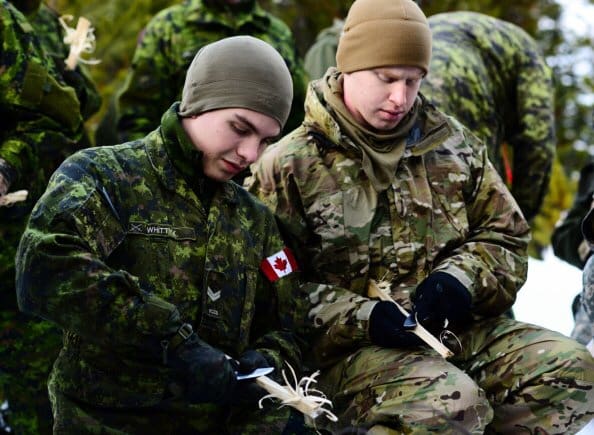
Nearly 40 Oregon Army National Guard Soldiers with 2nd Battalion, 162nd Infantry Regiment, 41st Infantry Brigade Combat Team, traveled to British Columbia, Canada, Jan. 24-28, 2019, to participate in the Westie Avalanche Exercise alongside the Royal Westminster Regiment (RWR), 39th Canadian Brigade Group (CBG).
Westie Avalanche is an introduction to arctic warfare focusing on winter survivability, cold weather tent operations, and light infantry winter mobility. The purpose of the exercise is to build winter survival skills while cultivating relationships between the North Atlantic Treaty Organization allies.
“Through active participation in light infantry engagements we continue to build our ability to conduct our mission in any environmental situation alongside partner NATO nations,” said Oregon Army National Guard Lt. Col. Kyle Akers, commander, 2-162nd Infantry Battalion.
Akers emphasized that 2-162nd Infantry Battalion Soldiers must be effective and ready to serve in any condition or terrain. However, Oregon Army National Guard Soldiers don’t often get a chance to train in adverse winter conditions, an environment Canadian Soldiers are familiar operating in.
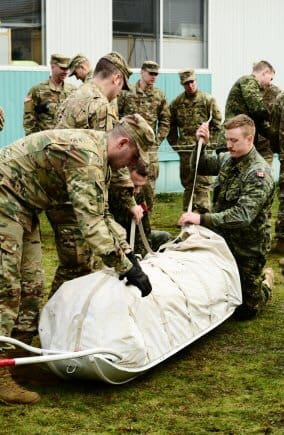
“It’s one thing to be able to tactically operate, but it’s another thing to be able to sustain yourself throughout prolonged operations in arctic conditions,” said Canadian Army Reserve Maj. Greg Chan, commander of Alpha Company and operations officer for the RWR. “We thought it would be a good exercise to invite elements of 2-162 up here and showcase some of the skills that we have and share our knowledge with you.”
DIFFERENT ANGLES ON INTEROPERABILITY
Canadian Lt. Col. Chuck MacKinnon, commander of the RWR, emphasized the importance of understanding different interoperability perspectives.
“The U.S. is our partner and the reality is we both end up operating together in places around the world,” said MacKinnon. “Our armies are now intermingling so much, and what I found overseas is that we approach the same problem with two different perspectives. Understanding what we both bring to the picture and how we think differently is a huge advantage.”
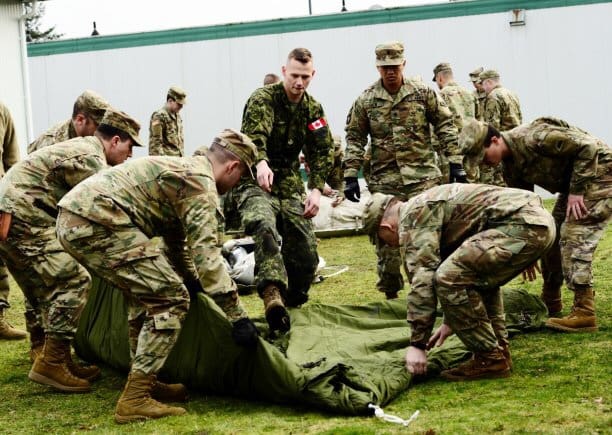
The Oregon and Canadian Soldiers gained real-world interoperability experience by fully integrating with their peers. Each Oregon Soldier was paired with a Canadian Soldier to encourage the exchange of knowledge and skills.
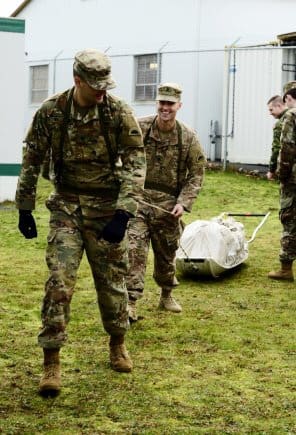
“With Soldiers on both sides being integrated, they’re more likely to learn those different perspectives in a very short period of time,” said MacKinnon. “They both get to understand the different language we have: cultural references, acronyms, and terminology, having different equipment, understanding how the different command and rank structures work.”
SHOULDER-TO-SHOULDER
The Canadian and U.S. Soldiers worked shoulder-to-shoulder and camped together in combined ten-man infantry squads, known as toboggan or tent groups.
“They all integrated at every level and I think there was great sharing of information,” said Chan. “They [U.S. Soldiers] got to experience some of what Canada has to offer, but also learned a lot of the critical Soldier skills to survive in a winter environment.”
Oregon Army National Guard Staff Sgt. Eric Givens, training noncommissioned officer with Delta Company, 2-162nd Infantry Battalion, said the Oregon and Canadian infantrymen worked really well together.
“It was just as if we were Canadians,” said Givens. “Being integrated into their daily operations felt like I was part of the Canadian Army.”
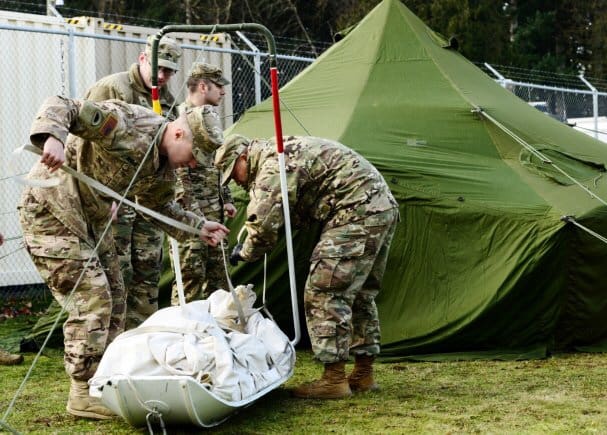
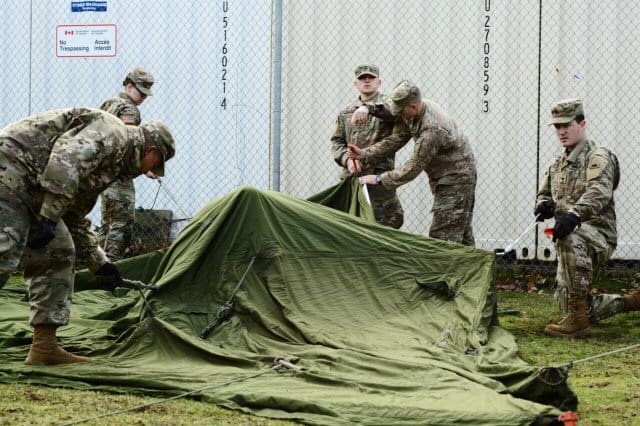
The Oregon Guard Soldiers spent the first day of training, Jan. 25, at the Chilliwack Armoury becoming familiar with the Canadian Army’s arctic tent/toboggan kits, and learning proper procedures for tent group operations.
“They were open to informing and teaching us; giving us ample time to get hands-on experience with their equipment,” said Givens.
The Soldiers received classes on cold weather clothing and gear in which the objective is to stay comfortably COLD: Clean, Overheating (avoid it), Layered, and Dry. The forecast for the weekend predicted highs around 30 degrees Fahrenheit and lows dipping down below 20. The Soldiers packed their rucksacks and assault packs in preparation for their frozen adventure, only taking what they could manage to carry on their backs.
“You pack to survive, but you also have to count out your weight per pound,” said Givens. “You have to decide if you want to be uncomfortable while moving, carrying more weight, or uncomfortable while stationary and packing fewer layers and thermal barriers.”
On Friday evening, the Canadian-U.S. formations were bussed to E.C. Manning Provincial Park where they had to establish a hasty campsite. The Canadian Soldiers blazed a trail through the snow with snowshoes and toboggans as though they were walking on clouds. The Oregon Soldiers’ boots sank deep through the soft snow as they were weighted down with heavy rucksacks.
“We were all cold and tired, but we laughed and made jokes about it, and at that moment you wouldn’t want to be anywhere else,” said Givens. “As infantry Soldiers, there was camaraderie in sharing the misery of being cold together.”
CAMARADERIE IN THE COLD
Together, the U.S. and Canadian Soldiers worked under the cover of darkness to stake down their tents in the snow and set-up camp. Relief from the cold finally came when the tents were up, the stoves and lanterns were lit, and the Soldiers could finally cram together in their sleeping bags.
“Even though we wore different flags, I was cold, and they were cold too,” said Oregon Army National Guard Staff Sgt. Dionicio Vega, with Charlie Company, 2-162nd Infantry Battalion. “Everyone was dying to get that stove lit and that was our most important task. Once it was lit, there was a level of comfort and peace that came over.”
The Soldiers didn’t stay “cozy” for too long. Tag, “you’re it” … as their buddy woke them up in the middle of the night for a turn at pulling fireguard, manning the stove and lantern. That “tag” from their buddy came again too soon the next morning as they were woken up early to begin the day’s events.
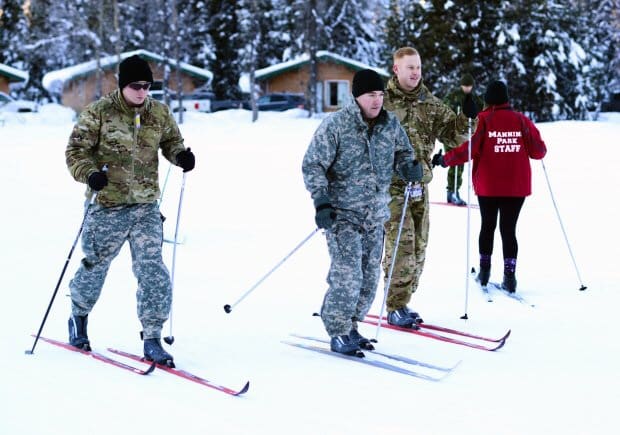
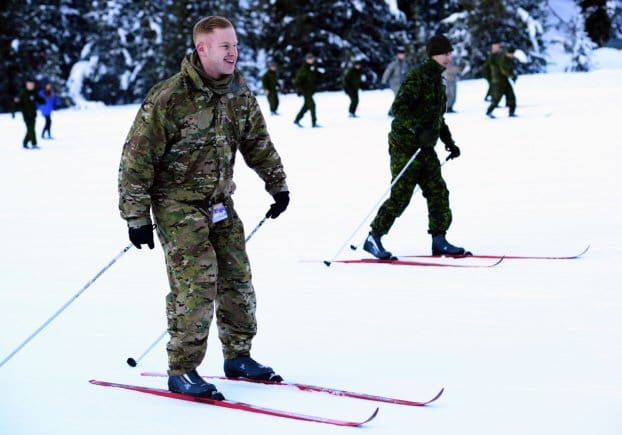
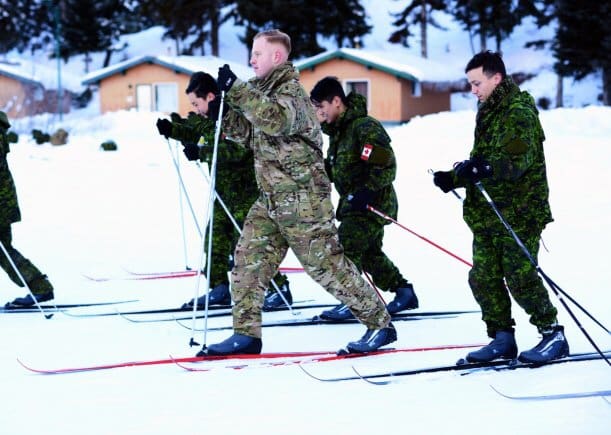
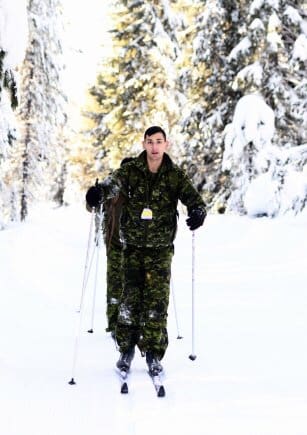
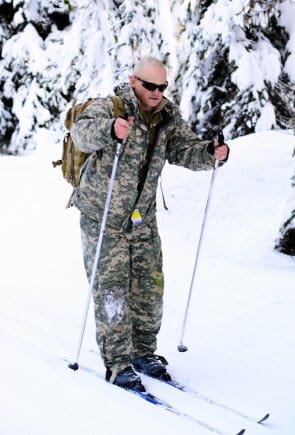
Over the course of the next two days, the units rotated through winter mobility training, including cross-country ski lessons and snowshoeing. Several Soldiers had experience downhill skiing and snowboarding, but many of them had never been cross-country skiing and were surprised to learn how strenuous it can be.
“Cross-country skiing really slowed us down,” said Vega. “I don’t want to do that again, but I was a real fan of snowshoeing and I will probably buy my own and pick it up as a hobby back home.”
Most of the Oregon Soldiers had never been snowshoeing before this experience. Their introduction to it was a 12-kilometer march along a steep, narrow path that winded around frozen Lightning Lake. Canadian and American Soldiers took turns hauling the toboggans up and down the peaks and valleys of the mountain path, shadowed by towering trees drooping with the burden of heavy snow.
“We were simulating an infantry movement, as close as possible, but without weapons,” said Givens. “The Canadians set the pace and we were hustling.”
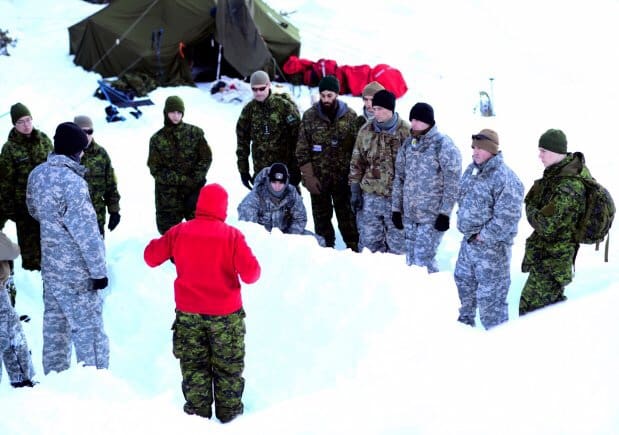
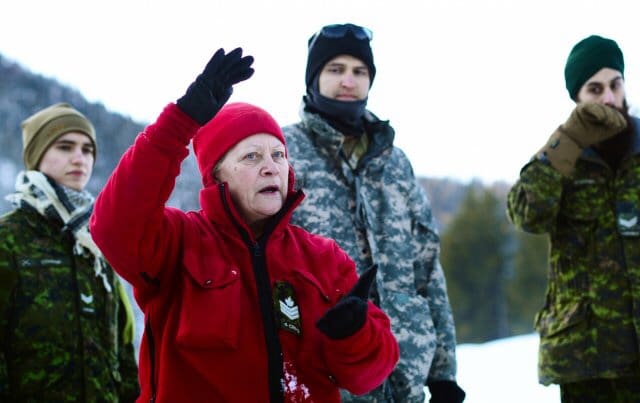
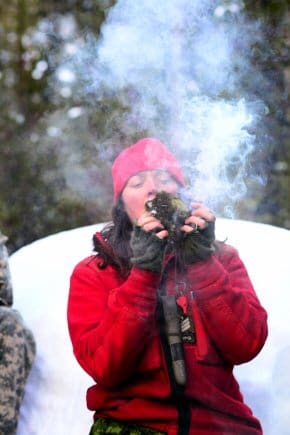
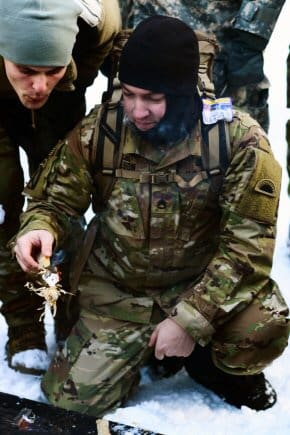
There was little time to rest their aching muscles as the winter survival lessons continued on through the evening. Instructors from the 4th Canadian Rangers Patrol Group (4th CRPG) taught the Soldiers how to make a fire in winter conditions, tips for survival food, and how to construct snow shelters. The 4th CRPG assists the Canadian Armed Forces with national security and public safety missions in sparsely populated, coastal and isolated areas of Western Canada.
“The instructors training us in these techniques are some of the best in the world,” said 1st Lt. John Rohrer, intelligence staff officer for 2-162nd Infantry Battalion, who volunteered to lead the U.S. Soldiers for this mission. “It was some of the highest quality training, learning how to survive in arctic conditions from winter survival experts who work for the Canadian government in the far north.”
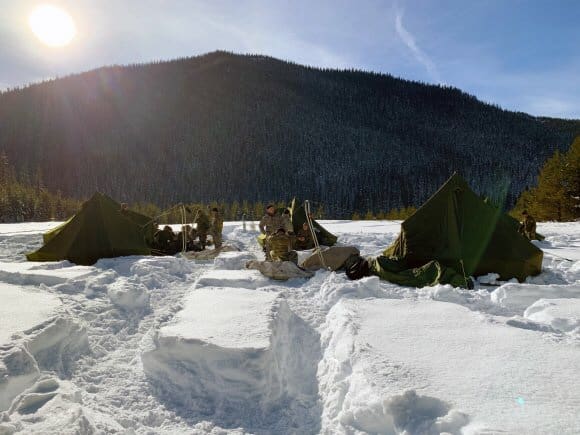
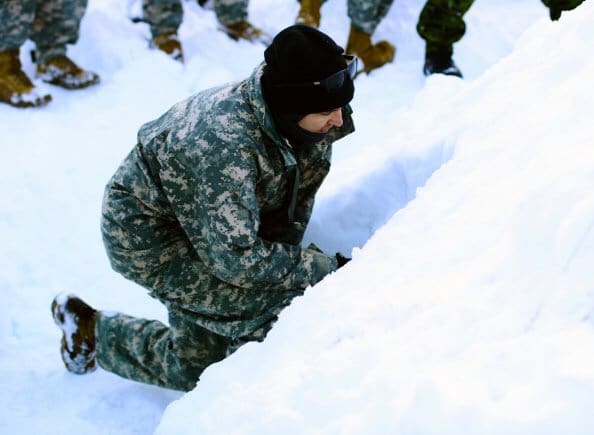
Part of the exercise included establishing a tactical bivouac in austere conditions. As the sun went down over the camp on Saturday night, January 26, the Soldiers were instructed to forego their tents and build their own survival shelters where they would be sleeping in the snow for the night. The sharp winter night air stung their lungs as they feverishly dug through the snow to make arctic beds.
“We were already in our tents warming up and finally getting a chance to eat, so we weren’t too excited to get back out in the cold,” said Vega. “But as soon as we got out there, all of us started working together on one task and we knocked out the first snow cave in 45 minutes. We immediately started working on another one.”
Vega said making snow shelters alongside the Canadian Soldiers ended up being his favorite part of the entire exercise because it was unique.
“Many of us were doing this for the first time and we only had 40 minutes of training on it,” said Vega. “We asked for the Rangers’ expertise and the Canadian sergeants’ experience and it felt good to know that we were doing it right.”
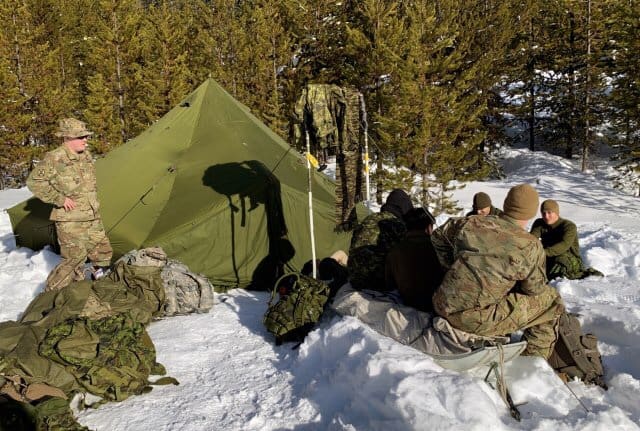
Clouds of steam hung in the air above their heads with every breath and every word spoken on that frigid, sleepless night. The goal was to build the Soldiers’ confidence, to recognize that they can endure extremely cold weather conditions.
TACTICAL TRAINING IN A NEW ENVIRONMENT
“From a tactical perspective, it’s always good to enhance Soldiers’ skills and situational awareness in an unfamiliar environment,” said Rohrer. “You’re forced to learn a new skillset, such as awareness for how to manage and regulate your body heat. The more times you do that, the better you get at the mechanism of adapting and the learning curve won’t be as steep the next time.”
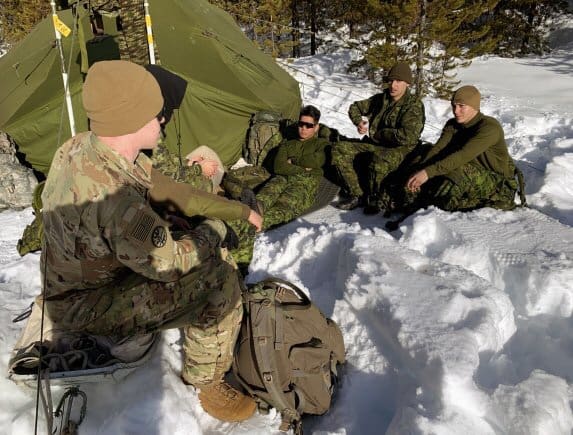
Givens, with ten years of service and two deployments (Iraq and Afghanistan), said he has a newfound confidence that he can operate in any conditions and any climate after this training.
“I feel like I can confidently challenge different weather and elevations now, and maybe even go backpacking in extremely cold weather at Mt. Hood or Mt. Bachelor,” he said.
The training was also a chance to develop and/or refine standard operating procedures (SOP) for winter operations. Soldiers representing every company in the 2-162nd Infantry Battalion participated in the exercise with the objective to take their new knowledge and experience back to their units and train others.
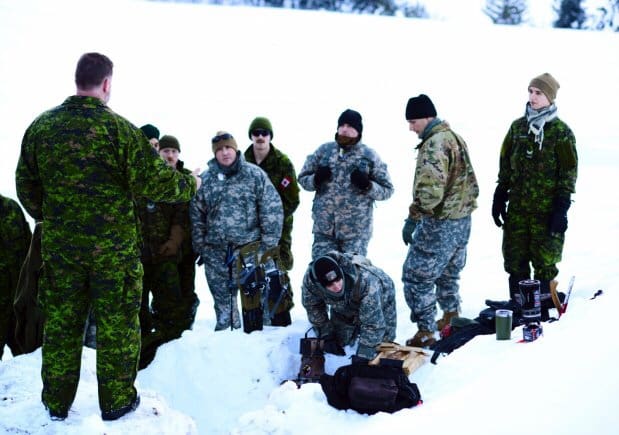
“Unknowingly, the Canadians taught us to trust our own equipment,” said Givens. “We never had the chance to use our [Extreme Cold Weather System] equipment to its full capability and this was the perfect opportunity to test it. So, I plan to develop a cold weather SOP with everything I’ve learned for the Soldiers in my unit.”
Working and living together in austere cold weather conditions, the U.S. and Canadian Soldiers discovered they have more commonalities than differences with their Pacific Northwest neighbors. Many of them made new friends that they plan to stay in touch with.
“The two militaries are pretty similar, at the end of the day we are just guys, doing the same job,” said Canadian Army Reserve Cpl. Riley Turner, with A Company, RWR. “Being around staff sergeants and seeing different leadership styles was a good learning experience. We worked well together and I made new friends [pointing towards Vega].”
Vega agreed saying, “We are the same, there’s really no difference. Two armies can come together. We may be different armies wearing different flags, but we all came together at end of the night joking about the same things and we overcame some stereotypes. So, I feel more Canadian and hopefully, Corporal Turner feels a little more American.”
A COMMITMENT TO BUILDING READINESS
The Oregon Soldiers said they want to continue this relationship with their Canadian partners and are looking forward to more opportunities to train with them again in the future. A sentiment the leadership in both the 2-162 and RWR also share.
“This unique opportunity and relationship will help posture our units for future engagements with our different platoons and companies across the formation,” said Akers. “We are committed to building readiness and an enduring, mutually beneficial partnership with the RWR and the 39th CBG.”
“It’s a great opportunity for members of the RWR to work with a partner nation and just be better infantry Soldiers and better prepared for future deployments,” said Chan. “The more interoperability training that we can do always benefits our troops. It helps them become familiar beforehand, so the first time we’re working together is not when we’re deployed overseas.”
This was the second time that the 2-162 Infantry Battalion and RWR have partnered-up for a bi-lateral training engagement. In April 2018, the two units jointly planned and executed a multi-day infantry exercise known as “Cougar Rage” at Joint Base Lewis-McChord, Washington.
“These training opportunities have turned out to be very beneficial lessons for both organizations, as well as the troops participating. You can’t put a price on its value,” said Canadian Army Reserve Maj. Pavel Dudek plans officer for the 39th CBG. “We want to continue this relationship with our Oregon National Guard partners and expand on it. We hope it will be enduring in nature.”
By SFC Class April Davis