Aquaterro

Archive for the ‘Guest Post’ Category

Primary Arms x Second Amendment Foundation

Sunday, October 5th, 2025

Each month, Second Amendment Foundation (SAF) teams up with an industry partner to host a giveaway that helps raise donations for their mission. This month it is our friends at Primary Arms.

Every donation counts as an entry, and these contributions go directly toward SAF’s work defending and advancing the Second Amendment through education, legal action, and grassroots initiatives. The more people who see these giveaways, the bigger the impact—and the more support SAF receives to continue this important work.

WIN This Rifle and Great Prize Pack from Primary Arms!  Prize Package Includes: 

Rifle: LaRue Tactical KRG Siete 6.5 Creedmoor Bolt Action Rifle – 23″

Optic: Primary Arms SLx 3-18x50mm FFP Gen II Rifle Scope – Illuminated ACSS Athena BPR MIL Reticle

Mount: LaRue Tactical 20 MOA PSR 30mm Scope Mount with QD Lever Mount

Bipod: Magpul MOE Bipod – Sling Stud – Black

Rifle Case: Magpul DAKA 53″ Soft Rifle Case – Black

Shooting Mat: Primary Arms Gear Compact Shooting Mat – Flat Dark Earth

Magazines: AMEND2 AICS Short Action 12 Round Magazine (x3)

Total MSRP $4,127.51Thank you to Primary Arms for their donations and support to make this sweepstakes possible.

Make your donation and enter to win here.

CMSSF Unveils World-Class Master Sergeant Framework

Sunday, October 5th, 2025

NATIONAL HARBOR, Md. (AFNS) —

The Space Force is charting a new course for enlisted development, focusing on building “World-Class Master Sergeants” to lead the way. During a recent address at the Air, Space and Cyber Conference, Chief Master Sgt. of the Space Force John Bentivegna outlined a new framework aimed at strengthening leadership and expertise at the core of the service. 

Bentivegna emphasized that the future of space operations hinges on empowering exceptional leaders. “Our focus is at the tactical and operational levels, ensuring that our master sergeants are fully prepared to lead across critical mission areas,” he stated. 

Master sergeants, with support from senior enlisted, will drive mission execution and foster the development of technical sergeants, sergeants, and specialists. In this model, the Space Force is reimagining the Master Sergeant rank, positioning it not merely as a step within the senior noncommissioned officer tier, but as the pinnacle of enlisted service – a role that embodies mission-focused leadership. 

“If we focus on developing the right master sergeants … we’ll naturally have the right talent to create E-8s and E-9s,” Bentivegna explained. “There is a need for meaningful and challenging training to build a strong and cohesive team for the future of the Space Force.” 

A key element of this vision is a rigorous training pipeline. The Space Force will implement a demanding Basic Military Training program, designed to push trainees to their limits. Successfully completing this initial training will result in promotion from E-1 to E-2, signaling their readiness. Subsequent specialized skills training will be equally selective, with successful completion resulting in promotion to E-3, demonstrating warfighting competence. 

Following specialty training, Guardians transition to operational roles, undergoing qualification training. Certification by their local squadron commander signifies their “combat-mission ready” status, leading to a promotion to E-4. This commitment to combat readiness is a cornerstone of the new framework. 

The Space Force is also embracing a “fully-qualified promotion” model. Historically, promotion to E-5 involved sending records of eligible Guardians to a board where each record is scored and only a set percentage are promoted based on merit.  

Bentivegna emphasized that promotions shouldn’t be based on competition against others, but on meeting established standards. “Guardians who demonstrate competence through training, experience, and acceptance of greater responsibility will be rewarded through promotion.”  

This model focuses on proving skills and preparedness, rather than competing for a limited number of promotions. This year marks a shift toward this model. A 100% opportunity was offered for eligible E-4s to advance to E-5 by meeting established standards rather than being compared against their peers. 

Looking ahead, the Space Force aims to further empower commanders. In 2026, the service plans to delegate promotion authority for E-5s to tactical-level commanders, rewarding Guardians for their ability to learn and prove their skills. This initiative emphasizes warfighting competence and proven skills over competition for limited promotion slots. 

Master sergeants will be central to the Space Force’s culture of mentorship and leadership. They will lead diverse teams comprised of officers, enlisted, and civilians, managing resources, executing critical missions, and mentoring the next generation of leaders to shape the force’s future success.   

As Bentivegna said, “We need Guardian who are subject matter experts, but we also need them to teach, to train, to mentor. So, there is no saying, ‘I will be a technical subject matter expert, I want to do operations, I don’t want to lead.’ There is no such thing, We all lead at our levels. We all have influence over others.” 

This framework underscores the Space Force’s commitment to developing highly skilled and effective enlisted leaders. By implementing demanding training programs, modernizing the promotion system, and emphasizing operational excellence, the Space Force seeks to empower its master sergeants to lead and develop the next generation of Guardians, ensuring readiness for future challenges in the space domain. 

Secretary of the Air Force Public Affairs

Army Fields M250 Automatic Rifle to Minnesota National Guard

Saturday, October 4th, 2025

CAMP RIPLEY, Minn. — The Minnesota National Guard’s 34th Infantry Division is among the first Guard units to field the Army’s newest automatic rifle, the M250, during a new equipment training event at Camp Ripley.

The M250, part of the Army’s Next Generation Squad Weapon program, replaces the M249 Squad Automatic Weapon and introduces a new 6.8mm cartridge, higher muzzle velocity and advanced optic capabilities. The new equipment training fielding marks a milestone for the Guard, giving Soldiers hands-on instruction to build confidence and proficiency with the new system.

The event is led by Project Manager Soldier Lethality, PM SL, under Program Executive Office Soldier, which oversees the Army’s small arms and fire-control systems. PM SL experts deliver classroom instruction, explaining the M250’s technical features, ballistics and optic functions.

On the range, the U.S. Army Marksmanship Unit’s Instructor Training Group, ITG, turns that technical knowledge into practical performance. Sgt. 1st Class Chuck Riegel, ITG’s primary instructor for the event, emphasizes fundamentals such as sight alignment, trigger control and recoil management to ensure Soldiers can use the weapon effectively in live-fire conditions.

“We take PM Soldier Lethality’s technical knowledge and put it into performance on the range,” Riegel said. “We show Soldiers everything they learned in class, then focus on the shot process and what they need to do to get hits on target.”

The M250’s advanced optic is one of the biggest changes for Soldiers. With its onboard ballistic system, it is unlike anything many have used before. Riegel said once Guardsmen fire live rounds with it, their confidence grows quickly.

“The optic ensures every Soldier has the capability to make first-round hits at distance, whether in single shot or burst,” he said. “And the cartridge’s terminal performance is incredible — it will defeat pretty much anything they come across.”

The shift from the 5.56mm round of the SAW to the 6.8mm cartridge means Guardsmen must adjust to new ballistics and extended ranges. According to Riegel, this requires more understanding of long-range shooting but ultimately makes units more lethal.

The NET fielding also highlights the value of PM SL and ITG working together. While PM SL explains the technical aspects of the M250 and its optic, ITG makes sure Soldiers can apply that knowledge in live training.

“ITG provides the most up-to-date marksmanship instruction and techniques used across the Army,” Riegel said. “PM Soldier Lethality explains the technical aspects in great detail so Soldiers understand the why behind the new equipment.”

As the Army continues to field the NGSW program, Guard units like the 34th Infantry Division are among the first to gain experience with the M250, strengthening readiness across the Total Force.

For units interested in similar training, Riegel encourages them to reach out. “If units want to get in contact with the Instructor Training Group, all they have to do is send us a message,” he said. “We’ll provide a training request form and deliver tailored training to meet their needs.”

By SFC Timothy Hamlin

The SureFire Turbo Series

Friday, October 3rd, 2025

The SureFire Turbo series pushes the limits in both handheld and weapon-mounted lights to give you the upper hand in any hostile encounter, near or far. Every Turbo model delivers high-candela illumination that reaches out to extreme distances. Our tightly focused Turbo beams are ideal for LE and military use, where piercing through tinted windows or assessing threats from a safe distance can provide a crucial advantage. You can count on them to offer the far-reaching light you need while also retaining a corona of diffused light, so you maintain situational awareness. And they deliver the same proven durability and dependability that’s synonymous with SureFire.

www.surefire.com/turbo

FirstSpear Friday Focus: Operator Glove

Friday, October 3rd, 2025

The FirstSpear Operator Glove (OG) is built for moments where maximum dexterity and precision are non-negotiable. Designed with cutting-edge materials and modern construction methods, the Operator Glove delivers peak performance without compromise.

Its patent-pending trigger finger design sets a new standard in tactile sensitivity, giving operators precise control for critical weapon functions, magazine changes, and other high-stakes tasks.

The Operator Glove excels as a lightweight, standalone solution for missions that demand speed, accuracy, and superior touch. For added durability and protection, it is engineered to seamlessly integrate with the Operator Outer Glove (OOG), creating a complete combat system for the hands. This versatility makes the Operator Glove adaptable across a wide range of operational requirements.

Constructed from ultra-thin, high-performance fabrics, the OG is optimized for unmatched dexterity and lightweight feel. The palm features FirstSpear High Dexterity Leather (FS-HDL) with a digital-textured Pittards Goatskin overlay for enhanced grip and precise weapon handling. Core-spun Merino Wool with a nylon core provides breathability, durability, and moisture resistance while remaining inherently flame resistant with No Melt, No Drip protection.

Touchscreen-compatible index and thumb tips allow seamless use of PDAs and tablets without breaking stride. The natural odor resistance and antibacterial properties of the materials add to long-wear comfort in demanding environments. While the OG is not designed for prolonged heavy abuse, it is engineered to excel throughout a full training cycle and deployment, making it an ideal tool for operators who need performance at the highest level.

To request an estimate click image above or visit First-Spear.com/Request-For-Estimate. FirstSpear is the premier source for cutting edge-tactical gear for military, law enforcement and those who train. For more information visit First-Spear.

NSA’s 12th Annual Codebreaker Challenge is Underway for 2025

Thursday, October 2nd, 2025

The National Security Agency (NSA) is launching their annual series of critical real-world scenarios for U.S.-based academic institutions titled Codebreaker Challenge. In its 12th iteration for 2025, the Codebreaker Challenge gives students the opportunity to analyze high-risk situations closely resembling the Intelligence Community’s classified tasks, equipping them for national security challenges. Participants will go head-to-head with other schools to accomplish mission-driven tasks aimed at enhancing their skills in reverse engineering, vulnerability research, cryptography, programming/scripting, and beyond.

This year’s challenge is to assist the Air Force’s Cyber Operations Squadron in maintaining the U.S. military’s cyber dominance against advanced foreign adversaries attempting to infiltrate and steal information. The goal is to investigate unusual behavior detected by an Air Force analyst and defend American interests against sophisticated nation-state threats. Maintaining vigilance and reinforcing the defense of robust yet vulnerable military networks is paramount.

“The Codebreaker Challenge is an opportunity for the future leaders of cyber defense to showcase their skills, and it’s extraordinary to see the enthusiasm and dedication they bring to the competition,” said Lieutenant General William Hartman, performing the duties of the Director of NSA. “I look forward to announcing this year’s winners and celebrating their success.”

The seven tasks in the challenge each have a particular point value and ramp up in complexity as students advance. After completion, points are earned by schools, and the highest totals win in three divisions, each based on the count of student participants.

The Codebreaker Challenge is open to anyone with an email address from a recognized U.S. school or university. All players register and log in individually. Students, professors, and alumni can participate, but only students will earn points and awards.

Join in and register for the challenge at nsa-codebreaker.org, where you can also watch this year’s kick-off video. Get ready to make your mark in the world of cybersecurity!

Via NSA

Next-Gen Navigation Systems Reach Army Units

Thursday, October 2nd, 2025

Fielding of the Mounted Assured Positioning, Navigation and Timing System, MAPS, GEN II hardware is underway across the Army to provide increased operational effectiveness with advanced positioning, navigation and timing, PNT, systems.

MAPS GEN II is the next-generation PNT system used to provide highly accurate and resilient PNT data to Army vehicles, especially in GPS-degraded or denied environments.

Fielding of the MAPS GEN II systems supports Transformation in Contact 2.0, the Army’s current initiative to rapidly deliver new equipment to operational units.

GEN I vs. GEN II – What’s changed?

The goal when developing MAPS GEN II was GPS security, first and foremost. At the most basic level if Soldiers don’t know where they are or where they are going and have confidence in the information, that’s not a very effective Army. PNT’s number one priority is to enable Soldiers to shoot, move and communicate.

The old trope, never judge a book by its cover, is true for MAPS GEN II. While it may look similar to its predecessor, GEN II boasts several welcomed improvements.

With the advancements in electronic warfare threats, a hardened, more secure PNT system was necessary. MAPS GEN II has stronger and more secure encryption through M-Code, uses alternative sensors providing sensor fusion and advancements to the exterior antenna providing Soldiers with more advanced anti-jamming and anti-spoofing capabilities, two of the main electronic warfare threats the Army faces.

“Jamming is disruptive, but spoofing can be far more damaging,” Jennifer Thermos, acting product manager, Mounted PNT said. “When you don’t have a GPS signal, you know something’s wrong but there are still ways to take action. With spoofing, you’re still getting GPS signal but if you don’t have a system like MAPS GEN II that can recognize a spoofing attempt and reject it, you could be following a false GPS signal which could lead you right to where the enemy wants you.”

“MAPS GEN II is able to detect and reject GPS interference and provide the Soldier with a notification that it is operating despite the electronic warfare environment,” Thermos said.

The system was designed with size, weight and power in mind, as are all Army systems, to address space limitations inside vehicles.

“MAPS GEN II can take the place of MAPS GEN I systems as well as multiple Defense Advanced GPS Receivers, providing Assured PNT to client systems with one platform,” Thermos explained.

C2 Enabler

Built using open architecture standards which allows modularity and scalability, MAPS GEN II easily integrates with various platforms currently in use as well as future systems still in development that fall under the Command and Control, C2, umbrella.

MAPS GEN II also fits in well with Next Generation Command and Control, NGC2, architecture, part of the “how” the Army accomplishes its TIC goals. The system is a critical enabler of C2 and Fires capabilities. Networks, radios and Fires systems rely on highly accurate timing and positioning data to function.

“If legacy systems don’t have accurate timing and positioning data, the effectiveness of the system overall is degraded,” Thermos explained. “We want to provide every Soldier the full capability, so we want to field as many MAPS GEN II systems as possible, and as fast as possible.”

Training

MAPS GEN II represents a significant leap forward in assured PNT capabilities, but realizing its full potential requires Soldiers to be proficient in its operation and maintenance. The new equipment training provided a foundational understanding of the system’s architecture, operational procedures, troubleshooting techniques and integration with existing platforms.

“This training isn’t simply about learning how to use the system; it is about building confidence and fostering a proactive approach to maintaining PNT superiority in contested environments,” Maj. Shay Wright, assistant product manager, Mounted PNT production and fielding lead said. “Without this dedicated training, the Brigade’s ability to effectively leverage MAPS GEN II’s capabilities would be severely hampered.”

Fresh off training, the 2nd Stryker Brigade Combat Team, 2nd Infantry Division, attached to the 7th Infantry Division, put MAPS GEN II through its paces during a follow-on training event.

“GPS jamming was an issue we had to deal with in training,” Capt. Tianna Johnson, 2nd Stryker Brigade Combat Team said. “We must be prepared to respond to GPS jamming. In one case, MAPS indicated a detected threat, which was exactly what MAPS GEN II was designed to do, and we were able to take the appropriate actions.”

The value of in-person, hands-on training is not an expense, but a critical investment in maintaining our warfighting edge.

Future Plans

With fielding and training to the 2nd Stryker Brigade Combat Team complete, the MAPS Team at Program Executive Office Intelligence, Electronic Warfare & Sensors is focused on fielding and training various units including other TIC units, continuing with Stryker BCTs.

New Equipment Fielding is critically important to maintaining Army readiness and achieving overmatch against potential adversaries. These trainings enhance combat capability, maintain readiness levels and align with Army priorities.

By Shawn Nesaw

Army’s 1st Cavalry Division Conducts First Switchblade 600 Live-Fire Exercise

Wednesday, October 1st, 2025

As part of Pegasus Charge, 1st Cavalry Division’s effort in support of the Army’s “Transforming in Contact” initiative to modernize armored formations, soldiers assigned to the 2nd Armored Brigade Combat Team, 1st Cavalry Division, conducted Fort Hood’s first live-fire exercise of the Switchblade 600 Loitering Munition System, Sept. 15.

The Switchblade 600 — a tube-launched, unmanned aircraft system — has already seen extensive use by Special Operations Forces, light infantry units and foreign partners. The 1st Cavalry Division is among the first armored units to field the system.

“This is the first time for all of our soldiers to see these munitions fired, and you can feel the excitement in the air,” said Army Capt. Jeffrey Weller, Multifunctional Reconnaissance Troop commander, 2nd Armored Brigade Combat Team, 1st Cavalry Division. “The Switchblade enables the brigade to engage targets with precision between 5 and 15 kilometers in front of our forward line of troops, extending our reach and lethality.”

Modernizing the Fight

The Army’s broader Transforming in Contact initiative aims to overhaul how armored formations fight by integrating new technologies, particularly drones and advanced communications.

“A huge thing the Army has seen across multiple battlefields, whether in Ukraine or elsewhere, is the rapid modernization and high usage of drones,” Weller said. “We’re taking those lessons learned and revamping our [unmanned aircraft] systems to stay ahead of adversaries.”

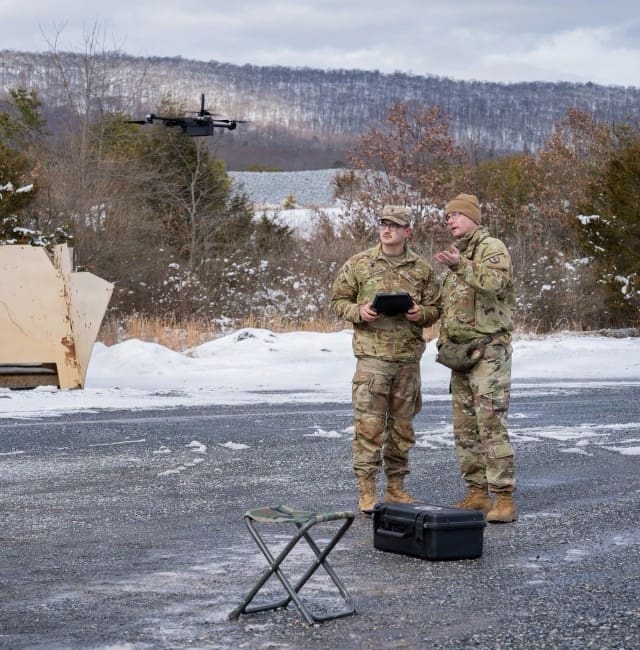
Roughly 5 feet long and weighing 75 pounds, the battery-powered Switchblade 600 resembles a drone, but carries a Javelin multipurpose warhead. It has a flight time of 40 to 45 minutes, a range of up to 27 miles and delivers a 5-pound explosive payload.

“It’s a remote-controlled missile that flies like a drone until it gets to the target,” explained a flight operations supervisor with the system’s manufacturer. “The operator uses onboard cameras to identify, select and engage the target.”

Once launched from its tube, the Switchblade can navigate through waypoints, loiter over the target area and strike with precision. Operators also retain the ability to wave off a strike mid-flight if conditions change.

“The Switchblade allows us to target vehicles or small groups of personnel from much farther away than before,” Weller said. “It increases our lethality, minimizes collateral damage and helps protect soldiers on the front lines.”

Before the live-fire exercise, soldiers completed a five-day training course with the manufacturer, during which they learned to set up, arm and program the drones for flight and strike missions.

Army Spc. Drake Cross, a Switchblade operator who has flown RQ-7 Shadow and RQ-28 Quadcopter drones for the division, said this was his first experience with a munition-carrying UAS.

“Everything else I’ve flown has been for surveillance and target acquisition,” Cross said. “This is the first one where I can actually deliver a round. It’s exciting because it saves soldiers’ lives by hitting targets without putting us in danger.”

Cross said the system was user-friendly and similar to other UAS platforms, adding, “There’s not much of a learning curve. Once you identify and lock onto a target, you can adjust right up until impact to make sure you’re hitting what you want.”

Looking Ahead

Weller said the Switchblade is just one example of how Transforming in Contact is reshaping the 1st Cavalry Division’s armored formations. He noted that the unit will use the system during their upcoming rotation at the National Training Center at Fort Irwin, California.

“The battlefield is constantly changing, and the Army has to modernize to keep pace,” he said. “Seeing systems like the Switchblade in action shows us the future of how our formations will fight. It’s a big step toward keeping our soldiers safer and more lethal.”

By Heather Ashley, Fort Hood Public Affairs Office