INTRODUCTION
In war, whether its counterinsurgency (COIN) operations or large-scale combat operations (LSCO), “the side that is best prepared, best understands an operational environment, adapts more rapidly, and acts more quickly in conditions of uncertainty is the one most likely to win.”[1] This is a lesson best observed in urban environments, such as in the large cities in Ukraine where the local population influences and are influenced by the tactical and operational outcomes of military operations. This document explores existing COIN doctrine and seeks to relate how, during LSCO, the principles of clear, hold, and build remain valid in terms of consolidating gains, especially through the lens of security force assistance (SFA). In doing so, it is important to define doctrinal terms such as COIN, LSCO, and consolidation of gains to frame the discussion of how clear, hold, and build connects to existing doctrine as it all relates to the ongoing military operations in Ukraine, for example. Therefore, the purpose of this document is to inform Army planners at all echelons of the utility of how clear, hold, and build are still relevant during LSCO to achieve those tactical gains that support decisive operational outcomes.
COIN, as a subset of irregular warfare, is defined as “the blend of comprehensive civilian and military efforts designed to simultaneously defeat and contain insurgency and address its root causes.”[2] If insurgency is the organized use of subversion and violence to seize, nullify, or otherwise challenge the political status quo in a country or region, then COIN is the unified approach to countering an insurgency’s momentum. There are several examples of recent U.S. COIN, such as in Afghanistan, Iraq, and Columbia. The important consideration in understanding COIN is it tends to be long-term, often decades to achieve desired strategic outcomes. Much of COIN, when active, is tied to country- or region-specific foreign internal defense programs, which recently have shifted away from lethal counterterrorism operations to building partner capacity to address the broader security challenges in a country or region.
“LSCO are extensive joint combat operations in terms of scope and size of forces committed, conducted as a campaign aimed at achieving operational and strategic objectives.”[3] During large-scale ground combat, Army forces focus on defeating enemy ground forces through a balance of offensive, defensive, and stability operations. Yet, critical to these three operations is the consolidation of gains once Army forces have achieved relative advantage over enemy ground forces, but how is consolidating gains understood or implemented at the tactical level?
Consolidation of gains are “activities to make enduring any initial operational success and to set the conditions for a sustainable security environment, allowing for a transition of control to other legitimate authorities.”[4] At the tactical level, this should look like short term, yet sustainable, stability activities or targeted civil-military operations in large urban centers, such as Mariupol in Ukraine. It also could translate into training and equipping local security or police forces, as part of broader campaign objectives, depending on the authorities, but it may not necessarily be an assigned mission of a security force assistance brigade (SFAB). During a LSCO fight, SFABs will most likely support their partner force and liaise between their partner and the U.S. joint force. If true, consolidating gains in the division’s rear area, especially in terms of SFA as part of hold and build, may be tasked to other available units, such as military police or combat engineers.
Critical to consolidating gains in the rear area, or uncontested areas outside of the rear area, is understanding the civil considerations and how civil support to U.S. military operations allows Army forces to maintain momentum to conduct limited offensive operations and shape the environment in terms of influencing local populace perceptions. This document examines consolidating gains through a clear, hold, and build construct with examples of how Ukrainian security forces used COIN-era SFA developmental activities in contested areas of the Ukraine since 2014, but before the Russian invasion in 2022. Finally, this document covers what support and liaise, two of the more prominent LSCO-focused advising tasks, should look like in post-invasion Ukraine also using a clear, hold, and build construct.
CLEAR, HOLD, AND BUILD IN UKRAINE (COIN AND LSCO)
In COIN doctrine, clear, hold, and build is part of a larger concept known as shape, clear, hold, build, and transition. This document does not explore shape or transition as it is outside the scope of advising partner forces while consolidating gains in division rear areas as part of broader SFA objectives. Although consolidating gains can mean almost anything during LSCO, such as establishing defensive perimeters in key terrain or conducting civil-military operations in large urban centers, the methodology to examine the proper context of advising partner forces on SFA is through a clear, hold, and build construct. In the following three sections, COIN is introduced and described first, followed by a brief description of what advising support and liaise should look like during LSCO through the hypothetical lens of U.S. advising teams.
Clear
In COIN, clear is an offensive-oriented task to remove insurgent forces and eliminate organized resistance in an assigned area. During the clear phase, it is critical for the United States to comply with the international law of war and avoid the destruction of civilian homes or the disruption of business as upsetting either will have negative amplifiable effects to U.S. COIN efforts, especially in large cities. Once insurgent forces have been removed or eliminated, eliminating their capabilities to influence or coerce becomes a police function that will rely heavily on military forces and intelligence assets until a host nation’s security sector institutions have the capacity to assume responsibility within an assigned area.
In 2014, Russia seized Crimea and sponsored an insurgency in eastern Ukraine that killed more than 13,000 people.[5] Russia annexed Crimea, resulting in demonstrations by pro-Russian supporters that broke out across Ukraine’s southern and eastern oblasts. In the Donbas region, for example, civil unrest eventually became an armed conflict, and despite a negotiated cease-fire, low-intensity fighting continued until the Russians invaded in full force in 2022. Yet, from 2014 to 2022, despite episodic clearing operations from Ukrainian security forces, the fighting in Donbas was largely a frozen conflict, or, in international relations parlance, a situation in which an active armed conflict ended without a satisfying peaceful resolution for both combatants.
In LSCO, like COIN, clear is also an offensive-oriented task and is the most dangerous and dynamic phase. Ukrainian security forces launched a counteroffensive 29 August 2022, to retake control of the southern regions of Kherson and Mykolaiv, which were occupied by Russian troops. By 12 November, despite heavily fighting acrost Kherson oblast, Ukrainian security forces recaptured the city of Kherson, breaking Russia’s access to that area of the Black Sea coast. In this example, and as a hypothetical, had U.S. advisor teams accompanied Ukrainian security forces during their counteroffensive, support and liaise could have demonstrated greater targeting capabilities from the Ukrainians to strike at large enemy troop movements that were deployed to repel the Ukrainian counter-offensive, reducing potential partner casualties.
Hold
In COIN, hold is a defensive-oriented task to secure the populace and separate them from the insurgents. During the hold phase, U.S. forces need to establish a firm and persistent government presence and control over the assigned area. It is preferable to establish a governance apparatus that replaces the insurgent’s apparatus. Concerning consolidating gains, it is during this phase where U.S. advisors conduct SFA developmental activities, such as organize, train, equip, build, and advise (OTEBA) security forces. While LSCO continues, advisor teams may remain in the corps or division rear area to develop capabilities and build greater capacity in the security forces and their institutions.
To this end, the U.S. effort to assist Ukraine during the hold phase was through security assistance, which encompassed formal training and equipping Ukrainian security forces, but on a grander scale, which included developing greater capacity in Ukrainian defense institutions. For example, from 2015 to 2021, the United States manned a training and advising mission in Ukraine located at the Joint Multinational Training Group–Ukraine (JMTG–U) in Yavoriv. JMTG-U focused on the defense and security training of Ukrainian security forces at the echelons of brigade and below. Because of JMTG-U’s mission, some analysts speculated Ukrainian forces had the resources to develop sufficient warfighting capabilities, and, equipped with the latest military gear, were able to provide a sustained defense against the Russians when they invaded in early 2022.
In LSCO, like COIN, hold remains a defensive-oriented task. Three days following the Russian invasion of Ukraine, on 25 February 2022, Russian forces launched a massive attack to capture Kyiv, Ukraine’s capital. Yet, Russian offensive efforts stalled, along with their 40-mile-long logistics convoy that was, then, about 24 miles from Kyiv. This allowed the Ukrainians to fortify much of Kyiv, even arming civilians with more than 25,000 assault rifles and approximately 10 million bullets.[6] Russian forces made little gains capturing Kyiv during their offensive and eventually withdrew, without admitting defeat. Ukrainian forces conducted a few counteroffensives, as part of the hold, to repel Russians from suburban areas in Kyiv.
In this example, and as another hypothetical, had U.S. advisor teams partnered with Ukrainian security forces to defend Kyiv, not only would the support and liaise function facilitate more accurate counterfires from Ukrainian artillery, but it would also facilitate a more accurate common operational picture of the Russian order of battle to be shared with other interested allies and partners. Finally, as the hold becomes permanent, U.S. advisors could enable further OTEBA activities in recruiting, training, and equipping local security forces in Kyiv to build on the consolidation of gains.
Build
In COIN, build is a stability-oriented task to restore essential services, restore civil control, provide support to infrastructure and economic development, and, in a continuation from the hold phase, build on the capability and capacity of the security forces. During the build phase, the emphasis is on stability activities in an assigned area. It is also during this phase when messaging the populace about security force legitimacy should be the strongest. Stated differently, if the populace does not believe their security forces can protect them from insurgent intimidation, coercion, or reprisals, the populace may not overtly support the local security force.
In LSCO, like COIN, build remains a stability-oriented task and is arguably the longest phase most associated with reconstruction, development, and governance. In SFA terms, the build phase is where most of OTEBA occurs and is usually in safe areas identified by security forces for the reconstitution of security forces. Although not exclusively support or liaise, as it has been in clear and hold, build is immensely an advise and assist function for U.S. advisor teams and their partner forces.
CONCLUSION
Although Carl von Clausewitz is famous for his observation that war is a continuation of policy by other means, he also states the defense is intrinsically stronger in war than the offense because the offense requires overcoming resistance and is constrained by limitations, such as the culminating point where seizing key terrain becomes too costly to clear and hold.[7] This is an applicable observation for the ongoing war in Ukraine, where offensive and defensive exchanges between Ukrainian and Russian military forces are ubiquitous, especially in the cities. Stated differently, although the fighting in Ukraine is fluid, held areas can become contested again, which is why it is important to understand the clear, hold, build construct is not always a linear sequence, as some phases may overlap.
The defense, where the hold phase occurs, is also where units begin to consolidate their gains. In COIN, the center of gravity is the population, but in LSCO the center of gravity is focused on the enemy. The tactical defeat of an enemy, however, does not necessarily translate into a victory for the United States and their partner forces. Ensuring enemies cannot transition a conventional military defeat into a protracted irregular conflict is not only a foundation for achieving victory, it is the very essence of why the rapid consolidations of gains in rear areas is so very important during LSCO and why supporting and liaising with local security forces matter during the clear, hold, and build phases.
By Robert Schafer, Center for Army Lessons Learned
[1] Army Doctrine Publication (ADP) 3-0, Operations, 21 March 2025, page 1.
[2] Joint Publication (JP) 3-24, Counterinsurgency, 30 April 2021, page III-1.
[3] ADP 3-0, Operations (21 March 2025), page 4.
[4] Field Manual (FM) 3-0, Operations, 21 March 2025, page 16.
[5] Kim, Lucian. “How U.S. Military Aid Has Helped Ukraine Since 2014.” National Public Radio. 18 December 2019. Retrieved 15 April 2025. https://www.npr.org/2019/12/18/788874844/how-u-s-military-aid-has-helped-ukraine-since-2014.
[6] Khurshudyan, Isabelle; O’Grady, Siobhán; Morris, Loveday. “‘Weapons to anyone’: Across Ukraine, militias form as Russian forces near.” The Washington Post. 26 February 2022. Retrieved 15 April 2025.
[7] Michael Howard and Peter Paret, Clausewitz: On War (Princeton, NJ: Princeton University Press, 1989), 358. In Book VI, Chapter 26, Clausewitz notes it is far from certain the defensive is always the stronger form of warfare, but it is the more advantageous to adopt because it presents more conditions favorable to its success. Clausewitz further observes the defensive is a more elementary form of warfare, and therefore more readily mastered. Clausewitz was a contemporary of Sir Arthur Wellesby, 1st Duke of Wellington, and most likely drew his conclusions on defense from Wellesby’ s successful defense of key terrain over Napoleon’s offensive charge of infantry and calvary near the village of Waterloo on 18 June 1815.
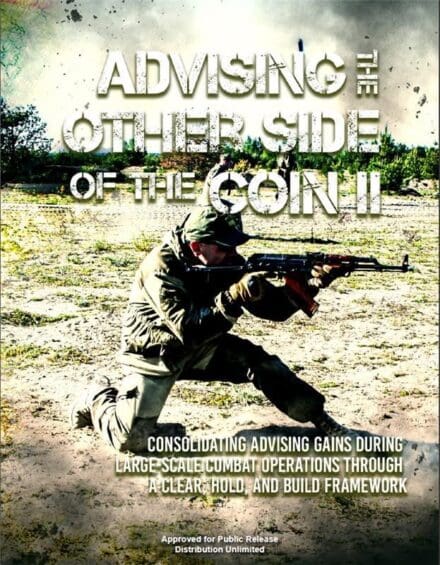
Download the article in PDF here: No. 25-1018, Advising the Other Side of the COIN II [PDF – 9.4 MB]