Register Now for SOF Week

Archive for the ‘Guest Post’ Category

Handbrake X from Emissary Development

Wednesday, December 11th, 2024

Introducing Handbrake X, a new evolution to our flagship Handbrake!

The Handbrake X features everything that makes the original Handbrake the best handstop design out there, including its forward swept angle, optimized size and geometry, tapered walls, barricade stops, and grip retaining bottom ledge, but brings some of its own new features to the table.

The Handbrake X is constructed of a rugged, impact resistant, fiber reinforced nylon polymer. The texture of the Handbrake has been reworked to feature a new rubberized texture surface that provides both enhanced grip and comfort. By utilizing an advanced multi stage mold manufacturing process, the dual material design is fused together positively with mechanical locks, resulting in a truly robust and solid product.

They are available in Black, FDE and OD Green with FDE and ODG being exclusively available at Revivaldefense.com at launch.

Visit Emissarydevelopment.com for more details.

2025 SFC Earl S. Ellis Memorial Scholarship Applications Open 13 December

Tuesday, December 10th, 2024

The Army Sniper Association is proud to announce the 2025 SFC Earl S. Ellis Memorial Scholarship applications begin December 16, 2024. To qualify, submitted applications require a postmark or e-mail receipt date no later than February 15, 2025. Awardees are announced via e-mail March 1, 2025. A scholarship awards ceremony is conducted in conjunction with the International Sniper Competition awards banquet at Columbus, GA. 10 April 2025, all scholarship awardees are encouraged to attend. Good luck to all who apply.

armysniperassociation.org/wp-content/uploads/2024/12/2025-ASA-Scholarship-Notification

Team O’Neil’s Tactical Driving Tuesday – NVG Driving

Tuesday, December 10th, 2024

In this week’s tip, Instructor Wyatt talks about what sets Team O’Neil’s training apart from others, Night Vision driving.

If you’re in need of in-person training like this, sign up for the Team O’Neil Tactical Driving Course at their facility in the White Mountains of New Hampshire. This five-day course includes driving under NODS and is available to military and other government agencies as well as civilians.

The Army Green Service Uniform Now Available At Flying Cross

Tuesday, December 10th, 2024

The AGSU reflects the iconic ‘Pinks and Greens’ uniform worn by America’s ‘Greatest Generation’ during World War II, and Flying Cross has worked closely with the U.S. Army to manufacture a solution that delivers the historically authentic look, with the professional, functional features required by the modern Soldier.

We are excited to announce that The Army Green Service Uniforms are now available for purchase at FlyingCross.com. Designed with precision and crafted with the highest quality materials, these uniforms embody the values of service, pride, and professionalism that define our armed forces. Experience the perfect blend of comfort, durability, and style that ensures you look your best, whether on duty or at formal events.

Order Your Army Green Service Uniform Today!

Chief of Naval Operations Highlights Robotic and Autonomous Systems with Visit to Orca Extra Large Unmanned Undersea Vehicle

Tuesday, December 10th, 2024

06 December 2024

LONG BEACH, Calif. – Chief of Naval Operations (CNO) Adm. Lisa Franchetti toured Boeing’s Orca Extra Large Unmanned Undersea Vehicle (XLUUV) manufacturing facility, met with Boeing contractors and Sailors assigned to Unmanned Undersea Vehicles Squadron (UUVRON) 3, and gave remarks about the importance of having robotic multi-mission submersibles in the fleet, Dec 6.

Chief of Naval Operations (CNO) Adm. Lisa Franchetti toured Boeing’s Orca Extra Large Unmanned Undersea Vehicle (XLUUV) manufacturing facility, met with Boeing contractors and Sailors assigned to Unmanned Undersea Vehicles Squadron (UUVRON) 3, and gave remarks about the importance of having robotic multi-mission submersibles in the fleet, Dec 6.

The Orca XLUUV is one of several unmanned maritime systems programs that the Navy is developing and acquiring to expand to the hybrid Fleet.

“Getting Orca into the hands of our warfighters will help us get after my project 33 targets because she is another player – with some really unique capabilities – on the field in America’s Warfighting Navy,” said Franchetti. “Orca, and other platforms like her, are an important step forward as we drive towards our future hybrid fleet, which is going be composed of manned and unmanned platforms. It’s a hybrid fleet that we know we will need to maintain our warfighting advantage.”

Orca and other autonomous systems represent a leap forward in naval warfare, providing unmatched operational advantages by extending reach, reducing risks to personnel, and enhancing strategic capabilities.

“I have no doubt that Orca will contribute to our future lethality, to our warfighting effectiveness, and further bolster our ability to deter any potential adversaries,” said Franchetti. “What we learn from this capability will inform the development of future robotic and autonomous systems, and ultimately provide a lot of agility, flexibility and new options to our nation’s decision makers, so that if deterrence fails, we’re ready to fight and win decisively.”

As reflected in CNO’s Navigation Plan for America’s Warfighting Navy “operationalizing robotic and autonomous systems: move proven systems into the hands of the warfighters”, is one of seven project 33 targets that will help the Navy permanently raise the baseline level of readiness for the possibility of war with the People’s Republic of China by 2027.

Construction of XLE-1 is complete, and the vehicle is at Marina Shipyard for contractor pierside and at-sea testing. Delivery of XLE-1 to the Navy is expected in early 2025, with follow-on Navy Developmental and Operational Testing (DT/OT) through the third quarter of fiscal year 2025. After completion of Developmental and Operational Testing, UUVRON 3 will complete crew certification, and XLE-1 will be ready for deployment.

– US Navy Public Affairs

Photos by Chief Mass Communication Specialist William Spears

Army Aviation’s Future: ‘Twice as Far, Twice as Fast’

Monday, December 9th, 2024

WASHINGTON — The Future Long-Range Assault Aircraft, or FLRAA, will dramatically impact the reach of Army Air Assault and how combat casualties are moved off the battlefield and protected.

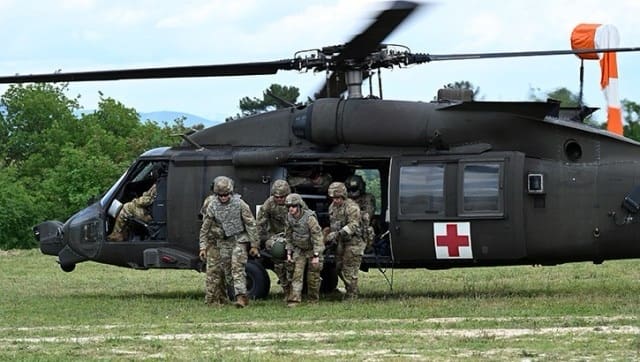
The FLRAA is a medium-lift, tilt-rotor aircraft that will augment or replace a portion of the UH-60 Black Hawk fleet. The Army intends for the aircraft to provide combat aviation brigades with long-range, high-speed utility capability with survivability in contested environments.

With enhanced speed and improved range, the Army wants FLRAA to take the mission twice as far, twice as fast, expanding the size of the battlefield and extending the reach of missions.

“We’re watching the very nature of warfare change,” said Maj. Gen. Clair Gill, commanding general of the Army Aviation Center of Excellence at Fort Novosel, Alabama. “The speed of technology is absolutely meteoric.”

Maj. Gen. Brett Sylvia, commanding general of the 101st Airborne Division (Air Assault) at Fort Campbell, Kentucky, said such swift change is needed because “we can’t actually do the large-scale, long-range air assault today” with the speed and distance required in modern warfare.

“What we can do is, we can build the new techniques and the procedures, build the doctrine, build the structures, understand the sustainment in order to be able to do that with a faster, future aircraft,” Sylvia said.

He said such a mission is defined as the ability to deliver one brigade combat team over 500 miles in one period of darkness, arriving behind enemy lines able to conduct sustained combat operations.

A recent exercise involved the 101st moving a combat team from Fort Campbell to Fort Johnson, Louisiana, a total of 575 miles. Making the move required establishing two mission support sites, six forward arming and refueling points, and positioning about 1,000 soldiers at those sites in advance for support and security, Sylvia said.

“It also took us three periods of darkness,” he said.

However, he said simulations show that by using the FLRAA for such missions instead of the UH-60, the division could take the brigade combat team 575 miles in only one period of darkness.

Sylvia said it would also cut in half the sustainment and security that we need.

The FLRAA is intended to operate and dominate in the air-ground littoral, which is the airspace over areas where Army operations take place.

Brig. Gen. Clinton Murray, commanding general of the Army Medical Center of Excellence at Joint Base San Antonio, Texas, said the planned long-range rotor aircraft will make a huge difference for transporting and protecting casualties.

The FLRAA will allow the Army to more quickly clear the battlefield of casualties, which gives commanders freedom of movement, Murray said.

The new aircraft will move critically injured Soldiers faster, over longer distances, with less need to refuel.

Brig. Gen. Cain Baker, director for the Future Vertical Lift Cross Functional Team at Redstone Arsenal in Huntsville, Alabama, said that FLRAA will positively impact survivability of warfighters through its extended range, ease of picking up and transferring patients, and the fact that the aircraft can communicate to the field hospital staff, allowing medical professionals to know what’s coming before the aircraft arrives.

Baker also noted that FLRAA maintenance crews at the launch point will understand the health of the aircraft before it returns from a mission.

Brig. Gen. David Phillips, Program Executive Officer, Aviation at Redstone Arsenal, Alabama, said the FLRAA program shows how the Army is now engaging in modern aircraft acquisition by going a little slower upfront, with the plan to move faster later.

“That means we’ve got model-based systems engineering. We’ve got standards and interfaces that are defined down to the individual component level,” he said.

What that will enable Army Aviation to do in the future is to bring new capabilities forward more quickly, making updates and changes timelier, Phillips said.

The ways of doing Army acquisitions today are markedly different than what was seen in the past, and FLRAA is a great example of that, Phillips said.

“If you go back and look at the historical timelines for aviation acquisition, this is absolutely an accelerated approach, but it does not sacrifice the rigor in the major program acquisition,” he said.

Phillips said Special Operations Command and allies have come on board early with FLRAA project agreements. The allies want to align their resources for when the U.S. starts exporting this machine in the 2030s, he said.

“This is a very transformational branch right now,” Gill said. The FLRAA is one of the Army’s signature modernization systems representing that change.

By Jonathan Austin, Army News Service

Gundam 22 U.S. – Japan Friendship Memorial: One Year on from Yakushima

Sunday, December 8th, 2024

YAKUSHIMA, Japan —

Close to 100 military and civilian personnel from the United States and Japan gathered at the Yakushima Town Hall Nov. 29, 2024 to attend a ceremony dedicating a cenotaph to the eight heroes who died when their CV-22B Osprey went down just off the coast of the island last year and the joint effort expended to search for and recover them.

The Gundam 22 U.S. – Japan Friendship Memorial, stands more than six feet tall and holds vigil over the Toshiro beach coastline, pointing visitors towards the spot the aircraft impacted the water. One of the only U.S monuments ever erected on Japanese soil, it represents a months-long, bilateral, volunteer effort that underscored the importance of the cenotaph to the American and Japanese personnel whose actions are now memorialized in stone, alongside portraits of all eight lost crew members.

The gathering at the town hall, which included family members of the deceased, was a fitting representation of the force assembled in the direct aftermath of the mishap. One year earlier, as locals witnessed the aircraft fall from the sky, it was local fishermen who were first on the scene, retrieving the first crew member from the waves near Anbo port and respectfully standing watch over his remains. The island’s fishermen would continue to contribute to the initial search and rescue operation, helping teams locate the site of the wreckage, and facilitating the use of the port for dive and recovery teams.

Among the first Japanese personnel on the ground in Yakushima to support the search and rescue effort was Haruo Morita, Deputy Director General, Bureau of Policies for Regional Society in the Japan Ministry of Defense. Mr. Morita would go on to stay on the island longer than any of his compatriots executing the search mission. As he delivered remarks at the dedication ceremony, he recalled the support received from the community in Yakushima.

“I would like to express our sincere appreciation to the people of the Kagoshima Prefecture and Yakushima Town, including the Yakushima Town Council and Yakushima Fishery Cooperative, for their great assistance and cooperation for 45 days, including the year-end and new year days, until January 12, 2024, when the search and recovery operations concluded.”

A ROBUST FRIENDSHIP CREATED

Yakushima Island is traditionally known for its beautiful peaks, ancient cedar woods and surreal vistas, but as the mammoth undertaking of finding and recovering the crew of Gundam 22 gained momentum and more personnel and equipment converged on the 500 square-kilometer island, this quiet community was about to be thrust into the international spotlight for a much different reason.

“It is an undeniable fact that although in the midst of tragedy of the Osprey mishap, a robust friendship was created between the U.S. Forces and the Yakushima Community.  I am certain that continuing to establish such a trusting relationship between our two countries will further strengthen our alliance.”

Morita’s words found truth in the make-up of the dedication gathering, which included U.S. Deputy Chief of Mission in Japan, Chargé d’affaires Katherine Monahan alongside Yakushima Town’s Mayor Koji Araki, Kagoshima Prefecture assemblymen, Yasuhiro Matsuzato and Shigeru Hidaka, and senior leaders from the Japan Self Defense Forces and multiple branches of the U.S. military.

Of those gathered, few were as intimately acquainted with the mission to recovery the lost Airmen and the wreckage of their craft as Rear Adm. Jeromy Williams. Williams, commander of Special Operations Command Pacific, received twice daily briefings on the progress of the search, recovery, and salvage efforts for over 45 days while operations persisted on the island. He witnessed the scope and impact of our Japanese partners’ contributions to the search.

“Overall, 21 Japanese Coast Guard and Navy ships came to our aide. Japan Coast Guard employed unmanned underwater vehicles, ROVs, and divers.  Japan Ground Self Defense Forces employed helicopters, activated reservists, and searched the cliffs, beaches, and shorelines.  Japan Air Self Defense Force sent aircraft, while police, business owners, local volunteers, the Fisherman’s Association, and Yakushima Woman’s association all remained determined in the search.”

MARKER OF A FINAL RESTING PLACE

Altogether, U.S. and Japanese forces searched 60,000 sq kilometers of water, 89 kilometers of Yakushima coastline and another 30 kilometers of coastline on neighboring Tanegashima, and 39 square kilometers of ocean floor. In just shy of two months, their search turned up 321 objects, and the remains of 7 crew members. The eighth, Maj. Eric Spendlove, has yet to be recovered, according to Mr. Morita a source of “deep regret” for the Japanese partners involved in the search. The cenotaph on the island now serving as a marker of his final resting place.

Instrumental to making the cenotaph a reality was Maj. Jake McCauley of the 353rd Special Operations Wing. One of the first Americans on the ground last November, he served as mission commander for the search, rescue, and recovery.

“It was a huge undertaking from the time we got here to when we finally closed the [Joint Operations Center]. Once it was coming to a close, we knew we wanted to do something here to thank the community for the help they gave us, and to honor the heroes we lost. Having a permanent place here for their families and the SOW to come and remember them and pay respects is awesome.”

For McCauley, the journey from search and rescue to the dedication of the cenotaph has represented a full circle experience, providing closure for him and many of the men and women involved in the operation. In the days leading up to ceremony, McCauley and more than a dozen volunteers from Kadena Air Base and Yokota Air Base engaged in beach clean-ups and beautification of the area around the cenotaph site.

A PHYSICAL ARTIFACT OF A ROCK-SOLID BOND

The monument itself is an extension of Yakushima, built by local craftsmen from monolithic stones taken from the same jagged shorelines where the crew of Gundam 22 met their fate. Across the top of the structure, eight portraits, chosen by the heroes’ families, are etched into the stone alongside their ranks and names. They’re held up on each side by two massive stone pillars each with inscriptions, one in English, the other in Japanese. They detail the crash, the scope of the search and rescue operations, and the contributions of the Yakushima Town community.

The inscription reads:

On the 29th of November 2023, one CV-22B Osprey, callsign GUNDAM 22, assigned to the 353d Special Operations Wing at Yokota Air Base, crashed off the coast of Yakushima Island, about 1KM northwest of this cenotaph, killing all eight U.S. service members aboard.

In the weeks following the mishap, an intensive period of 24/7 search and rescue efforts –and later recovery and salvage operations –were conducted by expert teams from the U.S. Air Force, U.S. Army Special Operations Command, U.S. Navy, Special Operations Command –Pacific, U.S. Forces Japan, the Japanese Ministry of Defense, Japan Self Defense Forces, Japan Coast Guard, local police, and many others from Yakushima and elsewhere in Japan and the U.S. In over 40 days of these combined efforts, the remains of seven out of eight Airmen were recovered and returned to their loved ones.

Throughout these operations, local public authorities, notably those from Yakushima town and Kagoshima prefecture, as well as civilian volunteers such as the Fishery Association and Women’s Association, extended generous and dedicated support to the search, rescue, recovery, and salvage efforts.

This cenotaph commemorates the souls of eight Heroes and enshrines the eternal commitment of all those involved to never again endure the same kind of mishap. May this monument also forever celebrate the steadfast friendship forged between U.S. Servicemembers and the people of Kagoshima who so warmly offered their unwavering support and partnership in our darkest days of shared tragedy.

Looking out to the ocean, the pillars and crossbeam frame a small area of the water, just shy of a kilometer away from the island’s lone airport, where the fateful flight ended.

Rear Adm. Williams, in his remarks at the town hall, summarized the symbolism of the cenotaph:

“Today’s dedication provides a physical artifact of the rock-solid bond between Japan and the United States.  It memorializes the faces of our fallen heroes, and records for posterity the benevolence of our Japanese allies.  The memorial stands watch over the waters that are the final resting place of our last missing teammate. It will serve as inspiration for generations to come that in our darkest hours, Japan and America will stand strong together.”

As the sun rose over the monument the day after the ceremony, it was evident that the Yakushima community had already embraced it, just as they had embraced the U.S. service members who came to their island a year ago. Groups of school children, elderly couples, and individual visitors came steadily throughout the morning, leaving traditional Japanese offerings, taking pictures, and praying. A day earlier, commander of the 353rd SOW, Col. Shawn Young said to the audience gathered at the dedication, “My hope is that this can now be a place of healing for two communities – American and Japanese together – who experienced this loss not just as allies, but as family.”

In memoriam: the crew of Gundam 22:

U.S. Air Force Maj. Jeffrey T. Hoernemann, 32, of Andover, Minnesota, was a CV-22 instructor pilot and officer in charge of training, assigned to the 21st Special Operations Squadron, 353rd Special Operations Wing, Yokota Air Base, Japan.

U.S. Air Force Maj. Eric V. Spendlove, 36, of St. George, Utah, was a residency trained flight surgeon and medical operations flight commander assigned to the 1st Special Operations Squadron, 353rd Special Operations Wing, Kadena Air Base, Japan.

U.S. Air Force Maj. Luke A. Unrath, 34, of Riverside, California, was a CV-22 pilot and flight commander assigned to the 21st Special Operations Squadron, 353rd Special Operations Wing, Yokota Air Base, Japan.

U.S. Air Force Maj. Terrell K. Brayman, 32, of Pittsford, New York, was a CV-22 pilot and flight commander assigned to the 21st Special Operations Squadron, 353rd Special Operations Wing, Yokota Air Base, Japan.

U.S. Air Force Tech. Sgt. Zachary E. Lavoy, 33, of Oviedo, Florida, was a medical operations flight chief assigned to the 1st Special Operations Squadron, 353rd Special Operations Wing, Kadena Air Base, Japan.

U.S. Air Force Staff Sgt. Jake M. Turnage, 25, of Kennesaw, Georgia, was a flight engineer assigned to the 21st Special Operations Squadron, 353rd Special Operations Wing, Yokota Air Base, Japan.

U.S. Air Force Senior Airman Brian K. Johnson, 32, of Cincinnati, Ohio, was a flight engineer assigned to the 21st Special Operations Squadron, 353rd Special Operations Wing, Yokota Air Base, Japan.

U.S. Air Force Staff Sgt. Jacob “Jake” M. Galliher, 24, of Pittsfield, Massachusetts, was a Direct Support Operator assigned to the 43rd Intelligence Squadron, Detachment 1, Operating Location – Alpha, 363rd Intelligence, Surveillance, and Reconnaissance Wing, Kadena Air Base, Japan. 43 IS Det 1 OL-A is a tenant unit in support of the 353rd Special Operations Wing.

By Capt Richard Caesar, 353rd Special Operations Wing

FirstSpear Friday Focus: FS and OSI Forge Strategic Partnership to Distribute Tubes Fasteners

Friday, December 6th, 2024

FirstSpear, a leader in Berry-compliant tactical gear for the warfighter, and Ocean State Innovations (OSI), a premier supplier of high-performance textiles, are pleased to announce a strategic partnership to expand the availability and access to FirstSpear’s patented Tubes® fasteners.

FirstSpear Tubes® Fasteners

Quick Release and Attachment: Designed for rapid gear donning and doffing with a simple two-motion technique.

Reduced Weight: Significantly lighter than traditional fastening systems, aiding in increased mobility for users.

Durability and Reliability: Constructed from high-performance polymers

Infrared Signature Reduction: Compliant with U.S. military specs for NIR signature reduction.

Modular Integration: Facilitates field repairs and customization for specific mission requirements.

Self Cleaning: Designed to clear dirt and debris through normal operation, ensuring reliability in critical operations.

Cross Compatibility: Available in 2” and 4” lengths. All male and female tubes are cross compatible between sizes.

“This collaboration with OSI marks an important step in our mission to equip the warfighter with the best and most capable tools available,” said Scott Carver, CEO of FirstSpear. “Tubes Technology is much more than a fastener; they are the release system relied on by the most demanding operators in the harshest conditions. OSI’s textile expertise and global supply chain complement our passion for equipping those operators built for the X.”


OSI is the exclusive distributor of FirstSpear Tubes Fasteners. FirstSpear will continue to support program sales and retail customers can continue to purchase them at www.first-spear.com.

“FirstSpear® has established itself as a leader in the tactical industry for many years, and we are excited to announce our exclusive partnership with them as the distributor of TUBES Fasteners. This collaboration guarantees that this reliable and innovative solution will be more readily available to our customers,” said Ben Galpen, Partner Ocean State Innovations.

This partnership not only broadens the distribution of FirstSpear’s Tubes fastener technology but also underscores both companies’ dedication to providing innovative solutions that meet the rigorous demands of their end users. 

FirstSpear retains commercial retail sales through their website & will also continue to support our core relationship and customers. For more information or questions about Tubes® contact sales@first-spear.com or visit www.first-spear.com/tubes.

For more information, contact Geoff Senko at geoff@osinnovate.com at OSI.