TYR Tactical

Archive for the ‘Materials’ Category

DuPont Hosts SSD

Monday, August 23rd, 2010

DuPont’s Spruance facility in Richmond, Virginia recently hosted SSD for an in depth look at Fire Resistance and Ballistic Protection.

Back in the 60s a new class of fabrics was developed, called Aramids with DuPont at the forefront of their creation. Two fabrics in this class have become the cornerstones of modern Soldier Survivability; Kevlar and Nomex. They provide Ballistic and Fire protection respectively. Kevlar was initially developed by DuPont for tire belts but not put to its current use until the early 70s. Nomex on the other hand was quickly integrated into flying and space suits not long after its creation.

The most compelling portion of the visit was the ThermoMan lab. Composed of 122 sensors, ThermoMan was designed with the assistance of NC State. In addition to the mannequin, there is also a skin burn injury model that takes data collected at the sensors and displays how a thermal threat would equate to an injury to the human body. One interesting aspect of the ThermoMan over other testing methods such as the commonly used vertical flame test is that the ThermoMan tests not only the material’s performance but also the garment’s overall design and construction. This is a critical factor in protecting a wearer from thermal threats. If a flame can get inside a garment then the wearer might as well not be wearing FR at all. Interestingly, the pocket configuration of the issue flight suit is designed to provide additional protection for the wearer by doubling the layers of Nomex in certain key areas. Testing has revealed that most injuries actually occur after the flame threat is removed and the wearer is subjected to residual heat retained by the garment.

We witnessed two burns consisting of a 3 second burn delivering 6 calories. It is intended to replicate a JP4 fire. In the first burn, an issue CWU-27/P US issue flight suit manufactured from Nomex III.

As you can see, minimal damage was sustained by the ThermoMan due to the material and design of the flight suit. it is important to note that while the ThermoMan does a great job predicting injuries, actual injuries may vary due to a wearers body and the fit of the garment. Experience has shown that 1% injury equates to 1 day in the hospital. In this case, the ThermoMan indicated 7% injuries.

In the second, a similar looking flight suit manufactured from 65/35 PolyCotton was subjected to the same threat. PolyCotton, a mixture of 65% Polyester and 35% Cotton is commonly found in Chinese made garments. There IS a place for this fabric, but as you will see in the video, it isn’t in a flame threat environment. Rather, PolyCotton is a cool fabric and very good for use in warm climates. The choice of materials goes back to our recent article concerning knowing your equipment, the threat, and environmental conditions and making an informed choice about which equipment to choose. As you can see the PolyCotton not only caught on fire but it continued to burn even after a direct flame was removed. In this case, the ThermoMan sustained 75% injuries.

During our visit to the ballistics lab we witnessed a demonstration of testing of an armor vest and were introduced to the various apparatus used during testing. Additionally, we were given the opportunity to try out first hand correctional armor which is designed to stop stab and puncture threats. We were amazed at how much differently ballistic and correctional armor reacted to the icepick type of shiv commonly found in correctional facilities. The bottom line is that correctional armor works.

We were fortunate enough to be able to discuss a variety of current Soldier Systems issues with the DuPont team but probably the most important message we got was that DuPont is constantly looking at new ways to use their flagship products. Adaptability is the key as they not work to improve the performance of their materials but also as they seek new ways to use their products as well as combine them with other fibers.

While in years past many vendors would have pushed monolithic solutions to threats, it makes more sense now to develop hybrid solutions that combine multiple fibers into a more robust material. This way, the best characteristics of different materials can be combined into a common solution.

Overall, the meeting was excellent and we left with a greater appreciation of the level of commitment DuPont has to protecting our troops and public safety professionals.
ResQ – New FR Fabric from Milliken

Friday, August 13th, 2010

The Army has been investigating new Fire Resistant fabrics for some time now in order to offer more capability for our troops. Milliken has just released their new fabric called ResQ. Check out the details in this associated document.


ResQ by Milliken

www.millikenmilitary.com

Stuff We Didn’t Write About

Sunday, August 1st, 2010

The Invention of the Leatherman: Patent Gallery

New A-TACS Images

New Wound Care Zaps Cuts Closed

DIY Wearable Computer Turns You Into a Cyborg

Are 3D-Printed Fabrics the Future of Sustainable Textiles?

Protect Yourself

Monday, July 26th, 2010

Recently, a close friend of the owner of Unleashed Tactical Equipment was severely burned in an IED attack. His wounds are particularly heinous due to his selection of clothing. He was not wearing FR and they worked against him in the blast. In response, UTE has reacted with the Fit to Fight initiative.

In particular, the US military makes it very easy for its troops. Directives prescribe exactly what clothing and equipment troops will wear. Unfortunately, there are scads of others on the battlefield who do not have someone telling them how to conduct themselves and so they must assess their own risks and mitigate them however they can. Has the pendulum swung too far in favor of swaddling our troops in FR? Probably, but they are safer than ever from flame threats. Civilians have a tougher go. They have to decide how to dress.


The point is, for those who are able, consider the environment and the threat. Then, choose proper clothing and equipment. Few would ever go into a high threat environment without armor and a helmet, yet everyday, many venture out into harms way covered in high performance fabrics that will shrink them in a blast.

When in a threat environment, wear a balaclava and gloves. Wear eye pro, preferably goggles. Consider your clothing and the threat you will face. Consider no-melt, no-drip clothing if you don’t want to wear full flight suits or other FR apparel. Do all of this at a minimum. Any part of you exposed in a blast or direct flame threat is going to burn. Research the fabrics your clothing is manufactured from. Find out how it reacts to heat and flame. Stay safe.

Later this week, SSD will be running a feature on the testing of FR fabrics.

Every Which Way Buckle

Monday, July 26th, 2010

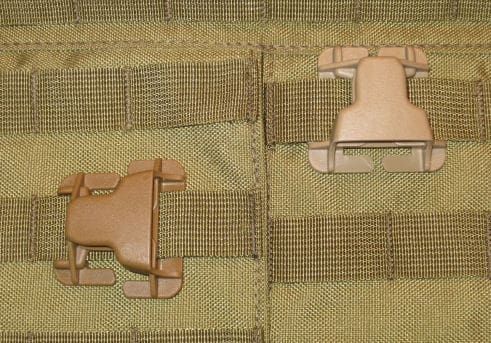
New from National Molding is the Every Which Way Buckle. It features their Quick Attach MOLLE Web Mount and can be fitted vertically or horizontally to PALS webbing. Additionally, it accepts any of National’s 1″ male buckles. The buckle is available in Black, Coyote Brown, and Tan 499.

www.nationalmolding.com

Warrior Protection and Readiness Coalition Welcomes Textile Industry Leaders

Wednesday, July 14th, 2010

The Warrior Protection and Readiness Coalition (the WPRC) is pleased to announce that three leaders in the textile and protective fabric industry have joined the effort to provide a unified voice for operational readiness and warfighter safety.

As of July 1, 2010, DuPont, the International Textile Group (ITG) and TenCate Protective Fabrics USA (TenCate) are all members of the expanding WPRC. These companies will join with WPRC counterparts in the effort to educate leaders on issues of warfighter protection and enable adequate funding for the development and procurement of first class Operational Clothing and Individual Equipment (OCIE) for American warfighters.

DuPont, ITG and TenCate collectively provide thousands of American manufacturing jobs and supply the U.S. military with the most technologically advanced protective fibers and fabrics in the world. These companies understand both the need to provide American warfighters with the best technology available, and the major role that the OCIE industry plays in the U.S. economy. The WPRC leadership is pleased to count these leading firms as allies in the ongoing effort to better equip and protect American warfighters.

In addition to DuPont, ITG and TenCate, members of the WPRC include ADS Inc., Darn Tough, Insight Technology, Integrated Wave Technologies, London Bridge Trading Company, Milliken, New Balance, Otis, Pelican, Sperian, Surefire, Wiley X and W. L. Gore. Additional leaders in the OCIE industry are expected to join as this effort gains momentum. For more information on the Warrior Protection and Readiness Coalition please visit www.warriorprotection.net.

ITW Military Products Expands Web Site

Monday, June 14th, 2010

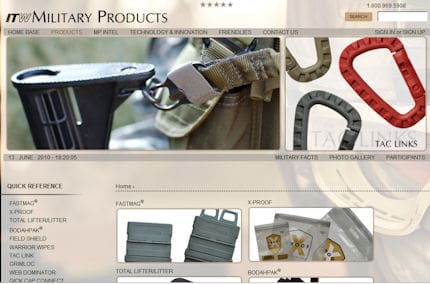
ITW Military Products just unveiled their newly expanded web presence. Once you begin exploring, you will have no doubt that they are more than just buckles and feature innovative products such as the popular Tac Link, Grimloc, and FASTMAG. But they also offer several new products not seen by most of our readers such as the Total Lifter/Litter and MAGBOOT. It is really worth your while to check it all out.

Also, be sure to look out for ITW Military Products representatives at this week’s Special Operations Forces Industry Conference in Tampa, Florida and Eurostatory in Paris, France. At SOFIC the entire line of ITW Military Products are on display in booth 1108, Supply Captain.

www.itwmilitaryproducts.com

A-TACS Nylon Cordura Fabric, Webbing and Hook and Loop Now Available

Tuesday, June 1st, 2010

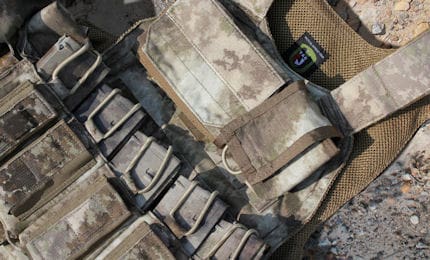
This is very exciting news for large businesses as well as the Do-It-Yourselfer. After many months of stage two development on A-TACS and further enhancement of the printing technology behind the pattern, Digital Concealment Systems has announced that Berry compliant A-TACS Nylon Cordura, Nylon webbing, and Hook and Loop is now available for purchase.

In an exclusive partnership, A-TACS Nylon Cordura is now available for worldwide distribution through LC Industries. As a result of this distribution deal, production-ready fabrics can be purchased in quantities as low as 5 yards which will enable a wide range of specialized gear manufacturers to begin producing product without the need to carry heavy fabric inventory.

Fabric will be available in 330D, 500D and 1,000D weights with urethane backing and DWR treated face. For additional information, pricing or to place an order, please call Julie Kammerer or Susan Fields with LCI / TAG at 1-888-890-1199.

A-TACS nylon webbing and bindings are now available exclusively hrough Texcel, Inc. in a variety of specifications ranging from three-quarter inch to three inch widths. For ordering information and pricing, please contact John Pinkos at 401-727-2113.

To complete the A-TACS total concealment system, DCS in conjunction with Aplix, Inc. is proud to announce the release of A-TACS hook and printed loop. For ordering information and pricing, please contact James Bishop at 800-438-0424.

For all other inquiries regarding A-TACS Nylons, please contact Steve Hanks with Digital Concealment Systems at 334-448-5442.