Phantom Lights

Archive for the ‘Materials’ Category

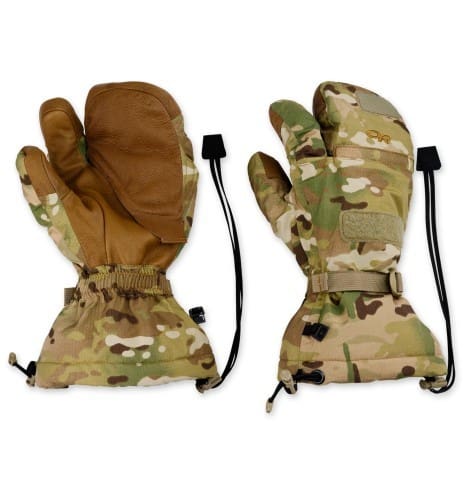
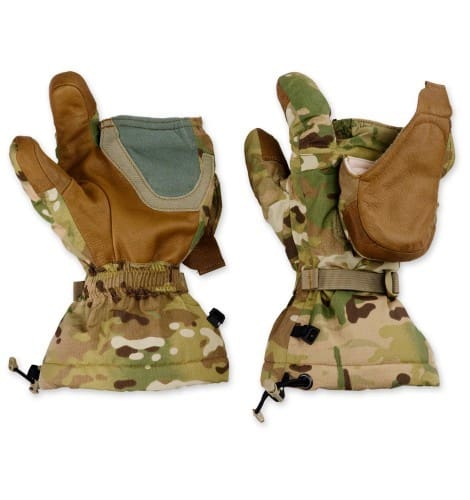
Gore Military – OR Swoop Mitt

Friday, October 12th, 2012

We continue our coverage of WL Gore’s various technologies and their military applications with the Swoop Mitt from Outdoor Research. While we are all familiar with the popular GORE-TEX brand, many do not know that WL Gore has worked extensively with the military since the mid-1980s to develop specific fabrics for various purposes.

Developed for pilots and aviation crews operating in extremely cold conditions at high altitudes, the shell of the Swoop Mitt provides waterproof and breathable protection via a Gore membrane. The water resistant goat-leather palm provides a solid grip. The Swoop is a trigger finger mitt design which accommodates all fingers in the mitt cavity for greater warmth and dexterity. What makes it unique is that the mitt cavity can be peeled back and the entire hand can be pushed through the mitt when required. It is insulated with EnduraLoft, a high-loft insulation that springs back after compression. Used in conjunction with an FR liner glove such as a flight glove, the Swoop works as a full system.

Here is a video featuring OR’s Mike Christian that describes the Swoop Mitt.

www.GoreMilitary.com

TacHacker – Revitalizing Your Hardshell

Monday, October 8th, 2012

It’s that time of year again boys and girls. I’ve made this an annual post for the past few years. Winter’s on its way so this is the perfect time to pull your kit out and check it over before it’s needed.

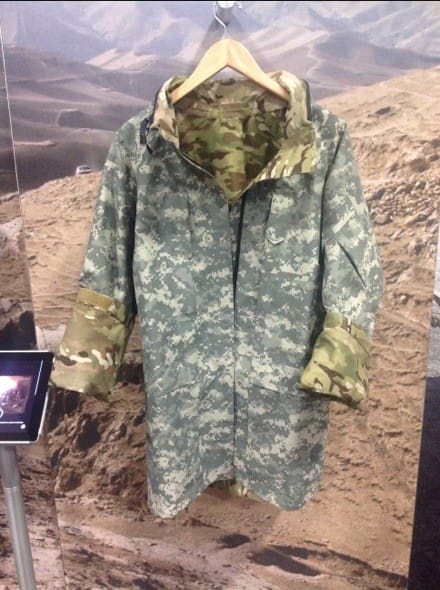
It looks like it’s going to be a LONG winter. During a recent shooting class I attended it started raining day one and by the middle of the second day it looked like a blizzard. Most of my fellow shooters were wearing waterproof breathable outerwear and several began to feel clammy and then damp the longer each day progressed. A couple of guys were wearing issue Gen I ECWCS parkas. Probably not the best garment available as WL Gore long ago decided that the basic design could not meet their “Guaranteed to Keep You Dry” standards. Of course these jackets were old. More than anything, they needed some maintenance.

The key to any modern outerwear is its Durable Water Repellent (DWR) which serves as your clothing’s first line of defense against moisture. There are quite a few treatments available and different manufacturers have their favorites but they are usually are based on flouropolymers. These are PTFE molecules that are applied to the surface of the fabric and cured at high heat to make them adhere better and increase performance. These treatments have a fluorine atom at one end which is highly hydrophobic meaning it hates water. Heat causes the fibers to align themselves with their flourines exposed. Water tries to move away from the flourines resulting in beading. This allows the water to roll off without wetting the fabric. Interestingly, Quarpel (Quartermaster Repellent) was one of the first DWRs and used to treat field jackets and other military clothing items back in the 1960s.

Since most of us can’t run out and purchase a new jacket every time the DWR needs refreshing I thought it would be a good idea to share a few tips with you that will not only revitalize your garment’s DWR treatment but also extend the life of your clothing.

DWR treatments work best when they are clean. I realize this seems counter to what you think is right since a DWR generally lasts about 25 washings and tactical garments get quite a beating in the field, but you need to wash your clothing. The first thing is to avoid using liquid detergents as well as fabric softeners. Additionally, avoid optical brighteners as they are not good for DWR or IR treatments. There are wash in treatments you can purchase as well as spray on options to help renew your clothing’s DWR. However, wash in treatments may affect the breathability of your membrane. One of the best spray solutions available is Revivex from McNett and it is what I have used in the past. It also serves as a stain repellent. Revivex can also be applied to garments that never had DWR in the first place so if you have hunting or field clothing that you find yourself wearing in inclement weather regularly you may want to give it a once over. If you use a spray treatment be sure to evenly coat your garment while it is still damp after washing and to pay special attention to any seams.

There are two additional ways you can put some life back into your DWR without a full retreatment. One is to put the garment in a conventional dryer on warm and the other is to iron it on low heat. This helps realign the fibers. If water fails to bead up on the surface of your garment you will need to retreat.

No matter which method you choose, proper maintenance of your foul weather clothing’s DWR will help keep you warm and dry and extend the life of your equipment.

Polartec Integral Technology for SOF PCU Lvl 9 Combat Shirt

Thursday, September 27th, 2012

Polartec, the developer, manufacturer, and marketer of Polartec performance fabrics, has worked closely with US Special Operations Forces and one of their fabrics was chosen for use in the first standard issue combat shirt developed specifically for the needs of SOF.
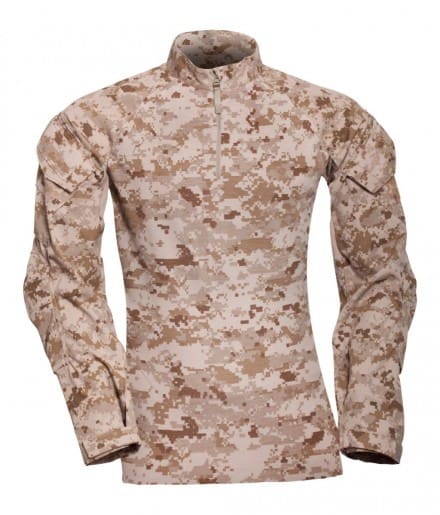
Designed by Patagonia, the Special Operations Forces’ (SOF) Protective Combat Uniform (PCU) Level 9 Shirt is currently being fielded to all US SOF users, and will enhance their combat advantage in the world’s most hostile conditions.

Designed to be worn next-to-skin, the new PCU level 9 combat shirt integrates Polartec Power Dry fabric in the shirt’s torso to provide moisture management, breathability, stretch, quick drying and comfort. Power Dry features a patented bi?component knit construction with two yarns. One picks up the sweat from the skin and the other disperses the sweat to the outer layer to rapidly dry it. It moves 30% more moisture than single component fabrics.
The Power Dry used in Level 9 is printed in a variety of camo patterns and also offers FR properties.

“Polartec is very proud of our longstanding development relationship with the Special Operations Forces. We are constantly challenged by the extreme performance that Operators demand of their clothing and equipment. These men are the tip of the spear of our country’s projection of power and always exhibit remarkable ability and patriotism. To be selected by this very demanding customer is a tribute to the abilities of the research and development team at Polartec who are honored to help support our warfighters.” said David Costello, Polartec Business Manager.

Polartec fabrics are found throughout PCU; in levels 1, 2, 3, 3A, and now 9. Additionally, Polartec offers numerous fabric solutions including wicking base layers, to insulation layers, to extreme weather protection and are utilized by the best clothing brands in the world

polartec.com

Climashield Adopted as Part of PCU

Thursday, September 27th, 2012

Climashield announced that their signature COMBAT continuous filament insulation was selected for the new and improved SOCOM-issue Protective Combat Uniform (PCU) Level 7 designed by Massif.

In extensive laboratory and field evaluations, Climashield repeatedly provided the right combination of technical elements to achieve greater warmth at lighter weights, significantly reducing the weight of the PCU. Designed specifically for use by SOF, the jacket, pants and vest boast a new, sleek design from Massif paired with Climashield COMBAT performance insulation. Along with superior ratings in thermal efficiency, Climashield COMBAT is durable, maintaining warmth throughout the life of the product even when stretched, packed or washed multiple times.

“When Massif was tasked with designing elements for the new PCU 18 months ago, the challenge was to increase functionality and reduce bulk while maintaining thermal efficiency in the process,” said Sarah Sameh, President and COO at Massif. “Climashield met our needs and we are grateful to have their brand and experience on board for these PCU garments.”

“From the zipper to the fabric, every element in the design of gear for the military is essential in providing the best protection for our troops,” said Brian Emanuel, General Manager at Climashield. “Massif is meticulous with each detail and Climashield is proud to be part of a superior product used around the world by the men and women serving in the U.S. Special Forces.”

Climashield insulation is manufactured in the U.S.A. in an ISO 9001-certified facility.

For a full look at the latest version of PCU check out our story at soldiersystems.net/2012/01/26/pcu-block-2-preview

www.climashield.com

MDM – Gore Military

Wednesday, September 26th, 2012

20120926-144649.jpg

Gore Military’s Lightweight Loft technology is a combination of PrimaLoft’s Fusion insulation (80g) hang in a Gore 2-layer Fast Pack membrane laminate. A comfortable softshell, it is also water resistant. It is not only wind proof but it can also quickly be packed. Because of the breathability it dries quickly and can be used to layer over wet garments to help dry via convection.

The Lightweight Loft has been adopted by USSOCOM as level 3B of PCU. The garment was designed by Patagonia and has been printed in several camo patterns including nIR protection.

www.goremilitary.com

MDM – DRIFIRE

Tuesday, September 25th, 2012

20120925-131131.jpg

This uniform, is a design concept for MARSOC of an FR combat garment (yes, thats Woodland Camo) featuring DRIFIRE’s Foretrex fabric. Not only is it FR, but it also incorporates Drifit’s moisture management and anti-microbial features. Recently developed, it’s an alternative to currently fielded FR materials.

www.drifire.com

Gore Military – Woodland Combat Desert Jacket

Monday, September 24th, 2012

In this third of our coverage of WL Gore’s various technologies and their military applications our subject is the Woodland Combat Desert Jacket. While we are all familiar with the popular GORE-TEX brand, many do not know that WL Gore has worked extensively with the military since the mid-1980s to develop specific fabrics for various purposes.

The Marine Corps has adopted a woodland MARPAT variant of the popular Combat Desert Jacket. It’s an interesting garment. Based on the name alone you’d probably realize that it was originally issued in Desert MARPAT. Other than being developed specifically for use in South West Asia, another thing that you don’t normally see with military garments is that it is made up of multiple types of fabrics. It’s a softshell garment featuring a lightweight, water-resistant fabric with a Gore membrane that is engineered to withstand rain, wind, and sand. Additionally, there are strategically placed stretch zones for increased flexibility and mobility. There is also a moisture-wicking lining. The CDJ also incorporates 99.9 percent pure silver in the gridded fleece lining to inhibit the growth of odor-causing bacteria and fungi in the garment. Early in the production of the original CDJ there were issues getting the printing to match on all of the different fabrics, but they long ago mastered that issue and as you can see from the photo, it looks great.

This waist length jacket features a chest mounted rank tab as well as a single chest and bicep pocket. Finally, there are slash handwarmer pockets on either side.

www.GoreMilitary.com

Gore Military – FR Fuel Handler Coverall

Friday, September 21st, 2012

This is the second in a series of articles covering WL Gore’s various technologies and their military applications. While we are all familiar with the popular GORE-TEX brand, many do not know that WL Gore has worked extensively with the military since the mid-1980s to develop specific fabrics for various purposes. In this article we will cover the FR Fuel Handler Coverall.

Military fuel handlers face a dirty, dangerous job. Petroleum, oils, and lubricants (POL) are both flammable and corrosive. In cold weather, fuel handlers face increased threat of cold weather injuries due to the lower freezing temperature of fuel. Diesel can remain in its liquid state down to 15 deg F. At these temperatures, spills can exacerbate the danger of cold injuries. That’s not to mention the flame threat associated with POL. To counter these environmental dangers, the Army and Marine Corps set about to develop a new garment for fuel handlers. The answer is the Fuel Handler Coverall which has been adopted by both the US Army and Marine Corps. It features GORE-TEX construction offering a wide variety of attributes. Not only does it integrate penetration-resistant against JP-8, DEET, and POL but it is also flame-resistant (thanks to Nomex technology), anti-microbial, durably waterproof, windproof and breathable and dissipates electrostatic charges. Additionally, it provides this protection for more than 25 wash/dry cycles. Finally, it is available in Coyote as well as UCP and includes n-IR signature reduction technology.

www.GoreMilitary.com