Phantom Lights

Archive for the ‘Parachuting’ Category

82nd Airborne Division tests new wheeled cargo delivery system to support Global Response Force

Sunday, February 25th, 2018

FORT BRAGG, North Carolina — 82nd Airborne Division troopers here are wrapping up testing of the Caster Assisted A-Series Delivery System (CAADS), which involves delivering mission essential supplies and munitions to ground troops.

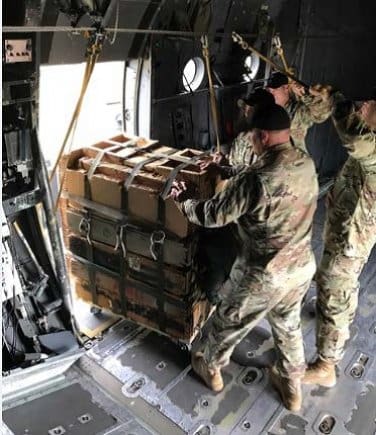
Soldiers from Company A, 2nd Battalion, 325th Airborne Infantry Regiment, 2nd Brigade Combat Team teamed up with subject matter experts from the United States Army Advanced Airborne School (USAAS).
FA60888B-D562-4DB5-9F8B-CFBBC574B64C
Paratroopers from the U.S. Army Advanced Airborne School develop Techniques Tactic and Procedures prior to testing with the U.S. Army Operational Test Command’s Airborne and Special Operations Test Directorate. (Photo Credit: Mr. Michael A. Zigmond, Airborne and Special Operations Test Directorate, U.S. Army Operational Test Command Public Affairs.)

With the Fort Bragg-based U.S. Army Operational Test Command’s (USAOTC) Airborne and Special Operations Test Directorate (ABNSOTD), they successfully rigged, dropped, and recovered the CAADS door bundles during operational testing on Sicily Drop Zone.

The 82nd Airborne Division is part of the XVIII Airborne Corps, and is the Army’s most strategically mobile division.
5EDDC699-D80E-4DB3-AF4A-43A7B8BC202F
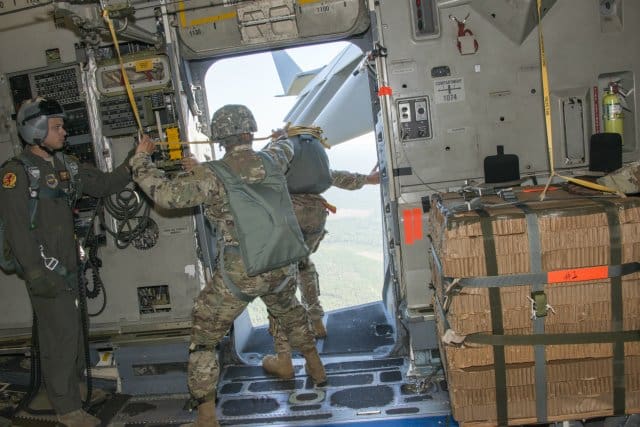
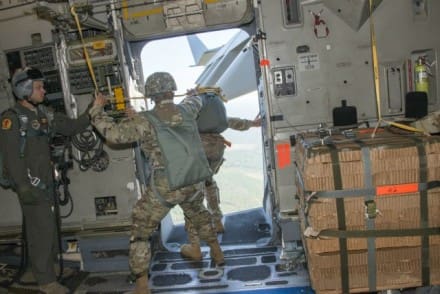
Capt. Matthew P. Carstensen, (right) Commander, Headquarters & Headquarters Co. 2nd Battalion, 505th Parachute Infantry Regiment, 3rd Brigade Combat Team, conducts a door check prior to exiting the first Caster Assisted A-Series Delivery System from a U.S. Air Force C-17 aircraft. (Photo Credit: Mr. Michael A. Zigmond, Airborne and Special Operations Test Directorate, U.S. Army Operational Test Command Public Affairs.)

82nd Airborne Division Commander, Maj. Gen. Erik Kurilla, said, “The 82nd Airborne Division is the elite Airborne infantry division of the United States Army, specializing in parachute assault operations into denied areas.”

Kurilla wants to be able to deploy three CAADS door bundles per paratroop door. Bundles can weigh up to 500 pounds of cargo and be airdropped from a variety of Department of Defense (DoD) transport aircraft to support the Global Response Force.
CD054ADB-0438-43DD-811E-74C778C54052
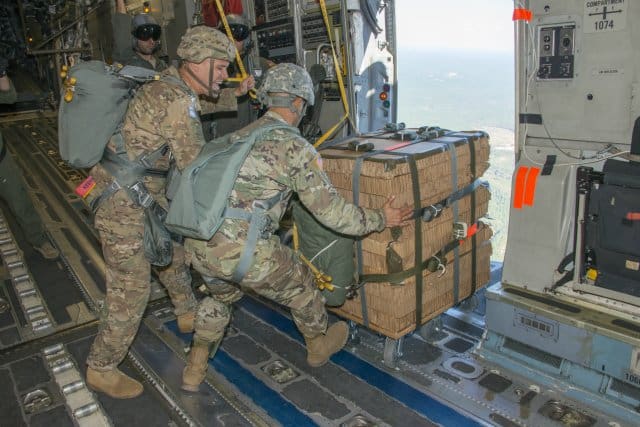
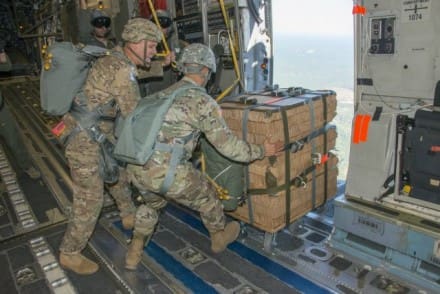
Sgt. 1st Class Miguel A. Amadis of Company A, 2nd Battalion, 325th Airborne Infantry Regiment, 2nd Brigade Combat Team, positions the Caster Assisted A-Series Delivery System in the door of a U.S. Air Force C-17 aircraft before deployment onto Sicily Drop Zone. (Photo Credit: Mr. Michael A. Zigmond, Airborne and Special Operations Test Directorate, U.S. Army Operational Test Command Public Affairs.)

The current door bundle limit without CAADS is two bundles per door per pass.

Currently, there is no standardized aerial delivery system in the Department of Defense (DoD) inventory that employs the dolly-assisted method, but other countries like France employ a similar system.

CAADS is a platform built of plywood, a brake, and six caster wheels which allow the door bundle to roll across the aircraft floor, speeding airdrop deployment.

Testing demonstrated safe deployment of door bundles using CAADS to improve the ability of Soldiers deploying the bundles while reducing exit time. The increased speed allows for additional bundles per pass.

The efficiency of the CAADS concept provides the capability of exiting more door bundles per pass, per aircraft — all increasing the amount of supplies on the ground to the paratroopers during their critical 12 hour initial entry phase.

Sgt. 1st Class Miguel A. Amadis of Company A, 2nd Battalion, 325th Airborne Infantry Regiment, 2nd Brigade Combat Team said, “I like the CAADS a lot. It was easy to push, easy to set up at the door, and it will be very useful for the upcoming missions.”

One Airborne unit commander said he liked CAADS’ simplistic design and concept, which can seriously lessen the physical wear and tear on the average paratrooper.

“The castor’s one free axle made the rotation into the door easy, but still kept two axles locked, which maintained control as the container exited the door and entered the slip stream,” said Capt. Matthew P. Carstensen, Commander, Headquarters and Headquarters Company, 2nd Battalion, 505th Parachute Infantry Regiment, 3rd Brigade Combat Team.

“I felt that the concern of jarring the container in the doorway was safely mitigated by those locked axles,” he added. “Looking at future application, a container of this size and capacity can significantly increase the combat power and lethality delivered onto a hostile drop zone on the first pass.”

According to Sgt. 1st Class Martin L. Ross, ABNSOTD Test NCO, operational testing is OTC’s opportunity to contribute to Army readiness.

“Anything less compromises the Army’s ability to provide the forces that fight and win the Nation’s wars,” he said.

“Operational testing is about Soldiers,” said Col. Bradley F. Mock, Director of the ABNSOTD. “It is about making sure that the systems developed are effective in a Soldier’s hands and suitable for the environments in which Soldiers train and fight. Operational testing is OTCs opportunity to contribute to readiness; anything less compromises the Army’s ability to provide the forces that fight and win the Nation’s wars.”

The ABNSOTD Test Division chief explained how test units incorporate systems under test into their actual missions and training requirements.

“Leaders of units involved in testing have the first look at new systems, which may also drive changes to operations and doctrine,” said Lt. Col. Gregory Oquendo. “Tests are unit-led, which translates into coordinated control under realistic operational environment scenarios.”

Other tests underway at ABNSOTD include the Advanced Medium Mobile Power Sources (AMMPS) 30K generator which will replace the relatively short-lived TQG (Tactical Quiet Generator) program and airdrop certification of the Light Armored Vehicle (LAV-25A2) Mobile Protective Firepower (MPF). Highly-instrumented test drops by Airborne and Special Operations Test Directorate (ABNSOTD) will help test overall airdrop survivability of the vehicles.

By Mr. James (J.C.) Cochran, Military Test Plans Analyst, Airborne and Special Operations Test Directorate, U.S. Army Operational Test Command Public Affairs.


Now That’s A Resupply Pallet

Monday, February 19th, 2018

(h/t Do You Even Jump? via AM)

SHOT Show 18 – Hel-Star 6 SWIR From Core Survival

Friday, January 26th, 2018

448251F4-CE33-4C7F-BD22-CEFEDDC82E0E

The Hel-Star 6 SWIR is a helmet mounted, multi-spectral personnel marker offering white, red, green and blue visible light as well as NIR and now, SWIR. It is shock and vibration resistant, dust proof, and waterproof to over 300 feet.

Powered by a CR 123 battery he white flash exceeds three statute mile parachuting requirement from FAA.

Additionally, it can be programmed with a wireless handheld device or, ID for future returns the light back to factory settings.

www.coresurvival.com

SHOT Show 18 – CPS-K9 Jump Bag

Friday, January 26th, 2018

Complete Parachute Solutions displayed their K9 Jump Bag in the Core Survival Booth.

img_5338.jpg

Offered in size Medium for Malinois and Large for Shepherds, the K9 Jump Bag contains the dog’s body, legs and feet. This protects the animal From the cold environment as well as a mechanical injury during exit, descent and landing.

Additionally, they offer a K9 mannequin which Simulates the size and bulk of a Malinois or Shepherd and weighs approximately 62 pounds. This allows for both static and jump training with the harness.

www.cpsworld.com

SHOT Show 18 – LBT-4040J Jumpable Maritime Pack

Thursday, January 25th, 2018

Seen beside their “Vault” waterproof insert.

Complete Parachute Solutions – Maritime Military Javelin Tactical Parachute System

Tuesday, December 12th, 2017

B243D2EF-DFB6-4C17-8DD8-30E5A24B485A

The Maritime MJ Tactical Parachute System features the Maritime Military Javelin harness with the container constructed of 420DWR Parapack with removable spacer foam and leg pads. After fresh or salt water immersion, the system is designed to dry quickly once rinsed.

D973BC40-12CC-4C5C-A538-5A07BEB01F87

The Maritime MJ is paired with their Cormorant CT280 main canopy and TR281 reserve with fabric and line sets specially treated for multiple water landings. The Maritime MJ has cargo attachment rings, weapon stow loops, oxygen and communications pouches as well as multiple flotation stow loops.

A79DB2D3-9E70-440C-8F64-8515DCB8E6EC

cpsworld.com

Operation Market Garden Commemorations

Monday, September 18th, 2017

IMG_0980

1500 paratroopers jumped Saturday, during day one of the four day long Operation Market Garden Commemorations.

IMG_0981

IMG_0979

US Army Paratroopers Testing Airborne Tactical Assault Panel 

Monday, September 4th, 2017
The Airborne Tactical Assault Panel (ABN-TAP) rigging configurations. (Photo Credit: Photo courtesy of PEO Soldier)

The Airborne Tactical Assault Panel (ABN-TAP) rigging configurations. (Photo Credit: Photo courtesy of PEO Soldier)

Fort Bragg, North Carolina — For the first time since their inception, Army Airborne forces will soon be fielding a new fighting load system tailored to the paratrooper’s unique requirements.

“The Airborne Tactical Assault Panel (ABN-TAP) was developed with the paratrooper in mind and will allow the paratrooper a greater degree of comfort, mobility and safety during static line airborne infiltration operations,” said Rich Landry of the U.S. Army Soldier Systems Center laboratories in Natick, Massachusetts.

Rich Landry of the U.S. Army Soldier Systems Center laboratories in Natick, Massachusetts, demonstrates key design features included in the Airborne Tactical Assault Panel (ABN-TAP) based on Soldier input. (Photo Credit: Photo courtesy of Natick Research laboratories)

Rich Landry of the U.S. Army Soldier Systems Center laboratories in Natick, Massachusetts, demonstrates key design features included in the Airborne Tactical Assault Panel (ABN-TAP) based on Soldier input. (Photo Credit: Photo courtesy of Natick Research laboratories)

Typical Airborne troops say the legacy load carrier systems have some drawbacks.

Previous designs must be worn under the T-11 parachute harness, which is less than optimal because it does not allow for a proper fit of the main parachute harness, and moves the T-11 reserve activation handle further away from the paratrooper’s grasp.

ABN-TAP enables Soldiers to rig the fighting load under the parachute harness but below the reserve parachute.

Soldiers from the 57th Sapper Company, 27th Engineer Battalion, 20th Engineer Brigade, assemble the Airborne Tactical Assault Panel (ABN-TAP) during New Equipment Training at Fort Bragg, North Carolina, before putting it through operational testing. (Photo Credit: Jim Finney, Combined Technical Services, Airborne and Special Operations Test Directorate, U.S. Army Operational Test Command)

Soldiers from the 57th Sapper Company, 27th Engineer Battalion, 20th Engineer Brigade, assemble the Airborne Tactical Assault Panel (ABN-TAP) during New Equipment Training at Fort Bragg, North Carolina, before putting it through operational testing. (Photo Credit: Jim Finney, Combined Technical Services, Airborne and Special Operations Test Directorate, U.S. Army Operational Test Command)

“This will allow paratroopers to properly adjust the T-11 parachute harness to their specific sizing requirements and keep the T-11 reserve parachute handle well within reach,” said Sgt. 1st Class Ian Seymour, Test NCO from the Airborne and Special Operations Test Directorate (ABNSOTD) here.

The ABN-TAP design actually draws its lineage from the older Load Bearing System (LBE) used with the T-10 and MC1-1 parachute systems by paratroopers for decades.

Soon after the Global War on Terror began, all branches of the armed services rushed to modernize field equipment to meet the rigors of modern combat and allow for the constant presence of body armor, according to Mike Tracy, deputy test division chief at ABNSOTD.

“With the vest/plate carrier systems seeing overwhelming Soldier acceptance, the task of providing the paratrooper with a modern design compatible with current parachute systems is challenging to say the least,” Tracy said.

Paratroopers assigned to the 57th Sapper Company, 27th Engineer Battalion, 20th Engineer Brigade, Fort Bragg, N.C., practice "buddy rigging" the Airborne Tactical Assault Panel (ABN-TAP) at the 82nd Airborne Division Advanced Airborne School during New Equipment Training. (Photo Credit: Michael Zigmond, Audio Visual Production Specialist, Airborne and Special Operations Test Directorate, U.S. Army Operational Test Command)

Paratroopers assigned to the 57th Sapper Company, 27th Engineer Battalion, 20th Engineer Brigade, Fort Bragg, N.C., practice “buddy rigging” the Airborne Tactical Assault Panel (ABN-TAP) at the 82nd Airborne Division Advanced Airborne School during New Equipment Training. (Photo Credit: Michael Zigmond, Audio Visual Production Specialist, Airborne and Special Operations Test Directorate, U.S. Army Operational Test Command)

The ABN-TAP bridges this gap by providing both new and old capabilities to the paratrooper.

Tracy explained that ABN-TAP allows not only for rigging under the parachute harness and reserve, but can be rapidly adjusted to serve as a “chest rig” design upon landing.

“Ground troops consider this to be the most efficient design under current operational conditions,” said Tracy.

“Operational testing using Airborne paratroopers, collects data which truly allows the Army to evaluate the suitability and safety of the ABN-TAP when worn during static line Airborne operations and follow-on missions,” Tracy said.

Before testing Soldiers participated in New Equipment Training (NET), which included familiarization with the system, fitting and proper rigging of the ABN-TAP with the T-11 parachute system.

Following NET, Soldiers conducted live parachute jumps from a C-17 high performance aircraft at 1,250 feet above ground level over Sicily Drop Zone here.

More senior Soldiers participating in testing were optimistic about the proposed rigging procedures.

“Having jumped the LBE system earlier in their careers, this proven rigging method signals a simple approach to a complex problem,” said Leon Price, senior ABNSOTD test officer.

“I think I benefitted personally by being a part of this,” said Spec. Aaron Adams, a Combat Engineer with the 57th Sapper Company, 27th Engineer Battalion, 20th Engineer Brigade. “I enjoyed participating in the testing because it allowed me to provide direct input into the test and I will get to see it once it is fielded to the Airborne force.”

“Any time Soldiers and their leaders get involved in operational testing, they have the opportunity to use, work with, and offer up their own suggestions on pieces of equipment that can impact development of systems that future Soldiers will use in combat,” said Col. Brad Mock, the director of all the Army’s Airborne testing.

Upon completion of testing, the ABN-TAP could potentially be issued to Army Airborne forces worldwide, signaling the first steps in modernizing the combat loads of thousands of paratroopers.

~~

The U.S. Army Operational Test Command is based at West Fort Hood, Texas, and its mission is about making sure that systems developed are effective in a Soldier’s hands and suitable for the environments in which Soldiers train and fight. Test units and their Soldiers provide feedback, by offering input to improve upon existing and future systems with which Soldiers will ultimately use to train and fight.


The Fort Bragg, North Carolina-based ABNSOTD plans, executes, and reports on operational tests and field experiments of Airborne and Special Operations Forces equipment, procedures, aerial delivery and air transportation systems in order to provide key operational data for the continued development and fielding of doctrine, systems or equipment to the Warfighter.