GORE-TEX Professional

Archive for the ‘UAS’ Category

DroneShield Formally Recognized for Innovation and Recruitment Efforts

Friday, November 15th, 2024

DroneShield Honored with Prestigious Military and Aerospace Electronics Innovator Platinum Award for Counterdrone Immediate Response Kit

Warrenton, Virginia – DroneShield, a leader in counter-unmanned aircraft systems (C-UAS) solutions, has been awarded the top Platinum Award for Innovation by Military and Aerospace Electronics for its Immediate Response Kit (IRK) solution. The prestigious accolade recognizes the IRK as a “superb innovation characterized by a groundbreaking approach to meeting a need” in the defense and aerospace sector.

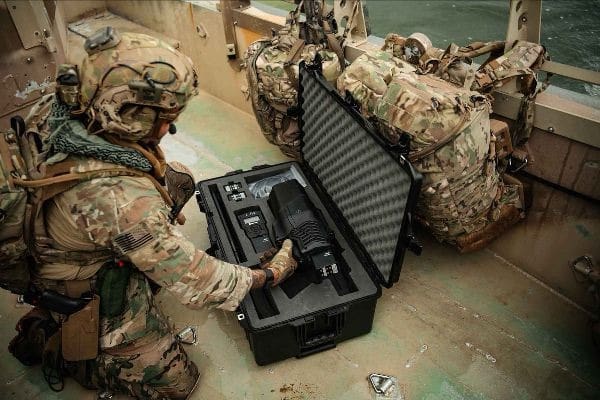
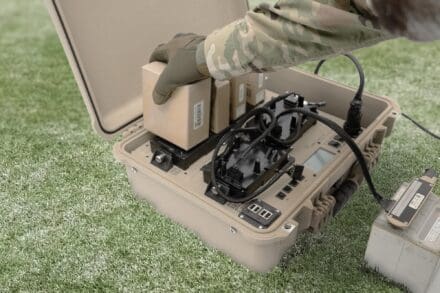
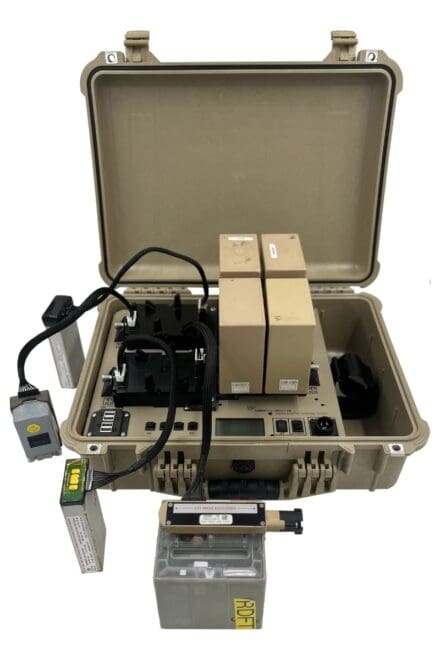
DroneShield’s IRK includes the DroneGun Mk4, a highly effective handheld defeat pistol designed to neutralize unauthorized drones, and the RfPatrol Mk2, an advanced handheld tool that detects, identifies, and locates drone signals in real-time. These devices, packaged in a compact and portable flyaway case, provide military, law enforcement, and critical infrastructure protection teams with rapid, reliable solutions for drone detection and defeat in field operations.


DroneShield’s Immediate Response Kit (IRK)

DroneShield’s IRK is designed to be highly effective in a range of demanding environments and can be body-worn, deployed on ground, or used in vehicle-based operations. The IRK is supplied with omni-directional ISM band antennas with no intentional RF transmissions for quiet and safe wearable operation. Continuing with a user-centric design, the IRK supports integration into existing software systems via existing API and utilizing common open standards. Notably, intuitive, and easy-to-use controls allow for rapid deployment with optimized power from the NATO-standard battery to deliver increased disruption range and effectiveness.

“By integrating state-of-the-art RF technology with user-centric design, the IRK sets the standard for portable drone defense, offering unparalleled ease of use and operational flexibility for those in critical missions and high-stakes environments,” said Matt McCrann, Chief Executive Officer at DroneShield LLC. “We are proud of the team responsible for our innovative technology, like the Immediate Response Kit, and grateful for the recognition of our cutting-edge solution that meets the evolving needs of our customers.”

For more information about the Immediate Response Kit and other advanced C-UAS solutions from DroneShield, view our range of C-UAS products.

Gray Eagle STOL Makes Historic First Flight From Ship To Land

Thursday, November 14th, 2024

Short Takeoff and Landing UAS Operates from South Korean Warship

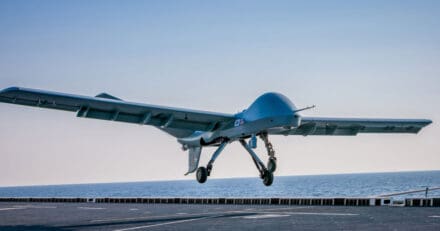
SAN DIEGO – 13 November 2024 – General Atomics Aeronautical Systems, Inc. (GA-ASI) logged another aviation milestone on Nov. 12, 2024, when its Gray Eagle STOL aircraft took off from a South Korean warship and landed at a ground base – the first-ever such mission for an aircraft of this type. Working with our GA-ASI’s in-country partner, Hanwha Aerospace, Gray Eagle STOL launched from the South Korean navy’s amphibious landing ship Dokdo underway at sea off the coast of Pohang, South Korea. The Unmanned Aircraft System (UAS) then flew to Pohang Navy Airfield and landed normally.

Gray Eagle STOL – which stands for short takeoff and landing – is the only medium-altitude, long-endurance aircraft of its kind with the ability to operate from large-deck warships such as amphibious ships and aircraft carriers, as well as short and unimproved fields on land. The test with the South Korean military further validates the aircraft’s capability and versatility.

“We applaud the South Korean navy for its foresight in examining the unique capability of GE STOL for its fleet. This demonstration illustrates the ability of the GE STOL to safely operate on many types of aircraft-capable ships, which opens myriad new ways our allies can use this UAS to support multi-domain naval operations,” said GA-ASI CEO Linden Blue.

Hanwha Aerospace is engaged with General Atomics to support national defense with proven, state-of-the-art technology suited for a multi-domain warfare environment, contributing to global security alongside allied nations in response to rapidly growing threats.

“The demonstration is a crucial step in verifying how the GE STOL can contribute to defense capabilities, and I am honored to witness this alongside the Republic of Korea Navy, to whom I extend my deepest gratitude for conducting the test,” said Hanwha Aerospace CEO and President Jae-il Son. “Hanwha is fully committed to making bold investments, fostering collaboration, and providing steadfast support in the Unmanned Aerial Vehicle (UAV) business.”

The Ministry of National Defense for the Republic of Korea is initially evaluating GE STOL for its ability to meet its emerging military requirements. South Korean navy, army and other officials were asked to evaluate Gray Eagle STOL and supported the test.

“The demo highlighted the versatility of STOL aboard a warship, in the Dokdo, designed not for fixed-wing aircraft but solely for helicopters. Gray Eagle STOL’s flight proves that navies can add significant new capability without costly major modifications to their existing warships,” said South Korean Chief of Naval Operations, Admiral Yang Yong-mo.

Gray Eagle STOL is highly common with the classic Gray Eagle aircraft, substituting a different engine, wings, control surfaces and landing gear. Gray Eagle STOL is General Atomics’ name for the production variant of the historic aircraft demonstrator known as Mojave.

In November 2023, GA-ASI and Mojave performed a demonstration of STOL takeoff and return landing aboard an aircraft carrier in an event with the UK Royal Navy’s HMS Prince of Wales, which is smaller than a typical U.S. aircraft carrier at 932 feet long (284m) and 240 feet wide (73m). The Dokdo class is considerably smaller than the Prince of Wales, only 653 feet long (199m) and 102 feet wide (31m).

GA-ASI and US Navy Fly MQ-20 Avenger Using MD-5 GCS To Perform Commanded Autonomy Maneuvers

Monday, November 11th, 2024

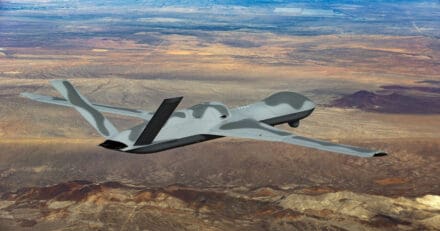
SAN DIEGO – 07 November 2024 – On November 5, 2024, General Atomics Aeronautical Systems, Inc. (GA-ASI) used its MQ-20 Avenger®Unmanned Aircraft System to perform commanded autonomy maneuvers as part of a demonstration with the U.S. Navy (USN). The USN used its MD-5Ground Control Station (GCS) with Lockheed Martin’s MDCX™ autonomy platform to command and control the jet-powered UAS. Working collaboratively with the USN and Lockheed Martin, the GA-ASI team successfully executed the flight demonstration over a Proliferated Low Earth Orbit (PLEO) datalink.

The USN’s Unmanned Carrier Aviation program office PMA-268 used GA-ASI’s MQ-20 as a surrogate to demonstrate how its Unmanned Carrier Aviation Mission Control Station (UMCS) can command a variety of unmanned aircraft. The MD-5 GCS was operated from the USN’s test facility at Patuxent River, Maryland, while the MQ-20 was flown out of GA-ASI’s Desert Horizon flight operations facility in El Mirage, California.

This flight was the first time a GA-ASI UAS completed bi-directional communications using the UMCS operation codes while performing autonomous behavior. The procedure was completed using the PLEO datalink.

“This effort was a prime example of industry partners and government agencies working together to perform important new capabilities,” said GA-ASI President David R. Alexander. “The team efficiently and safely demonstrated aircraft flight control from another government agency’s control station. Using GA-ASI’s Tactical Autonomy Core Ecosystem (TacACE) software, the team not only executed airborne commands, but did so in a safe, controlled environment.”

The demonstration was part of an effort to advance technology for future Collaborative Combat Aircraft (CCA). GA-ASI initiated the demonstration between PMA-268 and Lockheed Martin’s Skunk Works to demonstrate connectivity between the Navy’s UMCS and GA-ASI’s MQ-20Avenger. MQ-20 is a jet-powered platform used extensively as a CCA surrogate test bed for autonomous UAS technology development. GA-ASI was recently selected for the U.S. Air Force’s CCA program.

Army Experiments with Capabilities, Multi-Domain Integration at Vanguard 24

Saturday, November 9th, 2024

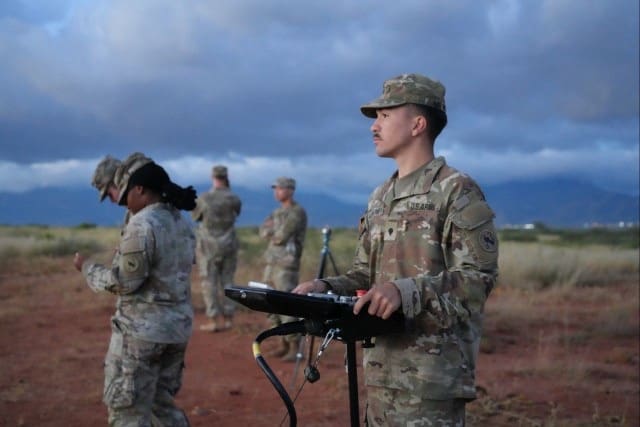
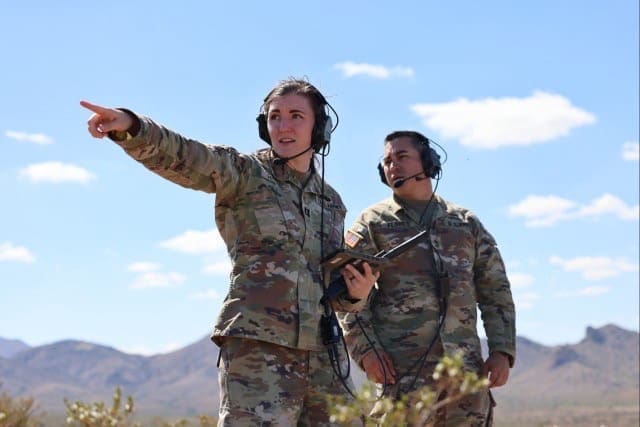
FORT HUACHUCA, Ariz. — The 3rd Multi-Domain Effects Battalion, 3rd Multi-Domain Task Force, partnered with the U.S. Army Intelligence Center of Excellence, Joint and Allied forces, and industry partners to execute the Vanguard 24 experiment from September 8-24, 2024.

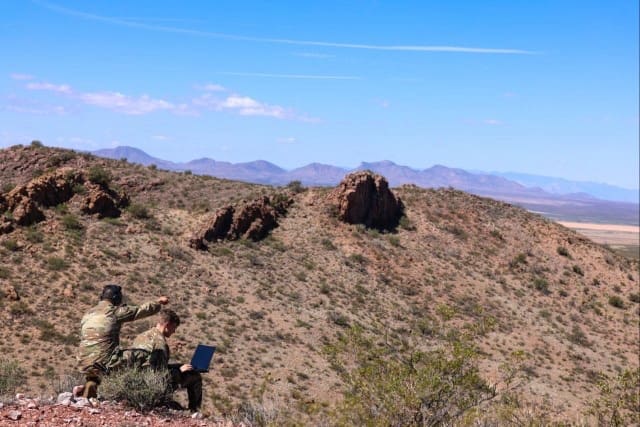
Mission-tailored teams of 3rd MDEB Soldiers operated from the 1st Lt. John R. Fox Multi-Domain Range, the Buffalo Soldier Electronic Test Range and other training areas in the Southwest. Vanguard provided a venue for 3rd MDEB Soldiers to experiment with and assess various cutting-edge sensors, high altitude platforms and data transport solutions that are not yet Army programs of record.

“Multi-Domain Task Forces are the signature formations for the Army’s continual transformation. The emerging capabilities our Soldiers are training on help inform the Army on which capabilities should be pursued and possibly developed further and integrated at scale across the Army and DOD,” said Col. Michael Rose, 3rd MDTF commander.

These teams executed training and experimentation focused on integrating cyber, electronic warfare, extended range sensing and data transfer. The distances between training areas and teams replicated the distances required to operate in the Indo-Pacific Command theater, where 3rd MDTF is assigned.

“The challenge with extended range multi-domain sensing comes down to several problem sets — platforms, payloads, data backhaul and analysis. Vanguard provided the venue for the MDEB to tackle each of these problem sets at operationally relevant distances,” said Rose.

“My team was able to effectively locate signals of interest, aggregate the sensor data, pass it back to the MDEB tactical command post at Fort Huachuca, then integrate the data into mission command systems to include the Army Intelligence Data Platform, and send the data to the TF level All Domain Operations Center back in Hawaii,” said MDEB Commander Lt. Col. Pablo Diaz. “We met our key training objectives and look forward to taking the lessons learned to keep pushing the envelope.”

Objectives for 3rd MDEB were to experiment with high altitude and persistent platforms such as high-altitude balloons and unmanned aerial systems, various electronic warfare and cyber payloads, long range data backhaul solutions and validate defensive cyber capabilities

Vanguard 24 is an annual capstone experiment that provides a venue to explore, integrate, and test emerging technologies, tools, and concepts that address specific capability gaps and future warfighting requirements.

Vanguard provided capabilities development, testing, and training elements, with an INDOPACOM operational scenario that expanded the scope and scale of the experiment, which spanned from Fort Huachuca’s Buffalo Soldier Electronic Test Range and 1st Lt. John R. Fox Multi-Domain Operations Range, as well as across the Southwestern U.S.

By MAJ Stephen Page

GA-ASI and BAE Systems Collaborate on Autonomous Electronic Warfare Link 16 Capabilities on MQ-20 Avenger

Friday, November 8th, 2024

SAN DIEGO – General Atomics Aeronautical Systems, Inc. (GA-ASI)collaborated with BAE Systems to demonstrate unique electronic warfare (EW) capabilities remotely controlled via a secure, jam-resistant Link 16 network on an MQ-20 Avenger® unmanned aircraft system (UAS). The Avenger is a jet-powered platform used extensively as a test bed for autonomous UAS development and the Collaborative Combat Aircraft (CCA) program. The demonstration helps accelerate emerging networked electronic attack capabilities for U.S. Air Force Autonomous Collaborative Platforms (ACPs).

The demonstration took place at GA-ASI’s Desert Horizon flight operations facility in El Mirage, California, and is part of an ongoing series of technology insertion and autonomous flights performed using internal research and development funding to prove important concepts.

“This effort featured novel mission system capabilities and the viability of autonomous payload control on our MQ-20,” said Mike Atwood, Vice President of Advanced Programs at GA-ASI. “We’re identifying key areas for improvement, while sharing investment and reducing risk.”

BAE Systems provided customized mission technology that included EW capabilities, a multi-functional processor (MFP), and a Link 16 terminal. The company successfully tested the integrated solution in its System Integration Lab to identify and jam threats autonomously and under control of an operator. Command, control, and status of the EW system was made possible through software-based, open-mission-system (OMS) compliant message translation hosted on the MFP. A secure Link 16 networking waveform was used to disseminate this information.

“We are working closely with General Atomics to highlight the maturity of autonomous EW mission systems in support of U.S. Air Force objectives,” said Scott Bailie, director of Advanced Electronic Warfare Solutions at BAE Systems. “We are combining proven EW technology and secure command and control on a rapid timeline in a small form factor well-suited for CCAs.”

Galvion Delivers an Order of 400 MAX-8 Mission Adaptive Charging Stations to AeroVironment

Friday, November 8th, 2024

Galvion, a world leader in the design and manufacture of integrated power and data management solutions and innovative head protection systems, has delivered the first order of its Nerv Centr® MAX-8 Mission Adaptive Charging Station™ to the US defense tech company, AeroVironment (AV).

The initial order of 400 units will be followed-up with an additional 800, to be delivered during 2025 and 2026 as part of a Long-Term Purchasing agreement.

AV is a leading provider of innovative, lightweight, and reliable uncrewed aircraft systems (UAS), specializing in versatile solutions designed for tactical reconnaissance and surveillance. Galvion’s MAX-8™ has been integrated to deliver intelligent and adaptable charging for AV’s UAS battery systems, replacing the existing solution. Following close collaboration and extensive testing, Galvion successfully designed a universal adaptor that enables the MAX-8 to interface across AV’s small uncrewed aircraft systems (SUAS). This partnership extends beyond the initial orders, as the two companies will collaborate on future UAS charging solutions to meet evolving needs and drive continued product innovation.

Galvion’s Nerv Centr® MAX-8™ is a portable charging solution built to withstand the harsh conditions of expeditionary operations, where UAS operations are becoming increasingly vital. With the ability to draw power from multiple sources, including AC, solar and vehicle, the MAX-8 battery adapters offer the ability to charge different types of UAS and other batteries simultaneously, with no setting changes needed. The MAX-8 features intelligent functionality, including prioritization of needs, topping off the fullest battery first, automatic evaluation of power source and adjustment of charge rates to maximize power and minimize charge time.

“AV is proud to partner with Galvion for our battery power management solutions for our small UAS. This Universal Battery Charger provides our customers with seamless plug-and-play functionality, featuring universal adapters that enable efficient charging for all of AV’s current and future batteries across both our small UAS and ground control stations,” said Mike Jorgens, AV’s sr. product line manager.

Todd Stirtzinger, CEO at Galvion, said: “Our relationship with AV is a great example of Galvion’s commitment to developing productive collaborations with industry partners to better serve the warfighter. AV is recognized as a leader in designing and delivering innovative UAS solutions; Galvion is an expert in power management and charging – together, we can accelerate the pace of innovation by helping AV focus on UAS systems, while we concentrate on maximizing operational efficiency by keeping them charged.” He added: “With this initial order of 400 MAX-8 charging stations and customized adaptor delivered, and another 800 in the pipeline, we’re very much looking forward to building our relationship with AV and finding opportunities to further drive industry advancements.”

D-Fend Solutions Enters Agreement with Naval Surface Warfare Center Panama City Division for Counter-Drone Technology Testing

Thursday, November 7th, 2024

Program set to Collect Data and EvaluateEnforceAir C-UAS System’s Capabilities in Airport Environments

RA’ANANA, Israel and MCLEAN, Va., Thursday, November 7th — D-Fend Solutions, the leader in field-proven radio frequency (RF) cyber-based, non-kinetic, non-jamming, counter- drone takeover technology, today announced a new agreement with the Naval Surface Warfare Center Panama City Division (NSWC PCD) under its Cooperative Research and Development Agreement (CRADA) program. This program will focus on conducting extensive evaluation of D-Fend Solutions’ advanced counter-unmanned aircraft systems (C-UAS) technologies in various Department of Defense (DoD) and Department of Homeland Security (DHS) test beds.

The testing will be conducted at various selected governmental airfields, commercial airports, and other facilities upon the mutual concurrence of both organizations. These evaluations will collect data to evaluate the capabilities of the EnforceAir C-UAS detection, tracking, and identification system on a continuous basis in an airport environment, with the system operational to gather data on drones when airspace regulations are violated. The test data will be analyzed, and test reports generated.

“Partnering with the Naval Surface Warfare Center Panama City Division under the CRADA program provides a pivotal opportunity for us to continue to advance our counter-drone technology in complex and challenging military and civil aviation environments,’ said Zohar Halachmi, Chairman and CEO of D-Fend Solutions. “The expertise and rigorous standards of the NSWC PCD make them an exceptional partner, as we move to fulfil evolving airport security demands. Together, we will accelerate the evaluation and demonstration of our leading RF-Cyber C-UAS technology as we carry out the mission of protecting public safety and maintaining the continuity of essential operations.”

D-Fend Solutions’ participation in the program is further recognition of the company’s leading presence in programs which demonstrate EnforceAir’s airport C-UAS technology capabilities. In 2023, D-Fend participated in and completed the FAA’s Airport UAS Detection and Mitigation Section 383 Research Program at Atlantic City International Airport (KACY) and Syracuse Hancock International Airport (SYR).

Strike Industries and Narsil Dynamics Announce Strategic Partnership to Launch Advanced AI Drone, “Waspy” in 2025

Friday, November 1st, 2024

FOR IMMEDIATE RELEASE – October 31, 2024

Pioneering autonomous drone technology with groundbreaking latency reduction, target acquisition, and real-time facial recognition capabilities.

Las Vegas, Nevada — Narsil Dynamics, a leader in drone technology with a legacy as Asia’s first large-scale drone manufacturer, has teamed up with Strike Industries (SI) to introduce the Waspy—a revolutionary AI-powered drone poised to transform military, commercial, and search-and-rescue (SAR) operations. Set for its first public demo flight in December 2024, Waspy leverages advanced AI capabilities to minimize latency, providing unmatched target acquisition without reliance on traditional FPV piloting.


Click here to watch our intro video.

Autonomous Precision Targeting and AI-Driven Tracking

Designed primarily for military use, Waspy’s AI-driven capabilities allow it to autonomously “chase” and secure targets based on predefined parameters. Operators can import specific target data, enabling Waspy to search and identify individuals based on features such as clothing colors or distance from a set location. By eliminating the need for direct control, Waspy significantly reduces the limitations traditionally posed by signal transmission delays.

This autonomous targeting is further enhanced by high-end models featuring integrated real-time facial recognition, priced competitively at around $2000, while entry-level models are set to retail at approximately $1000.

Manufactured in the USA and Taiwan with Zero Reliance on Chinese Chipsets

Reflecting Narsil Dynamics’ commitment to security and reliability, Waspy will be manufactured in both the USA and Taiwan. The drone’s production process is entirely free of Chinese chipsets, ensuring a secure, stable, and technologically independent platform.


Click here to watch our intro video.

Company History: Setting Global Standards in Drone Innovation

Founded with a commitment to innovation, the original team of Narsil Dynamics achieved a Top global ranking in the 2010s and delivered its first large scale drone to the Taiwan Police Department in 2013, advancing law enforcement capabilities across Asia. From law enforcement applications to groundbreaking solutions worldwide, the founders of Narsil have consistently set industry standards. Now, with Waspy, Narsil Dynamics pushes boundaries once again, bringing the world a new level of autonomy in drone technology.

Upcoming Demo and Purchase Information

Waspy’s debut demo flight is scheduled for December 2024, offering an exclusive look at its cutting-edge functionality. Narsil Dynamics will open purchase orders in early 2025, and interested parties can follow the company’s social media and website for the latest updates and details.

Stay Connected

For continuous updates on Waspy and other groundbreaking innovations, follow Narsil Dynamics on Instagram and visit our official website. Join us in witnessing a new era in autonomous drone technology.

Email: info@narsildynamics.com

Instagram: instagram.com/narsildynamics

Youtube: youtube.com/@NarsilDynamics

Website: www.narsildynamics.com

Narsil Dynamics and Strike Industries’ collaboration signals a major step forward in the world of autonomous drone technology, setting a new standard for performance, security, and innovation in both military and commercial applications.