GORE-TEX Professional - AWICS

Australian Army Boxer Combat Reconnaissance Vehicle Achieves Initial Operational Capability

October 17th, 2022

Rheinmetall is proud to acknowledge the Australian Army’s declaration of the Boxer Combat Reconnaissance Vehicle (CRV) Initial Operational Capability (IOC).

Announced on Saturday 15 October, by The Honourable Richard Marles, Australia’s Deputy Prime Minister and Minister for Defence, the Boxer IOC declaration reflects the vehicle’s success in meeting the Australian Army’s stated operational needs; paving the way for the Boxer to be deployed on operations.

Speaking of the Boxer CRV IOC declaration, Mr Gary Stewart, Managing Director Rheinmetall Defence Australia explained the importance in providing a protected capability to the Australian Army’s soldiers.

“The Boxer CRV is the most advanced combat reconnaissance vehicle now in service with the Australian Defence Force. It offers increased protection, lethality and digitisation, and is a game-changer to safely operate in hostile environments and on peace keeping missions.”

“The Boxer’s journey to IOC has included extensive testing and live exercises with the Australian Army. I am proud of the global Rheinmetall team who have worked in partnership with Defence to deliver this important capability milestone. Following this IOC declaration, Rheinmetall continues our work in supporting the path to Final Operational Capability,” said Mr Stewart.

Rheinmetall is the largest supplier of military vehicles to the Australian Defence Force, with over 2,900 Rheinmetall trucks already in service with the Australian Army. Rheinmetall is delivering a total of 211 Boxer CRVs and a further 490 trucks from the company’s Military Vehicle Centre of Excellence (MILVEHCOE), based at Redbank, South East Queensland.

“At Rheinmetall, we believe that what we do, matters to those who serve. This is a shared purpose between our staff, now over 730 here in Australia, and the over 30 Australian companies that directly contributed to the manufacture, delivery and support of the initial Boxer CRV capability.”

“As the company continues to design, manufacture and deliver the remaining 186 Boxer CRVs, Rheinmetall’s commitment to Australian Industry Capability will provide enduring jobs, skills and opportunity in Australia for many years to come” said Mr Stewart.

Poseidon Kronos Tactical Life Preserver Awarded NSN

October 17th, 2022

Safe Defence Pty Ltd, trading as Poseidon Australia, has been awarded NSN codification for their range of tactical life preservers.
This is a direct result of in increasing number of SF units trialing and moving forward with procurement of this unique life preserver.

The Poseidon Kronos was developed on request by Special Forces

The Poseidon Kronos LPU comes in three different models, ranging from the SuperLITE 157N model to the full spec Kronos 306N model. The latter incorporates the “damage resistant technology” that ensures that the LPU will fully inflate even if penetrated by projectiles or sharp edged weapons.

The Poseidon Kronos represent a generational shift in the development of life preservers used in hostile environments


Low profile to ensure the LPU doesn’t restrict natural head movement during operations

Standard for the Poseidon Kronos LPU are features like a cut-out at the shoulder to enable the user to shoulder his weapon while the LPU is inflated, high quality raw materials and production and a modular construction to mention a few.  

For inquiries contact Poseidon’s European representative: Fenris Consult AS

Naglev – Combat Desert Boot

October 17th, 2022

You saw the Naglev boot when it came out and said, “but I can’t wear Black boots.” Well, Naglev and Huckberry heard you and have introduced a Desert version of these light hikers in Coyote Brown.

They are constructed from a single piece of Kevlar and reinforced with padded leather, the uppers are bonded to a natural rubber sole with an aggressive tread, then finished off with a polyurethane footbed.

The inner boot is made from breathable mesh with an elastic collar at the ankle.

Offered in European sizing, from 40-47 with smaller sizes already sold out. Huckberry recommends you go up a half size.

Available exclusively from Huckberry.

Elberlestock – Recon Modular Bino Pack

October 17th, 2022

Recon Modular Bino Pack is a chest rig-style carrier for binoculars and other items you need to keep handy while hunting or conducting reconnaissance.

In addition to magnetic forward pull access to the bino pouch, there’s an easy access large front zipper pocket, and stretch side pockets as well as low-profile MOLLE compatible wings to securely add Recon pouches and accessories.

Offered in several colors and hunting camo patterns in sizes small or large to accommodate different body sizes.

eberlestock.com/products/recon-modular-bino-pack-lg

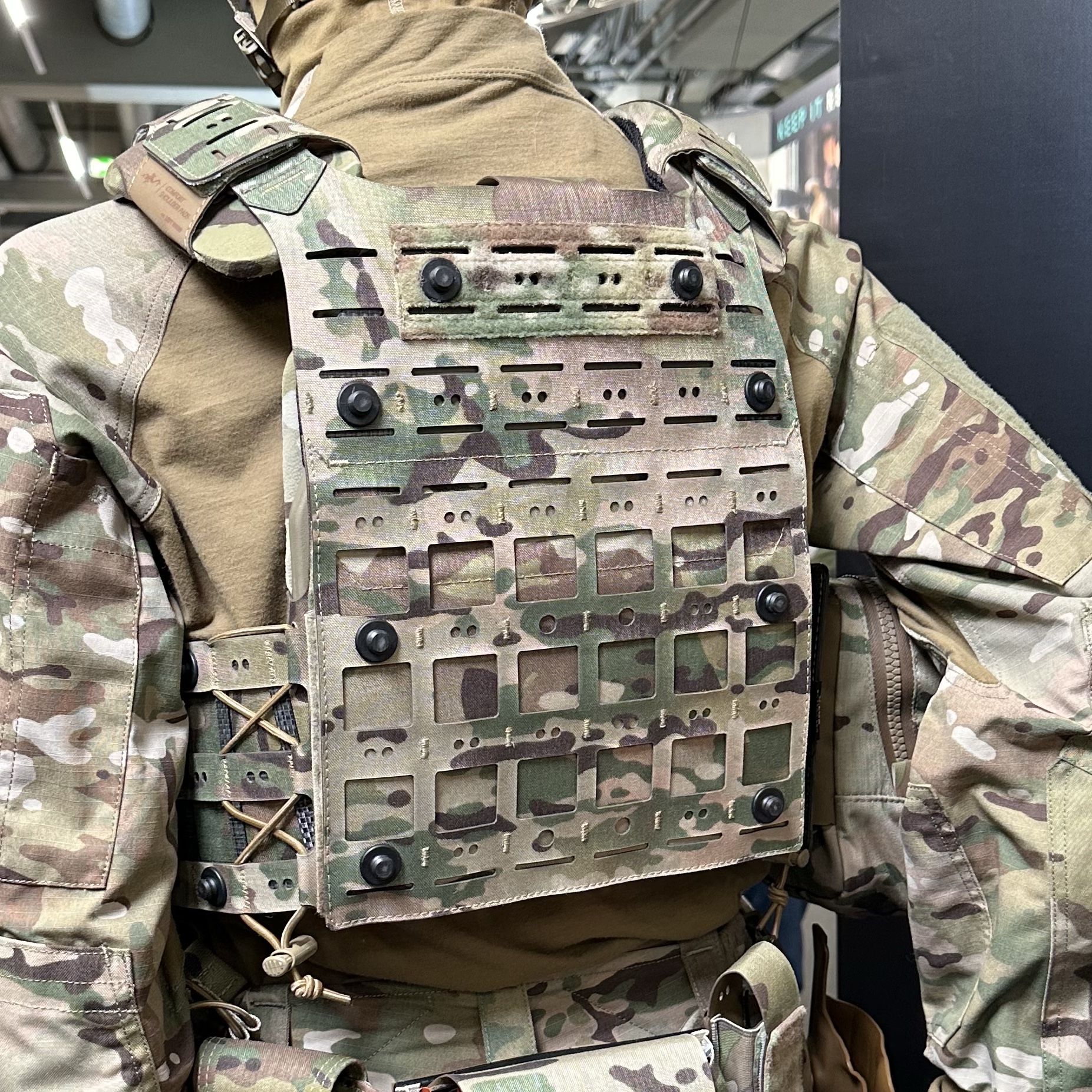
BCM Gunfighter History – Commanders In-Extremis Force (CIF) Assault High Cell Leader Kit

October 17th, 2022

I spent 2008-2012 as an assaulter in the Commanders In-Extremis Force, with my final years there as an Assault High Cell Leader. The CIF was tasked with direct action, hostage rescue, counter proliferation and counter terrorism actions.

Due to the nature of assaulting/fighting in an urban environment, I ran as light and as slim as possible. We trimmed our basic load down four to five M4 magazines, two initiators for interior charges, an M67 frag grenade, and, in my case, both an MBITR and PRC-117G with associated cables, PTT and antenna. It came out to 26 lbs all in, not including specialty items and tools we occasionally carried.

I had been originally issued the Eagle RBAV (Releasable Body Armor Vest), a platform I ran for three trips (one to Iraq and two in Afghanistan). During both deployments, the vest required repeated repairs. Duct tape and dental floss fixes dotted the vest where the sewing had failed. It got to the point where I began looking to find a more durable alternative that was both lighter, and less restrictive to fight in, even if I had to pay for it myself.

One of our attached Navy WMD specialists gave me a London Bridge Trading (LBT) 6094A and a set of LTC 28340 plates. Lighter and slimmer than the RBAV, the LBT 6094A came in a “shooter cut” with plate pockets that allowed me to run my M4 without fighting the vest. The LTC plates were also significantly lighter, half as thick and more capable (Level IV stand-alone) than my Army issued PPE. These plates were also size medium versus the size large I was issued due to my build. At the end of the day, the LBT and LTC package shaved pounds and inches while increasing mobility and protection.

This would be my set-up until I left the Army a few years later.

Here’s a run down, from a shooter’s perspective, of the layout and why things were positioned where they were.

Front Plate Pocket

I ran a double mag carrier on the right, and a single mag pouch on the left. The double mag pouch served a number of masters based on the mission, but typically was used for secondary exterior initiators, specialty grenades or extra M4 magazines. The remaining single magazine pouch was positioned for the most consistent and quick reloads based on positions I was most often in while working. The pouch featured a bungee strap that could be employed for retention when roping, but more often than not, I left the pouch top open.

Running no deeper than a single magazine on the front of my carrier allowed for a far better dexterity and capability when dealing with non-compliant people as well as climbing.

On the top right and left edges of the plate pocket I ran Nexus U-94A/U Push-To-Talk (PTT) activators. At the time, these were the most reliable and minimalist PTT available. The right side fed off a PRC-117G for external comms and on the left, an MBITR for team/enabler chatter. I set them on opposite sides of my body to eliminate the chance of keying the wrong radio.

Both systems fed into a Peltor dual comm headset, with the shortest cables possible to minimize excess cable management.

Cummerbunds

Right-side, I ran a M67 Frag in a High Ground frag pouch just rearward of where my belt worn Glock 19 pistol grip sat. This gave me rapid access to the frag as well as positive retention without a Fastex buckle. Fastex buckles had proven to be less than optimal for employing a grenade on mission.

Slotted into the PALs webbing just off the front plate bag, I had breacher’s tape to replace or augment any compromised charge attachment medium. Additionally, I had a QCC-CSD (Quick Cap Connector-Connector Single Delay) to replace compromised QCCs on interior breaches, and a QCC-CDI (Connector Dual Instantaneous) for replacement of dual-primed exterior charges.

On my left-side, a Paraclete triple M4/Glock magazine shingle cut down to a double shingle, was positioned with additional M4 magazines captured by bungie retention. Both pistol pouches carried initiators for interior charges as I never ran pistol reloads in combat. Set just off the front plate bag, this positioning gave me the most consistent reloads and equipment employment on mission.

Just adjacent to the rear plate bag, I ran a MBITR radio in Diamondback Tactical MBITR pouch, the most minimal/reliable radio pouch available at the time. Placed to put the antenna comfortably behind the left armpit or to provide protection for connectors when running an antenna relocator, the positioning allowed me to access and rapidly manipulate both dials and channels from memory. This also allowed me to remove the radio from the pouch without disconnecting all the attachments to troubleshoot the system. A lesson learned the hard way.

Finally, I rigged some 550 cord loops to create improvised cable management channels that reduced the odds of snags or other potential breakages in the routed comms wires. These loops also allowed the cables enough slack to move freely during movement and fighting.

Rear Plate Bag

Managing comms with unilateral assets + enablers, partner forces, and air assets across multiple objectives simultaneously required a second radio that could talk to a wide spectrum of receivers. To this end, I ran the PRC-117G manpack radio in a Tactical Tailor pouch (not pictured) and controlled the radio with a Keypad Display Unit (KDU) velcro mounted to my right shoulder (which I had also affixed with loop). Despite being mounted on my back, I was able to still access both the radio’s battery compartment as well as troubleshoot issues without pulling the 117 from the pouch.

Shoulder Straps

One of the first mods I made to the 6094 was to dump the shoulder strap pads. With the minimal weight, the discomfort was negligible, and I was able to further reduce bulk. Adding Velcro loop to both shoulders created a mounting surface for the aforementioned KDU, that was positioned high enough to not interfere with the rifle stock nor was it a snag hazard.

Today, I would relocate the KDU centerline along the top edge of the front plate bag, but there was no interface available in-country at the time.

I ran a host of other equipment, to include medical pouches, tourniquets, a Glock 19, and more on my belt, but this vest was set up based on years of combat experience and training. Every inch of it was informed by experiences, both positive and hard learned.

– Commanders In-Extremis Force (CIF) Assaulter

New Armored Multi-Purpose Vehicle Shows Its Stuff at the Army’s Cold Regions Test Center

October 17th, 2022

YUMA PROVING GROUND, Ariz. — Soldiers depend on armored vehicles for mobility in combat situations.

This past winter, a high impact, multi-month evaluation at U.S. Army Cold Regions Test Center in Alaska helped ensure the Army’s latest armored personnel carrier — the Armored Multi-Purpose Vehcicle, or APMV — works even in the world’s coldest environments.

The AMPV’s five variants — a general purpose vehicle, mission command vehicle, mortar carrier, medical evacuation and medical treatment vehicles — have nearly 80% more interior volume than the M113 armored personnel carrier, and significantly more power, survivability and maneuverability. The cooling and electrical systems are also more robust to accommodate both existing and future upgrades. It boasts the same powertrain and suspension system as the Bradley Fighting Vehicle and M109A7 self-propelled howitzer, which eases maintenance and logistics challenges for all three vehicles in the field.

Though the weather this past winter at CRTC didn’t reach the jaw-dropping low temperatures that are typical, the variation didn’t faze the testers.

“Extreme cold comes in windows, and it’s normally a scramble to try to get things into those windows,” said Stephan Krueger, test officer.

The coldest times still saw the mercury plunge below minus 35 degrees Fahrenheit, and the crew had much to do. The AMPV accumulated hundreds of miles on CRTC’s punishing road courses and undertook braking and acceleration tests at CRTC’s automotive test track. Further, the engine was subjected to cold starts in temperatures well below zero, oftentimes after having cold air blown on its engine from tubular fans to ensure a maximum of frigidness. The testers drove the vehicle for more than 1,000 miles across primary and secondary roads and cross-country trails.

“Normally when it is extremely cold, we prioritize cold starts,” said Krueger. “If it is extremely cold and we aren’t doing cold starts, I like to try to get a lot of durability miles in. Cross country is the slowest and takes the most time — the majority of our effort is getting those miles.”

A portion of the test involved a Soldier touchpoint where active-duty service members used the vehicle in the extreme cold.

“The Soldiers that participated were from a Stryker brigade,” said Hannah Henry, test coordinator. “The AMPV is fairly similar to it, so we wanted to get their feedback.”

The touchpoint utilized the medical evacuation variant of the AMPV.

“Their main focus was the ability to get patients into and out of the vehicle,” said Henry. “How slippery does the ramp get? Can you operate the medical equipment in the cold? They rode as patients in the vehicle and rated how they felt as the vehicle moved along.”

The AMPV has undergone extensive testing at all three of U.S. Army Yuma Proving Ground’s natural environment test centers — Yuma Test Center in Arizona; Cold Regions Test Center at Fort Greely, Alaska; and, most recently, at Tropic Regions Test Center in the jungle of Panama.

By Mark Schauer

Schiebel Awarded Prestigious Search and Rescue Contract by Sasemar in Spain

October 16th, 2022

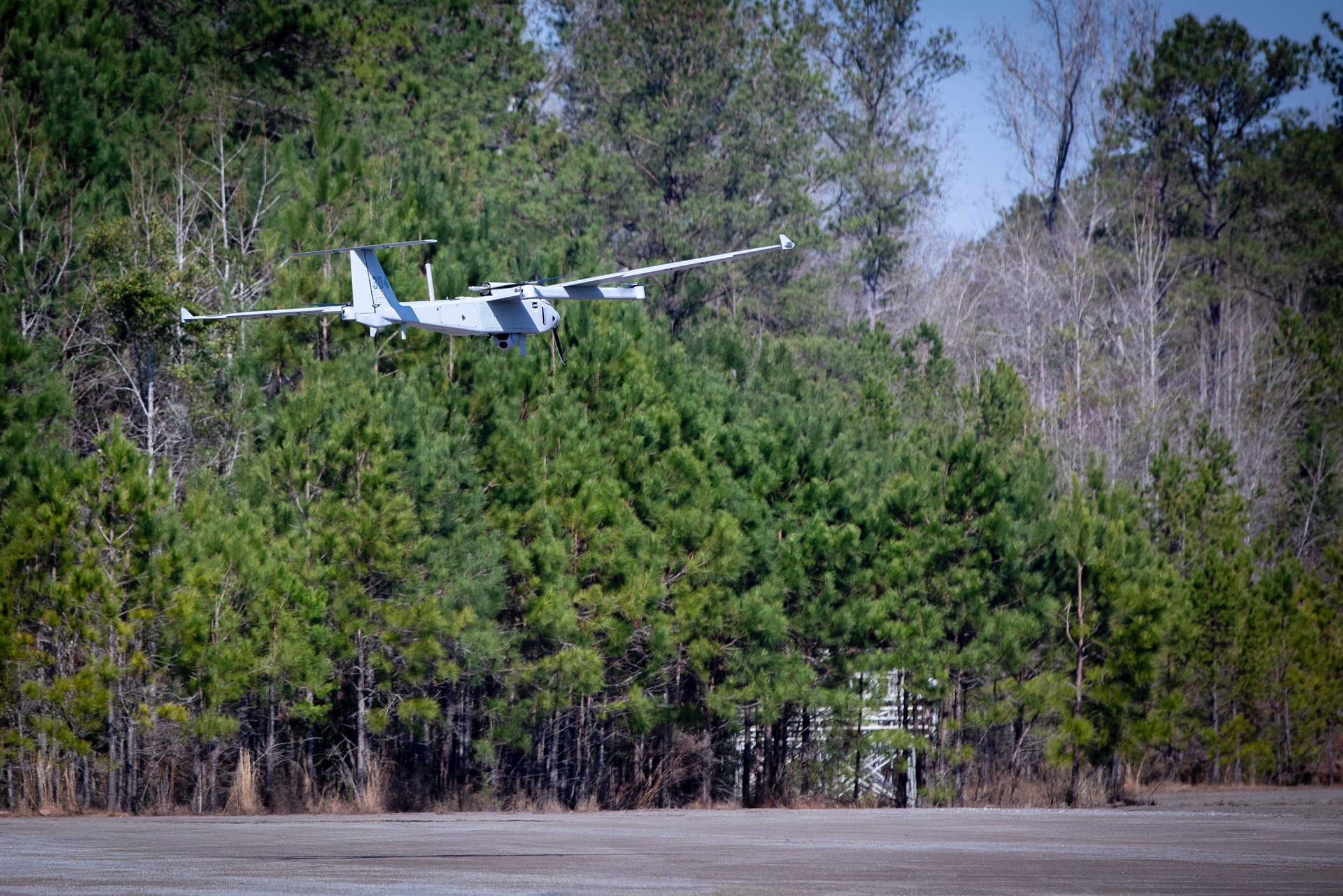
Vienna, 6 October 2022 – Schiebel was awarded with the iSAR Research and Development programme, which builds on the current CAMCOPTER® S-100 Unmanned Air System (UAS) with the aim of further developing its maritime Search and Rescue (SAR) capabilities, offering a higher level of automation.

The scope of this multi-million Euro contract includes the further development and delivery of the high performance CAMCOPTER® S-100 UAS, including the integration of the latest high-tech sensors, allowing the detection and identification, both day and night, of castaways, drifting objects and polluting substances in the high seas; as well as monitoring toxic and hazardous atmospheres, emissions from ships and sea surface pollution. Furthermore, this project includes a data collection and distribution system combining information from the S-100 sensors, the manned AW139 and CN235 helicopters, as well as sensor data from two ships.

The S-100 payloads will include an Overwatch Imaging PT-8DN Oceanwatch, a Trakka TC-300 EO/IR sensor, an Aeromon BH-12 Emission Measuring Device, and a set of SENSIA Gas Imaging Devices.

The innovative payload suite allows the S-100 to perform all requested missions simultaneously, without the need of having to change the sensors. For the integration and fulfilment of the contract Schiebel partnered with a number of technology leaders, including the Spanish technology business group GMV Innovating Solutions, which is responsible for the network infrastructure.

The Maritime Safety and Rescue Society (SASEMAR) is part of the Spanish Ministry of Transport, Mobility and Urban Agenda (MITMA).

Hans Georg Schiebel, Chairman of the Schiebel Group, said: “It is a pleasure and honour to add SASEMAR to our customers. This contract confirms the superiority of the solutions we provide and will further contribute to our technological dominance.”

SCUBAPRO Sunday – Gunners Mate First Class Ingram WWI  

October 16th, 2022

Gunners Mate First Class GM1 Osmond Kelly Ingram of Pratt City, Alabama, was the first enlisted man to die in World War I. On 15 October 1917, the 30-year-old seaman was serving aboard the Navy destroyer USS Cassin DD-43, which was sunk by a German submarine U-61. For his bravery that day, Ingram would be awarded the Medal of Honor. He would also be the first enlisted man to have a ship named after him.

Osmond Ingram was born in Oneonta, Blount County, Alabama, on 7 August 1887, to Naomi [Bettie] and Robert Ingram. His father was a Confederate Army soldier and Methodist Episcopal priest. Before Robert’s death in 1897, the family relocated to Pratt City, Jefferson County, Alabama. After becoming 16 years old in 1903, Kelly, as he was known, decided to join the Navy. On 24 November 1903, he enlisted in the United States Navy with his mother’s permission. He left the Navy after five years to join the Pratt City Fire Department. He spent five years as a firefighter before reenlisting in the Navy. As a Gunner’s Mate in the Gunnery Department, he was assigned to the USS Cassin. When the United States entered the war on 6 April 1917, Ingram was still aboard the USS Cassin. His ship was part of a Navy armada going to France and England to safeguard American commercial ships transporting merchandise.

The USS Cassin was patrolling off the coast of Ireland on 15 October 1917 when she came in contact with the German submarine U-61, which fired a torpedo. Ingram was the first person on board the destroyer to notice the torpedo heading straight for the ship’s stern. When Ingram realized the depth charges were kept in the stern, he dashed to the back of the ship and began releasing them to lessen the blast’s impact. Before the torpedo hit, he had detonated many of the depth charges. Ingram was thrown overboard from the explosion, and Cassin’s rudder was severely damaged. The warship was able to return to port for repairs. Ingram’s death was the lone fatality. His remains were never found.

In 1920, Secretary of the Navy Josephus Daniels wrote to his mother, notifying her of the decision to award Ingram the Medal of Honor posthumously:

“For extraordinary heroism in the presence of the enemy on the occasion of the torpedoing of the Cassin, on 15 October 1917. While the Cassin was searching for the submarine, Ingram sighted the torpedo coming and, realizing that it might strike the ship aft in the vicinity of the depth charges, ran aft with the intention of releasing the depth charges before the torpedo could reach the Cassin. The torpedo struck the ship before he could accomplish his purpose, and Ingram was killed by the explosion. The depth charges exploded immediately afterward. His life was sacrificed in an attempt to save the ship and his shipmates, as the damage to the ship would have been much less if he had been able to release the depth charges.”

After Congress established the Military and Naval Insurance Act in 1918, his mother became the first beneficiary of money for dependents of soldiers and sailors. The USS Osmond Ingram DD-255, a destroyer, was commissioned in June 1919 in his honor. It was the first navy ship to be named after an Enlisted sailor. The ship was one of the ships anchored at Pearl Harbor on 7 December, 1941.