SIG SAUER - Never Settle

CANSOFCOM Adopts Glock 45

July 24th, 2025

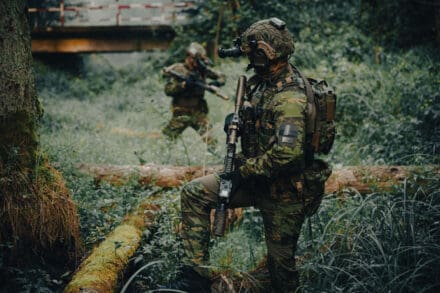
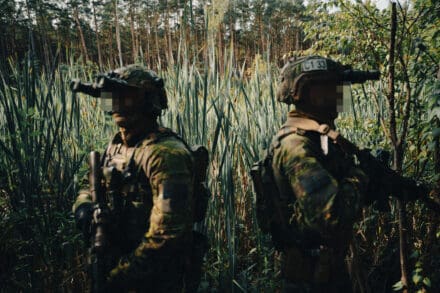
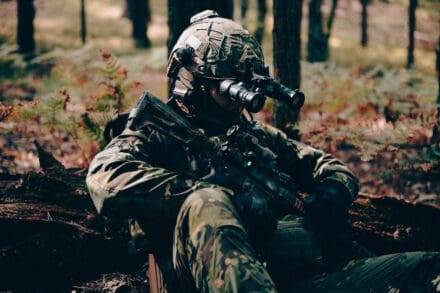
In a recently released recruiting video, Canada Special Operations Forces Command spilled the beans on a couple of new capabilities.

While there was no public contract award, this Operator is seen shooting a G45 (which is 9mm not .45). CANSOFCOM transitioned to the C22 pistol based on the SIG P320 along with the rest of the Department of National Defence. However, based upon the fact that it made into this new video, they’ve likely been with the command for some time now.

When we inquired with DND about the new weapon, they provided us with this response:

“CANSOFCOM employs a range of weapon systems to meet a diverse set of mission requirements. We will not comment further on specific equipment details to protect operational security.”

There’s another Easter Egg in the video as well. This RECCE operator’s rifle is equipped with the Millbrook Strategic Sciences Multi Function Muzzle Device. That contract was announced during SHOT Show this year.

Here’s the entire video.

US Army Leaders Discuss Vision for Future Armor Warfare at LANDEURO Conference

July 24th, 2025

WIESBADN, Germany – At the inaugural LANDEURO conference, U.S. Army leaders from the 1st Armored Division and 1st Armored Brigade Combat Team, 3rd Infantry Division laid out a path for transforming America’s armored forces in an era defined by pervasive surveillance, lethal drones and rapidly evolving precision strike capabilities.

On July 17, during a Warrior Corner panel titled “Reforging the Armored Spearhead: TiC 2.0 and the Evolution of Large-Scale Combat Operations”, Maj. Gen. Curtis Taylor and Command Sgt. Maj. James Light, command team of the 1st AD, and Col. Bryan Bonnema, commander of the 1st ABCT, 3rd ID, delivered an assessment of the changing battlefield and how U.S. armored formations must evolve to win future wars.

Taylor opened the panel by citing a watershed moment: a Ukrainian brigade’s fully robotic assault north of Kharkiv.

“That battle indicates the time to reimagine armor has begun and we have got to think about what armor will look like in the future,” he said.

According to Taylor, the war in Ukraine is proving that increased precision strike capabilities, lethality being cheaper than protection—especially from First-Person View drones—and the pervasiveness of surveillance are reshaping combat. Over 70% of vehicle losses in Ukraine have come from FPV drone strikes.

These trends mean our future fights won’t be defined by direct fire alone, but by platforms that can sense, survive, and strike first in a contested electromagnetic spectrum.

Four Core Imperatives for the Future ABCT

From these battlefield lessons, Taylor laid out four key takeaways required to shape the Army’s evolving concept for the ABCT:

1. Sense and Strike Integration at All Echelons. From platoon to brigade, formations must have persistent sensing and strike capabilities, from short-range FPVs to long-range ISR.

2. Layered Drone Countermeasures. Units must organically embed counter-UAS capabilities, transforming into something akin to carrier strike groups with their own protective systems.

3. Embedded EW Capabilities. Formations need robust EW teams capable of operating independently, targeting enemy systems, and navigating the electromagnetic spectrum effectively.

4. Robotic Breaching. Future assaults on entrenched defenses will depend on unmanned breaching systems, inspired by the challenges seen in Ukraine’s assaults on Russian defensive lines.

Despite advances in robotics and automation, Taylor underscored a core truth, even in high-tech battles, humans are still required to hold ground. Soldiers are not attritable assets, and the Army must invest in protecting and sustaining troops in these new operational environments.

Before passing the discussion to Light, he shared a comment from an Estonian battalion commander he thought was profound, “He said the winning side in the next war will be the army that first perfects the use of drones in maneuver warfare.”

NCO Perspective: Innovation Starts at Ground Level

Light echoed that message, emphasizing that the current generation of armored Soldiers is highly capable—but must evolve.

“Our infantry squads and armored formations are very well trained and they are very good at what they do,” Light said. “The problem is we’ve been doing it pretty much the same way for the last decade or so.”

The key to transformation, he argued, is empowering Soldiers and noncommissioned officers to innovate within their current means. He called it innovation by requirement in a resource-conscious environment.

“They absolutely are the ones that are going to be able to contribute the most and influence those outcomes that determine where we go in the future as a force,” he said.

He also emphasized training discipline, citing the U.S. tank crew that won the Strong Europe Tank Challenge by focusing on fundamentals and standard gunnery—a reflection of how strong basics still dominate the battlefield.

TiC 2.0: Experimentation at Scale

Bonnema, whose brigade recently completed the first Transforming in Contact 2.0 rotation at the Joint Multinational Readiness Center, Hohenfels, Germany, provided a detailed look at how his brigade is integrating technology, Soldier ingenuity, and new tactics to meet modern threats.

“As a TiC 2.0 ABCT, there were three things that we thought that we needed to be able to do better than a non-TiC ABCT,” he stressed. “The first was accomplish our mission, task and purpose more effectively, more efficiently. The second was to maintain more and constant pressure on the enemy through multiple forms of contact and all domains. And the last was to become more lethal. So, increase that kill ratio as opposed to non-TIC ABCT.”

Some key initiatives from the ABCT’s rotation at the Joint Multinational Readiness Center:

1. Command and Control Redesign. The brigade leveraged basic camouflage and security, virtual collaboration, and emerging communications technology to enhance decision-making while avoiding detection.

2. Maneuvering in Electromagnetic Warfare Spectrum. Small EW teams were deployed forward to locate, sense, and target to disrupt enemy formations and shape conditions for the next close fight.

3. New Task Organization. The formation task organized for purpose, creating FAAT teams—combining FPV drone pilots, artillery forward observers, and anti-tank personnel—employing them in restrictive terrain to deadly effect.

4. Comprehensive Counter-UAS Defense. Throughout the exercise leaders emphasized the need for persistent UAS defense from breach point to support area, enabling safe maneuver for both sensors and troops.

“JMRC is an opportune place for us to operate, train and experiment,” Bonnema said. “It really helped us get after readiness. From the complex terrain to the professional OPFOR, it gave us some good lessons.”

Challenges Ahead: Battery Life, Training, and Launch Concepts

Despite progress, Bonnema and Taylor acknowledged hurdles. Battery limitations, inconsistent environmental performance, and the dangerous logistics of hand-launched FPVs remain issues.

A critical future requirement, Taylor said, is deploying drones from under armor.

“We’ve got to move beyond launching drones from tough boxes in dangerous forward areas,” he noted, calling on industry to help deliver solutions like vehicle-integrated launch systems.

With no formal FPV operator military occupational specialty, U.S. Army units are adapting UAS (15-series) operators and cavalry scouts for these roles. Simulators are being used for early training, and Soldiers are logging hundreds of flight hours to reach proficiency.

Light called FPV drone piloting extremely difficult, noting that mastery takes time and dedicated talent.

“You don’t just wake up, grab your controller, and go fly up and take out a tank,” he said.

Bonnema also emphasized the training proficiency required for FPV operators, “We’re using simulations to get after training, conducting hundreds of simulated missions before we get into live. And then once we get into the live training progression in our tables, it’s hundreds. Six hundred and sixty [hours] is what we’ve flown so far in preparation for our live fire.”

Europe: A Catalyst for Innovation

Taylor closed by highlighting how being deployed to Europe, so close to conflict, has supercharged innovation for the division.

“You have an opportunity because of your proximity to the theater, because the energy that is here in the NATO Alliance to innovate at a pace that I never thought was possible,” he said.

The division will return home, he said, better trained and more prepared to adapt to the changing character of war.

As the U.S. Army confronts a future battlefield dominated by drones, sensors, and electronic warfare, the 1st Armored Division and 1st Armored Brigade Combat Team, 3rd Infantry Division are leading the charge to modernize America’s armored spearhead. Their message is clear: the time to adapt is now—and the Soldier remains central to victory.

The 1st Armored Division and 1 Armored Brigade Combat Team, 3rd Infantry Division are forward-deployed to the European theater, working alongside NATO allies and regional security partners to provide combat-credible forces to V Corps, America’s forward deployed corps in Europe.

By Lt. Col. Jessica Rovero

Schiebel Camcopter S-100 Demonstrates Cross-Domain Logistics Capabilities During EDA’s Inaugural OPEX Campaign

July 23rd, 2025

Vienna, 22 July 2025: Schiebel’s CAMCOPTER® S-100 Unmanned Air System (UAS) successfully participated in the European Defence Agency’s (EDA) first-ever Operational Experimentation (OPEX) campaign, showcasing its autonomous cross-domain logistics capabilities in a complex, simulated operational environment.

Held over five weeks at the Italian Army’s Multifunctional Experimentation Centre (CEPOLISPE) and UTTAT (Ufficio Tecnico Territoriale Armamenti Terrestri di Nettuno), the campaign brought together six leading European defence companies to showcase the performance of Unmanned Air and Ground Systems (UAS and UGS) executing autonomous logistics missions across both the aerial and terrestrial domains. The event marked a significant step in fostering innovation and interoperability within the European defence landscape.

Schiebel’s CAMCOPTER® S-100 conducted multiple daily logistics missions using an underslung cargo net, successfully transporting suspended cargo of more than 50 kg under challenging battlefield conditions. The UAS consistently demonstrated its robustness, reliability, and mission effectiveness – even when exposed to degraded communications, adverse weather, and contested operational environments.

“We are proud to have contributed to this important initiative led by the European Defence Agency,” said Hans Georg Schiebel, Chairman of the Schiebel Group. “The S-100’s proven operational track record, combined with its autonomous logistics capability, underscores its value as a force multiplier in multi-domain operations.”

Defoor Proformance Shooting Open Enrollment Classes Available Now

July 23rd, 2025

Defoor Proformance Shooting 2025-26 open enrollment classes –
are now live. Full sellouts are expected.

The offerings include multiple pistol, carbine and scoped rifle classes going up and a few new locations.

defoor-proformance-shooting.myshopify.com

Subsonic 308 Winchester from Black Collar Munitions

July 23rd, 2025

Cedar Park, TX (July 2025) – Filling a hole in the market while creating new holes in your targets, Black Collar Munitions is excited to announce a super quiet, uniquely affordable, and readily-available subsonic 308 Winchester ammunition offering!

Loaded in brand new brass, the Black Collar Munitions subsonic 308 Win bulk load fires 220 grain copper plated lead projectiles at 1,050 FPS. A very particular gunpowder is used, which optimizes both consistency and sound. When suppressed, this ammo is insanely quiet!

Sold in 100-round bulk packs for under a buck per round, this is the most affordable subsonic 308 ammo on the market. It’s also reliable, accurate, and consistent!

Steve of Black Collar Munitions says:

Supersonic 308 Winchester is about twice as capable as supersonic 300 Blackout, while subsonic loads are effectively identical – exact same projectiles, exact same velocities, possibly even quieter when suppressed. Unfortunately, subsonic 308 has always been a niche loading, typically too expensive to shoot for fun and hard to find in-stock. We set out to change that!

WARNING! We have decided to maximize subsonic performance by loading 220 grain projectiles. TEST WITHOUT A SUPPRESSOR FIRST to ensure projectiles are fully stable through your rifle. This means bullets are leaving ROUND holes in your target. We tested this ammo through four different, 1:10 twist 308 Win rifles from different manufacturers and all completely stabilized these projectiles out to at least 100 yards. It’s fair to say that 1:7 and 1:8 would be ideal twist rates, 1:10 has proven fully sufficient in our testing, and if your rifle has a slower twist rate than 1:10 we’d advise firing at least 10 rounds into a paper/cardboard target at 50-100 yards to ensure all bullets remain stable before attaching a suppressor.

Black Collar Munitions 220 grain subsonic 308 Win bulk ammo is in-stock and ready to ship! Find out more at the Black Collar Munitions website here: www.blackcollarmunitions.com/?product=308-winchester-subsonic

NOTE: this subsonic ammunition will not cycle most semi-auto firearms

Silvus Technologies Introduces StreamCaster 4400 XTREME

July 23rd, 2025

Ultra-Ruggedized MANET Radio Delivering Mission-Critical Connectivity in the World’s Harshest Environments

•                     Built for the Extreme – With a MIL-A-8625-F Type?III hard anodized enclosure and corrosion-resistant connectors, the StreamCaster 4400 XTREME MANET radio is purpose-built to deliver high-performance mesh network connectivity in harsh maritime, littoral, and highly corrosive environments.

•                     Extreme Performance – Powered by Silvus’ battle-proven MN-MIMO waveform, the SC4400X delivers unmatched range, data throughput, EW resilience and scalability for mission-critical operations in the harshest environments.

•                     Seamless Compatibility – Utilizing the same mounting pattern of the flagship SC4400E, the SC4400X provides a seamlessly compatible option for fixed infrastructure, vehicular, and airborne applications that demand field-proven StreamCaster MANET radio performance in a rugged, survivable form factor.

LOS ANGELES, CA — July 23, 2025 — Silvus Technologies, Inc. (“Silvus”), a global leader in advanced wireless networking solutions, today announced the launch of the StreamCaster® 4400 XTREME (SC4400X) MANET radio. Delivering high-fidelity video, voice, and IP data communications in an ultra-ruggedized form factor, the SC4400X is purpose-built for maritime, littoral, and other highly corrosive environments where durability and maximum MANET radio performance are mission-critical.

Engineered to be as tough as the mission, the SC4400X builds upon the proven performance of the StreamCaster 4400 Enhanced (SC4400E) MANET radio with up to 20 Watts of output power (80W effective, thanks to TX Eigen Beamforming), 100 Mbps data throughput and single/dual band frequency options, making it ideal for fixed infrastructure, vehicular and airborne applications in the harshest environments. Constructed from sea-grade aluminum with MIL-A-8625-F Type?III hard anodizing, the SC4400X design features a single locking marine-grade connector, and optimized enclosure with enhanced thermal characteristics to improve passive cooling and thermal performance during sustained high-power operations.

Designed for maximum versatility, the SC4400X supports a wide 9 – 50 VDC input voltage range for flexible platform integration and features a built-in status LED for real-time operational feedback. Compatibility with the existing SC4400E mounting pattern allows for seamless incorporation into existing deployed integrations, including StreamCaster PRISM.

Powered by Silvus’ battle-proven MN-MIMO waveform, the SC4400X delivers robust, high-bandwidth connectivity – capable of creating massively scalable mesh networks that connect hundreds of nodes with unmatched range, data throughput, and EW resiliency in contested spectrum environments.

In addition to AES256 and FIPS 140-3 Level 2 encryption for secure operations, the SC4400X provides access to Spectrum Dominance 2.0 – an expansive suite of LPI/LPD, Anti-Jamming EW resiliency and Advanced Threat Protection capabilities – providing secure and protected communications without sacrificing performance, even in contested environments.

“We developed the SC4400X in direct response to the growing demand for resilient MANET radio solutions that can operate in salt-laden, high-humidity and highly corrosive environments without compromising performance,” said Neema Daneshvar, Vice President of Product at Silvus Technologies. “Whether for shipboard, littoral, or offshore applications, the SC4400X delivers the class-leading tactical mesh networking power of Silvus’ StreamCaster 4400 MANET radio in a form factor that thrives where others corrode.”

With the launch of the SC4400X, Silvus Technologies continues to expand the StreamCaster family of MANET radios, reinforcing its commitment to delivering mission-ready, wireless networking solutions that extend tactical communications across the world’s most challenging operational environments.

To learn more, visit www.silvustechnologies.com. Stay connected with Silvus on LinkedIn.

Wet Bucket Tattoo’s “Frontline Field Day” Raises Over $20,000 to Support our Nation’s Military, First Responders, and Law Enforcement Officers

July 23rd, 2025

Sneads Ferry (July 21, 2025) – Wet Bucket Tattoo, a Veteran-owned tattoo shop located in Sneads Ferry, hosted their annual Wet Bucket Block Party, on Saturday, July 19th, with proceeds benefiting Frontline Healing Foundation, a 501(c)(3) non-profit organization, supports programs that address the unmet needs of suffering servicemen and women and give individuals and communities the tools to become self-sufficient.

Hosting friends, family and supporters of the Warrior community, Wet Bucket held an event like no other. 

With local Food and beverage vendors on site, along with local businesses, and a lineup of talented Veteran artists who dedicated their entire day to tattooing Flash Tattoos, the event brough in over $20,000 for Frontline Healing Foundation.

The money was raised from a combination of live and silent auctions, t-shirt sales and swag sales, Flash Tattoo sales, and generous donations. Auction items ranging from custom firearms to Fishing Excursions, Gear, Glasses and one-of-a-kind art pieces brought in an incredible sum for the organization.

The highlight of the day was the Team Competitions, where three, 5-man teams, Military / Law Enforcement / Fire Rescue competed against each other for the ultimate bragging rights, and a chance to win a Grand Prize, donated by Last Shadow. Celebrity team captains (Law Enforcement – Captain Blake Cook, Military/Veteran – Captain Doug Kiesewetter, Fire Department – Captain Jimmy Pribyl) lead their crews in physical and mental toughness for the coveted prizes.

“We have been so fortunate over the past six years to be able to grow in this community and host an event to benefit chosen charities,” stated Wet Bucket Owner and Marine Corps Veteran, Coy Azimuth. “When we learned that it costs approximately $10,000–$20,000 to fully fund one client through a treatment program, we felt convicted to align with Frontline Healing Foundation and do our best to support the vets and first responders that have given so much.”

Frontline Healing Foundation’s funding subsidizes the cost of treatment for veterans and first responders who do not have insurance or to pay for their healing. The funds raised will be immediately invested into programs, supporting treatments in detox, residential and outpatient, sober living, brain treatment, K9, and continuation of care for warriors who want to go to Warriors Heart or through other facilities.

“At Frontline Healing Foundation, we believe true healing happens through connection—and this weekend, the Wet Bucket Tattoo event reminded us of the extraordinary power of community,” stated Frontline CEO, Jordyn Jurezcki. “We are deeply grateful for the artists, organizers, and every person who showed up with open hearts. You’ve created a space where our Warriors feel seen, supported, and like they truly belong. This event was a reminder that none of us are in this alone.”

Air Force Global Strike Command Orders Pause In Use of M18 Modular Handgun System Following Fatality at FE Warren AFB

July 23rd, 2025

Following a fatality of a Security Forces Airman on 20 July, 2025, Gen Thomas Bussiere, the Commanding General of Air Force Global Strike Command has ordered a pause in use of the M18 Modular Handgun pending completion of Air Force Office of Special Investigations and Safety investigations.

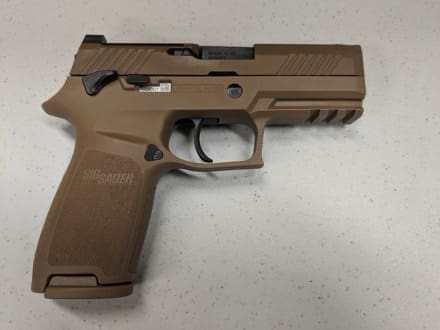
In lieu of the sidearm, subordinate Wing Commanders will arm personnel with the M4 rifle in place of the M18. The M18 is manufactured by SIG SAUER and is based on the commercial P320.

While the Internet is rife with rumors, other than the fact that a Security Forces Airman (and by that the AF means a member of the service and not a rank) tragically lost their life in an incident involving an M18, we don’t know much more.

We’re not going to expect official findings for some time. The last fatality in that Squadron was in September 2023 and involved a roll over of an uparmoured HMMWV in inclement conditions and the report was released just last week.

While it would seem at its surface that the pause in use is significant, it has always been Air Force policy to pause training and operational use of systems which are involved in fatalities. This usually includes aircraft or hazardous activities such as diving or parachuting. During the pause, the command’s Combat Arms personnel, who conduct weapons training and maintenance, will wisely conduct 100% inspections of all Wing-assigned M18 weapons systems using:
Technical Order 11W-3-4-32 and additional supplemental inspection guidance in development by AFGSC/A3S. This latter guidance will be interesting to see.

So far, this stand-down is not Air Force-wide and only applies to the units involved in the nuclear enterprise. Aside from collaboration with the Air Force Security Forces Center, there are indications that other Major Commands within the Air Force are also considering a pause in the weapon’s use. This isn’t surprising as they seek guidance at the service level.

We have not yet reached out to the Small Arms program office of the Air Force or PEO Soldier’s Product Manager Soldier Weapons for comment due to this story breaking late yesterday afternoon. Manufacturer SIG provided us with this statement:

“Our hearts are with the service members and families impacted by the recent reported event at the F.E. Warren Air Force Base. We have offered assistance to the U.S. Military as they investigate the incident and remain willing to help in furtherance of their ongoing investigation.”

Below is a copy of the implementing AFGSC memorandum.

As soon as we know more, we’ll share it.