Colt

True North Enterprises

July 19th, 2019

True North Enterprises specializes in kitting. They’re well known in both government and industry and they’ll work with the supply chain to assemble the gear you want and kit it together into any configuration you need. Once the kits are created, they will deliver where and when you need them.

And addition to kits they’ve already created for others, they can do pretty much anything you can dream up.

To give you an idea of what I’m talking about, I’m going to share some sample kits based on Android Tactical Assault Kit applications. These have already been created and fielded to other customers.

Here is a generic kit. As you can see, they’ll include everything you’ll need to put the equipment into operation. This can save you some serious headaches.

Additionally, TNE will assemble kits for specific applications, such as MFF, Low Viz and SR/DA.

TNE can also go beyond just the single kit and integrate a solution for an entire organization.

www.tne3pl.com

FirstSpear Friday Focus – Three Color Desert Sherpa

July 19th, 2019

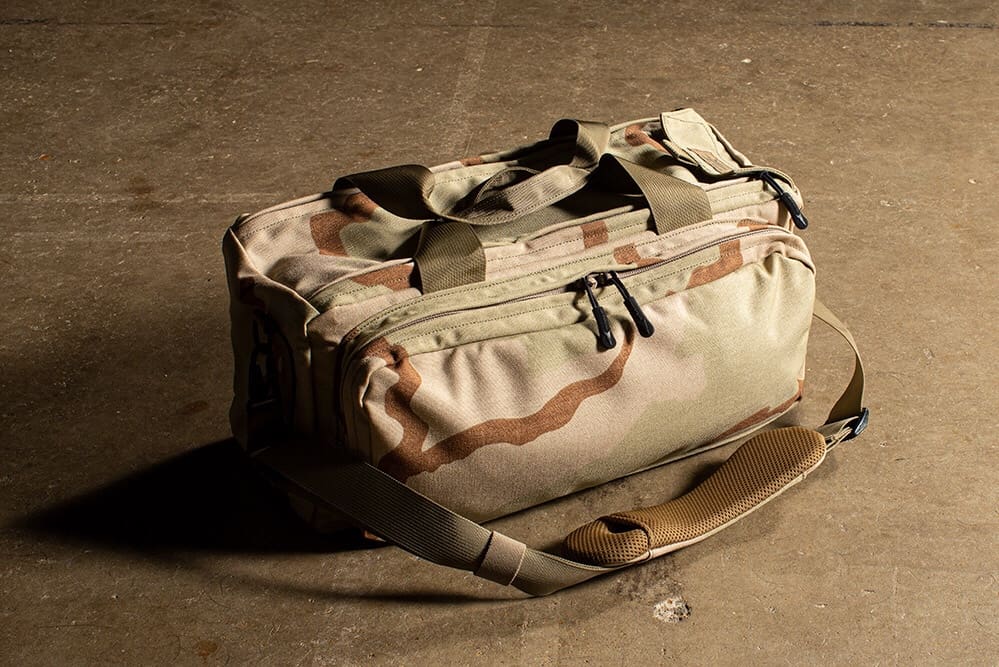
We saw a few teasers earlier this week and we now have the first look at an awesome new Sherpa in three color desert now available only in the FirstSpear web store. 1000D construction, moveable interior dividers, removable padded pistol inserts, built with premium hardware and made the FirstSpear way right here in the USA. Grab one while you can!

www.first-spear.com/sherpa-7446

Danger Close: The Battle of Long Tan

July 19th, 2019

The Battle of Long Tan is iconic in the Australian and New Zealand experience in the Vietnam War. A labor of love, this project has been a development for over 10 years.

In August 1966, in a Vietnamese rubber plantation called Long Tan, 108 young and mostly inexperienced Australian and New Zealand soldiers are fighting for their lives against 2500 North Vietnamese and Viet Cong soldiers.

In cinemas beginning August 8th in Australia. Hopefully, we’ll see it here in the US.

www.dangerclosemovie.com

Stop Your Boat!

July 18th, 2019

MissionSpec is considering getting into the morale patch game. What do you think?

A7 Defense & Aerospace’s tactical products are now Available Through TASCO Australia

July 18th, 2019

4360E409-7C10-4F96-B8FF-B3F7CFADB69B

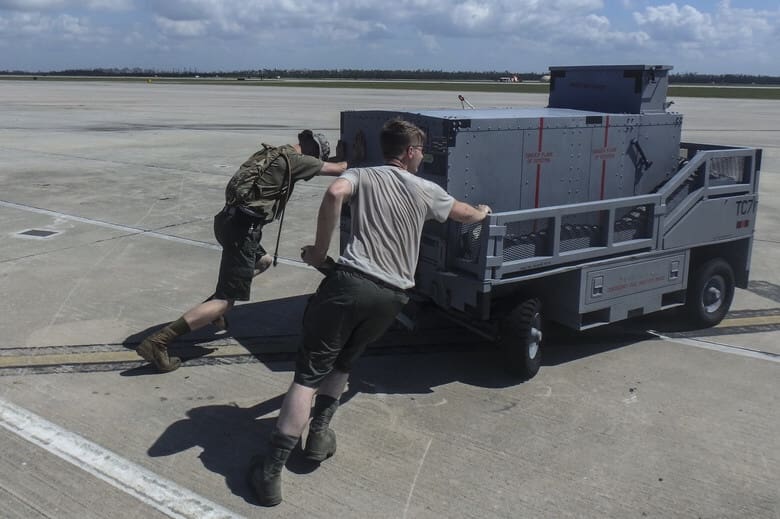
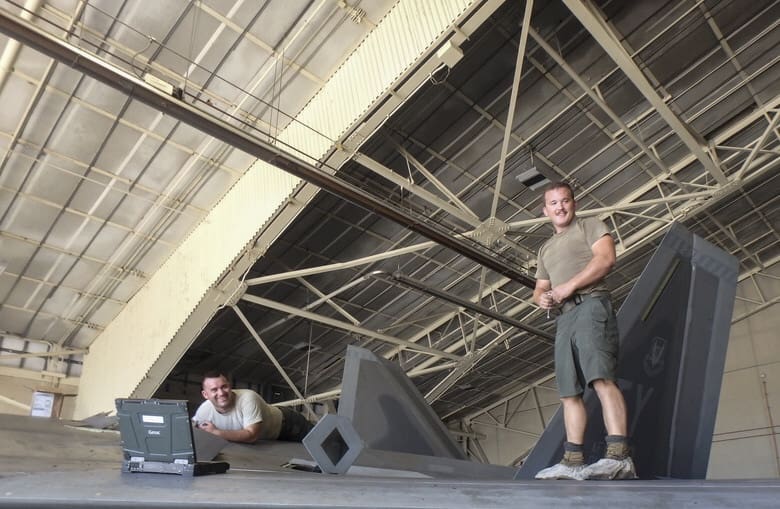
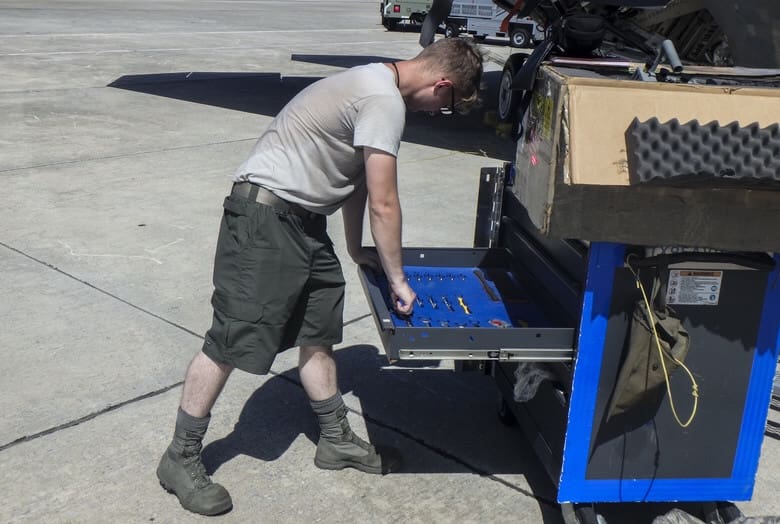
Tyndall AFB leads way in authorizing shorts on flight line

July 18th, 2019

TYNDALL AIR FORCE BASE, Fla. —

Working any job on the flight line can be an arduous task, but scorching heat and thick humidity can easily raise the temperature to triple digits along the long strip of pavement before sunrise.

Chief Master Sgt. Brent Salvadori, 325th Maintenance Group (MXG) superintendent, devised a way over the past 18 months to keep Airmen comfortable in the heat, without sacrificing mission accomplishment.

The 325th MXG Airmen are officially approved to wear shorts on the flight line when the temperature exceeds 80 degrees outside of a climate controlled area.

“When asked the question, ‘Should I?’ my response is simple, ‘It’s what my Airmen want, and this is what Chiefs do,” said Salvadori. “We make things happen for our Airmen. This who we are, and this is what we do.”

The idea originated from the 95th Aircraft Maintenance Unit deployment to Al Dhafra Air Base in southwest Asia, said Salvadori. The AMU was permitted to wear shorts while they were deployed and upon return Salvadori reached out for the local guidance authorizing Al Dhafra’s shorts to integrate them at home station. 

“After review, it was time to roll up my sleeves and get to work,” said Salvadori. “It was a long journey, as with any time you try to change something this drastic. But, when you peel the onion back, our fellow aircraft maintenance contractors and depot civilians have been wearing shorts in the same industrial environment while performing the same maintenance actions. So, why not Airmen?”

The shorts are incredibly beneficial and serve as a cooler alternative to wear during the day while the heat and humidity is unbearable, said SrA Michael Conard, 325th MXS Aerospace Ground Equipment journeyman.

Through this effort other bases, such as Nellis Air Force Base in Nevada, Homestead Air Reserve Base in Florida, Beale AFB and Edwards AFB in California and Joint Base Charleston in South Carolina are utilizing this idea for their flight lines.

This new attempt at innovation for flight line Airmen embodies their motto of #AWESOME: Always With Excellence Supporting Our Mission Everyday.

By Senior Airman Kevin Tanenbaum, 325th Fighter Wing

USAF Officer Training School Braces For “Godzilla” Class

July 18th, 2019

I attended a reasonably sized OTS class in 1996. We were organized into only three trainee Squadrons and we lived in the dorms which I later stayed in for Squadron Officer School. Even though here were only two to a room, it was pretty tight.

In the early 2000s, OTS got its own compound out on the old flight line at Maxwell AFB. Even so, I don’t know how they’re going to house a class this size.What’s more, OTS is set up in a “inmates running the asylum” scheme. This requires the upper class, which is halfway through OTS, to assume many of the duties normally fulfilled by a training cadre. If the upper class is substantially smaller than the lower class, supervision will suffer. Granted, over half of the new OTs will be prior service, but even then, the number of those right off the street will be larger than an average class.

The undertaking is so big, as of last week, many did still not yet have orders to attend OTS.

It’s going to be a tough go; for everyone involved. I wish everyone good luck!

MAXWELL AIR FORCE BASE, Ala. —

This past March, Air University’s Officer Training School celebrated the graduation of its largest class in school history: 340 officer trainees. Just a few months later, though, the radar is reading a class more than twice that size.

What is being dubbed the “Godzilla” class, OTS Class 19-07 will push the school to its maximum capacity by tipping the scales with the expected arrival of 800 officer trainees in mid-July.

OTS is considered the “shock absorber” for Air Force officer accessioning, said Lt. Col. Erick Saks, 24th Training Squadron commander. The school works with the Air Force manpower directorate and Air Force Recruiting Service to meet any projected shortfalls in the number of commissioned officers from the service’s other commissioning sources — Air Force ROTC and the Air Force Academy — based on the needs of the Air Force.

For the Godzilla class, OTS nearly tripled the typical number of seats allotted for active duty line officers, going from about 170 to 500, the majority of the increase. The 800 officer trainees coming in will be split between OTS’s two training squadrons, the 24th TRS and Det. 12. Previously, each squadron typically received a class of 250-300 OTs.

OTS leadership, however, does not expect the increase in trainees to cause a decrease in quality of training.

“It’s not just about getting numbers out, it’s about making sure our trainees leave here with the skills they need to be great officers,” said Capt. Kaitlin Daddona, 24th Training Squadron assistant director of operations for training. “That’s what we’re really focusing on with this many people in one class.”

In order to make sure operations continue to run smoothly, communication and coordination have been key in preparation of the class, Daddona said.

With the abnormally high number of trainees coming in, otherwise routine aspects of the OTS schedule, such as meal times and lectures, have required more forethought and planning due to the nature of the beast.

Communication and coordination are important, especially when there are only six military training instructors to take on Godzilla.

Master Sgt. Bobby Johnson, OTS MTI, said that tackling this monster of a class will help develop himself and his team into “masters of controlled chaos” and make them gain the ability to problem solve while in the presence of hundreds of future Airmen.

Molding almost a thousand civilians into Air Force leaders at once can sound like a daunting task, but the OTS team sees it as an opportunity to become laser focused on cohesion and developing into better leaders right alongside their very own Godzilla.

“The best part of this has been being able to open up those lines of communication so that we can connect and build relationships with the partners that we have, whether it’s here on base or within Montgomery,” said Daddona.

The team at OTS believe that they are up to the task, but they fear the class will take a major toll on the school’s facilities.

Capt. Curan Clonch, 24th TRS assistant director of operations for standardization and evaluations, said that the facilities are going to take the biggest hit from Class 19-07.

“We can anticipate all of the things that may happen, but there’s not much we can do as far as preventative maintenance,” he said.

While the hype of this class has created a paradigm shift in the OTS staff’s mindset, the school’s goal remains the same.

“Even though Godzilla seems like a terrifying beast, we recognize the importance of getting these officers through and giving them the training that they need,” said Daddona. “As long as our trainees are leaving pumped and ready to be officers, then we did our job.”

By Senior Airman Alexa Culbert, Air University Public Affairs

US Army Experiments With Robotic Combat Vehicles

July 18th, 2019

Soldiers to operate armed robotic vehicles from upgraded Bradleys

AUSTIN, Texas — Soldiers are slated to fire at targets next year using a platoon of robotic combat vehicles they will control from the back of modified Bradley Fighting Vehicles.

The monthlong operational test is scheduled to begin in March at Fort Carson, Colorado, and will provide input to the Combat Capabilities Development Command’s Ground Vehicle Systems Center on where to go next with autonomous vehicles.

The upgraded Bradleys, called Mission Enabler Technologies-Demonstrators, or MET-Ds, have cutting-edge features such as a remote turret for the 25 mm main gun, 360-degree situational awareness cameras and enhanced crew stations with touchscreens.
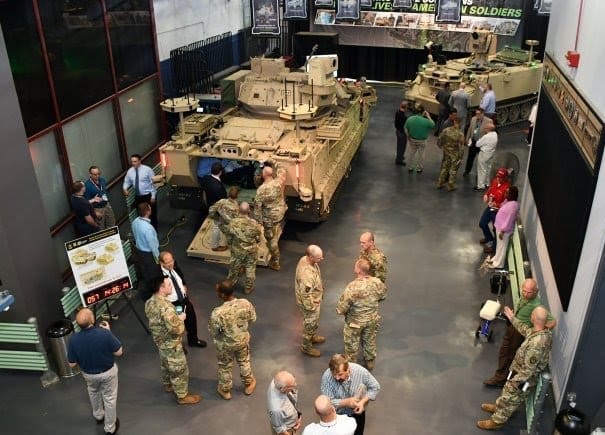
Initial testing will include two MET-Ds and four robotic combat vehicles on M113 surrogate platforms. Each MET-D will have a driver and gunner as well as four Soldiers in its rear, who will conduct platoon-level maneuvers with two surrogate vehicles that fire 7.62 mm machine guns.

“We’ve never had Soldiers operate MET-Ds before,” said David Centeno Jr., chief of the center’s Emerging Capabilities Office. “We’re asking them to utilize the vehicles in a way that’s never been done before.”

After the tests, the center and Next-Generation Combat Vehicle Cross-Functional Team, both part of Army Futures Command, will then use Soldier feedback to improve the vehicles for future test phases.

“You learn a lot,” Centeno said at the International Armored Vehicles USA conference on June 26. “You learn how they use it. They may end up using it in ways we never even thought of.”

The vehicles are experimental prototypes and are not meant to be fielded, but could influence other programs of record by demonstrating technology derived from ongoing development efforts.

“This technology is not only to remain in the RCV portfolio, but also legacy efforts as well,” said Maj. Cory Wallace, robotic combat vehicle lead for the NGCV CFT.
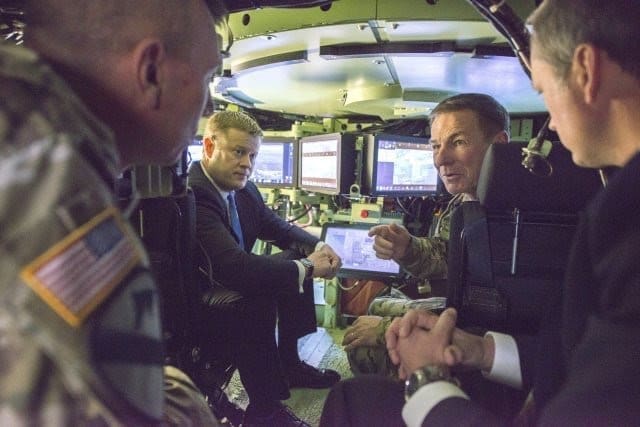
One goal for the autonomous vehicles is to discover how to penetrate an adversary’s anti-access/aerial denial capabilities without putting Soldiers in danger.

The vehicles, Centeno said, will eventually have third-generation forward-looking infrared kits with a target range of at least 14 kilometers.

“You’re exposing forces to enemy fire, whether that be artillery, direct fire,” he said. “So, we have to find ways to penetrate that bubble, attrit their systems and allow for freedom of air and ground maneuver. These platforms buy us some of that, by giving us standoff.”

PHASE II, III

In late fiscal year 2021, Soldiers will again play a role in Phase II testing as the vehicles conduct company-level maneuvers.

This time, experiments are slated to incorporate six MET-Ds and the same four M113 surrogates, in addition to four light and four medium surrogate robotic combat vehicles, which industry will provide.

Before these tests, a light infantry unit plans to experiment with the RCV light surrogate vehicles in Eastern Europe next May.

“The intent of this is to see how an RCV light integrates into a light infantry formation and performs reconnaissance and security tasks as well as supports dismounted infantry operations,” Wallace said at the conference.


Soldier testing for Phase III is slated to take place mid-fiscal 2023 with the same number of MET-Ds and M113 surrogate vehicles, but will instead have four medium and four heavy purpose-built RCVs.


“This is the first demonstration which we will be out of the surrogate realm and fielding purpose builts,” Wallace said, adding the vehicles will conduct a combined arms breach.

The major said he was impressed with how quickly Soldiers learned to control the RCVs during the Robotic Combined Arms Breach Demonstration in May at the Yakima Training Center in Washington.

“Soldiers have demonstrated an intuitive ability to master controlling RCVs much faster than what we thought,” he said. “The feedback from the Soldiers was that after two days they felt comfortable operating the system.”

There are still ongoing efforts to offload some tasks in operating RVCs to artificial intelligence in order to reduce the cognitive burden on Soldiers.

“This is not how we’re used to fighting,” Centeno said. “We’re asking a lot. We’re putting a lot of sensors, putting a lot of data in the hands of Soldiers. We want to see how that impacts them. We want to see how it degrades or increases their performance.”

The family of RCVs include three variants. Army officials envision the light version to be transportable by rotary wing. The medium variant would be able to fit onto a C-130 aircraft, and the heavy variant would fit onto a C-17 aircraft.

Both future and legacy armored platforms, such as the forthcoming Mobile Protected Firepower “light tank,” could influence the development of the RCV heavy.

With no human operators inside it, the heavy RCV can provide the lethality associated with armored combat vehicles in a much smaller form. Plainly speaking, without a crew, the RCV heavy requires less armor and can dedicate space and power to support modular mission payloads or hybrid electric drive batteries, Wallace said.

Ultimately, the autonomous vehicles will aim to keep Soldiers safe.

“An RCV reduces risk,” Wallace said. “It does so by expanding the geometry of the battlefield so that before the threat makes contact with the first human element, it has to make contact with the robots.

“That, in turn, gives commanders additional space and time to make decisions.”

By Sean Kimmons, Army News Service