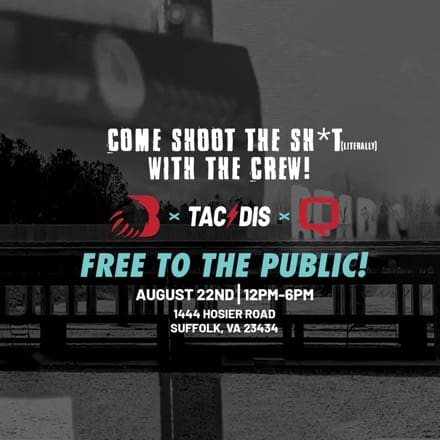
This Thursday August 22nd, from 12-6 PM, Tactical Distributors is teaming with Q at Bear Swamp range in Suffolk (1444 Hosier Rd, Suffolk, VA 23434) for a meet and greet and shoot. This event is free to the public. Come out and shoot Q firearms.


This Thursday August 22nd, from 12-6 PM, Tactical Distributors is teaming with Q at Bear Swamp range in Suffolk (1444 Hosier Rd, Suffolk, VA 23434) for a meet and greet and shoot. This event is free to the public. Come out and shoot Q firearms.
Yesterday, the Army Combat Capabilities Development Command-Soldier Center‘s Soldier Sustainment Directive (DEVCOM-SC SSD) published a sources sought notice to industry to to identify potential sources for a Personnel Air Mobility capability to ensure freedom of movement in Contested Environments. They plan to procure this system via an Other Transaction Authority.
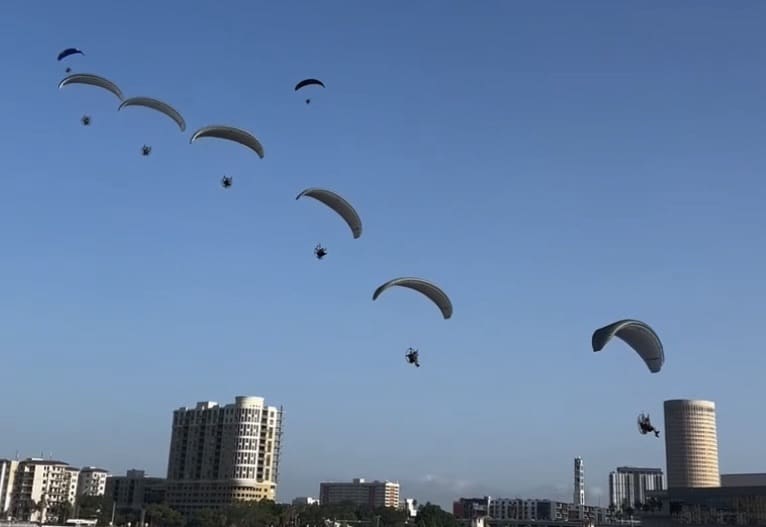
As demonstrated by SOF during May’s SOF Week capabilities exercise, a PAMS will provide an additional option to the unit commander, supporting freedom of action in remote and austere locations. This new system will be capable of transporting individual warfighters hundreds of kilometers, reducing dependency on traditional aircraft platforms and extending the range available through traditional parachute infiltration systems. A militarized powered paraglider platform is envisioned to provide both low-altitude (nap-of-the-earth and/or contour-level flight) infiltration and exfiltration capability to increase survivability and avoid detection by the enemy as well as higher-altitude (up to approximately 10,000 feet mean sea level) transit where possible given appropriate threat profile and mission parameters. The PAMS will support multiple mission types including reconnaissance, surveillance, troop movement, infiltration and exfiltration. This new PAMS will also significantly reduce the cost to deliver/transport warfighters over traditional means.
According to the notice, PAMS is planned to be developed to support the U.S. Army’s Airborne forces by addressing a capability gap to provide unit organic personnel air mobility to support freedom of movement in contested environments. Future battlefield threats are expected to require disbursed operations by small units in complex, contested environments. Traditional air assets, including fixed wing and rotary wing transport aircraft, will likely be unavailable for the movement of small teams due to supporting other missions and the difficulty of operating these vehicles in anti-access/area denial threat areas. To overcome the challenges of conducting operations in this space, a concept of expanded maneuver in all domains calls for new platforms that can provide low-cost mobility solutions over extended ranges which are available at the individual unit/warfighter level.
Desired System Performance Parameters:
Range
Threshold 100 kilometers
Objective 300 kilometers
Total System Weight (dry)
Threshold 75 pounds
Objective 60 pounds
Weight Capacity
Threshold 200 to 350 pounds
Objective 150 to 400 pounds
Maximum Altitude
Threshold 10,000 feet mean sea level
Objective 20,000 feet mean sea level
The textile components must be Berry Compliant.
To respond, submit a Broad Other Transaction Authority Announcement (BOTAA) preproposal as outlined in the DEVCOM Soldier Center BOTAA DEVCOM-SC BOTAA 22-01 located here.
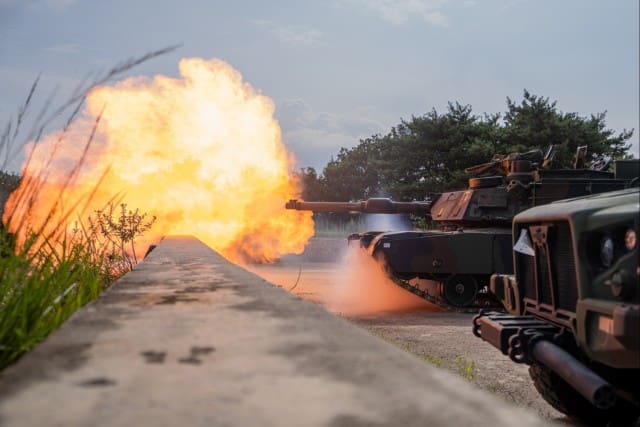
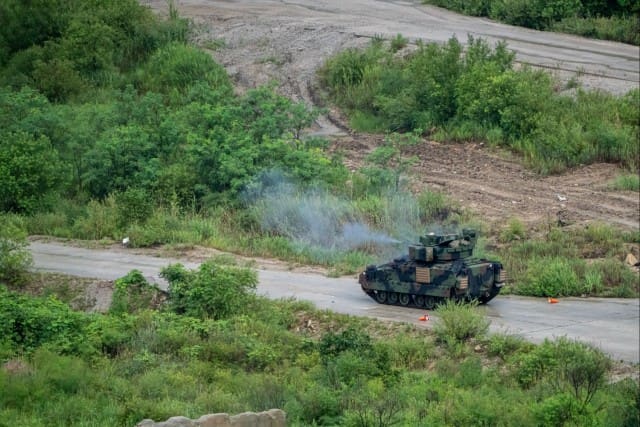
CAMP HUMPHREYS, South Korea — Soldiers from 4th Battalion, 70th Armored Regiment, 1st Armored Brigade Combat Team, 1st Armored Division, fired their tanks, howitzers and Bradleys during the live-fire portion of their rapid deployment readiness exercise at Rodriguez Live-Fire Complex, South Korea, Aug. 5-9, 2024.
The battalion, based out of Fort Bliss, Texas, arrived during the final week of July and drew their combat equipment from Army prepositioned stock maintained on the Korean Peninsula by the 19th Expeditionary Sustainment Command and 403rd Army Field Support Brigade. The 25th Transportation Battalion transported 1ABCT’s newly donned equipment from Daegu city to RLFC for the live-fire validation.
After zeroing their weapons, 1ABCT Soldiers fired their M1A2 Abrams tanks, M109-A6 Paladins and M2A3 Bradley Fighting Vehicles throughout the week.
“Task Force Thunderbolts received a no notice deployment exercise where we were able to demonstrate our ability to project combat power into the Indo-Pacific under a condensed timeline,” said Lt. Col. Christopher Lorete, 4th Battalion commander. “We rapidly drew our combat fleet from the Army Preposition Stock-4 to assist the Army in validating its combat readiness in a critical area of responsibility.”
On July 17, 4th Battalion, 70th Armored Regiment Soldiers were notified they would leave Fort Bliss for a no-notice deployment readiness exercise. Six days later, they began drawing their combat equipment at Camp Carroll, South Korea. This deployment readiness exercise is part of Pacific Fortitude, which is part of a longstanding agreement to support the Republic of Korea – U.S. alliance.
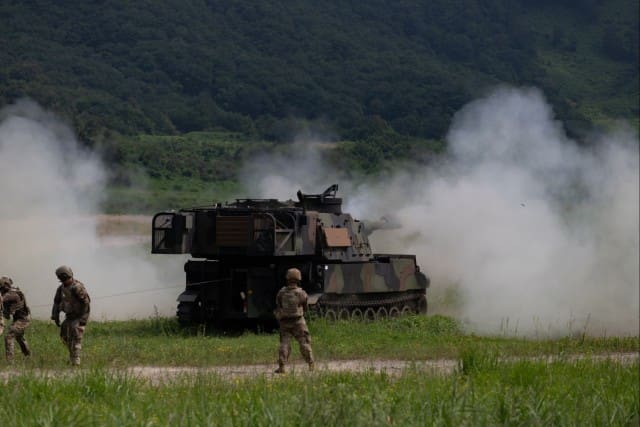
The rapid deployment exercise is a standard, routine readiness validation where a U.S. Army unit is tested on its ability to rapidly deploy personnel successfully to a given environment, conduct training and redeploy back to their home station. This exercise also tests the swift deployment and decisive utilization of vehicles and equipment already present on the Korean peninsula. Army Prepositioned Stock-4, or APS-4, are strategically placed caches of warfighting equipment in Korea and Japan that serve as a critical component of the U.S. Army’s ability to rapidly project combat power throughout the Indo-Pacific.
“We are extremely proud of our team who worked tirelessly to prepare our equipment to conduct squad and platoon collective training, culminating in tank platoon live-fires and a combined ROK-U.S. mechanized infantry platoon live-fire,” Lorete said. “This opportunity to train as part of Pacific Fortitude enhances our operational readiness enabling our team to grow and learn every day and reinforces our commitment to the ROK in maintaining security and stability on the Korean peninsula. It is an honor to train side by side with our Republic of Korea Army partners increasing readiness and winning every day.”
Pacific Fortitude enhances the U.S. Army’s combat readiness and the ROK-U.S. combined defense posture, and further strengthens security and stability on the Korean peninsula. All professional militaries train on routine and continuously executed events to maintain readiness, proficiency, credibility, and trust.
By Eighth Army Public Affairs Office
DA-Group updates its strategy and organization to meet the future demands of a changing operating environment. Pekka Airola has been appointed as DA-Group’s CEO as of 20 August 2024.
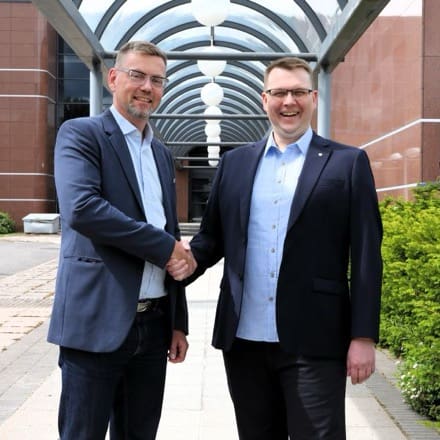
Pekka Airola (left) and Sami Kotiniemi (right) shake hands.
Pekka Airola has previously worked in the fields of industrial electronics, mobile phone supply chains and health technology. He has held various management positions related to product portfolios and projects, as well as production. Airola’s most recent role was Vice President of the Welding Machines Business Unit at Kemppi Oy, where he was responsible for ensuring the competitiveness of welding machines in a highly competitive market. For Airola, the most important management principles are creating added value for the customer and taking care of employees and developing their skills.
“DA-Group’s success is built on a strong foundation of expertise, from engineering to production, and the customer is instilled with a sense of security and trust through timely and accurate information on deliveries. In the current global situation, growth is supported by the increased attention paid to geopolitical risks in the supply chain now more than just ten years ago. Value is increasingly placed on companies that keep the entire supply chain in its own hands,” states Airola. He sees strong possibilities for DA-Group – the company has its own products and impressive customers, and the diversity of the Group’s operations bring security in an ever-changing world. “I am grateful for the trust shown in me, and I look forward to the opportunity to be part of building the future DA-Group,” he adds.
DA-Group’s long-standing CEO Sami Kotiniemi will support Airola and will continue working in a strategic role as Chairman of the Board, actively driving innovations and fine-tuning the company’s future direction. DA-Group’s strategy work is currently carried out jointly by the management team, business units and the Board of Directors.

An archery elk hunt is the pinnacle for many hunters—like GOHUNT’s own Omar Lopez. When their founder, Lorenzo Sartini, invited him to join his next elk hunt, Omar couldn’t contain his excitement. However, while planning their hunt, Lorenzo’s appendix ruptured, throwing a massive wrench into their plans. Trying to fill two tags in two different units is hard enough when not recovering from major surgery, but now? The pressure was really on.
The pair now venture into the backcountry with hopeful hearts, eager to pursue Omar’s first bull. All their meticulous preparation and hard work had led to this moment, and they aren’t about to let a little thing like an appendix get in the way of turning Omar’s dream into a reality.
See the video at www.gohunt.com/browse/videos/gohunt-originals/a-backcountry-archery-elk-hunt-now-its-real
SOFWERX, in coordination with the United States Special Operations Command (USSOCOM) Office of Small Business Programs (OSBP), will provide a networking opportunity on 07 November 2024 for Small Businesses with capabilities that support National Security Interests and/or the USSOCOM mission to engage with Government Stakeholders, Prime Contractors, and Investors in the form of “Speed Dating.”
The objective of this event is to allow open networking with key stakeholders, to include Government, Industry, and Investors, in order to advance partnerships with USSOCOM. Additionally, this event will give small businesses access to Government stakeholders, prime vendors, and other resources to further their journeys into Federal contracting.
Request a Networking Table NLT 22 October 2024 11:59 PM ET. Details here.
New User-Friendly Features
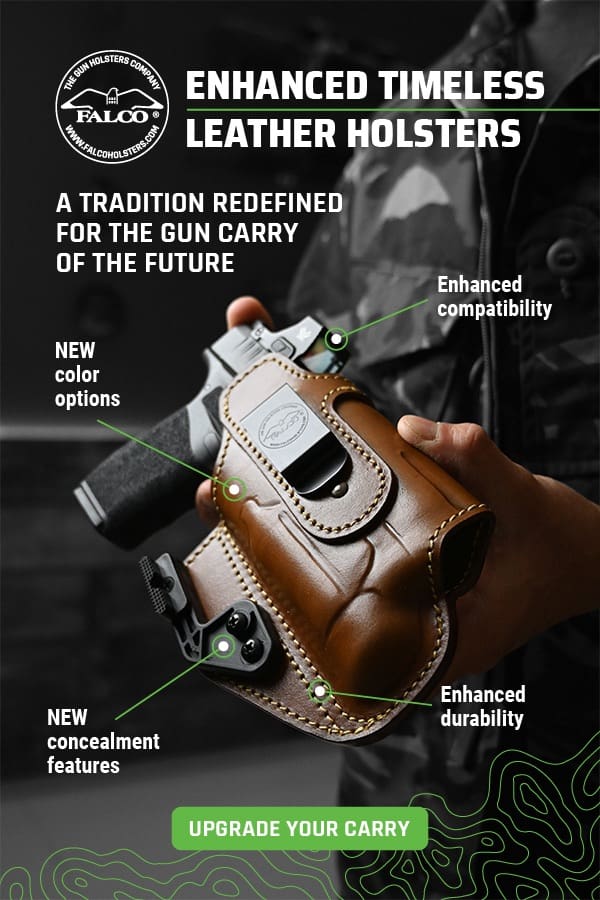
Katarína Zacharová, Vice President of Sales and Marketing at FALCO Holsters, shared, “Our Timeless Leather Holsters have always stood out as a popular choice in our collection. By integrating thoughtful feedback from our loyal customers, experts, and industry leaders, we’ve enhanced the entire category to ensure our new Timeless leather holsters offer even better performance and comfort for contemporary carry styles. At only $99, these feature-rich holsters are a great deal,” she emphasized.
According to Zacharová, “We have named individual holsters in our Enhanced Timeless Line in honor of the 39 delegates who shaped and signed the U.S. Constitution on September 17, 1787. We admire the cooperative statesmanship that laid the foundation of the United States of America and the innovative spirit of that historic endeavor. Notable figures such as George Washington, Benjamin Franklin, James Madison, and Alexander Hamilton were instrumental in crafting the Constitution, embodying the vision and heritage we strive to reflect in our products. By naming our holsters after these Founding Fathers, we acknowledge their contributions and align our commitment to excellence with their enduring legacy.”
ENHANCED FEATURES OF TIMELESS LEATHER FALCO HOLSTERS
Safety and Performance:
• Thumb Break Reinforcement: A steel-reinforced thumb break, concealed between two layers of leather, ensures reliable access to your handgun.
• Rugged Mouth Design: The holster mouth is fortified with an additional layer of premium full-grain leather, providing a durable opening that remains stable even during one-handed reholstering.
Concealed Carry Innovations:
• IWB Holster Claw: This optional attachment (or wing) tilts the grip of your handgun snugly toward your body, minimizing printing and enhancing concealment—essential for appendix carry.
• Forward Molding: Present in IWB and OWB pancake-style holsters, this design helps tilt the grip of your handgun toward your body for reduced printing.
• Forward Cant and Straight Hip Designs: OWB holsters feature an FBI cant (10-15 degrees) ideal for 3-5 o’clock carry, while IWB holsters are designed for straight hip (no cant) or appendix carry.
Compatibility and Versatility:
• Light-bearing Options: Capable of accommodating more than 3,100 handguns and 60+ tactical lights and lasers, ensuring a perfect fit for various firearms.
• Optics Ready: Designed to accommodate modern pistols, classic firearms, and revolvers, they feature compatibility with red dot sights and high front sights, ensuring they meet the needs of contemporary gun owners. The new signature optics cut is stress-free, protecting your gear from damage and maintaining zero for your red dot sight, even under rigorous conditions.
• Open Bottom Design: Keeps the holster clean from dirt and allows pistols with threaded barrels.
Durable Attachments:
• New Shoulder Holster Harness and Straps: They are stitched all around for a prolonged lifespan and prevention of deformation even after years of use.
• Belt Width Customization: Standard clips and belt loops are available for 1.5” belts, and customization is available for other widths on demand.
Premium Materials and Craftsmanship:
• High-Quality Leather: Made of 1/8” thick, 7-8 oz heavy premium full-grain Italian leather, maintaining the highest quality standards of the Timeless line.
• New Colors: Our standard black remains an option, as do two new colors: old-school tan and saddle brown.
• Handcrafted Excellence: Holsters are molded on the exact replica of your handgun for a perfect fit. Then, they are hand-dyed, oiled, lacquered, and crafted with the attention to detail only FALCO artisans can achieve.
• Meticulous Stitching: Holsters are carefully stitched with a solid thread and double-stitched in areas of the highest stress to prevent deformation and maximize lifespan.
• Attention to Detail: Rivets, snaps, and screws on the whole holster are either incorporated between two layers of leather or hidden behind the plastic cover to protect the finish of your precious handgun.
Zacharová added, “Our commitment to excellence and passion for innovation has driven us to create the Enhanced Timeless Holster Series. Each holster looks like a fine piece of art and performs flawlessly under various conditions,” added Zacharová. “These holsters come with a lifetime warranty, underscoring our dedication to quality and customer satisfaction. Experience a tradition redefined for the gun carry of the future with our new Timeless line.”
For more information or to order a new FALCO Holsters Timeless Premium Leather Holster, visit FALCOHolsters.com/Timeless.
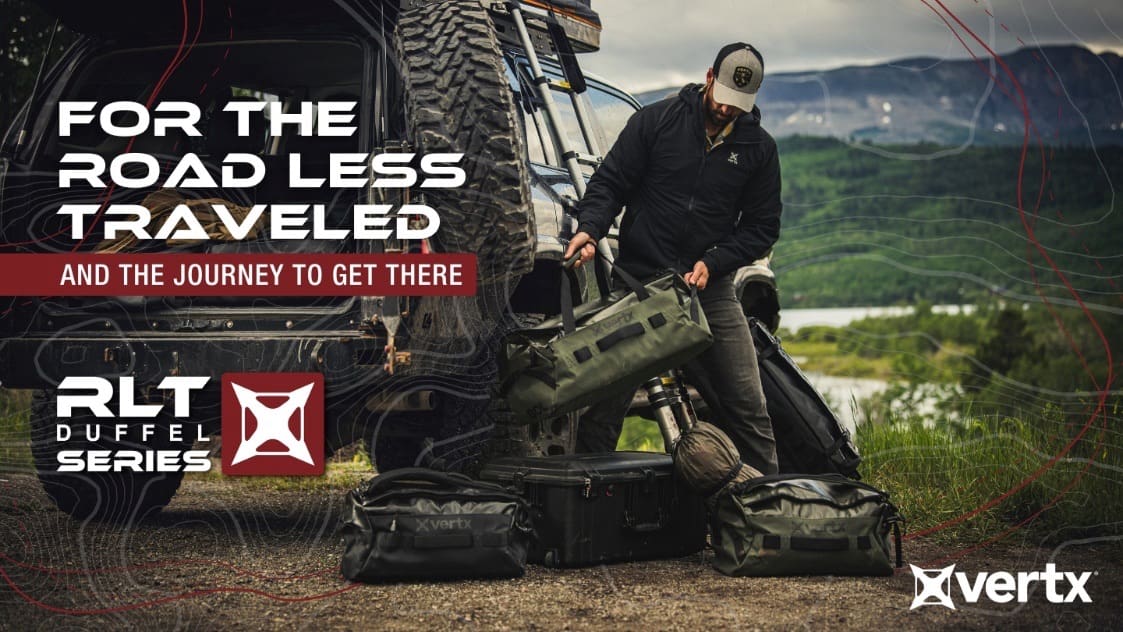
Vertx introduces the new RLT Duffel Bag series, designed for those who embrace the “Road Less Traveled.”
These exceptional duffels are engineered for individuals who dare to venture where others won’t, embodying the spirit of the (R)oad (L)ess (T)raveled and the journey to get you there. Unlike conventional duffels, these are reliable companions for remote trails, bustling terminals, and every destination in between. Crafted from water-resistant, wipe-clean, ripstop fabric, these robust bags are built to withstand any challenge thrown their way. The RLT Duffel series stands ready for action in any environment.
Two standard duffel sizes (50L and 80L) offer versatile carry options and are infused with Vertx DNA, allowing users to customize their carry experience. The 100L model features a durable bottom pan and wheels, catering to those who seek adventures beyond airport terminals.
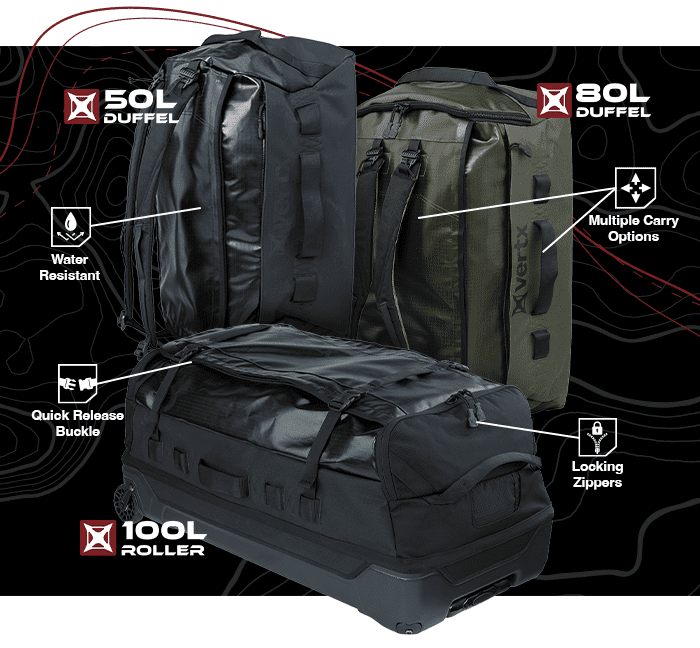
No matter the road you choose, these bags are built to get your there. Because Vertx knows that being prepared isn’t merely a preference – it’s a way of life.
The RLT Duffel series is now available for those ready to gear up for the unexpected at vertx.com.