GORE-TEX WINDSTOPPER

HII Debuts GRIMM Spectrum Dominance Solution at AOC 2025 International Symposium & Convention

December 10th, 2025

McLEAN, Va., Dec. 08, 2025 — HII (NYSE: HII) announced today that its Mission Technologies division has deployed and operationalized a next-generation high-performance spectrum dominance solution, now available for rapid detection and location of hostile communications, radar and other electronic threats.

HII will showcase its GRIMM® technology — and its field-proven capabilities in situational awareness, intelligence support and force protection — at the Association of Old Crows’ 2025 International Symposium & Convention at National Harbor, Maryland.

GRIMM® leverages decades of HII expertise developing electromagnetic warfare technology for national defense. Now deployed with mission success across a range of defense customers, it stands as a testament to HII’s commitment to innovation and operational excellence.

“GRIMM® is a proven strategic asset for the U.S. military and its allies — and it is available now,” said Andy Green, executive vice president of HII and president of Mission Technologies. “Mission success requires a multi-domain, fully capable solution that provides the agility and precision our forces need to protect national interests worldwide, and GRIMM is delivering that capability today.”

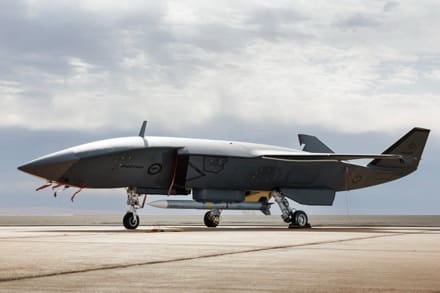
GRIMM can fulfill a variety of missions, including military operations; counterterrorism and counternarcotics; intelligence, surveillance and reconnaissance; border security; and electromagnetic warfare (EW) and RF-enabled cyberspace operations. To date, the system has been deployed on unmanned platforms for both passive and active EW missions.

“GRIMM empowers advanced operations across diverse environments around the world, including contested electromagnetic spectrum scenarios,” said Grant Hagen, president of Mission Technologies’ Warfare Systems group. “We are excited to introduce this next evolution of our EW technology, a small form factor spectrum dominance solution enabling operations on unmanned systems.”

HII Mission Technologies’ products support mission readiness in every domain — from land, sea and air to space and cyber — and span a variety of technology areas — from AI and Big Data to rapid prototyping and spectrum engineering.

For more information about GRIMM and Mission Technologies’ other advanced technology products, visit: hii.com/what-we-do/products.

Whiskey Two Four PALS Loader Panels

December 10th, 2025

WTF’s PALS Loader Panels offers a method for your excess pouch madness. Breath new life and purpose into old pouches. Better organize your load.

Shock cord snaps smartly into place offering ample retention for glass vials, syringes, Sharpies, small hand tools, LifeStraws and similar, glow sticks, and more. Connect multiple panels with optional VELCRO® Brand ONE-WRAP® connectors.

Laser cut from Berry compliant CURV® thermoplastic*, PLPs are as light as they are tough.

Available 1×3, 2×3, 3×3, 4×3, 5×3, and 6×3 PALS fields.

Add optional handles & pull straps, shock cord, and panel connectors to make it your own.

wtfidea.com

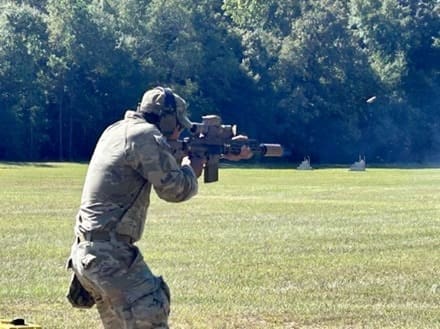
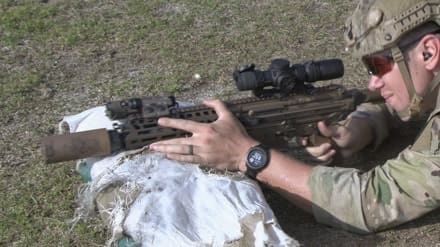
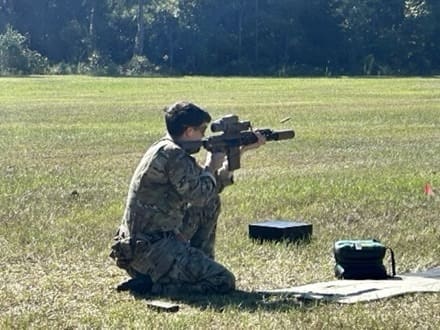
USSOCOM Cancels LMG-A Effort, For Now

December 10th, 2025

USSOCOM has updated the call for white papers issued in March of this year for their Lightweight Machine Gun – Assault effort with the following statement:

PEO-SW PM SOF Lethality has adjusted the LMG-A Prototyping Project.  SOF AT&L-KR will no longer be moving forward with the prototyping effort.  Instead, the Navy Crane Contracting office will restart the effort.  That said, expect something to be announced by that office in the very near future. 

This Other Transactional Agreement procurement effort was intended to seek out a life cycle replacement for the MK48 Light Machine Gun (LMG) chambered in 7.62 NATO, with the future intent to adopt other calibers such as 6.5mm Creedmoor, but not limited to, as a multi-caliber / intermediate caliber machine gun.

The system was envisioned to include a lightweight, belt fed, fully and semi-automatic weapon system, including a primary barrel, spare barrel, buttstock, receiver, sound/signature suppressor, operator manual, cleaning kit, operator tool kit, maintainer tool kit, spare parts kit, training munition kit, bipod, backup iron sights, and a Transportation Security Administration (TSA) approved locking hard carrying case

Army Drone Team Advances Tactics at Drone Crucible Competition

December 10th, 2025

FORT RUCKER, Ala. – The Army Drone Team competed in the National Drone Association’s Drone Crucible Competition Dec. 4-6, joining some of the military’s top drone operators and industry experts in a series of combat-focused challenges.

The event, held at Camp Blanding, Fla., brought together teams with their own unmanned aircraft systems to test and refine squad-level drone capabilities. Scenarios included close-quarter breaching and room clearing, strikes against moving enemy convoys and aerial targets, long-range engagements on critical assets, and integrated missions against multiple targets and counter-drone systems.

Capt. Jacob Bickus, officer in charge of the Army Drone Team stationed with the 1-145th Aviation Regiment, US Army Aviation Center of Excellence at Fort Rucker, said the competition was only the third event for the newly formed unit since its launch in September. Over the three-day event, the team, comprised of top drone operators and specialists from across the Army, showed they belong among the military’s leading drone experts in both technical and tactical drone employment.


Chief Warrant Officer 2 Scott Carpenter, an unmanned aircraft system operations technician from the 20th Special Forces Group said the Drone Crucible Competition offered a rare chance to bring together some of the Army’s best minds in unmanned systems.

“I think it’s a great way to bring all those different viewpoints and experiences and really generate the best tactics, techniques and procedures,” Carpenter said. “It’s powerful as far as how UAS is employed.”

Carpenter noted that success often hinges on having the right tool for the mission, whether infrared cameras for night operations or quadcopters with prop guards for close?quarters training. He said developing subspecialties within units could strengthen capabilities across the force.

The event also gave Carpenter, a National Guard Soldier and Dual Status Military Technician, the opportunity to see how active?duty units are employing drones. “It’s a very good opportunity to get outside of your normal sphere and see what the conventional Army is doing across the nation,” he said. “Even down to the finer details, like what kind of antenna they’re using. It absolutely translates.”

The Army Drone Team’s participation in the Drone Crucible competition is aimed at more than testing equipment though. Capt. Nathan Rosenberger, a military intelligence officer and artificial intelligence technician assigned to the Army’s Artificial Intelligence Integration Center in Pittsburgh, said the event highlights the value of working across branches.

“Inter-service collaboration is extremely important,” Rosenberger said. “One of the main takeaways from a competition like this is having all of the services come together, work together, and take some lessons to work from.”

Sgt. Ernesto Viveros, an unmanned aircraft systems operator in the 1st Armored Brigade Combat Team, 1st Cavalry Division at Fort Hood, Texas, said his path to the team began after the Army retired the Shadow system, forcing soldiers to adapt to new platforms. “I’ve been flying drones since August of last year,” Viveros said. “Our chief put us on a path to figure it all out, because he saw what was going on and wanted us to be prepared.”

Viveros said that the rapid pace of innovation has pushed the Army to keep up. “Shadow was an old system, and they just kept it around,” Viveros said. “Now you’ve got conferences, the USNDA, everyone’s trying to learn and buy new systems. From last year it’s just been fast-paced, and we’re jumping on.”


Bickus reflected on the competitive nature of the exercise and the opportunity to train alongside elite units. “Anytime you can train with someone as elite as the Navy SEALs, it’s a good day,” Bickus stated. He also compared commercial drones with systems developed in?house, noting that Soldiers are still building trust in different platforms. “The more we use them, the more we’ll get comfortable and kind of build trust with certain systems,” he said.

Finally, Bickus addressed the broader learning environment, pointing to the importance of adapting established tactics while observing global drone employment. He remarked that the competition allowed Soldiers to refine their skills in close?quarters battle scenarios and nighttime operations, while also learning from allied and partner practices.

The Army Drone Team came out on top in many of its matches, underscoring the unit’s rapid growth and potential. The competition, however, was less about winning individual events and more about building trust in emerging systems, refining tactics and strengthening ties across the force. As the Army continues to adapt to the fast pace of drone innovation, the team’s performance at Camp Blanding marked another step toward shaping how Soldiers employ unmanned systems in future conflicts.

By Leslie Herlick

Hegseth Introduces Department to New AI Tool

December 10th, 2025

Yesterday, several employees at the Pentagon got a pop-up on their computers inviting them to use a new artificial intelligence tool developed for the War Department. Some were skeptical, wondering if the invitation was part of a cybersecurity test.

But by this morning, those concerns were gone — posters around the Pentagon and an email from Secretary of War Pete Hegseth assured everyone that the new tool is not only legit, but that he wants everybody to start using it. 

“I am pleased to introduce GenAI.mil, a secure generative AI platform for every member of the Department of War,” Hegseth wrote in the email. “It is live today and available on the desktops of all military personnel, civilians and contractors. With this launch, we are taking a giant step toward mass AI adoption across the department. This tool marks the beginning of a new era, where every member of our workforce can be more efficient and impactful.”

Visitors to the site will find that what’s available now is a specialized version of the Google AI tool Gemini, Gemini for Government. This version is approved to handle controlled unclassified information. A green banner at the top of the page reminds users of what can and can’t be shared on the site. 

In addition to Gemini for Government, the site indicates that other American-made frontier AI capabilities will be available soon. 

“There is no prize for second place in the global race for AI dominance,” said Emil Michael, undersecretary of war for research and engineering.

“We are moving rapidly to deploy powerful AI capabilities like Gemini for Government directly to our workforce. AI is America’s next manifest destiny, and we’re ensuring that we dominate this new frontier.” 

Access to the site is available only to personnel with a common access card and who are on the War Department’s nonclassified network.

When GenAI was asked, “How will you help the Department of War achieve its mission,” through a user prompt, it replied with a list of capabilities, including, among other things, creating and refining documents, analyzing information, processing and analyzing satellite images, and even auditing computer code for security purposes.

“I can support the DOW’s mission by providing a range of capabilities designed for a secure, high-impact environment,” GenAI replied. “I am ready to support your mission requirements.”

The tool reminds users to double-check everything it provides to ensure accuracy. The highest authority within the War Department, Hegseth himself, provided that validation. 

“The first GenAI platform capability … can help you write documents, ask questions, conduct deep research, format content and unlock new possibilities across your daily workflows,” he wrote. “I expect every member of the department to log in, learn it and incorporate it into your workflows immediately. AI should be in your battle rhythm every single day; it should be your teammate. By mastering this tool, we will outpace our adversaries.”

For those unfamiliar with how to use AI, online training is available at genai.mil/resources/training.

By C. Todd Lopez, Pentagon News

Ti Defense Unveils Game-Changing “Military Virtual Trainer” and Biometric Integration at I/ITSEC 2025

December 9th, 2025

ORLANDO, Fla. — December 8, 2025 — Ti Defense emerged as a standout innovator at I/ITSEC 2025, drawing significant industry and customer attention with the debut of its Military Virtual Trainer (MVT). From December 1–6, Ti Defense showcased its “Built by Warfighters for Warfighters” approach, demonstrating new solutions designed to fill critical training gaps in marksmanship, decision-making, and joint fires.

The MVT system offers a unified platform built on three pillars of training:

Shooter: Marksmanship and weapon skills development.

Judgment: Use-of-force and decision-making scenarios.

Shockwave: Joint Fires Training.

“The overwhelming interest we received at I/ITSEC confirms that the industry is ready for a new standard in simulation,” said Brent Ludlow, Military Business Developer at Ti Defense. “Our team of experienced Veteran Subject Matter Experts (SMEs) and engineers recognized training gaps that have been ignored for years. The MVT is the direct result of listening to the needs of the end-user.”

Innovation in the Spotlight: SFP and the Go-bag 

Attendees focused heavily on two key innovations: the patent-pending Smart Firing Point (SFP) and the expeditionary Go-bag.

The SFP is currently the only product on the market capable of training a shooter on how to effectively group and zero their individual weapon; a fundamental skill often overlooked in simulation. Meanwhile, the Go-bag addresses the need for affordability and ultra-portability. Designed for minimal footprints (8×15 feet), it can be set up in under 15 minutes at the range, in barracks, day rooms, hotel rooms, or ship decks.

Breakthrough Partnership with Neurosmart Ti Defense also announced a strategic partnership with Neurosmart to integrate breakthrough stress-monitoring technology into the MVT. This integration synchronizes biometric data with scenario events, allowing instructors to assess human performance in real-time. By identifying stress triggers, trainers can help Warfighters recover from high-pressure spikes and evaluate if a scenario is too challenging or if the student has mastered the skill.

MVT System Capabilities The MVT is designed for flexibility and service doctrine accuracy. Key features include:

High Throughput/Scalability: Configurations supporting up to 3 shooters with 4-foot firing lanes per screen.

Visual Versatility: Options for 4K projection, elevated 4K projection, and LED screens.

Recoil Realism: Electric or pneumatic weapon recoil solutions.

Data & Analytics: Automatic scorecard production and comprehensive After Action Review (AAR) capabilities.

Customization: Adaptable to any Service Doctrine.

Ti Defense offers comprehensive support, including warranty services and a 24/7 customer support line.

Ti Defense is a subsidiary of Ti Training, headquartered in Golden, Colorado, as well as a presence in the Orlando, FL area.  Ti Defense is a leading provider of advanced simulation training solutions for military and law enforcement for over 19 years, with systems deployed worldwide.

For more information or to schedule a demonstration, visit TiDefense.com

Silvus StreamCaster 4400 Enhanced MANET Radio Receives Department of Defense (DoD) Certification for Secure U.S. Military Drone Operations

December 9th, 2025

DoD’s innovation unit and AUVSI, a leading autonomous innovation industry group, validate expanded portfolio of Silvus NDAA-compliant radios for secure use in unmanned missions

CHICAGO – December 9, 2025 – Silvus Technologies (Silvus), a Motorola Solutions (NYSE: MSI) company and a global leader in advanced wireless networking solutions, today announced that the U.S. Department of Defense (DoD) Defense Innovation Unit (DIU) has added the StreamCaster 4400 Enhanced (SC4400E) mobile ad-hoc network (MANET) radio to its Blue UAS Framework, a rigorous testing and certification program that approves technologies for use in U.S. military unmanned aircraft system (UAS) operations. The Association of Uncrewed Vehicle Systems International (AUVSI) has also added the SC4400E to its Green UAS Cleared Components list, certifying it meets rigorous cybersecurity and supply chain standards for commercial drones and components.

“The Blue UAS Framework and AUVSI Green UAS certification validate that the SC4400E MANET radio meets the rigorous standards for secure, mission-critical connectivity demanded by today’s leading-edge unmanned systems operating in the world’s most challenging and contested environments,” said Neema Daneshvar, vice president of Product, Silvus Technologies. “Its addition to both programs strengthens Silvus’ position as a benchmark for robust, secure and resilient command and control (C2) and mesh networking solutions for UAS and unmanned operations.”

Powered by Silvus’ proprietary Mobile Networked MIMO waveform, SC4400E radios create a scalable connected mesh network that can link hundreds of nodes, from drones to ground radios, to stream high-bandwidth video, voice and sensor data back to command with extreme range. The radio is designed to easily integrate into fixed infrastructure or vehicular, maritime, airborne or unmanned systems, to support missions across air, land and sea. 

The SC4400E provides access to Spectrum Dominance 2.0, an ever-expanding suite of electronic warfare (EW) defense capabilities, including Low Probability of Intercept/Low Probability of Detection (LPI/LPD), Anti-Jamming and Advanced Threat Protection. These capabilities help deliver secure and protected communications in congested and contested spectrum environments without sacrificing performance, even under electromagnetic attack.

The National Defense Authorization Act-compliant SC4400E joins the StreamCaster SC4200EP, StreamCaster LITE SL4200 and SL5200 MANET radios on the Blue UAS Framework and Green UAS Cleared Components list. 

SIG SAUER P320 Will Serve as the Swiss Armed Forces Official Sidearm

December 9th, 2025

NEWINGTON, N.H., (December 8, 2025) – SIG SAUER is proud to announce the P320 was selected by the Swiss Armed Forces to serve as their new standard issued sidearm. The selection is a critical component of the Swiss Armed Forces New Generation Project, demonstrating Switzerland’s commitment to soldier focused modernization.

The Armasuisse competitive selection process required extensive technical testing and field trials centered on user feedback with a comprehensive focus on safe, reliable operation.  SIG SAUER is truly honored by Armasuisse’s selection and validation that the P320 meets the stringent quality and precision demands of the Swiss Armed Forces.

Armasuisse’s highly competitive process sought a pistol with modern ergonomics, modularity, and the ability to reliably meet a 30-year service life and operational support demands.  The P320 is one of the most adaptable pistols on the market; it is customizable to meet the ergonomic preferences of a variety of soldiers and accepts a wide range of compatible enhancements and accessories.  The P320’s precision and reliability make the platform extremely well suited for the dynamic and unique needs of the Swiss Armed Forces and their traditional citizen-soldiers.    

The P320 consistently meets and exceeds the stringent expectations of armed forces around the world, including the militaries of the United States, Australia, Denmark and Canada.  We are proud of SIG SAUER AG for this incredible achievement and honored for the opportunity to expand our manufacturing footprint in Switzerland and meet the incredible demands of the Swiss Armed Forces.

To learn more about SIG SAUER, please visit sigsauer.com.