Aquaterro

Alien Gear Holsters To Exhibit at the AUSA 2022 Annual Meeting & Exposition

October 3rd, 2022

Alien Gear Holsters® Rapid Force™ duty retention holsters will be showcased at the Association of the United States Army’s Annual Meeting, the largest land power exposition and professional development forum in North America.


Post Falls, Idaho (September 2022) – Alien Gear Holsters®, designers and manufacturers of American-made holsters and firearms accessories, and the Rapid Force™ line of Level 2 and Level 3 Duty Holsters, will exhibit at Booth #3625 during the Association of the United States Army (AUSA) Annual Meeting, to be held Oct. 10 – 12, 2022 at the Walter E. Washington Convention Center, in Washington D.C.




AUSA brings in over 33,000 registrants including top Army leadership and industry partners. Exhibitors and attendees from over 80 countries showcase leading-edge technologies and products. Seminars and social events provide participants the opportunities to meet top military brass and international leaders.

“Alien Gear Holsters is strategically entering into the military markets with products that are designed specifically for the warfighter,” Joe Lienemann, Director of LE Sales for Alien Gear Holsters, explained. “The Rapid Force line of holsters will be building on our success since the introduction of our Level 2 and 3 Duty Holsters with products for our men and women in the Armed Services.”

The Rapid Force Duty Holster is designed specifically for law enforcement and military professionals. The revolutionary retention mechanism was engineered to provide the highest level of security while maintaining an incredibly fast and fluid draw. Alien Gear Holsters’ patented Gross Motor Response (GMR™) retention control system allows the user to draw consistently with a perfect grip, even under stress. The Rapid Force Duty Holster has been thoroughly tested in extreme environments and under extreme conditions so that it has been referred to as a “tank” of a holster, able to withstand anything thrown at it. The Rapid Force Duty Holster is available in four configurations: Belt Slide, Paddle, MOLLE, and Drop Leg.

The optional Quick Disconnect System (QDS) allows the user to switch the holster from one carry configuration to another, quickly and easily, without tools. Made in the USA, the Rapid Force Duty Holster comes with a 30-day field test drive and a three-year full manufacturer warranty. It is available for GLOCK, Smith & Wesson, and SIG Sauer model handguns. MSRP is $115.88.

For more information on Alien Gear Holsters and the Rapid Force line, visit www.aliengearholsters.com. Join the conversation on Alien Gear Holsters’ Facebook page, Instagram, and YouTube.

Platatac – ASAD B&S XL

October 3rd, 2022

The Platatac ASAD B&S XL (All Singing All Dancing Bits & Stuff) Pouch is part of the versatile ASAD Velcro-In accessories range and provides you with a configurable plate carrier/chest rig mounted pouch.

It can be mounted either under the front flap and cummerbund, or inserted into the plate pocket on most plate carriers.

The front of the pouch features a zippered pocket for storage of smaller or flat items, the pleats allow for expansion for bulky items. Dual zippers allow the pouch to fold down to clear your platform allowing easier access Velcro loop is sewn internally front and back to allow for the attachment of the Velcro hook backed elastic loop organiser panels (sold separately).

Available MultiCam®, MultiCam® Tropic, MultiCam® Black, M81 Woodland, Ranger Green & Black.

platatac.com/platatac-asad-b-s-xl

Mechanix Wear Launches Mil-Spec Eyewear – Mechanix Vision Type-X Tactical Safety Eyewear

October 3rd, 2022

When Mechanix Wear announced their new eyewear line we knew it was only a matter of time before they brought the technology over to the tactical side. The new Mechanix Vision Type-X Tactical Safety Eyewear meets MIL-PRF 32432 Ballistic Fragmentation standard as well as ANSI Z87.1 impact standard.

In addition to impact protection, the lenses are treated for anti-fog as well as anti-scratch. Type-X also features a wraparound, vented temple and comfort nosepiece.

The Type X line is offered with Black frame with Amber, Clear, and Smokes lenses or in a Grey frame with Smoke lens.

www.mechanix.com

NextGen 2.0 Helmets on the Way to Defenders Across Air Force

October 3rd, 2022

JOINT BASE SAN ANTONIO-LACKLAND, Texas – Defenders at installations across the Department of the Air Force are set to don the Security Forces NextGen Helmet 2.0 later this year.

Following a recent contract award by the Air Force Security Forces Center (AFSFC), Helmet 2.0 includes the ability to mount a wider variety of accessories, features bolt-on accessory rails and a night vision goggle mount that’s easy to adjust or replace, and a chinstrap extender for gas masks.

The 2.0 effort is part of AFSFC’s “replacement through attrition program,” and builds on the functionality of the SF NextGen 1.0 helmet released in 2020, said Master Sgt. John Sutherland, individual protective equipment (IPE) program manager at the center.

“In modern society, we’re all familiar with the urge to update our phones to the latest and greatest model, but this hasn’t translated to some of the most important things in our profession, like ballistic helmets,” the master sergeant said.

“The rate of technological advancements today is astounding, and produces emerging threats and requirements rapidly,” Sutherland said. “As the world’s preeminent air power, we make great strides to update and upgrade airframes and other operational technologies, so it only makes sense to modernize the equipment used by those that defend them.”

Part of that modernization includes listening to and implementing, where possible, feedback from Defenders across the enterprise.

“Feedback from the field is critical and is actually the reason that some of the characteristics for the 2.0 helmet were developed.,” Sutherland said. “No amount of testing or technical evaluations will cover everything because at the end of the day, only Defenders know what Defenders need.”

“The field has multiple avenues of approach from surveys, direct visits to installations and open lines of communication like quarterly teleconferences and emails,” said Master Sgt. Raymond Santiago, AFSFC’s security forces individual equipment manager.

The AFSFC’s S-4 Individual Equipment section is a customer service entity and relies on the enterprise to provide feedback and submit issues, Santiago added.

“We can’t grow, if we don’t know,” he said.

“The best way to get feedback from the field is by putting our equipment through real-life practical scenarios that a Defender might face in every part of their career from year one all the way through retirement,” said Defender Instructor Supervisor Tech. Sgt. Travis Hillard with the 343rd Training Squadron’s Security Forces Apprentice course in San Antonio.

Hillard, other instructors and students were instrumental in testing functionality before AFSFC gave the modified helmet the thumbs up.

The Defenders put the helmets through “rigorous testing” conducted during field training which included mounted and dismounted operations, low crawl/high crawl and a variety of other air base defense training objectives, Sutherland said.

“These helmets were soaked in sweat and caked in sand, and after hours of use each tester was fitted with a gas mask and jacket to ensure compatibility with the helmet,” he added.

Participants also completed an extensive survey on the equipment and its functionality.

The NextGen helmet program is just one part of the greater AFSFC’s individual protective equipment effort to standardize and modernize Defender equipment across the Air and Space Forces.

“Helmet 2.0 is only one aspect of the initiative,” Sutherland said. “The Modular Scalable Vest and Female Body Armor … Model Defender which will provide equipment such as pouches, holsters, duty belts and more for each and every member. These efforts ensure that Defenders can expect technologically relevant and high-quality gear no matter where they are performing their mission.”

“The need to innovate gear is important for the protection of our Airmen and Guardians,” said Santiago.

Hilliard echoed those sentiments.

“It’s incredibly important to constantly update our equipment to meet both modern threats, and to best utilize the constantly upgrading technology available to security forces protecting installations around the globe,” he said.

Consistently rolling out new and updated equipment across the enterprise “helps create the elite weapon systems Defenders need to be in the modern operating environment.”

“Threats are increasing and evolving so it’s critical our team provides the enterprise with the latest technology to ensure mission capabilities aren’t hindered and our greatest of asset are protected,” Santiago said. “At AFSFC, we continue to collect feedback and upgrade Defender gear to defeat or deter any enemies that threaten our installations.”

“Helmet 2.0 is a big win for security forces but it only plays a part in bigger things to come for our Defenders,” he said. “We’ll continue these efforts with an agile approach while keeping an eye on emerging requirements and new technologies.”

“In five years’ time, we may be fielding IPE solutions that we’ve only seen in science fiction a few years ago.”

By Debbie Aragon, AFIMSC Public Affairs

HQS Slim Suppressor

October 2nd, 2022

The direct thread HQS Slim Suppressor is available for UK hunters from Edgar Brother.

You can expect a 30dB noise reduction from this Bulgarian can. Offered in a variety of thread patterns, the HQS Slim can be had in .223, .264, .30 and 9mm Para.

www.edgarbrothers.com/shooting-sports/brands/hqs-slim

SCUABPRO Sunday – Common Dive Skills

October 2nd, 2022

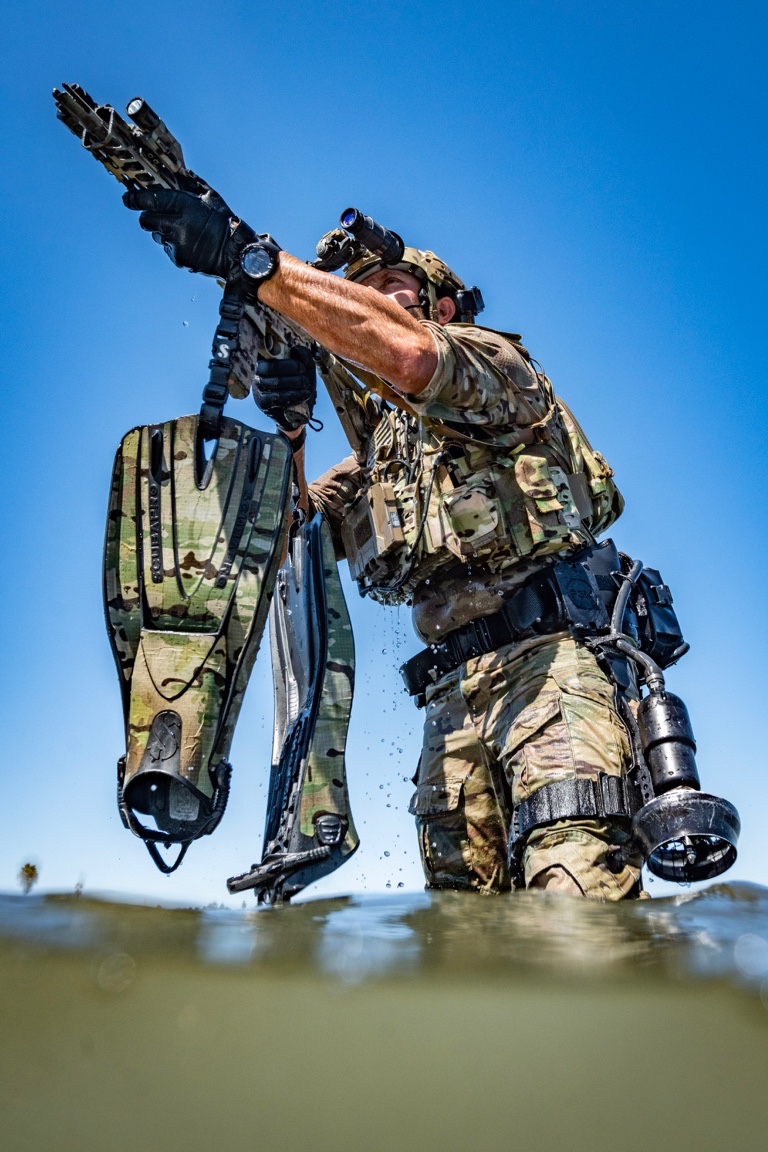
Training like you fight doesn’t just mean having your body armor on when you are on the range, and you should always practice basic skills whenever you get in the water. The best way to become a better diver is to practice and improve on the basic skills constantly. Here are some basic skills you should practice every time you get in the water.

Buoyancy

This is one of the most critical skills for every diver to master. Mastering buoyancy is not necessarily a difficult task, but it requires a calm, focused mind, and practice. You will consume less air when your buoyancy is on point, and you will not risk shooting to the surface and giving yourself away or, worse, getting injured. To practice your buoyancy, try and be a couple of feet off the bottom of the pool using a body positions simulation to sky diving. Try maintaining the same distance from the bottom and now just using your fins spin to your left, then spin to your right, again holding your positions. Now once you have that, try, and move backward, besides just using your fins. This will help you with moving in confined spaces and around piers.

Descents

The descent should always be performed slowly and controlled. You will need to equalize the pressure in your ears as you descend constantly; that can mean every 12-18 inches 30-40cm for some divers. Descending too quickly can cause your eardrums to rupture, which can lead to more severe complications. A slow descent will also prevent silting on the bottom, which will decrease visibility. Also, practice your emergency descents. It will be the same as before but faster.

Clearing Your Mask

At some point, you will get water in your mask. So, it is better to practice in a controlled environment than to have not done it a long time and try and remembered when it is the middle of the night in someplace where you don’t want the water touching your face. If you have water in your mask, follow the clearing techniques you learned in your training. If you need to stop momentarily, alert your buddy so you do not get separated. You should be able to master this essential skill without having to stop. It would help if you also did this, allowing as a minimal number of bubbles as possible. Make sure you practice this when you are learning to use any diver propulsion vehicle.

Emergency Ascent

It is no different than practicing a down man drill.  Well, other than the fact that you are in the water. Your emergency ascent may require that you share air with your buddy, swim in a controlled manner to the surface, you might have to drop your or their weights. I have had to do this when my dive buddy passed out, and I was so freaked out I didn’t have to drop anything to get him to the surface. It was also my first dive in the teams, and I thought he was dead Practice all types of emergency ascent techniques whenever possible to not panic when a real emergency occurs.

Hand Signals

Once you start diving with someone, you might come up with some hand signals of your own, like you have your head up, you’re a$$. But the essential hand signals will be used by everyone worldwide. You never know when you will be diving with someone from a partner nation, and that is all you have to go by. So, knowing the basics will help.

Going Up or Down

Use a thumbs-up signal to indicate that you are going up or a thumbs down to indicate the opposite.

I’m OK

Place your thumb and forefinger together, forming a circle, and leave the other three fingers extended upright. This is the same as you would say, OK, as you would above water.

Stop

Signal your dive buddy to stop by holding up one hand, the same as you would in any other instance. You can also use a closed fist like being on patrol.

Changing Direction

Just like with up and down, point your thumb (or your index finger) to indicate which direction you’re heading. You can tell again like on land.

Turn Around

To let everyone know it’s time to turn around, put your index finger up and rotate in a circle. Similar to rally-up.

Slow Down

Place your hand in front of you with your palm facing down. Wave your hand up and down to indicate that you need everyone to slow down a bit.

Level Off

To indicate that you want to level off once you’ve reached a certain depth, put your hand out in front of you, palm down, and wave it back and forth.

Something’s Wrong

Place your hand out in front of you, fingers spread and palm down. Wave your hand back and forth in a rocking motion. It is similar to the hand signal, maybe.

Help!

Wave your entire arm from outstretched by your side to over your head. Repeat the motion as long as you need to.

How much air do you have?

With the forefinger and middle finger hit in the palm of your hand to ask your buddy how much air is left in the tank. The usual response is in numbers.

I’m Low on Air

It takes practice to be able to make your air last. Clench your hand into a fist and pull it in toward your chest. Repeat as much as you need to indicate how urgently you need to resurface. When diving a rebreather, you should point at the pressure gauge. With some of the newer rebreathers, you can pull your gauge out and show it to your dive buddy if needed.  

I’m Out of Air

Suppose something has gone wrong with your equipment, signal quickly and repeatedly. Place your hand, palm down in front of your throat, and move back and forth in a cutting motion.

Travis Mills and Gary Sinise Foundation on Wreaths Across America Radio RoundTable

October 2nd, 2022

This discussion, focused on veteran healing through stories of resilience, purpose and success, will be heard exclusively on Wreaths Across America Radio!

COLUMBIA FALLS, Maine — Sept. 28, 2021 — Wreaths Across America Radio is proud to announce the next episode in its series of roundtable discussions focused on veteran healing through sharing stories of resilience, purpose, and success. This discussion will take place on Thursday, October 13, 2022, at 12 PM ET, and can be heard exclusively on Wreaths Across America Radio.  

The roundtable will focus on the recalibrated warrior, and how finding purpose can benefit not only in your own journey of resilience but help connect with others working to overcome similar challenges. Guest panelists – listed below – will be interviewed by Wreaths Across America’s Executive Director Karen Worcester and Director of Military and Veteran Outreach, Joe Regan, United States Army Veteran. 

Guest Panelists Include:

Travis Mills, Founder and President of the Board for the Travis Mills Foundation. United States Army Staff Sergeant (ret.) Travis Mills of the 82nd Airborne is a recalibrated veteran, a motivational speaker, actor, author, and advocate for veterans and amputees. He is one of only five quadruple amputees from the wars in Iraq and Afghanistan to survive.

On April 10, 2021, Travis was critically injured by an improvised explosive device (IED) during a routine patrol in Afghanistan and spent 19 months at Walter Reed. After his recovery, Travis attended an adaptive sports camp in Colorado and realized the need for a such a place where a veteran, and their entire family could relax, reconnect, and find strength. Born out of this idea, the Travis Mills Foundation Veterans’ Retreat was founded.

Ginger Gilbert Ravella, Author, Military Wife, and Ambassador for the Gary Sinise Foundation. Ginger Gilbert Ravella is a military wife, Gold Star (widow), mother of five and stepmother of two. Her personal mission is to encourage anyone who seeks reconciliation and peace when life hurts the most and to continue to serve a nation by serving others.

Ginger works tirelessly to support and raise funds to help fallen and disabled veterans and their families. She is an international speaker and author devoted to her God, her family, and her country. She is remarried to another widower and USAF fighter pilot, Colonel (Ret) Jim Ravella, who lost his wife to breast cancer. Ginger currently resides in Nashville, Tenn., with her family.

The goal of the roundtable series is to help reduce barriers for veterans by:

• Supporting generational bonds between service veterans through stories of service and success;

• Destigmatizing issues faced by veterans and asking for help;

• Combating inaccurate perceptions of veterans by discussing the diverse experiences, challenges, and success of service members, veterans, and their families; and

• Connecting veterans with valuable resources.

“I know this is going to be a meaningful discussion,” said Karen Worcester, Executive Director, Wreaths Across America. “As everyone involved has a synergy of mission and a deep understanding of veterans’ needs and the needs of their families. We look forward to this opportunity to share these stories and the importance in addressing veterans’ healing.”

You can listen to Wreaths Across America Radio’s 24/7 internet stream anytime and anywhere on the iHeart Radio app, Audacy app, TuneIn app, or at www.wreathsacrossamerica.org/radio.

This is the seventh broadcast in this series, RoundTable discussions are broadcast on Wreaths Across America Radio at least once per quarter.

Learn more at: www.wreathsacrossamerica.org/pages/19520/News/823

Marine Officer Leads Joint-Service Team of Hackers in an IT Competition

October 2nd, 2022

LANGLEY AFB, Va. —

During the week of July 18-22, 2022, U.S. Marine Corps 1st Lt. Anthony Rosa, an unmanned-aerial surveillance electronic warfare officer with Marine Unmanned Aerial Vehicle Squadron 2, and his team competed in the BRAVO Hackathon. The BRAVO Hackathon was an event to help the Department of Defense by combining the information-technology knowledge of civilians and service members. Rosa’s team won first place for “Most Tactically Relevant for Maintenance Data,” and second place for “Most Tactically Relevant for Cyber Operations” with their program.

When attending the BRAVO Hackathon, Rosa and his team of U.S. Airmen and Guardians all had the same mission in mind.

“The premise is we have all this classified data,” said Rosa. “Nobody knows how to properly manipulate the data. In our minds all of that is pretty retroactive. What is more effective is to understand data that’s coming out of present systems.”

“When you build something useful, and then you see somebody’s life improved by it, that’s good and positive feedback from that experience. That makes you want to build more things.”

 1st Lt. Anthony Rosa, an unmanned-aerial surveillance electronic warfare officer

Rosa and his team made a program that safely and efficiently compresses and sends classified documents and data. The program creates and processes electronic messaging in seconds as opposed to upwards of a week.

“This is a way to press down data so that you can send a lot of information at once,” said Rosa. “If you’re trying to send a classified document right now, we have to use couriers. We might use FedEx or [U.S. Postal Service] and they’ll bring the letter by hand. Our program can send all the information in less than a minute using the smart contract we wrote.”

Rosa has been interested in programing since high school.

“I taught myself how to program when I was in high school, then got a job with website development,” said Rosa. “I continued to work in in tech fields, and even after I went into the Marine Corps, I continued to do it.”

Rosa spends his free time working on his programming skills. He plans on continuing his work in the future.

“I understood that this was going to be a high-income skill,” said Rosa. “When you see people using , you understand exactly how it’s helping them. When you build something useful, and then you see somebody’s life improved by it, that’s good and positive feedback from that experience. That makes you want to build more things.”

Rosa plans on continuing to program and finding new ways to help people with it. His program was made from thousands of lines of code and took the hard work of his entire team. Their program is currently being looked at by multiple companies and organizations.

“They are maybe going to move the application over to the National Security Agency,” said Rosa. “They have a program for integrating technology. When it gets operationally used, then I’ll feel that satisfaction. You could build something amazing, but if nobody uses it, then it doesn’t matter.”

LCpl Anakin Smith

2nd Marine Aircraft Wing