TYR Tactical

Archive for May, 2026

FirstSpear Friday Focus: SIEGE-R Optimized

Friday, May 22nd, 2026

The SIEGE-R OPTIMIZED was built for operators who need their gear to move with them—not fight against them. It cuts unnecessary bulk while keeping the protection, scalability, and durability needed for real-world work. Its low-profile design moves better in vehicles, tight hallways, cramped doorways, and every other place your gear likes to get hung up.

FirstSpear’s Tubes® Fastener technology gives you rapid don/doff capability when seconds matter—or when the briefing suddenly turns into “grab your stuff and move.” Lightweight materials and breathable mesh help keep heat down during long hours under load, because sweating through your uniform by 0900 gets old fast.

The adjustable shoulder system spreads weight comfortably without turning your carrier into a couch cushion. Internal plate pockets keep armor secure and stable while maintaining a streamlined footprint.

The removable bellyband and scalable cummerbund let you configure the setup for mission requirements instead of carrying everything you own “just in case.” Integrated routing and attachment points support comms, cables, and essential equipment without turning your kit into a spaghetti disaster. 

Every detail of the Siege-R Optimized was designed to reduce drag, increase mobility, and keep unnecessary nonsense off your body. It’s built for military, law enforcement, and specialized teams who need equipment that works as hard as they do. Whether you’re running warrants, working PSD, hitting objectives, or sitting in a vehicle longer than anyone should, the SIEGE-R Optimized stays lightweight, capable, and out of your way. Because the mission is already hard enough without fighting your gear too.

To request an estimate click image above or visit First-Spear.com/Request-For-Estimate. FirstSpear is the premier source for cutting-edge tactical gear for military, law enforcement and those who train. For more information visit First-Spear.com.

Senior Special Ops Leaders Discuss Value of Partnerships, Alliances

Friday, May 22nd, 2026

Senior military special operations forces leaders from the U.S., Sweden and the Philippines participated in a morning panel today about the importance of SOF partnerships and alliances, as part of Special Operations Forces Week 2026 in Tampa, Florida.

During the one-hour conversation, the four participants discussed how building trust through international alliances enhances collective readiness and interoperability, making it a prerequisite for mission success in contested environments.

“I think the most important thing is to continue to build trust between partners within the alliance, [and] also between partners,” Swedish army Brig. Gen. Rickard Johansson, commander of Sweden’s special operations forces, replied after the panel was asked what the international SOF community needs to focus on most to ensure that alliances are stronger, truly integrated and capable of meeting the challenges of an increasingly complex and contested world.

“And we will continue to do that, because that is the bottom line for all activities that we are supposed to do: build trust,” Johansson added. 

Air Force Maj. Gen. Claude K. Tudor Jr., commander of U.S. Special Operations Command Africa, concurred with Johansson’s assessment, noting that his command has to monitor 53 countries on the African continent, so strong relationships with those countries’ SOF elements are vital.

“Any day that ends in a ‘y,’ you know, there could be crisis out there. And so, as we continue to go through that — in order for us to have the placement and access that we need without building huge infrastructure all over the place — it’s critical to have those relationships,” Tudor said, adding that such relationships are “very, very critical.”

The panel also discussed the need to build trust and develop strong working relationships with partners and allies to enable joint interoperability of advanced warfighting technologies.

Specifically, the leaders discussed the incorporation of abundant, attritable autonomous weapons systems — robustly designed drones that are cheap and scalable enough that commanders can tolerate losing them in combat.

Army Maj. Gen. Jasper Jeffers III, commander of U.S. Special Operations Command Central, explained that incorporating such technologies into the fight will make things happen fast and that SOF partners will need to be on the same page.

“Things are going to happen at a speed [where] human relationships are going to be the thing that gets you [into the fight], but it’s not going to let you execute and win. … And we’re going to need partnerships that include all of those trust aspects. … But then, on the outside of that, you’re going to need to be able to go to any one of these partners, and we’re going to have to be able to scale quickly,” Jeffers said of incorporating the weapons systems into SOF partnerships.

Jeffers cited relationships with Jordan, the United Arab Emirates and Israel as good examples of countries with which the U.S. SOF community is partnering to synchronize their respective warfighting technologies.

The panelists were also asked to cite examples of how establishing a deep personal trust between their SOF community and a partner nation have directly led to a strategic success that would otherwise have been impossible.

Philippine army Maj. Gen. Ferdinand B. Napuli, commander of that country’s special operations command, pointed to the strong relationship his island nation has had with the U.S. for the past 80 years.

Specifically, he cited Exercise Balikatan, a massive annual U.S.-Philippine military drill that regularly integrates special operations forces to execute complex counterterrorism, unconventional warfare and crisis-response scenarios, as an example of the partnership, an exercise that is growing in size each year.

“Thank you, world partners, for this year. The growing number of participants in Balikatan is [warmly] felt,” Napuli said.

Johansson told the partner nation members in the audience that Sweden could not have reached a high level of military competence without their help.

“The support from a lot of partners in this room, [has] actually made us be what we have become. Thank you for that,” he said.

By Matthew Olay, Pentagon News

Saab Receives Carl-Gustaf Order from Lithuania

Thursday, May 21st, 2026

Saab has received an order from Lithuania for the Carl-Gustaf M4 weapon and training equipment. The order value is SEK 460 million with deliveries planned 2026-2029.

The order is part of a newly signed contract between Saab and Lithuania, which allows for potential options collectively valued up to a total of SEK 640 million. The agreement is valid for ten years and includes Carl-Gustaf M4 weapons, sub-calibre adapters for the use of training ammunition and Carl-Gustaf Outdoor Trainers. The agreement also includes cooperation with the Lithuanian defence industry in accordance with Lithuanian regulations.

“We are proud to continue providing the Lithuanian forces with the highly effective capabilities of the Carl-Gustaf weapon together with our training equipment, enabling the soldiers to prepare for and carry out their missions safely and with confidence,” says Görgen Johansson, head of Saab’s business area Dynamics.

The Carl-Gustaf recoilless rifle is a man-portable, multi-role weapon system that allows dismounted soldiers to safely and effectively deal with multiple challenges on the modern battlefield. Adaptable and flexible, the system is constantly evolving to meet user and market needs. The Carl-Gustaf training systems enable advanced and collective skills training, allowing forces to prepare for a wide range of scenarios.

GA-ASI Completes First Flight of MQ-9B With AEW Pods

Thursday, May 21st, 2026

New Development Effort Will Enable Airborne Early Warning Capability for MQ-9B

SAN DIEGO – 21 May 2026 – General Atomics Aeronautical Systems, Inc. (GA-ASI) flew its MQ-9B Remotely Piloted Aircraft for the first time with Airborne Early Warning (AEW) pods. The much-anticipated AEW capability is being provided through a partnership with Saab. Once the AEW sensor, named LoyalEye, is made available to MQ-9B operators and new customers, it will deliver persistent and cost-effective air surveillance capabilities in regions where it is currently unavailable. 

GA-ASI conducted a validation flight of MQ-9B using AEW radar pods on May 19 from GA-ASI’s Desert Horizon flight operations facility in Southern California using a company-owned aircraft. The flight signaled the first step in a development process that is expected to take several months and culminate with a full-capability demonstration later this year.

GA-ASI and Saab announced their partnership last year with the intention of bringing AEW capability to the MQ-9B platform.

MQ-9B models include the SkyGuardian®and SeaGuardian®, the United Kingdom’s MQ-9B variant known as Protector, and the new MQ-9B STOL (Short Takeoff and Landing) configuration currently in development for naval aircraft carriers.

“AEW for MQ-9B will offer critical aloft sensing to defend against tactical air munitions, guided missiles, drones, fighter and bomber aircraft, and other threats. Operational availability for a medium-altitude, long-endurance UAS is the highest of any military aircraft, and as an unmanned platform, its aircrews are not put into harm’s way,” said GA-ASI President David R. Alexander.

“This partnership integrates MQ-9B with LoyalEye, equipping operators with vital information for critical decision-making. LoyalEye extends the capabilities of manned systems, and it offers persistent surveillance and greater operational flexibility. This enhances situational awareness and boosts mission success,” said Carl-Johan Bergholm, Senior Vice President and Head of Business Area Surveillance at Saab.

GA-ASI and Saab’s AEW offering will span a wide range of applications, including early detection and warning, long-range detection and tracking, and simultaneous target tracking and flexible system integration, all over line-of-sight and SATCOM connectivity.

Red Cat Closes Acquisition of Quaze Technologies

Thursday, May 21st, 2026

ACQUISITION ADDS WIRELESS POWER CAPABILITY TO RED CAT’S ALL-DOMAIN SYSTEMS, REMOVING A CRITICAL BOTTLENECK TO PERSISTENT AUTONOMOUS OPERATIONS ACROSS AIR, LAND AND MARITIME ENVIRONMENTS

SALT LAKE CITY, May 20, 2026 — Red Cat Holdings, Inc.(Nasdaq: RCAT) (“Red Cat” or the “Company”), a U.S.-based provider of advanced all-domain drone and robotic solutions for defense and national security, today announced it has acquired Quaze Technologies Inc. (“Quaze”), a Québec-based developer of wireless power transfer technology for unmanned systems, drones and autonomous machines.

Quaze will operate as an independent Red Cat business unit, continuing to develop and scale its wireless power architecture for integration across Red Cat’s Family of Systems, while maintaining its platform-agnostic model supporting third-party OEMs across air, ground and maritime domains.

The acquisition addresses one of the most significant remaining barriers to true robotic autonomy: power. While unmanned systems have rapidly advanced in autonomy, navigation and mission execution, most still rely on manual battery swaps or precise, connector-based charging systems that are difficult to deploy reliably in contested or harsh environments. Quaze’s technology enables systems to recharge autonomously, extending mission duration while reducing operator burden and exposure.

At the core of Quaze’s platform is its QU6 electronic architecture, which enables large surfaces to function as wireless energy access points and can be embedded across a wide range of platforms and environments. Unlike traditional charging approaches, the system does not require precise alignment, physical connectors or direct contact between transmitter and receiver, allowing systems to access power even in the presence of debris, sand, ice or snow. By eliminating moving mechanical parts, the architecture reduces failure points and enables reliable operation in real-world field conditions where conventional solutions often break down.

“Autonomous systems are only as effective as their ability to stay in the fight,” said Jeff Thompson, CEO of Red Cat. “Quaze gives us a critical advantage by removing one of the biggest operational constraints, which is how systems recharge in the field. This enables longer-duration missions, supports distributed operations across air, land and sea, and strengthens our ability to deliver fully integrated, all-domain solutions for the warfighter.”

Quaze’s technology can be deployed across a wide range of environments and platforms, including vehicle-mounted systems, drone-in-a-box solutions, uncrewed surface vessels, fixed infrastructure and underwater charging stations. This enables new operational concepts such as vehicle-based “mothership” deployments, distributed charging networks and persistent operations across complex terrain, borders, infrastructure corridors and maritime environments.

Red Cat expects Quaze to play an important role in expanding its all-domain capabilities, particularly as the Company advances further into maritime systems and multi-platform autonomy. The ability to integrate wireless charging into uncrewed surface vessels and other mobile platforms creates new opportunities for persistent drone operations, including swarming, extended ISR missions and autonomous deployment cycles.

The acquisition also expands Red Cat’s addressable market by introducing a new revenue channel beyond its own platforms. Quaze’s technology is designed for seamless integration into third-party systems as an embedded power capability, enabling adoption across a broad range of robotics platforms. This platform-agnostic approach positions Quaze as a potential standard for wireless power across the unmanned systems ecosystem, allowing Red Cat to generate revenue from systems it does not manufacture while accelerating adoption of autonomous technologies.

“Robotics has made major advances in autonomy and intelligence, but energy has remained a limiting factor,” said Xavier Bidaut, Co-founder of Quaze Technologies. “Our goal is to make power as accessible and reliable as fuel is for traditional vehicles and something every drone or robot can tap into, anywhere, without friction. By joining Red Cat, we can accelerate that vision and help establish a common power infrastructure for autonomous systems across industries.”

Quaze’s technology has been demonstrated across multiple robotic platforms, including aerial drones, ground systems and autonomous underwater vehicles, and is currently being evaluated for a wide range of dual use applications. The Company’s focus on simplicity, ease of integration and operational resilience has enabled rapid adoption across early partners and positions it to scale alongside the newest innovations in autonomous systems.

PROOF Research Introduces PXT: A New Era of Rifle Barrel Technology

Thursday, May 21st, 2026

COLUMBIA FALLS, Mont. – May 20, 2026 – PROOF Research is proud to announce the launch of PROOF Exponential Twist (PXT), a groundbreaking advancement in rifling that improves durability, accuracy and shootability. As originators of this barrel technology, PROOF Research developed PXT to push beyond the limitations of conventional barrels, backed by extensive military testing and research. Engineered to meet the demands of modern high-pressure ammunition, PXT represents a significant advancement in barrel technology by delivering longer barrel life, improved consistency and enhanced performance.  

As the leader in advanced carbon fiber barrel technology, PROOF Research continues to push the boundaries of firearms engineering through innovation rooted in real-world performance. PXT was developed to solve limitations inherent in conventional rifling design and to create a platform built for the next generation of ammunition and shooting performance. Unlike conventional constant-twist rifling, PXT uses a progressively changing twist profile designed to reduce initial bullet stress while maintaining  rotational stability.

“PXT is a complete redesign of how the bullet engages the rifling during initial rotation. As the industry advances and ammunition continues to evolve toward higher pressures and performance, we set out to address the technological gap between current barrel systems and where ammunition is headed,” said Brandon Hulzebosch, director of sales and marketing. “PXT gives shooters smoother, more controlled engagement that translates into greater consistency and improved performance. We are excited to be at the forefront of modern technology that will redefine barrel performance across the industry.” 

In traditional barrels, the design relies on sharp-edged rifling, and engagement forces the bullet into abrupt rifling. While the conventional approach has long defined rifle barrel design, the excessive stress can create pressure spikes, accelerated barrel wear and bullet deformation. These issues become greater with modern high-pressure cartridges, faster velocities and repetitive firing. 

PXT addresses these challenges through an exponential twist rifling profile that progressively brings the bullet into rotation rather than abruptly forcing it into rotation. Combined with PROOF Research’s proprietary, smoother-edged profile, PXT reduces the twist angle by as much as 95-98% and lowers bullet engraving force by approximately 30%, creating a more controlled and gradual twist progression. 

The result is a barrel system capable of delivering measurable increased performance in consistency and accuracy. Varying with barrel length and application, PXT barrels provide a 30-100% increase in barrel life by spreading degradation over much more of the bore. This redesign supports much higher pressures and velocities without shortening barrel life. Additionally, PXT barrels provide 20-50% improvements in consistency and accuracy across multiple ammunition types and lot variations, helping maintain accuracy across a wider range of factory loads over the barrel life.  

PROOF Research has available barrel options that include barrel blanks, AR barrels and select pre-fit offerings with more coming soon. PXT barrels are also currently available in PROOF Research’s Elevation FDX and Elevation MTR (Mountain Tactical Rifle) FDX rifle platforms in the following chamberings: 22 Creedmoor, 6.5 Creedmoor, 6.5 PRC, 7mm PRC, 7mm Backcountry and 300 PRC. The Elevation FDX has a starting MSRP of $3,499, and the Elevation MTR FDX has a starting MSRP of $3,799.  

With the launch of PXT, PROOF Research continues its commitment to evolving firearm technology through cutting-edge engineering and advanced materials. Designed for military and law enforcement personnel, precision rifle enthusiasts, competition shooters and hunters alike, PXT establishes an all-new category in barrel performance, setting a modern benchmark for what shooters can expect from rifle barrel systems.  

For more information about Proof Research, visit ProofResearch.com.

Aerial Intel and Tech Adaptation: 2nd Cavalry Regiment Tests Innovative Drone Technologies at Saber Strike 26

Thursday, May 21st, 2026

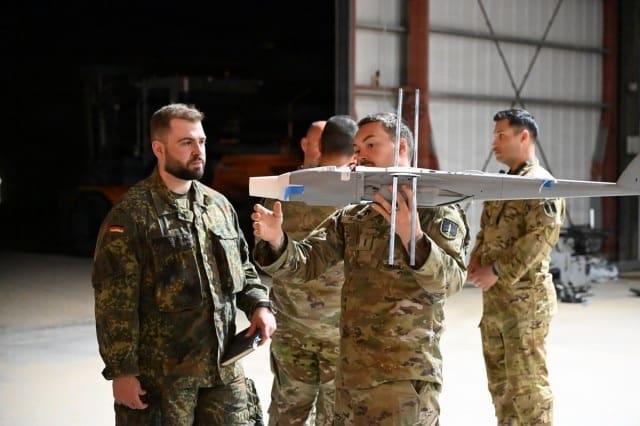
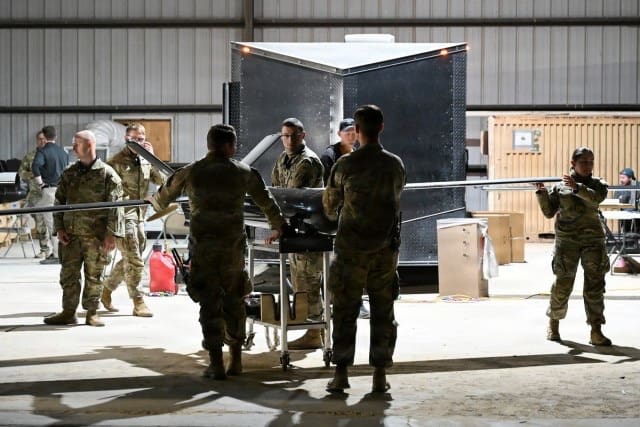
Bemowo Piskie, Poland — On May 7, 2026, at Bemowo Piskie Training Area in Poland, three Soldiers from the U.S. Army’s 2nd Cavalry Regiment (2CR) tested a Group 3 unmanned aircraft system (UAS) with a vendor during the Saber Strike combined arms live-fire exercise (CALFEX) to explore a potential partnership.

A Group 3 UAS weighs greater than 55 pounds and can fly longer distances than smaller sized systems.

“This Saber Strike CALFEX is showing that right now our platoons have a Group 3 asset, where they’re able to communicate with the intel cell and the fire cell,” said 1st Lt. Ethan Moore, UAS platoon leader, 409th Military Intelligence Company, 2CR. “Our drone can cue on the fire’s assets and call for fire on enemy positions at a greater distance than we’ve had before.”

At the CALFEX, Moore was joined by U.S. Army Staff Sgt. Dalton Kastner, the standardization officer, and Spc. Mason Tomplait, the drone operator. The trio met with the Group 3 UAS vendor to evaluate its technology.

There are many advantages to utilizing a Group 3 UAS, which is considered medium-sized among drone capabilities

“Our short-range reconnaissance drones only go from five to seven kilometers; a medium-range reconnaissance might go 30 or more,” said Moore.

The RQ 7B Shadow is what Kastner knows to be the U.S. Army’s medium-sized drone for roughly 20 years.

Comparing this updated medium-sized drone to the Shadow, Kastner said, “This system has extremely similar capabilities, with a much smaller footprint and a much smaller weight, and for me, that’s a positive. This system also has the vertical takeoff and landing, or VTOL kit, so it’s able to just take off straight up and then transition into forward movement.”

After the drone flew out, mission sets were sent to Moore, who coordinated with Tomplait in control of the gimbal camera on the system.

In real time, they could fly to specific areas of the training area and confirm friendly forces, possible enemy camps and target accuracy – all part of intelligence, surveillance and reconnaissance (ISR).

Today, ISR relies more on machine-driven intelligence rather than the previously human-centered model.

“They’re able to get that long range, very good camera view to see the targets on the ground, to provide accurate targeting grids for us to push fires and to get faster reports,” explained Kastner, “to make those jumps even quicker with accurate and rapid intelligence.”

The combat-support training exercise lasted around 41 hours.

“They’ll be able to use infrared capabilities, and we’ll be able to do everything at night as well,” said Kastner.

With eight years of experience with drones, Kastner feels that the drone was easy to put together and use.

“They even have the controller for manipulating the camera and some of the programmable features in the camera as well, so it’s very user friendly,” said Kastner.

Moore, who’s also an intelligence officer, said the Army needs equipment like this in order for intel cells to find the enemy.

Moore added, “Not only is this craft able to fill a regimental gap in intelligence collection, but it’s also something that’s valid and capable in today’s conflict that we need to enable us for the intelligence collection and fires.”

Moore said when choosing a vendor, they must be able to modify and adapt as new technologies and capabilities emerge.

After departing Poland to evaluate other vendors’ drone systems, Moore and his team went to Project Flytrap in Lithuania — part of a series of exercises (including Sword 26, Saber Strike, Immediate Response, and Swift Response) that turn experimentation into capability.

Project Flytrap is a counter-unmanned aerial system exercise designed to integrate emerging technologies and inform future Army requirements and doctrine.

The Army stays innovative by partnering with vendors and the UAS industry, alongside the real-world feedback from Soldiers.

By SSG Emilie Lenglain

MOD Enhances Its Communications Capability and Supports British Industry with the Procurement of Spectra Group’s GENSS

Wednesday, May 20th, 2026

UK MOD enhances its communications capability and supports British Industry with the procurement of Spectra Group’s GENSS tactical communications system

Spectra Group (UK) Ltd, specialists in delivering secure, reliable and resilient beyond line-of-sight communications for operations in denied and contested environments, has received its first order from the UK MOD for the recently launched GENSS tactical communications system as a defence unicorn. The UK MOD becomes the GENSS launch customer with an initial order of 40 body-worn systems, 14 platform systems and a full-service wrap.

GENSS is an evergreen software-defined tactical communications system designed, engineered and manufactured in the UK, shaped by operational experience and built on UK sovereign engineering expertise. It delivers adaptable, efficient voice and data connectivity for distributed forces, with a system architecture designed to support capability evolution as operational requirements and technologies change. Spectra Group has a long history of producing innovative satellite communication solutions, and the UK MOD was also the first to adopt its award-winning SlingShot system, which enabled L-Band satellite access for existing tactical radios, and has over 10,000 in operation with specialist and regular NATO forces globally.

GENSS delivers tactical communications beyond traditional line-of-sight boundaries, providing secure voice and data connectivity using L-Band tactical satellite networking (L-TAC). GENSS builds on Spectra’s SlingShot heritage, delivering typical networking speeds of 64kbps at 25kHz, and up to 90kbps in optimal conditions and the radio offers flexible bandwidth operations from 5-200kHz. GENSS initially supports three core operational roles: SlingShot capability, MANET / Data bridging beyond line-of-sight and efficient beyond-line-of-sight voice and data connectivity.

By combining efficient bandwidth usage, adaptive coding and modulation and low-power transmission methods, GENSS enables resilient communications for mobile forces operating in contested or denied environments. It maintains reliable link performance in dynamic environments and inherently reduces the probability of detection and interception, using LPI-D techniques, AES encryption and anti-tamper protection, enhancing its security and operational effectiveness. Built as a software-defined system with modular architecture, GENSS is designed to support continuous capability evolution through software development, new waveforms and system integrations.

Simon Davies, Chief Executive at Spectra Group, said, “As a veteran and owner of a British business, it is extremely rewarding to have designed, engineered and manufactured GENSS to meet the complex and evolving communication demands of the modern soldier. Engineered with input from ex-serving military specialists to minimise operator burden and support effective use in demanding field conditions, GENSS is a lightweight, easy-to-use and highly adaptable communication system that provides assured connectivity in the most demanding of environments. We have worked closely with the UK MOD to ensure that GENSS meets their current and future requirements, and I am very pleased that again the UK MOD is leading the way in adopting this new capability.”

Defence Secretary John Healey MP said “This government is backing British innovators and entrepreneurs, doing things differently to deliver for our forces. These are contracts, not words or promises, and they mean that thirteen British companies, many of them new to defence, are receiving real investment to develop the technology our Armed Forces need. This is defence