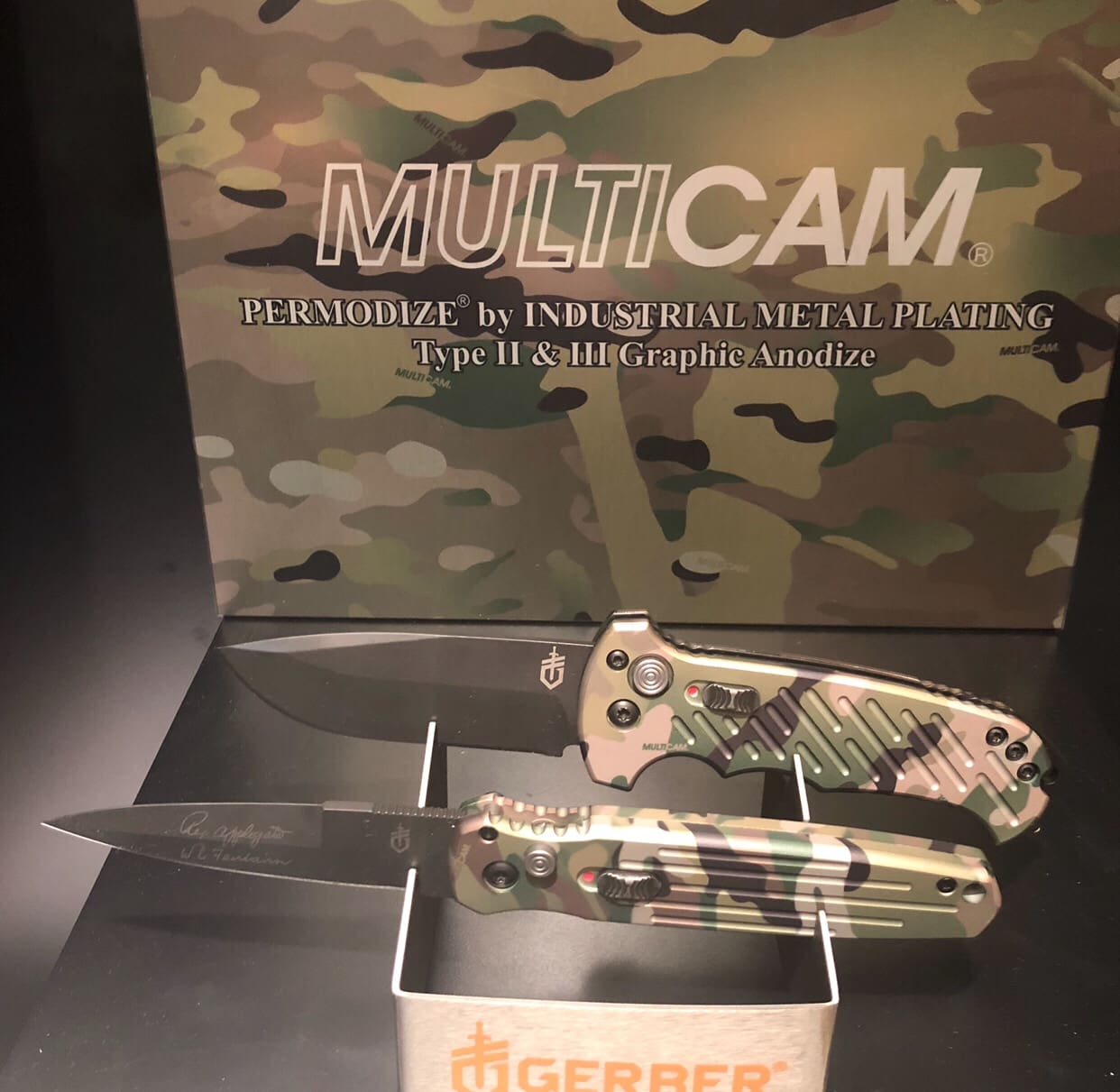
Gerber displayed versions of their 06 Auto and Covert Auto featuring a MultiCam anodized finish.



TNVC has introduced Remote Battery Case for the FLIR PTS 233, PTS 536 and PTS 736. It mounts to a Pic Rail and will offer an additional 13 hours of operational time.

The Huron™ FR Balaclava Hood (HRN-BLCVA-FR) is the first of its kind, being both FR and in MultiCam print. It was designed to be flame-retardant, lightweight, moisture wicking and quick drying. It is treated with Ag47® Anti-Microbial finish.


There are two comm ports and wire routing sleeves on both sides of the hood. The HRN-BLCVAFR provides facial, head and extended neckline protection.

DESIGN FEATURES:
• Flame-Retardant
• One Size Fits All
• Two Comm Ports and Wire Routing Sleeves
• Patented blend of Modacrylic & FR Rayon
• Superior Acclimate® Dry Moisture Wicking
• Intense Quick Drying
• Ag47® Anti-Microbial Protection
• Durable, Breathable & Won’t Shrink
www.tyrtactical.com/products/details/featured-products/huron-fr-balaclava-hood
Wilcox showed two shrouds at SHOT Show.
First is the Wilcox Lightweight Shroud.

It is completely new and is 20% lighter than their standard three-hole Shroud.

The other new Shroud is the Wilcox Modular Shroud.

Featuring the same construction as the WLS, it allows the user to configure the Shroud.

The Lanyard can be moved as well as a tie down hole.


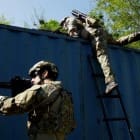
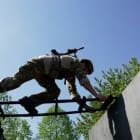
LIFT Ladder is part of a multi-product system, and over the next few weeks, we will look at all of the various products that are found in this revolutionary system. The Combat Carbon Poles are the backbone of the entire system, which allows operators to tailor the kit for different missions in ever-changing battlefields.

The LIFT Ladder was built so operators could scale and bridge obstacles with ease at only 4.975lbs. It comes with a 400lbs load capacity and is built from American made Carbon Fiber. This short video was taken at the MATBOCK HQ, to show the quick assembly of this ladder and how compact the ladder rungs are when the poles are not attached.
Technical Specifications:
Material – Carbon Fiber / Spectra Cord
Total Weight: 4.975 Pounds
Weight without poles: 2.375 Pounds
Dimensions folded up (without poles): 3in x 3in x 12in
www.matbock.com/collections/medical/products/lift-ladder

Driven by over a decade of feedback from real-world combat operations, BCM® has made continual design refinements and structural improvements to the charging handle in the M4 and M16 to address the current manual of arms for the weapon system.


Optimizing the contours into a snag-free profile that facilitates immediate manipulation with an end user’s reaction side grip, the range of BCMGUNFIGHTER™ Charging Handles is available with both ambidextrous and MIL-SPEC controls as well as a size range accommodate different end-users hands.


Redesigned to eliminate the load on the pivot pin and keep the energy from charging close to the centerline of the carbine/rifle, BCMGUNFIGHTER™ Charging Handles provides an uninterrupted engagement surface with no pinch points to catch skin or other material that could induce a malfunction during a time-is-life manipulation. A patented ambidextrous design with simplified mechanism for robust performance, each Charging Handle is crafted with MIL-SPEC grade forgings and machined from 7075 T6 aluminum, with a hard coat anodized finish per Mil-A-8625F, Type III, Class 2.


Traditional – US Patent No D798.409
Ambi – US Patent No. 9,739,549
URL bravocompanymfg.com/charging_handle
This is Mayflower’s new Jungle Ultralight Chest Rig features Trilor Grid, which is stronger than standard laser cut PALS slots due to its shape.

It features a comfy, wide H harness which is removable as the rig is SwiftClip compatible.
SureFire Field Notes is a multi-segment informational video series with tips and techniques from subject matter experts of all backgrounds. In this episode, Aaron Barruga of Guerrilla Approach discusses different approaches to stress induced training.
Aaron joined the military because of 9/11. Accepted into the 18 X-ray program, he was allowed to directly try out for Special Forces, where he eventually served for nine years. Deploying to Iraq, Afghanistan, and the Pacific Theater of Operations, Aaron trained and performed missions with foreign commandos, law enforcement, and militia fighters. He utilizes lessons learned from success, but also failure in designing his training courses for domestic law enforcement and civilians.