XC3 Weaponlight

Archive for the ‘Air Force’ Category

USAF Cyber Careerfield Discusses New Training Baseline

Wednesday, August 4th, 2021

KEESLER AIR FORCE BASE, Miss. (AFNS) —

The 81st Training Support Squadron hosted the Cyber Operations Specialty Training and Requirements Team conference at Keesler Air Force Base, July 19-23.



“The conference was held to ensure the upcoming evolution from cyberspace support to cyberspace operations is a smooth transition, eliminate training deficiencies and maintain the health and welfare of the entire career field at the highest standard,” said Staff Sgt. Matthew Storer, 81st TRSS cyberspace support force development noncommissioned officer in charge. “It impacts the entirety of the cyberspace support career field by creating baseline requirements for training.”

The conference included cyberspace support career field managers, functional managers from each of the 10 major commands, including Guard and Reserve, representation from Space Force Cyber, technical training school houses and qualifications flight to determine the training requirements for the most elite cyber operations troops going forward.

“The STRT and Training Planning Team meetings are an essential part of the Air Force, and encompasses each career field, major command and learning program’s representatives,” said Chief Master Sgt. Victor Cordero Jr., Air Force cyberspace support career field manager. “This is a historic conference, advancing the Career Field Education and Training Plan, future training requirements and establishing formal training requirements for Air Education and Training Command aligned to the new transition.”

As a result of the conference, a partnership was formed between Air Combat Command and AETC to reimagine training that works the way Airmen work in order to develop the 30,000 total force cyber Airman capable of conducting the build, secure, protect and defend mission on the Air Force network enterprise.

“Future conflicts will be fought and won in cyber, and we need to develop and deliver a mission-ready cyber force armed for tomorrow’s fight,” said Chief Master Sgt. Patricia Ford, ACC support functional manager. “The capability of our cyber Airmen will be the deciding factor between mission success and mission failure.”

By SrA Kimberly L. Mueller, 81st Training Wing Public Affairs

Undaunted Service: Elite Firefighters Serve in Austere Environments

Sunday, August 1st, 2021

ALI AL SALEM AIR BASE, Kuwait (AFNS) —

A quick reaction force is an elite unit comprised of Airmen from multiple squadrons trained in combat and evasion. These Airmen are not only highly-skilled professionals, but they undergo special training to perform their duties in austere and potentially hostile environments.

Recently, the QRF firefighter component from the 386th Expeditionary Civil Engineer Squadron, was sent to a forward operating base in Syria to provide support to its flight line.

“This team is made up of highly-qualified firefighting professionals trained for bare environments,” said Senior Master Sgt. Michael Rigsby, 386th ECES deputy fire chief. “We’re a rare group. Also, it’s just not very common for firefighters to get sent on a forward deployment. I’ve been in 16 years and this was my first time.”

The QRF firefighters’ purpose in Syria was to provide flight-line support per Air Mobility Command instructions. This allowed for a limitless number of aircraft to take off and land, and people and equipment to be removed for rotation. Their mission was to provide support so that the Army’s M2A2 Bradley Fighting Vehicle unit could be extracted and replaced.

“We flew in with three fire trucks and our firefighting equipment. The Army was due to change out their people and equipment, and our presence allowed more aircraft to land in a shorter time span,” Rigsby said. “That enabled the Army to keep their same level of base and area protection and perform change-out 16 days quicker.”

While the QRF firefighters are tactically trained to operate under hostile and combative conditions, their essential duties are the same as non-QRF firefighters. They are vital to safe and expedient flight-line standards.

“Our primary job on a flight line is to provide it with crash-fire support so that they can maintain air operations over the area of responsibility, and also to provide hazmat and medical support as well,” said Senior Airman Travis Ferrell, 386th ECES firefighter. “So if anything goes down on the flight line, we respond. Whether it’s an in-flight or ground emergency, we will respond to mitigate any possible crisis that could happen. We like to say we’re the insurance policy for anything that happens on the flight line.”

Without the firefighter component of QRF, the flight line would only be able to support a limited number of aircraft taking off and landing per week, but with the QRF, the number of flights were unlimited. They supported 15 aircraft at two per day during their 30-day mission.

QRF members went through pre-deployment combat skills training at McGregor Range, New Mexico, and Evasion, Conduct After Capture training at Joint Base San Antonio-Lackland, Texas. This type of training is for Airmen who will be operating outside the wire in high-risk environments.

“As QRF, we go to pre-deployment training so that we can deploy to places that don’t have established support, like FOBs,” Ferrell said. “Here, at Ali Al Salem (AB), we have great support and infrastructure, but we didn’t find that in Syria. We had nothing there.

We had to find our own water sources. We had to basically write our own standard operating procedures while we were out there on the fly. For instance, this is where we’re going to stage and this is how we’re going to respond,” Ferrell continued. “We get there. We make all these decisions. We face all these challenges, and then we complete the mission as quickly as we can, pack up and move on to somewhere else keeping the mission alive wherever we go.”

By SSgt Ryan Brooks, 386th Air Expeditionary Wing Public Affairs

MQ-9 Agile Combat Employment: A Big Step Closer to Reality

Saturday, July 31st, 2021

CREECH AIR FORCE BASE, Nev. (AFNS) —

The 556th Test and Evaluation Squadron proved the MQ-9 Reaper’s Automatic Takeoff and Landing Capability (ATLC) is ready as of July 8, enabling crews to divert to airfields without traditional launch and recovery infrastructure or personnel. This capability is a key enabler for MQ-9 Agile Combat Employment and, combined with the MQ-9’s next software upgrade and receipt of the portable aircraft control station, will change how it will be employed in theaters worldwide.

Previously, all MQ-9 takeoffs and landings required a specialized launch and recovery crew located wherever the Reaper intended to land. But this time, with aircrew controlling the MQ-9 via satellite from their operating location at Nellis Air Force Base, the MQ-9 taxied to the runway and took off from Creech AFB, 55.6 miles away from the crew controlling it. The 556th TES recently proved this concept and landed at Creech AFB using ATLC while under satellite control from the aircrew at Nellis AFB, but this week’s sorties pushed the envelope much further.

On the first day of the two-day test, the 556th TES flew the MQ-9 from Creech AFB to Cannon AFB, New Mexico, landed, taxied, and took off again before returning to Creech AFB —  all under satellite control. In this instance, the aircrew used imagery in the cockpit to generate the reference points for the automated landing system. On the second day, the destination changed to Holloman AFB, New Mexico, and the team again proved the capability, this time using the targeting pod to survey the runway, feed the ATLC system the data needed to fly an airport traffic pattern, land, and take off again.

Initially published ATLC procedures required an MQ-9 to be at the airfield of operation to taxi down the runway and have the aircrew electronically mark reference points when the aircraft was physically in position on the runway. The sorties proved that requirement obsolete. The technology and 556th TES-derived tactics are ready today for the aircraft to divert to a foreign field where an MQ-9 has never been before, and there is no longer a requirement for specialized infrastructure to land the unmanned aerial vehicle.

“We’re taking up the chief of staff of the Air Force’s charge to accelerate change,” stated Lt. Col. Michael Chmielewski, 556th TES commander. “This is a clear win and I couldn’t be prouder of the team that put this test together, this quickly, to include the support we received from Air Force Special Operations Command and the 27th Special Operations Wing at Cannon (AFB), as well as Air Education and Training Command and the 49th Wing at Holloman (AFB). Their support and patience made the impact of this test what it needed to be and we are grateful for the opportunity to work with them.”

According to Chmielewski, the ATLC capability will shift the Remotely Piloted Aircraft Enterprise’s mindset. It sets the enterprise up to become more agile with the next scheduled software release in spring 2022.

556th Test and Evaluation Squadron

Photos by photo by A1C Jessica Sanchez

A Mile In A Defender’s Boots

Friday, July 30th, 2021

YOKOTA AIR BASE, Japan – The 374th Security Forces Squadron hosted the fourth iteration of the 374th Mission Support Group training day on July 21, 2021, where Airmen from other MSG squadrons learned about the SFS mission.

The training was conducted as part of the group’s focus to enhance Yokota’s Agile Combat Employment capabilities, which allows for a faster response to contingencies with a smaller footprint.

“In a combat situation, you have all these different career fields that don’t necessarily work as a singular unit,” said Master Sgt. Charles Bell, 374th SFS superintendent of plans and standards evaluation. “The ACE concept will take care of that. It could be a maintainer, who knows just the basics of security forces, coming to assist us. Or it could be a security forces member, going to the 374th Logistics Readiness Squadron to help them refuel and get the jets off the ground.”

The all-day event took place at SFS headquarters, where participants were able to get a little glimpse into the day-to-day life of a defender. The day was filled with hands-on exercises, in place of lectures.

“There is a lot of stuff we can teach by PowerPoint but the readiness comes when we actually apply it,” Bell said. “This training gets our trainees excited while at the same time showing them what we do.

“One of the trainings we hosted was the Multiple Interaction Learning/Training Objective systems, which are ‘shoot, no shoot’ scenarios,” he added. “We also conducted baton training, where the trainees had to fight a simulated combatant. And to top it off, there was taser training and oleoresin capsicum spray for any volunteers who were up for the challenge.”

According to Senior Airman Tyler Gutierrez, 374th SFS training instructor, the training allows members to learn how to react to high-stress situations while in a safe, controlled environment.

“I think this type of training is very important,” said Gutierrez. “With us all being in the military, it is imperative that we rely on each other, especially in a deployed environment or during contingency operations.”

The MSG will rotate the training within their squadrons every month. Each time the training will become more detailed, further producing more effective and capable Airmen.

Story by Senior Airman Brieana Bolfing, 374th Airlift Wing Public Affairs

San Antonio Innovation Summit Open for Registration

Friday, July 23rd, 2021

JOINT BASE SAN ANTONIO-LACKLAND, Texas (AFNS) — Registration is now open for the inaugural San Antonio Innovation Summit.

With the theme of “Accelerate Change,” the summit takes place Aug. 3-4 at the Henry B. González Convention Center. The event – a partnership between the Air Force Installation and Mission Support Center, Air Force Civil Engineer Center, Air Force Security Forces Center, Air Force Services Center, Air Force Personnel Center, Air Education and Training Command, and AFWERX – will bring innovation collaboration opportunities to an expanded installation and mission support audience.

Registration is free and the summit is open to everyone including military, civilians, community members and industry.

“We’re excited to work with our local partners to bring leading government and industry innovation experts together in San Antonio,” said Marc Vandeveer, AFIMSC chief innovation officer. “The more we educate and train our innovative Airmen how to connect to the innovation ecosystem and bring their ideas to life, the more we empower them to succeed.”

The summit will include speakers and breakout sessions highlighting successes, failures, lessons learned and paths taken to successfully implement innovative projects across the Department of the Air Force and Department of Defense. Functional experts in civil engineering, services, security forces, personnel and contracting will share their vision about the future of innovation and help innovators pave a path toward sustainment.

Guest speakers include experts from Air Force Ventures, AFWERX, Platform One, Tech Port San Antonio, National Security Innovation Network, Defense Innovation Unit, Air Force Gaming, and Business and Enterprise Systems Product Innovation office.

Innovation panels will include presentations, and question and answer sessions, on the topics ranging from artificial intelligence, machine learning, small unmanned aerial systems, augmented and extended reality, to autonomous mowers, robotic process automation and next-generation gaming.

“In order to maintain our competitive advantage across the air and space domain, we need every Airman and Guardian to make change a priority. The San Antonio Innovation Summit will give them the tools they need to innovate and, more importantly, implement that innovation at the speed of relevance,” Vandeveer said.

The summit will also feature a vendor exposition highlighting successful projects currently in progress with many Air Force and DoD partners including Microsoft, UiPath, Booz-Allen-Hamilton, Mobilize, Aerial Applications, Athenium, 3rd Insight, Clarity, Oddball and Renu Robotics.

Registrants will receive the full agenda. Event organizers are also planning a virtual stream for those unable to attend in person. More details will be provided as they become available.

To register, visit here.

By Shannon Carabajal, Air Force Installation and Mission Support Center Public Affairs

AeroVironment Receives Puma 3 AE and Raven Unmanned Aircraft System Orders Totaling $15.9 Million from United States Air Force

Thursday, July 22nd, 2021

• United States Air Force to equip its Security Forces with Puma 3 AE systems; support existing fleet of Raven systems with spares packages

• AeroVironment’s family of tactical UAS allows customers to use the same ground control station and software for multiple UAS for added simplicity and efficiency

The Puma 3 AE and Raven systems empower operators with on-demand tactical intelligence, surveillance and reconnaissance that they can rely on for situational awareness and mission success. (Photo: AeroVironment, Inc.)

ARLINGTON, Va., July 22, 2021 – AeroVironment, Inc. (NASDAQ: AVAV), a global leader in intelligent, multi-domain robotic systems, today announced receipt of two firm-fixed-price orders totaling $15,940,378 from the United States Air Force. The orders, received on April 19, 2021 and May 6, 2021, encompass the procurement of Puma™ 3 AE unmanned aircraft systems (UAS) and spares packages, as well as Raven® UAS spares packages. The Puma 3 AE systems and spares were delivered on April 30, 2021. Delivery of the Raven spares is anticipated by November 2021.

“The combat-proven Puma 3 AE and Raven are versatile, rugged and reliable tactical unmanned aircraft systems designed to provide the United States Air Force Security Forces with the enhanced situational awareness and mission effectiveness they require when safeguarding bases,” said Trace Stevenson, AeroVironment vice president and product line general manager for small UAS.

The AeroVironment Puma 3 AE UAS is designed for land and maritime operations. Capable of landing in water or on land, the all-environment Puma 3 AE and Mantis i45 EO/IR sensor suite empower operators with extended flight time and a level of imaging capability never before available in the tactical UAS class. The hand-launched Puma 3 AE has a wingspan of 9.2 feet, weighs 15 pounds and can operate for up to 2.5 hours. The aircraft also has a range of 12.4 miles (20 kilometers) with a standard antenna, and up to 37.2 miles (60 kilometers) with AeroVironment’s Long-Range Tracking Antenna (LRTA). It also features reduced system packaging with a flyable configuration and GCS in one case.

AeroVironment’s Raven system is designed for rapid deployment and high mobility for operations requiring low-altitude intelligence, surveillance and reconnaissance. With a wingspan of 4.5 feet (1.4 meters) and weighing just 4.2 pounds (1.9 kilograms), the hand-launched Raven provides situational awareness, day or night, with an operational range of 6.2 miles (10 kilometers). The Raven’s Mantis i23 EO/IR gimbaled payload delivers real-time video or infrared imagery to ground control and remote viewing stations.

Both Raven and Puma 3 AE UAS can be operated using Crysalis™, AeroVironment’s next-generation ground control solution for command and control, which improves battlefield communication and collaboration by enabling users to easily share real-time information and coordinate mission-critical decisions.

AeroVironment has delivered tens of thousands of new and replacement unmanned air vehicles to customers within the United States and to more than 50 allied governments. For more information, visit www.avinc.com/uas.

When You’re Finally Featured By Public Affairs, But Don’t Want To Show Mom

Wednesday, July 14th, 2021

Ok guys, this is where you can have some good clean fun at the expense of the Air Force.

Preparation in the Face of the Unexpected – How USAF SERE Educates Military Members

Wednesday, July 14th, 2021

KADENA AIR BASE, Japan —

In efforts to prepare and protect the Air Force’s most valuable resource of all — Airmen — survival, evasion, resistance and escape specialists undergo extensive training to make certain aircrew members are up to date with the latest on survival and evasion tactics. The tactics taught give Airmen skills to aid in their survival in worst-case scenarios.

The SERE specialists have to be experts in their profession in order to teach tactics and procedures effectively. To accomplish this they must complete rigorous training at technical school and pass the certification phase that follows.

The process for becoming a SERE specialist begins with a three-week-selection course, followed by a six-month technical school, which includes a three-week survival crash course that pilots and aircrew take to become operational, explained Tech. Sgt. Casey Carter, 18th Operations Support Squadron NCO in charge of SERE training. Once they successfully complete their technical school, they then go through a 6-12 month certification phase.

“When you’re certifying for those 6-12 months, you’re actually teaching aircrew and pilots that are coming through the schoolhouse and you have a trainer that’s evaluating you as an instructor,” Carter said. “Once certified, you’re on your own, and you get your own class of aircrew and pilots to take into the woods and instruct.”

Both Tech. Sgt. Kenji Scouton, 18th OSS NCO in charge of SERE operations, and Carter now lead the refresher courses on Kadena, recertifying pilots and aircrew members on the fundamentals of survival.

“It’s been interesting, I’ve seen some students I taught at the schoolhouse at Fairchild come through and get stationed out here,” Scouton said. “So I’ve had some guys be my students multiple times, whether it be in the initial course or the refresher courses.”

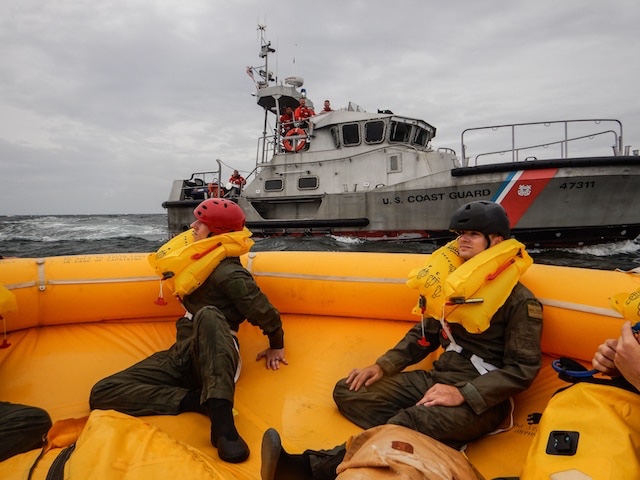
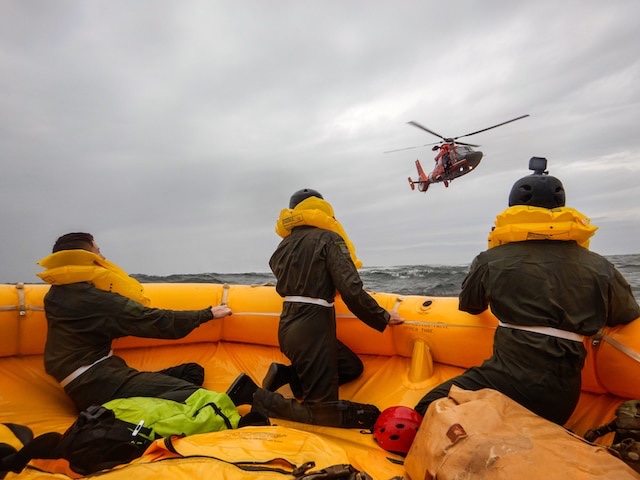
The refresher courses taught by SERE specialists include many classes such as combat survival training, conduct after capture training, water survival training and emergency parachute training. The training sessions typically begin with a few hours of lecture, followed by real-life application of the newly obtained knowledge.

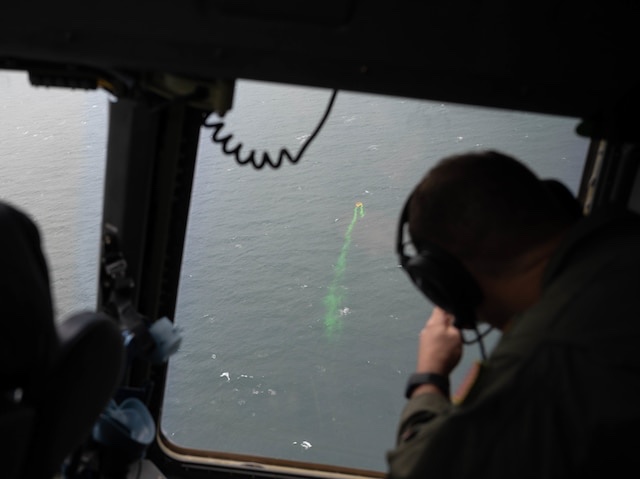
The real-life applications vary for each lesson so preparation and execution can take hours. One of the more involved exercises, combat survival training, starts at sunset and goes until students are rescued, which can sometimes be as late as midnight.

“We put students through an invasion and navigation scenario that culminates in their successful recovery at the end of it,” Scouton said. “With a two-man shop, we have to play many parts. We go from teaching the class to kicking off the survival scenario, then from trying to catch them to trying to recover them. We try to provide them with what could look like real-world information so if the real event does happen, so they would at least be familiar with the steps it would take to be successfully recovered.”

Many factors make Kadena’s SERE team’s courses unique. Not only do they have to take into account the island life environment, but they also have to contend with the variety of aircraft and missions based out of here. This means the local SERE specialists have to be well versed in the specific gear that accompanies each aircraft.

“With each one of the refresher training courses, we have to tailor training to particular aircraft and the equipment they have,” Scouton said. “Being that we have fighter ejection seat aircraft, heavy aircraft and rotary-wing aircraft, we have to carry a multitude of different equipment to make sure we are meeting the needs of each person.”

During deployments, the main mission for SERE is personnel recovery. This entails working with PR assets directly, getting in contact with isolated personnel, guiding them to recovery and finally reintegrating the recovered personnel into their regular day-to-day life.

“Reintegration takes place in three phases. Everyone goes through phase one. If they are psychologically and medically cleared, then they are fit to fight again.” Carter said. “Phase two and three go deeper, and require more rehabilitation and frequent visits with medical and psychological professionals.”

Although their schedules are usually packed with training and refresher courses, the SERE specialists find enjoyment with their roles on island.

“Some may perceive it as a difficulty, but since we have so many different types of aircraft and missions on Kadena, it gives us a good opportunity to actually teach all the available refresher trainings,” Scouton said. “It’s really provided us with a lot of opportunities that you wouldn’t be able to get elsewhere.”

By A1C Cesar J. Navarro, 18th Wing Public Affairs