Atrius Development Group

Archive for the ‘Guest Post’ Category

Oak Grove Technologies – FOV Drone Operator Course

Saturday, February 3rd, 2024

Mark your calendars! We’re excited to share our upcoming two-week digital FPV drone course, scheduled for 11-22 March 2024, at our Test and Training Center in Hoffman, NC (Adjacent to Camp Mackall).

Training Includes:

Expert Instruction: With a wealth of commercial and hobbyist experience, our instructors bring a unique blend of skill, passion, and real-world insights to elevate your FPV drone proficiency, including our lead instructor ranked 10th globally by MultiGP.

Optimal Training Environment: Navigate our tactical flying area plus student-build stations equipped with 3D printing capabilities for crafting custom parts. A protective net guards the pilot pit to ensure safety, offering a secure space for uninterrupted training.

Advanced Learning: Begin with computer simulations, mastering radio flight controls, and understanding FPV drone responses. Transition to hands-on experience, starting with basic flight skills on a Tiny Whoop, and progress to the 5” FPV drone you assemble.

Culminating Mission Experience: Reach the summit of your training with an immersive tactical mission scenario, where you apply and refine your skills in a real-world setting, solidifying your expertise through practical experience.

Materials: Upon completion, leave with your fully assembled digital drone, TX16S radio, HDZero goggles, spares, and a Pelican Air deployment/travel case.

This course is for military, government or law enforcement only.

Please Scan the QR code to begin the registration process, or reach out for more detailed information, including pricing and registration details: uas@oakgrovetech.com

US, Allies and Partners Integrate for Dynamic Targeting Kill-Chain Automation Experiments at Nellis AFB

Saturday, February 3rd, 2024

The 805th Combat Training Squadron, also known as the Shadow Operations Center – Nellis, executed their annual Capstone event by experimenting with and developing tactics, techniques, and procedures for integrated two-way kill-chain automation between the operational and tactical command and control including battle management levels, to create competitive advantages for the United States and its allies and partners at Nellis Air Force Base, Nevada.
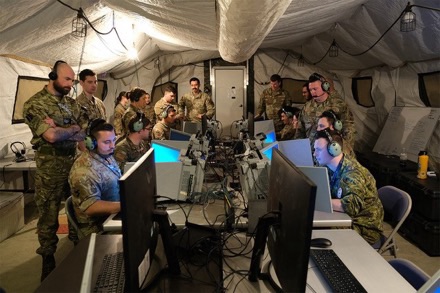
As the United States Air Force’s lead Advanced Battle Management System Battle Lab, the ShOC-N (a.k.a. the Rhinos) experiments and assesses emerging concepts, applications, and technologies, as well as develops TTPs for the Multi-Domain Operations Center of the future.  During the five-day Capstone event, the Battle Lab executed a constructive large-force employment, using data generated organically within the ShOC-N’s modeling & simulation environment, to improve dynamic targeting kill-chain automation through software integration and associated TTP development.
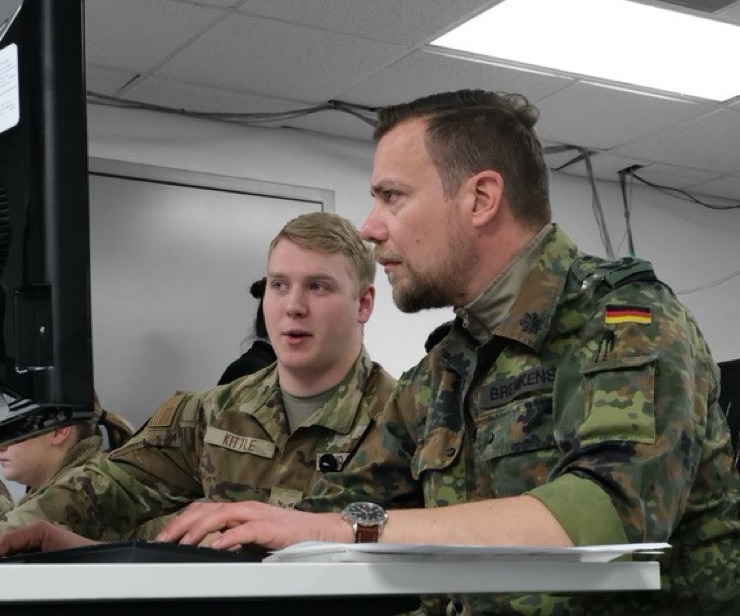
“During the Capstone event in 2022, the ShOC-N proved it was possible to quantify, observe, and measure command and control; the idea of measuring C2 has been overlooked in the past because of the misconception that ‘C2 is an art’. Human judgment will continue to play a critical role, but we’re proving C2 decision making is far more science than art,” said Col. Jonathan Zall, Department of the Air Force ABMS Cross Functional Team.  “The Rhinos are taking the lead to correct the oversights of the past. They’re developing and conducting crucial scientific C2 experiments.”
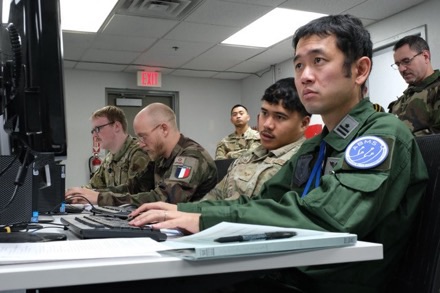
Zall continued, discussing the 2023 Capstone event. “The ShOC is an incredibly professional class act, disciplined ensuring the data is credible, not just if they like the toys, but how the tools perform, and they are measuring those things.  That is why I am genuinely impressed with the Rhinos, with everyone coming in and all the TDY support and everything that has been achieved.”

This year’s event featured independent but related experiments influenced by Indo-Pacific Command tactics that were identified and selected by the Command, Control, and Communications Battle Management, or C3BM, Operational Response Team, DAF, Air Combat Command, and Pacific Air Forces. Experiments included:

1 Dynamic Targeting Kill Chain Automation

2 Connect the Five Eyes, or FVEY, Battle Labs, also known as the Combined Federated Battle Laboratories Network, or CFBLNet, to the ShOC-N

3 Transformational Modeling for Battle Management, or TM-BM

4 Digital Battle Management Node, also known as Tactical Operations Center – Light, and Mobile Solutions

“The ShOC-N doubled the number of experiments this year and primarily focused on the scientific rigor needed for data collection and analysis in order to provide data-driven insights for new prototypes or processes,” said Lt. Col. John Ohlund, 805th CTS/ShOC-N commander.

The Dynamic Targeting Kill Chain Automation experiments utilized tools focused on increasing the speed, scale and accuracy of the find, fix, track, target and engage, or F2T2E, process for PACAF’s experiment while also supporting ACC’s NEXUS integration efforts.

The ShOC-N modeled and replicated PACAF’s current operational- to tactical-level systems and processes, allowing for the secure experimentation of two new dynamic targeting kill-chain automation technologies.

The ShOC-N hosted personnel from across the DAF, industry, and coalition partners for the experiment. Data collection and analytics measured speed, scale, and accuracy during the experiments.

The ABMS CFT’s experiment objectives focused on procuring data through connecting FVEY Battle Labs/CFBLNet, TM-BM, and data capture and debrief tools.

Japan Self-Defense Forces, German and French Armed Forces, along with FVEY New Zealand Defence Forces, and United States Air Force Weapons School students participated in the TM-BM artificial intelligence-enabled technology experiment known as “Match Effectors,” or the decision to appropriately pair effectors with targets while taking into consideration many factors.  The experiment observed two groups of participants one using one operating system’s software and a control group using a different operating system’s software to compare the effect of human-machine-team decision speed, quality, and human confidence in HMT solutions.

The United Kingdom and Canada were the first coalition partners to integrate into the ABMS Battle Lab, allowing them to connect and participate in the TM-BM experiment.  The ShOC-N is currently working with Australia and New Zealand to connect their Battle Labs.  The two FVEY Battle Labs used the CFBLNet enclaves to establish a releasable, or REL, environment allowing the exchange of mission-related files, simulation data, and voice/chat/data link messages, providing the initial validation for the United Kingdom and Canada to host future combined C2 experiments. 

“This new capability provides our coalition partners access to the Battle Lab as if they’re physically on the operations floor, allowing our partners to fully participate in CJADC2 [Combined Joint All-Domain Command and Control] and ABMS exercises and experiments,” said Jeffery Compoc, 805th CTS/ShOC-N chief technical officer.

During the final ABMS CFT experiment, the simultaneous effectiveness of four data capture and debrief tools that support C2 were assessed. The experiment compared the type of data collected, quality of measurements, and display between the four applications.

“Watching the TM-BM and dynamic targeting experiments was like holding a prism into the light to reveal distinct decision categories, like the prism reveals the distinct colors of the rainbow,” said Zall.  “We [ABMS CFT] eventually wanted to get to experiments where we combined different decisions, but there were concerns the more decisions we put together that each little decision might be lost in the chaos, but now we know that we can do these combined decision experiments because the Rhinos just did it and they’ve been doing it all week.  Since the Rhinos are so methodical with collecting data, we can use it like it was our own experiment.  All we have to do is apply the model and pull the insights from the data.”

Throughout the Capstone event, the TOC-L, now known as the TOC-enabled Control Reporting Center, or CRC, team executed tactical C2 primarily from the TOC kit in a tent outside the ShOC-N.  The TOC family of systems provides a tailorable Battle Management C2 center that scales up or down based on the Component Commander’s needs. The TOC kit is a mobile ground based tactical BMC2 capability used to conduct BM functions within a CRC or Air Support Operations Center.  The ShOC’s dynamic targeting and M&S cells sent data to the TOC enabled CRC for use within the common operational picture display and target prosecution. The experiment analyzed the operational speed of data exchange utilizing experimental software and traditional crews executing the target process.

The ShOC-N deployed Wi-Fi on the combat operations floor for the first time, allowing mobile solutions for C2 warriors.   The Rhinos, in partnership with the C3BM ORT office utilized ORT’s Mobile Solution tablets employing Commercial Solutions for Classified, or CfSC, infrastructure during the Capstone event. 

“The mobile solutions experiment allowed operators to move freely on the operations floor and maintain communications and situational awareness of the operations, while the ShOC-N analyzed battle-management data, instrumentation network metrics, and experimentation on the influence for the kill-chain execution,” said Compoc.

“The partnership between the C3BM Operational Response Team’s Mobile Solutions/CfSC prototype and the 2023 ShOC-N Capstone event provided battle management operators with a hands-on experience of what mobile C2 could look like in an ACE CONOP [Agile Combat Employment concept of operations] environment,” said Capt. Shane Toner, DAF C3BM ORT program manager. “C3BM collected user feedback of the operator experience while replicating the battle management functions of operator workstations on the ShOC-N operations floor that will influence CSfC capability and End User Device form factors for the future DAF Battle Network.”

Toner continued, the use of CSfC End User Devices can reshape thinking around operations floor physical layouts, the ability to collaborate and generate teaming environments, and the DAF’s ability to conduct mobile C2 in a wireless fashion. ShOC-N Capstone provided a key venue for the development of C3BM ORT’s plans for the Mobile Solutions prototype and the team looks forward to supporting the ShOC-N in 2024.

“What we are seeing here [at the ShOC-N] is 90% ingenuity and grit and 10% resourcing, so one of my messages back to my bosses and anyone who will listen is, now just imagine what these folks could do with more resources? And you can trust them to be good stewards of resourcing because they have already proved it,” said Zall.

The ShOC-N’s mission is to provide an environment for the DAF to make rapid acquisition decisions, provide data-driven requirements, and distribute warfighter feedback to the industry to drive information advantage and decision superiority against current DOD pacing challenges.

“The ShOC team is excited for 2024 and the continued experimentation with the Secretary of the Air Force’s Operational Imperative team for ABMS and CJADC2. Our goal is more experiments, potentially smaller and more frequent, and culminating in an annual Capstone,” said Ohlund.

Deb Henley

505th Command and Control Wing

Public Affairs

FirstSpear Friday Focus – Beanie & Neck Gaiter

Friday, February 2nd, 2024

Introducing the two latest editions to the FirstSpear ACM Lineup.

Neck Gaiter

Cut from the latest addition to the ACM family of materials and design, the Neck Gaiter – ACM 150 is the next evolution in FirstSpear layering systems. Years of feedback amongst clandestine units, across continents and bushwhacks abroad, provided our designers and engineers all the dope they needed to produce the Neck Gaiter of the 21st Century. With cutting edge stretch and durability, quality American stitching and color selections, you’ll be glad you squared yourself away with this one.




Beanie

The Beanie – ACM 150 is the latest advancement in our lineage of wool beanies. Made from the same revolutionary 150 wool blend as the Hooded Field Shirts v2. This Beanie provides the same stretch, durability and quality American stitching as the Neck Gaiter. Combine these two for solid protection.

Both are constructed of ACM Base 150 – 55% Lenzing FR, 33% Wool, 12% Nylon.

Visit FirstSpear to find American Made kit and accessories, Built For The X.

Marine Corps Selects Prototyping Participants for Medium Tactical Truck Development Program

Friday, February 2nd, 2024

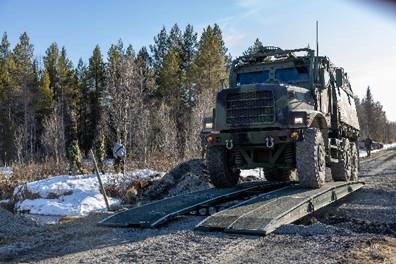
MARINE CORPS BASE QUANTICO, Va. — The Marine Corps has selected Mack Defense and Navistar Defense to participate in Phase I for the development of the Medium Tactical Truck (MTT) program. This pivotal phase, spanning an estimated 12 months, will see the performers leveraging the Corps’ top-level requirements to submit innovative design concepts and comprehensive project plan for Phase II (prototype build phase).

The Medium Tactical Truck is slated to replace the existing Medium Tactical Vehicle Replacement (MTVR) fleet, including Cargo, Dump, Wrecker, Tractor, and Re-Supply Variants. The focus of the competitive prototype phase will be on the Cargo variant.

Key top-level requirements for the Medium Tactical Truck include:

Cargo Variants: The MTT Cargo variants consist of three configurations:

a 10 ft Cargo bed

b 15 ft Cargo bed

c 20 ft Cargo bed

Hybrid Electric Technologies: Integration of hybrid electric technologies for reduced fuel consumption, extended range, and a silent watch capability.

Onboard and Export Power: 10 kW on-board power generation to support all mission packages and scalable exportable power up to 30 kW to meet external system power demands.

Mobility: Continued robust all terrain mobility with a 70% off-road and 30% on-road mission profile, with a unique 60” water fording capability specific to the United States Marine Corps (USMC).

Safety and Stability: Advancements in safety and stability control systems, increased interoperability, and heightened mission flexibility through modularity and open systems architecture.

Armor System: Modular and scalable armor system that allows for the change/upgrade of force protection and survivability levels, considering ease of installation and maintenance.

Maintenance and Reliability: Advancements in condition-based maintenance systems, increased reliability, durability, and corrosion prevention.

The Marine Corps looks forward to collaborating with Mack Defense and Navistar Defense in this crucial development phase, working toward the common goal of delivering a Medium Tactical Truck that meets the diverse and challenging needs of Marine Corps missions.

Marine Corps Systems Command

USMC Photo by Sgt Christian M Garcia

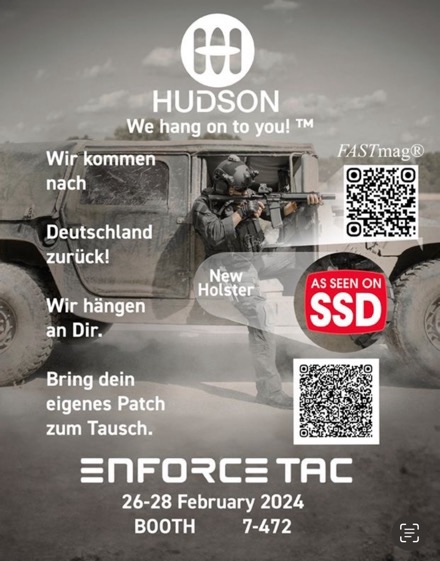
Visit Hudson Supplies Corp at Enforce Tac

Thursday, February 1st, 2024

Meet us at Enforce Tac 2024 (Nurnberg, Germany)  26-28 February 2024 (NEW 3 days event).

We’ll be introducing new products from Down East Innovation and Hudson Supplies Corp (USA)

Bring a patch and will trade for our Enforce Tac 2024 fun morale patch. 

Special offers will be available at the booth 7-472. 

VTAC Tomahawk Heart

Thursday, February 1st, 2024

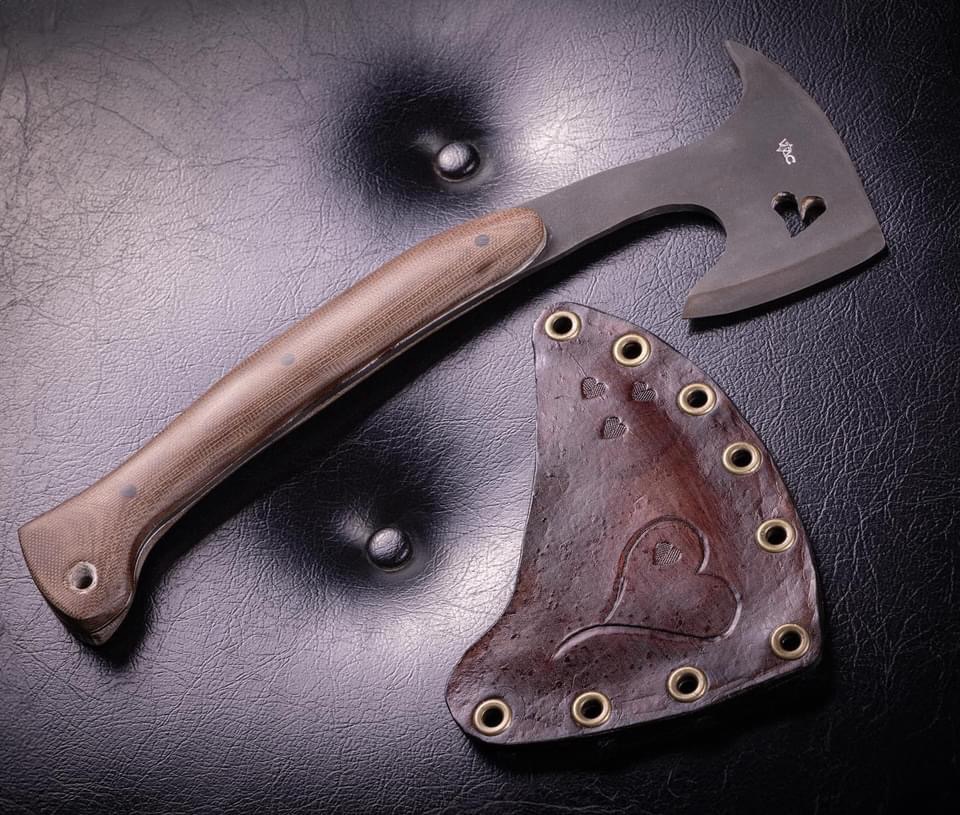
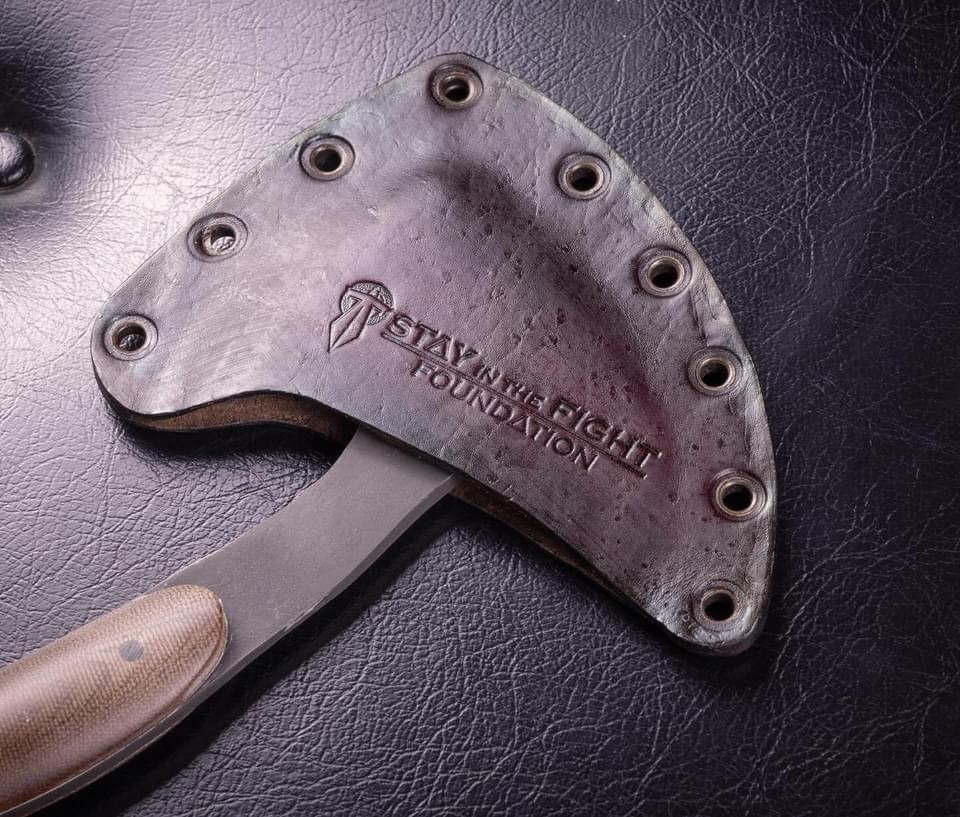
If you jump in the “Way Back” machine and look at many of the tomahawks from the frontier days of our country you will see many hearts cut into tomahawk blades. They wanted to make something similar so here is the VTAC take on old school with the asymmetrical heart and new school made with 80CRV2 Steel. The tang is tapered and the handles are made from canvas micarta. The leather sheath was made by Melynda and is decorated with hearts as well. Make a donation to Stay in the Fight Foundation and receive this, just in time for Valentine’s Day.

Available at www.vikingtactics.com/shop/vtac-tomahawk-heart

Northern Strike 24-1 Tests Winter Warfare Skills

Thursday, February 1st, 2024

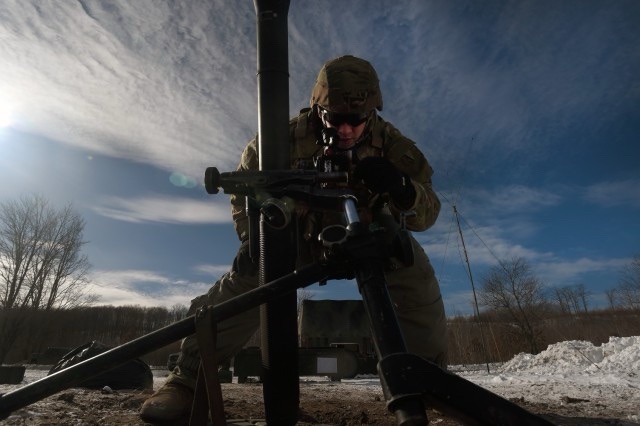
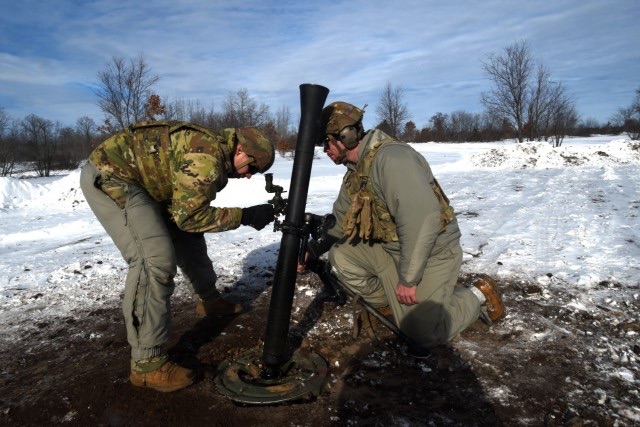
CAMP GRAYLING, Mich. – A frigid winter wind fluttered past the snow-covered landscape as Sgt. Shane Vanderhoek, an indirect fire infantryman with Headquarters and Headquarters Company, 1st Battalion, 125th Infantry Regiment, Michigan Army National Guard, adjusted his team’s 81 mm mortar.

Hunched over the mortar’s sights, the sun lit up his breath steamy and bright each time he exhaled while painstakingly making the needed adjustments. Though seemingly minor in their movement, each change took longer to make than expected.

“Everything is just cold,” he said. “A lot of our equipment takes longer to start to work, or it just doesn’t really like working.”

Learning to navigate those cold weather issues is one of the goals of exercise Northern Strike 24-1, a weeklong winter warfare training exercise hosted by the Michigan National Guard. Vanderhoek and his unit supported friendly elements while squaring off against both opposing forces and Arctic-like conditions.

“This just offers that extreme weather and the ability to test your ability to maneuver and to test your unit’s ability to function and plan in a totally different environment,” said Army Col. Todd Fitzpatrick, the officer in charge of the exercise’s ground elements. “With the temperatures we have, it closely replicates a near-Arctic environment.”

Held at Camp Grayling Maneuver Training Center and the Alpena Combat Training Center — which together comprise the Michigan Guard’s National All-Domain Warfighting Center — the exercise’s location and terrain make it and the National Guard key elements of the Department of Defense’s Arctic strategy, said Fitzpatrick.

“Obviously, Alaska is an ideal [cold weather] environment to train in,” he said, adding that getting units and their equipment to Alaska for training can be both difficult and expensive. “So, this offers a very similar climate, very similar complex terrain and just is cost-effective for units to do that near-Arctic training.”

Northern Strike 24-1 focused on integrated air and ground operations. Elements of the Army’s 5th Special Forces Group operated with close air support from Air Force and Michigan Air National Guard units while Michigan Army Guard units provided mortar and helicopter support.

The joint focus is another key element of the exercise, said Fitzpatrick.

“It’s really integral to Northern Strike because this is such a valuable training area for the joint force — air, maritime, land component — and, more importantly, across all domains of warfare,” he said. “The jointness and the all-domain nature of the exercise are really what separates it from others.”

Northern Strike began in 2011, typically taking place each August and often including participants from all U.S. military services and components as well as international partners. It was expanded to include a winter portion in 2020 after feedback, specifically from special operations forces, indicated a need for cold weather training.

“It was actually a demand from rotational units,” said Fitzpatrick. “SOF-oriented units wanted a place to train the way we do in a near-Arctic or winter setting with a complex maneuver space like we have here.”

While the winter portion of the exercise is typically smaller — this year’s iteration included about 200 participants while the summer exercise often includes more than 7,000 — its challenges are no less complex.

For Fitzpatrick, those challenges include ensuring the exercise meets or exceeds the training needs of participating units.

“It’s not a cookie-cutter exercise,” he said. “We like to say that every unit is the main event. So, it’s challenging deconflicting all that training, integrating those joint, multinational, multicomponent partners.”

Planning starts about a year ahead of the exercise rotation.

“Because we have two exercises, we have two [planning] cycles running,” he said. “And, of course, we’re looking into the future. We’re already scheduling units for 2025 and beyond.”

For Vanderhoek and many other units on the ground, the challenges are often more immediate, such as ensuring the mortar’s baseplate is emplaced properly.

“We like to dig little holes if we’re operating in a place just so the base plate can settle down easier,” he said. “Obviously, it takes longer when the ground’s frozen to do that.”

The frozen ground also makes it more difficult to ensure the mortar’s bipod support legs are dug in. Simply placing them on the ground means the mortar may move.

“Then we’re running the risk of the legs sliding out when we’re firing, which will cause a round to go somewhere completely different [than intended].”

None of those were challenges faced by the unit during its recent deployment to the Middle East, but the winter iteration of Northern Strike prompted them to find solutions to those challenges.

Though it took longer than expected, Vanderhoek dialed in the needed adjustments to the mortar.

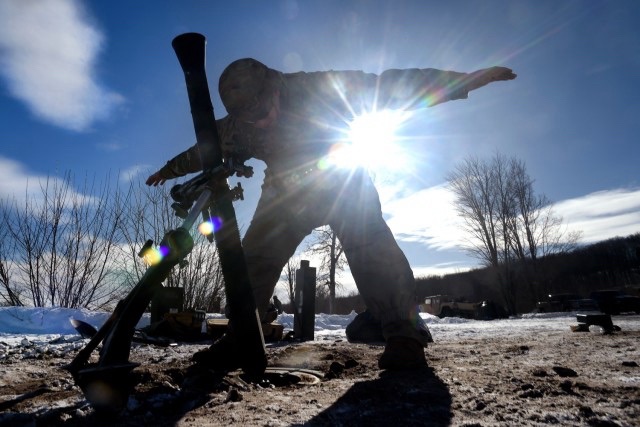
“Gun 1 is up,” he called out. Shortly after, another Soldier came out of the tent that served as the fire direction center.

“Fire mission!” he shouted, as Vanderhoek and his team scrambled into position to execute.

By SFC Jon Soucy, National Guard Bureau

WAPS Testing Going Digital in February 2024

Wednesday, January 31st, 2024

ARLINGTON, Va. (AFNS) —  

Beginning with the CY24 E6 promotion cycle in February, the Weighted Airman Promotion System test will be administered electronically, supporting a long-awaited modernization need in the Air Force’s personnel development efforts.

The eWAPS platform is a collaborative effort between the Air Force, the Personnel Data Research Institute and PearsonVUE. Airmen participating in the 2024 technical sergeant and staff sergeant promotion cycles will be the first to use this system.

“This initiative, along with others such as the myFSS applications, is just one of many human resources transformation efforts,” said Lt. Gen. Caroline Miller, deputy chief of staff for Manpower, Personnel, and Services. “Transforming HR Information Technology is one of my five priorities and underpins the entire HR enterprise.”

Promotion-eligible Airmen can anticipate receiving invitational emails later this month, prompting them to visit the PearsonVUE website to establish an account by creating a username and password.

Test Control Officers or unit WAPS monitors will contact each eligible Airman to come into the base education and testing center to sign for their assigned official test date. During this time, they will review testing instructions and individual responsibilities, which include the requirement to have their username and password with them on test day.

Airmen will also receive instructions on how to create their PearsonVUE account if they did not receive the PearsonVUE email or did not create an account due to reasons such as not updating their email in vMPF or a deployment.

Airmen are required to arrive in uniform, punctually, and with their Common Access Card. Additionally, it is now imperative for them to remember their username and password.

Lack of preparation, to include not having or knowing their username and password, can result in being marked as a no-show for testing. Airmen can retrieve their username using their first and last name and their email account and will also be able to reset their password by responding to security questions they established during the account creation process. Airmen who cannot reset their password and access their PearsonVUE account will be marked as a no-show for testing.

“This is a transformative step that enhances the careers of our Airmen,” said Chief Master Sgt. of the Air Force JoAnne Bass. “By aligning with industry standards, e-testing ensures a secure and innovative platform for a fair and equitable opportunity in promotion and career advancement. It also streamlines the process by allowing test responses to be submitted directly to the Air Force Personnel Center, eliminating the need for traditional mailing of answer sheets. This advancement not only instills total confidence in our Airmen but also provides unhindered access, empowering them to reach goals with greater efficiency and effectiveness. This is a much-needed change…and there are more to come!”

Airmen who are not co-located near a base testing center, such as Airmen assigned to a geographically separated unit, could test at one of many PearsonVUE centers, affording greater flexibility.

If eligible Airmen do not receive an e-mail or they can’t find it, they can go directly to the PearsonVUE website and create an account. Accounts can only be created through the PearsonVUE website after Jan. 30, 2024.

Secretary of the Air Force Public Affairs