Phantom Lights

Archive for the ‘Guest Post’ Category

Army’s Air Assault Division Ushers in Network Paradigm for Tomorrow’s Battlefield

Saturday, May 6th, 2023

FORT CAMPBELL, Ky. — The Screaming Eagles are experimenting with the latest iteration of modernized Army communications capabilities, both at home and abroad, to help guide development of technologies, doctrine, and policy.

Supporting the Army’s process of using Soldier feedback and lessons-learned to enhance the network, the 3rd Brigade Combat Team, 101st Airborne Division (Air Assault), or 3-101, recently completed an Integrated Tactical Network validation exercise at their home station, while elements of the Division are using additional capabilities while deployed to Romania.

Since its introduction to Soldiers in 2019, the Integrated Tactical Network, or ITN, has been providing secure but unclassified and encrypted mobile network communications that increase communications mobility, flexibility and resiliency. As part of division-centric network design efforts, the Army will simplify the network at brigade and below levels to support the Army’s Division as Unit of Action plan, which will elevate network-related complexity to the division echelon, freeing up maneuver units to focus on the fight.

“We are asking ourselves, what does that division commander need in order to command his division and all his forces, so we are designing the next capabilities to be centered around the division as unit of action,” said Col. Shermoan Daiyaan, Project Manager for Tactical Radios, under Program Executive Office for Command, Control, Communications-Tactical.

The key to refining ITN capabilities at all echelons is through continued fielding, Soldier feedback and iterative improvements, providing more units across the globe with hands-on, real-world experiences using the capability. The Army will use this feedback to inform Army of 2030 network designs, centered on large-scale combat operations.

So far, the ITN has been fielded to multiple infantry brigade combat teams across the 82nd Airborne Division, 25th Infantry Division, 11th Airborne Division and one Stryker unit, the 2nd Cavalry Regiment, with additional BCT and division enabler fieldings underway or planned for the remainder of FY23 and FY24.

The 82nd Airborne Division, as an early ITN adopter, will be the first full division equipped with ITN, followed by the 101st and 1st Cavalry Division.

“The ITN is going to give our commander better situational awareness of what’s going on across the battlefield,” said Chief Warrant Officer 2 Craig Alhouse, brigade network operations officer with the 3-101. “Whether we’re doing a forcible entry or an airfield seizure, what’s different is what’s displayed and how the commander reaches out to the subordinate and tells them what he needs them to accomplish.”

That also would give the commander more informed decision abilities in the long run, he said.

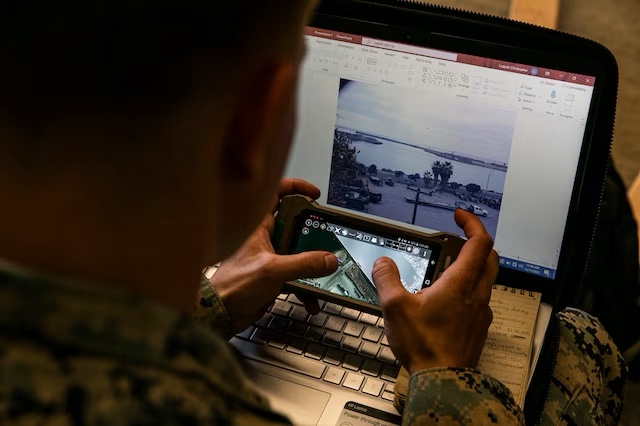
The thrust of the validation exercise featured individual Soldiers using the full ITN suite, including leader radios connected to their end-user devices to send text messages up to the brigade level, which then compiled operational graphics to send up to the nationalized higher headquarters over the Secret network.

With options for assured voice, text and graphics communications over several channels, the ITN provides multiple paths for communications, even in network-degraded environments.

“I think one of the things we noticed with ITN is that it removes the ability to say you didn’t get that message,” said Capt. John Dacier, 3-101 Brigade Assistant S3. “You have a plethora of ways to communicate all the way down to the granular level.”

The pathway providing seamless two-way communications is the Secure But Unclassified-Encrypted, or SBU-E, enclave. Since the ITN’s initial fielding, SBU-E has been used at the battalion and below level, with division headquarters and enablers communication at the mostly Secret level. Because communications are encrypted, SBU-E provides appropriate levels of security for safe mission partner collaboration without the complexity of setting up a secret environment.

As part of assessments that will inform division-centric design, the 82nd Airborne Division is nearly exclusively employing SBU-E at its Joint Readiness Training Command rotation this spring. The 25th Infantry Division is also incorporating SBU-E during this spring and summer’s multi-national Pacific Pathways exercises across Hawaii, the Philippines, Indonesia and Australia, providing the Army with even more critical feedback.

“Island hopping experimentation using SBU-E in the Pacific, and in the European theater, is critical for the Army to prepare for future conflicts because we will never fight alone,” said Daiyaan. “That’s real combat power at the tactical edge.”

Technology enhancements aside, Army leaders may consider policy changes to implement the proliferation of SBU-E network communications at battalion and below, which is a consideration for the next round of capabilities in 2025.

“We are looking at different courses of action to reduce that complexity at brigade and below levels, so if policy allows mission partner environment data exchange in SBU-E we could certainly reduce complexity because there’s fewer domains and enclaves,” said Matt Maier, Project Manager for Interoperability, Integration and Services, under Program Executive Office for Command, Control, Communications-Tactical.

In addition to exchanging operational graphics and position location information with Romanians inside of the mission partner environment, the 101st Airborne Division (Air Assault) is employing a simplified data plan focused on data security and credential management identification while deployed in Europe.

“Once you secure data, then you don’t necessarily have to secure the network all the time, [which adds] a layer of complexity,” said Lt. Col. (P) Randy Linnemann, 101st Airborne Division G6. “While we’ve been here, we made progress replicating a lot of our Army mission command information systems into a cloud environment.”

The 101st Airborne, along with the 4th Infantry Division and on a larger scale I Corps, has piloted data and cloud capabilities as part of the Army’s overarching data-centric networked environment experimentation.

“ITN brings [the ability] to pull that data from the edge up to the headquarters, process it at the headquarters and then deliver refined data back down to the edge,” Linneman said. “So we’ve become much more effective, pushing our data exchanges down to the lowest level so that we get the best data going through the chain of command, enabling more rapid and better decision making at every echelon.”

Leveraging the cloud to leave behind cumbersome network equipment, which can be vulnerable to damage due to the elements, also been a game changer, according to Linneman.

“Not having to run that equipment there with us has led us to actually have a higher reliability rate then we would have had running it on premise,” Linnemann said. “Having our data available to us everywhere we go in the world [in the cloud] is really kind of what we’re looking at.”

Army network developers are taking this feedback and incorporating it into cloud-native command post options for Army of 2030 network designs.

Over the next several months, the Army is working plans to simplify and adapt the network foundation for 2030, while enabling design and requirements to support Army of 2040.

As the Army moves forward with its preliminary design process for FY25 network design, it will also take lessons learned from previous, current and future laboratory and operational exercises to meet Division as Unit of Action requirements.

“Working with the 101st is our first opportunity to identify how we can move the complexity up to Division to meet Army 2030 imperatives,” Maier said. “Lessons learned and iterative improvements are the only way we get good at this, which is why we talk to units and pull them into the conversation early and often.”

By Kathryn Bailey, PEO C3T

FirstSpear Friday Focus – Concealable Vests

Friday, May 5th, 2023

This week, we’re focusing on our concealable vest options. The Slick™ and Deceptor™ are durable and lightweight discrete carriers.

Designed for wear underneath garments or load carriage platforms, the Slick is light and comfortable. The soft material can be folded up and stashed on your cargo pocket when not needed. This is a minimalist carrier and not designed to be an outer most carrier for overt tactical operations.

Sizing corresponds to SAPI plate size. Swimmer Cut available here.

Designed to conceal rifle velocity protective plates in hight threat environments, the Deceptor will discretely hold a pair of special threat plates and two 6” x 6” rifle side plates. Our Ragnar pockets can quickly attach to the front or the back of the carrier as well. The Deceptor shines with SAPI cut plates in the 2.2 to 4.5 Ibs medium-sized weight range which are .5” or thinner. For larger, thicker, or heavier plates, you need to consider another capability. This carrier comes with stretch and non-stretch shoulder straps to accommodate user comfort preference.

Check out FirstSpear to find American Made kit and accessories, Built For The X.

16th Annual Emerald Warrior Jumps Into Action

Friday, May 5th, 2023

HURLBURT FIELD, Fla. —  

Air Force Special Operations Command is hosting the 16th Annual Emerald Warrior exercise at multiple locations across Florida, as well as Puerto Rico and will run through May 6.

This joint, combined exercise provides realistic and relevant, high-end training to prepare special operations forces, conventional forces, and international partners in the evolving strategic environment, shifting focus to growing kinetic and non-kinetic effects in strategic competition.

Emerald Warrior applies lessons learned from real-world operations to provide trained and ready personnel to the joint force, while addressing priorities laid out in the 2022 National Defense Strategy. Vital to this effort are effective trained forces and strong international partnerships. Partner force participants for this year are primarily from France, Germany, and Lithuania.  

This exercise hones the skills of participating units and is an opportunity to test future concepts in support Agile Combat Employment operating under the new Air Force Force Generation deployment model. In line with AFSOC’s Strategic Guidance, the exercise fuels on-going pathfinding and experimentation efforts within the command.

By Air Force Special Operations Command

AFSOC Implements Wing-Level A-staffs, Breaks Down Bureaucratic Barriers and Increases Readiness

Thursday, May 4th, 2023

HURLBURT FIELD, Fla. —  

Five wings assigned to the Air Force Special Operations Command implemented the new wing air staff (A-staff) structure on March 30, 2023.

This change has been in the works since the 2021 CORONA Conference when Air Force Chief of Staff Gen. CQ Brown Jr. approved a redesign of the wing headquarters that adds a functional staff to an existing wing headquarter staff. The A-staff is designed to break down bureaucratic barriers, improve speed and quality of decision making, allow better alignment with higher headquarters and grow leaders needed for Great Power Competition.

“By reorganizing wing staffs, we streamline authoritative actions and processes throughout the chain of command,” said Col. Jocelyn Schermerhorn, AFSOC Director of Operations (A3). “This new structure alleviates the administrative burden at the squadron level allowing them to focus on the mission.”

Each wing within AFSOC is organized with an A-staff that best suits their mission set, which includes:

A1 – Manpower, Personnel, and Services  

A2 – Intelligence                                  

A3 – Operations  

A4 – Logistics, Engineering & Force Protection

A5 – Plans & Requirements 

A6 – Communications  

Wing Staff Agencies – such as Public Affairs, History, Chaplain, JAG Corps, Inspector General, etc., transition to Special Staff in the A-staff model.

Ultimately, Airmen are exposed to the wing A-staff and their processes earlier in their careers, making them better prepared for operating within joint organizations.

“Prior to this change, Airmen were arriving to headquarters assignments and joint deployments without a good or even general understanding of how a numbered staff functions,” said Col. Christopher Busque, AFSOC Director of Manpower, Personnel and Services (A1). “This new structure addresses that concern by allowing Airmen to gain exposure to the A-staff construct earlier on in their careers.”

The transitioning AFSOC wings are expected to meet full operational capability of the A-staff implementation by early FY24.

By 2nd Lt Cassandra Saphore

Effective June 1, First Term Airmen Can Retrain into AFSCs Under 90% Manning in Lieu of Separation

Wednesday, May 3rd, 2023

ARLINGTON, Va. (AFNS) —  

The Air Force is changing the process of how First Term Airmen can retrain to provide additional opportunities for Airmen to stay in uniform instead of separating.

Effective June 1, all FTA can retrain into any Air Force Specialty Code they qualify for that is under 90% manned prior to separation, even if their current AFSC is below 90% manned.

Qualified Airmen must be within their retaining window and meet medical, Air Force Enlisted Classification Directory standards, Armed Services Vocational Aptitude Battery score and physical fitness standards to be approved.

“Glad to see us make this change as it relates to retraining opportunities for the force,” said Chief Master Sgt. of the Air Force JoAnne S. Bass. “Providing these opportunities for our Airmen helps us keep talent on the bench. While this particular change impacts First Term Airmen, expect to see more initiatives like this as we evolve our policies and talent management to focus on the force of the future and building the Air Force our nation needs.”

Additionally, the FTA Retaining Selection Board is also no longer required during the retraining application process. This removes the racking-and-stacking retraining application process based on the number of quotas needed for a more streamlined ‘first in, first out’ process. Phase 1 FTA retraining quotas will be open to all FTAs entering their retraining window during Fiscal Year 2024.

The Exception to Policy will be reassessed June 1, 2024, unless it is rescinded earlier.

Secretary of the Air Force Public Affairs

Special Warfare Training Wing: Preparing for Strategic Competition

Tuesday, May 2nd, 2023

JOINT BASE SAN ANTONIO-LACKLAND, Texas   –  

We consistently talk about the future fight and preparing for strategic competition. This is by design, with the singular purpose of defending our nation against any who would test our resolve. The character of war is constantly changing, yet its fundamental nature remains the same. Special Warfare Airmen and operators must be prepared to face the harsh nature of war and be ready to master its new character.

Over the past 30 years, China has rapidly transformed its military capabilities, which means we must prioritize our own transformation and modernization to ensure superiority on the battlefield. We must be deliberate in the investment and development of our force to preserve our nation’s freedoms and way of life in the future.

How does the Special Warfare Training Wing fit into the equation? How does your work every single day determine the outcome of the future fight? Both are, in every sense of the word, vital.

This team shoulders the precarious burden of shaping the minds, strength and emotional capacity of our next generation of Air Force Special Warfare operators, the Multi-Capable Airmen who will remain our competitive advantage now and going forward.

Your daily work sharpens the most strategic players in our nation’s arsenal. But this extends beyond your work with candidates and includes your time with each other. Each of you is a strategic asset, able to leverage access, strike and recovery to position the U.S. for strategic advantage in competition. By taking advantage of everything this Wing offers, we look to ensure you remain the most agile, empowered, lethal and combat-effective Airmen in the world.

Yes, we select and equip the next generation of operators, but we also consider it our mission to invest in and develop our nation’s best who come to us as instructors and staff. Use this assignment to learn more about how your own brain works and how your body trains by taking advantage of the wealth of knowledge amongst your teammates.

Additionally, carve out time in your busy schedules to understand the environment of strategic competition and our adversaries. I recommend visiting the China Toolkit that Air University’s China Aerospace Studies Institute recently released. The Toolkit is full of videos, articles and even Chinese publications that the CASI team translated into English.

The work you do every day is crucial in preparing yourself, your colleagues and our candidates for strategic competition. I am proud of this team, and of everything you do to set our nation up for victory.

By Col Nathan Colunga Commander, Special Warfare Training Wing

High Risk, High Reward

Monday, May 1st, 2023

CAMP BONDSTEEL, Kosovo — The people of Kosovo have been working for over 20 years to continue removing unexploded ordnance from conflicts that occurred in the region. The torch has now been passed to the 720th Explosive Ordnance Disposal (EOD) Company during Kosovo Force Regional Command-East’s 31st rotation.

“Normally whenever we get one of the 9-lines they’re coming from local civilians,” said Sgt. 1st Class Matthew Baldwin, an EOD Technician with the 720th EOD Company from Baumholder, Germany. “They’ll encounter ordnance either on their own property or when traveling for commerce up in the mountains.”

The team typically receives two to three calls a week during the winter months, and up to five calls during the summer months. This increase is due to individuals going into areas that are usually inaccessible during the winter, like up in the mountains for example, Baldwin said.

“We’ve been finding a wide range of stuff, all the way from World War I up to the war in Kosovo back in the ‘90s,” said 1st Lt. Naomi Dawood, commander of Task Force EOD from the 720th EOD Company, Baumholder, Germany. “I would say hand grenades are probably the most common things we find here though.”

The EOD team at Camp Bondsteel is on call 24/7 and has an average response time of 30 minutes upon receiving a 9-line request. After normal business hours, or if there are multiple calls at once, it may take an hour or more before they are able to leave the base.

However, it’s not just the Soldiers from 720th EOD Company that gets to have all of the fun. Their team works closely with other NATO partners and allies, as well as the Kosovo Security Forces, or KSF, to work together on clearing the region and keeping communities safe.

“Working with other EOD units has really been an honor,” Baldwin said. “It’s very interesting to see some of their practices, they’re very different from what we typically do on response missions, but that’s because we haven’t had a lot of interoperability training with them before coming into theater.”

The KSF also has an advantage when it comes to locating these unexploded ordinances, known as UXO, according to Dawood.

“They’ve been super cooperative and eager to work with us,” Dawood said. “They obviously live here, so they’re a little bit more knowledgeable about the land than we are, which is nice when we get lost sometimes trying to find a UXO.”

The road to becoming an EOD technician is no small feat. The job comes with a rigorous interview process, followed by 9 months of advanced individual training. Another unique part about this military occupational specialty is that enlisted Soldiers and officers alike work side-by-side as classmates throughout the entire course.

1st Lt. Dawood originally wanted to become a doctor when she was commissioning through the Reserve Officers’ Training Corps program, but decided she wanted something a little more adventurous.

“Wanting to become an EOD tech is probably the best thing I’ve done in the Army,” Dawood said. “It’s very exciting and it’s always a challenge, which I really like.”

The excitement and challenges seem to be a large interest in those Soldiers who are interested in taking the career path of an EOD technician. As one of the noncommissioned officers in Task Force EOD, Baldwin said he also enjoys the high intensity moments that come with the job.

“As an EOD tech, I think my favorite part of my job is wherever I’m working with my team members, essentially by ourselves. There is a huge degree of responsibility we inherit whenever we are on mission,” Baldwin said. “We have support from local law enforcement and usually a medic, but other than that, it’s myself and two of my team members working on UXO calls in very high risk situations.”

Operations such as these are vital to the region in ensuring a safe and secure environment for all people of Kosovo. The collaboration between Kosovo Force and local law enforcement is essential for continuing effective communication and dialogue.

“The KFOR mission really is important because it is one of the examples of NATO coming together, supporting a conflict resolution and trying to bring stability to a region,” Baldwin said.

Task Force EOD is committed to their mission here in Kosovo. Their team members are dedicated to the history of the region and the people who live there today.

“This is something that I’ve heard about for a very long time, even before I became an EOD tech, so it’s awesome for me to actually be here and have an impact on the community and learn about the ordnance that’s here,” said Dawood.

By CPL Skyler Schendt

Sky Soldiers Train to Defend the Skies with NATO Allies

Sunday, April 30th, 2023

PULA, Croatia — A small group of 173rd Airborne Brigade paratroopers, or “Sky Soldiers,” traveled to Croatia take part in a multinational air defense and electronic warfare exercise from April 19 through 21, 2023 called Exercise Shield 23.

Exercise Shield is an annual Croatian air defense exercise that aims at strengthening the execution of air defense tactics against low and medium altitude moving aerial threats.

During the exercise this year, units from the United States, Croatia, Poland and Slovenia collectively trained on air defense and electronic warfare tactics, techniques and procedures, including air-space control, synchronization, surveillance, threat detection and live fire engagements against flying objects.

The exercise strengthened air defense interoperability between NATO allies by combining multiple air defense platforms in the same area of operations.

Capt. Mitchel Hess, the 173rd Airborne’s air defense officer, has attended the last two Shield exercises.

“The relationship we have built with the Croatians is of great importance to our collective security,” said Hess. “Through allied training and collaboration, we have developed a strong partnership. The Croatians have demonstrated their dedication and professionalism, and we look forward to continuing our partnership with them for years to come.”

Croatian Army 2nd Lt. Jure Brkic, Croatian Air Defense Regiment, has been one of the lead officers on the Croatian side for building a successful partnership with the 173rd Airborne Brigade.

“From the initial planning to final planning, we had a lot of brainstorming of ideas for training,” said Brkic. “And of course, the relationship between allies is important in many ways. Such as getting familiar with different doctrines, problem solving, interoperability and learning new weapon systems.”

Each country brought a different air defense platform to the seaside training area near Pula and utilized basic drones and flares to simulate detecting and engaging enemy targets. The Sky Soldier air defenders brought Dronebuster 3Bs, while the Croatian Air Defense Regiment used the QR-07S3 Drone Jammer System.

Last year, the Sky Soldiers brought FIM-92 Stinger missiles to engage launched flares. This year, Polish air defenders brought their Piorun Portable Anti-Aircraft Missile System or “Thunderbolt” and demonstrated two live missile launches.

Distinguished visitors from each participating country’s military came to oversee the training at the end of the exercise. The culminating event was an incredible display of NATO air defense. All countries’ militaries demonstrated their capabilities by engaging aerial targets with their respective platforms. From Dronebusters to missiles to anti-aircraft guns, the point got across — the air defenders are truly stronger together.

The 173rd Airborne Brigade is the U.S. Army’s Contingency Response Force in Europe, providing rapidly deployable forces to the United States European, African, and Central Command areas of responsibility. Forward deployed across Italy and Germany, the brigade routinely trains alongside NATO allies and partners to build partnerships and strengthen the alliance.





Story by MAJ Robyn Haake

Photos by SGT Mariah Gonzalez