SIG SAUER - Never Settle

Archive for the ‘Guest Post’ Category

AFSOC Establishes New Directorate: A7 Air Commando Development

Tuesday, May 16th, 2023

HURLBURT FIELD, Fla. —  

On April 25, Air Force Special Operations Command established the Air Commando Development Directorate, also known as the A7, that will lead the way America’s Air Commando’s deliberately train, exercise, experience, and educate to prepare, prevent, and prevail in competition.

This new directorate is aimed at providing policy, oversight, and guidance to support the Command’s collective training, readying Air Commando’s to win.

“We have a no-fail mission to ensure America’s Air Commandos are Ready to Fight Tonight,” said Lt. Gen. Tony Bauernfeind, AFSOC commander. “The A7 will serve as the AFSOC HQ Champion to ensure prioritization and integration of training, education, exercises and experiences for the command as we evolve to a new force presentation model.” 

Col. Eries L.G. Mentzer will serve as the first AFSOC/A7, Air Commando Development director and CMSgt Jeremiah Clark as the senior enlisted leader. The new directorate is the key integrator for the headquarters staff and will also closely collaborate with Headquarters Air Force and USSOCOM counterparts, as well as AETC, SOF partners, and allies to maximize knowledge sharing and leverage best practices.

“As the command broadens from decades of success countering violent extremism and organically gaining experience and building relationship through high ops tempo deployments, the A7 and Air Commando Development Center will orient Air Commandos to the evolved force presentation model, strengthened though integrated training and exercise experiences in a mission command culture,” said Mentzer.

In response to the Air Force Chief of Staff, Gen. “CQ” Brown’s cultural change areas, the A7 is also leading the command’s pivot to a Mission Command culture.  In partnership with joint counterparts and the LeMay Center, A7 will host the second Mission Command Summit, from 16-18 May, at Hurlburt Field to identify barriers to Mission Command in AFSOC formations.

The execution arm for the A7 will be the Air Commando Development Center, which is scheduled for activation on July 14 at Hurlburt Field.  The center will be comprised of units focused on education, training, and exercise integration executed by the U.S. Air Force Special Operations School, the 371st Special Operations Combat Training Squadron, and the 370th Special Operations Combat Training Squadron.

By Air Force Special Operations Command Public Affairs

19th SFS Implements New ACE Training Course

Monday, May 15th, 2023

LITTLE ROCK AIR FORCE BASE, Ark. (AFNS) —  

The 19th Security Forces Squadron recently implemented a new 30-day training program to equip defenders with the foundational skills and knowledge to counter peer adversaries, ensure security in an Agile Combat Employment environment and develop leadership qualities as valuable multi-capable Airmen.

The locally designed program, known as Agile Combat Employment and Leadership for Multi-Capable Airmen, was implemented in the squadron to reteach and emphasize the basics of air base ground defense and help train for atypical missions.

Defenders were able to expand their knowledge on dismounted operations and tactics and conduct by-law training, which teaches and evaluates use of non-lethal weapons for de-escalation, to demonstrate mission readiness in a contested environment and at home station.

“The main goal of this program is to better the capability of our defenders by honing in on close-quarters battle tactics and focusing on doing things to help out our adjacent forces, such as explosive ordnance disposal, medical and other career fields,” said Staff Sgt. Alexander Jackson, 19th SFS training instructor.

During the course, Airmen went through scenarios where they practiced security and troop-leading procedures while demonstrating base defense principles, force protection measures and multi-domain awareness.

ACE-LMC is an improved and revised program that was constructed from a previous week-long program called Horse Blanket.

“Horse Blanket was beneficial, but it only focused on by-law training and not much on dismounted operations,” Jackson said. “ACE-LMC helps us practice more on our skills and become more agile in order to be ready for tomorrow’s fight.”

Throughout the course, Airmen practiced active threat response in ready training areas, basic communications, chemical biological radiological and nuclear training, comprehensive Airmen fitness, integrated defense, small arms and tactical combat casualty care.

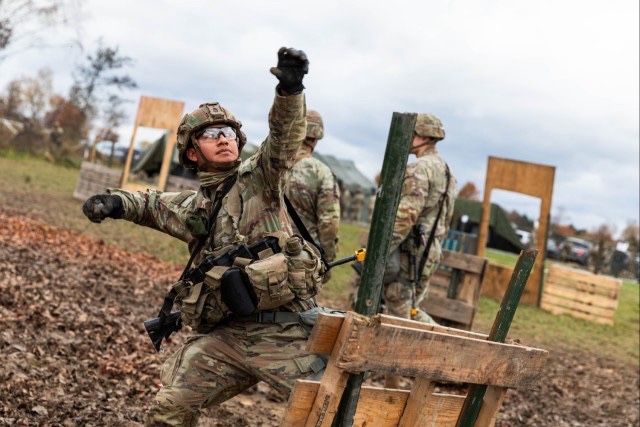
The 30-day training course culminated in a 12-hour field training exercise where defenders spent the night in a simulated contested environment, drilled securing and assuming control over an airfield and practiced various scenarios relating to air base ground defense.

As an instructor, Jackson gives defenders skillset repetitions that can be used in future operations and empowers Airmen at all levels with the opportunity to lead and train in a contested environment.

“My role as the lead instructor for the course is to motivate and bring the intensity back into our career field,” Jackson said. “We are trying to get Airmen out of their comfort zones and make sure that they are able to carry out the mission anytime and anywhere.”

The ACE-LMC program has successfully introduced critical training into the squadron, aiding in the development of mission-ready Airmen. All defenders are able to benefit from the course, whether they are fresh out of technical training or they have been in the unit for a while.

“As an Airman who just graduated from tech school not too long ago, ACE-LMC has been a refresher and I am able to enhance my skills,” said Airman 1st Class Angel Sacta Espinoza, 19th SFS main entry controller. “It really makes us think outside the box and realize that this is preparing us for future conflict against our adversaries. We are touching on stuff we don’t really perform day to day.”

Although ACE-LMC is currently only available to security forces members, Jackson said his hope is for Airmen from other career fields to be able to experience this training in the future.

“We are trying to integrate adjacent career fields to join in the course as well in order for them to gain familiarization on skills that could help them during a situation not related to their job,” Jackson said. “We want to make it bigger and better every time, and every day we learn something new and different in order to improve the course.”

By Airman 1st Class Maria Umanzor Guzman, 19th Airlift Wing Public Affairs

French-led NATO Exercise ORION is First of its Kind in Over 30 Years

Saturday, May 13th, 2023

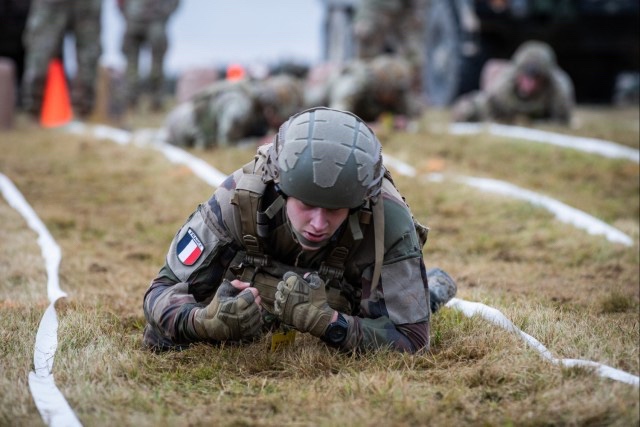
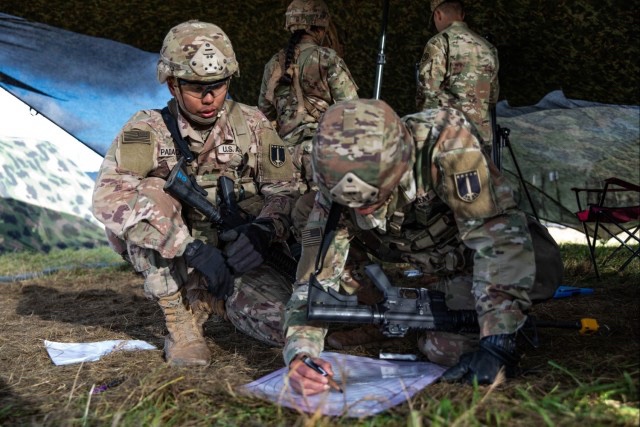
CAMP DE MAILLY, France — U.S. Army and NATO allies work side by side in a French-led interoperability coalition training for the first time in over thirty years.

The French 3rd Division’s exercise, Large-scale Operations for a Resilient, Integrating, high-intensity Oriented and New Army, nicknamed ORION, was a culminating national exercise that took place across several French regions, from April 17-May 4, 2023.

“It’s their national exercise, so it’s their ability to show that they can lead this force in a large-scale combat operation,” said Maj. Robert Moore, an operations officer assigned to 1st Battalion, 77th Field Artillery Regiment. “It’s also an opportunity to show that we can have seamless unity and be able to provide large-scale combat operations against any foe that we may encounter.”

The exercise combines field tactic maneuvers, artillery maneuvers as well as air-space surveillance technology with joint air-ground integration centers composed of command teams from multiple nations.

“ORION encompasses a command post exercise,” said Capt. Shawn Botin, a brigade planner assigned to the 1st Armored Brigade, 34th Infantry Division. “It builds multinational interoperability and allows us to train with our partner nations in NATO.”

The exercise jointly trained over thirteen countries and foreign military forces in multiple facets.

“Our main interoperability goal is to learn the similarities between our nation and the other nations,” said Botin. “This refines our processes because if the United States were to be called upon to serve with a partnering nation, we can assist with providing a seamless transition into their work processes.”

ORION focused on large-scale combat operations; foreign forces have rallied together under French 3rd Division command to exhibit multinational interoperability.

“We are not just here to train our Soldiers but also to assist with the training of the French 3rd Division as they are conducting the live portion of this exercise,” said Botin. “This exercise fortifies the relationships the U.S. Army has with its partners and lays the foundation to build new ones.”

During the exercise, U.S. Army troops with different specializations had the opportunity to work with their immediate counterparts from countries like Belgium, United Kingdom, Germany, Spain and more.

“I think the biggest take-away for the Soldiers is understanding that there are military members outside of the United States military,” said Botin. “Learning how to operate with them and seeing a specialist in the U.S. Army isn’t that much different from a specialist in the French or British forces.”

Moore went on to express that more than just on a tactical level, this campaign has benefited Soldiers on a personal level as well.

“The Soldiers love to work with other countries and to build camaraderie, not just within their own unit but also our partners’,” said Moore. “You realize that we have a lot more in common than we have different.”

By PFC Alejandro Carrasquel

FirstSpear Friday Focus – Sherpa

Friday, May 12th, 2023

Designed in conjunction with FS professional users, the Sherpa is a hard use day bag that can be put to work across a wide variety of environments and situations. Whether you are going to the range, relaxing on the boat, or heading to a call out, this bag is the perfect size for those on the move. It comes standard with full 500D construction and premium hardware. Interior organizer panels can be completely removed or re-arranged to fit new equipment. Our Deluxe Sherpa Divider is available to accessorize your new Sherpa.

Check out FirstSpear to find American Made kit and accessories, Built For The X.

M4 Weapon Accessories Added to Additional Authorized List

Thursday, May 11th, 2023

We’ve got some great news thanks to the CA Military Department Combat Shooting Team:

NEW service rifle quick-adjust slings, butt stocks and QD mounts have NSNs and are added to the Additional Authorized List, per TACOM. ALL of the following are -10 (End User!) level accessories:

Slings:

> Vickers Push Button quick-adjustable sling from Blue Force Gear (NSNs: Tan, NSN 1005-01-707-1744; Black, 1005-01-625-4470)

> Magpul MS4 Dual QD quick-adjustable sling (NSN: Black, 1005-01-693-8723; Tan, 1005-01-692-2559)

Butt Stocks:

> Magpul CTR (NSNs: Black, 1005-01-614-7778; Tan, 1005-01-616-4923)

> B5 Systems Bravo (NSNs: Black, NSN 1005-01-706-2373; Tan, 1005-01-706-2510)

> Hogue (NSN: Black, 1005-01-706-2547)

QD Rail Hardware:

> Side mount: NSN 1005-01-706-2552

> Top mount: NSN 1005-01-706-2366

Additional NSNs from PS Magazine.

DEVCOM Soldier Center’s Tube Foods Fuel High-Altitude Pilots

Thursday, May 11th, 2023

NATICK, Mass. — Proper nourishment is key to achieving great heights. This is especially true for the elite group of pilots who rely on the expertise of the Combat Feeding Division, part of the Soldier Sustainment Directorate, at the U.S. Army Combat Capabilities Development Command Soldier Center, or DEVCOM SC.

The Combat Feeding Division’s food technologists, equipment specialists, engineers, microbiologists and packaging specialists have been perfecting tube foods for almost 60 years. DEVCOM SC is the only place that designs and produces the foods that meet the specific needs of the Air Force’s U-2 reconnaissance aircraft pilots and the National Aeronautics and Space Administration’s, or NASA’s, ER-2 research aircraft pilots.

Elite pilots wear pressurized suits and helmets to perform their missions. The foods, which have a pudding-like consistency, come out of a container about the size of a large tube of toothpaste.

The tube foods are attached to feeding probes that are inserted into an opening in the helmets.

The tube foods help pilots power through missions that can last up to 12 hours. The foods come in 19 different offerings, including entrees, fruits and desserts. Choices range from chicken with tortilla soup, to hash browns with bacon, to key lime pie, to chocolate pudding with caffeine — to name just a few. Given the difficulty and length of pilot missions, caffeine is included in some of the selections. The offerings keep evolving. CFD plans to add pasta with marinara sauce next year as well as a new vegan option.

DEVCOM SC’s longtime and unique innovation and expertise in food science and technology and food packaging play a substantial role in tube food development.

“The Combat Feeding Division has a long history of developing nutritionally optimized, good-tasting ration products to meet warfighters’ unique needs and preferences,” said Erin Stomberg, PhD, RD, division chief of Combat Feeding. “The tube foods produced by the division food technologists are one important example of this. Air Force pilots on long flight missions need nutrition for sustainment and performance of their mission, and we are honored to provide this service to them. We accomplish this by using our knowledge of food product development and food processing technologies available in our pilot plant and listening to customer feedback in order to formulate custom varieties based on pilot preferences.”

Daniel Nattress, a food technologist who has served as the project officer for the Tube Food Program for 24 years, pointed out that “decades of knowledge and expertise go into every tube.”

“We have the expertise to make healthy, wholesome foods that taste good, meet nutritional requirements and meet required shelf-life requirements (three years at 80 degress Fahrenheit and six months at 100 degrees Fahrenheit),” said Nattress. “We also need to know how to manufacture foods which meet the nutritional requirements and still fit through the narrow straw-like probe.”

Nattress explained that colleagues in the Tube Food Program also have the “knowledge and expertise to operate the specialized equipment, as well as pack the tube food for safe storage and transportation.”

Equipment upgrades have improved the process. A new state-of-the art tube filler and sealer is easier to clean and maintain than the previous version and a new steam retort, which preserves the tube foods, is more efficient and extremely reliable.

Direct interaction with pilots is key to making the best product. Nattress and his colleagues have visited the home base of the U-2 pilots several times, and the pilots have visited Combat Feeding as well.

“Face-to-face contact is essential to understand what products the pilots want and for them to understand our capabilities,” said Nattress. “We conduct surveys with the pilots every three or four years to verify what they currently like, what they’d like to have and any changes they’d like to have. When we were at Beale Air Force Base, the training base, we got to try on the U-2 suits. This gave us an understanding of what they go through on their missions.”

DEVCOM SC’s efforts to understand pilot needs and to provide them with a quality product are reflected in comments from the U-2 pilots themselves:

“Caff apple pie (Caffeinated Apple Pie) is a must after 8 to 10 hours and preparing to recover the hardest jet in the world to land!”

“Nothing better than hash browns and bacon (Hash Browns with Bacon) after you kick on the autopilot during climbout to an early morning sortie.”

“Not only does it give us some energy, but it’s something we look forward to — especially truffle mac (Truffle Macaroni and Cheese). Delish.”

Comprehensive review sessions also provide Combat Feeding with additional insights.

“We also participate in the twice-yearly U-2 Program Management Reviews, a meeting of all government agencies and contractors,” said Nattress. “These meetings give us an overview of the entire U-2 program from Tube Foods to U-2 suits to the airframe. This gives us the overall picture and shows us where we fit in.”

Robert Bernazzani, team leader of the Joint Foodservice and Engineering Team, praised the comradery of the experts who produce the food tubes, their eclectic set of skills, and their creation of a quality finished product.

“It is very gratifying to be part of such an important and vital program for the military,” said Bernazzani. “Most of the work that is done in Combat Feeding is research and development. This program is unique because we actually not only do the R&D but produce the tubes that are consumed by the warfighter.”

“Everyone who works on the Tube Food Program, that includes several others from packaging specialists to microbiologists, are very proud to provide U-2 pilots the sustenance they need to perform these vital reconnaissance missions,” said Nattress. “When we have had the opportunity to visit Beale, or to host pilots, they are very appreciative of the products we are able to manufacture.”

By Jane Benson, DEVCOM Soldier Center Public Affairs

New AF Deployed Medical Training to Expand Medical skills, Build Multi-Capable Medics

Monday, May 8th, 2023

FALLS CHURCH, Va. (AFNS) —  

The Air Force Medical Service is expanding its MEDIC-X initiative across the Air Force to ensure all Airmen assigned to medical treatment facilities are adaptable and ready for a dynamic future battlefield. 

Brig. Gen. Thomas Harrell, Air Force Medical Readiness Agency commander, signed a memo on April 3 outlining the rollout of MEDIC-X across the Air Force by July 1. MEDIC-X is the Air Force Surgeon General’s initiative to ensure all medical personnel are equipped with the life-sustaining skills needed for a challenging and dynamic future battlefield where resources may be limited. 

“We know the future fight will be different, and so will the idea of what it will take for us to sustain readiness. I believe we are taking the necessary steps to do just that.”

Lt. Gen. Robert Miller, U.S. Air Force Surgeon General

The rollout of MEDIC-X is the Air Force Medical Service’s response to the demand for multi-capable Airmen, aligning with Air Force Chief of Staff Gen. CQ Brown, Jr.’s operational doctrine, which requires equipping Airmen with skills that go beyond their duty title. 

“Future conflict will never look like wars of the past, and that is why we have to get after building multi-capable, strategically minded Airmen today, so they can compete, deter, and win tomorrow,” said Chief Master Sergeant of the Air Force JoAnne S. Bass. “AFDN 1-21 presents, in doctrine, expeditionary and multi-capable Airmen capable of accomplishing tasks outside of their core Air Force specialty to provide combat support and combat service support to [Agile Combat Employment] force elements.” 

With MEDIC-X, every Air Force medic, including those not involved in patient care like administrators or lab technicians, will need to be proficient in 52 skills that will ensure the Air Force’s medical force is ready for the next fight. 

“These 52 skills are not normally within a majority of medical group training,” said Lt. Col. Samantha Kelpis, the Air Force Medical Service’s MEDIC-X team lead. “An administrator doesn’t normally do any hands-on patient care. MEDIC-X trains them on skills they will need in a challenging deployed environment where the priority is not going to be completing administrative tasks, it is going to be saving lives. When they are deployed and resources are limited, they need to know how to perform some level of patient care.” 

MEDIC-X’s 52 skills encompass base-level patient care that is easily teachable through hands-on, in-person training to any medical personnel, whether they treat patients regularly or not. The training includes such skills as assessing pain levels, infection control, taking a patient’s vital signs, assisting with spinal immobilization, patient movement, and respiratory care. 

According to Kelpis, every medical Airman must participate in the full annual training or demonstrate competency in those skills in a formal evaluation. She also explained that most physicians, nurses, and medical technicians can be granted credit for most of the skills, especially the ones they use in their day-to-day jobs. 

“Even though the MEDIC-X training is primarily focused on those individuals who do not engage in direct patient care on a regular basis, there could be skills a traditional clinician may need a refresher on,” Kelpis said. “For instance, if you are a critical care medical technician who works with an aeromedical evacuation unit, you would be familiar with most of the MEDIC-X skills already compared to a family medicine medical technician that works in a clinic. Those clinical-focused individuals may not have the working knowledge of a ventilator or offloading a patient from a fixed wing aircraft depending on their prior work or deployment experience. With that said, those individuals would need to go through the training of those skills they are unfamiliar with.” 

By Shireen Bedi

Air Force Surgeon General Public Affairs

Stepping Back in Time, U.S. Soldiers Invited to WWII Reenactment in Bulgaria

Sunday, May 7th, 2023

NOVO SELO TRAINING AREA, BULGARIA (April 23, 2023) – On 23 April, U.S. Army Soldiers from the Army Support Activity-Black Sea (ASA-Black Sea) stationed at Novo Selo Training Area (NSTA), along with the 1st Battalion 18th Infantry Regiment, and the 418th Civil Affairs Battalion attended a World War II reenactment in Yambol, Bulgaria.

The Military Historical Reenactment of “Hungarian Spring 1945” depicted the battle between the Bulgarians and Germans near Lake Balaton in Hungary at the end of World War II.

The event featured weapons, explosives, howitzers, military trucks, several motorbikes, and a stationary tank.

Twenty students from the National Military University “Vasil Levski” in Veliko Tarnovo and 45 volunteers from the Reenactment Club participated in the reenactment.

“U.S. Army soldiers were in the audience and watched the historical reenactment,” said Georgi Vardarov, Director of the Museum of Battle Glory. “By the time the Bulgarians were fighting the German-Nazi soldiers, the American Army was also fighting the German Army, but on the Western front,” said Vardarov as he emphasized the significance of bringing together Bulgarian and American military personnel during the reenactment.

The reenactment lasted an entire 20 minutes, and spectators had the opportunity to relive the historic battle through their own eyes.

“It is an honor to be here and learn so much about Bulgarian history and its role in World War II. I got the chance to see many historical vehicles and weapons that were key to the Bulgarians’ success in the battles they fought,” said Cpt. Avery Smith, a team leader assigned to the 7th Mobile Public Affairs Detachment. “The re-enactment was phenomenal, and I could tell that a lot of details and training went into perfecting this performance for the guests. Their ability to preserve their history so well makes me proud to say we are military partners. Bulgaria is a beautiful country, and the community here in Yambol felt friendly and welcoming.”

Besides the reenactment, the museum also set up static displays of tanks and other military equipment from WWII for visitors to see up close.

“This event with the Yambol Military Museum was a wonderful way to educate not only myself but the rest of the U.S. Personnel who were present,” said James Adamski, deputy garrison Manager at NSTA, as he shared his appreciation for the opportunity to learn about Bulgarian history. “Very few people know of the Bulgarian History that was so very critical at the end of WWII.”

ASA-Black Sea continues to build strong relationships with the local communities as it emphasizes the importance of strengthening its ties with the people of Bulgaria.

By Joshua Rojas