Register Now for SOF Week

Archive for the ‘Guest Post’ Category

The Long Wait Is Over: Vietnam Veteran to Receive Medal of Honor

Saturday, March 4th, 2023

WASHINGTON — The White House announced retired Army Col. Paris Davis will receive the Medal of Honor for his acts of bravery as a commander during the Vietnam War.

President Joe Biden will present the award to Davis during a ceremony at the White House Friday.

Davis commanded American Special Forces as well as an inexperienced South Vietnamese company against a large North Vietnamese force June 17-18, 1965. His tactical leadership allowed the company to gain an advantage and surprise the enemy.

Davis was wounded in the initial assault, but he continued to push forward, killing several enemy soldiers.

Following a counterattack from the North Vietnamese and facing intense gun fire, Davis led a small group of Soldiers as they destroyed locations defended by the enemy.

Davis then regrouped with his company and ordered air strikes on the enemy. The North Vietnamese, however, launched another attack with increased numbers. Davis was again wounded but managed to hold off the enemy.

Noticing two of his Soldiers seriously injured, Davis disregarded his own safety and went to save them. He was shot in the leg as he pulled the first one to safety.

Davis went back to get the second Soldier and drew heavy enemy fire. He crawled 150 yards and was hit by grenade fragments, causing multiple wounds. He didn’t let that stop him and was able to get the Soldier to safety.

After rescuing both men, Davis directed the helicopter extraction of the wounded but refused it for himself. He continued to fight the enemy until his entire company made it out safely. He then remained on the battlefield to coordinate the final aerial and artillery attacks, ensuring victory.

Davis saved the lives of multiple Soldiers during the battle and led his company to victory over a much larger enemy force. He was awarded the Silver Star for heroism.

Now, after nearly six decades, Davis will receive the nation’s highest award for military valor.

By Christopher Hurd, Army News Service

Light Fighter Manifesto Volume II

Friday, March 3rd, 2023

Are you ready to go where the mainstream media fears to tread? Then our uncensored Light Fighter Manifesto Volume II, “Disrupt and Destroy,” is just what you need!

We’re not afraid to dig deep into the darkest corners of modern warfare and technology. Our team of writers exposes the world of emergent war, uncovering the strategies and trends shaping the current conflicts.

This hard-hitting volume examines disruption and denial operations from anti-tank tactics, cyber warfare, nefarious drone use, and sniping. We also spend time underground and explore the dangers of Subterranean Operations.

Head over to CR2 Supply Cage to Order.

FirstSpear Friday Focus: Technical Woobie

Friday, March 3rd, 2023

The FS Technical Woobie™features top of the line materials including FS-WARM ACM 600 Merino Wool, our warmest wool layer. 100% made in the USA with 100% USA materials backed up by our standard lifetime warranty on materials and craftsmanship.

Premium nylon accents add abrasion and wind resistance, making this a durable cold weather top when worn as the outer layer.

The Full-length zipper and pockets utilize premium YKK zippers and durable FirstSpear S-Pulls.

Buttonholes inside the hand-warmer pockets and cord loops along the internal zipper seams allow for easy and discreet cable management.

Hood drawcords stash inside for windy days and an external loop hanger on the back gives you a handy place to secure the garment.

The cuffs are strategically designed with thumb holes for added protection and comfort.

The Technical Woobie offers an everyday style thats matched with some of the most high-performance material combinations available and will quickly become your go-to top when the weather drops.

The Technical Woobie has a climbers fit (more fitted). If you prefer a loose fit, go up one size from your regular wear (L goes to XL).

Visit FirstSpear to find America’s premier tactical gear and equipment.

US Army Tests Cutting Edge Parachute System

Friday, March 3rd, 2023

YUMA PROVING GROUND, Ariz. — In a combat theater, ground troops in the most isolated areas depend on airlifts for resupply. In the worst conditions, time can be a matter of life or death.

U.S. Army Yuma Proving Ground is home to all manner of parachute testing, with spacious and instrumented ranges large enough to accommodate even the world’s largest cargo parachutes.

YPG has long been on the cutting edge of developmental and operational testing of new airdrop capabilities, including the Rapid Rigging De-Rigging Airdrop System, or RRDAS, which promises to get Soldiers out of a drop zone and into the fight with the equipment they need faster than ever.

Conventional cargo payloads are typically cushioned with a honeycomb-like cardboard material between the vehicle or other heavy item and the steel palette that carries it from an aircraft to the ground. Even with good cargo parachutes and a perfect landing, multiple layers of the honeycomb will collapse upon impact with the ground. RRDAS, however, dramatically reduces the amount of honeycomb necessary to dissipate the force of impact with 10 reusable airbag modules. The self-inflating airbags can be utilized as low as 750 feet above ground level and carry loads from between 5,000 and 22,000 pounds.

“When it flies through the air, ambient air pressurizes all of the fabric-based airbags,” said Maj. Matthew Rohe, Assistant Product Manager for Cargo Aerial Delivery at the U.S. Army Program Executive Office Combat Support and Combat Service Support. “When it hits the ground, the airbag modules cushion the payload, so we don’t need as much honeycomb as in the current design.”

The reduced use of honeycomb should lower rigging time by 25%, but testers are particularly excited about reducing de-rigging time by 40%, which gets Soldiers out of harm’s way faster.

“The end state is that it will reduce the de-rigging time by about two and a half hours primarily through the reduction of the use of honeycomb so Soldiers on the drop zone won’t have to use axes, shovels and picks,” said David Emond, operations manager for Product Manager Force Sustainment Systems. “Currently, once the vehicle crushes the honeycomb Soldiers have to cut out all the honeycomb around the vehicle’s tires to be able to drive it off.”

The system also boasts features to ensure an airdropped vehicle will land upright.

“The system has deployable outriggers on it,” said Rohe. “If it is a high center of gravity load with a chance of tipping over when it hits the ground, these outriggers kick out and will stop it from flipping over.”

Though developmental testing of RRDAS is scheduled to end later this year and full fielding of the system to troops is expected in Fiscal Year 2025, intermittent testing at YPG based on feedback from operational testing at Fort Bragg, North Carolina should continue for two years after that.

“We will be able to increase the load of the payload and the length of the platform so we can drop heavier and longer items,” said Rohe. “We’ll be testing on and off at Yuma for several years to come.”

YPG is the Army’s primary personnel and cargo parachute tester, with decades of institutional knowledge in both rigging and evaluating these complex airdrop systems, as well as coordinating multiple sorties safely. The post’s nearly 2,000 square miles of restricted airspace and favorable weather make it an ideal location for air drop testing.

“We always use YPG because of the test assets available,” said Emond. “It is safer and cheaper to conduct developmental testing here: it is the most reliable and dependable place to get the aircraft that we need to fly test missions.”

By Mark Schauer

Airborne Innovation Lab Presents Additive Manufacturing Course

Thursday, March 2nd, 2023

Last week, the AIL hosted a Basic Additive Manufacturing Course. This 40 hour course taught the basic concepts of Additive Manufacturing and how to efficiently implement it within the DoD.

Students came from various units across Fort Bragg including Division, 18th Fires, 3SFG, and 2SFAB. Students completed the course with a capstone project Highlighted here was a handcuff skeleton key which van be hidden in a boot lace.

AIL offers a variety of courses that can be found on our website:

www.army.mil/82ndairborne#org-airborne-innovation-lab

First-Ever Multi-Domain Effects Crews Increase Readiness at Fort Huachuca

Thursday, March 2nd, 2023

FORT HUACHUCA, Ariz. — Senior leaders from across the Army converged on Fort Huachuca on Feb. 13, to observe a new development in Army Modernization: the successful conclusion of the 1st Multi-Domain Effects Battalion’s inaugural exercise, conducted on the newly built 1st Lt. John R. Fox Multi-Domain Operations Non-Kinetic Range Complex.

Throughout the day, the 1st MDEB demonstrated a wide array of non-kinetic effects, highlighting the significance of this milestone in the 1st Multi-Domain Task Force’s path to become fully operationally capable.

The Multi-Domain Effects Battalion, assigned to the 1st Multi-Domain Task Force, has the mission of employing non-kinetic effects to deter adversary aggression in the Pacific.

The commander of the U.S. Army Intelligence Center of Excellence and Fort Huachuca, Maj. Gen. Anthony Hale, hosted the visiting party, consisting of almost 50 general officers and senior leaders, to demonstrate the effects of a collaborative effort to create realistic training and to test Army crews on using technologies and hardware that no military on earth has ever before fielded.

“This is a great opportunity for Fort Huachuca to show our unique capabilities in the electromagnetic spectrum on the 1st Lt. John R. Fox range,” said Hale. “We have 700 acres of training area, we have 1,500 square miles of restricted airspace, and since we are surrounded by mountains, we can keep the electrons in our range complex. And this really allows the MDEB to come out here and really test their capabilities to train on their systems that they are going to deploy with into theater.”

Completion of this range complex marks the culmination of two years of collaborative effort, starting when the Chief of Staff of the Army approved Fort Huachuca for a planning task to develop the first multi-domain operations-capable range.

“We have been testing equipment for the Army and for the joint force for over 70 years now we are bringing this training capability, not only to the Army, but to the joint force,” said Hale. “The MDEB is training their teams on their equipment that they will deploy with into theater and use. As we do that in the joint environment, that makes everybody better in our warfighting capabilities.”

Soldiers training on this new range complex emerged with an enhanced understanding of multi-domain operations and their important role in the Pacific region, ultimately to ensure a free and open Indo-Pacific.

“This will certainly be a key component of our training program as we move forward,” said Brig. Gen. Bernard Harrington, commander of the 1st Multi-Domain Task Force. “As our Soldiers go through this training, they are rehearsing their individual and small unit tasks in preparation to deploy forward in theater and operate in a real-world environment.”

This exercise is a major milestone, and a critical part of a massive Department of Defense effort to modernize the force and prevent future conflicts.

“The Army and the Department of Defense is taking on the largest modernization effort in the last four decades,” said Peter Don, Senior Technical Advisor for USAICoE and Fort Huachuca. “We realized that as we modernized our kit, our capabilities, and our formation, our ranges were not keeping pace and would not allow us to work through the next generation of weapon systems, collection systems, and also have us work through our warfighting functions and concepts. So, we wanted to create an environment and a range and a training area that would allow us to train and certify our Soldiers on their weapon systems, but also explore and expose different technology that will allow us to adjust how we need to fight.”

Story by LTC Derek Wamsley, 1st Multi-Domain Task Force

Photos by SFC Henrique De Holleben

Access and Opportunity: How the Naval Studies Certificate Starts the Journey of Lifelong Learning

Wednesday, March 1st, 2023

OAK HARBOR, Wash. – AWO2 Brooke Graham was one of the first 34 students to complete the Naval Studies Certificate, a naval-relevant education program offered as a part of every associate degree program with USNCC.

“Petty Officer Graham, you have a visitor,” says one of the chief petty officers attached to the command. Naval Aircrewman (Operator) 2nd Class Brooke Graham, of Oakley, California, looks at the senior enlisted leader with furrowed brows. Sgt. Maj. Michael Hensley introduces himself and congratulates her on her recent completion of the Naval Studies Certificate.

“I’m used to being around Navy people all the time,” said Graham about her experience with USNCC. She said her interactions with active duty Sailors, Marines, and Coast Guardsmen in the five courses that comprise the Naval Studies Certificate “makes me take a step back and see how we fit in. It gave me more awareness of our place in the world and how our mission impacts it.”

Graham was one of the first 34 students to complete the Naval Studies Certificate, a naval-relevant education program offered as a part of every associate degree program with USNCC. These five courses were taught entirely online and asynchronously, giving service members access and opportunity to balance their work life with the pursuit of naval-relevant education.



“We can’t spend our way to victory,” said USNCC’s Sgt. Maj. Michael Hensley. “We need to educate our Sailors, Marines, and Coast Guardsmen if we want to invest in our success.”

 “The Naval Studies Certificate is designed with fleet input to be both a part of the student’s associate degree and build skills the operating force needs,” said Russ Evans, associate dean of Naval Studies at USNCC. “Whether it is expeditionary advanced operating bases or distributed lethality, we will ask more junior individuals to make bigger decisions with less support more quickly. The Naval Studies Certificate is designed to prepare students for those challenges.”

The Naval Studies Certificate’s 15-semester-credit program is a stackable certificate within each of the associate degree programs offered by USNCC. These stackable certificates mean USNCC students will be able to build on the education they earn to develop a journey of lifelong learning.

“We want our Sailors, Marines, and Coast Guardsmen to continually progress in learning. Through continued lifelong learning, our men and women in uniform are key to enhancing operational readiness and advancing the warfighting advantage over our competitors and adversaries,” said President Randi R. Cosentino, Ed.D., of USNCC. “This Naval Studies Certificate program is a key component to ensuring the Navy, Marine Corps, and Coast Guard better develop the intellectual talent we have at all paygrades in the services.”

The Naval Studies Certificate program opened up for a pilot command-referral phase February 1, 2023. These Sailors, Marines, and Coast Guardsmen will be directly referred by their commands as prime candidates to earn an independent Naval Studies Certificate.

“For the USNCC to be successful, we have to provide naval-relevant classes and content,” said Dan Goff, Ph.D., professor of Naval Studies and a retired Marine. “The only way we can really ensure that is feedback from the students, but also the commands where those students come from.”

After her studies, Graham was meritoriously promoted to petty officer 2nd class, a process that relies on the Sailor maintaining sustained superior performance as identified by command leadership. While the promotion was not the direct result of her education, Graham said the Naval Studies Certificate helped her take a step back and see how she fit into the bigger picture of the mission.

To learn more about the Naval Studies Certificate program, or to find out more about the command nomination program, go to www.usncc.edu

The United States Naval Community College is the official community college for the Navy, Marine Corps, and Coast Guard. To get more information about the USNCC, go to www.usncc.edu. Click on the Apply Now link to become a part of the USNCC Pilot II program.

From Chief Mass Communication Specialist Xander Gamble

Army Software Factory, USAREUR-AF Partner on Tech Modernization

Tuesday, February 28th, 2023

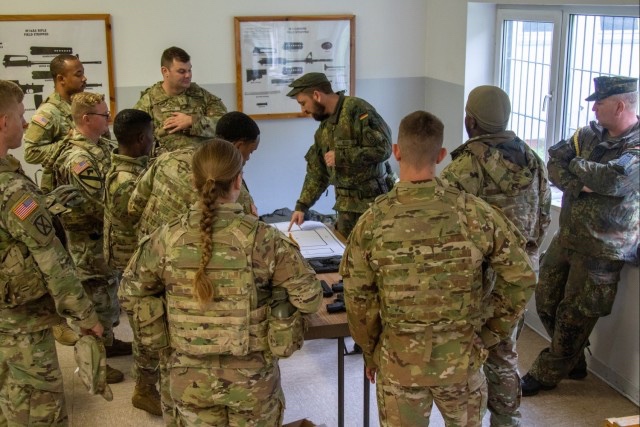
GRAFENWÖHR, Germany — In today’s rapidly evolving digital landscape, many organizations strive to stay ahead of the curve in terms of technology and innovation. The Department of the Army is no exception, and its efforts to modernize and streamline its operations have recently taken a leap forward due to the agile software development processes of the Army Software Factory, or ASF.

The ASF is a significant step forward in the modernization of military operations. By streamlining an agile software development cycle, minimizing the need for external acquisition and promoting collaboration, the ASF is positioned to deliver innovative solutions to the military.

“The idea here is that we’re trying to meet Soldiers where they are at,” said 1st Lt. Aanand Shah, a software engineer for ASF. “What that means here in Europe is we are able to develop solutions that can work across multiple networks with Allies, partner countries and nations as well as internally within theater.”

During a recent interoperability exercise at 7th Army Training Command the Soldier-led ASF, in collaboration with U.S. Army Europe and Africa Mission Command Support Branch, developed new solutions directly addressing issues that in the past created challenges for U.S. and NATO allied system interoperability.

“My developer initially wrote an application that would bridge data between U.S. and NATO systems from the Army Tactical Assault Kit,” said Martin Christian Dudel, a civilian senior software engineer with USAREUR-AF. “The Army Software Factory came to Europe and helped us modernize the code and take it from a standalone application that must run on a server, into a container that can operate in a cloud native environment on the tactical edge bridging U.S. and NATO systems. This is a capability that we didn’t have before.”

The solution opens an entirely new range of possibilities as now essentially any application can be developed, deployed and seamlessly interact with the data of a partner nation’s application operating at the tactical edge.

“We’ve developed a path to production where apps go from origin to security scanning to deployment into Kubernetes clusters that will run on a TSI stack here on the edge of the battlefield,” said Sgt. 1st Class Joshua Millett, a platform engineer with ASF.

At the heart of ASF is a commitment to continuous improvement and a focus on collaboration. Teams within the ASF are encouraged to work together and closely with their end users to cultivate user stories, share ideas, determine best practices and learn from each other. This helps foster a culture of innovation and ensures that everyone is working toward a common goal of delivering high-quality software solutions to meet the needs of the military.

“It’s incredibly rewarding for our Soldiers to assist USAREUR-AF in accomplishing its challenging mission while we help Army Futures Command design the Army of 2040,” said Col. Vito Errico, director of ASF. “The Army has exceptionally talented Soldiers who can help lead us through digital transformation at the lowest levels.”

Upon meeting with representatives from the 7th Army Training Command’s public affairs team, Col. Michael Kaloostian, a senior leader and decision maker with USAREUR-AF’s G-6 division, confirmed the ongoing collaboration and solutions from ASF’s efforts.

“Our relationship with the Army Software Factory is essential to the command’s digital transformation,” said Col. Kaloostian. “The European theater’s digital landscape is complicated, and it’s our responsibility to simplify it by innovating software-based solutions that are shareable with our mission partners at the speed of conflict. Incorporating a DevSecOps model into our cloud environment assures that we can rapidly meet the command’s operational priorities and truly become data-centric.”

One of 7th Army Training Command’s core missions is to lead the Army in developing Allied and partner nation interoperability by providing the Army with an active learning, near-peer environment to press modernization initiatives. Working with ASF to furnish a realistic operational training environment for U.S., NATO, Allied and partner nations to introduce solutions to the military’s modern challenges is one of the ways 7th ATC works toward accomplishing that mission.

Story by CPT Darryl Padgett

Photos by SSG Ashley Low