TYR Tactical

Archive for the ‘Guest Post’ Category

Low-Cost Tech Shaping Modern Battlefield, SOCOM Commander Says?

Thursday, July 28th, 2022

ASPEN, Colo. — In his 38 years as a soldier, across theaters ranging from the Middle East to Europe, the commander of Special Operations Command says he never had to look up. But those days are ending.

“I never had to look up because the U.S. always maintained air superiority,” Army Gen. Richard D. Clarke said during a discussion Friday at the Aspen Security Forum in Aspen, Colorado. “We won’t always have that luxury,” he added.

Low-cost quadcopters and larger unmanned aerial vehicles are disrupting the status quo as militaries and insurgents increasingly rely on them, the general said.

“When Russia is running out of them for Ukraine, and they’re going to Iran to go buy more, [that] should cause us all a bit of concern because you can see how valuable that they can be in the future fight,” he said.

U.S. and partner forces have largely focused on ways to defeat enemy drones after takeoff, but Clarke said there is also a need for interagency discussions on ways to disrupt supply chains to prevent them from taking off.

But first, there must be a discussion on norms and authorities for their use, he said. With a “very low” cost of entry for some of the small unmanned systems, the general said some countries may want to use drones to move patients or supplies. Medical transport vehicles are protected under the Geneva Conventions.

Chemical, Biological Weapons

Clarke said the Defense Department has charged Socom with looking at another threat that is inexpensive to produce and use — chemical and biological weapons.

ISIS used chlorine and mustard gases in Iraq and Syria, he said. Russia has used chemical weapons against its political allies — on its own soil and elsewhere, Clarke added.

“The fact that someone in the basement in Mosul [Iraq] with a few lab sets can do this,” proved that it’s a simple process to create these weapons, the general said. Chemical and biological weapons are a terrorist weapon system, he said, and ISIS and al-Qaida will continue to use them because they instill fear.

“As we go into the future, we have to be prepared for that eventuality … and look for methods to continue to combat it,” Clarke said.

Cyber Threats

Though U.S. officials have said government and other critical systems are receiving daily cyberattacks, the general said he’s equally concerned with the way adversaries are using cyber to exploit the information space.

Malign actors are spreading misinformation and disinformation online, and these have had an impact on elections, he said.

Misinformation is false or misleading information — a mistaken breaking news announcement, for example. Disinformation is meant to intentionally deceive the recipient.

Clarke said cyber gives adversaries a quick route to spread false information that can damage the U.S. cause.

“The message, if you look at the internet and what is happening from the African countries, its U.S. sanctions against Russia are causing food shortages in Africa,” the general said. “So we’re being blamed for people in Africa not getting to eat. … We have to look at what is on the internet and get the truth out about what is happening. And I think we have to be able to do that as a government a little bit faster than what we’re doing today.”

By Claudette Roulo, DOD News

How Drones Will Transform Battlefield Medicine, Save Lives

Wednesday, July 27th, 2022

FALLS CHURCH, Va. (AFNS) —  

Blood loss or “bleeding out” is the leading cause of preventable death on the battlefield, military health experts say.

So, one of the best ways to save lives during combat operations is to provide blood products to forward-deployed medics and corpsmen as soon as possible.

During the wars in Iraq and Afghanistan, getting the needed blood products to injured warfighters was typically not a major challenge when the U.S. military controlled the skies and maintained a nearby network of medical facilities.

“We were pretty reliant on medevac ‘dust off’ to deliver our blood,” said Air Force Col. (Dr.) Stacy Shackelford, Joint Trauma System chief.

However, in future conflicts against a “near-peer” adversary, Shackelford said, that could be far more difficult. Injured troops may have to remain at the frontlines for days while needing blood transfusions or other major medical care.

The solution: Drones may become essential to combat medicine.

“I think it’s going to come down to drone delivery of blood by some type of unmanned vehicle that can fly in and drop off more blood or more bullets, whatever is needed,” Shackelford said.

Resupply by Drones

“We think that drone resupply of blood and immediate-need medical products are really just around the corner,” said Dr. Adam Meledeo, a research scientist for coagulation and blood research at the U.S. Army Institute of Surgical Research at Joint Base San Antonio-Fort Sam Houston, Texas.


“There are multiple off-the-shelf solutions that are being considered,” and the Defense Health Agency is funding several other innovations to optimize the ability to provide drones in the battle space, Meledeo said.

Yet using drones to resupply blood and other medical supplies will be challenging.

“There’s obviously trade-offs between some of these different platforms, such as making sure that we have a vehicle that’s fast, and somewhat stealthy … and has a very large battery that will be able to keep it airborne for a much longer period of time if it needs to loiter somewhere in anticipation of there being a problem,” Meledeo said.

“There’s also been some talk of outfitting some of our combat hardware drones that are already in use with alternative payloads that would be able to supply blood, medical supplies and really just about anything, such as MRE’s, ammunition, and water” to frontline medics or service members caring for wounded Soldiers, he explained.

Blood Resupply

“The primary issue with blood resupply is that it has to be maintained at specific temperatures, as do a number of pharmaceuticals including certain pain medications, and antibiotics,” Meledeo explained.

“The biggest technological hurdles right now are being able to maintain those temperatures inside those drone payloads very consistently, at a variety of altitudes, and a variety of different ambient conditions for potentially lengthy periods of time, without drawing too much power away from the system itself,” Meledeo continued.

The Marines Corps used drones for resupply during an exercise in Australia. Drones have also been used in Rwanda and Uganda to transport medical supplies to rural areas across mountain ranges and in bad weather, Meledeo said.

“I think that we’re going to get there much faster than we had initially anticipated,” he said.

The use of drones for future near-peer conflicts is starting to filter down into the operational forces as a potential solution in the near term, he noted.

Wounded Warrior Evacuation

“In the long term, there are a number of lines of effort, such as involving drones for the extraction of patients,” Meledeo said.

U.S. partner countries are examining some of these platforms that can evacuate a patient rapidly without risking other personnel in potentially contested airspace, he added.

How does one transport casualties stealthily?

“Part of it is marking the vehicles appropriately with standard medical nomenclature. That gives you the Geneva Convention protection. But obviously, we go up against certain enemies that will not care about that at all,” he explained.

Artificial Intelligence

Stealth technology continues to improve. When it comes to drones, “it may be just a matter of keeping the drones low to the ground, and that they’re being piloted by an artificial intelligence system,” Meledeo explained.

“So, hopefully, AI will be faster to react than a human would be. But even still, I think there are a lot of concerns about” the use of drones to extract wounded warfighters.

“The long-term goal … is to actually have some sort of robotics onboard these drones that would be doing medical care to the patient during transport,” he said.

DARPA AI Initiative

A new Defense Advanced Research Projects Agency initiative called “The In the Moment Program” aims to ultimately give AI systems the same complex, rapid decision-making capabilities as military medical staff and trauma surgeons who are in the field of battle based on algorithms of care and decision-making capabilities.

One example is smart tourniquets that will be able to detect whether they need to be released. Other automatically guided solutions include IV placement or catheter placement, Meledeo said.

“It sounds like science fiction. It is still a little bit science fiction, but it’s not as far off as it may sound,” he said.

“At least on a rudimentary level, the community is already pursuing a lot of automated solutions or artificial intelligence-derived solutions for automation of different medical processes.”

This research is underway but there’s no timeline on this concept.

“Hopefully, we’ll be able to get some confident results from some of these different technologies that are going to be packaged together in this system and enable the drones to then not only resupply at the point of injury, but also actually take care of the transportation and the management of patients during that transportation.”

By Janet A. Aker, Military Health System Communications

PEO Soldier Welcomes New Leader

Tuesday, July 26th, 2022

Fort Belvoir, VA  –  

PEO Soldier held a change of charter ceremony as Brig. Gen. Christopher Schneider assumed responsibility as the organization’s leader from Maj. Gen. Anthony Potts, at the National Museum of the United States Army, at Fort Belvoir on June 21st.

Soldiers, Department of the Army civilians and family members and friends of the ceremony participants filled Veterans Hall for the event, presided over by Assistant Secretary of the Army for Acquisition, Logistics, and Technology (ASA ALT), Mr. Douglas Bush.

PEO Soldier delivers 127 programs, 253 products and integrated capabilities to Soldiers across the world, including weapons systems, body armor, helmets, sensors, lasers and uniforms. Its mission is to “rapidly deliver agile and adaptive, leading edge Soldier capabilities in order to provide combat overmatch today and be more lethal tomorrow.”

Much of the ceremony highlighted the achievements of Potts as Program Executive Officer and the scope of the work performed by the many directorates under his command for nearly four and a half years.

Bush cited how more than six million items were fielded to Soldiers since Potts’ tenure began in January 2018 – 114,000 items for 53 months – to include protective equipment, armor, helmets, combat and service uniforms, cold weather gear and flame-resistant clothing.

“An awesome level of achievement,” said Bush, who awarded Potts the Distinguished Service Medal as part of the ceremony.

Specifically, Bush praised Potts for overseeing the ongoing Rapid Fielding Initiative, which supplied tens of thousands of Soldiers this year with clothing and gear before they were sent to Europe. He applauded Potts’ multi-year efforts in the design, development, testing, evaluation and rollout of the Army Green Service Uniform (AGSU).

Bush also commended Potts for overseeing the quick fielding and delivery of the Enhanced Night Vision Goggle-Binocular (ENVG-B), which he described as, “the highest performing night vision device ever.”

He noted the Next Generation Squad Weapon and the Integrated Visual Augmentation System (IVAS) as programs PEO Soldier has brought to fruition through Potts’ leadership, successfully synchronizing efforts with Army Futures Command and Cross Functional Teams (CFTs) to increase the capabilities of Soldiers on the battlefield.

During his remarks, Potts was quick to credit others for PEO Soldier’s accomplishments, thanking by name dozens of mentors, Army leaders and current and former staff from the organization.

“Our three priorities at PEO Soldier are to deliver capability, take care of people and develop a culture of innovation,” he said. “This is a team that sees the possibility of the future and asks the question, ‘what if,’ and then they go after it.”

Potts singled out as successes the Modular Handgun System and Sub Compact Weapon as popular programs that delivered improved pistols and machine guns to Soldiers, and the Soldier Enhancement Program, which “enabled us to accelerate modernized clothing and equipment to our force.”

Our Soldiers are “grateful to the men and women that design, build, test and deliver the capability they need to have overmatch today,” remarked Potts.

The day after PEO Soldier’s change of charter, Potts assumed the charter as Program Executive Officer for Command, Control and Communications – Tactical (PEO C3T), during a ceremony at Aberdeen Proving Ground, Maryland.

Schneider assumes command of an organization with a $2.3 billion budget, comprised of 1,300 personnel, four project management offices, eight product management offices and one project director office.

Schneider is familiar with many of these offices. He previously served in several positions within PEO Soldier, to include Project Manager for Soldier Sensors and Lasers and Project Manager for the Integrated Visual Augmentation System. He returns to PEO Soldier after his most recent assignment as Deputy for Acquisition and Systems Management, Office of the Assistant Secretary of the Army (Acquisition, Logistics and Technology).

Bush said Schneider’s “top level knowledge of acquisition, coupled with his valuable experience will enable him to continue this PEO’s tradition of strong, effective leadership.”

Schneider said he was “excited and grateful” to return to the PEO Soldier workforce.

“It’s my greatest professional honor and privilege to serve for a third and final time amongst your ranks,” Schneider said. “Your work is sacred. Every ounce matters. Every bullet counts.”

By Frederick Shear PEO Soldier

The Light Fighter Manifesto Volume One

Monday, July 25th, 2022

Historically, light fighters fought as scouts, raiders, and skirmishers—who fought in a loose formation ahead of the main effort to harass, delay, disrupt supply lines, and generally “soften up” an enemy before the main battle.

The Light Fighter must embody a light fighting ethic that exists and manifests itself into a distinctive tactical style, with freedom from dependence on fixed lines of communication, and with a strong propensity for self-reliance.

Today’s wars calls for like minded individuals to build a community of thinkers who use broadly available commercial technologies and proven tactics to be an asset; in all operating environments.

The Light Fighter Manifesto Zine is a way for Subject Matter Experts to put pen to paper and share ideas and best practices. LFM has no ads, or filler content, but just honest advice from respectable individuals.

Christopher M. Rance, founder and editor of LFM, sought out to encourage the community to contribute to LFM and all profits will be used to fund future Light Fighter projects, such as the Light Fighter Symposium.

Head on over to CR2 Solutions to grab a copy and support the cause! The first shipment sold out in less than two hours; but a new shipment is coming August 5th. Don’t miss out!

www.cr2shootingsolutions.com

Wright-Pat’s GearFit Shortens Feedback Loop

Monday, July 25th, 2022

WRIGHT-PATTERSON AFB, Ohio (AFNS) —  

A new application called GearFit is giving Airmen a direct line to share feedback on fitment and utility of the gear they wear to perform their missions.    

Members can input their comments on body armor, harnesses, helmets and more, and they are instantly shared with the development teams responsible for designing and acquiring that gear.     

Taylor Harrison, Combat Ready Airman program manager in the Agile Combat Support Directorate, joined with Nicole Wright and Sarah Tress with Skylight Digital, on an episode of AFLCMC’s Leadership Log podcast to discuss the new application.     

“This program has been super amazing because we are getting feedback from our Airmen, the end user,” Harrison said.  “We are not just delivering and hoping that we hit the mark.”     

This application, and the Combat Ready Airman program, is designed to help the 91% of Air Force jobs that do not include aircrew members or special operations, which already have programs focused on their needs.     

“We focus solely on maintainers, Security Forces, medics, anybody that isn’t aircrew or special ops,” Harrison said.  

Currently, equipment is identified at the unit level, which leads to a lack of consistency for gear across the Air Force.  The Combat Ready Airman program is looking to ensure all gear is standardized. That could be simply providing a list of approved body armor vests that units can pick from.   

GearFit came about in 2019 as the result of an AFWERX challenge. Specifically, it was designed to collect anthropometric data on female Airmen to better define requirements and specifications of gear being acquired from industry. The program is now expanded to collect data from male Airmen as well.  

Nicole Wright, GearFit product manager, led the team from Skylight Digital that collaborated with Air Force developers at the Business and Enterprise Directorate’s BESPIN software factory to develop the GearFit website.  

“We are working on building out the GearFit website and experience. We are continuously releasing new features and iterations on feedback we hear to get closer to optimizing the goals that Taylor was talking about,” Wright said.         

You can also listen by searching “Leadership Log” on YouTube, Apple Podcast, Google Podcast, Spotify, Overcast, Radio Public or Breaker.

By Daryl Mayer, Air Force Life Cycle Management Center Public Affairs

SCUBAPRO Sunday – The Seawing Supernova

Sunday, July 24th, 2022

Following in a long line of great fins. The new Seawing Supernova continues in those footsteps (get it footsteps? It’s a fin, and your foot makes a, No ok).

I started using the Supernovas a couple of months ago and noticed a difference immediately. I felt like I had a lot more maneuverability than with conventional fins. It also feels like what you expect a great dive fin to feel, but without the weight and, honestly, a lot more flexibility on the kicks, Frog, Reverse, Scissor or Flutter.

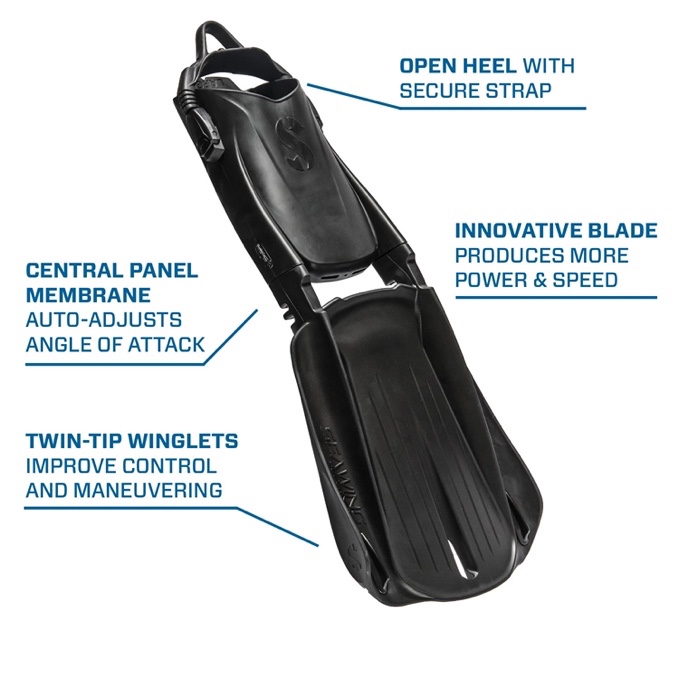
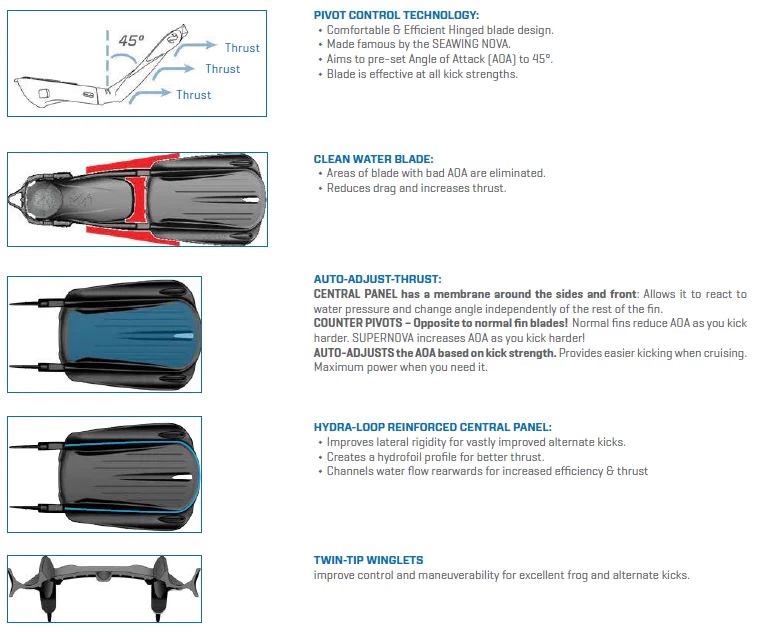
A diving fin needs power, and the Seawing Supernova has it. The fins are designed with Pivot Control Technology. The blade is pre-set in the 40º to 50º range, which is the appropriate angle of attack for the blade and ideal for translating kicks into forward propulsion.

The blade’s revolutionary flexible Auto-Adjust center panel coordinates with this hinge mechanism to adjust the angle of attack by counter-pivoting in response to the force of the kick. So, what does that all mean? On a traditional paddle fin, the harder you kick, the more the blade bends. That means a soft fin will achieve the ideal 45-degree angle when kicked gently but will over-bend and lose thrust when kicked hard. On the other hand, stiffer fins achieve that ideal 45-degree angle when kicked hard but remain too flat to be efficient when kicked gently.

Consequently, both types require the diver to compromise their kicking style to get any efficiency out of the fin.

When you are fining, you can kick so hard that it will bend the blade so far back that it can “technical” pull you backward; this offers a softer angle of attack for comfort while lightly kicking, a more aggressive angle of attack when powerfully kicking, and anything in between. New twin-tip winglets improve control and maneuverability when doing frog and alternating kicks.

The Seawing Supernova, winner of the prestigious Red Dot Award for product design, is a remarkable improvement over the Seawing Nova in terms of performance, construction, fit, and versatility. It also features a cutting-edge blade shape that generates significantly more power, speed, and maneuverability.

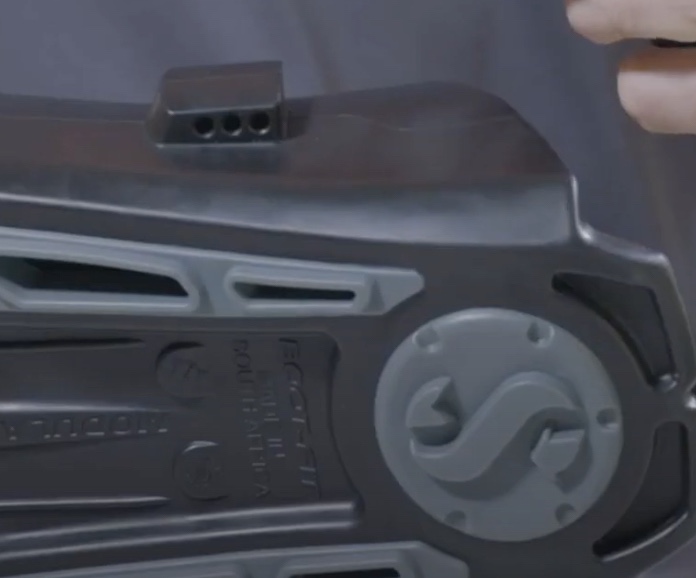
The Seawing Supernova also has a novel two-piece design, with the blade and foot pocket molded separately, is made of quality Monprene® for maximum durability, and breaks down effortlessly for transport. This will also allow you two change your blades as SSCUABPRO designed more. The Seawing Supernova’s open heel foot pocket has an updated heavy-duty bungee strap that enables micro-adjustments to accommodate various boot types and extended grip pads that improve non-skid traction on wet surfaces. It is sold as an open heel set with a foot pocket and blade already built.

Additionally, the two-piece construction enables the option of a full foot pocket in place of the usual open heel foot pocket for barefoot diving. You may quickly get ready to hit the water by disassembling the fin’s Socket-Lock Connecting System, replacing the open heel foot pocket with a complete foot pocket, and then reassembling. The entire foot pocket also has a re-profiled heel-retention cup to reduce slippage and chafing and is made of superior Monprene®

Project Arc Fosters Innovation Across Air and Space Force

Sunday, July 24th, 2022

PATRICK SPACE FORCE BASE, Fla. – Scientists and engineers across the U.S. Air and Space Force are being deployed to more than a dozen bases in the United States to develop innovative solutions to a variety of problems.

The Airmen and Guardians are part of Project Arc, a program that sends scientists and engineers to 13 bases in nine states where they use their skills to promote innovation and enhance mission efficiency.

“We need to be able to solve problems faster and with this program, we can put scientists and engineers side by side with operators to solve problems,” said Capt. Jason Goins, Air Force Technical Applications Center assistant director of operations and Project Arc manager.

“We talk about if we don’t accelerate change, we will lose,” Goins said. “And we know the next battlespace is going to be technologically focused. This is how we get after that. Our greatest strength is our diversity. Our advantage is our Airmen and Guardians. By taking advantage of their talents, we can deliver real time capabilities at the point of need.”

One Project Arc mechanical engineer deployed to Joint Base Pearl Harbor-Hickam, Hawaii, in October 2021. That engineer cut a monthly inventory check from eight hours to 20 minutes by automating tasks and using weight-based systems, Goins said. This saves “five-man weeks a year” at one base.

A team of computer scientists at Joint Base Andrews, Maryland, in November 2021, developed a software prototype for centralizing repair facility work order management that accelerates the repair process and saves 2,000-man hours a year, the captain said. The innovation is currently being considered for implementation across the service.

“The acquisition processes are in place to develop solutions, but they can take time to manifest and implement, so we are here to look at problem sets that are small in nature but can be scaled quickly through the products we develop,” said Space Force 2nd Lt. Kevin Tran, Space Analysis Squadron developmental engineer, Wright Patterson Air Force Base, Ohio.

Tran is deployed to Patrick Space Force Base, Florida, where he works alongside Air Force 1st Lt. Kennith McLoud, Air Force Operations Test and Evaluations Center operations research analyst, who is deployed to Patrick from Eglin AFB, in Space Launch Delta 45’s innovation center, The Forge.

Since the duo arrived in April, they have met with several units at Patrick and Cape Canaveral Space Force Station. Those meetings identified several concerns including the damage corrosion causes, as well as the need for a medical training interface and a collaborative space launch environment where all launch data is centralized in one place.

“Corrosion is a big problem we are working on right now,” McLoud said. “Just from all the salt from the ocean and ultraviolet light, the environment is highly corrosive. Because of that the HVAC (heating, ventilation and air conditioning) chillers, which cool buildings and are supposed to last 15–20 years, are only lasting for four or five years.”

Research discovered corrosion was eating away the material the chillers are made of which eventually causes them to break down and be replaced.

Corrosion is also a concern of the 45th Logistics Readiness Squadron. The unit manages SLD 45’s government vehicle fleet.

“Many of those vehicles have to be serviced by a third-party company about every two years because the coating they’re using now isn’t holding up well,” McLoud said. “We discovered a silicon ceramic non-conductive coating that can be applied to multiple surfaces to prevent corrosion. That is something that can be used to extend the life of the chillers, protect government vehicles, and even extend the life of lighting fixtures.”

The coating can extend the life expectancy of HVAC systems and vehicles by at least four or five years, Tran added. This could lead to an estimated savings of $100,000 in annual maintenance costs.

Tran and McLoud are currently working on a dozen projects to enhance the space launch mission.

“Our adversaries are developing different ways to launch their payloads into orbit and if we don’t find ways to innovate, we will not be able to secure space and ensure access to space the way we want to,” Tran said. “We need to constantly push ourselves, take advantage of the expertise of our Airmen and Guardians, and help our warfighters. When we stop innovating, we start to lose the fight.”

McLoud echoed Tran’s sentiment and said he hopes Project Arc continues to grow.

“We have the capability, the Airmen and Guardians to do so many things,” he said. “We have people who know how to program, code, and so much more who can save money, several man hours, and enhance our mission, so why not? Let’s Invest in our Airmen and Guardians, so they can use their skills to advance our mission.”

By TSgt James Hodgman, Space Launch Delta 45 Public Affairs

Special Warfare Training Wing Physical Medicine Technician Embeds with NASA

Saturday, July 23rd, 2022

JOINT BASE SAN ANTONIO-CHAPMAN TRAINING ANNEX, Texas  –  

From advancing force development of future Air Force Special Warfare Airmen to working with astronauts, life has been far from boring for the SWTW’s Staff Sgt. Emily Valdovinos.

Valdovinos was hand-selected to assist the NASA Astronaut Strength, Conditioning and Rehab Group to help develop personalized strength, conditioning, and rehabilitative plans for NASA astronauts with Crew-3 after they returned from the International Space Station for their 45-day reconditioning period.   

“Emily was specifically selected based on the skillset she has worked so hard to achieve for herself,” said Maj. Danielle Anderson, musculoskeletal medicine and rehabilitation lead, ASCR Group. “With her passion for human performance, dedication to ensuring the highest quality of service is delivered, and her energetic professionalism, Staff Sgt. Valdovinos was the perfect NCO to support our team.”

The mission of the ASCR Group is to optimize the performance and physical readiness of the astronaut corps by utilizing an interdisciplinary team approach, evidence-based practice, and emerging science and technology throughout an astronaut’s lifespan. The team focuses on optimizing the astronaut’s physical performance as he or she prepares for, lives in, and returns from the ISS.

At the SWTW, Valdovinos serves as the non-commissioned officer in charge of performance rehabilitation for the Special Warfare Candidates Course and Pre-Dive Course, where her experience working with SWTW trainees directly transfers to working with NASA astronauts.

“In [both the SWTW and NASA], I work hand in hand with a multi-disciplinary team to provide the best possible care to our caseload,” said Valdovinos. “I work directly under a physical therapist alongside a strength coach and athletic trainer to help develop personalized strength, conditioning, mobility, and rehabilitative plans for each person who needs assistance; we do ruck marches every week, throw sandbags, and are on a very strict workout schedule at NASA, just like the SWTW.”

In addition to working with astronauts, Valdovinos has also been afforded many unique opportunities available only at NASA while embedded with the ASCR Group.

Valdovinos joined in a live call to the ISS with Crew-4, toured NASA’s Neutral Buoyancy Lab where astronauts train for extravehicular activities (space walks), visited the Apollo Mission Control Center, learned about the various exercise equipment available to astronauts while in space, and much more.

When asked what she will take away from her time working at NASA, Valdovinos stressed the importance of the multi-disciplinary team and its ability to work seamlessly together to provide the best level of care for the individual, regardless of whether that individual is an astronaut, SWTW trainee, or AFSPECWAR operator.

“Personally, I have grown in many ways as a professional and as a person,” said Valdovinos. “I feel incredibly humbled to have even been considered for this position as it has been my dream to train astronauts and support the Space Exploration mission ever since I was young.”

Members of SWTW provide initial training for all AFSPECWAR training specialties, including combat controllers, pararescue, special reconnaissance and tactical air control party Airmen.

To learn more about SW Airmen or other U.S. Air Force Special Warfare career opportunities, go to www.airforce.com/careers/in-demand-careers/special-warfare.

By 1st Lt Xiaofan Liu

Special Warfare Training Wing Public Affairs