Pirata Series from OTB Boots - Coming March 2026!

Archive for the ‘Guest Post’ Category

Arctic Environment : Why the Insulation in Your Clothing System is Critical to Mission Success

Saturday, August 21st, 2021

Cold and Wet

It’s early March 1988 400 miles north of the Arctic Circle, a small team of special operations guys are loading into the torpedo tubes of a diesel submarine to lock out and conduct a mission sinking a small craft. Climbing into the tube taking care not to hit our dive rigs and gear on the lip or rails, we work our way deep into the dark tunnel. Situated in the tube, cold steel closing in all around us the loading door is sealed shut just before the tube fills with arctic water. Pitch black, water fills the tube and pressure equalizes with the outside depth. The exit door opens, and we escape to the open water. The water is cold like an ice cream headache, we can feel it thru our dry suits but there is something else… wetness slowly expanding around my right knee. As the dive continues, I get wetter and wetter…. soon my whole clothing system is soaked with seawater.

This may not be your normal occurrence for the hiker or climber but getting wet and needing to maintain body heat is. This is where a little discussed thermal value comes to play called “Wet CLO”. Let’s segment that a little, starting with CLO. The CLO Value is a measurement of warmth and can be used to characterize apparel items including garments, gloves, headwear and footwear.  1 CLO is the amount of insulation that allows a person at rest to maintain thermal equilibrium in an environment at 21 degrees Celsius or 70 degrees Fahrenheit.  This is said to be equivalent wearing a three-piece business suit with undergarments at that temperature.   When we discuss Wet CLO, we talk about the insulation value degrading because of the water content. That water can come from sweat, rain, condensation, etc.

Let’s look at the insulation spectrum starting with Down which can have a super high Dry CLO value of 1.68, but a super low Wet CLO value, near zero! Please note, that the Dry CLO value is dependent on garment design, and grade and thickness of the Down.  The high differential in thermal capability is problematic to the novice adventurer and most military folks, as they do not get to pick a blue bird day to execute a mission.

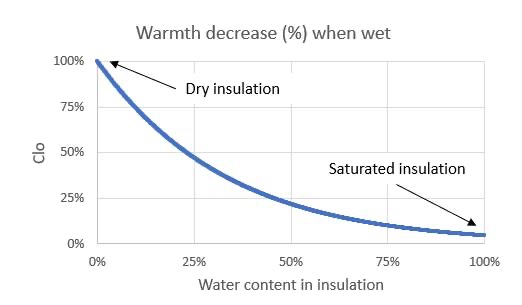
Air is one of the best insulators for apparel systems. Most insulated apparel systems work by trapping air next to the wearers’ body. When an insulation becomes wet, the trapped air within the insulation is replaced by liquid water. This can lead to huge decreases in in warmth or CLO value, as air is 24x more insulative than water.  As you can see from the graph below, even a little bit of water pick-up can lead to a huge decrease in CLO value.

If the water in the insulation later freezes, the impact is even worse, as air is 90x more insulative than ice.   On top of decreasing the CLO value of the insulation, water inside insulation can evaporate, causing cooling. This is similar to how our bodies cool ourselves by sweating on a hot day. But in a cold environment, this can be dangerous. In some wet situations, having wet insulation can be worse than having no insulation at all!

Wool has been a baseline measure for years; we have all heard the ‘warm when wet’ moniker. Today’s insulation world has been inundated with synthetics from Primaloft to Thinsulate, Climashield to Gore Thermium. These insulations have been developed to deliver the highest CLO value per gram, be hydrophobic and feel comfortable inside the garment.  Ultimately, the easiest way to reduce the impact of water on the CLO value is to minimize the amount of water that the insulation can pick up in the first place!  This can either be done by changing the properties of the insulation itself (ex., making it hydrophobic), or by protecting the insulation from water exposure (ex. by utilizing a GORE-TEX barrier to prevent rain ingress).  Some insulations, like Gore Thermium, do not pick up any moisture, therefore the CLO value does not change when exposed to water. Thus, minimizing the water content within the insulation is key to effectively closing the gap between wet CLO and dry CLO.

Today, there is no standardized test method for measuring Wet CLO across the outdoor industry, but engineers and scientists are working to characterize this phenomenon as it an important issue in protective apparel. Primaloft has worked on this issue since the early days of PCU and developed Primaloft Gold, their best performing insulation is 97-98% clo value when wet.

Our goal in the military and those that ‘GO’ when duty calls is to build clothing and sleep systems with the narrowest CLO differential dry or wet possible. With a narrow CLO differential, the user can select an insulation for the appropriate temperature range and the moisture content of the clothing system has little to no effect on warmth. USSOCOM made a deliberate decision to build their clothing and sleep systems to complement each other, remain unaffected by moisture and be ‘continuously drying’.

Back to my story, upon exiting the water in soaking wet clothing we had to make every attempt to walk for the next twelve hours to dry the clothing system out as it had little insulation value wet, was hard to dry and made for a challenging night above the Arctic Circle.  No teammates were injured during this event.

How do you know you’re getting wet after 2-3 days in the field? Your sleeping bag just doesn’t fit the same as when you left the house, your jacket is a little heavier, all signs that moisture is in the system, you just don’t feel it next to skin. That moisture degrades your comfort and warmth. So the next time you’re out for a trip weigh your kit before and as soon as you return… check your water weight!

Scott Williams, NSW (ret), Former OIC Naval Special Warfare Center, Det Kodiak, USSOCOM Cold Weather Equipment Project Director. Currently at the Wing Group leading Defense efforts.

Eastern National Robot Rodeo Showcases EOD Emerging Capabilities

Saturday, August 21st, 2021

INDIAN HEAD, Md. (AFNS) —

Explosive ordnance disposal and bomb squad experts in the Department of Defense and civilian sector tested the latest EOD robotics and emerging capabilities during the Eastern National Robot Rodeo and Capabilities exercise Aug. 2-6.

The Robot Rodeo, in its fifth year, was back after more than a year-long hiatus due to the COVID-19 pandemic.

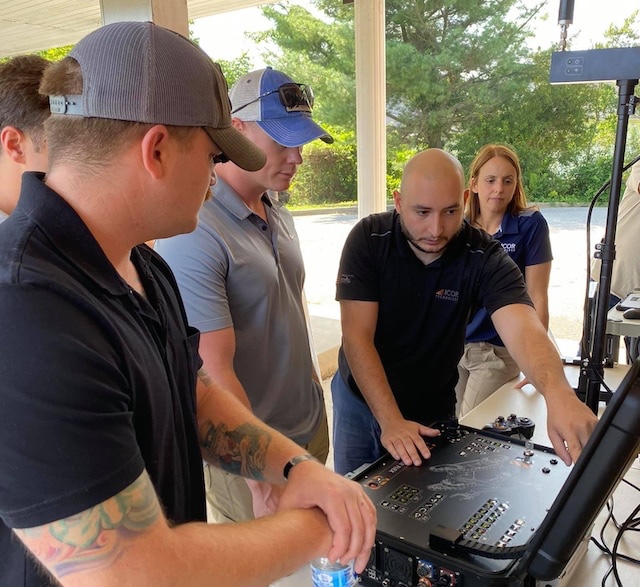
The event, conducted at the Naval Surface Warfare Center Indian Head Division and town of Indian Head, brought together experienced EOD operators and public safety bomb squads to evaluate EOD capabilities in real-world operating environments and provide real-time feedback to industry partners.

“Everyone – sponsors, vendors and participants – was excited about the 2021 ENRR-CAPEX, especially after having to cancel the 2020 event due to the COVID pandemic,” said Dr. John Olive, deputy director of the Air Force Civil Engineer Center’s EOD Division and Air Force EOD subject matter expert.

The rodeo is extremely important to AFCEC, which is responsible for central procurement of equipment for the Department of the Air Force’s 1,700 Total Force operators at 84 locations around the globe.

“The rodeo showcases technologies under development from various industry vendors and has a direct impact in putting the absolute best tools in the hands of our EOD and public safety bomb squad operators, and international partners,” he said.

While all CE missions are critical to the Department of the Air Force and mission platforms, EOD is perhaps the most dangerous.

“Having these technologies that give our operators the ability to do more standoff investigation, interrogation and mitigation of hazards, keeps our warfighters out of harm’s range and enables them to do things more efficiently,” said Col. John Tryon, AFCEC Detachment 1 commander.

AFCEC in general is always looking to push the envelope and do things smarter and more efficiently, Tryon said, with EOD in particular always being on the cutting edge.

“With new threats it won’t be one or two unexploded ordnance we’ll be dealing with in future, it will be hundreds or thousands of UXOs and we have a limited number of EOD operators. We need technologies that we can leverage, that are force multipliers, so we can achieve the result that we need,” Tryon said.

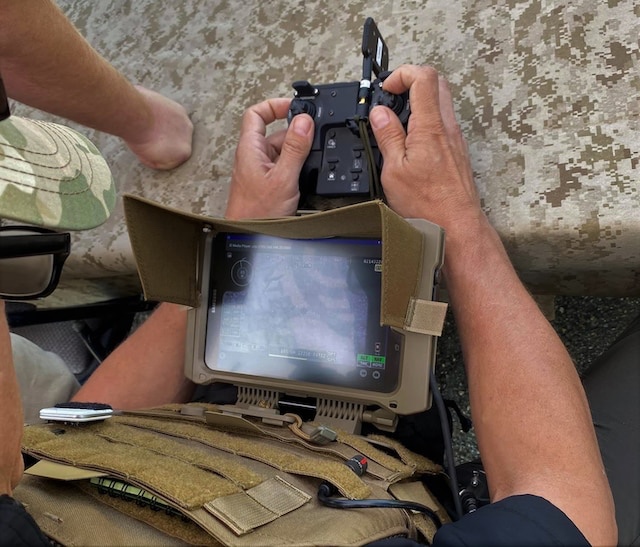
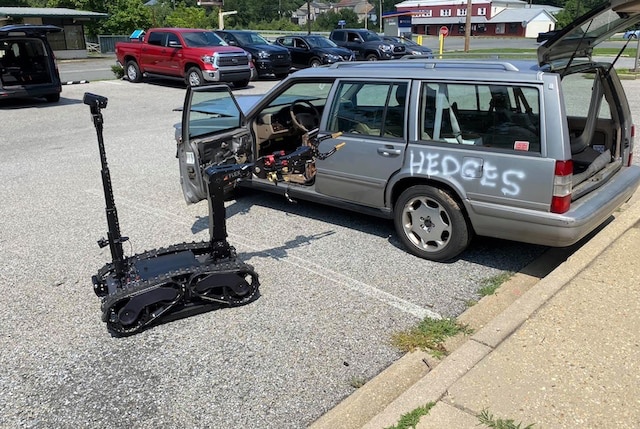
In addition to the equipment showcase, ENRR included a multi-day, multi-event technical competition to include potential real-world scenarios like a swarm of unmanned aerial systems employing explosive devices, and clearance of a homemade explosive laboratory, while integrating emerging technologies such as advanced radio graphics and multi-shot disruption off from existing robotic platforms.

“Participating multi-agency teams were given one hour to train on new equipment, then given three hours to complete a scenario that challenges that new technology,” Olive said. “Operators provided vendors direct feedback, which shapes future development of that technology in-line with the Chief of Staff of the Air Force’s accelerate change or lose initiative.”

The rodeo directly allows AFCEC to build relationships with industry partners, public safety bomb squads and various other agencies, Olive added, to shape future tech development and “enable us to better support our nine core mission areas for the Air Force EOD program.”

“Getting military and civilian bomb techs together is vital to the overall success of defeating hazardous devices,” said T.J. Brantley, a member of Plano Police Department’s Bomb Squad in Texas. “You get the opportunity to talk about different tactics and procedures other teams are using. Meeting with vendors and getting hands-on training with the latest and greatest technology available helps us do our job safely. Hands down (Robot Rodeo) was one of the best training opportunities I have been to.”

During the event’s distinguished visitor day, Brig. Gen. Bill Kale, director of Air Force Civil Engineers, said he appreciated the opportunity to meet with industry.

“I think it’s very important, as civil engineers, that we stay on the cutting edge of technology,” Kale said. “We need to make sure that whatever we decide to procure, or what we’re looking at, that we can use it or innovate it to improve our readiness.

“We have quite a challenge ahead of us with near peer competition with some of our adversaries and we need to use every tool in our toolkit to make sure we make it challenging for them to even think about trying to come after the United States or our interests,” Kale said.

The Air Force Civil Engineer Center’s Readiness Directorate was one of four sponsors for the event, but it was a joint effort with Naval Surface Warfare Center Indian Head Division and the town of Indian Head as hosts, and the United States Bomb Technicians Association as a core partner.

“We very much appreciate the NSWC hosting ENRR and the opportunity to come together with the different vendors that provide the robots, sensors and different technologies that EOD teams can employ now and in the future, and for them to interact with our Air Force and joint partner warfighters,” Tryon said. “Actually getting some stick time and providing direct feedback with the vendors is valuable for them not only on how to adapt their technologies, but also for us being able to see what we want to add to our arsenal going forward.

By Debbie Aragon, Air Force Installation and Mission Support Center Public Affairs

FirstSpear Friday Focus: Deuce And A Half Shorts

Friday, August 20th, 2021

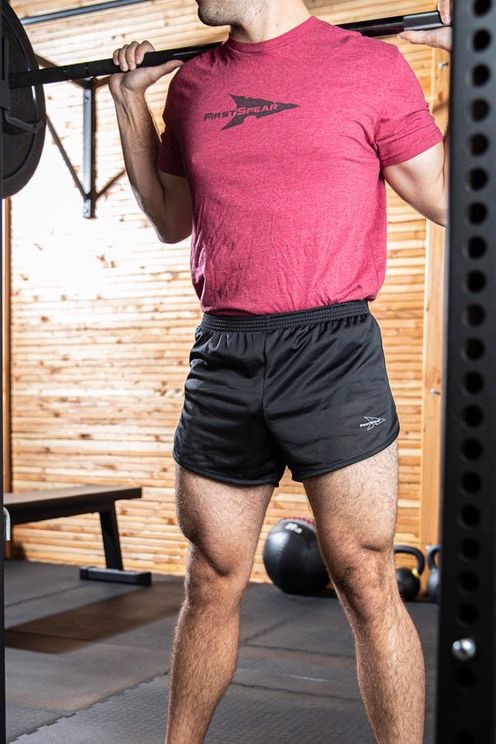
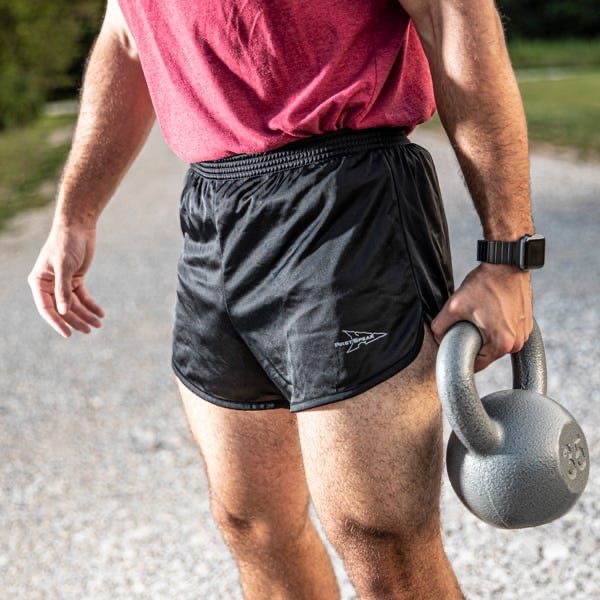
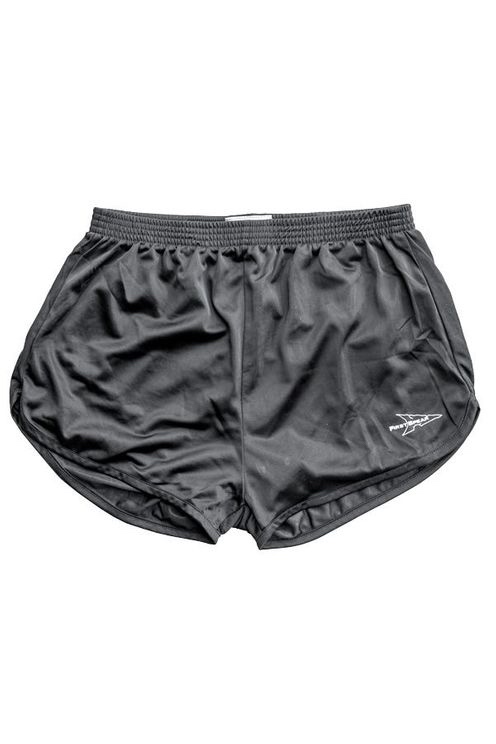
Regardless if you are smashing personal bests’ on leg day, or chips from the comfort of your couch, the FirstSpear Deuce and A Half shorts have you covered (mostly). Like their namesake, they are a classic that always gets the job done. Nothing screams freedom like a super soft, comfortable silkies. These daisy dukes of freedom will serve you well.

• These shorts feature an elastic waistband and no drawstring for a comfortable, high-performance fit and feel
• Brief style liner in these shorts provide additional support and helps prevent chafing
• PT shorts feature a short inseam for optimal athletic capability
• Made of durable, moisture-wicking 100% nylon material that will help keep you cool and dry while you sweat
• Feature an inner waistband pocket for storing a key or money while exercising
• Available in Black with the FirstSpear Logo in S, M, L, XL, 2XL


Embrace the short shorts life. Featuring a 2.25” to 2.5’” inseam on all sizes.

Snag a pair before they’re gone www.first-spear.com/2.5-shorts.

Leaping Squirrels Could Help Scientists Develop More Agile Robots

Friday, August 20th, 2021

RESEARCH TRIANGLE PARK, N.C. — Understanding the split-second decisions squirrels make as they jump from tree branch to tree branch will help scientists develop more agile robots.

With funding from the U.S. Army, researchers at University of California, Berkeley studied how squirrels decide whether or not to take a leap and how they assess their biomechanical abilities to know whether they can land safely.

Understanding how squirrels learn the limits of their agility could help scientists design autonomous robots that can nimbly move through varied landscapes to help with military missions such as traveling through the rubble of a collapsed building to aid in search and rescue or to quickly access an environmental threat.

“The team at UC Berkeley is challenging the comfort zone of today’s robotic design in a very clever way, taking us one step closer to tomorrow’s truly autonomous and versatile robots,” said Dr. Dean Culver, program manager for Complex Dynamics and Systems at the U.S. Army Combat Capabilities Development Command, known as DEVCOM, Army Research Laboratory. “Studying organisms’ behavior, like jumping squirrels, lets the engineering community ask fascinating questions about an autonomous agent trying to navigate an uncertain environment. For example, what stimuli cause learning? How does the interplay between structural compliance in a limb and surprises in an environment permit adjustments during a maneuver?”

To tackle these questions, Dr. Robert Full, professor at UC Berkeley and former doctoral student Dr. Nathanial Hunt, now an assistant professor of biomechanics at the University of Nebraska, Omaha, joined forces with professor of psychology Dr. Lucia Jacobs and former UC Berkeley doctoral student Judy Jinn.

Jacobs and her students developed precise methods to study cognition in wild campus squirrels, and they proposed integrating these studies with biomechanics, extending Full’s laboratory models not only to mammals for the first time, but to a wild mammal–squirrels–that had experienced the full natural development of its agility.

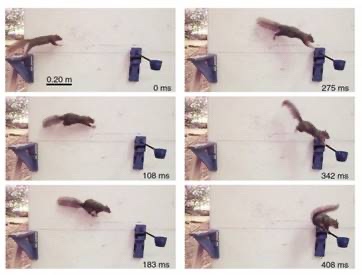
In the journal Science, the researchers report on their experiments on free-ranging squirrels, quantifying how they learn to leap from different types of launching pads–some bendy, some not–in just a few attempts, how they change their body orientation in midair based on the quality of their launch, and how they alter their landing maneuvers in real-time, depending on the stability of the final perch.

“As a model organism to understand the biological limits of balance and agility, I would argue that squirrels are second to none,” said Hunt, now an assistant professor of biomechanics at the University of Nebraska, Omaha. “If we try to understand how squirrels do this, then we may discover general principles of high-performance locomotion in the canopy and other complex terrains that apply to the movements of other animals and robots.”

Researchers conducted the experiments in a eucalyptus grove on the UC Berkeley campus, where the Berkeley team enticed fox squirrels that roam the campus into sketchy situations where they had to decide whether to leap for a peanut or let it go.

They found that, as expected, the flimsier or more compliant the branch from which squirrels have to leap, the more cautious they were. But, it took squirrels just a few attempts to adjust to different compliances.

“When they leap across a gap, they decide where to take off based on a tradeoff between branch flexibility and the size of the gap they must leap,” Hunt said. “And when they encounter a branch with novel mechanical properties, they learn to adjust their launching mechanics in just a few jumps. This behavioral flexibility that adapts to the mechanics and geometry of leaping and landing structures is important to accurately leaping across a gap to land on a small target.”

The squirrels don’t balance the bendiness of the launching branch and the gap distance equally. In fact, the compliance of the branch was six times more critical than the gap distance in deciding whether to jump.

This may be because squirrels know that their sharp claws will save them if they miscalculate. Their claws are so failproof, Hunt said, that none of the squirrels ever fell, despite wobbly leaps and over- or undershot landings.

“They’re not always going to have their best performance–they just have to be good enough,” he said. “They have redundancy. So, if they miss, they don’t hit their center of mass right on the landing perch, they’re amazing at being able to grab onto it. They’ll swing underneath, they’ll swing over the top. They just don’t fall.”

That’s where exploration and innovation come into play as squirrels search for the best leaping strategy.

“If they leap into the air with too much speed or too little speed, they can use a variety of landing maneuvers to compensate,” Hunt said. “If they jump too far, they roll forward around the branch. If they jump short, they will land with their front legs and swing underneath before pulling themselves up on top of the perch. This combination of adaptive planning behaviors, learning control and reactive stabilizing maneuvers helps them move quickly through the branches without falling.”

One unsuspected innovation was that during tricky jumps, squirrels would often reorient their bodies to push off a vertical surface, like in human parkour, to adjust their speed and insure a better landing. Parkour is a sport in which people leap, vault, swing or use other movements to quickly traverse obstacles without the use of equipment.

“Learning from squirrels the limitations of improvisation with a given controller architecture and compliant actuators will help engineers understand how to design a robot controller and actuators to maximize improvisational capabilities,” Dean said. “To get to that next step for more agile robots, we first have to observe and quantify the ideas of adjustment and improvisation, which this research provides.”

This research complements earlier Army-funded research at UC Berkeley that developed an agile robot, called Salto that looks like a Star Wars Imperial walker in miniature and may be able to aid in scouting and search-and-rescue operations.

In additional to the Army, the National Science Foundation and the National Institutes of Health supported this research.

By U.S. Army DEVCOM Army Research Laboratory Public Affairs

SureFire Field Notes Ep. 65: The Importance of Being Familiar with a Fight with Greg Lapin  

Thursday, August 19th, 2021

Greg Lapin runs Vida Jiu-jitsu and VATA Group Training. Greg spent eight years as a Louisiana Law Enforcement Officer with the majority of his time in Special Investigation and Narcotics units. He went on to work for Triple Canopy conducting high threat protection for the Department of State in conflict zones. Greg was then recruited for a Department of Defense program in which he also worked in conflict zones while deployed. He has conducted various missions for both government and non-government clients around the globe. Greg is currently a Sheriffs Deputy assigned to SWAT,  an instructor for both firearms and Brazilian Jiu-jitsu and is also an avid USPSA competitive shooter.

www.vidabjj.com/schedule

www.vatatrainingcenter.com

www.surefire.com

Special Tactics Airmen augment Haiti earthquake humanitarian relief efforts

Thursday, August 19th, 2021

HURLBURT FIELD, Fla.– Special Tactics Airmen assigned to the 24th Special Operations Wing are currently responding to a request to augment humanitarian aid efforts in Haiti following a 7.2 magnitude earthquake on Aug. 14.

            The Special Tactics Airmen responding to the relief efforts will be working with Joint Task Force-Haiti under Rear Admiral Keith Davids, the commander of U.S. Special Operations Command South. While in country, the ST Airmen will be responsible for conducting various airfield surveys to determine suitability for bringing in humanitarian aid via airlift. Special Tactics teams are also postured and ready to establish airfield operations and conduct air traffic control if necessary.

                            “Our Special Tactics Airmen are trained and ready for a number of humanitarian missions that we may be called upon to accomplish,” said Col. Jason Daniels, 24th Special Operations Wing commander. “Our teams are looking forward to providing assistance to the people of Haiti while working alongside our joint teammates in U.S. Southern Command in support of USAID’s Bureau for Humanitarian Assistance.” 

            In recent years, Special Tactics Airmen have responded to several natural disasters including Hurricanes Eta and Iota in Honduras, Hurricane Michael in Florida and Hurricane Katrina in Louisiana.

            Special Tactics Airmen fall under Air Force Special Operations Command and U.S. Special Operations Command and are trained to execute global access, precision strike, personnel recovery and battlefield surgery operations across the spectrum of conflict. Special Tactics operators are experts in air-ground integration and have the ability to assess, open, and control major airfields to clandestine dirt strips in any environment.

            More information will be released as it becomes available.

For more information on Air Force Special Tactics visit our website, www.airforcespecialtactics.af.mil

Dept of Veteran Affairs Message Regarding Dealing With Events In Afghanistan

Wednesday, August 18th, 2021

There are loads of vets out there like me who don’t interact with the VA, so we don’t get emails like this. Thanks to my friend Thulsa Doom, I’m sharing the contents of an email that went out on Monday. Please share this with friends.

Veterans from all eras are reacting to the events in Afghanistan, such as the U.S withdrawal and the takeover by the Taliban.

You are not alone.

Veterans may question the meaning of their service or whether it was worth the sacrifices they made. They may feel more moral distress about experiences they had during their service. It’s normal to feel this way. Talk with your friends and families, reach out to battle buddies, connect with a peer-to-peer network, or sign up for mental health services. Scroll down for a list common reactions and coping advice.

Resources available right now

• Veterans Crisis Line – If you are having thoughts of suicide, call 1-800-273-8255, then PRESS 1 or visit www.veteranscrisisline.net

? For emergency mental health care, you can also go directly to your local VA medical center 24/7 regardless of your discharge status or enrollment in other VA health care.

• Vet Centers – Discuss how you feel with other Veterans in these community-based counseling centers. 70% of Vet Center staff are Veterans. Call 1-877-927-8387 or find one near you.

VA Mental Health Services Guide – This guide will help you sign up and access mental health services.

MakeTheConnection.net – information, resources, and Veteran to Veteran videos for challenging life events and experiences with mental health issues.

• RallyPoint – Talk to other Veterans online. Discuss: What are your feelings as the Taliban reclaim Afghanistan after 20 years of US involvement?

Download VA’s self-help apps – Tools to help deal with common reactions like, stress, sadness, and anxiety. You can also track your symptoms over time.

• Tragedy Assistance Program for Survivors (TAPS) –  Request a Peer Mentor

• VA Women Veterans Call Center – Call or text 1-855-829-6636 (M-F 8AM – 10PM & SAT 8AM – 6:30PM ET)

• VA Caregiver Support Line – Call 1-855-260-3274 (M-F 8AM – 10PM & SAT 8AM – 5PM ET)

• Together We Served –Find your battle buddies through unit pages

• George W. Bush Institute – Need help or want to talk? Check In or call:1-630-522-4904 or email: checkin@veteranwellnessalliance.org

• Elizabeth Dole Foundation Hidden Heroes – Join the Community

• American Red Cross Military Veteran Caregiver Network – Peer Support and Mentoring

• Team Red, White & Blue – Hundreds of events weekly. Find a chapter in your area.

• Student Veterans of America – Find a campus chapter to connect with.

• Team Rubicon – Find a local support squad.

Common Reactions

In reaction to current events in Afghanistan, Veterans may:

• Feel frustrated, sad, helpless, grief or distressed

• Feel angry or betrayed

• Experience an increase in mental health symptoms like symptoms of PTSD or depression

• Sleep poorly, drink more or use more drugs 

• Try to avoid all reminders or media or shy away from social situations

• Have more military and homecoming memories

Veterans may question the meaning of their service or whether it was worth the sacrifices they made. They may feel more moral distress about experiences they had during their service.

Veterans may feel like they need to expect and/or prepare for the worst. For example, they may:

• Become overly protective, vigilant, and guarded

• Become preoccupied by danger

• Feel a need to avoid being shocked by, or unprepared for, what may happen in the future

Feeling distress is a normal reaction to negative events, especially ones that feel personal. It can be helpful to let yourself feel those feelings rather than try to avoid them. Often, these feelings will naturally run their course. If they continue without easing up or if you feel overwhelmed by them, the suggestions below can be helpful.

Strategies for Managing Ongoing Distress

At this moment, it may seem like all is lost, like your service or your sacrifices were for nothing. Consider the ways that your service made a difference, the impact it had on others’ lives or on your own life. Remember that now is just one moment in time and that things will continue to change.

It can be helpful to focus on the present and to engage in the activities that are most meaningful and valuable to you. Is there something you can do today that is important to you?  This can be as an individual, a family member, a parent, or a community member. Something that is meaningful to you in regard to your work or your spirituality? Such activities won’t change the past or the things you can’t control, but they can help life feel meaningful and reduce distress, despite the things you cannot change.

It can also help to consider your thinking. Ask yourself if your thoughts are helpful to you right now. Are there ways you can change your thinking to be more accurate and less distressing? For example, are you using extreme thinking where you see the situation as all bad or all good?  If so, try and think in less extreme terms. For example, rather than thinking “my service in Afghanistan was useless” consider instead “I helped keep Afghanistan safe.”

Finally, consider more general coping strategies that you may want to try including:

• Engage in Positive Activities. Try to engage in positive, healthy, or meaningful activities, even if they are small, simple actions. Doing things that are rewarding, meaningful, or enjoyable, even if you don’t feel like it, can make you feel better.

• Stay Connected. Spend time with people who give you a sense of security, calm, or happiness, or those who best understand what you are going through.

• Practice Good Self Care. Look for positive coping strategies that help you manage your emotions. Listening to music, exercising, practicing breathing routines, spending time in nature or with animals, journaling, or reading inspirational text are some simple ways to help manage overwhelming or distressing emotions.

• Stick to Your Routines. It can be helpful to stick to a schedule for when you sleep, eat, work, and do other day-to-day activities.

• Limit Media Exposure. Limit how much news you take in if media coverage is increasing your distress.

• Use a mobile app. Consider one of VA’s self-help apps (see www.ptsd.va.gov/appvid/mobile) such as PTSD Coach which has tools that can help you deal with common reactions like, stress, sadness, and anxiety. You can also track your symptoms over time.

PTSD Coach Online. A series of online video coaches will guide you through 17 tools to help you manage stress. PTSD Coach Online is used on a computer, rather than a mobile device, and therefore can offer tools that involve writing.

If you develop your own ways of adapting to ongoing events and situations, you may gain a stronger sense of being able to deal with challenges, a greater sense of meaning or purpose, and an ability to mentor and support others in similar situations.

The Baldwin Files – Old Army Stories: REFORGER 1975

Tuesday, August 17th, 2021

Like many stereotypical curmudgeons, as I go about my work here on the Homestead, I spend more time than I probably should relitigating episodes of my life in my mind. Second guessing decisions made or deferred, imagining how my life’s branches and sequels might have taken a divergent course – and perhaps affected the lives of others differently. Cataloging the satisfactory and the regrettable. I suppose it is a natural – albeit inconclusive – mental exercise. Of course, it is self-evident that getting older has not made me any smarter. Over the years, I have not gained a single IQ point despite benefiting from considerable formal education, extensive advanced training, and broad life experiences. I have accumulated considerably more knowledge over time, but not any more brains. I trust that means that I am perfectly qualified to continue to offer unsolicited advice to others. I am going to keep acting like it does.

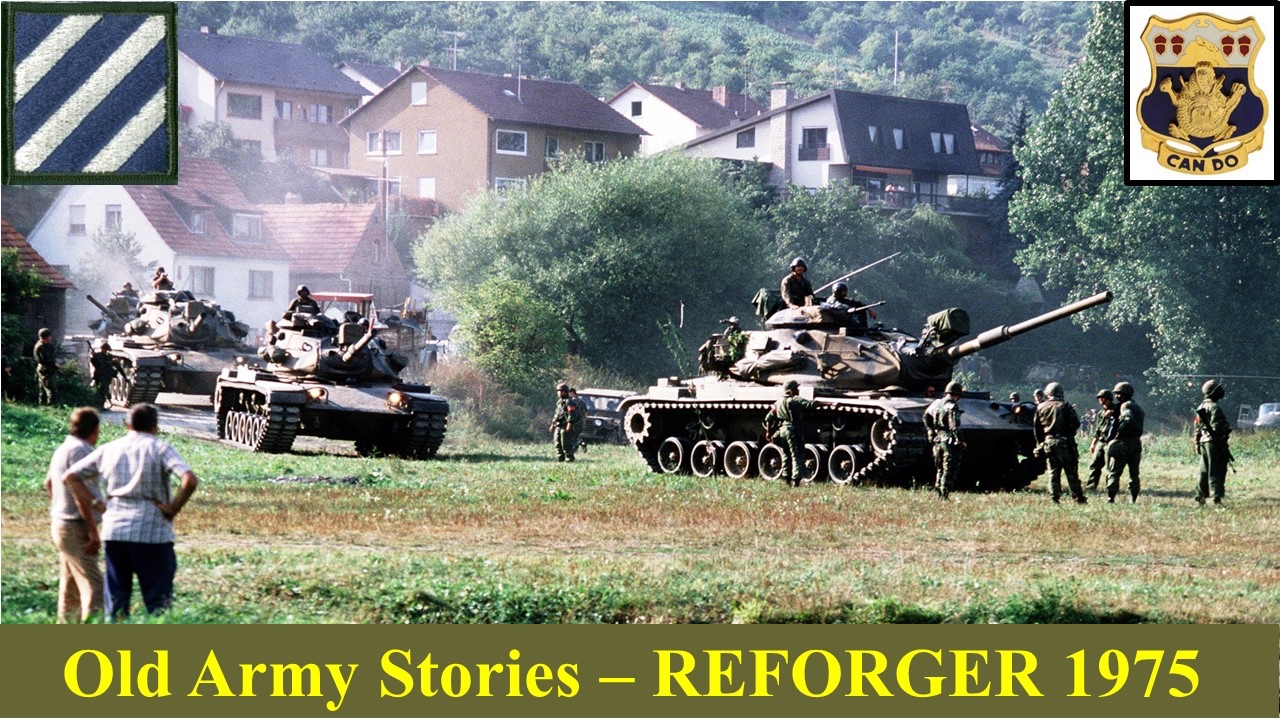
The best place to start a story is near the beginning. I served as an infantryman in West Germany from 1975 to 1978. In this article, I will start talking about that first formative year or so when I was assigned to Alpha Company, 1st Battalion, 15th Infantry (Mechanized), of the 3rd Infantry Division (patch at top left in the picture), stationed at Kitzingen, Germany. Bravo Company of that Battalion had been Audie Murphy’s unit in WWII. The unit crest is shown in the top right corner of the picture above. The unit motto “Can Do” and the dragon date back to the early 1900s and the Regiment’s 26 years of service in China. The four acorns commemorate the major battles the Regiment fought in during the Civil War: Chattanooga, Chickamauga, Murfreesboro, and Atlanta.

Although I had been in the training pipeline for some time stateside, it is safe to say that I did not have any firsthand knowledge of the “real” Army before I got there. Still, even I quickly recognized that the Army in the mid-70s was in pretty sad shape. The Vietnam war had left deep bruises in the Officer and NCO Corps. A number who remained in uniform immediately after the war were of markedly poor quality. Morale was low for those relatively few selfless professionals that had stayed on to rebuild. The draft had ended in 1973. In fact, at Fort Polk, I had in-processed as the last draftees were out-processing. One of them tried to convince me that he was naturally a better quality soldier than I was because he made the Army “come after him.” It was an interesting perspective, but it was not just him. Indeed, VOLAR – or the “Volunteer Army” – was an experiment that most of the leadership expected to fail. In 1975, there was not one leader in the Army that had ever served in an entirely all-volunteer force. Side note: eventually, I observed that the airborne qualified NCOs in my rifle company – who had grown up in always volunteer Airborne units – generally dealt with soldiers more positively as junior teammates. “Leg” NCOs, having grown up principally with draftees, tended to foster a more “us vs them” adversarial relationship with their soldiers.

I got off a chartered commercial plane at Rhein-Main Air Base in September. It was an ordeal that lasted several days to get from there to an actual unit. First, soldiers processed through the theater replacement center on the airfield. Then on to the Division of assignment. There were four complete Army Divisions stationed in Germany at the time and “Forward Brigades” of two other divisions. Not to mention two Corps HQs and an Army HQ and all the ancillary organizations – some 300,000 U.S. soldiers in all distributed throughout the country. In my case, I passed through the 3rd ID Replacement Detachment at Wurzburg, Germany, and then to my battalion in Kitzingen. I got there just in time for REFORGER 1975. In fact, when I got there, part of the unit had already moved out to a staging area. Therefore, I was not immediately assigned to a platoon and barely had enough time to draw my gear (no CIFs in those days, we got our TA50 from our Company Supply Room) before I was heading to the field in the back of a Deuce and a half.

As it turned out, the REFORGER exercises served to bookend – and in some sense define – my tour in Germany. In 1975 it was my first experience. I also played in the 1976 and 1977 iterations. REFORGER 1978 was my last time in the field before I was reassigned to Fort Lewis. REFORGER is an acronym for Return of Forces to Germany (RE-FOR-GER). It involved thousands of soldiers deploying from home stations in the U.S. to fall in on pre-positioned equipment warehoused in Germany, and then participate in a large-scale force-on-force wargame involving German-based American units as well as NATO Allies including the West Germans. Getting the forces from CONUS and drawing equipment was actually the most important strategic element of the exercise. The follow-on wargame itself was mostly for show; both to visibly reassure allies and the German population of our commitment and to – hopefully – deter the Soviet Union from invading. The picture above is from REFORGER 1982, but it perfectly captures the dynamics of the exercise I want to highlight below.  

A large-scale, free play training exercise like REFORGER requires a lot of overhead. My new unit was going to play in the wargame; while I, and several others, got detailed to support the exercise Umpires. Umpires were only there to move the wargame along by adjudicating engagements (no MILES lasers in those days). They did not evaluate or provide feedback to the units like Observer Controllers do today. Since I did not know much of anything, I had a simple task. An NCO would drop a couple of us off with some water, a case of C-Rations, and wooden signs saying “OBSTACLE.” Whenever a unit approached us, we would inform them, via pre-printed and laminated 3×5 Cards, as to the nature of the obstacle. For example, a minefield or tank ditch – and how long it would take to reduce the obstacle once engineer assets were on site. Of course, an Umpire would show up about this time to keep everyone honest and assess casualties on both sides if the obstacle was defended as most – but not all – were. Then, as the units maneuvered through that obstacle, we would be moved to another location and do it all over again.

This routine went on for most of two weeks. Sometimes we were in place for only a couple of hours; however, in one case, we saw no one for two days because the “war’ had moved in a different direction and that particular notional obstacle had been bypassed with no contact between forces. The engagements themselves were anticlimactic, to say the least. Both sides would fire a few blanks, count coup, and the “losing” side would move off. As I recall, the weather was not too bad, the days were warm enough to go without field jackets and we were able to make fires most nights to ward off the chill. Still, I was in a foreign country and many of the fake obstacles were adjacent to – and even inside – the small towns. We had the German civilians – especially children – to interact with. Thankfully, they knew more English than I did German. I was surprised by how friendly they were, and how they took the major inconvenience of the wargames in stride. During that time, the West Germans took the Cold War and a Soviet invasion very seriously. Indeed, they knew a lot more about the threat than I did at that point.    

Later, I became fairly familiar with the practical implications of the strategic “Mutually Assured Destruction” policy adopted by both sides in the Cold War. Elements of that doctrine are still in effect today – albeit not maintained at quite the same level of urgency. Those of us stationed in Germany in the 1970s fully expected to be in a no mercy, no quarter, no prisoners, and – ultimately – no win fight with the Soviet Armies in the vicinity of the famous “Fulda Gap” if war came. We also expected that whatever feats of collective valor or personal heroism or any tactical success we might achieve on the battlefield would be meaningless and unknown to history. Tactical nukes – including short-range tube artillery, and Atomic Demolition Munitions (ADMs) – were expected to be employed within the first couple of days. It did not matter which side used them first because the other would respond in kind immediately. And none of that mattered, because shortly after that line had been crossed, we would very likely have witnessed the contrails of the ICBMs of both sides being launched. So, within days of the initiation of hostilities, those at home that we were supposed to be defending would be dead. Barring a highly unlikely battlefield miracle, that was indeed the plan. I never liked that plan.

In any case, I was oblivious to all of that in the Fall of 1975. I actually enjoyed my tour of the German countryside and my brief cultural immersion. I even picked up a few words of German. What I did not get, was any professional development. I had only the vaguest understanding of what was happening. I do not think anyone ever took any time to explain what the exercise was supposed to accomplish. I had no map or compass and no clear idea where I was at any point. The soldiers I was partnered with were just as clueless. I did not know if the 3rd Infantry Division, or my Battalion, were playing good guys or bad guys in the wargame. I had no idea what patches represented Germany-based units or who the rotational units were. At the time I just thought that was how the Army rolled. Granted, no one needed to waste their time explaining the history of the Cold War and the geopolitical implications of the REFORGER series to PFC Baldwin. I was clearly not ready for that. However, I could have potentially contributed a lot more if I had been told how my role – no matter how small – fit into the bigger picture.

I found out that I hated to be in the dark. Later, I learned that most soldiers hate that. The more I knew about whatever mission was at hand, the more I wanted to know. Additionally, I learned that the more soldiers know about the mission the better they tended to perform. If anything, I came to believe in what some call “over communications.” As I practiced it, that meant routinely giving people more information than they might need immediately at their grade. Of course, a leader still does not want to swamp that PFC with more “strategic” level data than he or she can reasonably process or use. However, I have rarely found that there is any good reason to withhold any tactically relevant information from my subordinates. If you believe knowledge is power – and I do – then the more every member of the unit knows the better the chances for mission success.

I am going to take a couple of paragraphs to talk about tactical gear in those days. The Army was much more frugal then. Even the newest gear I was issued in Germany dated from the mid-1960s. I was issued an M1951 Field Jacket manufactured in 1958. So faded that it was practically white. But it was still “serviceable” so they kept issuing it. A mess kit with utensils and canteen cup all from the 1950s; and a Shelter Half with buttons not snaps from 1948. Although I did not yet know it, the M1956 Load Carrying Equipment (LCE) I was issued was already being slowly replaced with ALICE gear. I had only seen M1956 gear in training and did not see any ALICE until I got to Fort Lewis in the late Fall of 1978. We had no rucksacks in Germany. The nylon and aluminum Lightweight or Tropical Rucksacks had been special issue in Vietnam but were not authorized in temperate zone assignments.

Units literally could not even request items not already on their property books. If it had not already been issued, it was not authorized. To get a replacement, a Supply Sergeant had to first turn in some unserviceable remnant of the item to be replaced. There was no such thing as unit purchases either. I have attached a couple of pictures for those unfamiliar with M1956 LCE. At the bottom are five stalwart young troopers probably at some training base in CONUS. I am not one of them, but that is how I looked during REFORGER. We had the two-sided “Mitchell” camouflaged helmet covers with a brown side and a green side. These guys have the green side out. I probably had the brown side out during the exercise but I cannot swear to it. Change over dates were put out at the highest level and soldiers all switched on cue – regardless of the status of the surrounding vegetation.
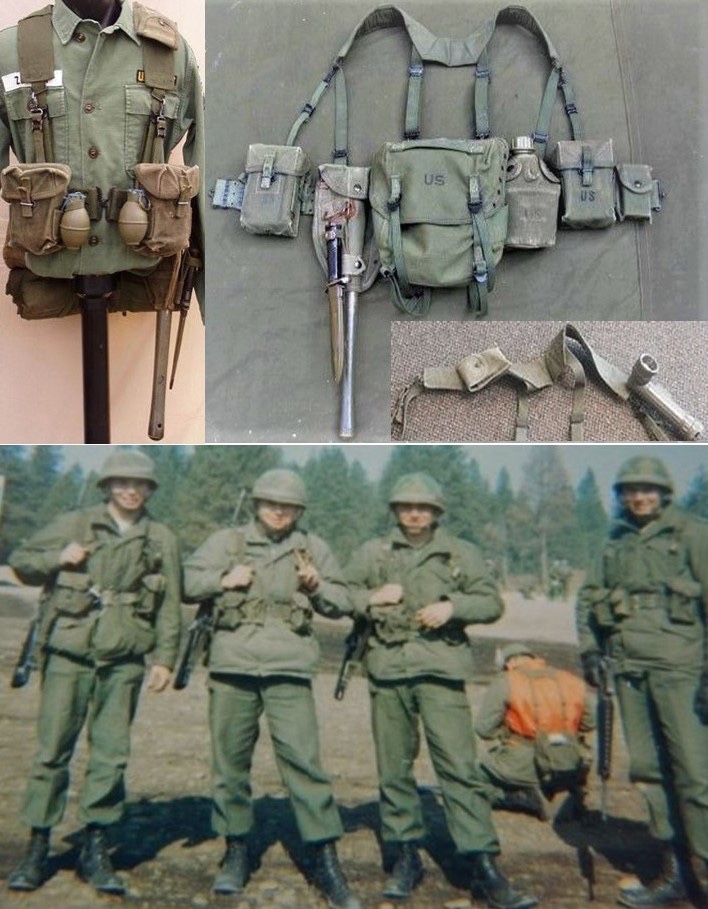
On the top right (above) is a picture of the LCE as it appears in the manuals of the day like FM 21-15, Care and Use of Individual Clothing and Equipment. It shows the harness set up as a six-point system with the ammo pouch attachment straps spread out from the front suspender straps. That is not how it was normally worn. With three 20-round M16 magazines in the ammo pouch and a grenade or two mounted on the sides of the pouches, there was quite a bit of weight that needed to be counterbalanced. Most everyone aligned the ammo pouches with the suspenders with both straps running more or less down the center of the uniform pockets as you see in the top left picture. With a couple of C-Rations, a change of socks, and a poncho in the buttpack on the back the load balanced out quite well.


However, there was not a lot of free real estate on the belt or harness once both ammo pouches, a buttpack, canteen, entrenching tool, flashlight, and first aid pouch are added. That is why in the M1956 system, the bayonet piggybacks off the E-Tool in the picture. Again, despite what the manuals said, I never saw anyone set up their gear this way. In the Mechanized Infantry, we used the M113 Armored Personnel Carrier (APC) as our foxholes. The E-Tool was stowed in the duffel bag on the side or top of the track and rarely used. We just wore the bayonet directly attached to the left side of the belt instead. By the way, it did not matter if you were right or left-handed. The unit SOP and uniformity dictated which side the canteen and bayonet were required to be carried. Most SOPs were based on the pictures in the manuals – canteen on the right, E-Tool and/or bayonet on the left.

Furthermore, if you wore the M1956 E-Tool as shown it would beat your thighs black and blue in short order – even just walking at a quick pace. There was only one time when I remember mounting the E-Tool on my LCE. We were required to wear all the LCE components for the EIB 12 Mile Roadmarch. We turned the E-Tool carrier upside down and tied the handle as tight as we could to the suspenders. It was not entirely satisfactory, but was better than doing it “by the book.” We had to work with what we had. Back in the day, there was no such thing as an after-market gear source so options were limited to adapting what was issued. I have mentioned before that the Airborne Units of WWII famously used their organic Rigger detachments to manufacture Airborne specific items that did not exist in the Army supply system. To the Army’s credit, the post-Korean War M1956 system was well thought out, fairly comfortable, and, therefore, generally popular with the troops. Indeed, it was more comfortable than the follow-on ALICE harness. M1956 gear served as a system throughout the Vietnam War and some individual items – like buttpacks – soldiered on for a couple more decades after that. However, the fact that “extra” M1956 parts were not readily available to soldiers served to limit opportunities to hack or supplement that generation of tactical gear in any way.

Jumping ahead, ALICE gear was treated differently by the Army. The most important change was that the Army decided, unlike previous “field gear” items, to make ALICE components available at Clothing Sales Stores (CSS) for individual soldier purchase. And ALICE items were cheap. $4.00 for the Y-suspenders/ shoulder straps as I recall. Now soldiers finally had the option to buy more than they were issued. That meant even privates could have one clean new set for parades and another for the field. It meant that troopers could experiment and make adjustments to their gear in ways we could not with M1956 – adding extra ammo pouches for example. Concurrently, non-issue ALICE compatible items began to appear on the market from companies like Eagle, Blackhawk, and Brigade Quartermasters. I do not think it is an exaggeration to say that ALICE and that CSS decision by the Army gave birth to the extensive tactical gear industry we know today.

I know a lot more now about how things work than I did then. Our M1956 LCE was already obsolescent in 1975 but still worked pretty well. We had battle-tested major end items like the M60A1 tanks shown in the first picture, and M113A1 APCs and UH1 Huey and Cobra Helicopters. We had a good number of truly great NCOs and Officers with extensive combat experience. Unfortunately, we had quite a few more that were not up to the Herculean challenge of rebuilding the Army after Vietnam. We had serious “indiscipline” problems and drug and alcohol abuse were endemic. A week after we got back to Kitzingen from REFORGER, two soldiers in my company overdosed on Heroin and died in the barracks. As Dorothy said, I was not in Kansas anymore. Like it or not, it was my Army now too.

De Oppresso Liber!?

LTC Terry Baldwin, US Army (Ret) served on active duty from 1975-2011 in various Infantry and Special Forces assignments. SSD is blessed to have him as both reader and contributor.