X-PAC

Archive for the ‘Guest Post’ Category

US, Colombian Army Paratroopers Successfully Conclude DFE Bilateral Exercise

Tuesday, August 17th, 2021

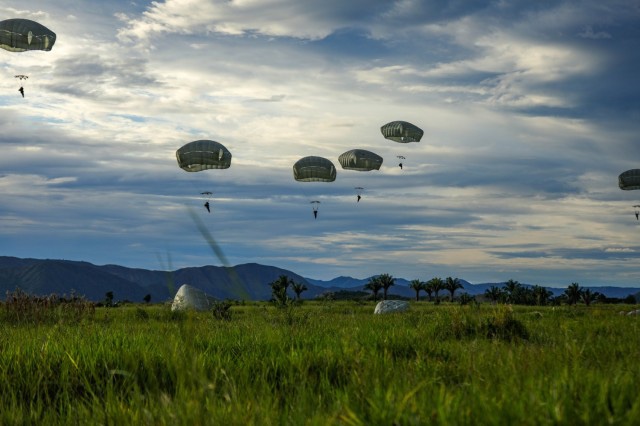
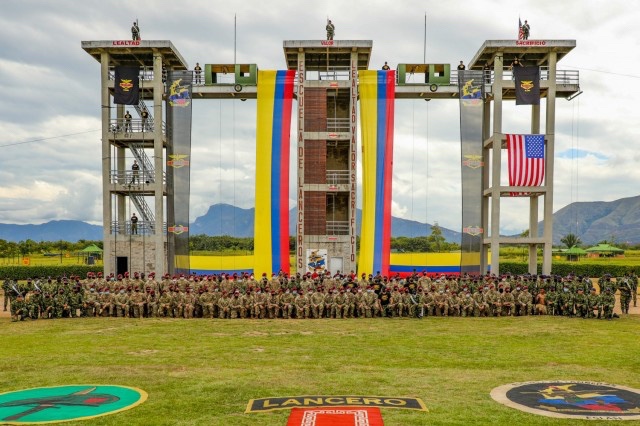
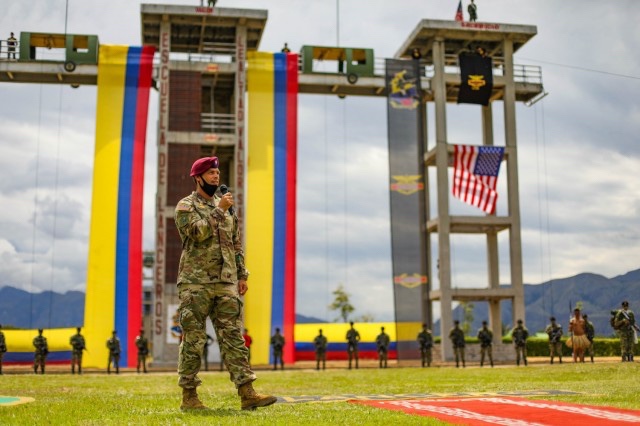
TOLEMAIDA AIR BASE, Colombia – U.S. and Colombian army paratroopers concluded a bilateral airborne training exercise July 30 with a demonstration of the tactical capabilities of the Colombian Army’s elite special forces unit, the Lanceros, at Tolemaida Air Base in Colombia.

The six-day U.S. Southern Command (SOUTHCOM) and U.S. Army South bilateral Dynamic Force Employment exercise allowed for the rapid deployment of U.S. troops within the SOUTHCOM area of responsibility to respond to crises and support partner nations in the Western Hemisphere.

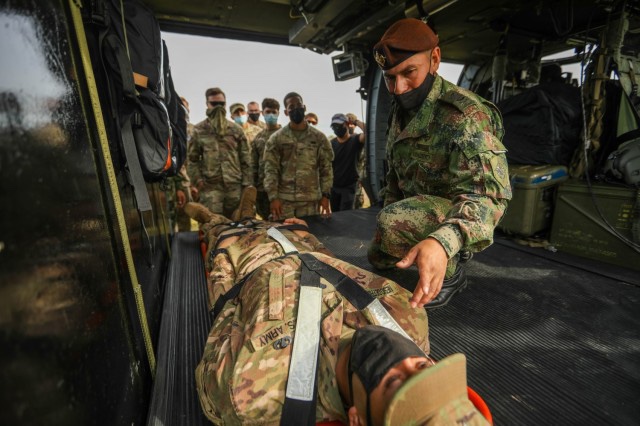
Over the course of the week, the two armies collectively trained on day and night airborne operations, a tactical field training exercise, medical evacuation procedures, a combat water survival course and engaged an obstacle course at the Lancero School.

The Lancero School was established by U.S. Army Ranger, and recent Medal of Honor recipient, then-Capt. Ralph Puckett, who earned gallantry for his combat during the Korean War.

Brig. Gen. William L. Thigpen, U.S. Army South commanding general, and Gen. Eduardo Enrique Zapateiro, Colombian army commander, observed the paratroopers take part of the combined airborne jump on the first day of the exercise.

“General Thigpen and I are in the field today, working hard to develop this training and be completely interoperable,” Zapatiero said. “We are going to put in practice all the distinct skills and capabilities that make a great soldier.”

The trip to Colombia marked Thigpen’s first to an Army South partner nation since his assumption of command on June 30, 2021, and provided him an opportunity to see firsthand the operational and tactical capabilities of the Colombian army.

“We want to thank both General Zapateiro and the Colombian Army for hosting us,” Thigpen said. “This Dynamic Force Employment is critical in demonstrating readiness with the U.S. and Colombian Army.”

As SOUTHCOM’s Joint Forces Land Component Command, Army South conducts security cooperation operations and activities with partner nation Armies in the SOUTHCOM area of responsibility in order to strengthen regional security and counter threats in support of a networked defense of the homeland. Through previous agreements at the conclusion of staff talks between the two armies, Army South staff planned, coordinated, synchronized and executed the DFE; with the 82nd Airborne Division serving as the operational unit of the exercise.

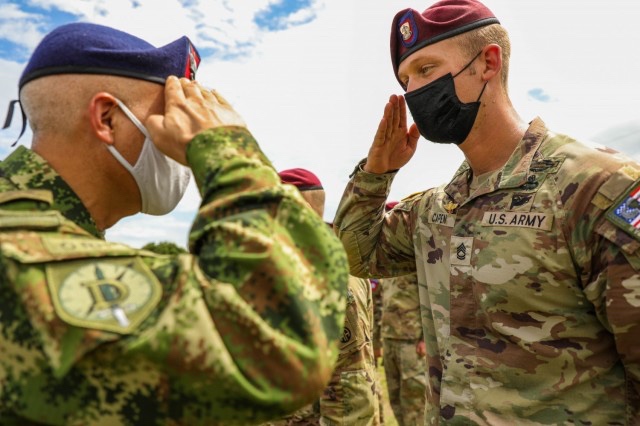
U.S. Army jumpmaster and platoon sergeant for Charlie Company, 2nd Battalion, 501st Parachute Infantry Regiment, 1st Brigade Combat Team, 82nd Airborne Division, Sgt. 1st Class Joseph Capen reflected on the efficiency of the Colombian paratroopers with whom he trained and jumped.

“One of my favorite things to see was how similar their military and our military operate,” Capen said. “Another thing was, from a technological standpoint, is they don’t utilize the newest and most advanced equipment, but they are still very proficient in how they operate tactically. It was neat to see.”

The positive impression of the Colombian military echoed throughout the ranks of U.S. paratroopers who took part in the exercise, as they were impacted by the various training events and cultural exchanges during the week.

At the closing ceremony, Lt. Col. David Webb, 2-501st Battalion commander, expressed his gratitude and respect for the military participants from the Colombian army who took part in the Dynamic Force Employment exercise.

“The Colombian military is the best partner force that I’ve worked with in 18 years,” Webb said. “I pray for peace, but I’m always ready for war. If I do have to fight a war, I would be proud to serve with each and every one of you.”

By Joshua Taeckens

Combat FlipFlops – Written in Taliban

Monday, August 16th, 2021

Over the weekend Matt Griffin and Matt Chapman, founders of Combat FlipFlops posted a look at the current situation in Afghanistan written from the Taliban’s point of view. It went viral and in typical Technogarch fashion, social media censored it.

So here it is. Read it all the way to the end.

Written in Taliban

The first time I saw you was in the Khyber pass.  You came with your technology, elite fighters fueled by revenge, and the hubris to believe you could disprove history.

This was a war that you didn’t have the stomach to fight.  But I’m glad you tried.  

We bled you the same way we bled the Soviets in our Holy Land.  We bled you the same way the Vietnamese bled you in their home land.  We did it patiently and deliberately.  

Patience.  Something Westerners never learn.  

Our history is millennial.  We don’t yearn for an early victory when the Infidel ravages our Holy Land.  Our victory is celebrated decades from now.  We’ve endured, then ravaged every standing military that crossed our borders.   Why?  How?  We’re patient.  

In 30 days, we’ll be stronger, richer, and have control over precious natural resources that you need for your pathetic life that’s dictated by comfort.  We will have women, riches, land, guns, and ownership of one of the greatest chapters in military history. 

You lose. 

If you want to try again, we welcome the challenge.  You will fail regardless of how much money you burn in our deserts. For pity, here is free advice that may contribute to your future success; should you ever decide to invade again.

You recruit your warriors and supporters from a drug addicted, distracted, disillusioned population that’s obsessed with comfort and entertainment.  A population obsessed with altering their mundane reality.  Alcohol, marijuana, pills, and our new favorite — Tide Pods.  Every time your doctors prescribe opiate painkillers, you line our coffers with gold.  Your population’s thirst for our pristine heroin has never been more lucrative for our warrior tribes.   We will keep feeding you poison for as long as you keep your hands out.  

If your population wasn’t so spineless, undisciplined, and self loathing, then you might be able to compile a raiding party with enough tenacity to outthink ours. 

Our fighters are born into war.  Raised in it.  It’s a way of life that evades your “first world” nations. They live a life of such immense misery and pain that they’re willing to fight barefoot in the snow for the opportunity to martyr themselves. They yearn for the opportunity to die.  When they do have the blessed opportunity to sacrifice themselves, they sit above Mohammed at the right hand of God.  Blessed in Allah for eternity

What honors do your fighters receive?  Their empty sacrifice is remembered in the form of a “three day weekend.”  The majority of your population uses this sacred time to get drunk and grow more fat as a way to celebrate their fallen warriors.  Sadly, we pay tribute to their death more honorably.

The colored pieces of cloth you pin on their chests are similar to the jewelry worn by our women.  What good are accolades and vanity if you don’t have the stomach to endure a fight?   We don’t offer the burden of healthcare to our fighters as they often want to die for Allah.  Your fighters fight to live.  Their inability to reconcile the inevitable outcome of our patience leads them to kill themselves.  Your medications, counselors and non-profits will never undo the pain and suffering you’ve forced them to endure.  It will never remove the pain we’ve caused your broken nation.  You are your own worst enemy. 

We will give your fighters credit.  Some are creative, tenacious, and fierce. They outgun us in every way possible.  But again, we simply wait them out.  Allah is patient.  You cycle them through our Holy Lands every 3 to 12 months for their combat rotations. After their tour is complete, they return to the comfort of their warm beds and endless entertainment.  If you left them here, in our Holy Land, with no way out but to win, then you might of have had a chance of success.  The longer you poisoned our Holy Land with your presence, your “rules of engagement” only strengthened our position. There is only one rule in war – that is to win. 

Your commanders made you fight with your hands tied behind your back. Your rules also confused our fighters too.  “We’re clearly the enemy, why are they letting us go?”  Thank you for your compassion as it allowed our fighters to kill more Infidels.  We began to feel as if your commanders were on our side.  We’re thankful your most vicious dogs were never allowed off their leash. 

Your showcase Generals make us laugh.  You spend millions of dollars flying them around our country inventing new ways to win, while ignoring the guidance of our most capable foes.  Your Generals make decisions to minimize risk to their fragile reputation with the ultimate goal of securing a lucrative retirement–jobs with suppliers that fuel your losing force. A self-serving circle that’s built on the backs of your youngest and most naive fighters.

Your retired Generals “earn” tens of thousands of dollars talking to your political, industrial, and financial leaders about “teams, winning, and discipline.”  It’s a mockery of the war they refused to fight.  It’s a mockery of the Infidel warriors who died in our lands. We urge you to continue following their vacuumous personalities so we can further watch your once great nation collapse. 

Your statesman and elected officials are spineless, narcissistic, and more cowardly than your Generals. They crave power over you above all else. They come to our country, hide behind blast walls, and only heed the word of the indiginous leader they put in power.   I believe your soldiers call this a “self licking ice cream cone.”  

They’ve burned billions of dollars in a wasted effort to bring clean water, electricity, business, education, agriculture, and exports to a region that didn’t ask for it.  You should have saved yourself the effort and simply given the money directly to us.  Don’t worry, your diplomatic friends gave us plenty of your American tax dollars.  If you want to give it another shot with your “soft power,” send those with real experience, not fancy degrees and silver tongues. 

Over the next few months, we will  make the world understand that you failed worse than any fighting force that’s ever invaded our lands.  Today we celebrate victory.  

As you evacuate your embassy, our fighters will be standing in the shade. We thank you for the parting gifts.  You’ll find surface-to-air missiles staged in the back of Toyota pickup trucks that you purchased for us.   Our marksmen will be patient.  

We saw what Extortion 17 did to your nation and the morale of your fighting force.  Do your citizens even remember that victory? We’ll be repeating and improving upon our victory while your citizens and sympathizers evacuate in disgrace.  Every one of your foes around the world will know exactly how to break you. 

You are welcome to fly your empty drones, target our cell phones, and send your spies.  But they, too, will ultimately fail.  We’ll use their failures to show the world that you’re not all-powerful.  You’re a false front.  An empty shell. You lie, cheat, steal, and are easily defeated because you lack the spine to fight.  This is your history now.  We’re grateful Allah gave us the opportunity to show the world how to defeat the Infidels. 

We look forward to seeing you again across the battlefield.

Praise be to God,

The Taliban

***Authors’ Note***

If you’ve read this far.  Thank you.  I’ve spent the past week trying to find a way to communicate this to the American people in a manner that would cause anger, rage, action, and understanding.  Writing in the voice of a Taliban felt right.

If this made you angry, cry, or contemplative–then our goal is achieved.  Our hope is that it inspires you to take action with your elected officials.  They’ve been repeating the same failing playbook since World War II with your sons, daughters, and tax dollars.  If you want this to keep happening, do nothing.  If you don’t, then do something.  If we all do a little, together we do a lot.

About the Authors: 

Matthew Griffin is a 2001 United States Military Academy Graduate, Army Ranger, Combat Veteran with the 75th Ranger Regiment (3x Afghanistan, 1x Iraq), CEO of Combat Flip Flops, author, and 2019 Henry Crown Fellow with the Aspen Global Leadership Institute. 

Scott Chapman is a 2000 Murray State University Graduate, Army Ranger Fire Team Leader from Alpha Company 2/75th Rangers (‘01 – ‘05), OGA Blackwater Alumni, entrepreneur, and author. Combat Veteran ( 21x Afghanistan, 1x Iraq)


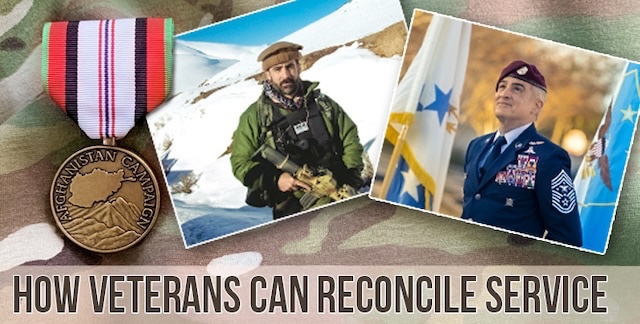
Afghanistan: How Veterans Can Reconcile Service

Monday, August 16th, 2021

Major news outlets for the past few months have focused on the drawdown of our nation’s longest war: Afghanistan.

At its peak, there were more than 100,000 U.S. troops in Afghanistan in 2010; the number of troops have steadily shrunk over the past decade. While news coverage debates the decision to cease combat operations, the highest-ranking enlisted service member in the military said Veterans from the war should remember the positive to help reconcile their service.

“Our purpose for being there was to prevent further attacks on the homeland,” said Senior Enlisted Advisor to the Chairman Ramón “CZ” Colón-López. “We wanted to make sure that we denied Al Qaeda, specifically, of sanctuary, training ground and places where they could plan terrorism attacks. If you look at the past 20 years, that is exactly what we did. There hasn’t been a single attack on the homeland. They will think twice about doing it because of our actions over the past 20 years. For our Veterans, be proud of what you did, because you have kept the country safe over the last 20 years.”

Deployment and PTSD

Colón-López has lived the war for two decades. He was an element leader with the 24th Special Tactics Squadron on 9/11. Shortly after, he deployed to Afghanistan on direct action and combat search and rescue missions to capture or kill high value targets. He also provided security for Hamid Kharzai, who later served as Afghanistan’s president. Now, as the senior enlisted service member, he serves as an advisor to the Chairman of the Joint Chiefs of Staff on all matters involving joint and combined total force integration, utilization, health of the force, and joint development for enlisted personnel.

Colón-López admitted getting to a place of being proud of his own service wasn’t easy. Serving as a special operator in Afghanistan, he’s dealt with tragedy and personal demons. He said one of his personal hardest moments was hearing the death of Air Force Veteran Scott Duffman, who died with seven others on a mission in 2007. He also faced repeated deployments, placing both physical and mental stress on his body. While stationed at Kirtland Air Force Base in New Mexico, a July 4th celebration in neighboring Albuquerque turned traumatic. The combination of the desert, smoke in the air, loud noises and smell of powder triggered his PTSD.

Years of dodging his PTSD led to heavy drinking, moodiness, hiding his trauma during physical health appointments and engaging in reckless behavior. Once, while stationed in North Carolina, he left work for his 45-minute drive home. By the time he got there, he was in tears. He went inside and talked to his wife, Janet, about his PTSD. While talking about it helped him, he said the breakdown was simply “mitigation.”

Seeking help

Colón-López said a mountain biking accident in Germany led to an ultimatum from Janet to get help. He crashed his bike while seeking a thrill to replace his combat experience.

“She said, ‘you’re going to the clinic now,’” he said. “It was liberating by the time I actually went in there. I thought I could fix myself and that is not the answer.”

He now encourages every Veteran to get help for PTSD.

“The first thing I will tell them is there is no shame in doing so,” he said, citing 20 years of combat operations in Afghanistan, as well as Iraq, Syria and other locations. “We’re resilient, we know how to suck it up, and we know how to power through it. But there’s going to come a time to where you won’t be able to do that.”

Dealing with the end of combat

While some troops have reconciled their service, not all have. With the recent news and announcements over the end of the Afghanistan mission, VA facilities also started seeing an increase in Veterans seeking help. Two psychologists from the National Center for PTSD said they are starting to see Afghanistan Veterans bring up issues around their service.

“Reactions aren’t always what people think they are going to be, and that’s okay,” said Dr. Jennifer Vasterling, the chief of psychology at the VA Boston Healthcare System and affiliated investigator with the National Center for PTSD.

Veterans should be on the lookout for red flags if news of Afghanistan starts changing behavior, said Dr. Sonya Norman, director of the National Center for PTSD Consultation Program. These include isolating, using alcohol, drugs or any increase in unhealthy behaviors compared to normal. This could even include things like excess work or video games.

Avoidance

Another unsuccessful coping mechanism many Veterans use is avoiding the topic.

“It can feel really good in the short term,” Norman said. “In the longer term, avoidance breeds more avoidance. It felt so good that one time that you begin avoiding more and you start doing less. Your world becomes so small, time over time, as you avoid more and more.”

Norman said that numbness can spread and snowball, where people aren’t feeling pleasure or joy. She said people can feel danger in relatively safe situations. For those people with PTSD, replacing traumatic wartime memories with thoughts and activities that make them happier can be difficult without treatment and may feel reluctant to let the memories out.

“It’s pretty hard to do on your own without treatment,” she said. “If you actually let the emotions from the time of the trauma flow, they kind of do their thing and someone feels a lot of relief. There’s room to bring in other positive memories and experiences, which are just as real.”

As an example, she used an analogy of a 17-room mansion, saying the traumatic memory may still have a room, but there will be 16 other rooms for positive memories.

‘Be proud of what you have done’

According to Colón-López, one of those positive memories Afghanistan Veterans should be proud of is the fact that U.S. troops arrived home safe. The last U.S. combat death was Feb. 8, 2020, more than 17 months ago.

“We had been there for 20 years, and I know because I was one of the first people to go out there on the first rotations. What we have done from then to now is phenomenal,” he said, pointing toward the progress made in Afghanistan, including helping stand up a government and building a military force.

“For any Veteran out there listening, be proud of what you have done,” he added. “Our government has made the decision and we have followed lawful orders.”

Watch Colón-López talk about mental health: www.facebook.com/watch/

Story by Adam Stump, Department of Veterans Affairs

SCUBAPRO Sunday – Should your Gear Sink or Float?  

Sunday, August 15th, 2021

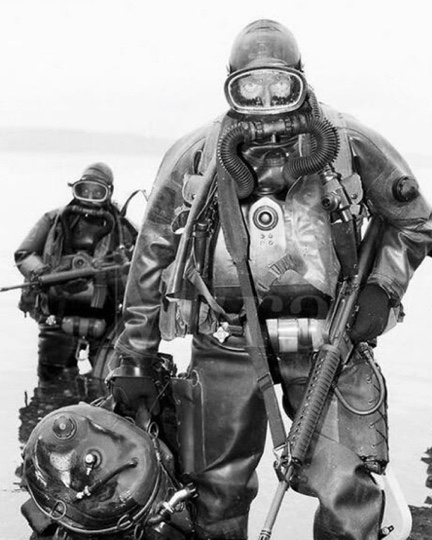
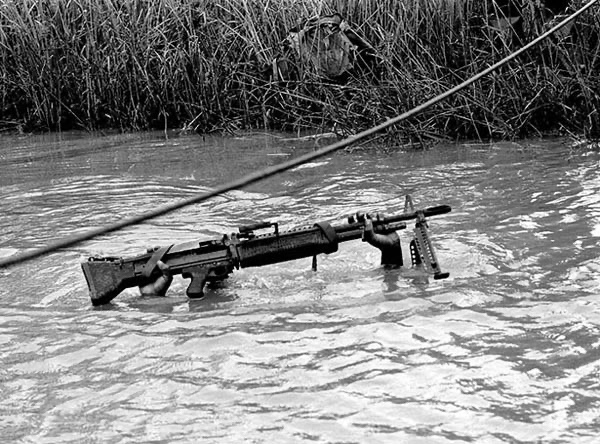
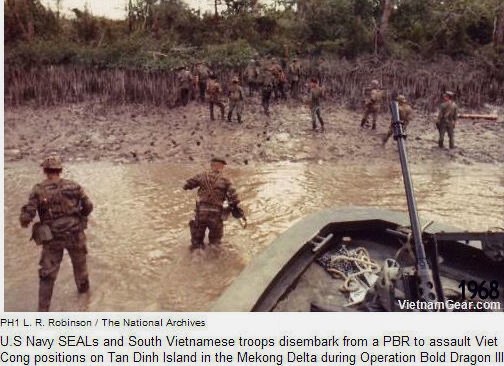
When it comes to your gear, there are two primary schools of thought. It should sink, so if you lose it going over the beach or during a river and stream crossing, someone won’t find it. The other is that it should float; the main reason for that is so you won’t be pulled down, but if you are going over the beach, doing a river and stream cross or taking a ship down and you go overboard and are knocked out it can help float you. So, what is the correct answer?

Well, they both are for different operations. You have to take everything into account. If you are conducting a ship attack and coming up behind it on a High-Speed Assault Craft (HSAC) or Combat Craft Assault (CCA), you will want your stuff to float or be able to float (yes, there is a time when you fall in depending on where it happens, you might want to go underwater to avoid something). If you are doing a two-stage ladder-climbing onto an oil platform and you fall and get knocked out, you want to float or at least have a life vest that will inflate automatically.

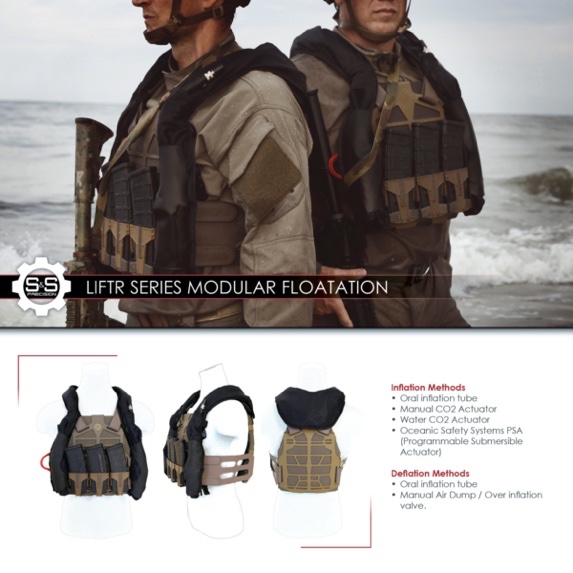
You should look at it like this, your gear should float itself or be neutrally buoyant, and if you want to float, you need to have something on you for that. Think of you and your gear as two different things. If you go into the water, your kit should be neutral, and you should have some type of Personal Flotation Devise(PFD) for yourself. Still, you should always be able to go underwater if needed, like for going under a wave or if you need to avoid someone/ something. 

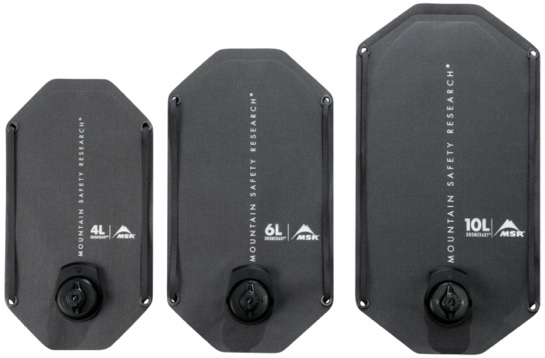
So how do you make your gear neutral buoyant? The best way to start is by knowing how much everything you are carrying weights. I will go old school, so let’s use 100rds of 7.62 x 39 weights 7 pounds. You should have a list of what things weigh or have a good idea of everything you might take out in the field with you. Keep in mind that if you are using a hard water bottle, like a canteen or Nalgene bottle, as you drink from it, it will start to float. It won’t be so bad as to affect you that much but keep it in mind as you stay out in the field, things weights will change. The same goes for needing to float. You can always use them in an emergency. MSR makes water storage bladders that are great to have in your pack. They can be used as flotation if needed and water. Even in the jungle in the rainy season, it never hurts to have a way to store extra water. When you come across water, always take as much as you can carry.

If you have other things that might float like your fins, chemical light, or rucksack liner (and never go anywhere without that old school ruck liner). Try using the lead weights that are made for balancing a car tire. Most come with an adhesive side. You can put it anywhere you need. They also come in black. You can put them on the side of the fins; this way, it doesn’t affect the way the fin performs, and if for some reason it falls off, or you drop it, it will sink. If you have chemical lights on you to use for signaling, or as an old school frogman flashlight (when you have it all taped up for use underwater and you have the end open so you can use it for your compass) if you put lead solder on them and drop it, it will sink and not float away.

Remember that packaged food (MREs, Mountain house meals) will float.

If you are taking a new piece of gear out, let’s say it’s a new pack make sure you take it to the pool and see how it acts in the water, put some weight in it and see what it takes to make it sink, don’t just throw it in and say “yup it sinks” leave it in there so it is nice and soaked so you can also see how  it drains, do you need to add more drain holes? How heavy will it be when it is wet and how long will it take to dry. With today’s technology almost everything can float or even be close to neutral to include body armor plates.

So, what is the right answer, float or sink? I think they both are the correct answer depending on the situation. But the key is to make sure you are ready for whatever might happen during any giving case. Have your gear set up so it can float itself if needed. So do your homework, or at least hang out with someone that does.

Defender Pacific 21: Special Forces Soldiers, JGSDF Conduct Bilateral Operations in Guam

Sunday, August 15th, 2021

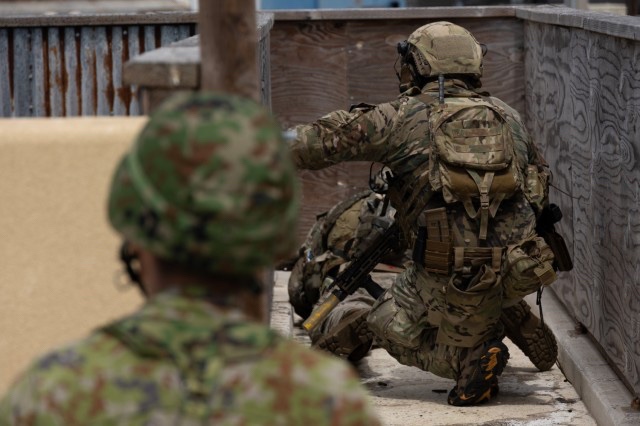
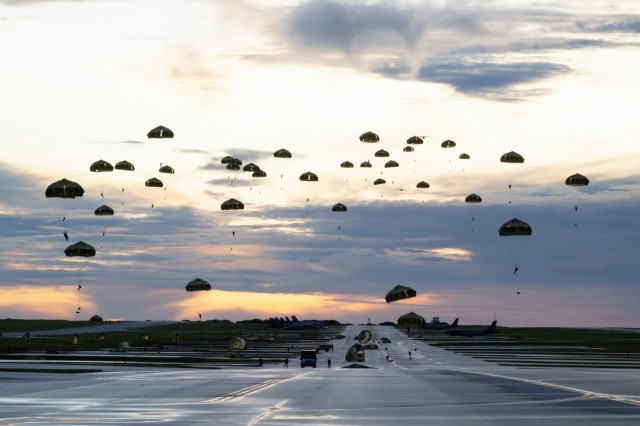
GUAM — Two C-130s launch from Yokota Air Base, Tokyo, into midnight darkness on course to deliver airborne personnel with U.S. Army Special Forces and the Japan Ground Self-Defense Force members to Guam.

History is being made as Green Berets with 1st Battalion, 1st Special Forces Group (Airborne), and members of JGSDF, execute their first bilateral airborne operation outside of Japanese territory. On board, both units know well the commands and procedures that lead up to exiting a high-performance aircraft.

The operation begins with a call from the drop zone control party. The pilots check in and wind calls are made. The JGSDF exits on first pass with the Type 13 parachute. On second pass, special operations forces exit with the steerable MC-6 parachute. Directly below is a flight line—which guarantees a hard landing—and grass off to the sides.

On July 30, 2021, a Special Forces Operational Detachment-Alpha (ODA) assigned to 1st SFG (A) and approximately 80 members with JGSDF conducted bilateral operations in Guam as part of Defender Pacific 21.

DP21 is a U.S. Army Pacific exercise designed to operationalize the national Defense Strategy through realistic, iterative training across all domains—land, sea, air, cyber and space.

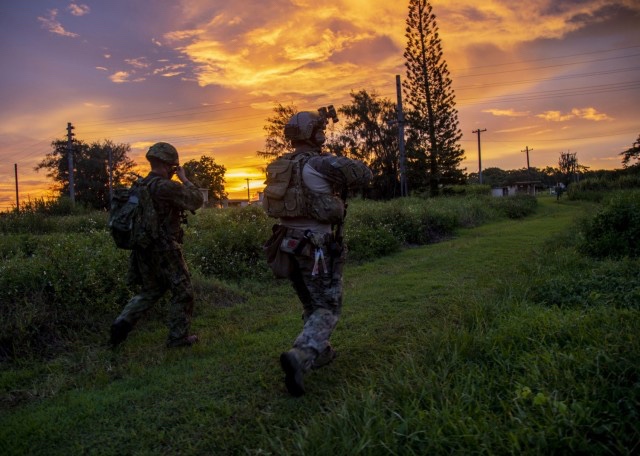
Following the airborne infiltration, U.S. Special Forces and the JGSDF conducted an air assault in vicinity of their first objective near Naval Base Guam, said the Special Forces ODA team leader assigned to 1st Bn., 1st SFG (A). After destroying the first objective, which were anti-air weapon systems, the bilateral force reconsolidated and moved toward their follow-on mission.

Thirty-six hours elapsed from when mission planning started to when the second objective — an enemy command and control node — was destroyed.

Despite tropical heat, humidity and lack of sleep, the bilateral force conducted a high-performance mass-tactical airborne operation and executed two targets with zero major injuries, said the team leader. The airborne operation sends a clear message that the United States and Japan share a commitment to freedom and security and can employ a combined force in support of these principles.

“This experience provided valuable insight into JGSDF capabilities and maneuver techniques; giving insight into how we can better support their operations in the future,” he continued. “Furthermore, this operation allowed the team to create valuable relationships with JGSDF [members] and leadership that will serve as the foundation for future bilateral operations.”

Throughout the operation, the ODA team leader made sure bilingual Green Berets and JGSDF members were placed strategically in the formation to ensure communication and commands were understood.

“Joint operational capability is important for us to defend [Japanese] territory,” said Capt. Ryosuke Taki, lead U.S.-Japan bilateral operations planner for JGSDF.

For six months, Taki coordinated with the JGSDF and 1st SFG (A) on making this training opportunity a reality.

“I had to overcome many obstacles to accomplish this mission,” he said. “As far as airborne operations go, [U.S. Army] uses many words we don’t know. Language sometimes [created] misunderstandings making coordination difficult…[however,] our members wanted to coordinate with 1st Special Forces Group.”

“Special Forces are experts in military freefall and close-quarters combat, as well as static-line jumps,” Taki said. “We have more lessons to learn from their rich experiences.”

The Indo-Pacific region is the most consequential theater on the planet and DP21 provides opportunities necessary to create, refine, and deploy new options and solutions for the challenges our nation, allies and partners face. This exercise anticipates requirements to support regional alliances and the existing security architecture to exploit opportunities.

By Anthony Bryant

Counter-UAS: Going Beyond “Selling Boxes”

Saturday, August 14th, 2021

Small drones or small unmanned aerial systems (sUAS) moved from a novelty to an everyday presence over the past decade across civilian day-to-day life, and also finding a place supporting nefarious uses such as contraband smuggling, airport disruption, terrorist attacks, and military conflicts. Rapid improvements in maneuverability, autonomous flight capabilities, flight endurance, camera technology and more, make small and cheap drones an appealing platform for reconnaissance and payload delivery.

The counterdrone (also known as counter-UAS, c-UAS) industry has also been rapidly growing to keep pace.

Early Days of Counter-UAS

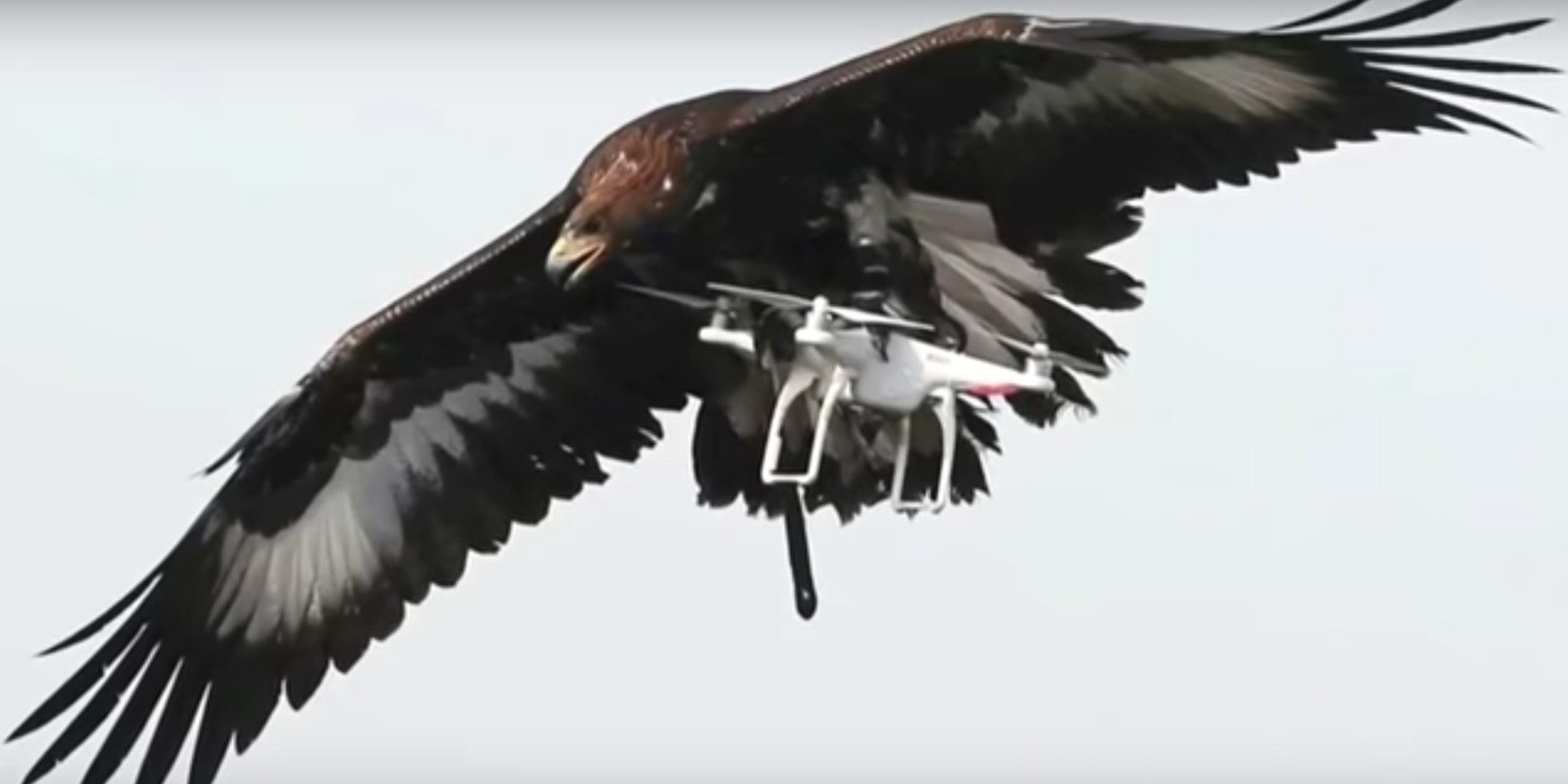
Early efforts (mid 2010s) are viewed as mostly “garage work”, a combination of repurposing existing technologies for a new objective of detecting drones (such as the use of traditional ground-based radars to now monitor the skies for drones). Both counter-UAS manufacturers and customers experimented and learned at this stage, what worked and what didn’t, while often exploring exotic concepts including hunting drones with eagles, using barking dogs to detect drones, and leveraging other emerging technologies.


Image: Early days of counter-UAS

Maturation of an Industry 

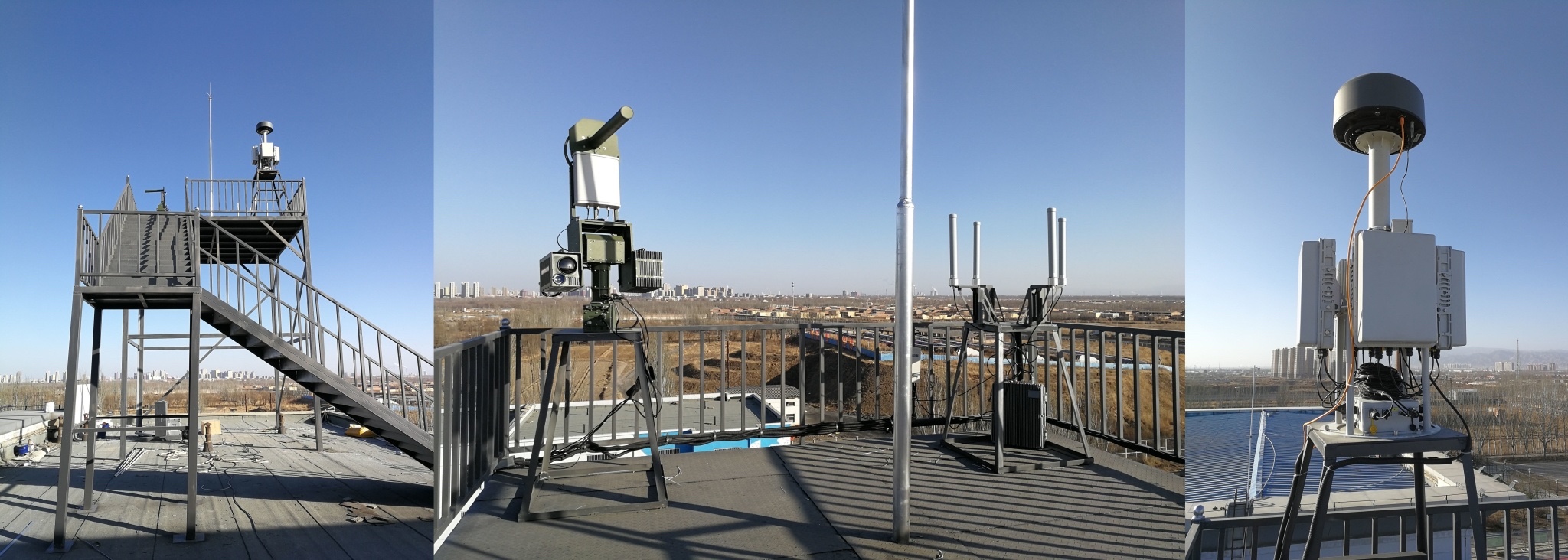
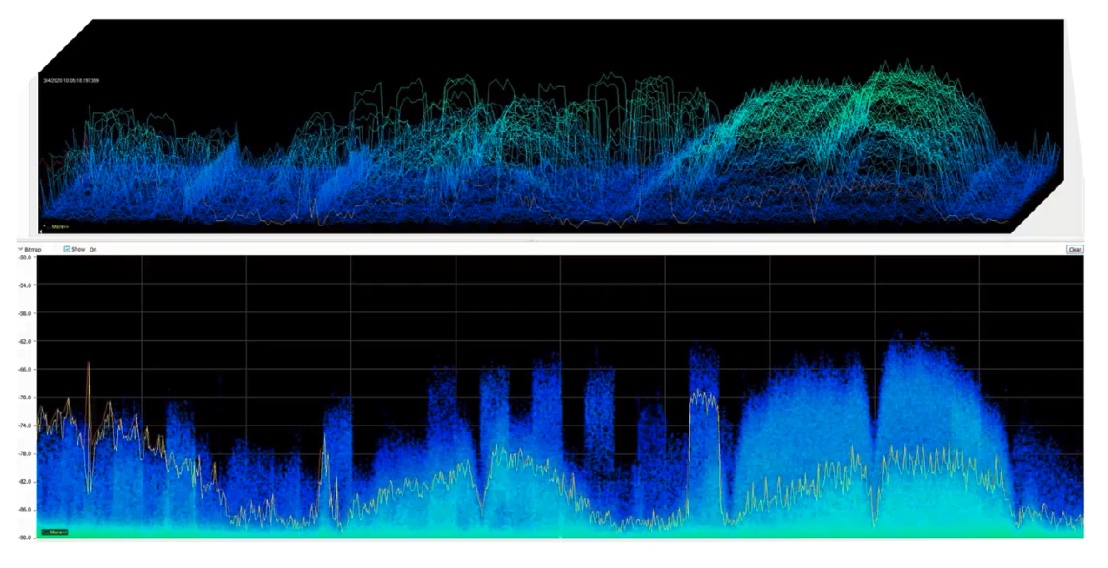
By the late 2010’s, Radio Frequency (RF) started to emerge as a single sensor winner, owing to its ability to accurately detect and track drones without the very substantial false alarms produced by standalone radar sensors, as well as its ability to detect hovering drones, significant range advantage (up to 10km for best of breed sensors), and superior cost-to-covered area ratio.  As an example of this cost per coverage difference, most radars, even today, cannot detect small drones more than 1-2km away, and those that can, often cost in the hundreds of thousands of dollars, or more. Additionally, RF systems can pick on Unmanned Ground Vehicles (UGVs), and Unmanned Surface Vehicles (USVs) on the water, as those tend to use largely similar RF protocols without getting caught in the ground clutter that would influence the radar or call for a completely different radar to perform the job effectively. In the counter-UAS industry the threat shifted to a UxS threat (UAVs, UGVs and USVs) and RF sensors were more easily adapted to support the multi-domain threat.

Sophisticated customers have started to adopt a multi-sensor approach, such as systems including RF, radar, cameras, acoustics and more. The concept behind a layered system is essentially two-fold – either increase the likelihood of any stealth/rare drone being detected by setting the system to “alarm if any sensor type triggered” mode or reduce false alarms through seeking multiple sensors to confirm the alert prior to alerting the user. Higher end systems enable a setting of value ranges for the multi-sensors, optimizing the probability of detection, minimising the false alarms, and tailoring the system performance for a particular installation.

Present Day

The counter-UAS industry has grown from a small handful of companies in mid 2010s, to hundreds globally today. While many counter-UAS providers are resellers or suppliers of early-stage prototypes, the list also includes few dozen OEMs (Original Equipment Manufacturers), with a few of them also integrating third party technologies.

This evolution of the threat and need for a more comprehension solution, creates a challenge for end customers, many of whom realize they need to move beyond “buying boxes” as in the early counter-UAS days (“boxes” being individual counter-UAS products, such as a jammer or single detection devices). 

Users now seek a streamlined counter-UAS capability. This includes:

• utilisation of any counter-UAS equipment they may have already purchased previously through enhanced signal processing from those sensors,

• augmenting with complementary sensors and effectors, and

• stitching the whole solution together into an intuitive, low cognitive burden on the user, complete system, which is interoperable with other systems they may already have in place.

Appropriate deployment advice and post-sale service including regular software upgrades, is part of the picture.

End users of counter-UAS equipment increasingly want their problem of airspace control and awareness solved, rather than having to “buy yet another box” to address the latest threat. Solution providers who will continue to win in this space, will be focused on understanding and solving (often via a custom solution) the customer’s capability gap, rather than forcing the customers to buy their wares.


Image: Counter-UAS customers are looking to solve their airspace control and awareness issue, rather than purchase more “boxes”

Future of the counter-UAS industry

The early “cowboy” days of small, single product firms are starting to come to an end for the counter-UAS industry, with customers requiring tailored solutions to address their gaps in a unified and complete counter-UAS security system, which communicates with other broader systems, rather than a collection of individual products. Some of the largest customers of counter-UAS are starting to consolidate their approach to counter-UAS procurement. The set-up of the Joint Counter-UAS Office (JCO) by the US Department of Defense and the Centre for Protectional of National Infrastructure (CPNI) in the UK are two examples of this consolidation of effort by customers. Solution provides need to take a similar approach in providing consolidated, multi-faceted capabilities that address the problem and capability gap, rather than just adding their box to the shelf of disparate equipment.

Artificial Intelligence and Machine Learning (AI/ML) software is becoming an increasing part of the requirement, both at an individual sensor and multi-sensor fusion level. As new types of drones continue to evolve, AI-based solutions can enable detection of never-seen-before threats, whereas the library-based systems of the early years are limited to detecting only the threats defined in their static list.


Image: AI and Machine Learning software is increasingly becoming a part of counter-UAS requirement

As the use of UAS continues to rise in military operations, where they have become highly visible assets in Greyzone and Asymmetric warfare, as recently seen across the Middle East, in the Azerbaijan/Armenian conflict, and the Ukraine/Russian conflict, counter-UAS equipment will continue to mature and integrate into the broader Electronic Warfare (EW) and Signals Intelligence (SIGINT) space. For that, again, selling “boxes” won’t do, and the challenge becomes about solving specific customer capability gaps.

Wanted: Innovative Ideas for Spark Tank 2022

Saturday, August 14th, 2021

WRIGHT-PATTERSON AIR FORCE BASE, Ohio (AFNS) —

Spark Tank 2022, a Department of the Air Force annual competition in which Airmen and Guardians pitch innovative solutions to operational problems, will accept submissions in early August 2021.

Spark Tank is co-sponsored by the Deputy Under Secretary of the Air Force for Management (SAF/MG) and AFWERX. “Spark Tank is a crucial part of the Air Force’s relentless search for innovative technology,” said Col. Nathan Diller, AFWERX director. “The operational skills and knowledge our Airmen and Guardians possess give them the expertise not only to identify problems unique to their jobs, but also solutions.”

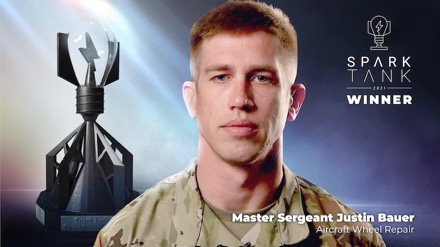
This is the fifth year of the Spark Tank competition. Spark Tank 2021 drew more than 300 submissions with five finalists. Master Sgt. Justin Bauer from the 355th Fighter Wing at Davis-Monthan Air Force Base, Arizona, was awarded the Spark Tank trophy for his idea, “Innovative Approach to C-130 Wheel Repair.” Previous winners and finalists have offered improvements from smart weapons loading checklists to robotic process automation for personnel records and everything in-between.

As a bonus, SAF/MG and AFWERX are introducing Spark Tank innovation awards to recognize innovative solutions proposed and developed by Airmen and Guardians across the enterprise. The awards are designed to encourage innovation development, talent retention, and speed up adopting emerging, game-changing technologies that impact the Air and Space Force.

“Spark Tank offers a great opportunity to highlight the innovative spirit of our Airmen and Guardians,” said William Gautier, Spark Tank director. “These risk-takers, idea makers, and entrepreneurs reject the status quo, instead they seek inventive answers that improve how our jobs are done.”

To enable participation, interested members will submit ideas through the recently launched Guardian and Airmen Innovation Network portal. GAIN allows personnel to share ideas, critique submissions, and vote on the most promising solutions.

Innovation submissions are due via GAIN no later than close of business, Oct. 1, 2021. Finalists will be announced in January 2022. The pitch-finals competition will take place on March 4, 2022, at the Air Force Association’s Aerospace Warfare Symposium in Orlando, Florida.

More information will be forthcoming at www.afwerx.af.mil/spark-tank. Ideas can be submitted to the Spark Tank competition at afwerx.af.mil.

FirstSpear Friday Focus: OEM Spotlight Hunt Redi

Friday, August 13th, 2021

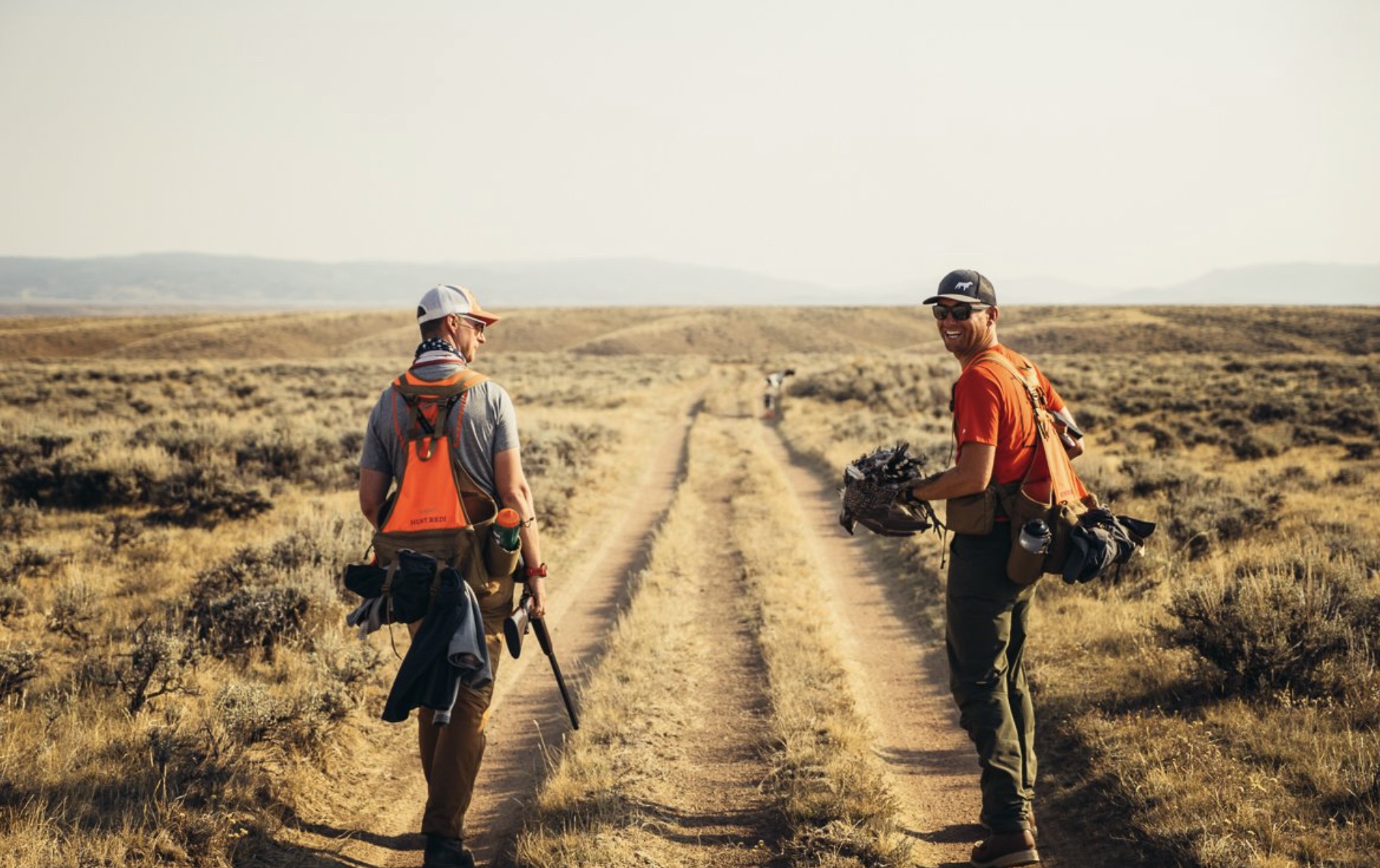
This week’s Friday Focus, we’re going to focus on one of our OEM brands. With fall right around the corner, it’s time to gear up for hunting season. Enter Hunt Redi, an American company that harnesses the technology and innovation of FirstSpear products in their own lineup of highly versatile, ultralight hunting products.

Why/How did Hunt Redi get its start?

As passionate outdoorsmen, we spend quite a bit of time each year passing the seasons hiking, camping, kayaking, hunting, etc and have all sorts of gear for these endeavors filling up the garage. One of our favorites pursuits is certainly chasing birds in the uplands and it simply became frustrating that upland hunters were being “left behind” in terms of innovative gear, clothing, etc. Year after year we complained among ourselves and had numerous, “man, I wish…” types of conversations when comparing our options in other ventures. During a pheasant hunting road trip to South Dakota  we just started talking about “what if we…” and a number of years later we are hunting in our own gear.

What products do you have for 2021? (Maybe we discuss the modularity of your pockets and attachment points and the tech? or do you have something new in the works?)

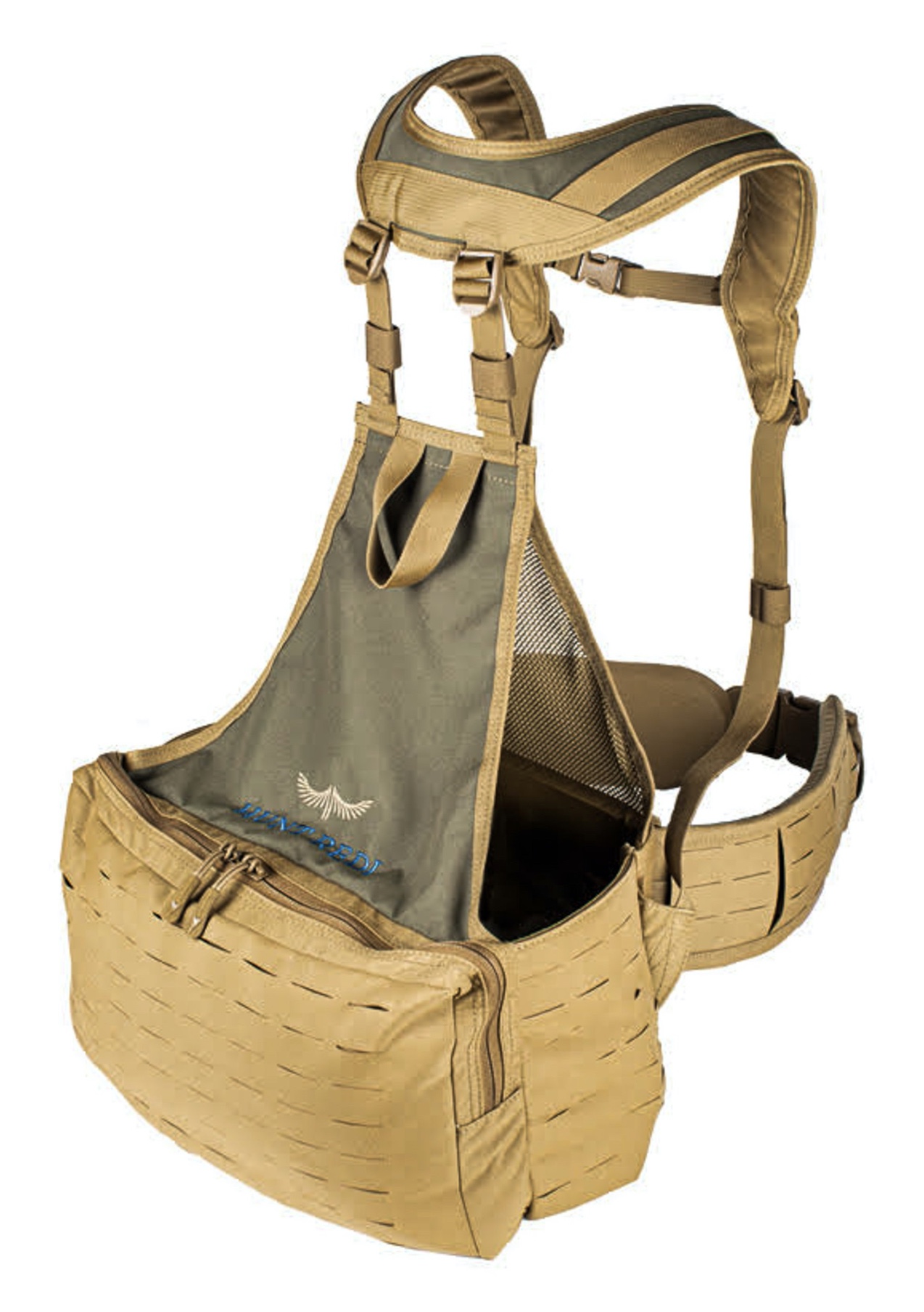
The Deviate Upland Strap vest provides passionate upland hunters with a pack that further enables their pursuits in the field through a highly configurable, extremely durable, and ultralight platform. A wide selection of pouches, pockets, and accessories provide each individual with the opportunity to build a highly customized upland vest to meet their unique needs in the field.

There are options for private label manufacturing all around the world, how did you find us and why did you ultimately choose FirstSpear OEM manufacturing?

From the outset, we were simply not interested in offshore manufacturing options so we focused our partner search in the US which narrowed things down a bit. It’s a big question each organization must answer for themselves and there are implications with each direction. We were looking for specific capabilities, top shelf quality, and simply good people to work with as we launched Hunt Redi. After meeting with the folks at FirstSpear, it seemed like a natural fit for all of our needs in a partner.

Why was Made in the USA important to the brand?

The simple fact a couple of lifelong buddies are on this journey is evidence we still live in the land of opportunity and that the American dream is out there to chase for those willing to pursue it. We believe in it and feel a responsibility to support it.

What sets your product apart from others on the market?

Modular capabilities which not only include our pockets, pouches, accessories and numerous options available through FirstSpear but also any standard MOLLE/PALS accessories to provide an extremely customizable pack for upland hunters to meet their unique need in the field.

Extreme durability due to the military grade components sourced and handcrafted in the US to ensure our gear will hold up to the most demanding pursuits.

Ultralight platform while maintaining that modularity and durability due to the innovative and patented technologies to reduce fatigue allowing passionate upland hunters to go further.

Why did you choose FS Technology?

Due to some specific requirements we had for our product level roadmap, we needed specific capabilities for a partner – high configurability, extreme durability, and an impressive strength-to-weight ratio – and FirstSpear’s innovative technology and military spec materials were a perfect fit for our needs. When you combine what FirstSpear brings to the table from a manufacturing capability with people that simply “get it” when taking product ideas through the entire process of prototyping, testing, refinement, and production…it was a no brainer for Hunt Redi to work with FirstSpear to bring innovative gear to the upland hunting community.

For more information on Hunt Redi, check out www.huntredi.com

For more information on FirstSpear, check out www.first-spear.com