FirstSpear TV

Archive for the ‘Guest Post’ Category

SCUBAPRO Sunday – Split Fins vs Paddles Fins

Sunday, March 21st, 2021

When you first went thru dive school, you were giving a set of fins, and that’s what you used. When you got to your command after, you were giving a set of fins, and that’s what you used (most of the time). But as you started to see other guys at the team using different fins and you would ask, “Hey, where did you get those, and do you like them?” You would hear “they use to issue them” or “I bought them at Lynnhaven Dive” (or insect local dive store name). My point is sometimes you never know what else is out there, and I see a lot of people using gear they don’t like, but it is what they were issued.

In the big picture of dive fins, there are two basic blade types paddles and split. Both fins help you move underwater quicker and smoother, although there are distinct advantages and disadvantages of each kind of dive fin. So how do you choose what is the right fin for you? Well, the easiest way is to try different ones out. Remember also that gone are the days that one fin does it all, or I should say one fin needs to do it all. Many people love Jet fins, but there is no point in carrying them with you in the jungle for river and stream crossing or try and put them on over combat boots for an OTB.
In propulsion capacity and air conservation, split and blade fins often vary.

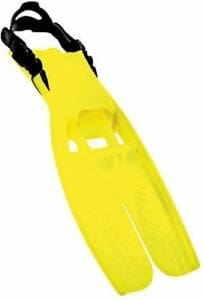
Split fins are based off of a whale’s tail with a slit down the middle, a relatively new choice for divers. When they came out. Instead of only moving them forward, this slit produces a vortex that lets divers get optimum thrusts and pace underwater.

Split fins act much like a propeller: the slit allows water to flow smoothly from both sides of the blade on the upward fin stroke, resulting in a foil shape. By creating the right lift, this shape helps you to step forward through the water. Split fins do not allow you to move fast in the water, and if you are a slow swimmer, there is a good chance you still will be. Their flow-through nature becomes less effective the harder you kick. Their design also provides less movement if you are pushing a lot of weight thru the water.
Paddle fins force the water back to help you move forward through the water, and they are more effective than split fins. Paddle fins often differ in length and stiffness, two factors contributing to speed and the kicking force required. Greater stiffness provides you with more forward momentum. Depending on the stiffness, this will make it harder to kick and lead to leg cramps. On the other hand, split fins do not have the rigidity of blade fins since they are relatively light and flexible.

Split fins channel any surface water in and out of their opening rather than over their arms. A spring-like movement is produced by this method, which provides a more robust and solid kick. Usually, you are using a flutter-type kick. It also decreases drag and effort, resulting in greater performance.
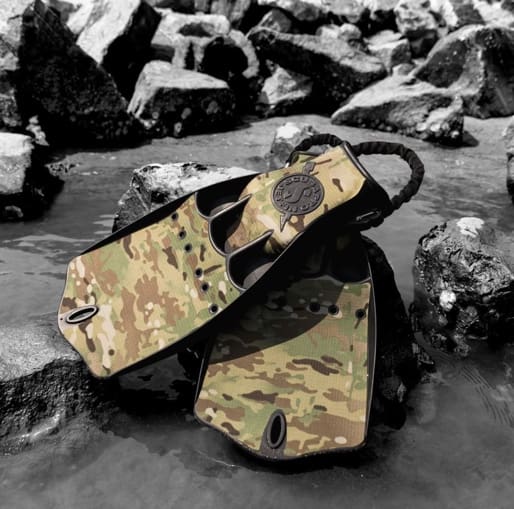
On most paddle fins, you will get spills of water over the sides of their blades. These fins are less powerful than split fins because of this reaction. It also results in more drag, and to go forward; you’ll need to kick more. That being said, many blade fins have ridges and stiffer sides to help fix that problem. The SCUBAPRO SeaWing’s and the Go Sport fins are just a couple of examples of that. I say those two because they are my go-to fins.

Split fins are said to be good for people with ankle or knee issues and divers who easily get cramps. Again, we say the same thing about the SCUBAPRO SeaWing’s  They are good for divers who only go straight without turns or moving in tight spaces. With the proper technique, the split fins can provide less joint pressure and pain because your strokes will feel less effective. I have found that they don’t give as much power for bigger divers, and if you have a lot of gear on, like a Dräger, a limpet, and your swim buddy, you have been pulling for two hours because he is “not a strong swimmer”. But they do have a place and a lot of people like them. The downside is. There are only two types, open or closed heal. There have not been any new break through’s when it comes to them.
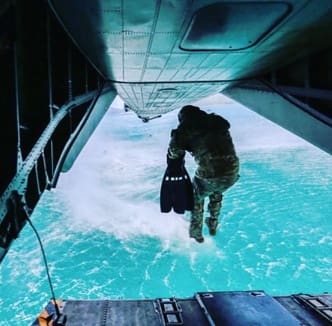
Paddle fins are like the swiss army knife of fins. There are so many different ones to choose from that you can almost always find the right one for the job. They are ideal for use in strong currents or swimming against the tide. They allow you to use different kick styles in more technical dives, like the frog, scissor, reverse, or dolphin, to name a few. Those types of kicks are more effective with paddle-type fins. If you have to pull a lot of weight, like going over the beach with a ruck or have to perform a buddy rescue, blade fins are going to be the best for this. Paddles are also suitable for doing a hook and climb; if you are the guy with the pole doing the hook, paddles are the way to go.
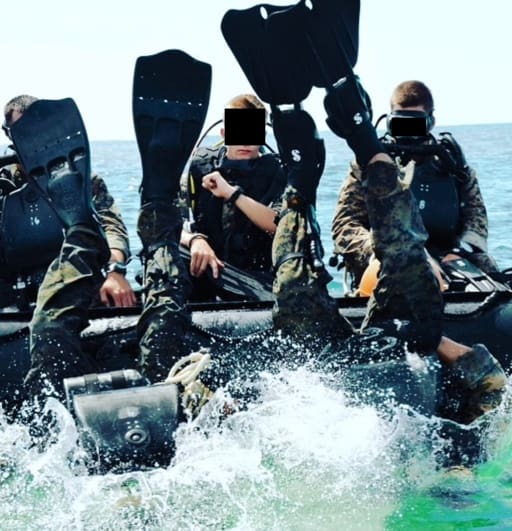
To summarize, split fins have more efficient thrusts and oxygen conservation. They, however, have some drawbacks such as decreased speed and kicking ability. Paddle fins excel in both departments because they give you more strength underwater. Paddle fins may be used in a variety of situations, from combat swimmer to over the beach.

Although split fins have some advantages over paddle fins, it’s difficult to say if they’re better. One of the biggest advantages over the split fins is that there are so many types of paddle fins. It comes down to trying both types of fins out and decide for yourself. I like to look at fins like shoes (I was going to say running shoes, but I do not run, everyone knows it breads cowardness). You are not going to wear the same shoes in the jungle that you would in the mountains. So, if you look at fins like that; you might be able to use just one set but having more than one opens up many more options and helps you do the job better and posable easier.

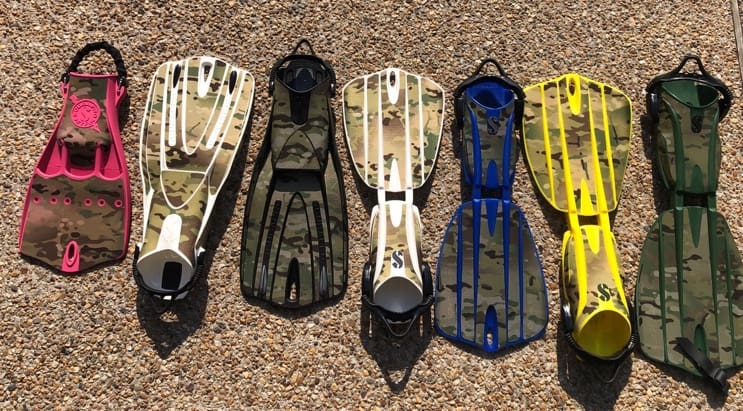
The fins have the Matbock Skins for SCUBAPRO, Jet fins, Seawing and Go Sport fins.

www.matbock.com/collections/skins/products/scuba-pro-skins

Army, Air Force Fund Research to Pursue Quantum Computing

Saturday, March 20th, 2021

RESEARCH TRIANGLE PARK, N.C. — Joint Army- and Air Force-funded researchers have taken a step toward building a fault-tolerant quantum computer, which could provide enhanced data processing capabilities.

Quantum computing has the potential to deliver new computing capabilities for how the Army plans to fight and win in what it calls multi-domain operations. It may also advance materials discovery, artificial intelligence, biochemical engineering and many other disciplines needed for the future military; however, because qubits, the fundamental building blocks of quantum computers, are intrinsically fragile, a longstanding barrier to quantum computing has been effective implementation of quantum error correction.

Researchers at University of Massachusetts Amherst, with funding from the Army Research Office  and the Air Force Office of Scientific Research, identified a way to protect quantum information from a common error source in superconducting systems, one of the leading platforms for the realization of large-scale quantum computers. The research, published in Nature, realized a novel way for quantum errors to be spontaneously corrected.

ARO is an element of the U.S. Army Combat Capabilities Development Command, known as DEVCOM, Army Research Laboratory. AFOSR supports basic research for the Air Force and Space Force as part of the Air Force Research Laboratory.

“This is a very exciting accomplishment not only because of the fundamental error correction concept the team was able to demonstrate, but also because the results suggest this overall approach may amenable to implementations with high resource efficiency, said Dr. Sara Gamble, quantum information science program manager, ARO. “Efficiency is increasingly important as quantum computation systems grow in size to the scales we’ll need for Army relevant applications.”

Today’s computers are built with transistors representing classical bits, either a 1 or 0. Quantum computing is a new paradigm of computation using quantum bits or qubits, where quantum superposition and entanglement can be exploited for exponential gains in processing power.

Existing demonstrations of quantum error correction are active, meaning that they require periodically checking for errors and immediately fixing them. This demands hardware resources and thus hinders the scaling of quantum computers.


In contrast, the researchers’ experiment achieves passive quantum error correction by tailoring the friction or dissipation experienced by the qubit. Because friction is commonly considered the nemesis of quantum coherence, this result may appear surprising. The trick is that the dissipation has to be designed specifically in a quantum manner.

This general strategy has been known in theory for about two decades, but a practical way to obtain such dissipation and put it in use for quantum error correction has been a challenge.

“Demonstrating such non-traditional approaches will hopefully spur more clever ideas for overcoming some of the most challenging issues for quantum science,” said Dr. Grace Metcalfe, program officer for Quantum Information Science at AFOSR.

Looking forward, researchers said the implication is that there may be more avenues to protect qubits from errors and do so less expensively.

“Although our experiment is still a rather rudimentary demonstration, we have finally fulfilled this counterintuitive theoretical possibility of dissipative QEC,” said Dr. Chen Wang, University of Massachusetts Amherst physicist. “This experiment raises the outlook of potentially building a useful fault-tolerant quantum computer in the mid to long run.”

By U.S. Army DEVCOM Army Research Laboratory Public Affairs

FirstSpear Friday Focus: FS Will Attend ADS Take Your Best Shot

Friday, March 19th, 2021

FirstSpear will attend ADS’ Take Your Best SHOT at Lost Rhino Brewery in Ashburn, Virginia, on March 25th, 2021. Attendees will be able to network with industry leading suppliers and learn about the latest and greatest products at each their respective booths. We look forward to being able to showcase some of our new products and technology.

“With most trade shows being predominantly virtual this spring, we appreciate ADS’ efforts to make an in-person exhibition possible,” said Ronnie Fowlkes Vice President of Business Development at FirstSpear.

Qualified attendees include active duty military, federal, state and local government agencies, law enforcement, and first responders. Military and government attendees must present official government-issued identification.

For more information about FirstSpear, check out www.first-spear.com.

For more information about Take Your Best Shot, check out events.adsinc.com.

New Infantry Squad Vehicle Tested at US Army Yuma Proving Ground

Friday, March 19th, 2021

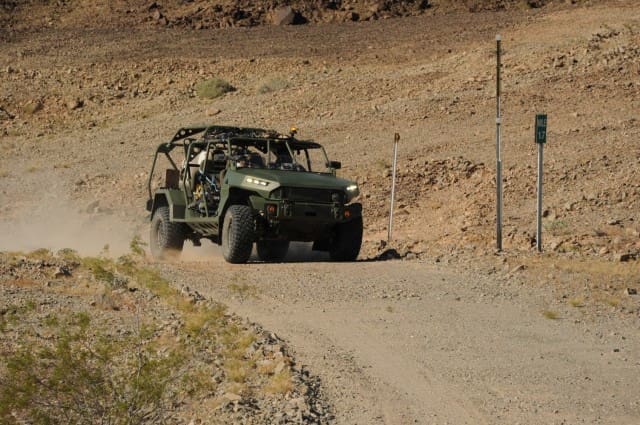
There’s a new vehicle turning heads on the range at U.S. Army Yuma Proving Ground (YPG), and it will likely begin arriving in Army brigades in a matter of months.

It’s the Infantry Squad Vehicle (ISV), and it promises to give Soldiers an opportunity to arrive to a fight faster, rested, and ready.

Powered by a 2.8 liter turbo diesel engine with a six speed automatic transmission, the four-wheel drive vehicle carries up to a nine Soldier infantry unit and their heavy gear. If it looks familiar, it is because the platform is based on a commercially-available vehicle.

“About 70% is common with the Chevy Colorado ZR2, and the rest is a mixture of commercial parts that you can modify and put onto the Chevy Colorado,” said Steve Herrick, product lead for Ground Mobility Vehicles. “About 90% of this can be bought on the commercial market.”

The ISV is meant to reduce the burden on infantry Soldiers weighed down by heavy gear and faced with rugged terrain. The fast and lean ISV can be air transported into locales within theater rapidly and efficiently.

“It provides an operationally relevant vehicle for a small tactical unit to be transported to a drop off point as quickly as possible in a mission-ready state,” said Sean Lamorena, test officer. “It’s intended to be transported by means of the infantry’s rotary or fixed wing aircraft platforms.”

“This vehicle is going to help Soldiers in the Infantry Brigade Combat Teams that currently walk everywhere,” added Herrick. “It’s made to be ‘a better boot,’ a capability that allows you to effectively change how you operate.”

Right now it’s being put through its paces across the more than 200 miles of rugged road courses at YPG to ensure it functions as it should wherever in the world it could be called on to serve.

“We’re performing reliability and maintainability (RAM) testing to support the evaluation in a desert environment,” said Lamorena. “We’re also doing two performance tests at the conclusion of RAM testing.”

Over the next few months, the ISV will traverse 5,000 miles across Yuma Test Center’s rugged ranges, including sand slope mobility tests that will see it tackle a sandy 30% grade—for perspective, the steepest grade on an interstate highway in the contiguous United States is 6%. Through much of the testing, the vehicle and its driver will be joined by plastic dummies weighted with sand in the vehicle’s remaining seats.

“We up-weight the vehicle to its operational weight expectation,” said Isaac Rodriguez, team leader in the Combat Automotive Systems Division. “We also install a data acquisition system that monitors GPS and the vital signs of the vehicle.”

During testing, simulated missions take the vehicle across road courses featuring various terrain conditions, from paved to gravel, to punishing desert washboard that would severely rattle a vehicle without four wheel drive. As they traverse these roads, test vehicle operators continually verify performance of all the platform’s performance.

“Yuma provides the capability of extreme weather differences, as well as a desert terrain,” said Herrick. “We can’t get those things that Yuma provides at other testing locations. The distances travelled on the courses and the weather conditions really help here.”

The rising temperatures as spring approaches will also help the testing.

“We’ll take advantage of the hot temperatures to execute cooling performance of the vehicle,” said Rodriguez. “We’ll load the vehicle up and verify that it is able to maintain its proper operating temperatures.”

Though the vehicle is manufactured by General Motors and the company’s desert proving ground is co-located at YPG, there are currently no plans to utilize their road courses in tests of the ISV.

“We have the capability to do so, but based on the scope of testing for this vehicle it isn’t necessary,” said Rodriguez. “If the customer added a requirement that would need to be done at that facility, we would certainly entertain that idea.”

Eventually, the Army intends to field 59 ISVs to each brigade, beginning with brigades within the 82nd Airborne Division in May. The testing completed at YPG is an important element of the success of this rapid adoption and deployment of the vehicle.

By Mark Schauer

Sean Matson Will Attempt To Break Men’s 1 mile Bomb-Suit World Record

Thursday, March 18th, 2021

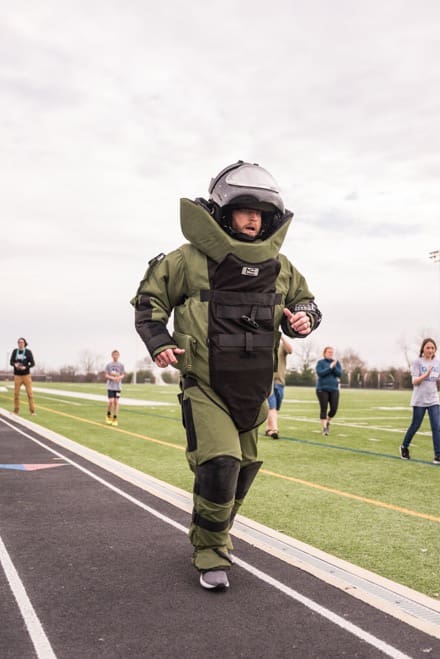
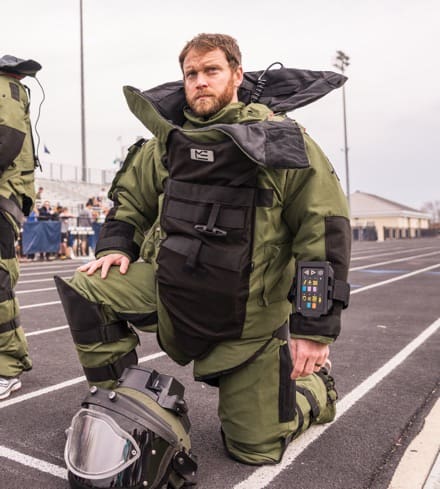
On 3 April 2021, I am setting out to break the men’s 1 mile Bomb-Suit World Record! The current record has been held by Mark Gibbs of the UK at a blistering fast time of 7:24.21. He has held this record since 2017.

In 2019, I attempted to break this record; however, wasn’t successful. Before the event, I “Planned my dive”, but when the race gun went off, I took off in a sprint and completely forgot all about my plan that I have “dove” in my head a thousand times. “Plan your dive, dive your plan”. My pace at the 1/2 mile was around 6 mins and my heart rate pegged and I was about to pass out, so I had to walk. Very humbling experience and also a HUGE lesson learned.

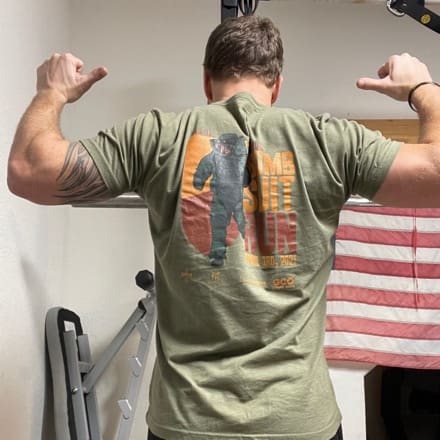
This year, I will have a pacer and training has been going extremely well. We are raising money for Get Head Strong and with proceeds from every purchase of the #TeamSean shirt will go directly to Get Head Strong.

Show support by purchasing his shirt with the discount code “SEAN“. www.militarymuscleinc.com/collections/military-families-program/products/military-families-program-team-sean-tee

ADS Take Your Best SHOT at Lost Rhino Brewery in Ashburn, VA on March 25th

Thursday, March 18th, 2021

Join ADS at Lost Rhino Brewery in Ashburn, VA on March 25th at 1500 for Take Your Best SHOT. Learn about the latest and greatest products at each exhibitor booth, play in the cornhole competition, compete against your fellow peers, and connect with an ADS Sales Representative to plan for an amazing year.

Register here.

Soldiers and Marines Airdrop Medical Supplies, Food to Forward Personnel

Thursday, March 18th, 2021

CAMP ARIFJAN, Kuwait — Soldiers with the 1st Theater Sustainment Command’s operational command post, or 1st TSC-OCP, headquartered here, successfully executed joint airdrop missions with a Marine C-130J Hercules aircrew and Army riggers in the U.S. Central Command’s area of operations.


Pallets loaded with key medical supplies, food and other materiel were delivered in three drops to different locations, said Army Warrant Officer Michael Romeo, who works in the air section of the 1st TSC-OCP Support Operations, or the SPO shop.

The aircrew belongs to the Marine Aerial Refueler Transport Squadron-352, Detachment A, and are known as the “Raiders” Romeo said.

“These missions are definitely a high priority,” said Romeo, who is a warrant officer in the 165th Quartermaster Company, Georgia National Guard, but now serving with the Army Reserve’s 310th Sustainment Command (Expeditionary), based in Indianapolis, Indiana. The 310th ESC acts as the staff for the 1st TSC-OCP.

Romeo, who was on the mission as an observer for the 1st TSC-OCP, said the airdrops are a regular part of 1st TSC-OCP’s support for personnel forward deployed, especially for perishable medical and food supplies.

“They will send in an airdrop request for review, and then it comes to me,” he said. “The biggest thing we do as logisticians and sustainers is making sure we are getting the right equipment and supplies to the people who need it,” he said. “Using aerial delivery is a quick and easy way to do that.”

The 101st Sustainment Brigade, based at Fort Campbell, Kentucky, and the 151st Quartermaster Detachment from Fort Bragg, North Carolina, also supported the air drop operations, he said.

Marine Gunnery Sgt. David Hoyt, the loadmaster for the flight, said he was impressed by the Army riggers.

“They are quick and focused and do a good job,” he said. “They understand we have time constraints and got the job done.”

Army Spc. Christian Ramos, 151st Quartermaster Detachment, said he is a team leader for airdrop system, equipment and repair.

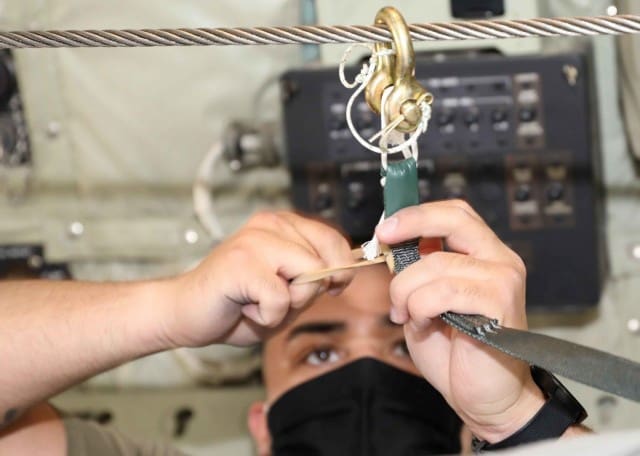
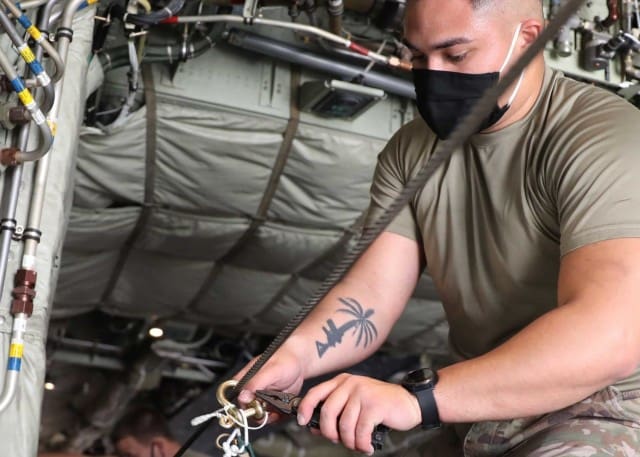
The Guam native said once the pallets were loaded onto the aircraft, he and the other riggers use strings and rubber bands to attach the parachutes to the static lines on both the left and right sides of the plane.

“The static line is connected to the G-14 clevis, upon deployment, it will pull the parachute off,” Ramos said. “The strings I was attaching with the rubber or retainer band, are called anti-oscillation ties, so they prevent the static line from moving around in flight and getting tangled.”

The G-14 is a U-shaped piece of metal that slides on the static line, like a curtain ring on a curtain rod. When the pallet reaches the plane’s back door, the rubber band snaps from the weight of the pallet and the parachute deploys.

Ramos said this air drop mission was his first time as a joint airdrop inspector. “It means that I am inspecting the loads and ensuring that these loads are free of deficiencies, which reduces the likelihood of a malfunction, so the guys on the ground can get the supplies that they need.”

Spc. Hope Mastroberti, a parachute rigger, 151st Quartermaster Detachment, said during this deployment, she was able to attend the Joint Air Load Inspector course.

Mastroberti, a native of Crystal River, Florida, said she loves being a rigger, a job she has had for two years. “I love the opportunities I’m provided. I pack personal parachutes and I pack heavy rigging parachutes.”

By SSG Neil W. McCabe

The Oakley Elite Assault Boot

Wednesday, March 17th, 2021

Oakley worked hard to create a comfortable and lightweight boot that could be worn for long periods of time, and it paid off with the Oakley Elite Assault Boot. Great for active duty or outdoor adventuring, these boots are AR670-1 and AFI 36-2903 compliant, durable, and designed to provide quality ventilated support.

The construction of the Oakley Elite Assault Boot provides maximum durability while maintaining a lighter weight. The Vibram Litebase technology reduces the thickness of the sole without compromising durability and reduces weight while maintaining the traditional characteristics of a military boot. Maintain a full range of motion and mobility while marching or hiking long distances, and like the Oakley SI Light Assault Boot, the Elite is precision-engineered – from the sole to its molded EVA insert – to transition across variable terrains. They include a breathable 8” Cordura upper that is abrasive resistant, paired with the Vibram SPE Midsole specifically crafted to provide Oakley’s signature cushioning while giving you support and protection from all types of terrain. Combined with Oakley’s Lace-Lock system, it’s now possible to achieve comfort and durability for long periods of time.

This military boot packs a lot of protection and is perfect for anyone who wants a lighter boot at a fair price – USPatriot.com lists the boot for an incredible price of $165 – this is the best we could find anywhere online. Oakley has a long term partnership with US Patriot to serve their customers with the gear needed from head to toe.