GORE-TEX Professional

Archive for the ‘Guest Post’ Category

Is CBD Oil Right For Me?

Saturday, February 20th, 2021

I’m going to preface this article with a short introduction. Over the past few years, the national dialogue on marijuana has shifted significantly and particularly for CBD. While still banned for use with DoD and by many other agencies, CBD has offered relief for several complaints such as PTSD.

Some swear by its properties while others brush it off as a placebo. Let’s use this testimony by my friend and former SEAL Will Branum to open a respectful dialogue. And yes, Will believes CBD so much, he founded a company.

-Eric Graves

The transition from military to civilian life was the toughest military mission I had ever been on. I went from being surrounded by a TEAM of World Class Professionals who challenged me every day to NO TEAM, NO PURPOSE, and NO MISSION.

I’ve spent my entire adult life in the military and 23 of those 26 years as a Navy SEAL.  As a SEAL, every morning I woke up, knew what I was going to do and with whom I would do it. I was surrounded by a badass team with a badass mission. And then in the summer of 2018,  it was gone.

My nightly routine consisted of just one glass of Vodka on the rocks to turn off the noise in my head. One glass turned into another, and another and so on. Eventually the noise would reduce enough for me to go to sleep.  This habit started before my retirement, but had definitely intensified after I retired. I had to drink myself into a drunken stupor to quiet my mind, slow down, and be able to rest.

I had heard of CBD Oil while I was on active duty but wasn’t about to risk putting my final years in the military or my Top Secret Security Clearance in jeopardy.  I am also a child of Nancy Reagan’s War on Drugs, “Just Say No!” Campaign, so I was hesitant to try it.  A year after my retirement, I was in Virginia and had lunch with a former SEAL Team mentor.  I told him about my interest in CBD and discussed purchasing it while I was in town.  I was still unfamiliar with its benefits but was curious to know more. Coincidentally he owned some and gave me a bottle.

That night I noticed that I slept a little better and woke up a little pissed off as I had in the previous months. Over the next 30 days, with continued use of the CBD Oil, I felt small increments of improvement in my attitude as well as unexpected improvements in pain management.  Some of the sharp stabbing pain I had been experiencing began to decrease in intensity and become more dull.  Additionally, when I ran out of CBD Oil, much of the pain and ailments and my internal anger started to resurface. 

CBD helped me turn off the anxiety and noise. To illustrate, we know that water boils at 212 degrees Fahrenheit and, likewise, I often felt like I was living at 210, just under my boiling point.  Taking CBD helped bring down that internal emotional temperature; 208, 205, 200.  It helped me get out of the RED ZONE that I was living in and moved me into something closer to ORANGE or YELLOW, a much more relaxed mental and emotional state.  That new headspace allowed me to practice better self-talk so I could work on myself, and simultaneously start to quiet the noise in my head without the need for alcohol.  CBD isn’t a magical cure-all, but it is an essential tool in my tool box.

CBD had such a life changing effect on me that I started my own CBD Company to share the highest quality CBD available to Veterans and First Responders.  Naked Warrior Recovery’s mission is to help you recover from Mental and Physical Trauma, no matter how big or small.

How CBD works: CBD is a non-psychoactive (you don’t get high) molecule from the Hemp Plant.  It has been shown to have many medicinal effects on all mammals.  CBD supports the Endocannabinoid System, a giant neuro receptor connected to every other system in the body (ie. Central Nerves System, Digestive System, Immune System, Respiratory System, etc.).

The Endocannabinoid System (ECS) is supported by endogenous cannabinoids that all mammals create.  Sometimes the body does not produce enough natural cannabinoids to support the ECS.  CBD works like a multivitamin to support the ECS to help bring it back into balance.  When the ECS is in balance, it helps bring the other systems into balance.  A few other benefits that have been observed from CBD use are reduced chronic inflammation, elliptic seizures, pain, anxiety, depression, sleep disorders, acne, and Parkinson’s.

There is still a lot that to be learned about this natural remedy, but the future looks bright! There are studies coming out daily on PUBMED about CBD and the Endocannabinoid System.

For more information on CBD go to www.nw-recovery.com.
US Army Mortar Systems Keep Pace with Modernization Efforts

Saturday, February 20th, 2021

PICATINNY ARSENAL, N.J. — While much attention has focused on the U.S. Army’s ability to achieve greater distances with artillery and missiles, mortar systems are also keeping pace with technology advances.

When it comes to a relatively close fight with the enemy, mortars have a variety of advantages that over the years have made them a warhorse of warfare, with capabilities that have inspired the name “infantryman’s artillery.”

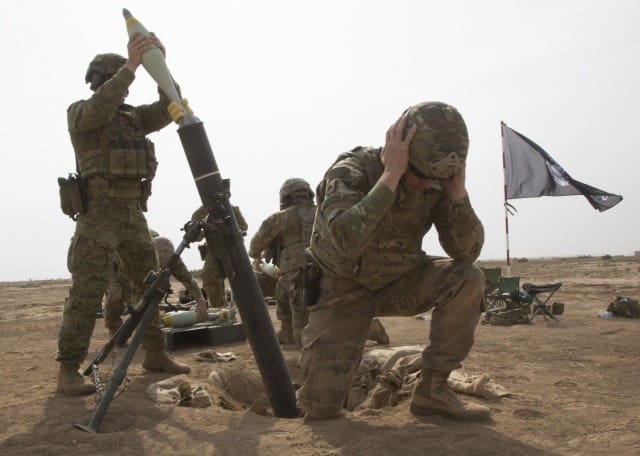
Typically, mortar systems provide close-range, quick-response, indirect fire in tactical combat. This is achieved by launching high explosive, smoke and illumination mortar shells in high-arcing trajectories.

“Mortars have historically been a cheap and effective form of indirect fire to provide suppression of enemies,” said Matthew Terreault, Chief, Mortar Systems Branch, Mortars Division, located at Picatinny Arsenal. The Division is part of the Combat Capabilities Development Command (DEVCOM) Armaments Center, which is under the Army Futures Command.

Mortars are considered an “organic” system because the level of control is assigned to the echelon that uses them. For example, the 60 millimeter mortar is the lightweight company mortar system, responsive to the direction of the company commander. Similarly, the 120mm is a battalion mortar system, so battalion leaders can use it as they see fit.


“When a maneuvering unit calls for fire support from their mortar section, they don’t need approval from any intermediary commands in order to get effective fires. This allows them to be very fast,” Terreault said.

“That’s also assisted by the fact that they’re relatively short range when you compare it to other forms of modern artillery,” he continued. “And because of their shorter range, they tend to be closer to the fight. With artillery projectiles, the time of flight alone in the artillery firing can be upwards of five minutes, where the flight time for a typical mortar mission is around 50 seconds.”

Improvements in technology and manufacturing have played a role in shifting mortars away from their historic role of bulk suppression of troop movements in favor of very precise fires.

Over time, mortar capabilities have been expanding, along with the increasing demand on the field for greater responsiveness. “That’s caused us to take a look at our mortar systems and try and get them to be more accurate to fit that new role of providing precise fires,” Terreault said. “And you’ll see that across the mortar system portfolio as a whole.”

Improving mortars involves several areas: greater responsiveness, survivability, range and accuracy. This is accomplished through increased automation of fires and adding Soldier protection when possible. The use of digital fire-control helps to both reduce human error and increase accuracy.

As part of the Army’s ongoing drive to improve mortar systems, the Armaments Center has signed a Cooperative Research and Development Agreement, or CRADA, with Finnish company Patria Land Oy to determine the feasibility of incorporating its new mortar (NEMO) technology into U.S. systems.

The Patria NEMO is a turreted, breech-loaded, 120mm smooth-bore mortar system with both direct and indirect fire capability. In addition to being highly protected, Patria Nemo is light, compact and easily installable on a light, tracked chassis, wheeled armored vehicles or navy vessels.

Under the agreement, the Army will assess the Patria NEMO’s compatibility with U.S. mortar fire control systems, as well as evaluate the use of, and potential range increase, of the current U.S. 120mm mortar ammunition in the longer, breech-loaded NEMO barrel.

The assessment continues the Army’s effort to provide Armored and Stryker Brigade Combat Teams with rapid, precise indirect and direct fire capability, along with protecting the operating crew and greatly reducing its physical burdens.

“The agreement between the U.S. Army and Patria exemplifies the capability leap that modern turreted mortar systems can introduce to armed forces and illustrates Patria’s leading role in this technology area,” said Jussi Järvinen, President of Patria’s Land Business Unit. “It is also logical continuation to the cooperation between Patria and the U.S. government that began with Patria NEMO sales to a third country through a Foreign Military Sales program.”

The agreement with Patria stemmed from an Army initiative to produce a 120mm Mortar Future Indirect Fire Turret by 2021, and a 120mm Extended Range Mortar system by 2026.

That initiative was undertaken by Product Manager Precision Fires and Mortars, which is part of Project Manager Combat Ammunition Systems. Those organizations are under the Joint Program Executive Office Armaments and Ammunition, which is located at Picatinny Arsenal.

The Army’s emerging Armored Multi-Purpose Vehicle, or AMPV, program has a turreted mortar variant, which provided part of the impetus to closely examine the current state of turreted mortar technology.

“Given the early age of the AMPV program, we felt like it was an opportune time to pursue and look at opportunities to meet requirements that include the incorporation of a turreted mortar system,” Terreault said. “We don’t look at the NEMO project, or the turreted mortar systems projects, as being specific to the Armored Multi-Purpose Vehicle because we would like to get a modular solution that would also work on the Stryker platform as well.”

A breech-loaded mortar system has several advantages compared to traditional, muzzle-loaded systems. “There’s a crew safety factor, where by the system being breech-loaded, the crew doesn’t need to be near the muzzle of the weapon, where all the blast-over pressure from the firing event occurs,” Terreault said.

Another safety factor related to breech-loading is that loading the weapon occurs from within the vehicle. In contrast, with muzzle-loading, the muzzle needs to be outside the vehicle or outside of protection. That’s because there can’t be anything between the mortar barrel and the open sky when it fires its ammunition.

Breech-loading also offered more flexibility in firing that is related to how the system is automated, maneuvered and controlled. “Once you’re breech-loaded, you no longer have to shoot directly up into the sky,” Terreault said. “You can shoot at lower angles, because you no longer are relying on the rounds that drop down the barrel in order to have enough kinetic energy to strike a firing pin, initiate the primer, and then come back out the muzzle.”

With a combination of breech-loading and an electronic firing mechanism, the weapon can be positioned in a near-horizontal angle and engage targets directly, similar to a tank cannon. “Now, that’s not an optimal mission role for a mortar system, but it does provide the system a certain level of self-defense that it didn’t have previously, which helps make the platform overall more survivable,” Terreault said.

“If we weren’t able to fire below 45 degrees, we’d be very limited in the amount of firing engagements we could use in order to achieve multi-round, simultaneous impact events,” Terreault added. “And typically, we consider anything above 45 degrees as indirect fire and below 45 degrees as direct fire.”

As the march of technology moves ahead, the “infantryman’s artillery” will be part of the impetus of enhancement and capability.

By Ed Lopez, Picatinny Arsenal Public Affairs

FirstSpear Friday Focus: Ragnar Vest

Friday, February 19th, 2021

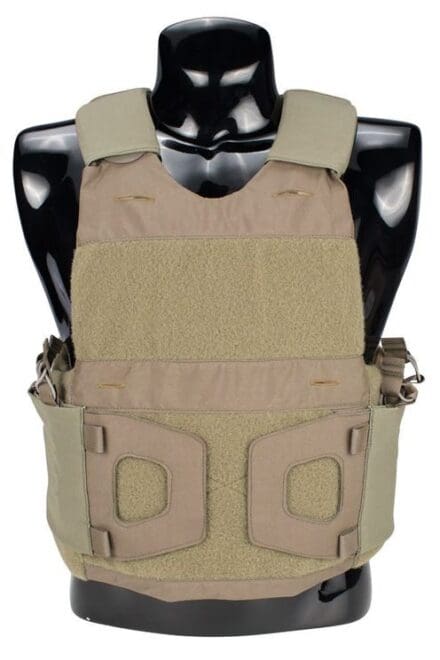
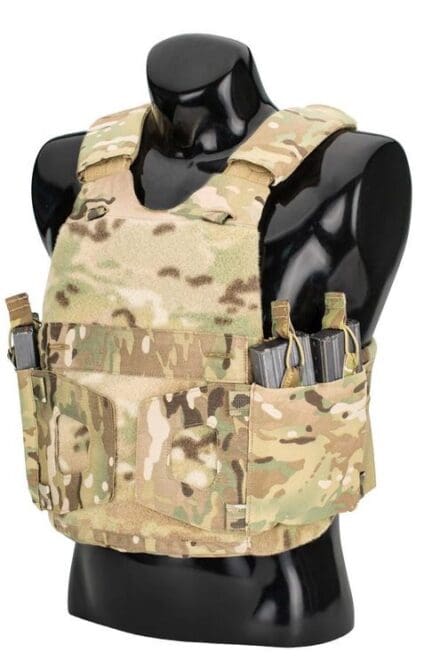
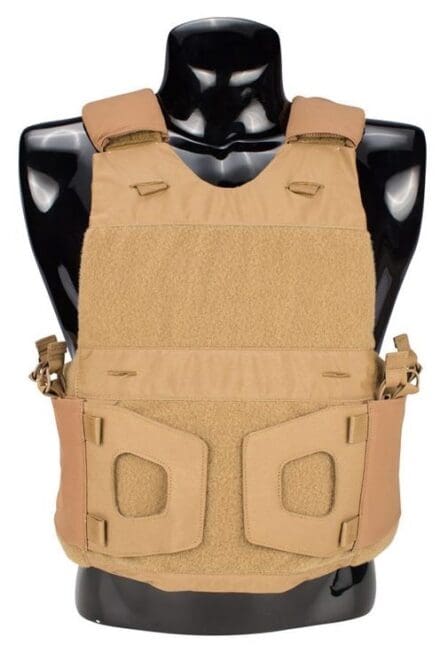
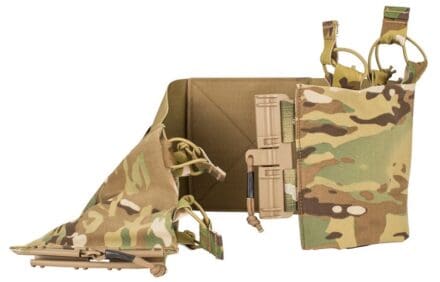
This week’s Friday Focus is the Ragnar Vest. They’re an FS nonstandard, nonstocking item, which means you’ll want to get them before they’re gone! The Ragnar is named for the intrepid explorer and cunning warrior Ragnar Lodbrok. This vest and its accessory components are suited for a wide variety of roles and circumstances.

• Loop fabric for pocket attachment
• Four special built-in pockets
• Works with Ragnar Tubes Cummerbund
• Compatible with Ragnar pockets


The carrier is covered in loop fabric and can be altered with different cummerbunds. Four special built-in pockets with retention tabs allow for storage of accessories based upon situational requirements.

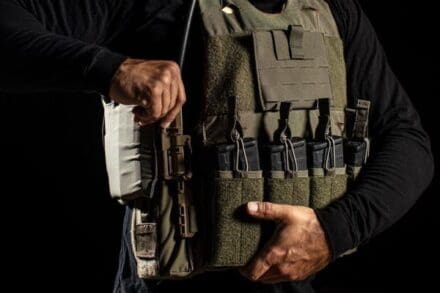
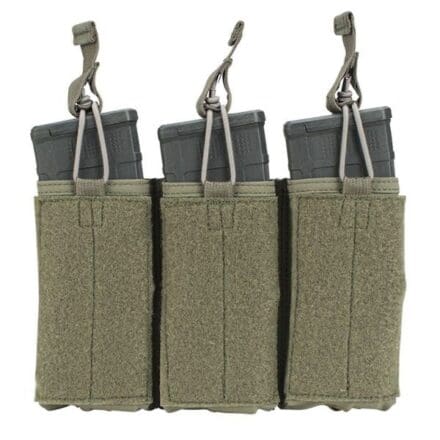
You can upgrade the cummerbund to the Ragnar Tubes Tactical Cummerbund to increase functionality. The Tubes Tactical Cummerbund is offered as an upgrade to the Ragnar Vest. It comes with four special pockets with shock cord retention for storing accessories such as magazines. The cummerbund has tubes which connect at the front to keep your Ragnar Vest secure. Get in and out of your Ragnar in seconds with FS Tube Technology.

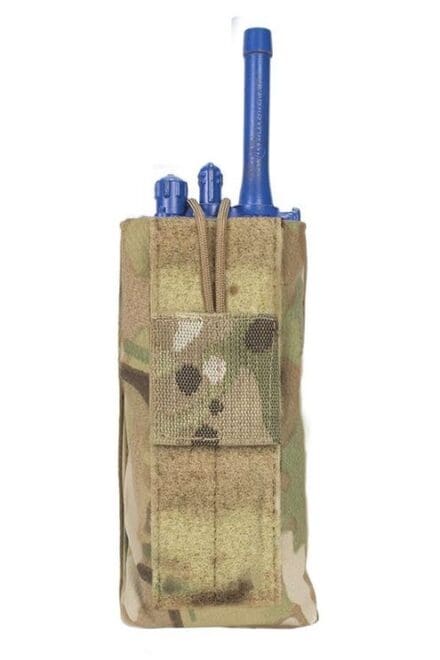
This is a great multi-mission vest with the sort of flexibility that allows you to use one system for a variety of profiles. There is also a full lineup of pockets compatible with the Ragnar.

Now available in limited quantities in black, ranger, multicam and coyote. For more information about the Ragnar, check out www.first-spear.com/ragnar-vest.

US Army Integrated Visual Augmentation System Mounted Amplifies Capabilities

Friday, February 19th, 2021

“IVAS is more than just a goggle, it’s changing the way we fight.”
– MAJ Kevin Smith, PM IVAS Platform Integration DRI

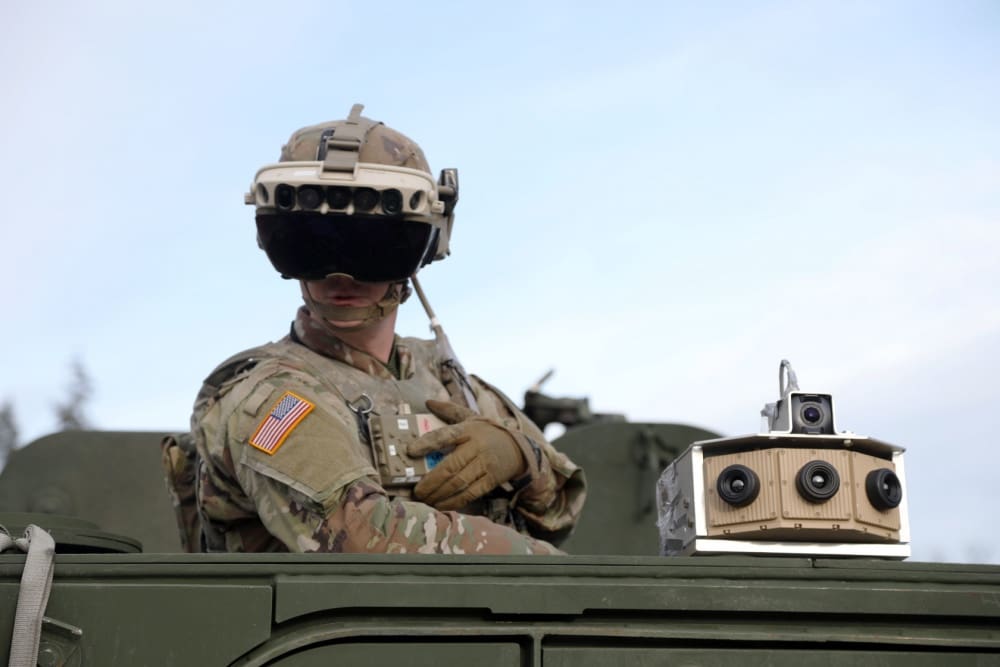
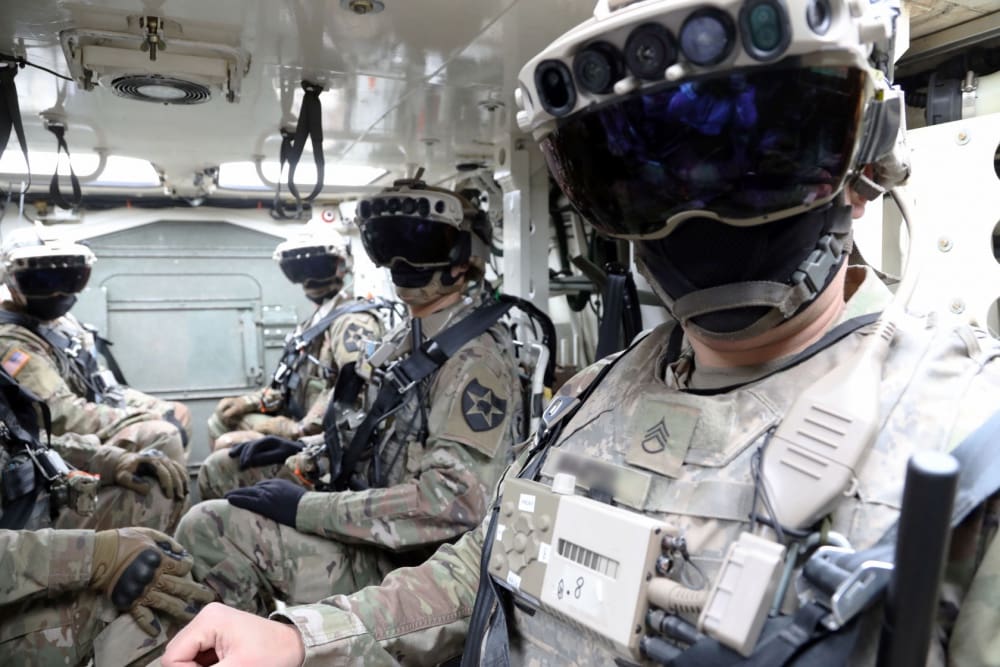
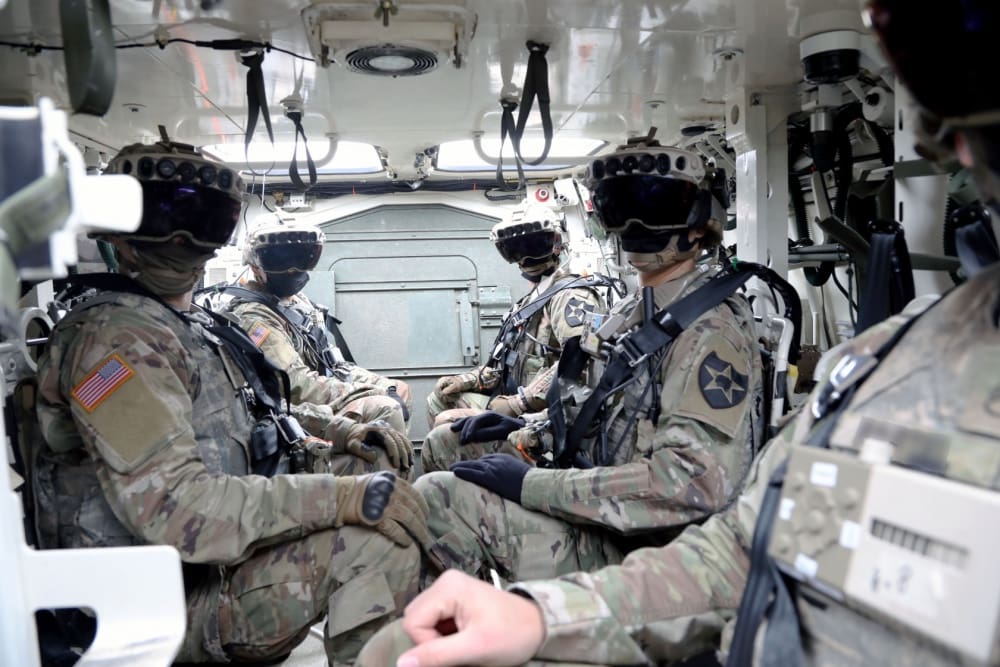
JOINT BASE LEWIS-MCCORD, WA – The Integrated Visual Augmentation System (IVAS) is being developed to address capability gaps in the dismounted close combat force identified by Army leadership via the 2018 National Defense Strategy. The intent is to integrate key technology systems into one device to provide a single platform for Soldiers to fight, rehearse, and train.

IVAS looks at the Soldier as a weapons system, carefully balancing weight and Soldier load with its enhanced capabilities. Therefore, the Army is looking to amplify the impact of one dismounted Soldier equipped with IVAS and apply its capability set to mounted platforms as well.

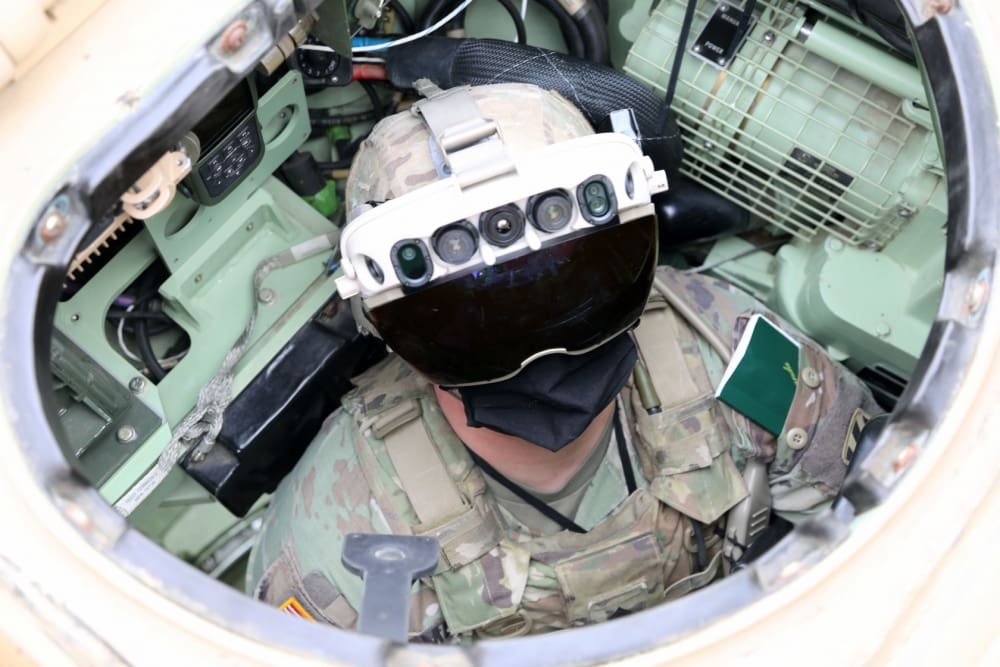
“Up until this point IVAS has really been focused on the dismounted Soldiers and getting that fighting goggle right,” said MAJ Kevin Smith, C5ISR Night Vision and Electronic Sensors Direction (NVESD) Research and Development Coordinator and PM IVAS Platform Integration Directly Responsible Individual (DRI). “So in parallel, we in the Night Vision Electronic Sensors Directorate have been working to build-in applications to leverage both new and existing sensors on the vehicles to give the Soldier not just enhanced visual situational awareness, but also C2 [Command and Control] situational awareness while they’re inside of a platform or vehicle.”

The integrated team made up of Project Manager IVAS, Soldier Lethality Cross Functional Team (SL CFT), NVESD and C5ISR Prototype Integration Facility (PIF), PM Stryker Brigade Combat Team (SBCT), PM Bradley, Army Capability Manager Stryker (ACM-S) and Bradley (ACM-B), and industry partners came together at Joint Base Lewis-McCord to tackle how to best amplify the capabilities of IVAS onto vehicle platforms.

“In the past, as the Soldier in the back who’s going to actually be dismounting on the objective you may have a single screen to look at that can maybe toggle between the driver’s view or the commander’s view, or the gunners view, or perhaps you’re looking through periscope blocks or asking the crew themselves what is actually happening around you,” said SFC Joshua Braly, SL CFT. “But overall when you are buttoned up in the back of a platform you have very limited situational awareness to what you’re walking into.”

Beyond the original problem set, IVAS is looking to be applied to an additional capability gap in order to allow the mounted and dismounted Soldier to maintain both C2 and visual situational awareness seamlessly across Army vehicle platforms.

Soldiers from 1-2 SBCT and 3rd Infantry Division joined the multi-dimensional team to learn IVAS and provide feedback on what would be most operationally effective as the technology integrates onto larger platforms.

SOLDIER EXPERIENCE

“I struggled when I was a squad leader getting out of the bay not knowing where I was because we get dropped at different spots in the op order,” said SGT John Martin, Bradley Master Gunner from 3rd Infantry Division. “Not having information on the ground was definitely a challenge that tripped us up.”

The squads took turns in the Stryker and Bradley vehicles testing each camera view and function, power management, communications, and the ease of mounting and dismounting with the IVAS. The Soldiers quickly saw that the capabilities being developed for dismounted Soldiers via IVAS are amplified by integrating the system into platforms using World View, 360 degree, and See capabilities that leverage the view of external sensors to be transmitted to the Heads Up Display (HUD) of each individual Soldier.

“There’s always a line between the squads and the tracks, and having this equipment is going to help tie them in so the dismounts in the back can see the actual optics of the vehicle itself and then they can seamlessly work with the crew because everyone can see around the vehicle without actually having to step outside of it,” said Martin. “It has countless uses like land navigation, being able to track things while on the battlefield, moving through urban complexes, moving through open terrain, it’s insane.”

Each Soldier with IVAS can “see through” the vehicle to what its external sensors are feeding into the individual HUDs, as if the vehicle has invisible armor. Soldiers with the Stryker Brigade Combat Team understood the implications to not only C2 situational awareness management and safety, but also overall lethality of the force.

“This changes how we operate honestly,” said SGT Philip Bartel with 1-2 SBCT. “Now guys aren’t hanging out of vehicles in dangerous situations trying to get views on what’s going on. Leadership will be able to maneuver their elements and get view-on-target without having to leave the safety of their armored vehicles. Maneuvering elements with that kind of information will minimize casualties and will overall drastically change how we operate and increase our effectiveness on the battlefield.”

“The fact that we are going to be more lethal on the ground, the fact that we won’t be losing as many guys because everyone can see and track the same information, the capabilities and possibilities and implications of this technology are endless,” added Martin.

SOLDIER CENTERED DESIGN

Soldier Centered Design is a driving principle of IVAS technology development. It calls for the Soldier and squad to be understood and developed as a comprehensive weapons system and prioritizes Soldier feedback. By addressing operational capability gaps with a holistic view, it allows the physical interface and load requirements of Soldiers to be better managed and balanced while integrating leap ahead technology to increase lethality on the battlefield.

“Right now the technology is in prototype phase, so we’re getting some really good feedback from actual Soldiers here on the ground today that we can take back and make some critical improvements with, which is awesome,” said Smith. “The reason why we do this is because these requirements need to be generated from the bottom up, not from the top down. So enlisting Soldier feedback is really important to us so that we understand what they need and what their requirements are.”

The program is revolutionizing the way that acquisition requirements are generated. Though engineers and industry experts have always been dedicated to develop effective products to meet Soldier needs through requirements, best practices have now shown that requirements should be developed hand in hand with and by the end user.

“Whereas before requirements were generated, in my opinion, inside of silos, we really need the Soldier’s feedback in order to generate a proper requirement that’s best for the Soldier, period,” said Braly. “It’s really important because we can’t build something that Soldiers are not going use. We have to get that feedback from Soldiers, listen to Soldiers, and implement that feedback. Then it becomes a better product for the Soldier, and they’re going to want to use it. If they don’t want to use it, they won’t, and it’s all for nothing.”

FUTURE OF IVAS

The event was another step towards developing IVAS, which was recently approved to move from rapid prototyping to production and rapid fielding in an effort to deliver next generation capabilities to the close combat force at the speed of relevance.

“One of the goals of IVAS was that it’s going to be a fighting goggle as well as a training goggle and we are 100% attempting to bring both to reality,” said Braly. “This is one of those key moments in our military’s history where we’re able to look back and acknowledge that we’re not where we want to be and we’re willing to make bold strides to get there. IVAS is without question an effort to do that, and we’re working diligently every day to make this a reality.”

Team IVAS continues to iterate the hardware and software prototype towards the Operational Test planned for July 2021 and FUE in 4QFY21.

“This is something that none of us imaged we would see in our careers,” said Martin. “It’s futuristic technology that we’ve all talked about and seen in movies and video games, but it’s something that we never imaged we would have the chance to fight with. It’s definitely technology that we are really excited to use as soon as they can get it to us.”

Story by Courtney Bacon, PEO Soldier

SERE Specialists Conquer the Arctic

Thursday, February 18th, 2021

EIELSON AIR FORCE BASE, Alaska (AFNS) —

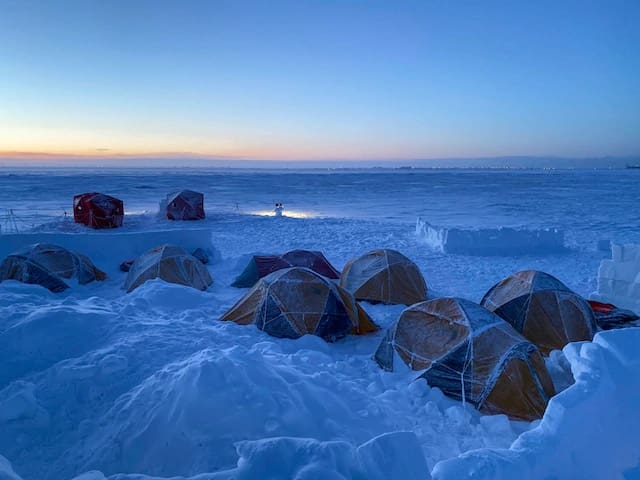
Wind gusts as high as 50 mph, wind chills dropping to minus 60 degrees Fahrenheit, and a place where the sun does not rise above the horizon for 65 consecutive days. Arctic survival training is not for the faint of heart however for the survival, evasion, resistance and escape specialists, it is a rite of passage.

SERE specialists from across the country participated in S-V81-C Barren Land Arctic Survival training Jan. 9-23 in Utqia?vik (Barrow), Alaska.

S-V81-C is a part of the SERE five-level upgrade course where SERE specialists gain valuable experience surviving in the harsh arctic environment.

“It’s the experiential factor that enables Air Force SERE specialists to provide the highest standard of arctic training to the Department of Defense,” said Master Sgt. Garrett Wright, Detachment 1, 66th Training Squadron, Arctic Survival School superintendent.

After leaving Barrow and completing training, SERE specialists have gained a new understanding of the difficult conditions isolated personnel could face in the Arctic. With this knowledge in hand, SERE specialists are able to educate personnel across the globe on the various environments they operate in.

From Eielson Air Force Base, five SERE specialists from the 66th Training Squadron, Detachment 1 led S-V81-C training in Barrow.

Staff Sgt. Jeffrey Waterbury, 66th TRS, Det. 1 operations noncommissioned officer in charge, once a student, is now responsible for imparting his technical expertise to others at S-V81-C.

“It is cool to teach a course that I came through (years ago),” said Waterbury. “I never really thought that I would be doing it again; especially running operations for it.”

This year, two classes trained in Barrow and 44 students graduated the course. 24 participants from Jan. 9-16 and 20 from Jan. 16-23. Active duty, Guard and Reserve SERE specialists attended this year’s training along with personnel from the 123rd Contingency Response Group and the Air Force Joint Test Program Office.

This year, Cool School’s operations were supported by an independent medical duty technician from the 354th Medical Group and two defenders from the 354th Security Forces Squadron, who provided overnight polar bear guard.

Additionally, a team led by Lt. Col. Nathan Barrett, the AFJO joint test director, conducted shelter temperature testing as part of Cool School’s efforts to modernize its instructional data.

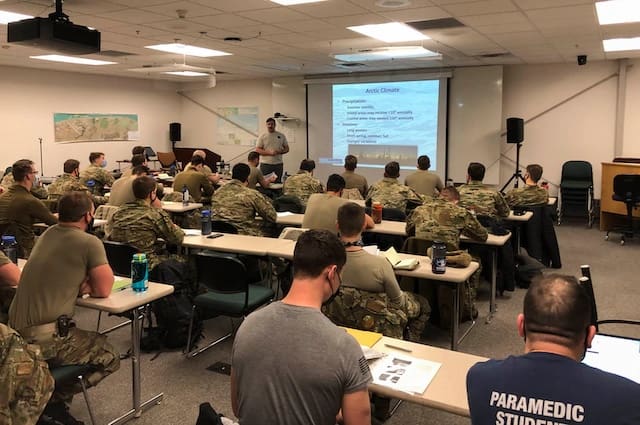
S-V81-C training includes a day of academic instruction where students learn about health, sustenance, personal protection, signaling, recovery and travel in an arctic environment.

Throughout the week, students learn how to operate in the Arctic and build shelters from snow caves to igloos. In total, students construct six different shelter configurations over the course of four days, to enable their survival in the Arctic tundra.

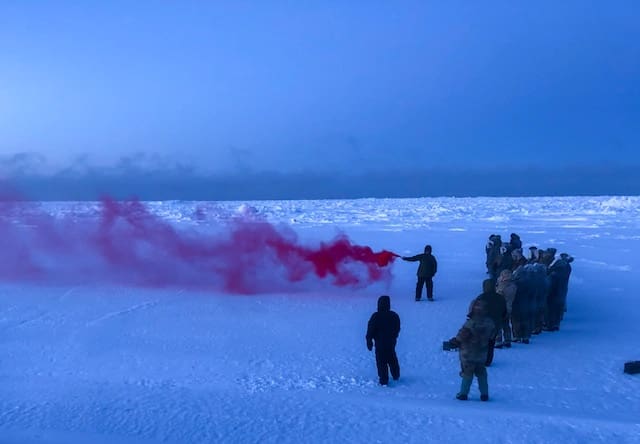
The Cool School team brought the students out to the Chukchi Sea where they ignited MK-124s, a smoke and illumination flare, to learn about the intricacies of signaling and recovery.

One of the highlights of the training is the cultural immersion with the local indigenous people, giving many students a broader perspective and appreciation for the Arctic.

“Our students have a unique opportunity to learn from the indigenous people, so they can come to a better understanding of the cultural influences that enabled them to survive in such a harsh region for thousands of years,” said Maj. Tyler Williams, 66th TRS, Det. 1 commander. “Before all of this modern equipment, it was the cultural values and practices that allowed them to thrive in this region.”

This immersion also aligns with the Department of the Air Force Arctic Strategy through collaborative planning opportunities particularly building upon relationships with indigenous communities in the Arctic region to learn from their expertise.

What makes this year’s training different from its previous iterations is the introduction of the geopolitical aspects of recovery.

“There’s a lot of people who live across the Arctic,” Wright said. “Students have to understand that they might not be picked up by American forces and they may not even be military.”

Williams emphasized that this training plays an important role in mission preparation to the Air Force Arctic Strategy. The Air Force has recognized the importance to prepare aircrew for operations in extreme polar regions, and SERE specialists perform a vital role in doing just that.

“It doesn’t matter if you’ve got the best equipment or aircraft in the world,” Williams said. “If you don’t have the right training, the Arctic environment will kill you.”

Story by Airman 1st Class Jose Miguel T. Tamondong, 354th Fighter Wing Public Affairs

Photos by Maj Tyler Williams and MSgt Ryan M. Dewey

Soldier Center’s New Capability Streamlines Munition Fragmentation Data Collection

Wednesday, February 17th, 2021

NATICK, Mass. – The U.S. Army Combat Capabilities Development Command, or DEVCOM, Soldier Center, working in conjunction with academia and industry, has developed the Fragmentation Rapid Analysis Generator using Computed Tomography, or FRAG-CT.

“FRAG-CT supports the Army Chief of Staff’s priority to better protect the warfighter in current and future combat situations,” said Lisa King-Schiappa, the Protection Technology Development team lead in the Protection Systems Division, Soldier Protection Directorate, at the DEVCOM Soldier Center.

King-Schiappa explained that the “FRAG-CT analysis tool has matured into a stand-alone Graphical User Interface, or GUI, that streamlines the gathering of valuable munition fragmentation data from indirect fire arena tests.”

The method produces a data file of the munition fragmentation characteristics along with a data file used for armor design and also distinct 3D files of each individually scanned fragments for follow-on future analysis. FRAG-CT makes it possible to process arena test bundles up to 200 times faster than current hand-count methods. This new methodology can decrease bundle analysis time from months to hours.

“Timely, accurate and repeatable evaluation of indirect fire threats are critical for developing new armor designs and expeditionary protection systems,” said King-Schiappa. “FRAG-CT is the solution to time-consuming and unreliable fragment hand-count data.”

“The FRAG-CT analysis tool streamlines the gathering of munition data,” said Tom Reynolds, Protection Systems Division leader, Soldier Protection Directorate, DEVCOM Soldier Center. “This tool is less time-consuming and more reliable than other methods and will aid in the development of improved armor design.”

To develop FRAG-CT, the Soldier Center collaborated with a number of agencies, along with its development partner Compotech, headquartered in Brewer, Maine, and a CT scanning expert at the University of Maine.

“The collaboration with the National Ground Intelligence Agency, DEVCOM Army Research Lab, DEVCOM Data Analysis Center, DEVCOM Armament Center, Naval Surface Warfare Center, Compotech and UMaine was significant in the development of FRAG-CT,” said King-Schiappa. “The team was comprised of subject matter experts in the fields of threat assessment, munition exploitation, armor design, CT scanning and expeditionary ballistics – these critical aspects support the rapid development of an improved methodology for armor design.”

In addition to protective equipment, FRAG-CT may also aid in munition development.

“Warhead development is an iterative process from design to prototype to testing and back to design,” said Henry Hsieh, mechanical engineer, DEVCOM Armament Center. “This process is often cost prohibitive due to the time and labor required to collect and analyze vast amounts of data after a destructive warhead event. The FRAG-CT technology has the potential to minimize or even eliminate the laborious process of manually picking, cleaning, weighing and sorting tens of thousands of fragments after each warhead test, drastically reducing labor cost as well as data turn-around time. With this technology in place, warhead developers can rapidly and confidently design munitions adapted for our next generation of warfighters.”

Data collection and analysis play an all-important role in DEVCOM Soldier Center’s commitment to advancing capabilities and technologies for the Soldier.

King-Schiappa noted that software technology and analysis capabilities associated with FRAG-CT will also help address mission priorities that emphasize increased maneuver and lightweight expeditionary ballistic protection — thus, delivering protective expeditionary maneuver systems and Mission Command Technologies into Soldiers’ hands more quickly to increase warfighter readiness.

“Threats of interest are ever changing,” said King-Schiappa. “The Army is working diligently to narrow the capability gaps that affect Soldiers and enable the rapid delivery of capabilities to the warfighter. FRAG-CT enforces the aspect of rapid delivery for ongoing threat characterization work.”

The DEVCOM Soldier Center is transferring the software technology and the analysis capability to both the DEVCOM Army Research Laboratory and DEVCOM Armament Center.

DEVCOM SC, DEVCOM ARL, and DEVCOM AC have signed a software use agreement, or SUA, that is emplaced for work to support both arena-test methodologies and water-test methodologies using FRAG-CT. This GUI and upgraded test methodology will enable DEVCOM AC and DEVCOM ARL to process arena- and water-test data with greater accuracy, speed and repeatability.

“FRAG-CT is a state-of-the-art software package that allows the user to quickly and accurately process large amounts of fragment data under one platform,” said Justin Pritchett, a mechanical engineer at the DEVCOM Army Research Laboratory. “It has a multiple-input, multiple-output capability that supports data input from different types of fragmenting munition experiments and outputs various data formats for modeling and simulation codes. This technology advancement will drive how we process and collect large data sets in the future.”

King-Schiappa explained that the methodology and GUI may also feed modeling and analysis efforts tied to software such as the Advanced Joint Effectiveness Model, or AJEM. AJEM is a survivability, lethality, and vulnerability computer simulation code that is capable of analyzing one or more threats attacking one or more rotary-wing or fixed-wing aircraft, small watercraft, ground-mobile system, and mounted or dismounted personnel.

Mike Maffeo, a senior engineer on the Ballistic and Blast Protection Team, Protection Materials Division, Soldier Protection Directorate at the Soldier Center, explained that there are other models in addition to the AJEM model that can also use this data, including a casualty software called the Integrated Casualty Estimation Methodology, or ICEM, model.

Maffeo, who serves as the model manager for ICEM, explained that ICEM was developed specifically to model dismounted soldiers and the body armor they are wearing.

Maffeo believes that FRAG-CT is an important innovation in fragmentation data collection and analysis.

“FRAG?CT looks to be a real game changer in getting new fragment files quickly for armor assessment and vulnerability analysis,” said Maffeo. “With all the data that is being collected by FRAG?CT, it opens opportunities to increase the fidelity of the modeling and analysis. Some of these newer munitions have asymmetric (non?symmetric) burst patterns that are difficult to model without the right data. FRAG?CT should allow us to get this type of data quickly.”

In the future, FRAG-CT may also have applications for Elastic Plastic Impact Computation, or EPIC, and beyond.

By Jane Benson, DEVCOM Soldier Center Public Affairs

The Baldwin Files – Knowing Yourself

Monday, February 15th, 2021

If you know the enemy and know yourself, you need not fear the result of a hundred battles. If you know yourself but not the enemy, for every victory gained you will also suffer a defeat. If you know neither the enemy nor yourself, you will succumb in every battle.
? Sun Tzu, The Art of War

I have used the first sentence of this famous Sun Tzu axiom before. The entire quote provides a more complete framework for a professional soldier to consider. In terms of knowing the enemy, Sun Tzu advocated that a General [leader] focus a great deal of effort on gaining superior intelligence while denying the enemy similar information. That is sound advice for any military leader. However, I am not going to talk about that aspect of the art of war today. Instead, I want to talk about the arguably even more critical “knowing yourself” element of the equation. In many ways, it is the harder of the two to master. Harder, because it first requires a leader to develop and – over time – hone his or her self-awareness and self-reflective skills.

Certainly, throughout a career, a wise leader will routinely seek the perspective and advice of others about his or her performance – formal and informal. That aspect of professional development is also very important. Still, I consider that a follow-on step in the process and will leave it for another time as well. The best start point, in my professional opinion, should always be a brutally honest self-assessment. A thorough and candid appraisal of personal strengths, weaknesses, skills, and idiosyncrasies that must be, likewise, continuously updated as a leader gains better self-perception. I will share some of my personal experiences as examples to illustrate. I admit up front that I was rarely as self-aware as I am now in hindsight. I wish I had known in the beginning what I know now. Unfortunately, that is not how it worked for me; but, perhaps, this article will inspire others to seek to know themselves better – and sooner – than I did. Keep in mind, that regardless of source, an assessment is of little value until it is internally “operationalized” to reinforce the positives and address any negatives.

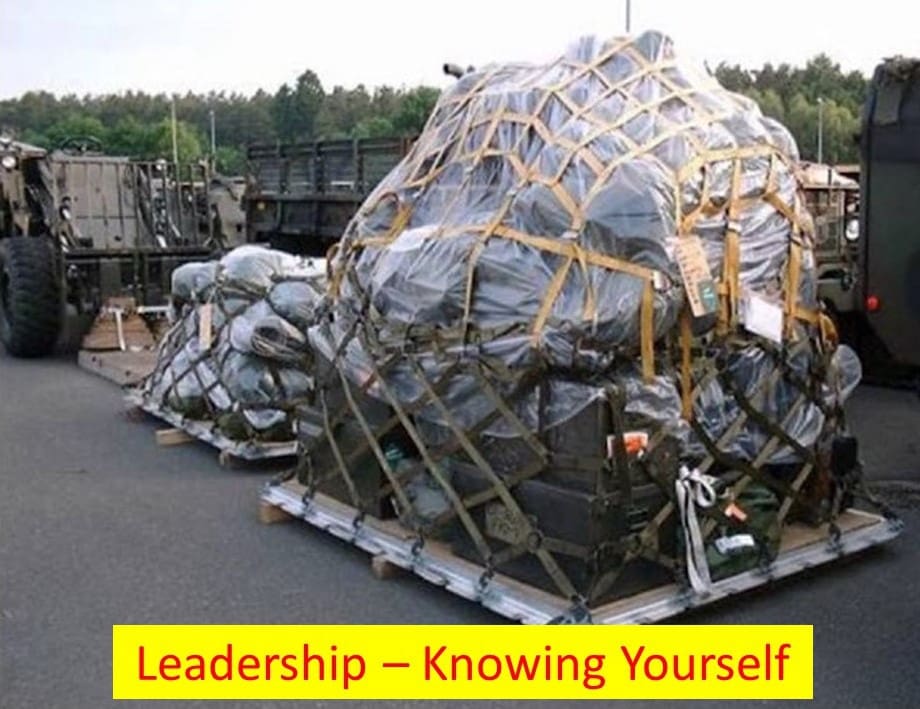
When I started my journey, I was not completely clueless. I knew early on that I wanted to be good at my job and was ready and willing to work at it. I took advantage of every training opportunity available to me and taught myself as well by intently studying the relevant manuals. At this point, the reader is probably starting to wonder what this has to do with the generic picture of the 463L Pallets above? It is simple. I really like building pallets. I always have. I built my first in Germany in the winter of 1975. Our Infantry Company was rotating to Berlin for MOUT training and I was part of the detail tasked to build and load our accompanying pallets on C130s. It impressed me that a loose pile of footlockers, duffel bags, and other gear could be so quickly organized into a symmetrical air-worthy load. As a Pathfinder, I received formal training on how to build pallets correctly and also taught classes on the subject to other units in the Division. Later, at Fort Lewis and then Schofield Barracks, I ran details building pallets for battalion-sized deployments. Belatedly, at Fort Bragg, I eventually received more training on all things air-movement by completing a Load Planners Course.

No matter how senior I got, if I saw a pallet that needed building, I jumped on it – literally. I did not care to just supervise on the sideline. I enjoyed the constructive process of manhandling hard and soft items like tuff boxes and kit bags, etc., and eventually getting that final stable cube configuration. It was fun for me and, frankly, I never gave it much thought beyond that. That changed in the late fall of 1997. I was nearing the end of my command of Alpha Company, 1st Battalion, 3rd SFG. We were getting ready to come back to Fort Bragg from a desert training iteration in an austere satellite facility of Fort Bliss. We had a half dozen empty pallets pre-positioned and were going to build the loads the next day. My Company SGM came to me that evening to confirm that all the teams were ready to go in the morning. He looked at me a little sheepishly and said that the Team Sergeants had asked him to do one thing. That was “keep Major Baldwin at least 50 meters away from the pallets.”

That caught me by surprise. I was not mad about it. We had been together for almost 18 months and they knew me well. I understood that they were just giving me some good-natured ribbing about one of my obvious eccentricities and they expected me to take it with good humor. It was kind of funny. So, the next day, I watched the pallets being built through a window from inside a building. I was missing the fun! That actually bothered me more than I thought it would. It made me think. Why did I like building those pallets so much? I did not find an immediate answer. With my follow-on tour at Leavenworth and then the schoolhouse at Camp Mackall, I did not even see a pallet again until after 9/11. During GWOT I did get to build a few more pallets from time to time. I still liked it, and by then I had done enough introspection to know why.

I got satisfaction from the process of solving what was essentially a life-size puzzle. Taking the individual pieces and fitting them together into a new coherent form. I eventually realized that building the pallets was something of a mental exercise that actually made me a better leader. After all, a lot of leadership involves building plans and making decisions – solving puzzles – without knowing exactly what the final end product will look like. So, in this case, my pallet quirk was indicative of a beneficial positive attribute that served me well over the years. Of course, it was still a little weird. Over time, I also became acutely aware of some of my other personality traits like impatience and temper that were two-edged swords. I came to understand that as long as I kept them under control and channeled that energy towards positive goals, they helped drive me forward and were useful. In that sense, they served me well. Yet, there was always the danger of a counter-productive emotional explosion that I learned to constantly guard against. I was successful more often than not, but it was a perpetual struggle.    


I had a few more epiphanies during other assignments. In 1978-80, I was stationed at Fort Lewis, Washington. It was the time of the infamous post-Vietnam “Hollow Army” – for those that can remember that far back. The 9th Infantry Division at Lewis was the lowest priority of the 18 divisions in the Army at the time. That meant that we had only a fraction of the soldiers and leaders we were authorized on paper. The practical result was that the Rifle Company I was assigned to had only two officers. A First Lieutenant who was the Company Commander, and a 2nd Lieutenant who was the XO. We had only one SFC and he was the First Sergeant. The Weapons Platoon (TOWs and 81mm Mortars) and two of the Rifle Platoons were led by Staff Sergeants. I was a Sergeant, E-5, with just two years in grade when I got there; yet, I was the most senior and experienced sergeant in the company. Therefore, for almost a year, I led the 2nd Platoon. The platoon had one other sergeant and a corporal and, including us NCOs, a grand total of 18-20 men present for duty during my entire tour.

Despite the challenges, that job was a wonderful leadership laboratory for me and an invaluable professional development experience. I learned more about myself and leadership in general during those months than in any other assignment. I was proud of that platoon. We got pretty good at doing more with less. At one point, we were practicing for a company raid on a small MOUT facility. We spent two days on the site practicing various techniques. On the third day, the company issued the raid order. In it, my platoon was tasked to establish a blocking position on the road intersection a couple of hundred meters away from the site. I was livid. I went to the Company Commander and asked for a mission change. I wanted us to be part of the assault element – not on the sideline.

I pointed out that my guys had performed at least as well as the other platoons during the train up. In fact, I thought we had done better. My CO agreed. Then he explained that he had made his decision based on three factors. First, the site only had 6 buildings and was too small for all three platoons to realistically maneuver simultaneously and the intersection needed to be blocked in any case. Second, he had observed that my platoon had done well and he figured that the other two platoons needed the additional training more than we did. Third, just as would be true on a real-world raid, he needed to be on the objective. Therefore, he had to have confidence that the leader responsible for the blocking position would be able to handle any likely contingencies without additional guidance. He said, “that is why I picked you.” I was still not entirely happy, but I could not argue with his logic.

That situation gave me a lot to think about. It was not the first time I recognized that I always had the compulsion to be in the middle of any action. My CO had me pegged. I wanted my team to take the hardest missions that mattered the most. I liked making the tough decisions, appreciated maximum autonomy, and was comfortable with ambiguity. In other words, I was invariably motivated to move to the sound of the proverbial guns – with or without orders. That realization not only gave me insight into what kind of leader I was, it also told me where my career needed to go. That eventually meant seeking a commission and later Special Forces duty. It turned out that I was a pretty good fit for that kind of organization and those specific leadership challenges.

One more. This is a Ranger School story. When I was in Florida, I had a minor dental issue with a filling and they took me to the Eglin AFB dental clinic. No Ranger Cadre stayed with me so I was under no supervision. There were soda and candy machines in the waiting area but any food item that was not issued to us was expressly off-limits. I never approached the machines. More importantly, although I was tired and the whole process took about 3 ½ boring hours, I never slept. My teammates were already out in the swamp patrolling and my only mission was to get myself fixed and rejoin them as quickly as possible. I took my duty to my team seriously. Readers of some of my other articles have probably noted that I am not afraid to dodge, bend, or even break, rules if I think it is vital to achieving mission success. Not all rules are created equal.

However, I do NOT believe in cheating on tests. In formal training venues like Ranger School, the standards are established specifically to test soldiers. If I could not meet those standards honestly – with my integrity intact – I would always know that my Tab was tainted and not entirely legitimate. Even if no one else ever found out. Sneaking a nap or a candy bar would have been entirely self-serving and was not going to help me get a passing grade on a patrol or ultimately to graduation. I also had confidence in myself. I knew I did not need to cheat to meet the demands of the school. And I sure as hell was not going to risk getting dropped over a candy bar! I never shared this story with anyone at the time. There was no need. Maintaining my discipline when nobody was looking was just a small victory for me to appreciate. Given that I was an experienced leader by that time, it would have been out of character for me to do anything less. As a side note, I did get a chance to shower and put on a clean uniform before they took me to the clinic – that was pretty nice.

Those are just a handful of the thousands of data points I collected during my career that gave me the unblinking and penetrating look at myself that I needed to evolve. It was certainly not all flattering. Be prepared for that. Solving the puzzle of who you are – and who you are not – is a continuous job for any leader. It does not happen overnight. Think of the 463L now as a metaphor. The enduring task is to fit all your traits – the good and the problematic – onto one metaphysical pallet in order to put the puzzle together and fully know yourself. Ultimately, building a solid professional structure that will improve with age, travel well, and successfully endure all the trials of leadership. Every good leader has to learn how to thrive and not just survive with whatever talents and liabilities that they are blessed or cursed with. In short, a leader is going to be more successful if he or she gets and keeps their own personal shit reasonable tight first!

Finally, always remember that leaders are just one part of an organization. It is not necessary or possible to do everything on your own. Learn to rely on the rest of the team. Cultivate some mentors and coaches for yourself. Be ready and available to provide the same service for your soldiers. Build your team. Develop your subordinates as you improve yourself. Even as relatively senior leaders, we rarely have the option to choose all of our teammates; but I suggest taking advantage of any opportunities that might present themselves to pick as many as you can. Try hard to get people who are smarter and better than you. For best results, strive to team up with people that complement your strengths and/or compensate for your weaknesses. Make sure at least a couple are honest brokers that will tell you when you are wrong. Usually, your senior NCO is that kind of trusted interlocutor. An Executive Officer, 2IC, or Deputy should be another. Take any personal or professional setbacks in stride. I do not know any successful leader who traveled a perfectly straight line to where they wanted to be. Good luck on your journey!

De Oppresso Liber!

LTC Terry Baldwin, US Army (Ret) served on active duty from 1975-2011 in various Infantry and Special Forces assignments. SSD is blessed to have him as both reader and contributor.

Air Mobility Command Hosts Operational Demonstration for Latest AE Innovation

Monday, February 15th, 2021

SCOTT AIR FORCE BASE, Ill. (AFNS) —

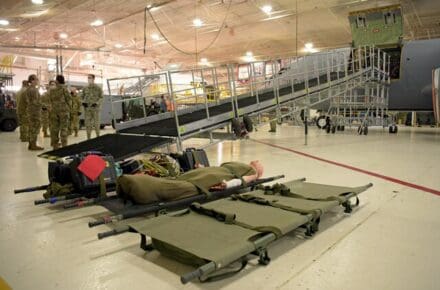
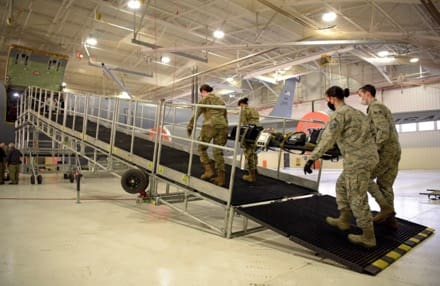
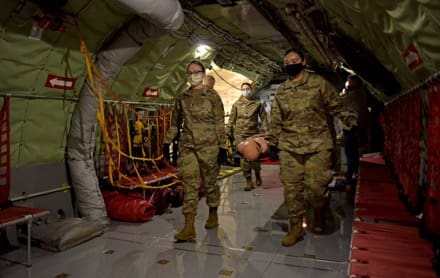
Air Mobility Command hosted the final operational demonstration for the Patient Loading System at Scott Air Force Base, Jan. 25-28.

The PLS is a portable and constructable ramp used to safely on and offload patients to high-deck aircraft, such as the KC-10 Extender, KC-46 Pegasus and KC-135 Stratotanker.

“This upgraded system represents a new frontier in our ability to support the global aeromedical evacuation mission,” said Brig. Gen. Norman West, AMC command surgeon.

Eight medical technicians from the 375th Medical Group were first trained on how to construct the system, then assembled it to demonstrate the capability to AMC leaders.

“Our AE system is designed to make us self-sufficient, so we don’t have to rely on non-medical staff to load our patients or equipment,” said Lt. Col. Todd Roman, medical modernization division chief at the AMC Office of the Surgeon General. “We have to teach our staff to put this together, which is what we’re doing this week. We’re also testing to see how long it takes to put it together.”

According to Roman, the goal is for an eight-person medical team to construct the system within eight hours. Despite having never seen it before, the team met all assembly requirements. They also provided invaluable feedback to improve instructions and ease of assembly as the system moves to final production.

“The ability to configure the device to meet the requirements of all three high-deck aircraft allows us to be adaptable to the aircraft available, even in the most resource-limited environment,” West said.

The current PLS design has multiple drawbacks, including weight limitations and steeper ramp incline. Additionally, since it was designed for Civil Air Reserve Fleet aircraft, its military utility is limited to the KC-135.

During AE missions that use low-deck aircraft, such as the C-17 Globemaster III and C-130 Hercules, patients can simply be carried on and off the aircraft. But high-deck aircraft present a unique challenge.

“For our high-deck aircraft, we need a mechanism to get our patients from the ground to deck level,” Roman said. “The PLS is designed to provide a safe, alternative method to loading patients when mechanical means are not available.

“This is a significant accomplishment from a strategic standpoint, because in this peer/near-peer competition, we can now use nearly any cargo aircraft for AE missions,” Roman continued.

The system also allows AMC to better project the joint force, one of its four command priorities focused on rapidly delivering combat power, humanitarian aid and disaster response, anywhere in the world and at a moment’s notice.

“The U.S. Air Force AE system is world-class and has been adapting to ‘aircraft of opportunity’ even before the retirement of the C-9A Nightingale, which was AMC’s last dedicated AE airframe,” Roman said. “This system further improves our AE capability by giving combatant commanders greater flexibility in our ability to evacuate patients using any available aircraft, regardless of available base support.”

By MSgt R.J. Biermann, Air Mobility Command Public Affairs