FirstSpear

Archive for the ‘Guest Post’ Category

Finally! Department of the Air Force Removes Waist Measurement from Physical Fitness Assessment Composite Score

Monday, December 7th, 2020

WASHINGTON (AFNS) —

The Department of the Air Force announced physical fitness assessments will now resume April 2021 and will no longer include the waist measurement component.
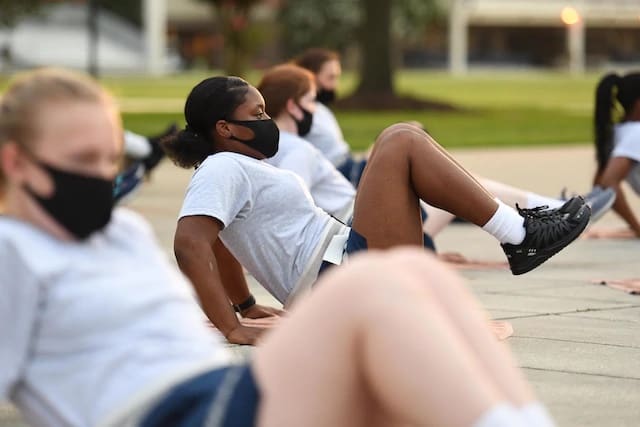
To ensure social distancing practices remain in place during the ongoing COVID-19 pandemic, and to give Airmen and Space Professionals time to prepare, testing was delayed from October to January and is now further delayed to April.

While the waist measurement is permanently removed from the assessment, height and weight measurements will resume October 2021.

“We trust that our Airmen understand the standard of good physical health practices and we are all finding innovative ways to stay fit,” said Air Force Chief of Staff Gen. Charles Q. Brown, Jr. “We also trust that leaders will take the appropriate steps to keep their Airmen safe while making every effort to provide fitness options during the pandemic.”

Fitness assessment cells, fitness center staff, physical training leaders and members performing fitness assessments will adhere to physical distancing protocols and other local precautions as determined by installation commanders once assessments resume.

Commanders may delay official fitness assessments beyond April 2021 if necessary, based on the recommendation of local public health officials, the continuation of closed fitness centers and extended state-wide restriction of movement and gatherings.

Space Professionals will adhere to the physical fitness policy of the Department of the Air Force.

Airmen and Space Professionals may determine their next fitness assessment due date by visiting the Official Physical Assessment Due Date Matrix on myPers which will be updated and available Dec. 8. Fitness assessment due dates will primarily depend on the date and score of the last official test.

“Originally, we hoped to resume testing by January 2021,” said Chief Master Sgt. of the Air Force JoAnne S. Bass. “However, based on the number of cases nationwide, the right thing to do is focus on keeping our Airmen and their families safe. Delaying and reevaluating the PT test is the best option for our people.”

The test will still consist of a 1.5 mile run, 1 minute of pushups and 1 minute of situps. However, the composite score will be calculated with full points for the waist measurement portion until system changes can be made.

Department leaders are also looking to reevaluate certain testing criteria moving forward.

“Along with removing the waist measurement, we are also exploring alternative strength and cardio components to our current Air Force fitness assessment,” Brown said. “We believe these potential test structure changes will impact Airmen in a positive way and help with a holistic approach to health and fitness standards.”

For more information, Airmen and Space Professionals should contact their fitness assessment cells and visit the COVID-19 Fitness Guidance page on myPers.

Secretary of the Air Force Public Affairs
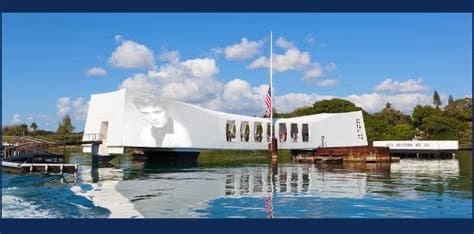
SCUBAPRO Sunday – How Elvis saved the U.S.S. Arizona

Sunday, December 6th, 2020

I ran this last year, but I wanted to do it again as I think it is great story.

The Japanese attacked on Pearl Harbor killed 2,403 military and civilians personal. A further 1,178 people were injured in the attack. 19 ships were sunk or damaged, and 188 aircraft destroyed. The efforts of the greatest generation raised all but three (The Arizona, The Utah, and The Oklahoma).

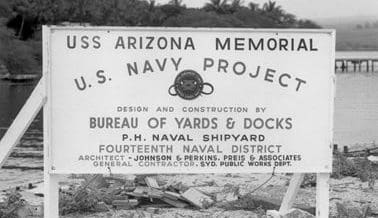
The wreck of the Arizona immediately became a memorial. Passing ships rendered honors to the Arizona and her crew throughout WW2 and still due to this day. Proposals for a permanent memorial started as early as 1943, but not until 1949 did an organized effort began to take shape with the creation of the Pacific War Memorial Commission (PWMC). As the PWMC considered ideas to formally recognize the role of Hawaii during the war, which would include a memorial to the Arizona, Admiral Arthur Radford had a flagstaff placed on the wreck in 1950. He ordered that the colors be raised at the site every day. This modest memorial was later expanded to include a wooden platform and a commemorative plaque.

In 1958, President Dwight Eisenhower signed Public Law 85-344 that allowed the PWMC to raise money on the Navy’s behalf for the construction of a memorial to the Arizona. A fundraising goal of $500,000 was set and the initial response from the public was promising. An episode of the popular T.V. series This is Your Life dedicated to Medal of Honor recipient Rear Admiral Samuel Fuqua. (Then Lieutenant Commander Fuqua serving as the U.S.S. Arizona ship’s Damage Control Officer and first lieutenant, and was on board her during Japan’s December 7, 1941, attack on Pearl Harbor. Though knocked unconscious by a bomb that hit the ship’s stern early in the attack, he subsequently directed firefighting and rescue efforts. After the ship’s forward magazines exploded, he was her senior surviving officer and was responsible for saving her remaining crewmen.)

That initial call for donations raised over $95,000. However, the project quickly stalled as donations dried up. By the start of 1960, only $155,000 had been raised.  

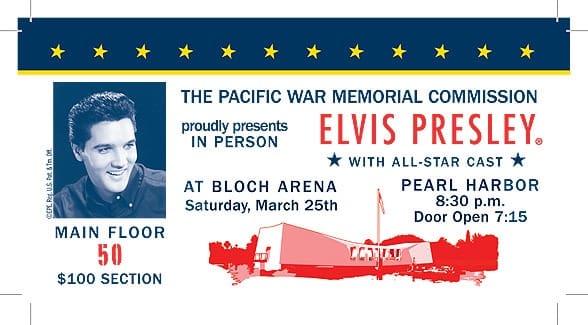
“Colonel” Tom Parker read about the struggling campaign in a newspaper and spotted an opportunity. As Elvis Presley’s manager, he was eager to get a bit of positive publicity for his client who had been out of circulation for a couple of years after being drafted into the U.S. Army. Parker surmised that a benefit concert for the U.S.S. Arizona Memorial would raise much-needed awareness of the fundraising campaign while also demonstrating that Elvis still had drawing power. Elvis was not only pleased to be able to perform for an audience. He was a patriot who genuinely believed in the cause and wanted to help.

The PWMC accepted Elvis’s generous offer and began making arrangements with the Navy to use the 4,000 seats Bloch Arena at Pearl Harbor as the venue for the concert. It was the same arena that had hosted the “Battle of Music” the evening before the attack in 1941. The “Battle of Music” was a spirited competition to determine the best ship band in the Pacific Fleet. Although they had been eliminated from contention, the band from Arizona was present and played dance music for the attendees. They would never perform again. The entire band was killed in the explosion on the ship the next morning.

With the venue secured and the show scheduled for March 25, 1961, Parker set ticket prices ranging from $3 to $100 and announced that everyone would have to buy a ticket to see the show. Rank usually has its privileges. Still, Parker seemed to take pleasure in rebuffing admirals and generals who approached him about complimentary tickets. When he said he everyone had pay, he meant everyone had to pay — even the performers. Elvis bought a $100 ticket for himself then bought dozens more to give to staff and patients at a military hospital.

After a brief introduction by Rear Admiral Robert Campbell of the 14th Naval District, Elvis took the stage as hundreds of teenagers screeched in excitement. The King looked resplendent in his signature gold lame jacket with silver sequin lapels. He let out a brief yell of his own in response to the ecstatic audience before launching into his hit “Heartbreak Hotel.” All accounts state that Elvis was in peak form, giving an enthusiastic and energetic performance that included favorites “All Shook Up,” “Don’t Be Cruel,” “Are You Lonesome Tonight,” and “It’s Now or Never.” He finished the show with a rollicking version of “Hound Dog,” during which he slid across the stage on his knees. The 15-song set, and 45 minutes of stage time were among the longest of his career. The concert would also be his last for 8 years.

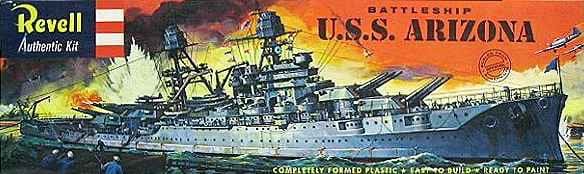
The benefit was a resounding success. Ticket sales accounted for $47,000 with additional donations ($5,000 coming from Elvis), pushing the total take to over $60,000. Funding for the memorial was still well short of its target. Still, the electricity of Elvis had generated the jumpstart the campaign needed. In 1961, Hawaii Senator Daniel Inouye got legislation passed to secure another $150,000 in federal funds. Money began to flow from other sources. The combination of public funds and private donations (including $40,000 from Revelle raised through sale of model kits of the Arizona) reached the goal of $500,000 by September 1961 – just 5 months after the concert. The end of the year completed construction on the memorial.

The U.S.S. Arizona Memorial was officially dedicated on May 30, 1962. Elvis certainly took pride in his role in building a permanent memorial to the crew of the Arizona. He made several visits to the site on subsequent trips to Hawaii. The memorial has reached its own iconic status and welcomes 1.5 million visitors a year.

Elvis did not forget the Arizona, and the Navy did not forget Elvis. When Elvis passed away in 1977, the Navy showed its gratitude by placing a wreath for him at the U.S.S. Arizona Memorial.

Much of today’s upkeep comes from the fundraising of the American Veteran (AMVETS), a veteran’s service organization that helped to secure around $250,000 in total for the memorial during the 1950s. The organization is responsible for the upkeep of the white marble wall inscribed with the names of the men who perished aboard the U.S.S. Arizona. In 1983, and again in 2014, AMVETS raised funds needed to replace the deteriorating Wall of Remembrance.

AFSOC’s SOF DT Undergoes Transformation

Saturday, December 5th, 2020

HURLBURT FIELD, Fla. —

As Air Force Special Operations Command drives towards transformation to the “AFSOC of Tomorrow” by developing its human capital, the Special Operations Forces Developmental Team instituted a more rigorous evaluation and scoring process to give SOF officers more specific feedback and purposeful career development. This enhanced process kicked off this year with the Apr. 20-24, 2020 SOF DT.

 “Over the last five to seven years, development team scoring hasn’t changed,” said Maj. Brandon Webster, Chief, Command Force Development. “There was no clear path on how we wanted to develop an individual, and we wanted to give officers more options and transparency on the future of their career.”

Historically, the DT only scored records for officers who were being considered for promotion to Lieutenant Colonel. The new process now incorporates scoring to begin with Captains, allowing for feedback and mentorship at a much earlier point in an officer’s career.

“Looking at an officer earlier on allows us to be intentional,” said Webster. “We now have the ability to look at a Captain’s records and tell him or her where they stand against their peers, and what their career pathway could look like five to ten years down the road based on where they’re at right now.”

DT record scoring provides objective data for more informative assignment placement, hiring for special duty positions, flying assignments outside of an officer’s normal aircraft, and the addition of sub-developmental pathways.

 “Overall, we’ve revamped the entire DT process. We’re focusing a lot more time on the individual to provide substantial feedback and mentor our officers at all levels, beginning at the rank of Captain,” said Webster. “It is the DT’s responsibility to ensure the right officer is placed in the right job at the right time, with the right training, education, and experiences.”

The fall DT, held Oct. 19-23, consisted of group scoring for Captains, Majors, and graduated squadron commanders. Each officer’s developmental vector will follow a percentile format, giving members direct feedback on where they fall among their peers.

“Synchronizing our efforts provides senior leadership the ability to manage officers and strengthen our future force,” said Webster. “The transformation of the SOF DT is one-step closer to building the SOF officers we need for tomorrow.”

Story by Capt Savannah Stephens, AFSOC Public Affairs

Photo by SSgt Rose Gudex

FirstSpear Friday Focus – ACM 600 Wool Lineup

Friday, December 4th, 2020

Gear up for winter. FirstSpear Advanced clothing material (ACM) is 100% sourced verified American Wool combined with high-quality materials you come to expect. In addition to warmth, wool is wrinkle-resistant, retains shape, is durable and moisture-wicking.

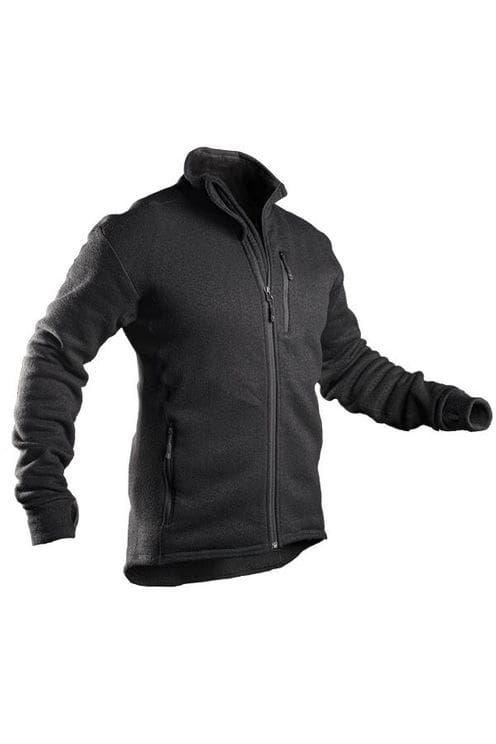
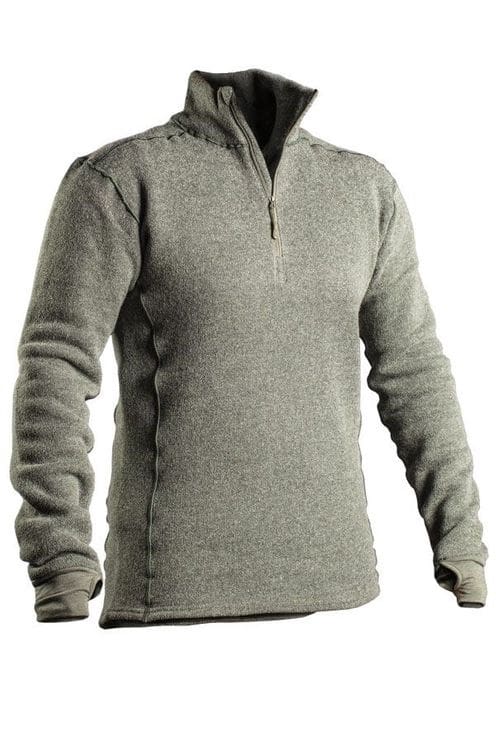
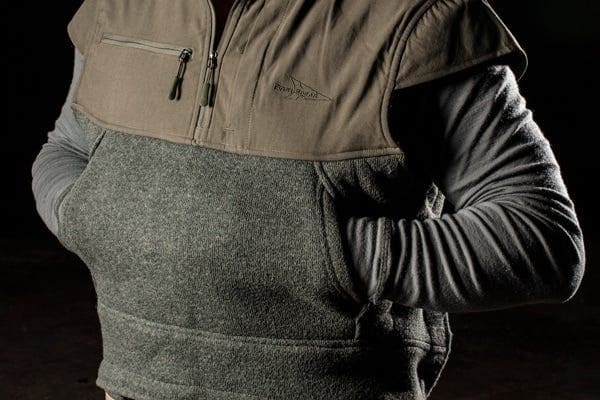
The FS Woobie Quarter Zip is comprised of the warmest 600 ACM lineup. It utilizes a 50/50 blend of the American Merino Wool and polyester and is 100% made in America. Built with a stand-up collar, low profile neck zipper and wrist overs with thumb holes, the Woobie is made to keep you warm in the coldest of climates. The slightly longer tail/contour adds comfort and warmth, preventing exposure and your shirt tails riding up during long days at the range or heading out the wilderness for a backcountry hunt. The ACM-Warm 600 is a heavyweight Merino Wool blend with super soft brushed fleece interior, designed for coldest temperatures. Additionally the lineup also include the Woobie Full Zip, which includes all the above mentioned features with a full-zip up jacket, two side pockets and chest pocket. Available in black, heather grey, FS sand and FS commando.

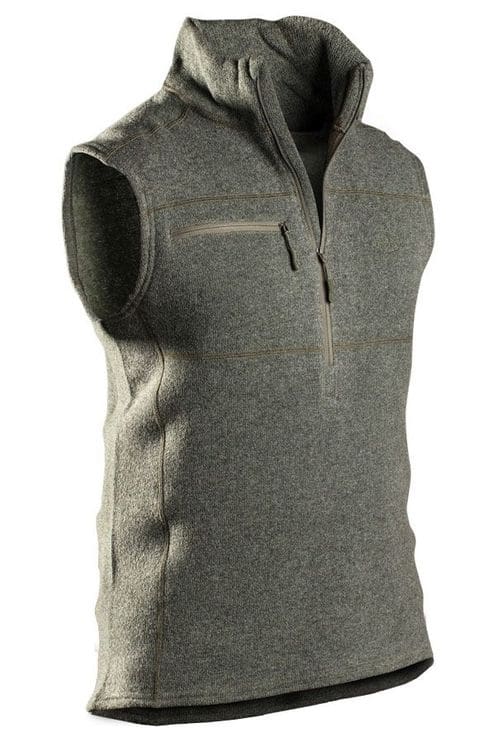
Not only does the 600 ACM lineup include the quarter zip Woobie, it also includes the Technical Woobie, the Everyday Vest (EDV) and Stalker Vest.

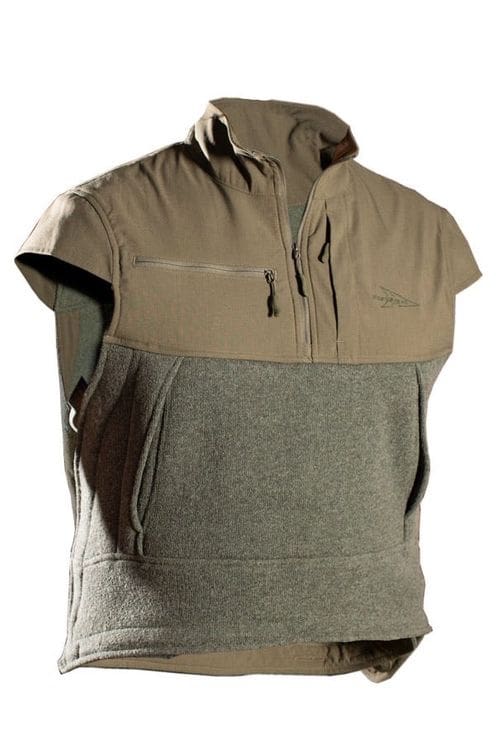
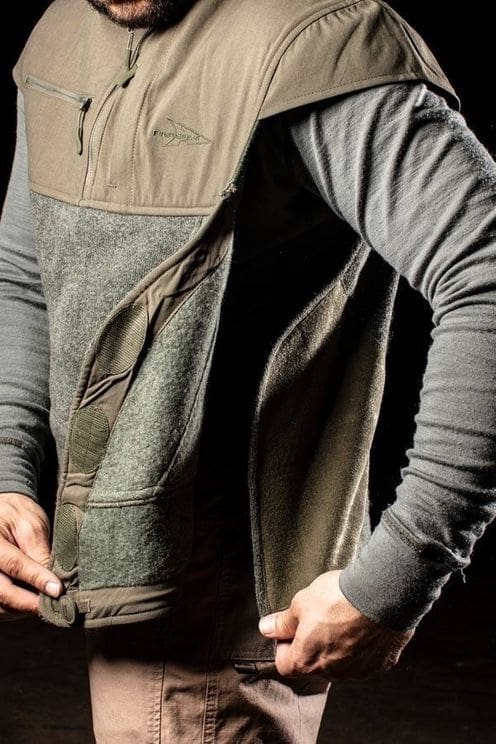
Some key features of the Stalker vest include the ability to remove the garment while wearing a vest thanks to the adjustable and can be opened from the sides via hook/loop and secured, if desired, with button. Sides can also open to increase ventilation. Generous hand warmer pocket and smaller internal pocket within sized for hand warmers. A very cool feature FS incorporated are button holes inside the hand warmer pockets along with cord loops along your internal zipper seams which allow the user to route ear buds or communication cables for discreet cable management. Available in black, black/heather, FS Sand and Commando.

For more information about FirstSpear check out First-Spear.com.

MarCorSysCom Fielding New Cold Weather Boot in 2021

Wednesday, December 2nd, 2020

MARINE CORPS BASE QUANTICO, Va.—This fiscal year, Marine Corps Systems Command plans to begin fielding a new boot that protects Marines in cold-weather climates.

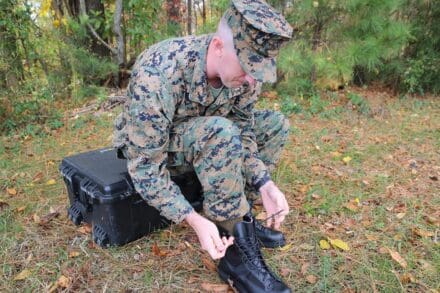
The Marine Corps Intense Cold Weather Boot is a full-grain, leather boot designed foruse in temperatures as cold as -20 degrees Fahrenheit. The ICWB allows Marines to complete various missions that might involve hiking or skiing in arduous, cold weather environments without having to change boots.

“In order to effectively conduct your mission in a cold weather environment, you need to be warm,” said Todd Towles, project officer of Cold Weather Gear with the Program Manager for Infantry Combat Equipment at MCSC. “This boot helps to accomplish this goal.”

The Marine Corps currently employs a temperate and an extreme cold weather boot. The Temperate Weather Marine Corps Combat Boot is designed for employment in conditions between 20 to 60 degrees Fahrenheit, while the Extreme Cold Weather Vapor Barrier Boot is intended for use in environments between -65 to -20 degrees Fahrenheit.

However, Marines have said the TWMCCB does not provide enough warmth in sub-zero temperatures because the boot is not designed for such environments. They often have to switch to the Vapor Barrier boot, which can cause excessive sweating if worn extensively in environments above -20 degrees Fahrenheit, said Towles.

The ICWB fills a capability gap left by these two boots. The ICWB will be used in temperatures ranging from -20 degrees to 20 degrees Fahrenheit. Towles said the boot can last up to 18 months or longer if cared and maintained correctly.

“The Intense Cold Weather Boot is not going to have the same insulation capabilities that the Extreme Cold Weather Boot provides, so the foot shouldn’t sweat as much,” said Towles. “It’s also less bulky than the Extreme Cold Weather Boot.”

From 2018 to 2020, MCSC held several user evaluations involving an early version of the ICWB, made of suede, in Iceland, Norway, Alaska and Montana, as well as at the Mountain Warfare Training Center in Bridgeport, California. Curtis Johnson, a logistics management specialist with MCSC, said Marines felt that the suede boot was well-constructed and durable but also thought it was bulky and did not dry well once wet.

Leveraging this feedback, MCSC then acquired a full-grain boot in 2020. Marines indicated the full-grain boot dried well but didn’t provide enough warmth in below-zero temperatures. CWO2 Christopher Latham, an infantry weapons officer for 3rd Battalion, 6th Marine Regiment, assessed the updated boot at Bridgeport earlier this year.

“When the temperature dipped into the negative-degree range, your feet became very cold,” said Latham. “I believe that we need more insulation in the boot to get down into the negative temperatures.”

The program office then added an additional 200 grams of insulation to the boot. If a Marine is wearing the boot for extended periods of time in sub-zero temperatures, MCSC provides a protective overboot for additional warmth if needed. The improved ICWB is also less bulky than the earlier prototype and comprises a black, leather boot to repel moisture.

“The first prototype ICWB we tested received mixed reviews, but the second prototype with the added insulation has been well-received by Marines thus far,” said Johnson. “The boot is similar to the boots they wear every day.”

The program office expects the ICWB to begin fielding in the second quarter of fiscal year 2021. Towles believes the ICWB will serve the warfighter well in the coming years.

“The ICWB lightens the load for the Marines by their needing only one boot for fighting and ski missions, as opposed to in the past when Marines had to maintain two boots,” said Towles. “I believe these boots will further support Marines in cold weather environments and help them achieve mission success.”

Photo by Matt Gonzales, Marine Corps Systems Command

Story by Marine Corps Systems Command

Competition-In-Arms: Pendleton Hosts

Wednesday, December 2nd, 2020

CAMP PENDLETON, Calif. —

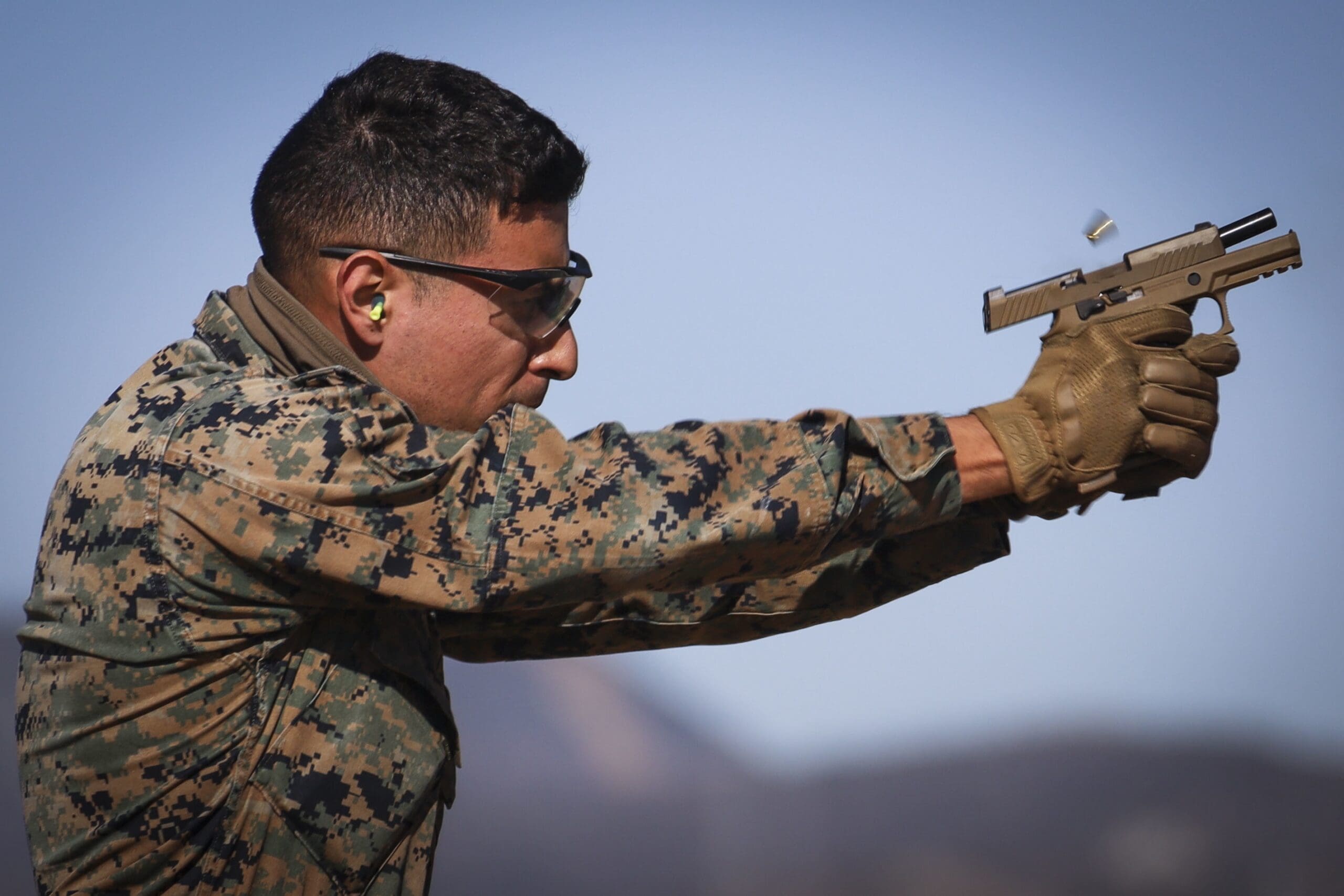
Marine Corps Base Camp Pendleton hosted a Marine Corps Marksmanship Competition for the first time in seven years.

The competition at Pendleton is the first part in a series of events for the 2021 Competition-In-Arms Program, which will end with a championship match in April at Marine Corps Base Quantico, Virginia.

As part of the program, the Marine Corps Shooting Team is coordinating and supervising five regional MCMCs held on Marine Corps bases across the world. Marines of all different trades are being encouraged to volunteer to participate in the event.

“We had operators, vehicle operators, engineers, infantrymen, intelligence Marines, and others,” said U.S. Marine Col. Carlos Jackson, the commanding officer of Weapons and Field Training Battalion, Marine Corps Recruit Depot San Diego, who hosted the completion aboard Pendleton. “They will be able to take back the skills they learned here and train others, which is all we can really hope for.”

Participants received a total of 12 training days over a two week period where they were given instruction on advanced pistol and rifle positions, firing while moving, dynamic target engagement and more.

“My biggest take away is learning how to run stages, think critically under stress and engage multiple targets in a dynamic environment.”

Sgt Evan Nicholas, a Combat Logistics Regiment 45 metal worker

“Marines who participate will not only get their annual pistol and rifle qualification taken care of but they’ll also learn how to use their weapons in an environment like they’ve never done before,” said Sgt. Evan Nicholas, a metal worker with Combat Logistics Regiment 45, 4th Marine Logistics Group. “It’s unlike any other course of fire that you’ll experience in the Marine Corps.”

The program is designed to significantly enhance participants’ proficiency in the use of individual small arms by refining fundamental marksmanship skills, learning marksmanship techniques, and pushing through mental and physical boundaries in a competitive forum.

According to Jackson, the goal of the MCMC is to make a more confident, more competent, more capable and lethal Marine to send rounds downrange, and that’s exactly what the Marines did on Pendleton over the last two weeks.

At the end of the competition, Marines were awarded for their hard work. The top 10 percent for rifle and pistol stages earned a MCMC medal, and the best performing rifle and pistol teams were awarded a trophy.

The next competition is slated to be at MCB Camp Smedley D. Butler in Okinawa, Japan, December 6-8.

Story by LCpl Kerstin Roberts, Marine Corps Base Camp Pendleton

Photo by Sgt Jeremy Laboy

UPDATE – Frank Woods – Belt Set Up

Tuesday, December 1st, 2020

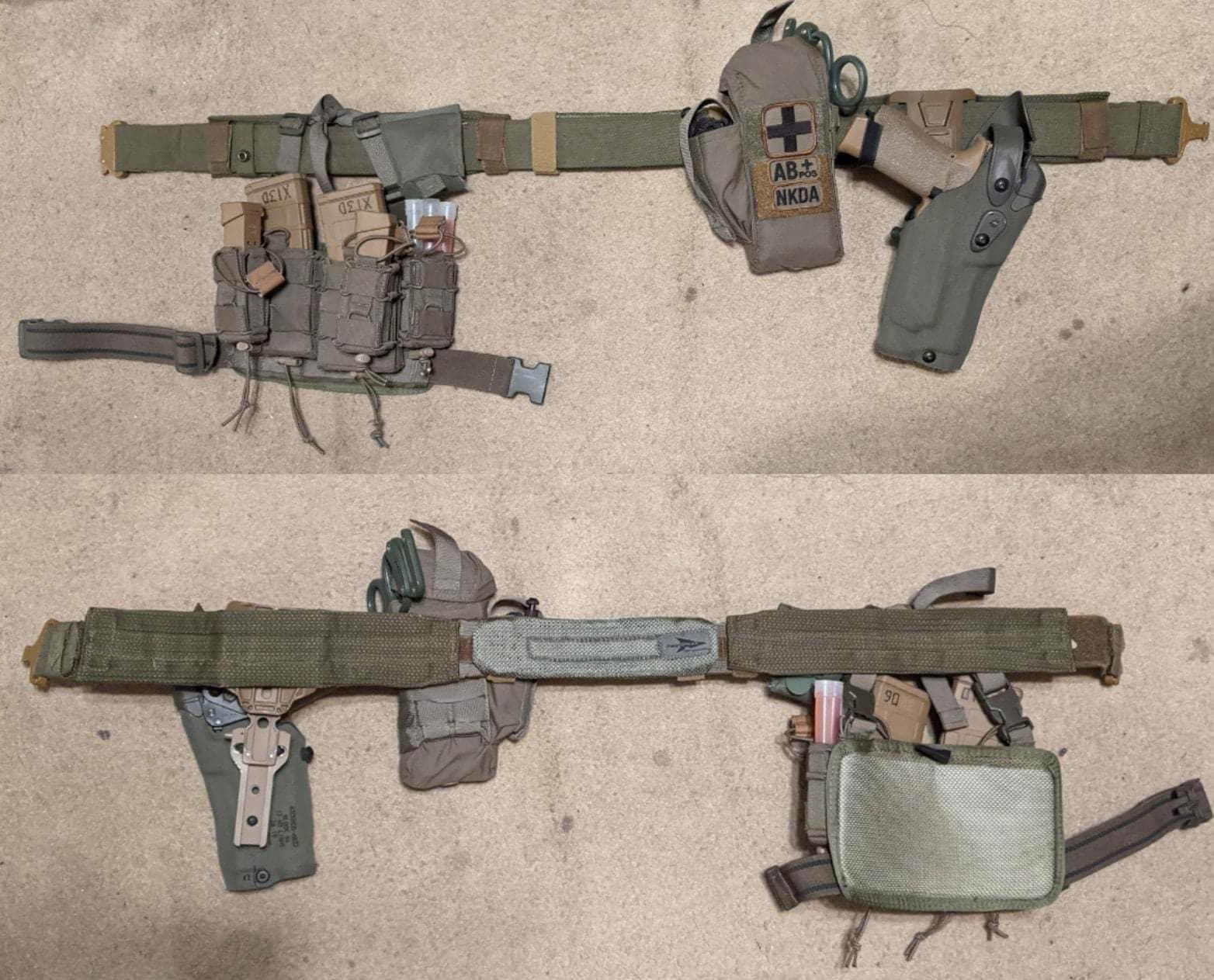
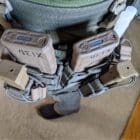
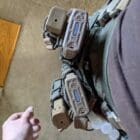
Since I’ve been asked about my belt setup a few times recently, and I needed to take new pictures of my belt as it’s currently set up anyway, here’s what I use:

– Emdom MM CM Belt

— Emdom MM CM Belt pads (Left & Right)

— First Spear AGB point pad (Center)

– Safariland 6305RDS ALS/SLS

— Glock 34 Gen 5 MOS/RMR, Ranger Green variety

– S&S Precision Holster Extender w/ GRT adjustable ride height mount

– Dark Angel Slim Gen 2 IFAK

– HSGI leg rig, blank MOLLE platform

— Tyr Tactical Combat Adjustable Pouches

— 2x Rifle, 3x Pistol

– Blue Force Gear Ten Speed Dump Pouch

This setup retains pistol, IFAK, and consistent point of reload regardless of which torso worn LBE is being used, if any. The Tyr Tactical pouches are like a better version of the TACO, and accommodate 5.56 & 7.62 sized mags easily, while offering additional retention between both the bungees and the interior surface of the pouches not being slick smooth plastic.

The belt itself is lined with PALS webbing, which allows for pouch attachment without a big thick padded sleeve. The belt pads, while making the belt fit tighter, add a friction lock of sorts that prevents the belt from rotating while I’m wearing it.

Though the S&S adjustable ride height holster mount hasn’t given me a problem, and helps when going from sitting to standing/walking, I’ve been seriously considering switching over to the True North Concepts, LLC MHA if it means I can:

1.) Delete the forward cant and situate the holster straight up and down.

2.) Using a leg strap would provide for the holster staying secure against my leg and not pulling outward and away from my leg while trying to draw the pistol. That’s always annoying.

I upgraded/replaced the dragon whatever buckle that comes with the Emdom MM CM belt with a 2″ aluminum cobra buckle from Milspec Monkey.

Leg rig allows me to spread the load and distribute the weight and not have it all concentrated at/on my belt line. I do that shit at work as mandated by policy, I’m not a huge fan. Reloads are located where my hand naturally falls at my side.

UPDATE – 23 March, 2021

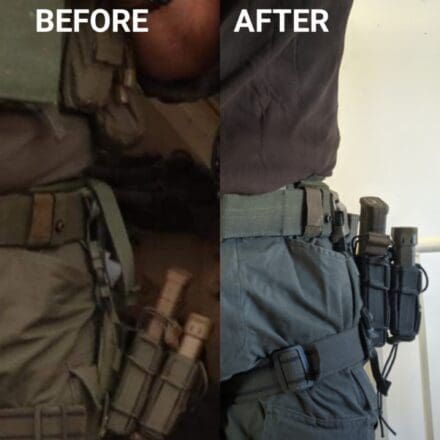
Since this article was posted, I have modified my HSGI leg rig so that it would stop sagging and tilting outwards/away from my body under the weight of the loaded magazines, due to the slack in the straps.

I’ll walk you guys through it in case you wanna do it on your own.

This modification took some minor effort to make it work, but nothing difficult and nothing permanent. The end result is that the leg rig rides much higher and conforms to my leg without sagging or tilting away, much to my satisfaction.

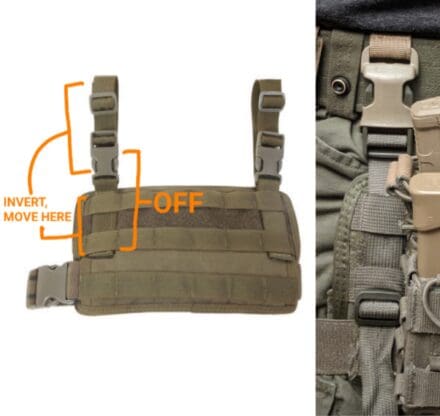
First I unclipped the buckles and took the leg rig off the belt, then I removed the male end buckles and the straps they were sewn into from the belt.

Then I got a good grip on the female end buckles attached to the leg rig itself (they’re attached via velcro, just give em a decent yank and they’ll come off,) and set them aside.

I put the QASM buckle loops (2″ variety) onto my belt and looped their straps through the PALS webbing on the inside of the belt.

Then I took the male end buckle loops, and slipped them through the PALS webbing on the leg rig upside down, reversed from their original orientation. Now the buckles are facing up, and the tri-glide is keeping them locked into the PALS webbing.

Ideally, I’d like to find male end buckles sewn into hook side velcro backed nylon straps, not unlike the female side buckles that come with the leg rig initially that I took off. Maybe I can send the ones I have to someone that can modify them.

Otherwise, tying a knot in the excess nylon strap under the tri-glide will keep it from pulling through the tri-glide under tension while it’s clipped in. Honestly though, the leg strap itself keeps enough tension on my leg to keep the rig from moving up and down.

After it’s all said and done, clip the newly located male end buckles on the leg rig into the QASM buckles on the belt, put it on, fasten the leg strap, and marvel at the new height and non-droopy stature of your leg rig platform.

Go forth and slay.

The Navy’s New Fitness Test Is Here – What You Need To Know

Tuesday, December 1st, 2020

From MC1 Mark D. Faram, Chief of Naval Personnel Public Affairs

The Navy will hold a single, six-month physical fitness assessment cycle during calendar year 2021, allowing the service to resume fitness testing while limiting Sailor exposure to COVID-19. That cycle will also see the Navy rollout the forearm plank, which as a replacement the curl-up, and the 2000-meter row as a new optional cardio event.

The Navy will hold a single, six-month physical fitness assessment cycle during calendar year 2021, allowing the service to resume fitness testing while limiting Sailor exposure to COVID-19.

The cycle was announced in NAVADMIN 304/20, released Nov. 18. The message also detailed rollout plans for the forearm plank, which will replace the curl-up, and the 2000-meter row as a new optional cardio event.

“Shifting the PFA cycle to March allows Navy to execute the PFA after the primary influenza season, leveraging outdoor venues as the weather warms,” Vice Adm. John B Nowell, Jr., the chief of naval personnel, wrote in the message.

The shift also “acknowledges the fact that while vaccines and therapeutics are expected to be available, their timing and impact are unknown.”

July’s NAVADMIN 193/20 announced the spring 2021 restart of the normally semi-annual Navy Physical Fitness Assessments, after two cycles were canceled due to COVID-19. Out of an abundance of caution, the Navy decided to proceed with the single cycle option for 2021 as the COVID crisis shows no signs of abating yet.

The Navy will resume two testing cycles once conditions permit. The Department of Defense has long mandated all services conduct annual fitness testing.

However, COVID-19 mitigation measures in place since the spring allow services to waive the requirement as a force protection measure.  The message notes that permission will carry over to allow Echelon II Commanders to waive the 2021 cycle if COVID 19 prevents its safe execution.


Where conditions permit, the message said, all Sailors must participate in the single 2020 cycle, meaning exemptions for scoring excellent or above from the previous cycle will not apply.

Going forward, however, those who score excellent or outstanding on the 2021 PFA will be exempt from participation in the first PFA cycle of 2022.

The message also details how the new plank and 2000-meter row optional cardio events will fit into the physical testing process as well as how they’re expected to be accomplished and graded. It’s the first major change to the assessment since the Navy introduced fitness assessments in the early 1980s.

Sailors have long complained about the curl-up. As Navy researchers studied the exercise, they found it was not a true test of abdominal strength. Also, it did not prepare Sailors to better accomplish shipboard tasks. In fact, curl-ups have been linked to an increased risk of creating or aggravating lower back injuries.

The forearm plank, however, is a functional movement required in 85 percent of regular shipboard tasks, including pushing, pulling, lifting and carrying.

The forearm plank uses isometric contraction to activate key abdominal and trunk muscles, mimicking the main function of the abdominal musculature – to act as stabilizers to resist the spine from moving while strengthening the lower back.

Training for the forearm plank strengthens the body’s core, improves posture, and reduces the risk of lower back injuries throughout a Sailor’s career.

Because there is overlap in the muscle groups used for the push-up and the forearm plank, the decision was made to conduct the push-up event first, followed by the plank and cardio portions.

This sequence was used in the initial tests. Researchers found it allows for maximum performance on the push-ups while limiting residual fatigue during the forearm plank.

The cardio portion’s new addition will be a 2000-meter row on the “Concept-2 Rower.” The other options remain as the 12-min stationary cycle, 500-yd/450-m swim, and 1.5-mile run. 

A non-weight bearing, low impact exercise, rowing reduces stress on the legs, while providing a great full-body cardio workout as it works 80 percent of the body’s muscles. 

A big benefit of the Concept-2 Rower is that it’s space saving and thus able to be easily used on any naval vessel as well as at shore installations.

A detailed description of how each of the new events will be conducted can be found in NAVADMIN 304/20.  As previously announced, the Navy will give Sailors a one-cycle grace period for the forearm-plank. Though the event will be conducted during the 2021 Cycle, it won’t officially count until 2022.

Initial performance standards for scoring the forearm plank and 2000-meter row were developed by the Naval Health Research Center (NHRC) and are available to both individuals and command fitness leaders on the Navy Physical Readiness Program website at www.public.navy.mil/bupers-npc/support/21st_Century_Sailor/physical.