SIG SAUER - Never Settle

Archive for the ‘Guest Post’ Category

Army Researchers Imagine Devices Without Cords or Batteries

Sunday, March 15th, 2020

ADELPHI, Md. — Imagine if you could wrap a small, thin piece of transparent material around any surface and it would charge electronic devices such as your phone or laptop. Thanks to Army researchers, this idea could be a reality for future warfighters in combat.

A team led by Professor Tomás Palacios at the Massachusetts Institute of Technology and Dr. Madan Dubey, a research physical scientist at the U.S. Army Combat Capabilities Development Command’s Army Research Laboratory, conducted game-changing study describing an antenna that can absorb Wi-Fi, Bluetooth and cellular signals and efficiently turn it into usable electrical energy. Their work is published in the high-impact journal Nature.

“Today, Wi-Fi is becoming increasingly omnipresent in both indoor and outdoor environments and provides an abundant source of always-on radiofrequency energy,” Dubey said. “What’s missing is an efficient, flexible and always-on energy-harvesting solution to power devices, which is indispensable for self-powered systems. We have discovered a way to potentially fill this gap and to make it useful for Soldiers on the battlefield.”

Dubey said the invention has proven the potential for a conformal atomically thin layer of material for generation of power without any power cords using Wi-Fi, Bluetooth and millimeter wave that is used in some 5G wireless communication systems.

“It has the potential to revolutionize Soldier’s situational awareness and readiness as these materials and devices can be integrated into health and monitoring systems, displays, communication and sensing systems for the Soldier,” Dubey said.

At the center of all of these components is a new revolutionary material, molybdenum-di-sulphide, or MoS2, which is only a few atoms thick. Its extreme thinness allows the electronics systems made out of it to be transparent, and only become visible when designed for displaying information.

“The technology is a game changer for the Army and Department of Defense as it will enable a transparent, flexible/conformal, self-powered, atomically thin system-on-chip embedded in smart textile that has never been realized before,” Dubey said. “These future systems will feature micron size, light-weight, optical transparency and state-of-the-art transistors and sensors to provide the Soldier with real time information, prepare for planning/action and security in all terrain. If the team’s radio wave-absorber succeeds, it will power those ever-present electronics 24/7, no battery needed.”

“The enabling technology is very critical for Army modernization formulation in Multi-Domain Operations,” Dubey said. “It will be a game-changer technology to power devices that will enable higher Soldier lethality, improve cognitive neuroscience and the novel engineered materials required for Next Generation Combat Vehicle.”

According to Dubey, this technology is a key building block to create, for example, an Alexa-like device that is 1,000 times smaller in size, but much more powerful in performance, while being flexible and conformable to meet mission requirements.

For Dubey, this research would not be as successful if it weren’t for the collaboration between the laboratory and MIT.

“MIT has been and continues to be a true and trusted partner with several successful proven achievements through the Institute for Soldier Nanotechnologies,” Dubey said. “ARL has established a very strong collaboration and partnership through the visit/exchange of researchers and scientists participating at the bench level.”

The Institute for Soldier Nanotechnologies is a team of MIT, Army and industry partners working together to discover and field technologies that dramatically advance Soldier protection and survivability capabilities.

The demonstrated energy harvester discussed here will have a huge impact in future systems, and is one of the several components that the MIT-Army team is jointly developing to transform the electronic microsystems that provide situational awareness and intelligence to the Soldier.

By CCDC Army Research Laboratory

Going Green: Eco-friendly Plastic to Replace Soldier’s Supplies in Battle

Saturday, March 14th, 2020

ABERDEEN PROVING GROUND, Md. — Advanced 3D printing from recycled plastic is an eco-friendly way to strengthen operational readiness, curb supply chain reliance, and improve troop safety, says a top Army scientist — with testing and evaluations on a mobile lab set for next year.

In a collaborative effort with the U.S. Marines, the U.S. Army Research Laboratory has explored new, resourceful ways to salvage plastic waste to integrate with 3D printers, said Dr. Nikki Zander, ARL research chemist.

“We have the [20 ft.] container at Marine Corps Base Quantico,” Zander said. “We’ve got all the extrusion equipment installed. We’re hoping by the end of this calendar year we’ll be able to do a demonstration of the capabilities there.”

The containers include the tools and equipment needed to fabricate 3D items from recycled materials, Zander said. Although the printing capabilities exist, ARL researchers plan to make them more automated, user-friendly, and eventually require less than a day of training for Soldiers in the field.

Right now, researchers are actively scanning parts to build an imagery database for Soldiers to pull from to quickly print parts.

“Three companies are working on making the next generation mobile lab,” Zander said. “We hope within three years we’ll have a prototype from one of those companies, and it will be more robust have more automation capabilities.”

“We’re trying to reduce supply chain dependence by using available materials,” Zander said. “We’re interested in looking at plastic packaging materials we could repurpose to use as a feedstock for additive manufacturing.”

In austere environments, a cache of plastic debris — such as empty water bottles, milk jugs, and yogurt containers — often pile up and cause a logistical burden on Soldiers to dispose of.

With nowhere to go, the garbage is often burned. The smoke releases toxic fumes into the air, and potentially causing respiratory hazards for Soldiers, Zander said.

Although actions to help the environment were “a huge motivation,” for Zander, an avowed environmentalist, the technology does more than provide conservational alternatives for troops. It is also a cost-effective way to help Soldiers be more self-sufficient on the frontlines.

One example of how recycled plastic is used on vehicle radio brackets, Zander said. It takes roughly ten emptied water bottles, and two hours, to fabricate a plastic radio bracket.

The vehicle brackets “commonly break, and usually a new, $200 radio is ordered. The new radio can take many months to get into the field, but, now you can print the part for [the cost of an empty, plastic water bottle] with no wait, and there’s very little statistical difference in the strength of the material.”

“This supports sustainment and the next-generation combat vehicle,” Zander said. “That is because there is a lot of plastic parts that need to be replaced and when you’re in a remote area, and it’s very difficult to get those shipments in.”

Even though some units have conventional 3D printers, their conventional filament must be refilled. Supplying troops with mission-critical items, like printing refills, can take weeks and the shortage can also leave Soldiers vulnerable during transportation.

“If Soldiers run out of conventional filament, then they’re dead in the water,” she said. “I think this technology provides a large level of comfort to know that they don’t need anything outside of what they already have to make the things they need.”

Not all plastic has the industrial strength of water bottles. Other plastics, such as polypropylene, often used as yogurt containers, and polystyrene, used in plastic utensils, are generally too weak to fabricate.

However, those plastics forge a stronger composite material when reinforced with other materials, “When PP is mixed with cardboard, wood fibers, and other waste materials found on military bases — they create a new composite filament,” Zander said. “Giving them the strength to make more durable filaments for 3D printed parts.”

This procedure is called solid-state shear pulverization. During this process, the materials are milled into a twin-screw extruder to form a fine powder that is melted down into a 3D printing filament. Looking ahead, ARL scientists hope to incorporate tire rubber.

“If we’re able to take the waste out of the area, and the burning out of the air and turn it into something useful, that’s win-win,” Zander said.

Story by Thomas Brading, Army News Service

Photos by E.J. Hersom

FirstSpear Friday Focus – Qtr Zip Woobie

Friday, March 13th, 2020

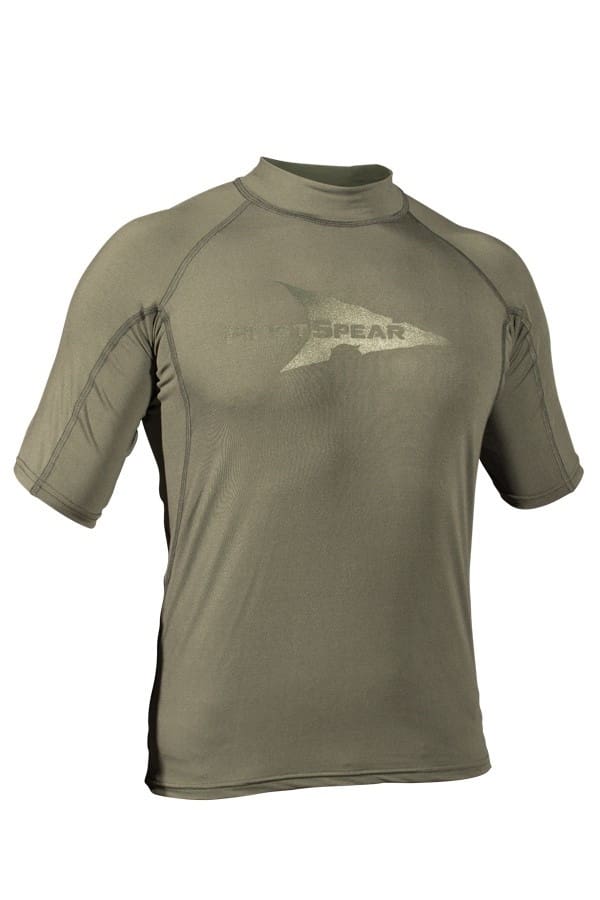
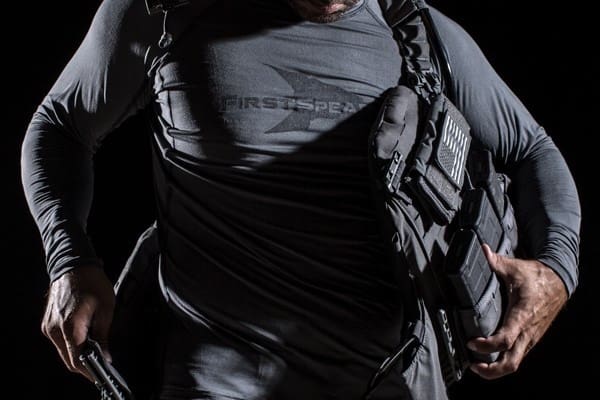
Today we have another addition to the FirstSpear American Wool Series where we have been moving through FS wool packages starting with ACM BASE, MID and now WARM. A few weeks ago we saw the all new full zip Woobie and today we are getting a look at the Qtr Zip Woobie.

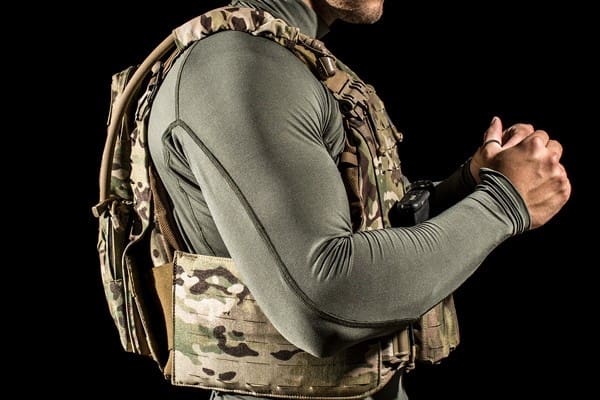
Constructed with ACM-WARM 600 this material package offers the greatest amount of warmth from the FS merino wool packages while still providing exceptional moisture wicking capabilities as well as trapping warmth even when wet. The Qtr Zip Woobie features a high collar and wrist overs with thumbs holes you can easily roll out of the way if not desired.

100% Made in the USA with 100% American materials including the merino wool. Check out the entire merino wool line up from FirstSpear.

Available in Commando, Black, Sand, and Heather Grey.

www.first-spear.com/woobie-fr-insulation-shirt

Kit Badger Discusses Q-Sert from Q

Thursday, March 12th, 2020

Our friend Ivan shared this article with us on the Q-Sert weapon accessory attachment system from Q, LLC.

Q-Sert : The Attachment Method

When it comes to methods of attaching equipment to hand guards, there is generally two different methods. You have KeyMod, which is great for shelving units, and there is M-LOK. Past that there is legacy Picatinny Rail. Q LLC has brought something new to the table though, largely under the radar, which is their Q-Sert.

Q-Sert is a method of attaching accessories to the handguard that offers a stronger mount up than M-Lok, a more repeatable zero and provides a lighter handguard at the same time. Magic right? It took a number of engineers to make it happen…

Right now Q-Sert hand guards are available on the Fix Rifle, MiniFix and Side Chick Chassis. They are currently working on AR-15 hand guards as well as more Q-Sert direct mount options.

Read the full details at kitbadger.com/q-sert-the-attachment-method.

Brigantes Presents – Adventurous Training Front Runners

Wednesday, March 11th, 2020

Each week we bring you products that should be considered on an AT kit list. This week it’s the Scarpa UK Manta Pro.

The Manta Pro is a tough mountain climbing boot for Scottish conditions and alpine summers.

Designed with UK mountain conditions in mind, the Manta is a perfect blend of durable boot building heritage and modern lightweight technology. The upper is a tough 2.8mm reversed suede giving great protection from the elements and long term durability, backed up with a Gore-Tex performance waterproof membrane. The microtech cuff is lightweight with great mobility giving a secure, neat fit around the ankle.

The Manta is built on the classic FT last, which has a little more volume, ideal for comfort on long Scottish walk-ins. The Vibram Pentax Precision sole unit is ideal for mountaineering, with a durable mont rubber compound and lugs spaced for mechanical grip, with a climbing zone for scrambling and via ferrata. The broad rubber rand runs from heel to toe and gives great durability against rocks, as well as reducing pressure from crampon bindings. The Manta is fully C2 crampon

compatible.

For more information contact international@brigantes.com

For UK sales contact warrior@brigantes.com


MATBOCK Monday – Cobra Sled

Monday, March 9th, 2020

Happy MATBOCK Monday!  For the month of March we will be focusing on some of our favorite and most innovative medical products. We will start the month off with our Cobra Sled.

The Cobra Sled is Easy to assemble as well as being the lightest and smallest hoistable evacuation stretcher on the market.

Decontamination Ready – Ultra High Molecular Weight Polyethylene Material, Kevlar Stitching, Kevlar Webbing. All straps included and configured for both vertical and horizontal lift.

Hoist strapping is 5,500 lbs Tensile strength Kevlar webbing with Kevlar stitching and an integrated chest harness directly attached to both horizontal and vertical hoist straps. There are 4 front drag straps that can create 2 x 10 ft loops for operators to sling and drag forward in a “hands-free” configuration, as well as stabilizing straps in the back for uneven terrain.

The system can also be rigged for 4 operators to carry the patient hands-free with the straps slung across their shoulders.

When it is folded up, the stretcher is only 12in x 8in x 8in.

Total Weight – 8.5 lbs

Carrying Capacity – 600 lbs

Here is a brief overview of the Cobra Sled.

Order Yours Today: www.matbock.com/products/cobra-sled

SCUBAPRO Sunday – Seawing Nova

Sunday, March 8th, 2020

The SCUBAPRO Seawing Nova turns ten years old. The Seawing Nova appeared in 2009 and
immediately turned heads with its clean sheet streamlined design. The original Seawing fin inspired it with its radical blade profile.

This innovative fin caught the attention of designers and engineers worldwide. It won Popular Science magazine’s “Best of What’s New in 2009” award. Then it won the ScubaLab Testers Choice award for the best performing new fin of 2010. In 2011 the Seawing Nova won the prestigious, internationally- recognized Red Dot Award for product design, then in 2013, when a full-foot version came out, it won the Testers Choice for the best full-foot fin of the year. And in 2015, after benefitting from several upgrades to make a great fin even greater, the improved Seawing Nova won the Testers Choice award for the best fin of the year once again.





Built with a space-age Monprene elastomer that is virtually indestructible. (The Seawing Gorilla includes a special additive to enhance stiffness and increase feedback.) Spotlighting its proprietary G4 (4th Generation) articulated hinge with enlarged Pivot Control notches that enables the entire wing-shaped blade to pivot and generate thrust, the Seawing Nova produces a propulsive snap that can rocket you through open water at top speed or propel you along reefs or in and out of tight spots with total control—all with little to no ankle or leg strain. Pivot Control technology ensures that the most efficient 45-degree angle of attack is maintained no matter how easy, or hard you kick.

 

The Seawing Nova also excels in low-speed maneuvering, including frog kicks, reverse kicks, and turtle backing. Offers improved handling when making small directional adjustments. This is due in large part to a slight increase in rigidity across the trailing edge of the blade, which has ratcheted up responsiveness and thrust at full power while requiring no increased kicking effort in cruising mode. 

The fin features a well-engineered footplate that extends all the way to the back of the heel, maximizing power transmission while minimizing stress on legs and ankles. Co-molded Grip Pads provide efficient non-skid footing on wet surfaces. The famous bungee straps have been redesigned and updated, reducing overall weight and providing enhanced durability.

• Monprene Shroud is 35% lighter.

• Re-engineered with the injection gate relocated to provide enhanced durability.

• More flex means improved comfort.

• It’s the same bulletproof 8mm marine-grade bungee as in existing Seawing Nova Straps.

The fin also features the popular self-adjusting heel strap made of marine-grade bungee. This bungee is highly elastic, resistant to the elements, and the soft heel pad with an over-sized finger loop is comfortable and simplifies doffing and donning. It can also be fitted with a steel spring strap  that also fits on the twin jet fins


SEAWING NOVA FAMILY OF FINS

Seawing Nova Open Heel This high-performance fin delivers the power, acceleration, and maneuverability of a blade fin, with the kicking comfort and efficiency of a split fin. Available in five sizes (XS-XL).  

Seawing Gorilla Open Heel
While identical in design to the Seawing Nova, the Seawing Gorilla uses a special additive in its compound to provide more stiffness and snap to the blade. This results in more power, speed, and control for divers who like a stiffer fin with more feedback in their kicks. The more rigid blade also allows for more effective sculling, frog-kicking, and reverse-kicking, making it an excellent choice for tech divers. Available in five sizes (XS-XL) Graphite (while supplies last) Black is available by special order.


THE SEAWING NOVA ADVANTAGE

On a traditional paddle fin, during a typical kick stroke, as water flow hits the fin, the blade will curve along its length. This means that the blade’s angle of attack, relative to the water flow, is going to be different at different points on the blade. In such a case, the leading edge remains too flat to generate efficient thrust, while the trailing edge flexes too much. Consequently, only the midsection can produce dynamic thrust.  

The Downfalls of traditional fins

The Seawing Nova will always maintain the most efficient angle of attack along the entire length of its blade because instead of the gradual curve of a traditional blade, the Seawing Nova’s blade stays relatively flat due to the G4 articulated joint that allows the entire blade to pivot (like the tail joint of a whale or dolphin). Also, the blade is longitudinally reinforced by pronounced rails that help prevent curvature (this is supported by the monocoque effect that takes place when the Variable Blade Geometry wing tips arc upwards).


On a traditional paddle fin, the harder you kick, the more the blade bends. That means a soft fin will achieve the ideal 45-degree angle when it’s kicked gently but will over-bend and lose thrust when it’s kicked hard. Stiffer fins, on the other hand, achieve that ideal 45-degree angle when kicked hard but remain too flat to be efficient when kicked gently. Consequently, both types require the diver to compromise his or her kicking style to get any efficiency out of the fin.


On the Seawing Nova, by creating a fixed angle of attack, the unique G4 hinge also allows the blade to flex easily to that ideal 45-degree angle but prevents it from flexing further as kicking strength increases. Therefore, the angle of attack is close to the optimal 45 degrees at all times, regardless of kicking strength. Kicking easy or kicking hard, the Seawing Nova lets you always maintain the optimum angle of attack for maximum performance.

On a traditional paddle fin, that non-productive or “dead” section where foot pocket and blade meet creates a lot of drag without generating any thrust.

On the Seawing Nova, engineers eliminated this section, creating a “Clean Water Blade” where water flows cleanly onto the working part of the blade, reducing drag and increasing thrust. 

The ‘dead’ section between the foot pocket and the blade of a traditional fin generates drag but not thrust. We removed it! This means that water is free to flow cleanly onto the working section of the blade. Drag is reduced, and thrust is increased.

MATBOCK Skins, SCUBAPRO, has been working with MATBOCK to develop Skins for SCUBAPRO fins that will help you adapt your fins to every environment. Perfect for Over the Beach or River and Stream crossing. The patent Pending MATBOCK Skins is a multi-layer adhesive/ fabric laminate designed to give the user the ability to camouflage any surface desired. The Skins are waterproof, and oil resistant can be reused mutable times. Skins are designed and laser-cut specifically for the following fins, Seawing Nova’s, Gorilla, and SCUBAPRO Jet fins.

The AFSOC Air-Ground team in action: How Precision Strike turned the tide of battle against ‘ISIS-K Pentagon’

Saturday, March 7th, 2020

The aircrew of Spooky 41, an AC-130U “Spooky” gunship from the 4th Special Operations Squadron, was awarded medals for their role in a nine-hour mission over Nangarhar, Afghanistan. These medals included two Distinguished Flying Crosses and 12 Air Medals.

Maj. Wright, an Air Force Special Tactics officer, led a seven-man Special Tactics Team (STT) in support of the Army Special Forces company conducting the operation on the ground.

The following is his account of the mission from his perspective on the ground.

Vignette by Maj Jeffrey Wright, 24th Special Operations Wing (Air Force Special Tactics)

I served as the lead joint terminal attack controller and fire support coordinator for a major assault against a notorious Islamic State – Khorisan (ISIS-K) stronghold in Nangarhar, Afghanistan. This operation took place from 1 April through 6 April 2019, and the events below took place on the night of 3-4 April.

It would be inaccurate to describe this target as a village. Rather, this was a military installation literally dug into the side of the mountains, with a single path through which friendly forces could assault. The enemy consolidated their forces here in a warren of interconnected command and control nodes, operations centers, staging areas, and ‘on-base housing’ for ISIS-K leaders. This was no low-level commander and his men: this place was ‘ISIS-K’s Pentagon.’

I am aware of at least three previous assaults against this position that were quickly defeated by virtue of the enemy’s elaborate defense, high degree of training and commitment, and skillful application of firepower against friendly forces.

In my 20-plus years of training and experience in the art of attacking and defending ground objectives, I have seen few more formidable defensive positions – or ones more daunting to attack. I would have to reach for examples like Normandy, Iwo Jima or Hamburger Hill to appropriately convey the degree to which the enemy were prepared and ready for our assault.

The enemy stayed hidden until the assault force drew close. The result was an intense firefight where the lead elements found themselves under fire from not only all sides, but also three dimensions. The enemy had prepared apertures in floors and ceilings, and used barricaded shooters to devastating effect. By using networks of subterranean passageways, the enemy would re-appear behind our forces even after they’d cleared buildings.

Despite our numerical superiority, the situation was dire. From my support-by-fire position, I could do little to help. The safe evacuation of the growing numbers of wounded was up to my Special Tactics teammates in close-range gun battles with the enemy – literally fighting room-to-room. During the fight, the combat controller with the lead element of the assault force reached out for help, and got Spooky41 on the radio.

In short order, I heard the bark of the AC-130U’s guns. I distinctly remember wondering whether they were shooting at the right target, given the speed of their reaction – in 10 years as a JTAC, I’d never seen any kind of fire support as responsive. Sure enough, the first rounds were right on target – a good thing, because the enemy was so close to the assault force.

The enemy now had a problem on their hands. They had probably figured that their proximity to friendlies would mitigate our ability to bring fires to bear on them. Now, they were being heavily attacked by the AC-130U’s weapons.

The precise application of fires allowed friendly forces to establish a defensive perimeter and turn to the task of evacuating the wounded. The terrain prohibited the helicopter from landing, so they performed hoist lifts of the most critical patients. This entailed coming to a hover within machine gun range of dozens, if not hundreds, of enemy fighters keen to press home their advantage.

I watched this unfold with a sense that ‘this is how it happens…this is how aircraft get shot down.’ Yet, the enemy wasn’t able to get a single shot off as the patients were extracted, one by one. The reason there will be no memorials for three separate medical evacuation aircrews is because Spooky 41’s fires were so responsive and so precise that the enemy was effectively neutralized.

At least three members of my team were relaying information on two different nets in an effort to coordinate air and ground movement. Looking back, I am amazed that Spooky41 managed to track everyone so effectively. Even with my high degree of situational awareness as the man on the ground and with my degree of experience, I had a hard time keeping it all straight. At several points they were engaging different targets simultaneously and on different nets. I had one net in each ear – I watched and listened as they delivered salvo after salvo of fires with zero error.

A co-located teammate directed a few F-16 strikes during this time and I worked with Spooky41 to integrate the fires. It felt almost like a weapons school exercise, in that the degree of difficulty was so high and the number of assets so numerous that it far exceeded normal training scenarios.

I don’t know exactly how many of the wounded would have died without immediate medical evacuation, but I can say with certainty that the medical evacuation aircrew would have been among the casualties if it weren’t for the fires provided by Spooky 41.

I personally took fire the following day and the enemy’s expert gunnery put the bullets within arm’s reach. Had they been allowed to get a shot off at the MEDEVAC helicopters, we’d have lost aircraft. But again – after the initial gunshots and IED blast injuries, no further harm befell Americans or our Afghan allies that night.

Spooky 41’s legendary airmanship is the reason why – period.

I resolved that the first thing I would do upon getting back to Bagram was to seek each of them out and thank them for what they did for us that night. I’ve been to far too many memorials and seen far too many folded flags. I didn’t have to do that on this trip because instead of Americans giving their lives for their country that night, Spooky41 made the enemy die for theirs – on time, on target, and in the most complex environment I’ve ever seen – training, or combat.

1st Special Operations Wing Public Affairs

U.S. Air Force photo by SrA Joseph P. Leveille