Colt

Archive for the ‘Guest Post’ Category

SCUBAPRO Sunday – Midway

Sunday, October 20th, 2019

The movie Midway is one of my favorite WW2 movies. They used a lot of real footage from the battle that was shot by director John Ford during the actual battle, (He also directed, They were Expendable, and Mister Roberts) you can tell it was old footage, but it does helps tell the story. So far Hollywood has not done a great job “remaking” movie or retelling the same story. They killed Red Dawn. Hopefully they use the same mindset that was used for Saving private Ryan, Band of Brothers and even Fury.

First Soldiers Awarded Expert Soldier Badge

Saturday, October 19th, 2019

WASHINGTON — Eleven top-performing Soldiers from around the Army came together Tuesday to receive the Army’s first-ever Expert Soldier Badges.

Army Chief of Staff Gen. James C. McConville made the presentation during the Eisenhower Luncheon at the Association of the U.S. Army’s Annual Meeting and Exposition.

“I’m really proud of what these Soldiers have accomplished,” Sgt. Maj. of the Army Michael A. Grinston said. “At the time, the [ESB] was a new challenge not only for them but for the Army. These 11 individuals can now proudly wear a badge that firmly recognizes them as experts in their profession, something all Soldiers should strive to be.”

Announced on the Army’s 244th birthday in June, the ESB is a proficiency badge designed to recognize a Soldier’s lethality outside of the infantry, by measuring their “mastery of physical fitness, marksmanship, and other critical Soldering skills necessary for combat readiness,” said Sgt. 1st Class Dennis Moore, the badge’s noncommissioned officer in charge at the Army Center for Initial Military Training.

“[The ESB] recognizes the next generation of competent, committed leaders who thrive in chaos, adapt, and win in a complex world,” said Master Sgt. Norbert Neumeyer, a U.S. Forces Command master gunner who oversaw the first ESB test.

In April 2017, 56 Soldiers were selected from FORSCOM units across the Army during the pilot phase of testing. Of those who tested, 12 passed, making the pass-fail rate on par with the Expert Infantryman Badge and Expert Field Medical Badge.

Spc. Mahrubius Ledford, released from active duty March 2019 , was unable to attend Tuesday’s ceremony.

For Staff Sgt. Tyler Lewis, a field artillery firefinder radar operator out of Fort Bliss, Texas, earning the ESB “represents all aspects of being a Soldier,” he said.

“Being a Soldier means being a tactical and technical expert from the level of basic Soldiering skills to the advanced levels of your [military occupational specialty],” he said. “A Soldier learns to be adaptable, disciplined, and master and steward of his or her profession in every situation.”

SHARPEN YOUR SOLDIERING SKILLS

For Sgt. Michael Ostrander, armament shop noncommissioned officer at Joint Base Lewis-McChord, Washington, he said he had to touch up his land navigation skills in order to earn his ESB.

The small arms repairmen said he relied on the Soldering skills he learned during basic combat training and throughout his military career during the test. He also suggested Soldiers planning to test for the badge “brush up on things they’re rusty on.”

For many Soldiers, the ESB tasks may seem like “common ones that have been taught before,” Lewis said. But, “[Soldiers] need to ensure that their knowledge is accurate to each standard tested. Practicing each skill until it becomes second nature is the key to success.”

Staff Sgt. Mike Mata, joint fire support specialist at Fort Sill, Oklahoma, echoed his fellow recipients when he credited “hands-on training and mock repetitions” to earning the ESB.

“It’s important to remember that testing is intended to be rigorous, mission-focused, and conducted under realistic conditions,” Neumeyer said.

The new skill badge is an equivalent of the EIB and the EFMB. It’s nearly a spitting image of the Combat Action Badge, minus the wreath. The badge displays the same M9 bayonet knife and M67 frag grenade inlaid against a solid, gray rectangular bar.

The test includes various commander-selected tasks essential to their respective units, like how to respond to an improvised explosive device attack, forging fighting positions, finding Soldiers in a tactical environment, and how to mark chemical, biological, radiological, and nuclear-contaminated areas. Other tasks include a day and night land navigation test, a 12-mile ruck march, and a series of individual assessments.

The test also contains a variety of events, sharing roughly 80% of the tasks in the EIB and EFMB, and takes five days for Soldiers to complete. Standards for the test will not be adjusted based on age, gender, or any other criteria.

“The [ESB] will increase overall readiness and lethality, and the first recipients are among the top-qualified Soldiers in the Army,” Moore said.

To qualify, Soldiers must first pass the new Army Combat Fitness Test, slated to be the official fitness test for the Army by October 2020. Soldiers must also qualify as expert on the M16 or M4 and be recommended by their chain of command.

“The ESB gives units a baseline and ability to measure their Soldiers’ physical fitness,” Neumeyer said. “It also ensures Soldiers perform to standard all the critical tasks they’re supposed to have knowledge of, and measures their abilities to an expert level.”

Grinston said today’s awards are only the beginning for the Expert Soldier Badge, adding it will increase readiness and Soldier lethality across the force.


“We have ESB testing that will be underway later this month at Joint Base Lewis-McChord and next month at Fort Eustis,” Grinston said. “I look forward to seeing the results. This is a truly challenging badge to earn with training along the way that will help better prepare our Soldiers for combat.”

The first-ever recipients of the ESB include:

Staff Sgt. Joseph Alcorn, Joint Base Lewis-McChord, Washington

Staff Sgt. Freeman Harris, U.S. Army Garrison Stuttgart, Germany

Sgt. 1st Class Christopher Harvey, Joint Base Lewis-McChord, Washington

Staff Sgt. Thomas Jacobsen, U.S. Army Recruiting Office, Gretna, Louisiana

Staff Sgt. Tyler Lewis, Fort Bliss, Texas

Staff Sgt. Anthony Lodiong, Fort Bliss, Texas

Staff Sgt. Julio Macias, Fort Campbell, Kentucky

Staff Sgt. Mike Mata, Fort Sill, Oklahoma

Staff Sgt. Evan Neilson, Fort Jackson, South Carolina

Sgt. Michael Ostrander, Joint Base Lewis-McChord, Washington

Staff Sgt. Bradley Sherman, Fort Benning, Georgia

Spc. Mahrubius Ledford, released from active duty March 2019

By Thomas Brading, Army News Service

1st Special Forces Group Soldier Receives Army Expert Soldier Badge

Saturday, October 19th, 2019

WASHINGTON, D.C. — To earn any coveted badge in the U.S. Army, be it the Expert Infantryman’s Badge (EIB) or Expert Field Medic Badge (EFMB), is to be among America’s most proficient Soldiers.

Sgt. Michael Ostrander, a small arms and towed artillery repairer assigned to 1st Special Forces Group, Joint Base Lewis-McChord, and native of Casnovia, Michigan, is one of the first Soldiers in the Army to earn the new Expert Soldier Badge (ESB).

“To hear that the ESB was actually going to be a thing, I was surprised,” Ostrander said. “Knowing I was one of the first Soldiers to earn it, I was excited to be a part of a great thing and honored to bring this great organization the credit it deserves,” he added.

Ostrander is one of the first 11 Soldiers to be awarded the ESB during the Association of the United States Army (AUSA) annual meeting, October 15, 2019, at the Walter E. Washington Convention Center in Washington, D.C.

The standards set to earn the Army’s new Expert Soldier Badge (ESB) are as challenging as the requirements to earn an EIB or EFMB.

Command Sgt. Maj. Edward W. Mitchell, senior enlisted leader at the Center for Initial Military Training, says like the EIB and EFMB, testing for the ESB consists of an Army Combat Fitness Test (ACFT), day and night land navigation, weapons, medical and more than 30 other individual tasks.

“We wanted every Soldier to make sure they understand that they are experts in their field,” Mitchell said. “Achieving the new badge … requires a much higher standard, just like its cousins, which are the EIB and the EFMB” Mitchell added.

Prior to the start of testing, participants underwent a week of intense training to prepare for the challenges they would face during the ESB qualification.

“There was a week of training before the week testing and it was pretty intense and there was also a big book of study material to go along with it,” Ostrander noted. “I learned a lot of medical stuff that I didn’t know before,” he added.

As with any competition, participants have one or more favorite parts.

“My favorite part of this was learning and solidifying the basic Soldier skills that I have forgotten or just never learned,” Ostrander said. “I learned that I’m a lot more capable than I thought.”

Since the ESB can be earned by any Soldier outside of the infantry, medical and special operations career fields, Ostrander suggests that Soldiers “brush up on things they’re rusty on” to be successful during testing.

-USASOC-

By SGT Larry Barnhill, USASOC Public Affairs

FirstSpear Friday Focus – ACM Hooded Field Shirt

Friday, October 18th, 2019

This Friday we are taking a look at another extremely popular garment from the FirstSpear American Wool line up. We are still looking at the lightest weight FS wool package ACM BASE-100, this time on the Hooded Field Shirt. Generously cut with an oversized hood with absolutely no hardware makes for an incredibly comfortable and highly functional base layer or perfect stand alone top when temperatures are fluctuating.

Get all the natural performance characteristics of merino wool in a stylish comfortable and light weight package. Available now in Sand, Charcoal, Heather Grey, Commando, and Black. FirstSpear American Wool is 100% Berry Compliant.

www.first-spear.com/technical-apparel/american-merino-wool/hooded-field-shirt

Answers to Top Questions about Army Combat Fitness Test Equipment Fielding

Thursday, October 17th, 2019

WASHINGTON — As Army Soldiers start preparing for the new Army Combat Fitness Test, behind the scenes Army logisticians are also preparing to distribute more than 36,000 equipment sets to conduct the new test.

At a recent Facebook Live event, watched by more than 150,000 viewers, Sergeant Major of the Army Michael Grinston encouraged all Soldiers across each component to begin training now. The Army released a training guide with exercises from the Field Manual to help Soldiers successfully prepare with or without the equipment (training guide: www.army.mil/e2/downloads/rv7/acft/acft_training_guide_final).

Equipment will begin arriving to Active Duty, Reserve, and National Guard units in January 2020, with issue of the equipment complete by May 2020 — at least five months before the test is slated to become the Army’s official physical evaluation.

During the Facebook Live event, viewers posted more than 2,700 questions and comments — many concerning equipment. Here are answers to the top six questions that were posed related to fielding the ACFT equipment:

Q1. What pieces of equipment are required to conduct the new test?

A1: A complete set of ACFT equipment includes deadlift hex bars with weights and collars, nylon drag sleds with straps and plates (each weighted with two, 45-pound plates), one 10-pound medicine ball, and two 40-pound kettle bells. Units also will need a location to do leg tucks and a 2-mile run.

Q2. Who will get the equipment first?

A2: The Army has established a regional approach. The first units to receive AFCT equipment will be in the southeast region of the United States. This will be followed by units in the Southwest, OCONUS, Northeast, Midwest, and Northwest.

Q3. Will Reserve and Guard units, or Active units in remote locations, have to wait longer for their equipment?

A3: No. Distribution is based on geography, not by component. In fact, seven Reserve battalions, seven Guard units, one recruiting battalion, and one ROTC battalion were part of the initial 63-battalion pilot test to evaluate and solve logistical challenges involved with remote locations. The Army has several remote locations across all components to include more than 1,500 recruiting stations, overseas assignments, Reserve and Guard unit locations, fellowships and training assignments that take Soldiers far from normal military base support. Additionally, training programs and equipping strategies are being developed in close coordination with all components.

Q4. Who is responsible for fielding the equipment?

A4. The U.S. Army Tank-automotive and Armaments Command (TACOM) will serve as the lead to distribute equipment. U.S. Army Training and Doctrine Command (TRADOC), with the U.S. Army Center for Initial Military Training (USACIMT), have worked hard to develop the program. Army G-4 is providing policy and program guidance.

Q5. What resources will be provided until the equipment arrives?

A5. Soldiers do not need to wait for the equipment to start training to improve their flexibility, mobility, agility, and core strength. The Army released a training guide with exercises from the Field Manual to help Soldiers successfully prepare with or without the equipment (training guide: www.army.mil/e2/downloads/rv7/acft/acft_training_guide_final). The Army has also established Mobile Training Teams that will conduct site visits and provide training to units across the Army. In addition, the Army has produced training videos and online resources, which can be found at www.army.mil/ACFT.

Q6. Can a unit use equipment we previously purchased for training and testing?

A6. Units can use equipment they have on hand for training, but not for testing. Standardization is important, particularly on items like the sled, hex bar, and 10-pound medicine ball. For example, if the ball the unit has is bigger than the standard ball, it may be too large for Soldiers to grip and impact the test. Once the equipment is fielded, units will be able to order replacement parts through GCSS-Army.

By Ms. Ilene S Zeldin (G4)

Jeff Gonzales, Field Notes Ep 48: Active Shooter Considerations for Those Who Carry

Tuesday, October 15th, 2019

SureFire Field Notes is a multi-segment informational video series with tips and techniques from subject matter experts of all backgrounds. In this episode, Jeff Gonzalez discusses considerations for concealed carry holders during active shooter scenarios.

Jeff Gonzales heads Trident Concepts, LLC a reality based company specializing in personal protection tactics and training for armed and unarmed conflicts. Their motto is “Concepts that meet reality.”

He was a decorated and respected US Navy SEAL and has worked in a variety of environments and capacities through out the globe. He brings to the company not only his hard & soft skills, but also his ability to manage and exploit the staff to best serve the interests of the company and their clients. Their goal is not simply to train you, but to better prepare you for the worst-case scenario.

He has also finished authoring the book Combative Fundamentals, An Unconventional Approach, now available for retail purchase. Presently, the book is keeping pace as a best seller and is considered by most to have set the high-water mark as an excellent resource. A must have for serious shooters across the board.

www.tridentconcepts.com

www.surefire.com

USAF Uniform Transition to OCP On Schedule

Monday, October 14th, 2019

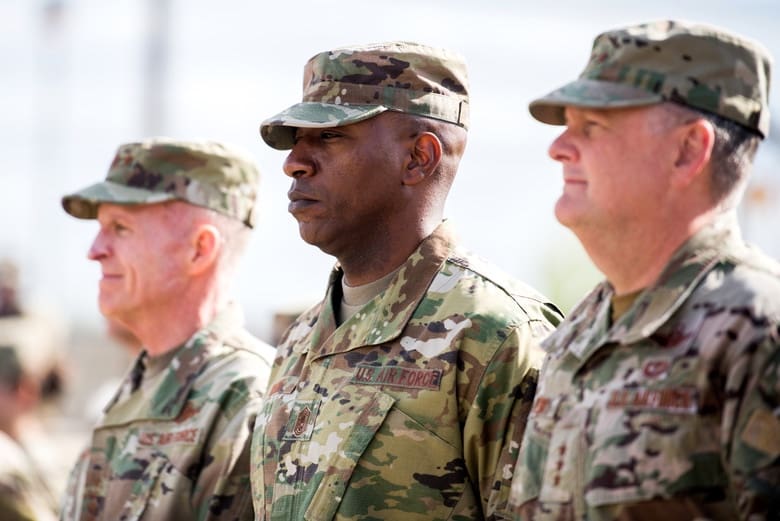
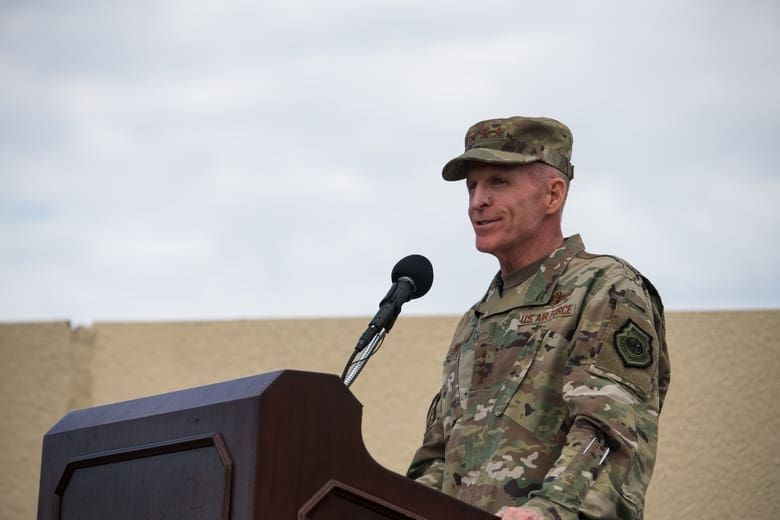
JOINT BASE SAN ANTONIO-LACKLAND, Texas (AFNS) — Trainees entering into Basic Military Training at the 37th Training Wing the first week of October were the first group to be issued the new Operational Camouflage Pattern uniforms.

When Air Force officials announced last year they were adopting the Army OCP as the official utility uniform, they developed a three-year rollout timeline across the force for the entire changeover. Last week put them on target for issue to new recruits entering BMT.

“Each trainee is issued four sets of uniforms with their initial issue,” Bernadette Cline, clothing issue supervisor said. “Trainees who are here in (Airmen Battle Uniforms) will continue to wear them throughout their time here and will be replaced when they get their clothing allowance.”

The 502nd Logistics Readiness Squadron Initial Issue Clothing outfits nearly 33,000 BMT trainees every year and maintains more than 330,000 clothing line items.

“We partner with Defense Logistics Agency who provides the clothing items upfront to be issued,” Donald Cooper, Air Force initial clothing issue chief said. “Then we warehouse and issue to the individuals’ size-specific clothing.”

After taking Airmen feedback into consideration, the uniform board members said they chose the OCP for the improved fit and comfort and so that they will blend in with their soldier counterparts’ uniforms in joint environments, according to Cooper.

“Right now, if someone deploys, they’ll get it issued,” Cline said. “And now that everyone is converting over to this uniform, (the trainees) already have the uniform to work and deploy in.”

Following the timeline, the OCP should now be available online for purchase as well.

The next mandatory change listed on the timeline, to take place by June 1, 2020, will be for Airmen’s boots, socks and T-shirts to be coyote brown. Also, officer ranks to the spice brown.

Switching from two different types of utility uniforms to just one, multifunctional uniform could also simplify life for the Airmen.

“I think the biggest value is going to be the thought that they aren’t required to have two uniforms anymore once they convert to a uniform that is for deployment and day-to-day work,’” Cooper said.

For more information on uniform guidance, visit www.afpc.af.mil/Career-Management/Dress-and-Appearance.

Story by Lemitchel King, 502nd Air Base Wing Public Affairs

Photo by Capt Monique Roux

SCUBAPRO Sunday – US Navy Birthday

Sunday, October 13th, 2019

On 13, OCTOBER 1775 the Second Continental Congress passed a resolution creating official establishment the Continental Navy. They voted to outfit two sailing vessels, armed with ten carriage guns, as well as swivel guns, and manned by crews of eighty, and to send them out on a cruise for three months to intercept transports carrying munitions and stores meant for the British army in America. Throughout the War of Independence, the Continental Navy sent to sea more than fifty armed vessels. The Navy’s squadrons and cruisers seized enemy supplies and carried correspondence and diplomats to Europe, returning with needed munitions. They took nearly 200 British vessels as prizes, and some of the British Isles themselves, contributing to the demoralization of the enemy and forcing the British to divert warships to protect convoys and thier  trade routes. But with the end of the American Revolutionary War, the Continental Navy was disbanded. Then with threats to American merchant shipping by Barbary pirates from four North African States, in the Mediterranean, President George Washington signed the Naval Act of 1794 the act authorizing the construction of the Navy’sNavy’s first six frigates ? Congress passed a resolution to establish a national navy that could protect U.S. commercial vessels from attacks by Barbary pirates in the Mediterranean and nearby Atlantic waters.