TYR Tactical

Archive for the ‘Guest Post’ Category

Hegseth Calls for Anti-Drone Task Force

Tuesday, September 2nd, 2025

WASHINGTON — Defense Secretary Pete Hegseth announced Thursday, Aug. 28, 2025, that he has directed Army Secretary Daniel P. Driscoll to formally establish a joint, interagency task force to counter hostile unmanned aerial systems, commonly referred to as drones.

Secretary of Defense Pete Hegseth speaks on the establishment of Joint Interagency Task Force 401 at the Pentagon, Washington, D.C., Aug. 28, 2025.

“Our job here at the Pentagon — when you think about it — is to prepare for the threats of the future and build a force to match them, and defeat them, and outpace them,” Hegseth said via a video message released to the public.

“And there’s no doubt that the threats we face today from hostile drones grow by the day,” he added.

Noting that hostile UASs are being operated overseas and at our borders while seeking to harm U.S. warfighters, bases and even the sovereignty of the national airspace, Hegseth said the new task force — Joint Interagency Task Force 401 — will be a unified team that will seek to bring together the best talent from multiple government agencies to counter UAS threats and restore control of the skies.

“It’s called counter-UAS — counter-unmanned aerial systems — and America will be the best at it,” Hegseth said.

Although the secretary did not comment on the estimated length of time before the task force will be operational, he did say the Pentagon is currently moving quickly to cut through bureaucracy and consolidate resources, so as to empower it with “the utmost authority to outpace our adversaries.”

He added that DOD is working to deliver real solutions and ensure American airspace remains secure at home, abroad and anywhere troops are stationed.

“They deserve to be defended by the best,” Hegseth said.

He added that the new task force will put the right tools in the hands of warfighters so they can defend the sovereignty of American airspace and “send a clear message” that the United States will “never be outmatched.”

“Because, make no mistake, under this administration — and President [Donald J.] Trump’s leadership — we’re going to out-innovate, we’re going to lead and we will win,” Hegseth concluded.

SD Memo: Establishment of Joint Interagency Task Force 401

By Matthew Olay, DOD News

Raptor Tactical Warns of Fraudulent Sales

Monday, September 1st, 2025

Dear valued customers,

It has been brought to our attention that there has been an influx of fraudulent sales that is negatively affecting our customers. The bulk of these fraudulent sales have been tracked to eBay accounts and other resale websites claiming to have our products in new condition at a significantly reduced price. We all love a good deal, but if it looks too good to be true, IT IS! Do not fall for these scams, your products will never arrive.

If you are interested in purchasing our products, please consider purchasing directly from our website and show room, or one of our reputable distributors and local surplus stores. Thank you for your attention to this matter!

Very respectfully,

Raptor Tactical Team

MATBOCK Monday: 60mm & 81mm Mortar Training with the MWAD

Monday, September 1st, 2025

Over the last few months we have been out with various units conducting mortar training using the digital indirect fire sight called the Multi-weapon Aiming Device (MWAD).

Software Integration with ATAK & NettWarrior:

The MWAD utilizes the current NettWarrior Tactical Scalable Mobile (TSM) adhoc network and NettWarrior DAPS Gen2 Navigation set for secured communication and PNT (Position Navigation and timing).

Another cool feature is the Dismounted Assured, Positioning, Navigation, and Timing System (DAPS) gen2 utilizes Bluetooth Low Energy (BLE) which would allow the MWAD to connect to the only GPS in the world that uses the new M-code (military code). Currently, gun lines use the DAGR, which is an easily jammed p/y code.

The MWAD can already function on the NettWarrior ensemble and is ready for the DoD’s next generation of M-code satellite vehicles.

60mm with DAPs:

81mm Training:

To schedule your demo, please reach out to the MATBOCK sales team at sales@matbock.com

Air Advisor’s Expertise Solves 2-year Aircraft Mystery, Belizean Counter-Narcotics Mission Soars

Monday, September 1st, 2025

TRAVIS AIR FORCE BASE, Calif. —  

An already multi-faceted training mission turned into a critical problem-solving opportunity for 571st Mobility Support Advisory Squadron (MSAS) mobile training team (MTT) who recently deployed to Belize.

More than that, it became a showcase for the exceptional technical skills and dedication of one air advisor on the team: Tech. Sgt. Miguel Capote.

”Tech. Sgt. Capote consistently demonstrates exceptional work ethic and character. His unwavering dedication and technical proficiency, honed from years as a crew chief, make him an invaluable asset to the team.”

Tech. Sgt. Roberto Barraza, 571st MSAS air advisor and Belize MTT team leader

During their May deployment, the 14-member MTT was working with the Belize Defence Force (BDF) when a vital piece of their counter-narcotics arsenal – a Cessna C-208 Caravan aircraft – suffered a debilitating malfunction. But the root cause of the malfunction was far deeper than anyone initially suspected.

While flying home, Belizean pilots discovered that their C-208, valued at $8M, had lost both its autopilot and navigation functions. This forced them to manually pilot the aircraft from the Gulf of America back to Belize, raising serious concerns about future operational capabilities. What they didn’t know was that this was the culmination of a two-year-long struggle.

“The loss of autopilot and navigation was a significant issue,” Capote explained. “It severely hampered their ability to conduct effective counter-narcotics patrols, especially in challenging weather conditions. More importantly, this was a recurring problem that had plagued the aircraft since its arrival in Belize in February 2023.”

The C-208 Caravan aircraft is a crucial asset for the BDF, known for its rugged utility and adaptability in a variety of missions. According to Textron Aviation, the C-208 manufacturer, the aircraft’s powerful turboprop engine delivers high performance and low operating costs. However, without a functioning navigation system, its effectiveness was significantly compromised, leaving the country vulnerable to Trans-National Criminal Organizations (TCOs).

The initial assessment pointed to a potential manufacturer repair order, which would have required shipping the aircraft to the United States – a costly and time-consuming process. That’s when Capote’s specialized training and tenacious dedication proved invaluable.

U.S. Air Force Airmen from the 571st Mobility Support Advisory Squadron, guide Belize Defence Force members on installing an air deflector toa C-208 Grand Caravan during a training mission in Ladyville, Belize, May 26, 2025. The training aimed to enhance the BDF’s ability to conduct aerial resupply operations. (U.S. Air Force photo by Tech. Sgt. Levi Reynolds)

“I guided the Belizean maintenance team through troubleshooting an intermittent Attitude and Heading Reference System (AHRS) issue,” Capote said. “My deep dive into manufacturer wiring diagrams and service bulletins led me to discover that key system components were improperly grounded.”

Capote’s investigation revealed that these ungrounded components were causing significant signal noise within the aircraft’s wiring harness. This increased noise interfered with both AHRS systems, rendering the C-208 as “Non-Mission Capable” and unable to respond to the increasing number of TCO narcotic flights into the country.

Instead of resorting to a costly and lengthy repair in the U.S., Capote worked tirelessly alongside the BDF technicians.

“The only way to resolve the problem without disrupting the mission was to come in early and study the wiring diagrams,” Capote emphasized. “Our joint effort finally solved a two-year navigation problem, so they can now fly in any weather condition without risking autopilot or navigation failures.”

The repair took approximately six hours to complete.

By restoring the C-208 to operational status, the team ensured the continuation of Belizean aerial interdiction efforts, directly contributing to the fight against narcotics trafficking that threatens the United States. This is particularly crucial given the unopposed operations of TCOs in Belize.

Tech. Sgt. Miguel Capote, 571st Mobility Support Advisory Squadron air advisor, poses for a photo at Travis Air Force Base, California, May 7, 2025. During his Belize deployment in May, Capote fixed a vital piece of the Belize Defence Force counter-narcotics arsenal, a Cessna C-208 Caravan aircraft, which suffered a debilitating malfunction to its autopilot and navigational systems. (U.S. Air Force photo by Staff Sgt. Scott Warner)

Beyond the immediate repair, Capote’s approach focused on building partner capacity. By teaching BDF technicians to diagnose and resolve the issue themselves, the 571st MSAS team fostered self-sufficiency and saved the BDF more than $100,000 in potential repair costs and prevented further unnecessary part replacements.

“Capote’s problem-solving was impressive,” added Tech. Sgt. Roberto Barraza, 571st MSAS air advisor and Belize MTT team leader. “He proactively delved into the C-208 manuals, providing crucial advice to address a persistent issue. His dedication and experience provided a solution that saved the Belize Defence Force a significant amount of money.”

Barraza continued, “Capote consistently demonstrates exceptional work ethic and character. His unwavering dedication and technical proficiency, honed from years as a crew chief, make him an invaluable asset to the team.”

This rapid and cost-effective support in the Western Hemisphere underscores the U.S. commitment to a free and open international order and complements global efforts to deter aggression. The 571st MSAS continues to build partnerships, enhancing the capabilities of allied nations for a more secure and stable world.

By SSgt Scott Warner

621st Contingency Response Wing Public Affairs

Second Harding Project Workshop Establishes Way Ahead for Broadening Opportunity Program

Sunday, August 31st, 2025

FORT LEAVENWORTH, Kan. — The Harding Project is consolidating gains after generating multiple wins over the last eighteen months to strengthen the Army profession by reinvigorating professional writing.

Fifteen Harding Fellows and civilian editors from the branch journals joined the project’s directors and Army University Press staff for the second Harding Project workshop from Aug. 18-20, 2025, at Fort Leavenworth.

Four of the fellows are the first to experience the new three-year broadening opportunity program, or BOP.

The expanded Harding Project BOP involves earning a Master of Science in Journalism and Mass Communications at the University of Kansas before returning to their assigned center of excellence to serve as the editor-in-chief of that journal.

Army University Press, which is responsible for the management of the Harding Project, coordinated and hosted the event.

Attendees heard from Maj. Kyle Atwell, Harding Project director, on the rapid progress made since the summer of 2024 and discussed the way ahead.

Working groups addressed items like the growing use of artificial intelligence in professional writing, marketing the journals and program, acquiring high-quality articles relevant to today’s Army and technical training for publishing.

Throughout the three days, Col. Andrew Steadman, Army University Press director, emphasized the various leadership roles the fellows must fill to ensure success of both their respective journal and the Harding Project at-large.

“What you all are in this program are enablers. This whole project is about telling people across the force that the ideas they have about leadership, artificial intelligence and future warfare have the potential to impact others,” he said. “Right now, there is someone sitting at Fort Bragg that has a solution to a problem that someone in Korea has. How do we connect those two?”

Atwell elaborated on the importance of the Harding Project and its impact on the joint force.

“I truly believe in the mission. We are in an interwar period. Interwar periods are an opportunity to learn lessons, that during [a conflict], we are going to have to learn through American blood. This is our chance to capture those lessons, to learn and to innovate,” he said.

A milestone for the Harding Project was the launch of the Line of Departure website, which provides a centralized, web and mobile-friendly access point for all Army professional journals.

The website, along with the Harding Project Substack, continues to see a growth in readership while the branch journals have seen significant increases in writing submissions.

Col. Ethan Diven, the Army University provost, emphasized the support the fellows have. He also explained the importance of exploring topics and challenges to develop how the Army and workforce develops. “The chief has charged us to transform the way we think, we fight, we deliver professional military education. Part of that is through communication,” he said.

The virtual keynote speaker, retired Lt. Gen. James Dubik, stressed the importance of continuing to encourage others to write, highlighting that senior leaders need the perspectives of junior leaders.

“Our profession is an intergenerational profession. We learn from each other,” Dubik said.

The changing character of war is impacting every facet of the Army and there is no limit to the topics Soldiers can write about, Dubik explained, to include implications for the professions and all the technology associated with the fourth industrial revolution.

“There are huge changes that are at play and only those who are in the field with their fingers on the pulse of these changes can write about this, and talk about this, and express this,” he said.

If you are a member of the armor, field artillery, medical, signal/cyber, protection or aviation branch and are interested in applying for the program, visit the Line of Departure website. The window for applicants for the Harding Fellows 2026 Cohort is open through Friday, Aug. 29, 2025.

By Jessica Brushwood, Army University Public Affairs Office

Army Awards Three OTA Agreements for UxS Autonomy

Saturday, August 30th, 2025

Today*, the U.S. Army awarded three Unmanned Systems (UxS) Autonomy agreements to Forterra (Clarksburg, Md.), Overland AI, Inc. (Seattle, Wa.) and Scout AI, Inc. (Sunnyvale, Ca.) to rapidly integrate and deliver commercial autonomous mobility into Army formations. The total award value for all agreements is approximately $15.5 million.

Under these agreements, each awardee will integrate their commercial autonomy solutions onto existing Army Infantry Support Vehicles (ISVs) and deliver prototypes to Army Soldiers for demonstration and evaluation in May 2026.

“We are looking forward to seeing how our industry partner’s autonomy solutions perform on vehicles while performing relevant military missions,” said Col. Ken Bernier, project manager, Future Battle Platforms “We remain committed to bringing the best technologies to our warfighters and shaping the future of autonomous mobility for our Army at an unprecedented speed.”

These demonstrations and evaluations will inform future Army decisions on the applicability of autonomous and unmanned systems across the force and could have the potential to directly transfer successful capabilities to a variety of other ground vehicle platforms.

“This effort will serve as an opportunity for the Army to assess the reliability of commercial autonomy and their ability to deliver real operational value to Soldiers in the field,” said Bernier.

By Ashley John

* published on 27 August.

Paratroopers Make History With Army’s First Drone-on-Drone Strike

Saturday, August 30th, 2025

For Army 1st Lt. Francesco La Torre, the Army’s first drone-on-drone strike wasn’t exactly a Hollywood moment.

“In [the Star Wars movie], ‘A New Hope,’ Luke Skywalker flies an X-Wing through the Death Star trench and blows it up,” La Torre said. “This wasn’t like that. It was way harder. Honestly, it felt more like Darth Vader shooting down rebel pilots. He might be the villain, but he’s also one of the best pilots in the galaxy.” 

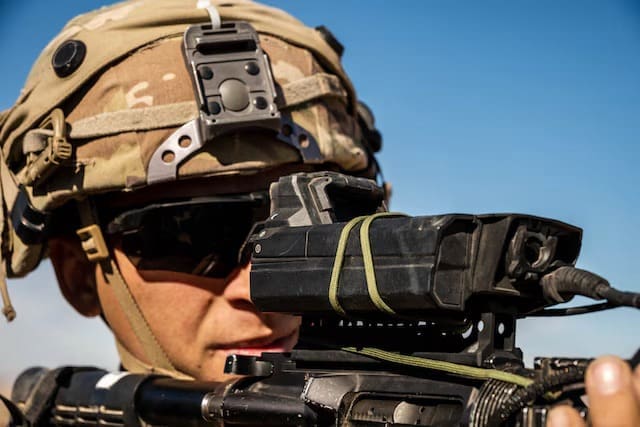
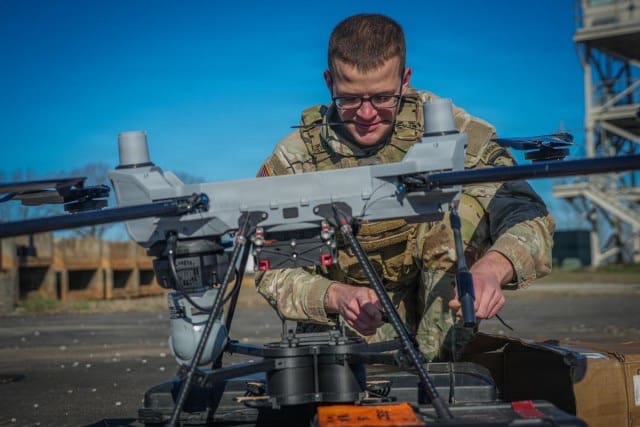
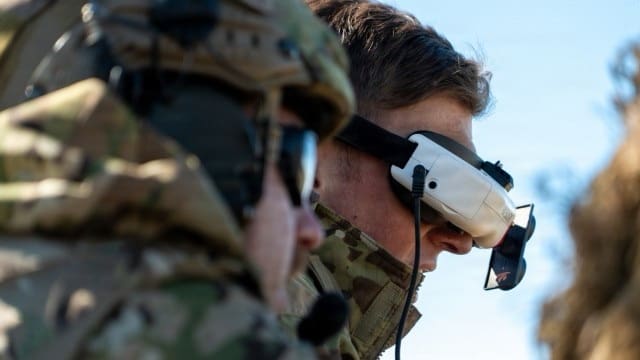
That was the image in La Torre’s mind as his team with the 173rd Airborne Brigade achieved a milestone once unimaginable for conventional Army units: destroying an aircraft in flight using a first-person-view drone carrying an explosive charge.

The strike took place earlier this month during the Army’s Unmanned Aerial Systems and Launched Effects Summit, held Aug. 11-15 at Fort Rucker, Alabama. The live-fire event was led by the brigade’s bayonet innovation team in partnership with the Pennsylvania Army National Guard and engineers from Army Combat Capabilities Development Command.

“When I heard [Army] Chief [Warrant Officer 2] Nate Shea say, ‘Arming,’ when he was lined up behind the fixed wing threat UAS, I knew he’d take it down,” La Torre said. “A few seconds later he detonated the claymore [mine], and I looked up from my end-user device to see the fixed-wing [aircraft] drop out of the sky.” 

The success came after weeks of training. Paratroopers flew for hours each day, building muscle memory while rehearsing how to engage a fast-moving aircraft. Army Chief Warrant Officer 2 Andrew Topits familiarized himself with the fixed-wing platform a month in advance, while Shea practiced with inactive claymores. Once on the ground at Fort Rucker, the operators flew daily in changing weather, preparing for a target that could appear anywhere across the range.

Technical skill proved as important as piloting.

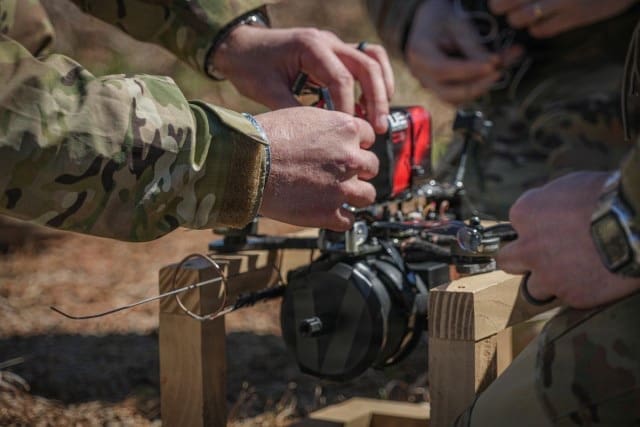
“The ability to train and solve problems immediately afterwards was critical to mission success,” La Torre said. “The team was soldering, disassembling, reassembling and performing [quality assurance] around the clock while rehearsals were underway. While tactical units and technicians may not share the same language, they do share an intellectual curiosity and desire to succeed.”

La Torre emphasized what it means for the average paratrooper.

“With the right kit, paratroopers will be able to utilize a low-cost system with preexisting munitions to execute a wide variety of mission tasks — and have the power to protect their unit from an endemic threat,” he said.

The drone demonstration showed that innovation doesn’t have to come from the top.

“It feels extremely satisfying to have this level of impact, but solving these kinds of problems should not be alien to junior officers, or any leader,” La Torre said. “Every year the Army produces leaders at all levels who are better educated now than ever before. At the end of the day, rank is immaterial when it comes to problem-solving.”

For La Torre, the milestone reflects how far the 173rd Airborne Brigade has come.

“At this time last year, this kind of training was a pipe dream for conventional units,” he said. “For the engagement itself, Chief Shea did an incredible job and so did Chief Topits. It’s such a difficult mission profile for both aircraft.”

Lessons from the bayonet innovation team fed directly into Fort Rucker’s new lethal UAS course, directed by Army Capt. Rachel Martin and Army Maj. Wolf Amacker. The course consolidates milestones within the Army’s UAS community and serves as a hub for education and experimentation.

“The more testing and experimentation we do, the less we must teach theoretically and the more we can back claims with real data,” La Torre said. “Safe and effective experimentation allows commanders to understand the true nature of the risks they assume with these systems and helps make this training more commonplace.”

For La Torre, the boundaries are clear: safety and scalability.

“We must safely conduct training, testing and experimentation,” he said. “We also must make sure everything we do is exportable to other units so they can do the same. I’m confident what we’ve done is scalable, and the lethal UAS course at Fort Rucker will centralize the growth of lethal UAS engagements while also serving as a hub for subject matter experts to gather and exchange lessons learned.”

By Army CPT Jennifer French, 173rd Airborne Brigade

EW 25.2: AFSOC Heightens Warfighting Readiness During Landmark DLE Series

Saturday, August 30th, 2025

HURLBURT FIELD, Fla. —  

Air Force Special Operations Command tested its warfighting readiness during Emerald Warrior 25.2, the command’s premier operational exercise held across Arizona and California from July 21 – Aug. 11, 2025.

EW 25.2 was part of the first-in-a-generation Department Level Exercise series, incorporating more than 12,000 personnel and integrating various forces into joint, coalition, and multinational training. The DLE series advanced the way operations were achieved in a contested, dynamic environment to build capabilities and make a stronger, more lethal deterrent force.

“Emerald Warrior’s integration into the DLE series reinforced our critical role in preparing our forces for the scope and intensity of future operations,” said Lt. Gen. Michael Conley, AFSOC commander. “This iteration provided the opportunity to test our capabilities within a larger strategic context. The training we completed during those three weeks demonstrated the exceptional full-spectrum readiness of our Air Commandos.”

Emerald Warrior provides the venue for realistic joint, combined special operations training to prepare U.S. Special Operations Command forces, conventional enablers, partner forces, and interagency elements to respond to various threats across the spectrum of conflict.

The exercise incorporated multi-domain training designed to give Air Commandos the opportunity to find innovative solutions to tactical problems and experiment with emerging capabilities.

“Our goal is to match the speed and scale of large, real-world operations where command and the areas of operation are distributed,” said Conley. “Creating these dilemmas is how our teams can best learn to adapt so they can excel in future combat environments and help set conditions for the joint force to win.”

Air Commandos completed a wide range of training scenarios that validated their ability to integrate aviation, special tactics, medical and mission sustainment functions. A key objective was executing Agile Combat Employment (ACE) to demonstrate a flexible aerial advantage.

“ACE has become a requisite ability to our operations and readiness,” said Brig. Gen. Clay Freeman, AFSOC director of operations. “We must be prepared to deploy rapidly and operate from austere environments with potentially limited resources. A contested venue does not change the need to generate airpower at any place, any time, anywhere.”

International collaboration was a key element of EW 25.2. The integration of partners in the Royal Air Force was highlighted by the RAF A400M Atlas facilitating transport and military free fall training for Special Tactics teams. Additionally, Czech Republic Special Operations Forces worked alongside special operations medical elements and surgical teams, honing collaborative abilities in humanitarian and disaster relief scenarios.

“Emerald Warrior strengthens our international relationships and interoperability”, said Freeman. “AFSOC is committed to fostering combined training opportunities with partners where we integrate our diverse skillsets and build shared capabilities to strengthen our collective security. For this iteration, we were grateful to grow our collective readiness with our RAF and Czech Republic partners.”

Along with international allies, Air Commandos trained with units from the U.S. Space Force, U.S. Marine Corps, and U.S. Army, among other interagency partners. This collaboration strengthened AFSOC’s capacity to deliver decisive effects in alignment with future force employment requirements.

EW 25.2 solidified AFSOC’s warfighting functions and underscored its commitment to adapting to succeed in today’s dynamic strategic environment.

Air Force Special Operations Command