FirstSpear

Archive for the ‘Guest Post’ Category

Army Developing Expeditionary Cyber-Electromagnetic Teams to Support Tactical Commanders

Sunday, February 11th, 2018

FORT IRWIN, Calif. — U.S. Army Cyber Command is deploying Expeditionary Cyber-Electromagnetic Activities Teams to support tactical commanders at National Training Center rotations, and the CEMA operations have tried to replicate real-world operations support through the cyberspace domain.
0D94302C-6AB7-468F-95D5-B0E17FDBB55D
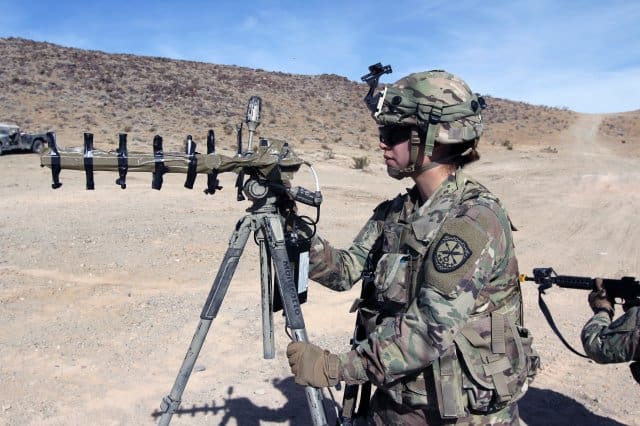
Sgt. Camille Coffey, a cyber operations specialist from the Expeditionary Cyber Support Detachment, 782nd Military Intelligence Battalion (Cyber), from Fort Gordon, Ga., provided offensive cyber operations as part of the Cyber-Electromagnetic Activities (CEMA) Support to Corps and Below (CSCB) program during the 1st Stryker Brigade Combat Team, 4th Infantry Division, National Training Center Rotation 18-03, Jan. 18 – 24, 2018. (Photo Credit: U.S. Army photo by Mr. Steven P Stover (INSCOM))

CEMA is an Army initiative designed to provide tactical commanders with integrated cyberspace operations, Department of Defense Information Network operations, Electronic Attack, Electronic Protection, Electronic Warfare Support, Spectrum Management Operations, Intelligence, and Information Operations support/effects.

According to Maj. Wayne Sanders, the ARCYBER CEMA Support to Corps and Below chief, success for the brigade combat team in the cyberspace domain begins at the D-180 planning conference — 180 days before the unit’s NTC rotation.
B0449699-F59A-4044-87CF-D93A5C2A2CE6
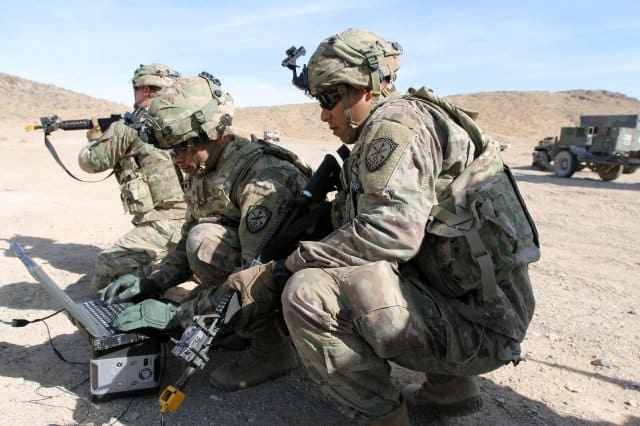
Spc. Victorious Fuqua (at the computer), and Staff Sgt. Isaias Laureano, both cyber operations specialists from the Expeditionary Cyber Support Detachment, 782nd Military Intelligence Battalion (Cyber), from Fort Gordon, Ga., provided offensive cyber operations, while Spc. Mark Osterholt pulled security, during the 1st Stryker Brigade Combat Team, 4th Infantry Division, National Training Center Rotation 18-03, Jan. 18 – 24, 2018. (Photo Credit: U.S. Army photo by Mr. Steven P Stover (INSCOM))

“The biggest thing for the D-180 are the key leader engagements,” said Sanders. “[At those conferences] we can inform the brigade commander about what types of CEMA support we can provide to help him shape conditions for his battle to be able to close with and destroy the enemy.”

Sanders said while he doesn’t foresee BCTs executing their own cyberspace operations organically, he does expect the commander and the staff to have an initial understanding of the CEMA environment and to provide their higher headquarters with a cyber effects request form. He said that if the brigade plans for an expeditionary CEMA capability to be brought out to support their operations correctly “then we can provide that for them.”

“If you’re looking at this from a real-world perspective, if they identify that they are going somewhere in the world — somewhere they would need additional capacity that they may not have coverage for — they can submit that through a CERF, as a request for forces,” said Sanders. “And the beauty of the Expeditionary CEMA Teams is their scalability and reach back.”
692DF15D-8624-440C-A2DA-52A603584BC5
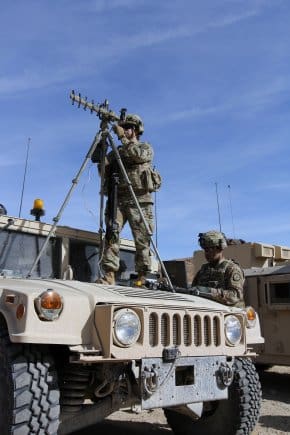
Sgt. Camille Coffey (at the antenna), and Spc. Victorious Fuqua, both cyber operations specialists from the Expeditionary Cyber Support Detachment, 782nd Military Intelligence Battalion (Cyber), from Fort Gordon, Ga., provided offensive cyber operations as part of the Cyber-Electromagnetic Activities (CEMA) Support to Corps and Below (CSCB) program during the 1st Stryker Brigade Combat Team, 4th Infantry Division, National Training Center Rotation 18-03, Jan. 18 – 24, 2018. (Photo Credit: U.S. Army photo by Mr. Steven P Stover (INSCOM))

Sanders explained the ECT concept originated from the Chief of Staff of the Army, who directed the Cyber Support to Corps and Below Pilot in 2015. The pilot tasked ARCYBER to assess the best package of equipment, capability, authorities and personnel to support a BCT.

“That’s why, out of the DOTMLPF-P (Doctrine, Organization, Training, Materiel, Leadership and Education, Personnel, Facilities and Policy) came the need for a force that provides the authorities, the senior and master level expeditionary cyber operators, and a quick turn cyber development capability, that doesn’t exist right now in the Army,” said Sanders. “It provides infrastructure support personnel that can provide the same thing as having people on the ground.”

Sgt. Maj. Jesse Potter, the operations sergeant major for the 780th Military Intelligence Brigade (Cyber), said that although this is the ninth rotation since 2015, it has been an iterative process to best replicate real-world operations, and more is being learned each time a rotation is conducted.

“We’ve learned that we were a very large logistical burden to the rotational training units. We learned our lessons about the CEMA capability that we can provide to a rotational training unit, and at the same time we were reducing the logistical requirement to provide that capability,” said Potter.

“Eventually, we concluded that an expeditionary mindset, based on the commander’s request for cyber effects, is best fitted with a plug and play capability,” he continued. “Meaning, we need to identify the personnel that fit those requirements, ensure the teams are self-sufficient with a reach back capability to reduce the logistical footprint, in both a flyaway kit, light capability, to a more robust sustained operation, whether in a peer or near-peer environment, permissive or non-permissive environment.”

Potter also said another area ARCYBER is looking at was CEMA support at the division and corps levels. “What’s missing, what’s next, are the division and corps level exercises,” he said. “Enabling the education of the commanders [is] through the institutional arm of the Army, which is primarily the mission of the Cyber Center of Excellence. That is what the CCoE is working toward –incorporating CEMA into all aspects of the PME (Professional Military Education).”

“And then for the higher level exercises, just like we’ve done for the NTC rotations, how does the staff enable cyber based effects that supports the commander’s objectives, and what can they gain from having the cyberspace capability that they currently don’t have?” Potter continued. “Because at the same time, that education will benefit the brigade combat teams.”

Furthermore, ARCYBER is not just looking at the development of the ECT structure and incorporating that support at the division and corps levels — the command is also determining the organizational structure to command and control those ECTs.

“Regarding the ECT structure…you have individuals, put together as a team, predominantly from four separate organizations across three MACOMs (Major Commands) — ARCYBER, Intelligence and Security Command, and the Cyber Center of Excellence,” said Potter. “Moving to an organizational structure whereby the ECTs are part of a larger unit as the force structure solution means we no longer have an organization that’s made up of a hodgepodge of people, further exasperating the issues that we have with the rotational training unit.”

Potter and Sanders said that’s where they are now. Organic ECTs, all assigned to the same unit, and subordinate to ARCYBER will provide the Army with an expeditionary CEMA capability.

ARCYBER used the lessons learned from the past nine NTC rotations to determine the optimized force structure they are proposing to the Army to stand up an organization with all those separate elements that were under different commands, to fall under one command with CEMA capabilities tailored to meet the tactical commander’s objectives.

By Mr. Steven P Stover (INSCOM)
Greyhive Snapshot – Ian Strimbeck

Saturday, February 10th, 2018

It’s Called a GunFIGHT for a Reason

We all have that one friend, or have encountered that one individual, who lacks the intellectual capacity to understand that pressing the trigger is just one tiny aspect of owning a gun. When it comes to handguns, how often do most of us drive the gun out to extension every time we go to the range? How many of us think about how often we’re in close quarters with multiple individuals on a day to day basis? The length of extension of our pistol correlates directly to the proximity of the threat we’re dealing with. To solidify the idea in our head that we’ll always have enough distance between our pistol and the threat is not only foolish but reckless as well.

Criminals don’t care about how you train or your range safety protocols. All they care about is completing their mission, whether that be taking your wallet or your life for that matter. Most criminal assaults occur after an ambush and the victim ends up “locking up” in a standing entanglement with the assailant. But the victim can just go for his gun now right? Wrong. That would be a recipe for failure. But why? Can’t I just shove the guy with my off hand and pull my gun out like Wyatt Earp? This is what I commonly see being thought of as a quality method for retention based shooting. Usually it’s because of the misinformation out there from social media entertainers. A rubber dummy or cardboard target doesn’t fight back. It doesn’t give pressure back. It doesn’t have limbs that will attempt to strip your gun away. And it definitely doesn’t have a will to continue the fight after you’ve already given up on yourself.

At the end of the day, think realistically as to how to approach the way you train. Steer clear of attempting to copy uncontextualized methods of entangled handgun employment. Get to a quality class that utilizes pressure based training to truly test the skills. It will be anything but easy, but to truly grow your skillset you must constantly put yourself in places of conflict.

strimbeckIan Strimbeck is a United States Marine Corps veteran and founder of Runenation LLC. Runenation is a consulting and education company specializing in the constant growth of the multidisciplinary tactician. Too often in the “gun world,” you see individuals who are drawn to a singular tool in lieu of looking at the bigger picture. It isn’t solely about the gun, blade, grappling, striking, medical, fitness, or verbal acuity. It’s a constantly evolving skillset that you put a varying amount of effort into throughout your life. Like the rings on a tree trunk , it will grow as long as you put in the necessary effort.

greyhive.com/articles

Snapshot is a bi-weekly series from Greyhive featuring content written by our Experts. It is our goal to deliver information that prompts you to examine your preparedness from all angles, not just how quickly and accurately you shoot.

Marine Corps makes history with mine plow prototype for Assault Breacher Vehicle

Saturday, February 10th, 2018

MARINE CORPS BASE QUANTICO, Va. —

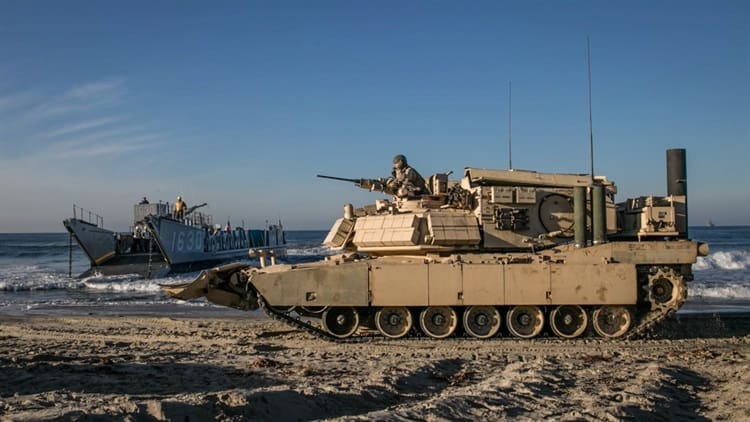
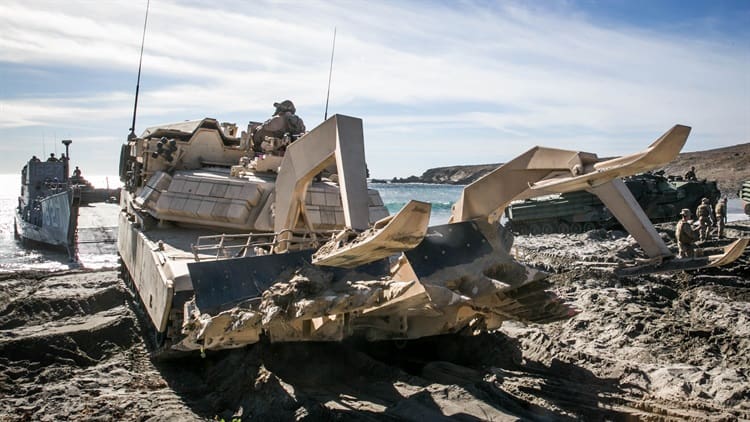
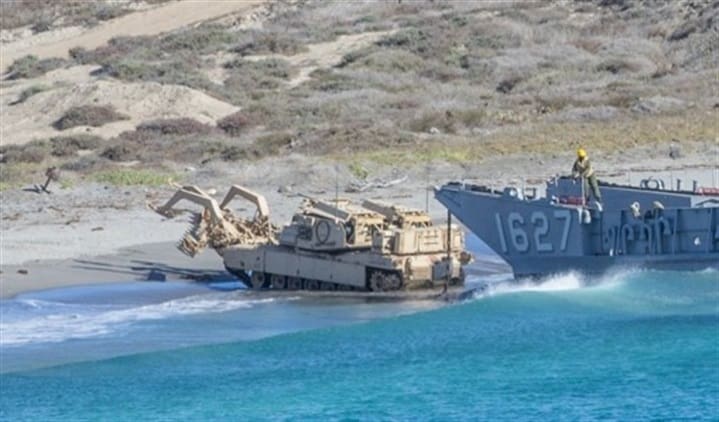
The Marine Corps’ Assault Breacher Vehicle made history last year when it conducted its first amphibious landing with a Modified Full Width Mine Plow prototype during a long-range breaching exercise in the western United States.

171208-M-ZZ999-005
U.S. Marines from 1st Combat Engineer Battalion, 1st Marine Division, prepare to load an Assault Breacher Vehicle onto a Landing Craft Utility at Camp Pendleton, California. All vehicles were loaded onto LCUs then transported to the USS Rushmore to conduct the first amphibious landing in an ABV with a Modified Full Width Mine Plow prototype. Marine Corps Systems Command tested the prototype which will make it easier to transport the ABV from ship to shore. (Courtesy photo)

In December 2017, Marine Corps Systems Command used Exercise Steel Knight as an opportunity to test the Modified Full Width Mine Plow prototype for the first time. Steel Knight is a division-level exercise designed to enhance command and control, and interoperability with the 1st Marine Division, its adjacent units and naval support forces.

In the future, this piece of equipment will make it easier for Marines to land and deploy an ABV from a Navy Landing Craft Utility boat to the shore to complete their mission.

171207-M-OB268-075
U.S. Marines from 1st Combat Engineer Battalion, 1st Marine Division, conduct the first amphibious landing in an Assault Breacher Vehicle with a Modified Full Width Mine Plow prototype during Exercise Steel Knight on the west coast. Marine Corps Systems Command tested the prototype which will make it easier to transport the ABV from ship to shore. (U.S. Marine Corps photo by Lance Cpl. Rhita Daniel)

“Our legacy Full Width Mine Plow on the ABV could not fit onto an LCU because it was too wide,” said Timothy Barrons, ABV project officer for Engineer Systems at Marine Corps Systems Command. “The prototype we are testing fills a current capability gap and gives commanders the flexibility to use multiple surface connectors to get ABVs in the fight.”

The modified plow prototype is not only easier to transport, but safer to use, Barrons said. Once the LCU drops the bow ramp onto land, Marines can drive the ABV off the boat, open the plow and breach the area to ensure they eliminate any unsafe obstacles.

“The Assault Breacher Vehicle is the premiere breaching tool in the Marine Corps, and there is no other tool like it,” said Alvin “Tommy” West, ABV platform engineer. “It can carry two Linear Demolition Charges (commonly referred to as the line charge) on the back with over a thousand pounds of C4 explosives in each of the charge. A rocket is attached to each line charge to propel the charge, which is critical when clearing a path through mine fields.”

171208-M-ZZ999-006
U.S. Marines from 1st Combat Engineer Battalion, 1st Marine Division, conduct the first amphibious landing in an Assault Breacher Vehicle with a Modified Full Width Mine Plow prototype during Exercise Steel Knight on the west coast. Marine Corps Systems Command tested the prototype which will make it easier to transport the ABV from ship to shore. (Courtesy photo)

After the line charge detonates, landmines in its path are destroyed or rendered ineffective. Marines use the mine plow to sift through the mine field and push any remaining landmines off to the side, leaving a safe path for the assault force.

“This plow prototype makes the ABV transportable and gives the commander options to accomplish his tasks on the battlefield,” said Barrons. “The capability makes the force more lethal because it helps keep other combat vehicles intact and saves the lives of Marines.”

The ABV Program Team plans to take the information and feedback from Marines gathered at Steel Knight to refine the design and improve the overall performance of the modified plow. The team wants to ensure the modified plow will meet all requirements of the legacy mine plow in performance and survivability. After the redesign is completed, the articles will be tested at the U.S. Army Aberdeen Test Center in Maryland.

“Because the plow is foldable and deals directly with explosives, it is going to take some hits, so we need to ensure it is more reliable than the legacy mine plow which was not hinged or foldable,” said West. “There is no other piece of gear in the Marine Corps that does what the ABV with the Full Width Mine Plow does. Our goal is to make the new plow even more reliable and easier to maintain.”
The ABV Program is a part of Engineer Systems under the Logistics Combat Element Systems program at Marine Corps Systems Command.

By Kaitlin Kelly, MCSC Office of Public Affairs and Communication | Marine Corps Systems Command

BG Tony Potts Takes Over PEO Soldier

Saturday, January 20th, 2018

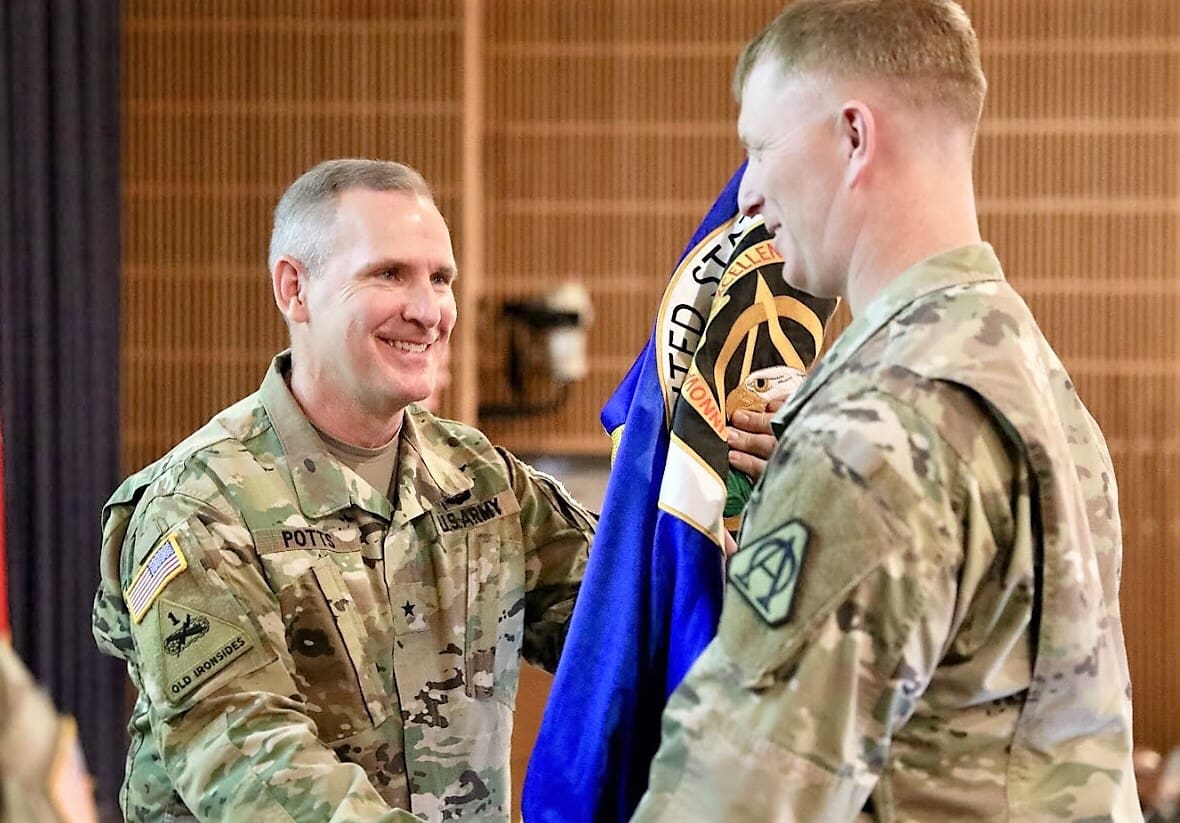
FORT BELVOIR, Virginia (Jan. 17, 2018) – The Program Executive Office Soldier workforce, Army Acquisition community members, and Industry witnessed the Change-of-Charter Ceremony Jan. 16 where responsibility for leading the organization transferred from Brig. Gen. Brian P. Cummings to Brig. Gen. Anthony “Tony” Potts.

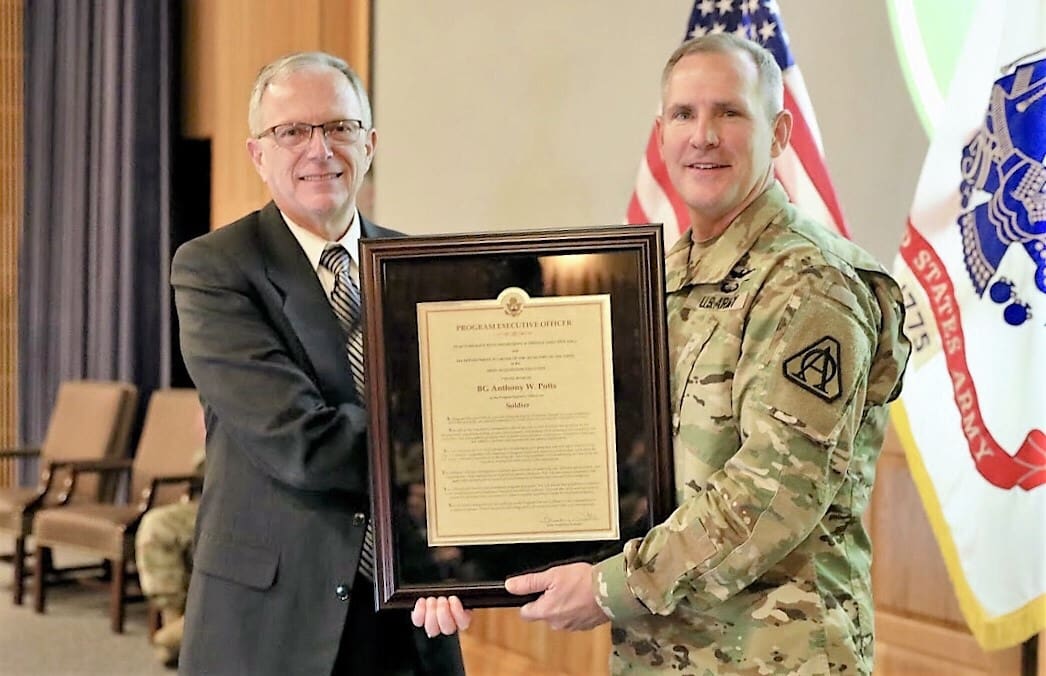
Presiding over the ceremony was The Honorable Bruce Jette, Assistant Secretary of the Army (Acquisition, Logistics and Technology) and Army Acquisition Executive. The ceremony took place at Howell Auditorium at Scott Hall at the Defense Acquisition University, Fort Belvoir. Dr. Jette presented BG Potts with his charter, which documents the appointment and describes his roles and responsibilities as Program Executive Officer.


Brig. Gen. Anthony “Tony” Potts receives his Program Executive Officer Charter from the Honorable Bruce Jette, Army Acquisition Executive. General Potts became PEO Soldier during a Change-of-Charter ceremony Jan. 16. (U.S. Army photo by Ron Lee)

During his remarks, Dr. Jette said PEO Soldier showcases the Army’s focus on Soldiers, citing PEO Soldier’s mission to provide everything a Soldier wears, carries or shoots. “Our Soldiers depend on you,” Dr. Jette said.

In recapping General Cummings’ tenure as PEO Soldier, Dr. Jette said the Army and its Soldiers benefited from many new products that improve their lethality and maneuverability. They include the Soldier Protection System, Female Improved Outer Tactical Vest, Operational Camouflage Pattern, the RA-1 Steerable Parachute, Jungle Combat Boots, Improved Hot Weather Combat Uniform, the XM17 Modular Handgun System, Enhanced Night Vision Goggles, Family of Weapons Sights–Individual, Nett Warrior, and Joint Effects Targeting System.

“Brian Cummings and his team have done an outstanding job,” Dr. Jette said. “Our job is to ensure Soldier readiness today and in the future.”

Additionally, Dr. Jette said General Potts’ PEO Soldier charter tasks him to take the organization to new places and new challenges.

In his remarks, General Potts said to the PEO Soldier workforce to always keep in perspective who we are and what we do. It’s about fielding the best equipment to the best Soldiers in the world, General Potts added.


Brig. Gen. Anthony “Tony” Potts receives the Program Executive Office Soldier flag from Master Sgt. Eric G. Buggeln, Senior Enlisted Advisor, during a Change-of-Charter ceremony Jan. 16. (U.S. Army photo by Ron Lee)

General Potts comes to PEO Soldier from Natick, Massachusetts, where he was the Deputy Commanding General, U.S. Army Research, Development and Engineering Command; and the Senior Commander, Natick Soldier Systems Center. Before Natick, General Potts served as acting Deputy for Acquisition and Systems Management, PEO Missiles and Space; and as Director, Terminal High-Altitude Area Defense and Army/Navy Transportable Radar Surveillance, Sustainment Management Office at Redstone Arsenal, Alabama. He has served as Deputy Director for Acquisition and System Management, Assistant Secretary of the Army for Acquisition, Logistics and Technology (ASA(ALT)); and Director of Resource Integration, (ASA(ALT)), in Washington, D.C. He also served as Project Manager, Aviation Systems, PEO Aviation; Deputy G-3, Aviation & Missile Command; Product Manager, Apache Modernization; Product Manager, Blue Force Tracker–Aviation; and as the Assistant Product Manager for the Army Airborne Command and Control System, at Redstone Arsenal. He also served as Task Force Commander-Balkans Digitization Initiative, the Balkans.

General Cummings leaves PEO Soldier to become the Program Executive Officer for PEO Ground Combat Systems in Warren, Michigan.

By Debi Dawson
Program Executive Office Soldier
Public Affairs Office

US Army To Introduce New Rifle Qualification

Tuesday, January 16th, 2018

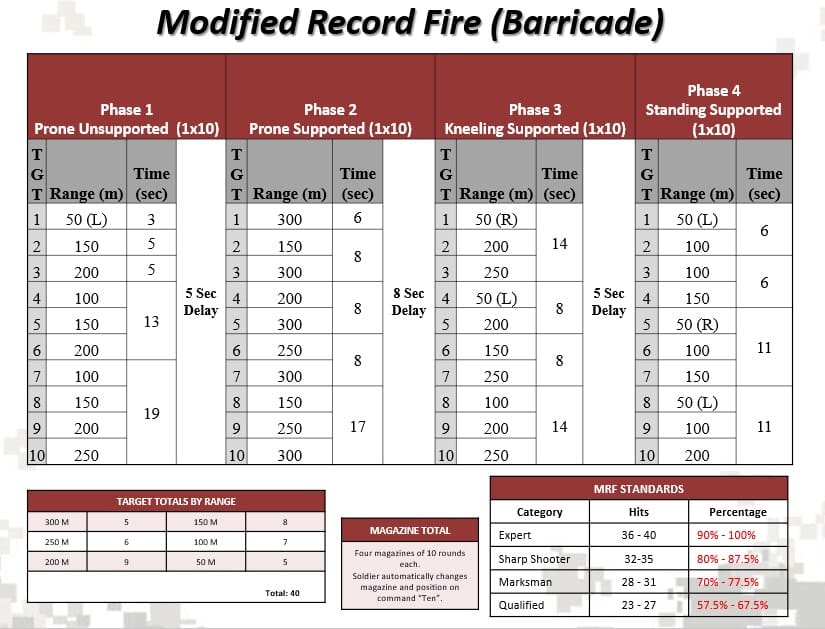
The 82nd Airborne Division Master Gunner posted this information on their Facebook page regarding the US Army’s impending rifle qualification changes. In addition to a completely new course of fire called Table VI, standards have also changed. This is the most significant change to small arms marksmanship in decades. The Army has been building up to this, improving the rifles Soldiers use, introducing new ammunition and publishing new training manuals. Now, the challenge rests with NCOs like the Master Gunner who wrote this piece to prepare their Soldiers for this new standard. If you aren’t following the 82nd Master Gunner Facebook page, you need to.

For Training Tuesday, we will be looking at the changes in qualification standards that were briefed during the Maneuver Warfighter Conference last week, and what we can do to ready our Paratroopers for the change. The reference for this discussion is the 82nd Integrated Weapons Training Strategy LPD Slides.

952E3B3E-504A-442D-A366-6EC3121E2DD3

Table VI (as record fire will now be known) has undergone some significant changes. The final product is slightly different from what you see here, but only in the exposure times. The basic structure remains the same. There are four tables: prone unsupported, prone supported, kneeling supported, and standing supported. Each table has one magazine of ten rounds, with up to four targets presenting at once.

Between each table, there is some time built in for the firers to transition from position and change magazines. If you doubt whether the time is enough, reference the live video we put up last week showing Paratroopers of the 1st Battalion, 508th Parachute Infantry Regiment conducting dry-fire of the table smoothly. However, that time does not begin until the target’s exposure time is complete. Firers have to be on the lookout for more targets and at further distances than they engaged before.

The prone supported has five exposures of the 300-meter target. Paratroopers have to engage them if they want to qualify expert. Paratroopers will have to engage at least 3 of the 200-meter targets to qualify.

Table VI is a non-alibi course of fire. Firers will get one attempt to qualify at marksman or higher. If they have a malfunction, they must perform immediate or remedial action and reduce the malfunction. As in combat, just because your weapon is out of operation does not mean threats will not stop presenting. If they do not achieve the standard of 23 out of 40 the first time around, regardless of what they score the second time, they are ‘qualified.’ That means no badge, no promotion points, and you can try again in four months. Moreover, the standard for Marksman has increased from 23 to 28.

If you do not practice this before coming to the range, you will fail. If our current qualification is analogous to doing the Army Physical Fitness Test, then the new qualification is the Ranger Physical Fitness Test. You can not do PT and fudge your way through the APFT and still pass… You cannot do the same for the RPFT and achieve a passing score.

Units will have to conduct dry-fire before coming to the range. In the Integrated Weapons Training Strategy, units have up to six weeks before the qualification date to pencil in one hour a week to conduct dry-fire training. This is an achievable standard.

Start by leading the Paratroopers through the drills as illustrated in the video we put up last week. Use the Master Gunner Cell Dry-fire calendars for Rifle as a quick reference, and start changing up the presentation of drills. The ‘fight up’ and ‘fight down’ drills start with standing, kneeling, squatting and prone positions. Have Paratroopers practice tactical and emergency magazine changes during all the positions, not just standing. Also, have them practice Immediate Action (‘Tap-Rack-Reassess’) and Remedial Action for time during all the positions.

Once that is starting to be easy, incorporate all the positions in Chapter 6 of the TC 3-22.9. Incorporate the use of loopholes, canted shooting, and time standards. Make them challenging, and leaders need to record that information as well. If you don’t keep track of it, you don’t know how well they’ve done and improved.

These are just a few ideas on how to incorporate dry-fire preparations for qualification into your calendar. Doing this will make your Paratroopers want to actually pick up their weapon, pick up a TC and learn something. And dare I say it, it is fun. If you make it an enjoyable activity, Paratroopers will want to do it more often. There is no excuse for not doing dry-fire. It is only a priority if we make it a priority. Squad and Team leaders need to do as they have always done, and get it done.

The Baldwin Articles – Leadership and Training

Saturday, January 6th, 2018

“As iron sharpens iron, so one man sharpens another.” – Proverbs 27:17

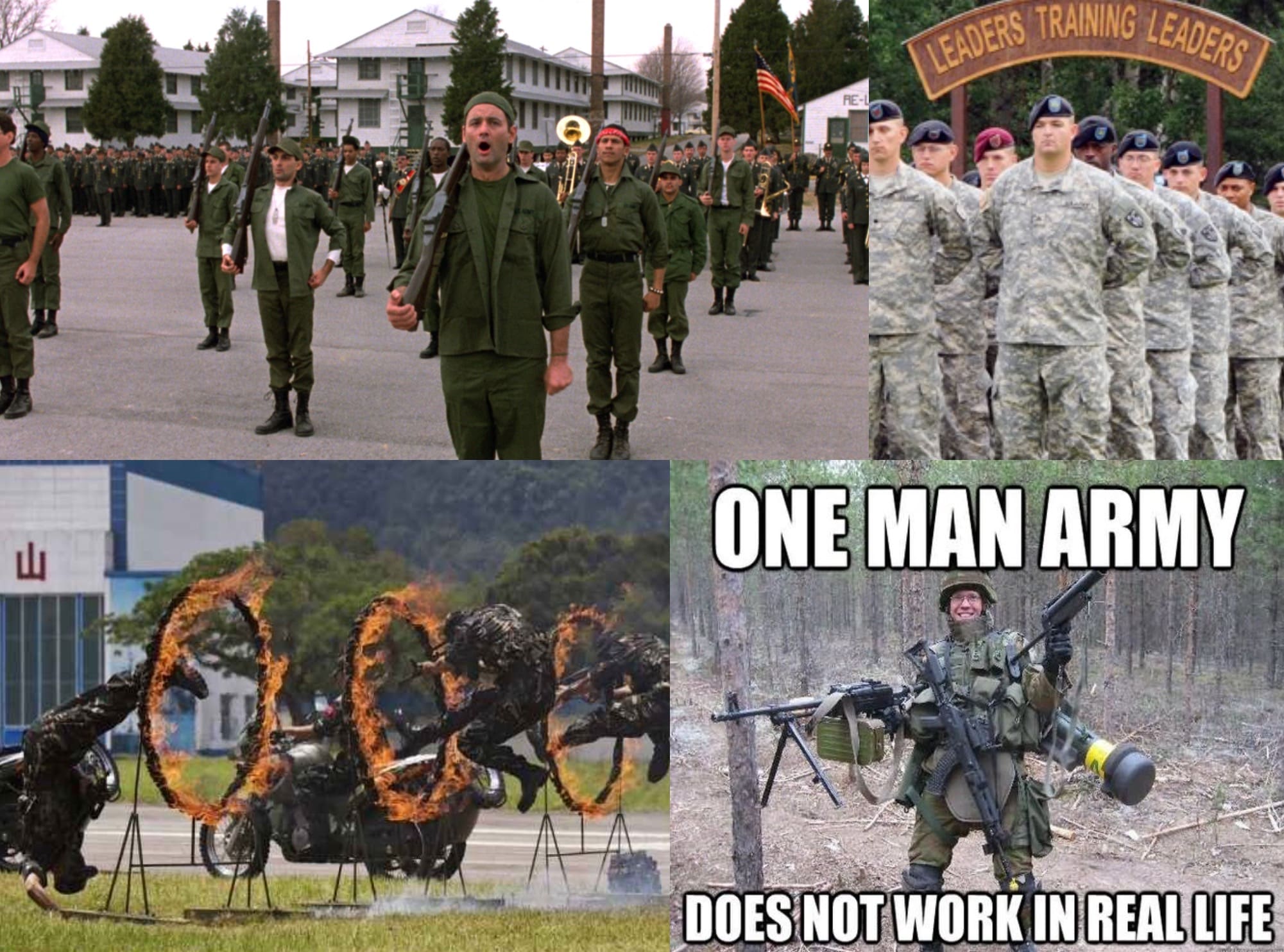
Although the above quotation is not specifically related to military training, it is very appropriate to the subject. Here is another exchange on the topic that many of you will recognize. “What kind of training have you men been doing?” “Army Training, Sir!” If you have seen the classic movie, you also know exactly why we do not let privates train on their own recognizance. As I said last time, planning, managing and conducting good training is a complex art – and in many ways is just as hard to master as war itself. In other words, it is a truly serious business requiring continuous attention and effort. Here are just a few points to ponder and discuss.

IMG_5927

Let us start with the bad news. There have been and always will be training distractions and obstacles. Those routinely include conflicting priorities, constrained resources, and especially limited time. The trick is not to let the distractions sidetrack you – stay focused on the mission. True, it is something easier said than done. Still, good units and effective trainers work around or through those diversions all the time. Unfortunately, it is also true that a good number of leaders simply do not know how to properly organize and drive their training efforts. I especially worry about those squad leaders, platoon sergeants and platoon leaders who do not necessarily know what right looks like when it comes to planning and conducting truly productive training at the tactical level.

Just as you have to fight for intelligence on the battlefield, a unit has to fight to train. Know what you are trying to accomplish before you start. Plan to train but do not get fixated on your plan – be flexible. The training objective is what is important not the process. Many units spend a great deal of time trying to make the training look good and in the process lose sight of their actual training goals. Likewise, others become preoccupied with making the training uber “cool” rather than effective. My advice is to make sure your people are well grounded in the fundamentals before moving to master the high-speed flaming hoops drill (above).

Always train to a pre-established and reasonable standard and not to a time schedule. Training is never finished so do not become obsessed with the outcome of any one event. Do not be afraid of failure. Training exposes our shortcomings – if we are doing it right. Take advantage of the opportunity to figure out why you failed to achieve the intended training objectives. Was it a planning mistake, a resource shortfall or an issue of poor time management? Did the trainers know beforehand how to do the task required properly themselves? Take corrective action and do better next time.

Aggressively prioritize. Some training is always better than no training. A good trainer can get something out of even the most unproductive training evolution. At least the experience can serve as a reminder to build a better plan for future training events as mentioned above. Know who needs or will befit the most from the training. When time or other resources are limited, it is usually much better to train a few to a higher standard then everyone to a sub-par level. Look for non-traditional training opportunities and partners. Old school and new techniques can often coexist and reinforce one another. Do not presume that they are mutually exclusive or that one is automatically better than the other.

We have all probably seen the following counterproductive dynamic on qualification ranges more than once. In units with poor training habits, the intent invariably devolves into just cycling everyone through as fast as possible. The alleged point of the drill, i.e. improving unit marksmanship, turns out to be a pretense and not the true objective. Unfortunately, the longer-term and deeper negative effect can be debilitating to that entire unit. The leadership has revealed to their soldiers that they consider training an onerous chore that is to be competed as quickly as possible. Positive results are optional or even irrelevant. Sadly, that dysfunctional lesson will imprint some soldiers for the rest of their careers. They in turn will invariably infect others. It is an all too familiar cycle – but it can be broken.

Fighting back against bad training habits is hard but not complicated. It starts with leadership. Recognize that all unit training always involves team building AND leader training. Make sure to give your subordinate leaders something important to do in the training plan; and keep them visibly in charge of their soldiers as much as possible. This is especially important for those new sergeants who are leading for the first time and are trying to establish their credibility. In turn, soldiers benefit directly from seeing their leaders treated like valued members of the unit’s leadership team. In short, properly conducted unit training should professionally develop better leaders and concurrently result in stronger teams.

This also helps mitigate the problem of a unit hampered from accomplishing quality training because the leadership is overly distracted with the many other balls they are juggling. First, recognize and take advantage of the fact that every leader is part of a team and does not have to carry the burden alone. Delegate dammit! Moreover, a leader has to learn (and teach subordinates) not just to juggle but also how to judge those balls. Some balls are more important than others; and not all of them are made of glass. In reality, some balls can be set aside for another time or safely dropped. In doing so, we have the opportunity to demonstrate that unit leadership indeed considers quality training a high priority – though action rather than empty platitudes.

As I have mentioned before, there is a great book on training in WWII that I would recommend called “The Making of a Paratrooper” by Kurt Gabel. The author was a trooper going through Airborne training as a unit with the 517th PIR. He describes how the NCOs and junior officers would go off by themselves, learn a skill and – sometimes the very next day – turn around and teach it to the other troops. Not the ideal situation of course, but they made it work. They optimized, as best they could, their available organic assets to maximize limited external resources and extremely constrained time. They successfully met the challenge as an increasingly cohesive team and always took their training seriously. They knew that there was no other option. It also sets a great example to emulate even today.

Remember that even the most realistic training, conducted by the highest-speed units, has logical constraints that require soldiers to suspend disbelief when necessary. One simple example would be blanks or simunitions. If used properly, blanks are not going to kill or maim. Nevertheless, soldiers are expected to react to blank fire drills as if they were life-threatening live rounds. Likewise, when introducing simulated casualties the expectation is that soldiers will act in as close an approximation as possible to how they would respond to a real injury.

Teach your soldiers to value training though your example. It is true that not all training is fun and adventure. For instance, there is a lot of necessary repetition required to master the fundamentals of any individual or collective task. That can become boring. Bad weather can also make even good training more than a little unpleasant. Still, successfully building skills, competence and confidence – even in the worst of circumstances – is always a net positive for the collective esprit of a unit and the morale of individual soldiers.

Most of the veterans on this board could point to countless hours wasted on the tarmac or field site somewhere waiting for transportation. Did anyone in your unit consider trying to use that otherwise dead time to get at least some critical training accomplished? More often than not the answer is no. If someone made the effort, it was probably less than effective because it was not pre-planned but pulled hastily out of their fourth point of contact. Still, to be fair, I would give them at least partial credit for trying. Assuming they do better next time.

Time, money and ammunition are always finite resources. Never waste those precious assets – especially time! Always seek to get maximum effect from the resources you have. Do not waste time lamenting the resources you do not have. As with everything else we have been talking about, I would submit that the wise use of resources always comes down to the quality of leadership at the small unit level. Funny thing is that good leaders, despite the perpetual distractions and constraints, always seem to have enough to build good strong units. Even during periods when resources are much more constrained than has been the case in the last 16-17 years. Poor leaders, on the other hand, always seem to need more time, money or ammo – and still cannot get quality training results.

My final advice on training is that leaders must be willing to take risks. Most soldiers, myself included, like to think that we can always be as physically courageous as required in battle. Perhaps not ready, but willing and able to risk our lives if necessary. From my experiences and observations in various hostile places, I would say that is generally true enough. However, displaying moral courage is arguably much harder. In part, that is because the need for action does not present itself as unambiguously as it does in combat. It sneaks up on a leader over time. It often starts with the insidious – often self-generated – pressure to pencil whip a few training records so the unit looks good or to CYA. After all, training is not life or death and is certainly not important enough to risk damaging a career…or is it?

Now we are clearly talking about dedication to duty more than we are training. You have to ask yourself a question. How much do I really value training and how hard am I actually willing to fight for what might only be a modest and temporary improvement? That is an individual decision we all have to make for ourselves. The Army does constantly tell soldiers to do “the hard right over the easy wrong.” That is noble and righteous advice. However, it would be a mistake to think the institution actually cares. It does not. The Army is a soulless, unfeeling and ungracious machine; a whore who has never loved you – and never will.

If you are a whistleblower, no matter how justified the complaint, you will not be rewarded for your courage or you honesty. No exemplary service award is waiting for you; no building or street named in your honor; and you are not going to receive public recognition as the unit’s soldier, NCO or officer of the year. Worse case, you might even be punished. It should come as no surprise to any professional soldier that truly selfless service is always a bitch. None of that changes the fact that the right thing is always the right thing. In the end, all I can tell you is that principled leadership in training and war is never easy or painless – but I strongly recommend it anyway. De Oppresso Liber and good luck with your training!

LTC Terry Baldwin, US Army (Ret) served on active duty from 1975-2011 in various Infantry and Special Forces assignments. SSD is blessed to have him as both reader and contributor.

The Baldwin Articles – Leadership and History

Monday, January 1st, 2018

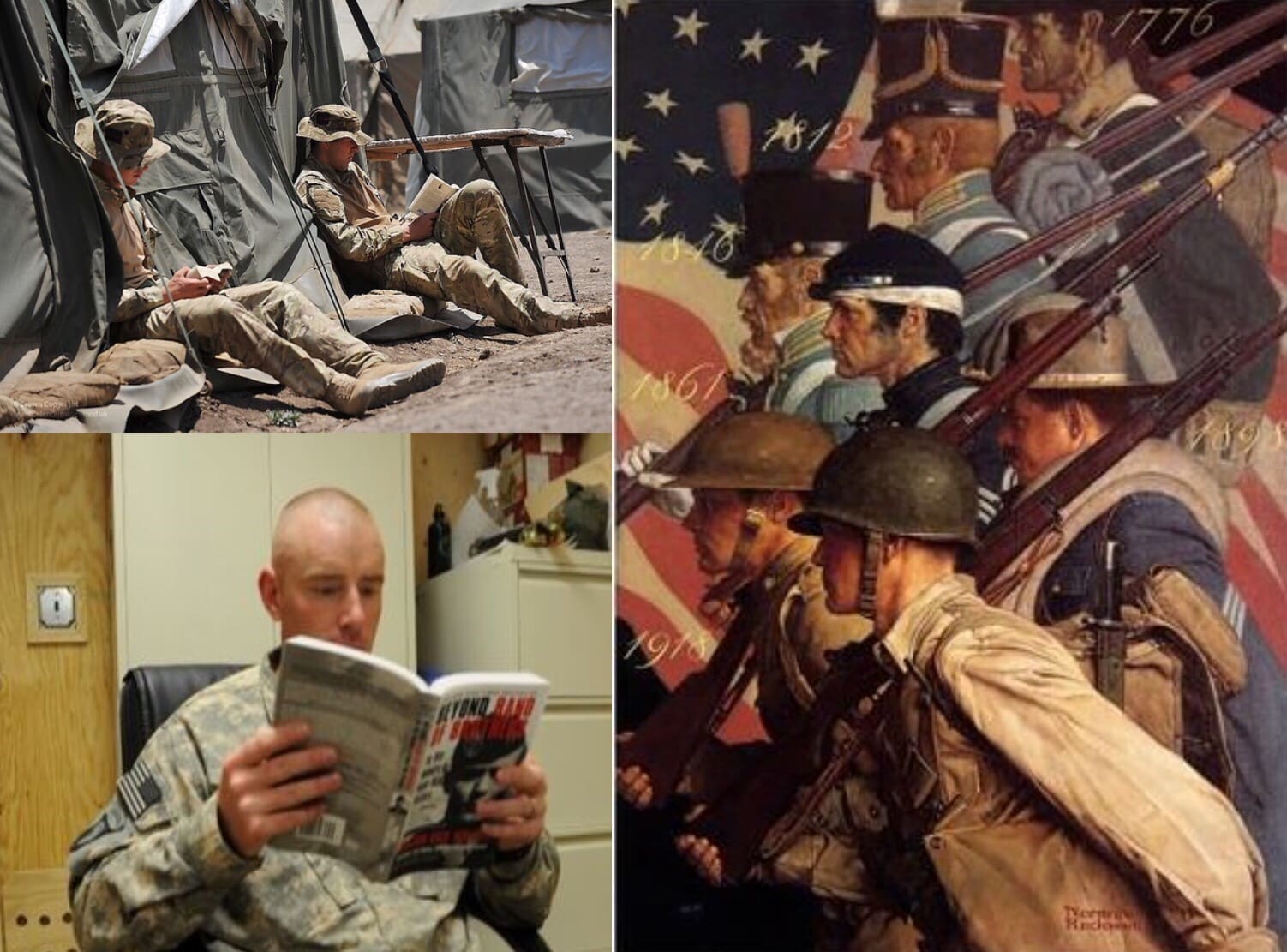
Lately there has been quite a bit of talk about the connection between history, professional military education and quality training on this site. Perhaps we can all initially agree on a couple of facts to frame some additional discussion. First, war is a bloody art form much more than it is a science and requires continuous study and practice to truly master even at the tactical level. Second, planning, managing and conducting good training is also an art – and in many ways is just as hard to master. For the sake of brevity, I am going to address training separately in part two of this article so that we can concentrate on history as a component of professional education up front.

So how can studying history help make you a better soldier and build stronger units? To be sure there is an important caveat; any “lessons” gleaned from history cannot and will not give definitive answers to today’s military questions. The past is not some accurate predictive tool that can somehow be used to prophesize future outcomes. Nevertheless, the study of history certainly often provides valuable context that can and does serve to inform decision makers in the present. Therefore, it is safe to say that seeking to understand events and characters in history does indeed teach and enlighten.

Obviously countless others have had a similar opinion about the enormous utility of historical study. I do not think it is an exaggeration to say that a great many notable historical figures have been self-acknowledged students of history. That has certainly been true of military leaders. Roman generals like Caesar studied the writings of the ancient Greek warriors intently. Not just to learn how they fought, but also how they successfully trained, motivated and sustained those earlier formidable armies. Later others studied Caesar’s campaigns to capture his insight into war. Each generation in turn contributing and perpetuating an unbroken military historiographic circle of life.

We now live in a golden age of information. I have more educationally sound books about all aspects of warfare throughout history sitting on the shelves in my home than were ever available to any general in WWII. Moreover, my collection is extremely modest compared to the exponentially greater volume of material accessible through any modern digitally empowered library. It would be a shame – really a crime – if those of us with that kind of fingertip access to vast reservoirs of information did not take full advantage of all of that educational abundance.

Based on my own personal experiences, I have always been able to learn a great deal about my profession from men and women who died long ago. Military philosophers and theorists like Clausewitz still speak to me. Over time I internalized his concepts, Sun Tzu’s teachings and Machiavelli’s advice and was no doubt the better soldier, trainer and leader for having done so. For me, reading “Lee’s Lieutenant’s” and “This Kind of War” or “The Uncertain Trumpet” was never some academic exercise that was not destined to serve any practical purpose. I learned to appreciate history from the example set by the leaders I met early in my career. In turn, I have tried to pass on that historical sensibility to those I have had the privilege to serve with, lead, and mentor over the years.

In fact, studying books like those above was vital to my vocational education and eventually critical to whatever success or failure I might achieve while practicing my profession. Most importantly, I was able to make better and timelier decisions in ambiguous and challenging circumstances than I would have if I had not had that reasonably broad and sufficiently deep historical exposure beforehand. I simply would not have full confidence in any senior military leader who had no informed sense of history.

To be clear, I am not talking about a formal educational or degree producing program. No one needs to run off and get a PhD in Military History in order to be a good soldier or capable leader. Indeed, we can start at the small unit level with resources we already have readily available. How many leaders out there have made the effort to teach their subordinates their unit’s unique history – let alone the Army’s service history? I can tell you that the answer is not enough. What campaign streamers do you display on your colors? What battles do the elements of your unit crest represent? Why is your unit called the Manchus or Cotton Balers or Devils in Baggy Pants. Of course you might ask, is that “minutiae” really truly important to know? How will that information help “kill the enemy” or keep my people alive?

The answer is simple and ancient in origin. Expending the energy to inculcate a unit’s history helps build stronger teams. The Roman Legions understood this dynamic. Even today, the USMC – better than any of the other services – still understands and leverages this important bonding practice. So why doesn’t the Army do the same? Some units certainly do, but far too many do not even try. Some units consider it a waste of time and a distractor from other priorities. I would argue that the leaders of those units have the wrong priorities. They are shortchanging the professional development of their soldiers and failing in arguable their most important duty. That is to build motivated, cohesive, and ultimately winning teams.

And no, this does not mean a unit has to “stand down” or curtail other training to get it done. Some still serving NCOs or former NCOs out there probably think I am trying to put another rock in your already-too-full professional rucksack. The fact is that particular rock has always been your responsibility. You are the keepers of a unit’s history, and by extension the Army’s history, and have always had the responsibility to pass on that knowledge to your soldiers. The majority of NCOs do not need a reminder. They know they have the mission and do a superb job. But far too many do not – probably because they were never taught what right looks like when they were growing up. You cannot set the example or effectively teach what you don’t know or don’t value.

Obviously, we need to work diligently on correctly that problem at the unit level. However, we should not stop there. What are some of the positive aspects of studying history for broader professional development? Below I have selected three relevant quotes from my favorite fiction book, “Starship Troopers” by Robert Heinlein. For those not familiar with the work, be advised that the book has absolutely nothing to do with the movie series of the same name except the title. I have literally read the book a hundred times or more and always carried a paperback copy with me on deployments. I also loaned it out many times. But it was not the plot or the characters that keeps drawing me back. Rather it was the core ideas; the embedded concept of civil responsibility and duty as well as selfless service and even insight into conflict and war itself.

As many of you know, Heinlein was a brilliant, unique and even odd historical figure. He wrote science fiction primarily and never saw combat himself. Yet in Starship Troopers, Heinlein was able to capture the quintessential rationale of voluntary military service and martial virtue. He clearly intended to present more of a philosophy of duty than a practical military theory or strategic concept of war. Still, his book is a recognized military classic and has been on the recommended reading list for the Army and the USMC for many years. That is not to say that all of Heinlein’s ideas were original. He was well read and had an inquisitive mind so I suspect he had read at least potions of Clausewitz and Sun Tzu and quite possibly Machiavelli as well.

I appreciate this first quote because it perhaps explains why Sun Tzu still resonates after more than two thousand years. Why Clausewitz and Jomini are still read intently to be both interpreted and misinterpreted by countless professional soldiers. And perhaps it also explains why no more contemporary authors have ever been able to convincingly threaten their intellectual authority or supplant them.

“Basic truths cannot change and once a man of insight expresses one of them it is never necessary, no matter how much the world changes, to reformulate them. This is immutable; true everywhere, throughout all time, for all men and all nations.”

The second quote might appear to be no more than a restatement of Clausewitz’s basic theory. And I am reasonably sure that was Heinlein’s original source. But it does expand on the idea that in war it is the application of coercive violence and not killing itself that is actually the military “means” to the political “end” or “objective” that Clausewitz referred to repeatedly.

“War is not violence and killing, pure and simple; war is controlled violence, for a purpose. The purpose of war is to support your government’s decisions by force. The purpose is never to kill the enemy just to be killing him . . . but to make him do what you want him to do. Not killing . . . but controlled and purposeful violence.”

Lastly, I have used what I call “the cooking analogy” below many times to try to explain the notion of military education and realistic training providing immense value added on and off the battlefield.

“…unskillful work can easily subtract value; an untalented cook can turn wholesome dough and fresh green apples, valuable already, into an inedible mess, value zero. Conversely, a great chef can fashion of those same materials a confection of greater value than a commonplace apple tart, with no more effort than an ordinary cook uses to prepare an ordinary sweet.”

Unfortunately, higher-level professional training and education is largely undervalued in the institutional military. That is a counterproductive but systemic organizational attitude. To use Heinlein’s analogy, the services consequently only manage to consistently produce good “fry cooks” that can perhaps reliably fashion an edible meal but have a limited repertoire. In other words they are generally “tactically sound” in the most limited sense but not necessarily adaptive, multifunctional or innovative in any way.

We simply do not produce many world-class chefs; i.e. master craftsmen or artists with more advanced skills that can take the raw material and other means provided to them and produce results approaching a tactical, operational or even strategic work of art. We need military artisans who can be hard fighters AND consummate trainers AND equally deep thinkers. Leaders that have the intellectual tools necessary to profoundly reflect on the art and artifices of war and the disciplined aptitude to translate the resulting thoughts into practical applications. The enduring challenge for us remains how to identify, cultivate and encourage the intellectual development of more martial master chefs at every level.

That brings us to the final point for now. It would certainly be possible to put a committee together and “distill” the more advanced works of Sun Tzu, Clausewitz, et al into 3×5 cards of command approved military axioms that every soldier could carry in his or her breast pocket. Laminated of course and dutifully memorized and regurgitated on command. But that will not make us any smarter. To seek legitimate understanding of Sun Tzu and the others it is important to consider the social, cultural and historical context in which they lived and wrote. In other words, it takes intellectual effort. There is no shortcut.

If simply taken literally, out of context, or only partially and imperfectly understood, Sun Tzu’s or Clausewitz’s or Machiavelli’s ideas can be truly dangerous rather than helpful to a soldier or politician trying to make a decision with life and death implications. Therefore, the services – especially the Army – would clearly be best served by providing more opportunities for high quality, practical and continuous professional education at all levels. This could start by making the effort to instill a deeper appreciation of history in Army leaders of all grades. That is probably the single most useful thing we can do to improve the U.S. Military’s tactical, operational and strategic rate of success in the future.

LTC Terry Baldwin, US Army (Ret) served on active duty from 1975-2011 in various Infantry and Special Forces assignments. SSD is blessed to have him as both reader and contributor.

MILDEP Brings SOF Perspective to Acquisition Strategy to Deliver Now

Saturday, December 30th, 2017

By John Higgins, PEO IEW&S Public Affairs, December 29, 2017

IMG_5805
On Aberdeen Proving Grounds, Md., Program Executive Officer Intelligence, Electronic Warfare & Sensors (PEO IEW&S) joined by members of other PEO’s: Command Control Communications — Tactical (PEO C3T) and Assembled Chemical Weapons Alternatives (PEO ACWA) along with Joint Program Executive Office Chemical and Biological Defense (JPEO Chem Bio) hosted Lt. Gen. Paul Ostrowski, the Principal Military Deputy to the Assistant Secretary of the Army, for his Acquisition Streamline & Culture Initiatives brief, Dec. 20, 2107. (Photo Credit: John Higgins)

ABERDEEN PROVING GROUND, Md. — Program Executive Officer Intelligence, Electronic Warfare & Sensors (PEO IEW&S) joined by members of other PEOs: Command Control Communications — Tactical and Assembled Chemical Weapons Alternatives along with Joint Program Executive Office Chemical and Biological Defense hosted Lt. Gen. Paul Ostrowski, the Principal Military Deputy to the Assistant Secretary of the Army (Acquisition, Logistics and Technology), for his Acquisition Streamline & Culture Initiatives brief.

Ostrowski’s whirlwind tour took him to Huntsville, Ala., for time with PEO Aviation and PEO Missiles & Space, then it was off to Warren, Mich., home of PEO Ground Combat Systems and PEO Combat Support & Combat Service Support.

The purpose of the tour was to meet with Army Acquisition professionals and discuss plans for the future.

Ostrowski certainly had a plan. It’s a rare thing when a speaker can be said to be “electrifying” in the field of acquisition.

“We’ve been so brain washed in a way,” Ostrowski said to a well-attended auditorium, “to follow processes and that those processes were more important than product, which has put us in a position where we no longer than keep up with the threat and we no longer can keep up with the advances in technology with the speed at which they are turning.”

In Special Operations fashion, Ostrowski directly offered to “fly high cover,” saying “I’ve got your back. Because it’s on me. Which is exactly where I want to be, because we have got to change this thing.”

The first part of these dramatic plans actually began almost a year ago with the Section 809 Panel, assembled specifically to assess acquisition and identify areas of improvement. They presented their initial findings to the Armed Services committee in May of 2017.

Their fifty page paper ended with this conclusion:
“All these events exact a toll on the morale of the acquisition workforce. At some point people, motivated by their desire to serve the country and the men and women defending it, feel frustrated in their efforts to make a difference and do not feel empowered with respect to work processes. The workforce deserves a better system.”

To find that better system, Ostrowski directed his team to “Go to the Navy: they got this thing called an ACAT [Acquisition Category] IV, I want to know all the things about what an ACAT IV is and whether or not we can use something like that in our Army.”
An Acquisition Category IV was exclusive to the Navy and Marines until very recently. It designates either testing or monitoring of a product. Further, those ACAT IV items will be directly managed at the Colonel (O-6) or Civilian GS-15 level.

“I also said, ‘Look, I want you to go to SOCOM and I want to you pull up a thing called a SAMP, a Simplified Acquisition Management Plan,” Ostrowski continued. “Right now one size shoe fits all, weather you’re at ACAT I or ACAT III, in our Army? The documentation isn’t substantially different.”

A SAMP contains acquisition strategy, logistic support plan and a testing plan in roughly ten pages. The reason for this is the paper work is required by law, the there is no specified length.

Ostrowski pointed out that there are waivers that would allow Acquisition personnel to tailor their paperwork, not just to the military requirement but how an item is created and what its intended purpose will be. The issue, he said, was it was easier to do something the “process” way, then to get permission to do it the “product” way.

“That’s why I had to do a Corrosion Prevention Control Plan for a combat shirt. In case you’re wondering, a combat shirt doesn’t have any metal on it at all. It’s just cloth. But I signed it! Because it was easier to that than to ask for a waiver!”

Ostrowski then launched into a comprehensive plan that would allow for a greater degree of customization across the board in acquisition strategies. Ostrowski also addressed testing, and how to hold industry partners accountable to a greater degree of initial functionality, but also a greater degree of long-term improvement. That also means communicating with industry partners on their level, the lieutenant said. “We have to bring the testing community into acquisition reform,” he said continuing, “Acquisition is a team sport.”

A key element of this, is “fly before you buy,” and “buy down risk.” Ostrowski said. This means that rather than rush a product to Milestone B where there is a greater oversight for development, project managers should utilize a more deliberate process to eliminate as much risk as possible before entering the next Milestone gate. Ostrowski said that while this will cost us time in the short term, it will save us time and money in the long term.

These reforms are even more necessary now, as The Army now owns 835 programs, with Integrated Air Missile Defense, Lower Tier Missile Defense and Future Vertical lift the only three programs still under the Office of the Secretary of Defense.

Ostrowski identified an ambitious plan, however, he made it clear that he had put in the work to make it happen and would continue to put in the effort to do so.

“You have equipped the most lethal, the most force protected and the most situational aware Army that has ever walked the face of this earth.” Ostrowski said, reflecting on the accomplishments of the PEO community. “You should be very proud of what it is that you have done.”