SIG SAUER - Never Settle

Archive for the ‘Guest Post’ Category

US Military Services, 10 Countries Compete in 18th Annual International Sniper Competition

Tuesday, October 16th, 2018

FORT BENNING, Ga. — The 18th annual International Sniper Competition opened at Fort Benning, Georgia, during a ceremony at the Sniper Compound Oct. 15.


The event brings 30 two-person teams from across the Army, Department of Defense, civilian law enforcement agencies, and around the world to determine who are the best two-person sniper teams globally.

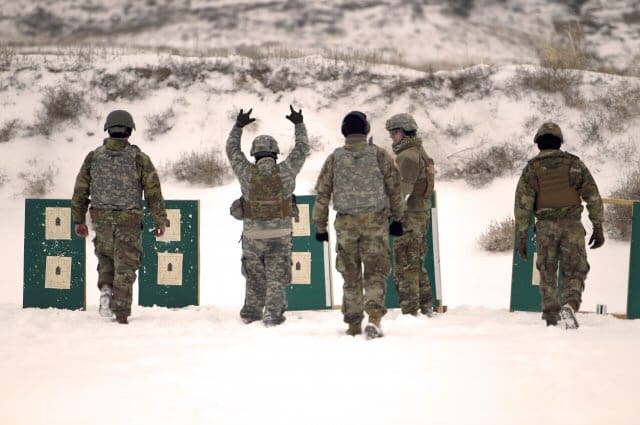
Thirty sniper teams run toward their equipment at the opening of the 18th annual International Sniper Competition, Fort Benning, Ga. (Photo Credit: U.S. Army photo by Markeith Horace)

Col. J. Frederick Dente, U.S. Army 316th Cavalry Brigade commander, spoke during the opening ceremony.

“I know that you’re ready,” said Dente to the assembled teams. “You’ve been issued your equipment, been briefed on the course of the competition, and I know that for each of you, today is the culmination of weeks and months of hard training and preparation.”

This year, 10 teams represent the countries of Australia, Canada, Denmark, Germany, Ireland, Israel, the Netherlands, New Zealand, Sweden and the United Kingdom. U.S. military services are represented by teams from the Army, Army National Guard, Army Reserve, Marine Corps, Coast Guard and Air Force. One team is joint service with both a Sailor and a Soldier. A team from the Federal Bureau of Investigation is representing civilian law enforcement.

Thirty sniper teams run toward their equipment at the opening of the 18th annual International Sniper Competition, Fort Benning, Ga. (Photo Credit: U.S. Army photo by Markeith Horace)

“Today is a once in a lifetime opportunity to meet your peers,” said Dente. “I know that they are your competitors this week, but in a larger sense, they are your comrades in arms, they are your allies and your partners. And when we leave the field of friendly strife on Friday, they will be the men that fight alongside you in the first battle of the next war.”

The two-man teams lined up next to a digital timer behind a red line. At the conclusion of the ceremony, the teams were to begin their first event, a simulation where they ran to a building, climbed the building and engaged a hostile target before the target killed a hostage.

Over the course of more than three days, beginning Oct. 15 and concluding Oct. 18, the teams are scheduled to compete in events that will test their abilities in long-range marksmanship, observation, reconnaissance and reporting, and stealth movement.

“Push yourself, push your equipment, push your team to its limits, and then set a new standard,” said Dente. “Push yourself, so that each of us, whether in the front of the field of competitors or in the back of the pack, each of us leaves here better prepared to fight and win the nation’s wars in the unforgiving crucible of battle.”

By Mr. Bryan Gatchell (Benning)

Army Chief of Staff Discusses Next Generation Squad Weapon

Monday, October 15th, 2018

WASHINGTON — Several prototypes of a next-generation squad weapon were advanced forward for testing and a request for proposal was sent out, said Chief of Staff of the Army Gen. Mark A. Milley during a news conference at the Association of the U.S. Army’s Annual Meeting and Exposition, Oct. 8.

A weapons squad of U.S. Soldiers assigned to the 3rd Cavalry Regiment and deployed in support of Combined Joint Task Force — Operation Inherent Resolve fire two M240B machine guns during a live-fire training exercise near Al Asad Air Base, Iraq, Sept. 26, 2018. The Army is currently testing a prototype for a new squad weapon. (Photo Credit: U.S. Army National Guard photo by 1st Lt. Leland White)

Test firing of the weapon prototype indicates that it has an accurate range far in excess of any existing military rifle today, he said.

Additionally, it fires at speeds that far exceed the velocity of bullets today and it will penetrate any existing body armor or body armor expected to exist over the next 25 years, he added. This sophisticated weapon also has a sight system that integrates into Soldiers’ gear that incorporates the latest in information technology.

Producing such a highly capable weapon is clearly in the realm of the possible, Milley noted, after speaking with engineers designing the prototypes. Right now, feedback from the prototypes looks like it will fire 6.8mm rounds.

Because the weapon is so capable and so sophisticated, “not surprisingly, we expect it to be expensive,” he said. “So we’re probably not going to field the entire Army with this weapon. We’ll prioritize to those Soldiers in all components who are in close combat quarters-type duties such as Infantry, Armor, Cavalry, Rangers, Special Forces, combat engineers.”

Soldiers with the 173rd Infantry Brigade Combat Team (Airborne) hold their position during a live-fire portion of the Saber Junction 18 exercise at Grafenwoehr Training Area, Germany, Sept. 12, 2018. he Army is currently testing a prototype for a new squad weapon. (Photo Credit: U.S. Army photo by Pfc. Matthew Marcellus )

The Army is looking to buy somewhere in the range of 100,000 of these weapons initially and may expand that later on, he said. The Army hopes to have them out on the range at Fort Benning, Georgia, hopefully by next summer.

“We look forward to it. It’s exciting. But we don’t want to speak too much about its technical capabilities because our adversaries watch these things very closely, so we prefer to keep the technical details out of the news,” he said. “The bottom line is we’re committed to a new rifle and a new squad automatic weapon.”

By Mr. David Vergun (Army News Service)

SSD Editor’s note: I cannot stress enough that the 6.8 round being looked at by the Army for NSGW is NOT the 6.8 SPC investigated by USSOCOM in the early 2000s. It is an entirely new capability.

Max Talk Monday: Tactical Problem Solving & Decision Making (+ Hasty Attack)

Monday, October 15th, 2018

This is the ninth installment of ‘Max Talk Monday’ which shares select episodes from a series of instructional videos. Max Velocity Tactical (MVT) has established a reputation on the leading edge of tactical live fire and force on force training. MVT is dedicated to developing and training tactical excellence at the individual and team level.

It is based on Max Talk 017 which discusses the necessity to train beyond the flat range in order to attain an effective warrior mindset / skillset. ‘Two way ranges’ (i.e. combat) present unique challenges in terms of tactical problem solving and decision making that must be trained and prepared for. Utilizing hasty attack live fire training footage for training purposes.

Max is a tactical trainer and author, a lifelong professional soldier with extensive military experience. He served with British Special Operations Forces, both enlisted and as a commissioned officer; a graduate of the Royal Military Academy Sandhurst. Max served on numerous operational deployments, and also served as a recruit instructor. Max spent five years serving as a paramilitary contractor in both Iraq and Afghanistan; the latter two years working for the British Government in Helmand Province, Afghanistan.

Website: Max Velocity Tactical

YouTube: Max Velocity Tactical

SCUBAPRO SUNDAY -Regulators

Sunday, October 14th, 2018

A regulator system is required to reduce the pressure of the compressed air contained in the cylinder to ambient pressure to supply breathable air when needed. It is also possible to connect pressure gauges (analog or digital), IP inflators to provide buoyancy compensators, dry suits and other devices to this system. The regulator system is composed of a pressure reduction device and one or more breathing devices. In this article, the pressure-reducing device and the breathing device will be indicated, respectively, by the terms “first stage” and “second stage.”

First Stage

Regulators can use either a piston assembly or a diaphragm assembly. The piston or diaphragm controls and reduces the air pressure from high pressure to moderate pressure in the first stage. Either design may be equally good and equally sensitive to the diver’s inhalation needs except under conditions where high flow is required: there the piston regulator delivers much more air than the diaphragm regulator. The first stage uses a standard piston, balanced piston or diaphragm mechanism. Air is compressed and stored in the tank under high pressure. To reduce this pressure, the first stage is a valve or piston that lowers the pressure to about 140psi to let air into the hose. The valve opens to allow some air into the hose and then closes again. A regulator compensates the pressure as it decreases in the tank when the air is used and as the diver changes depth which causes change the ambient water pressure.

Standard Piston

Standard piston first stages are the simplest mechanism with minimum moving parts to control the pressure drop from a tank to feed the second stage. Which translates to high reliability and durability, combined with minimal maintenance requirements.

Balanced Piston

First stages with air balanced pistons deliver significantly more air to the second stage than any other first stage, while their performance is unaffected by the changing tank pressure. A balanced system allows the use of lighter and more sensitive components, resulting in ultra fast breathing response, instant delivery of air on demand and extra high airflow.

Balanced diaphragm

The inner mechanism in a diaphragm first stage is isolated from the surrounding water. This feature makes it especially suitable for diving in cold-water conditions or murky water. In this system, the air flows through a seat & pin assembly, controlled by a loaded diaphragm. The seat receives equal inter-stage pressure from both sides, making it react independently of tank pressure. Balanced diaphragm systems deliver a slightly lower flow than piston regulators, due to the smaller diameter air passageways. However, these differences in performance are only detectable at great depth. Cold-water divers typically prefer diaphragm regulators because they are less likely to free flow in cold water than are piston regulators.

First Stage Body 

This metal cylinder contains the mechanisms that reduce the high-pressure air in the scuba tank to an intermediate pressure. High-pressure air flows in one side of the first stage body undergo pressure reduction and then flows out through the low-pressure hoses.

Yoke

The regulator first stage body is held against the scuba tank’s valve through one of two methods: a Yoke or a DIN fitting. This diagram illustrates a yoke fitting, also called an international fitting. The “yoke” is the metal oval that fits over the tank valve to hold the regulator in place. Two types of coupling fittings are used to attach a regulator’s 1st stage to the tank: DIN and Yoke.

Yoke couplings are more commonly found worldwide and are generally always used by the ever-popular aluminum 80 tanks.

DIN fittings are safer than yoke fittings and are the only fittings that can couple with high-pressure tanks. The advantage of DIN fittings is that they screw into the tank valve and trap the high-pressure o-ring so it cannot protrude, this can occasionally happen on a Yoke.

Yoke Screw

The regulator’s yoke is equipped with a yoke screw–a metal screw that runs through the regulator yoke and tightens the regulator first stage body onto the tank. To tighten the yoke screw, the diver turns the black, plastic handle attached to the screw.

Dust Cap

Keeps water from entering the regulator first stage body when not connected to the tank. The dust cap is a rubber cap that can be placed over the regulator first stage opening and tightened down using the regulator yoke screw. This seals closed the opening on the first stage.

Port/ Port Plug

Regulator first stage bodies have multiple openings, or ports, that regulator hoses and transmitters can bed screwed into. Most, regulators have more ports than the standard number of hoses, which allows divers to position their hoses in a variety of configurations. These openings are called ports, and the plugs that close the regulator ports when they are not in use are called port plugs.

Second stage

The second stage of a regulator is basically the part that goes in your mouth and delivers air upon demand. It contains a mechanism that reduces the intermediate pressure in the hose coming from the first stage to the surrounding water pressure making it comfortable and easy to breathe. The second stage also contains a piston or diaphragm construction which starts and stops the airflow. The mouthpiece, an exhaust valve, and an emergency purge valve/button are all parts of the second stage. The exhaust valve lets the air escape into the water when you exhale. It is a one-way valve and does not allow water in. When the purge button is pushed, it forces air to flow continuously into the second stage chamber forcing any water out of the mouthpiece through the exhaust valve.

This unit is supplied, with the intermediate pressure coming out of the first stage through the low-pressure hose. It reduces pressure further to balance air with the ambient pressure. The second stage may be balanced or unbalanced and equipped with a Venturi effect control (V.I.V.A.) and/or with an inhalation resistance control.

Second Stages 

There are two main types of the Second stage, Air Balanced, and Downstream

AIR-BALANCED VALVE

Air-balanced valve technology provides the optimum breathing comfort preferred by demanding divers. The air-balanced valve technology of SCUBAPRO’s second stages fine-tunes the pressure of the air delivered by the first stage to decrease inhalation resistance to the lowest possible level. The result is an ultra-high airflow that remains exceptionally stable under all breathing conditions.

CLASSIC DOWNSTREAM VALVE

The classic downstream valve is the best solution for resorts and rental facilities worldwide, as well as many recreational divers. These second stages are particularly noted for their legendary safety and reliability. A specific inhalation effort is always required to overcome the spring tension and opens the valve that lets the air flow in.

Parts of the Regulator

1. Purge Button
The purge button is located on the face of the regulator second stage. The purpose of the purge button is to flood the second stage with air, forcing water out of the second stage. Divers use the purge button when the second stage has been allowed to fill with water–for example, when a diver removes the regulator from his mouth during the regulator recovery skill.

2. Ease of Breathing Adjustment
Most regulators has a lever or knob that allows divers to adjust breathing resistance. This feature helps to prevent regulator free flow (a state when air flows rapidly out of the regulator second stage without the diver breathing from it), which typically occurs when the breathing resistance has been lowered too much. A free flow can quickly empty a tank.

Many second stage adjustments have a setting labeled “pre-dive” to help prevent free flow at the surface, and one labeled “dive” for easy breathing once underwater. As a diver descends, he can adjust the ease of breathing to compensate for the increased difficulty of breathing as he descends.

3. Exhaust Valve
The second stage exhaust valve is the plastic unit that channels exhaled air bubbles away from a diver’s face. The exhaust valve is usually located below the regulator’s mouthpiece to channel air down and to the sides. Helping to keep a diver’s field of vision clear of bubbles.

4. Mouthpiece
The Mouthpiece is the part of the regulator that a diver bites down on. High-quality mouthpieces are made of silicon or soft rubber and comes in a variety of shapes and sizes to fit divers’ mouths. Mouthpieces are removable and replaceable. A diver should check to make sure that his mouthpiece is secured to the regulator second stage with a SCUBAPRO Quick release mouthpiece clamp. Try not to use zip-ties. They are not designed for long-term water exposure. The SP Quick clips are designed for long-lasting UV and saltwater exposure.

Octopus

The Octopus /alternate second stage, does the same thing as a primary second stage. The Octopus second stage is not intended to be used, except in the case of an out-of-air emergency. A diver with an alternate second stage can allow a diver that is having an out-of-air emergence to breathe from their tank without putting themselves at risk.

1. Mouthpiece
The mouthpiece is the part of the regulator second stage that a diver bites down on. Alternate second stage mouthpieces should be a standard size to fit any diver’s mouth–not a custom mouthpiece. The idea is that any diver should be able to use the mouthpiece in an emergency.

2. Low-Pressure Hose
Low-pressure hoses (LP hoses) transport air from a regulator first stage to its second stages. An alternate second stage’s LP hose is usually longer than the LP hose attached to the primary second stage. This extra length makes it easy for an out-of-air to use an alternate second stage connected to a tank he is not wearing. The LP Hose attached to an alternative second stage is frequently a bright color, such as yellow, to make it easy to see.

3. Purge Button
The purge button on the alternate second stage, has the same function as a purge button on the primary second stage–to remove water that has entered the second stage. Alternate second stage purge buttons are usually brightly colored–this one is neon yellow. The bright color makes it easy for an out-of-air diver to locate the alternative second stage in an emergency.

4. Ease of Breathing Adjustment
Just like the ease of breathing adjustment on a primary second stage, the ease of breathing adjustment on an alternate second stage can be used to increase or decrease breathing resistance during a dive. If ease of breathing adjustment is present, a diver should adjust it so that the breathing resistance of the alternate second stage is increased. The diver should also turn any pre-dive/ dive adjustment to “pre-dive.” The regulator will still work if needed, but this adjustment will ensure that the alternate will not free-flow during the dive.

5. Diver adjustable inhalation resistance control

Second stages equipped with this system have an over-sized external control knob acting directly on the spring tension, allowing the diver to adjust the inhalation resistance to adapt it to the needs of the dive conditions. Adjusting the control knob (clockwise rotation) causes an increase in inhalation resistance. Adjusting with a counterclockwise rotation reduces the spring tension for lower inhalation effort. All depends on the diving conditions, such as in strong currents, when the diver spends some time with his head down and when the second stage is used as an alternate air source (octopus).

SCUBAPRO AIR2

The Air 2 is a second stage regulator and a balanced inflator for your BCD in a single, compact housing. SCUBAPRO introduces the inflator concept to diving almost 30 years ago with the introduction of the AIR2 ( Alternate Inflation Reg). The Air 2’s air-balanced power inflator valve gives a steady stream of air, regardless of the pressure in your tank. The Air 2 has a fixed Venturi Initiated Vacuum Assist (VIVA) Flow Vane for safe and uncomplicated use now has a dive/pre-dive switch. This switch allows the regulator mechanism to be set more like that of a standard second stage regulator. It is CE-certified for waters 50°F (10°C) or warmer.

Post dive

Close the cylinder valve and drain the system by pushing on the purge button of each second stage. Once the system has been depressurized disconnect the first stage regulator from the valve. All inlets must be closed with the provided protective caps to avoid the entry of debris, dirt or moisture. If the cylinder valve is equipped with a reserve system, the rod should be put in the “open” position (fully lowered) to indicate that the cylinder needs to be filled.

Care And Maintenance

Regulators are precision devices that are essential to the diver’s safety. After every dive and especially if in chlorinated water (pools), rinse the regulator with fresh water, preventing water from entering the system by following these steps:

1.    Ensure that the high-pressure inlet of the first stage regulator is closed with the special protective cap.

2.    Should water accidentally enter the low-pressure hose, connect the regulator to the cylinder, open the valve and press the second stage purge button down until all water has been expelled.

3.    Dry your regulator entirely in a dry ventilated place, away from heat and direct sunlight. So not in your garage.

4.    Store in a cool, dry place.

This is from our older site but it is still good.

ww2.scubapro.com/en-GB/HKG/technology-index

New Coveralls to Make Life More Comfortable for Fuel Handlers

Saturday, October 13th, 2018

FORT BELVOIR, Va. — Fuel handler coveralls are worn by some 17,000 petroleum supply specialists in the Army who fuel trucks, aircraft and boats, and who operate pipelines and storage tanks around the globe.


Soldiers from the 92F petroleum supply specialist military occupational specialty at Fort Hood, Texas, are test wearing four variants of new coveralls during limited user evaluation. (Photo Credit: U.S. Army)

It’s a dirty and often thankless job, but without them, nothing would move, said Captain WaiWah Ellison, assistant product manager with Product Manager Soldier Clothing and Individual Equipment, or PM SCIE, part of Program Executive Office Soldier, known as PEO Soldier. The coveralls are primarily designed to protect Soldiers from spills, which can be hazardous when they make contact with skin.

Last year, the Army was presented with a problem and an opportunity, according to Debbie Williams, a systems acquisition expert with SCIE. The manufacturer of fabric that previously made their coveralls discontinued production, so the Army needed to find a new supplier.

Williams explained that while searching for a new vendor, the Combined Arms Support Command decided to consult with Soldiers to see how they liked the current coveralls and mine their ideas on ways to improve them, noting that CASCOM provides fire support and operational assistance to combat elements.

It was apparent from previous Soldier feedback that an update to the design could assist with making the garment a better fit. And for a long time, this material was the only one known to meet the stringent requirement of being able to resist fuel penetration for at least 12 hours. This was an opportunity to solicit industry and understand what new technologies exist in the fabric industry as well as updates in design.

Soldiers overwhelmingly said fit and comfort would be paramount in the requirements for selection of a new fabric and design.

Williams said that the Soldiers who provided their opinions of the current design were instructors at Fort Lee, Virginia, who teach the 92F petroleum supply specialist military occupational specialty. In an effort to possibly make this a joint service uniform, they also conducted a limited user evaluation of the current design with the Marine Corps fuelers at Camp Lejeune, North Carolina, and received feedback on improvements on the comfort and style.

Multiple companies answered the request for proposals, she said, noting that it takes two vendors to produce the coveralls: a manufacturer who produces the fabric, and another who cuts and sews them.

Two of the designs being evaluated are two-piece and the other two are single-piece coveralls.

Laboratory testing of the four designs took place over the spring and summer at the U.S. Army Natick Soldier Research, Development and Engineering Center in Massachusetts, Williams said. Those tests included flame resistance and tear evaluation.

A four-week, limited user evaluation of the materials and design began on Sept. 17, 2018. Fort Carson, Colorado, was selected for the fabric testing while design tests are located at Fort Wainwright, Alaska, Fort Bliss, Texas and Fort Hood, Texas.

A selection will be made following user testing and Army Test and Evaluation Command certification. A supply request package will then be turned in to Defense Logistics Agency’s Troop Support Office, and once that is completed, production for long-term sustainment can start. Williams said it’s too early to give a production start date.

By David Vergun, Army News Service

Special Tactics Airmen Open Tyndall AFB Airfield for Operations

Friday, October 12th, 2018

HURLBURT FIELD, Florida- Air Force Special Tactics Airmen with the 23rd Special Tactics Squadron assessed, opened and controlled air traffic at Tyndall Air Force Base, Oct. 11.

Special Tactics Airmen have the ability to assess, open, and control major airfields to clandestine dirt strips in any environment, including those that have been impacted by a natural disaster.

The Special Tactics Airmen cleared and established a runway at 7 p.m., Oct. 11, and received the first aircraft at 7:06 p.m.

Special Tactics Airmen are in control of the airfield and are prepared to support airfield operations at Tyndall Air Force Base until further notice.

This will allow support to facilitate humanitarian assistance to Tyndall Air Force Base.

Tyndall Air Force Base received extensive damage in the wake of Hurricane Michael.

-1st Lt Jaclyn Pienkowski, USAF , 24th SOW PAO

USAF Stands Up Special Warfare Training Wing

Thursday, October 11th, 2018

To meet the demand for special operations warfighters and improve retention rates for these critical career fields, United States Air Force officials activated the Special Warfare Training Wing Oct. 10, here.

The mission of the new wing is to select, train, equip, and mentor Airmen to conduct global combat operations in contested, denied, operationally limited, and permissive environments under any environmental conditions.

“This new wing will help us provide additional oversight and advocacy for the complex, high-risk and demanding training that’s necessary to produce Airmen to meet the requirements of the joint force,” said Col. James Hughes, SWTW commander.

The new wing headquarters and subordinate organizational structure will consist of approximately 135 personnel. The existing Battlefield Airman Training Group, which was activated in June 2016, has been renamed to the Special Warfare Training Group and will report to the SWTW.

Building upon what the Battlefield Airmen Training Group has started, the previously established five pillars of marketing and recruiting, manpower and leadership, curriculum, equipment and infrastructure will serve as a starting point for the wing.

“Keeping these pillars in mind will allow us to continue focusing on building the best Airman we can from the time they step into a recruiter’s office up until the end of their careers,” said Hughes.

“Wings move the ball forward at an operational and strategic level,” said Hughes. “They can provide structure, oversight, strategic vision and unity of command. But to become a leader in the special warfare community, we have to continue pushing the envelope of science and technology. It all comes down to doing everything we can to create Airmen capable of problem solving across a wide-range of national security challenges to meet the joint force’s needs.”

Additionally, the wing will focus on improving human performance by staying at the forefront of science and technology with the addition of the Human Performance Support Group, a one of kind unit that will integrate specialists from a variety of sports and medical fields into special warfare training to optimize physical and mental performance, reduce injury and speed rehabilitation to create more capable and resilient ground operators.

“By pushing the limits of science and technology, we’re going to find the most efficient and effective methods for improving human performance,” said Hughes. “We’re going to take what we already have learned and enhance how we produce the most physically and psychologically fit Airmen possible for the joint force.”

Special Warfare Airmen, previously known as Battlefield Airmen, are the critical ground link between air assets and ground forces. They are trained to operate as a ground component to solve ground problems with air power, often embedding with conventional and special operations forces. Their requirements have grown substantially since 2001 due to the effectiveness of and increasing demand for the precision application of air power in the joint combat environment.

Seven Air Force specialty codes currently fall into the Special Warfare category: Pararescue, Combat Rescue Officer, Combat Control, Special Tactics Officer, Special Operations Weather Team, Tactical Air Control Party personnel, and non-rated Air Liaison Officer. These Airmen share ground combat skill sets and a sharp focus on joint, cross-domain operations.

The first step toward more efficient and effective training is to combine the courses of initial entry for all special warfare candidates into one cohesive course.

“The various Special Warfare Air Force specialty codes are a lot more similar than they are different,” said Chief Master Sgt. James Clark, SWTW command chief. “These courses of initial entry are the bedrock of lethality and readiness. By combining them, we’re making the pipeline much more efficient, while also building a team mentality that focuses on our similarities, rather than our differences.”

This change is also the first step toward answering the most important question facing the SWTW: How do we create and develop the most adaptive and agile leaders possible?” said Clark. “It starts by continuing to be critical of ourselves, while searching for any way to become more efficient in everything that we do.”

www.specialwarfaretw.af.mil

-Air Education and Training Command

Brigantes Presents – High Angle Solutions – La Sportiva Karakorum Evo GTX

Wednesday, October 10th, 2018

It isn’t often that troops need to scale vertical or high-altitude terrain but if you do the La Sportiva Karakorum Evo GTX is a great choice.  At 1760g it is a lightweight technical B3 option and therefore perfect for very difficult ground.  It is fully crampon compatible and with its 2.8mm one piece leather is exceptionally sturdy and hard wearing.  The Vibram sole with Impact Brake system offers excellent control on descents and ascents alike.  The Karakorum is currently in service with the UK’s mountain troops and has enabled a significant decrease in soldier burden with the lighter weight.

Although very similar in build to the La Sportiva Nepal the Karakorum has less insulation making it an ideal all year round boot and therefore perfect for the military user.

For more information get in touch by email on international@brigantes.com or for UK customers warrior@brigantes.com.

www.brigantes.com