GORE-TEX Footwear at Tactical Distributors

Archive for the ‘Power’ Category

Galvion CORTEX Offers Headborne Integration

Monday, July 7th, 2025

Galvion CEO Todd Stirtzinger looked at me and said, “We are not only going to transform how helmets are made, but how they are used.” That was how he opened our meeting during last month’s SOF Week in Tampa, Florida and it certainly got my attention.

He led me to a helmet with multiple enablers and began to explain Galvion’s digitally enabled smart helmet, CORTEX.

The project stemmed from development for the UK’s Defence Science and Technology Laboratory Future Integrated Dismounted Soldier Vision (FIDSV) program. Further work has been accomplished on behalf of US Special Operations Forces. Integration is an ongoing process.

What’s amazing about CORTEX is that a Soldier can dump out his bag of kit and Galvion can integrate it, digitally. Enablers like smart watches, biometric sensors, strobes, laser detection systems, night vision, and thermal optics are no problem. They’ve encountered it all. The system is hardware agnostic and relies upon software, cables, and connectors to act as bridgeware so that everything comes together as a system, no matter who manufactured it. It is both modular and scalable and offers both data and power management.
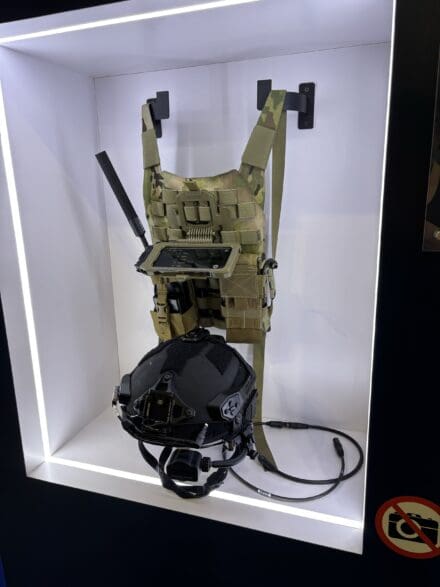
Using the helmet as a platform, edge processing is accomplished with a module featuring an internal battery and purpose-built android-based operating system which is compatible with Tactical Awareness Kit, the de facto command and control interface for the Dismounted Soldier. This increases Soldier acceptance and facilitates faster integration of new systems.

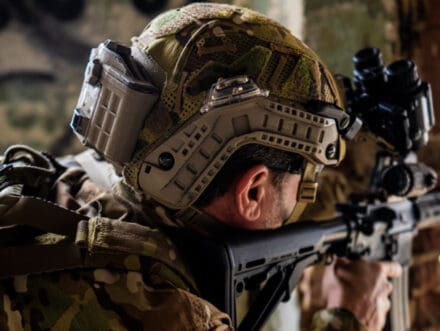
CORTEX is powerful. It will automatically detect whether a visual augmentation system is compatible with Augmented Reality inputs. This places key data in the VAS field of view, in the direction it is found in real life. Key ATAK functions can be accessed with a quick button press via the built-in 4-key controller at the temple, eliminating the need to open the EUD. This moves the data from the usual torso mount and puts it in front of the eye so the Soldier can concentrate on the battlespace.
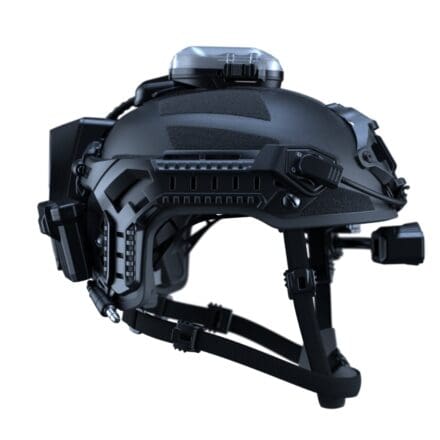
Everything is streamlined to make the data more digestible. There’s nothing worse than being overwhelmed with extraneous data and icons cluttering the field of view. Consequently, the AlertCentr plugin for ATAK is configurable by the Soldier who can setup multiple profiles for different phases of a mission. Navigation waypoints, target data, blue as well as red force information, and drone feeds can all be toggled data on and off based on what is needed for the task at hand.

With multiple system communication protocol options (USB, ISW, Bluetooth, Wi-Fi) and onboard battery, CORTEX is designed to fit Galvion’s Caiman and Hellbender helmets, although it has also been integrated unto select helmets from other manufacturers, based on customer needs.

With a combination of cabling running under rails (VAS connector, 4-key controller, Laser Sensor) as well as some exposed connection cabling, Galvion informs me that in the not-too-distant future, cables won’t be visible.  They’ll be incorporated inside. As Mr Stirtzinger alluded to in his opening statement to me, Galvion is going to change the way helmets are made. The result will be a more elegant way to integrate power and data into the helmet.

The system is already fielded in limited numbers with interest growing. Integration with new peripherals continues, along with functionality as more customers adopt the CORTEX ecosphere.
www.galvion.com

Ops-Core RAILINK Partner Spotlight: CORE Survival

Wednesday, July 2nd, 2025

We recently reintroduced you to Ops-Core’s RAILINK with a promise to begin offering in-depth coverage of the multiple enablers which work with this headborne integrated power and data system.

CORE SURVIVAL was one of the first companies to partner with Ops-Core on this project, developing the HEL-STAR Rail Strobe specifically to integrate with the RAILINK system.

The HEL-STAR Rail Strobe miniaturizes the high performance expected from a CORE Survival product. Powered by the RAILINK’s centralized Battery Pack+, the HEL-STAR Rail Strobe features dual compact, lightweight lights.

Features:

• Small Footprint with Four Settings – High and low visibility in both White and IR. Built with CORE Survival’s patented technology for maximum performance in a low-profile, snag-resistant package.

• Tactile Operation – Switches are designed for positive operation by a gloved hand while the helmet is donned. Patented double-switch blocks inadvertent switching between visible and IR functions.

• Left & Right-Hand Installation – Strobe modules attach to both the left and right side of the helmet-mounted rails. Communication to synchronize function between the strobes is achieved via the RAILINK system’s data capability.

• Familiar Sliding Button Operation – Settings for Off, Dim and Bright operation for both the Visible and IR functions.

You might think that a strobe light wouldn’t leverage RAILINK’s data capabilities, but the HEL-STAR Rail Strobe uses it to coordinate device communication at the physical layer—transmitting raw data signals between devices without interpretation. This allows the strobes to blink in unison, synchronize between visible and IR modes, and adjust light intensity in real time.

Aside from using the RAILINK’s common power distribution, the strobe is optimized for low power consumption, ensuring seamless integration with other low-power devices without placing a significant power burden on the overall platform.

To learn more about the Ops-Core RAILINK Power and Data ARC Rails System, visit shop.gentexcorp.com/railink

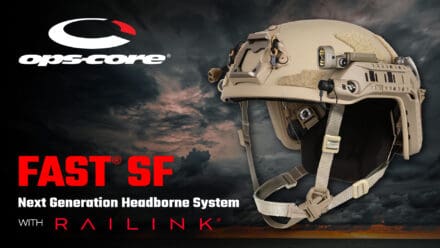
Gentex Corporation Launches the Next Generation Ops-Core FAST SF Helmet System with Factory-Installed RAILINK Power and Data ARC Rails

Tuesday, July 1st, 2025

CARBONDALE, PA, June 30, 2025 – Gentex Corporation is proud to announce the launch of its next-generation Ops-Core® FAST® SF Helmet System, now available with the innovative RAILINK® Power and Data ARC Rails factory installed. This new configuration streamlines setup and allows users the flexibility to add compatible accessories separately based on their mission needs.

As a global leader in personal protection and situational awareness solutions for defense forces, emergency responders and industrial personnel, Gentex Corporation now offers a streamlined way to purchase the FAST SF Helmet with factory-installed RAILINK Power and Data ARC Rails and Hotshoe.Trusted by elite Special Operations Forces, this setup delivers seamless integration out of the box while giving users the flexibility to choose the battery pack and mission-specific accessories separately. With optimal fit, proven reliability and reduced prep time, it’s a mission-ready solution built for the demands of the world’s most elite operators.

“Factory installation of the RAILINK Power and Data ARCRails represents a significant advancement in streamlining and speeding up field deployment of this cutting-edge capability,” said Rafe Bennett, Vice President of Product and Marketing at Gentex Corporation. “Providing a fully integrated, ready-to-use system right out of the box not only minimizes setup time, but also boosts operator confidence with a solution that’s been factory installed and proven in the most demanding operational environments.”

Users can expand the capabilities of the RAILINK Power and Data system with a growing lineup of compatible accessories available separately. These include the CORE Survival® HEL-STAR Rail Strobe®, which offers synchronized visible (white) and IR marking; the Princeton Tec™ Switch® MPLS for low-light and IR illumination; and the SureFire® HL2-A Light, delivering powerful white light or infrared output. Each of these accessories integrates seamlessly with the RAILINK Power and Data system to increase operational flexibility and situational awareness. In addition, Gentex Corporation has established development partnerships with MOHOC, Inc., Advanced Materials and Devices (AMAD) and NanoAi Technologies, along with seven other companies who have signed royalty-free license agreements to create new accessories. These partnerships are accelerating the expansion of the RAILINK ecosystem and enabling a broader range of capabilities for end users.

To learn more about the next-generation FAST SF Helmet System with factory-installed RAILINK Power and Data System, click here.

First Success for Rheinmetall Ermine – Dutch Ministry of Defence Orders 20 Manned/Unmanned Ground Vehicles for Ukraine

Friday, June 27th, 2025

The Dutch Ministry of Defence has, on behalf of the Ukraine Task Force, signed a contract with the Ede-based subsidiary Rheinmetall Defence Nederland B.V. to supply 20 Ermine vehicles. The Minister of Defence signed the contract with Rheinmetall on the 24th of June during the NATO Industry Summit in The Hague.

The variants now ordered are manned/unmanned ground vehicles. These are to be delivered to the Ukrainian armed forces, strengthening their capability for casualty evacuation near the frontline. The vehicles are to be delivered in 2026. In this configuration, a cooperation with other Dutch companies like DEMCON defense & security systems B.V. & Abiom Communication Systems (ACS) B.V. has been set up as a force multiplier. This national cooperation among industry and MoD will further develop knowledge and capabilities for the Armed Forces of the Nether­lands and Ukraine. Quote by Coen van Leeuwen, CEO of Rheinmetall Defence Nederland B.V.: “We are grateful for the trust in our capacities. Ermine is an innovative and capable solution for the modern battlefield.”

The Ermine (Hermelin) family of small vehicles represents a new generation of mobility, combining tactical transport with a mobile energy source (microgrid). Operational creativity is at the core Ermine’s design. Its features enable it to act as an effective force multiplier. 

The modular Ermine family currently consists of an UGV, a side-by-side buggy and a quad. Various 4×4 and 6×6 variants are available. All vehicles are based on the same diesel-electric hybrid drivetrain and base platform. This gives the Ermine maximum modularity with unrivalled agility. Thanks to the hybrid technology, up to one ton of payload, and a range of more than 1,000 kilometres are possible, depending on the vehicle’s configuration. Up to four Ermine vehicles can be transported by cargo helicopters such as the CH-47 or CH-53. 

This contract marks the first significant milestone for the Ermine and will, by supporting the Ukraine armed forces, also boost the defence industry in the Netherlands. 

Resilient Fuel for a Resilient Europe: Rheinmetall and INERATEC Forge Strategic Partnership for Decentralised Fuel Production

Wednesday, June 25th, 2025

Europe’s fuel supply is entering a new era: critical infrastructures are to be supplied with safe synthetic fuels in the future. INERATEC, a leader in synthetic fuel production, and Rheinmetall, a global technology leader in the defense sector, have signed a strategic partnership to deploy scalable Power-to-Liquid (PtL) solutions across defense and critical infrastructure sectors. This collaboration marks a milestone in building resilient energy systems that operate independently from fossil fuel supply chains and vulnerable infrastructure.

Europe needs secure fuel supply

Modern defense strategies depend not only on technology and logistics but also on energy resilience. As fossil fuel supply chains become increasingly vulnerable in case of conflicts, the ability to produce carbon-neutral synthetic fuels on-site becomes essential. Hospitals, critical infrastructure, and armed forces alike require a stable, independent, and clean fuel supply – in peacetime and during crisis.

The Giga PtX solution delivers secure, redundant and consistent access to high-quality fuel, independent of geopolitical dynamics. Giga PtX lays the groundwork for establishing a sustainable carbon-neutral fuel network all applications that are currently depending on fossil fuels.
Fuel is an everyday essential. In military operations, fuel consumption can reach 20 to 60 liters per soldier per day. Yet fossil fuel logistics, designed for peacetime, are increasingly fragile. Synthetic e-Fuels are the only scalable solution that match the energy density, storability, and versatility of conventional fuels – making them indispensable for modern defense readiness.


“INERATEC makes an important contribution to resilience – and the defense sector is a powerful catalyst to scale resilient, clean technologies,” said Maximilian Backhaus, Chief Commercial Officer at INERATEC. “This partnership proves that energy resilience and defossilization go hand in hand. By delivering scalable Power-to-Liquid solutions for systemically important operations, we demonstrate how European climate tech can play a pioneering role – not only ecologically, but strategically.”
“e-Fuels are more than a technological solution – they are a strategic necessity. With Giga PtX, we are creating a scalable network that strengthens energy autonomy for Europe’s defense forces,” said Shena Britzen, Head of Hydrogen Program at Rheinmetall. “What matters is not just energy security, but the ability to act independently – in logistics, in operations, and in times of crisis.”
With this partnership, INERATEC and Rheinmetall are sending a clear message: Fossil fuel supply chains function in peacetime, but security requires resilience. Giga PtX will demonstrate how synthetic fuels is set to become a cornerstone of energy sovereignty.
By providing access to INERATEC’s PtL systems through the current fuel logistic infostructure, militaries can decarbonize this critical sector with no changes to current vehicle technologies while increasing their flexibility in logistics. 

SFC Energy AG and Polaris Government and Defense Collaborate to Equip NATO and NATO-aligned Defense Organisations with Advanced Fuel-Cell Powered Vehicle

Wednesday, May 14th, 2025

Brunnthal/Munich, Germany, 13 May 2025 – SFC Energy AG (“SFC”, F3C:DE, ISIN: DE0007568578), a leading provider of fuel cells for stationary, portable and mobile hybrid power solutions, has announced a key collaboration with Polaris Government and Defense (“Polaris”) at Special Operations Forces Week (“SOF Week”) in Tampa, Florida, USA. Polaris showcased a high-mobility tactical vehicle with the EMILY 3000 as an optional integrated power supply. This capability is specifically being offered to NATO and NATO-aligned defense organisations.

Installing SFC Energy’s EMILY 3000 in the Polaris’ MRZR vehicle platform provides a highly reliable power solution available for mission-critical applications. The methanol fuel cell-based system can power radios, surveillance systems, drone equipment, sensors, and other electronic devices – all without the need to run the vehicle’s engine. This enables extended operations while preserving camouflage and reducing both thermal and acoustic signatures.

The EMILY 3000 delivers a dependable and autonomous power supply for a variety of electronic and communication systems. Weighing only 12 kilograms (approximately 26.5 pounds), it increases power output on lightweight tactical vehicles without compromising mobility. Its high energy density enables for extended runtimes and minimises the need for refuelling during prolonged operations. One of its key advantages is its virtually silent performance, producing minimal acoustic and thermal signatures – making it exceptionally well-suited for covert operations.

The system supports the simultaneous charging and use of various battery types, including lithium-ion, lithium-polymer, and conventional lead-acid batteries. In contrast to traditional setups, it eliminates the need to run the vehicle engine or rely on noisy generators. This reduces fuel consumption, acoustic exposure, and the risk of early detection. Fully automatic in operation, the EMILY 3000 contributes to longer battery life and reduced vehicle wear by cutting down on engine use and maintenance.

Its flexibility also enables the system to function either as an onboard charger or as a portable, field-based power supply. Additionally, the EMILY 3000 and its fuel cartridges are military-certified, carry a NATO supply number, and are approved for air transport in accordance with UN3473 regulations – making them fully deployable in international operations.

By integrating the EMILY 3000, Polaris light tactical vehicles gain enhanced operational endurance and power autonomy – especially critical in scenarios where silence, reliability, and energy independence are key tactical requirements.

Dr. Peter Podesser, CEO of SFC Energy AG: “By offering the EMILY 3000 as an accessory option in Polaris vehicles, we are delivering a mission-ready, low-signature power solution tailored to the needs of modern armed forces. The Polaris MRZR is widely deployed by the United States and other NATO and allied forces worldwide for its exceptional off-road mobility and versatility. By including our innovative and field-proven fuel cell technology on this trusted platform, military forces can significantly enhance their operational range, energy autonomy, and tactical utility in real-world missions.”

Further information on SFC Energy’s Clean Energy and Clean Power Management solutions can be found at www.sfc.com.

SOF Week 25 – Edgevolt Battery System from 3ME Technology

Tuesday, May 13th, 2025

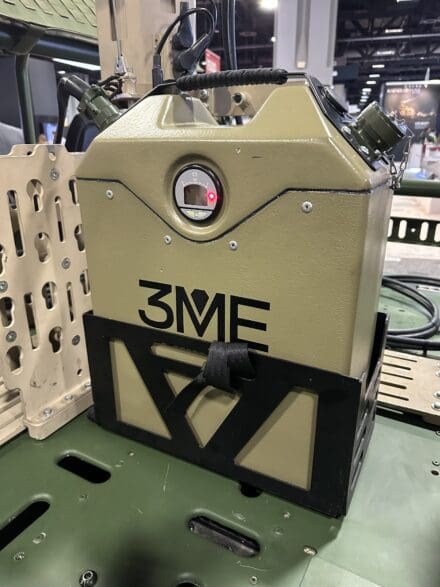
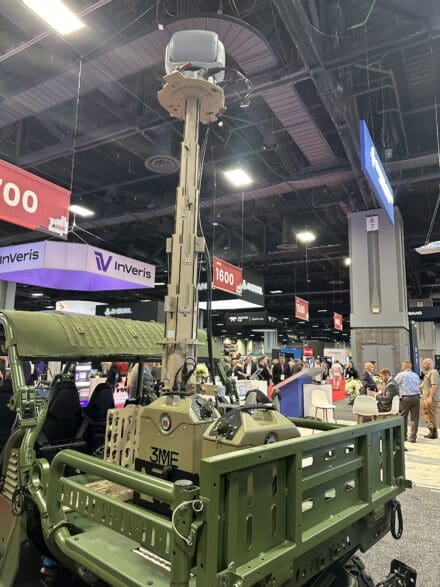
3ME Technology is an Australian company which has been working on battery systems for the ADF for the past few years.

Recently, they created a new form factor which mimics the size and weight (22 kg) of a 5 gallon Jerry Can, providing 24V 2.4 kWh. This means single person lift.

Weatherproof, they can be used alone or connected in serial (up to 10) for higher power requirements. What’s more, they are hot swappable while in serial.

Army Research Yields Rechargeable Battery for Extreme Operating Conditions

Saturday, May 10th, 2025

ABERDEEN PROVING GROUND, Md. (May 6, 2025) — Soldiers deploying in a wide range of climates for future conflicts will need batteries capable of powering their advanced electronics in extreme weather conditions. To meet these challenges, Army researchers are developing rechargeable batteries for Soldier-worn and handheld equipment with increased temperature ranges.

Initiatives to field Soldiers with next-generation equipment — such as night-vision devices, weapons, and radios — are driving the need to transition from single-use batteries to rechargeable versions, said Lexi Karalekas, an Army C5ISR Center chemical engineer.

The U.S. Army Command, Control, Communications, Computers, Cyber, Intelligence, Surveillance and Reconnaissance (C5ISR) Centeris working to improve performance of these batteries in cold and hot weather to meet the demands of Soldier-missions across a broad range of environments. Researchers are conducting lab testing of the cell technology.

“Results at the cell level show a significant enhancement in performance at extreme temperatures, achieving a higher capacity when compared with commercial-off-the-shelf options,” said Karalekas, C5ISR Center’s lead for the battery development project. “Through collaboration with industry, we are demonstrating advancements that potentially double the operational range and duration of systems powered by the innovative technology. This will enable Soldiers to operate in previously inaccessible temperatures.”

The Army’s next step is to incorporate these specialized cells into a prototype of the Army’s most widely used standard battery across many Soldier-portable systems. Because of the battery’s widespread use by Soldiers, any new iterations can be easily accommodated as ‘drop-in’ replacements. The new prototype will be delivered in the near term to C5ISR Center for lab testing before multiple rounds of Soldier field testing in extreme temperatures.

Once prototypes have been tested successfully in one battery pack, the cells inside can be incorporated into other standard Army batteries, said Dr. Ashley Ruth, a C5ISR Center senior electrochemical engineer.

“The use of standard batteries allows multiple systems to quickly see the benefits of this new technology rather than redesigning and requalifying bespoke batteries as improvements in cell chemistries occur,” Ruth said.

In addition to Soldier handheld electronics, the Army is looking to incorporate the technology into other battery types for vehicles, unmanned aerial systems and sensors.

Since 2023, the C5ISR Center has partnered with the Department of Defense Industrial Base Policy Office and Defense Innovation Unit to incorporate more advanced standard batteries from commercial industry to power Army equipment. C5ISR Center’s expertise in battery research and Army equipment power needs is paired with DIU’s commercial industry reach, flexibility and rapid contracting ability.

The newly developed battery cells can also be integrated into industry applications as the Army increasingly looks to commercial technology to support field experimentation.

For example, the Army is developing a rechargeable standard cell — the Operational Single Cell for Accessory Readiness (OSCAR) — in the same form factor as the common AA commercial cell.

“This cell has voltage flexibility and increased cold and hot weather performance that commercial manufacturers can leverage,” said Jon Novoa, a C5ISR Center division chief. “The voltage flexibility of OSCAR and emerging standard batteries allows military capability developers to focus on system development and their areas of expertise without having to focus on energy storage.

“The C5ISR Center continues to lead the way in standardizing Army batteries and coordinates capabilities and requirements across government agencies.”

Feedback from field experimentation continues to drive Army R&D to ensure batteries meet performance specifications required where Soldiers operate.

“Army technical investment, combined with industry partnerships, remains critical to meet the unique power needs of Soldiers,” said C5ISR Center Director Beth Ferry.

By Dan Lafontaine, C5ISR Center Public Affairs